automatic transmission GMC SIERRA 1994 User Guide
[x] Cancel search | Manufacturer: GMC, Model Year: 1994, Model line: SIERRA, Model: GMC SIERRA 1994Pages: 404, PDF Size: 20.91 MB
Page 94 of 404
When your headlights or parking lights are on, rotate the dial to the right of
your headlight switch up
to brighten, or down to dim, your transfer case
indicator light.
2H (2-Wheel High): This setting is for driving in most street and highway
situations. Your front axle is not engaged
in two-wheel drive.
4H (4-Wheel High): This setting engages your front axle to help drive your
vehicle. Use
4H when you need extra traction, such as on wet or icy roads,
or in most off-road situations.
N (Neutral): Shift to this setting only when your vehicle needs to be towed
or when using a power take-off.
4L (4-Wheel Low): This setting also engages your front axle to give you
extra power, but should be used only for off-road driving.
You can shift from
2H to 4H or from 4H to 2H while the vehicle is moving.
Your front axle will engage faster if you take your foot off of the accelerator
for a few seconds after you shift.
In extremely cold weather it may be
necessary to stop or slow the vehicle to shift
out of 2H.
To shift into or out of 4L or “N” (Neutral):
Slow the vehicle to a roll, about 1-3 mph (2-5 kdh) and shift your
transmission into neutral.
0 Shift the transfer case shift lever in one continuous motion.
Don’t pause
in “N” (Neutral) as you shift the transfer case into 4L, or your
gears could clash.
Remember that driving
in 4H or 4L may reduce fuel economy. Also, driving
in four-wheel drive on dry pavement could cause your tires to wear fdster
and make your transfer case harder to shift.
Front Axle Locking Feature
The front axle locks and unlocks automatically when you shift the transfer
case. Some delay
for the axle to lock or unlock is normal. If the outside
temperature is very hot, or the vehicle has been used under hard driving
conditions, there may be
a slight delay for the axle to unlock.
Whenever you are
in four wheel drive, the rear wheel anti-lock brake
system does not operate. The regular brake system operates normally. When
you shift back into two-wheel drive, the anti-lock brake system will
operate.
2-36
ProCarManuals.com
Page 200 of 404
I
Run your engine only as long as you must. This saves fuel. When you run
the engine, make it go a little faster than just idle. That is, push the
accelerator slightly. This uses less fuel for the heat that you get and it keeps
the battery (or batteries) charged.
You will need a well-charged battery (or
batteries) to restart the vehicle, and possibly for signaling later on with your
headlights. Let the heater run for awhile.
If you have a diesel engine, you may have to run it at a higher speed to get
enough heat. Then, shut the engine off and close
the window almost all the
way to preserve the heat. Start the engine again and repeat this only when
you feel really uncomfortable from the cold. But do it as little as possible.
Preserve the fuel
as long as you can. To help keep warm, you can get out of
the vehicle and do some fairly vigorous exercises every half hour or so until
help comes.
Power Winches
If you wish to use a power winch on your vehicle, only use it when your
vehicle
is stationary or anchored.
When operating a power winch on your vehicle, always leave the\
transmission
in "N" (Neutral). Leaving a automatic transmission
in "P" (Park) while using a power winch may damage the
transmission.
Also, leaving an automatic or manual transmission
in gear while using a power winch may damage the
transmission.
Use the regular brakes, set the parking brake, or block the wheels to keep
your vehicle
from rolling.
4-36
ProCarManuals.com
Page 202 of 404

If you are going to drive the vehicle, shift the transmission into th\
e gear
you want. Then shift the transfer case into the range you want, apply
the regular brakes and release the parking brake.
When you release the clutch, the power take-off will start.
5. Release the clutch (and the regular brakes) as you normally \
would.
Using a Transfer Case Mounted Power Take-Off
(Automatic Transmission)
1. Set the parking brake.
2. Shift the transfer case into “N’ (Neutral).
3. Shift the transmission into “N’ (Neutral).
4. Engage the power take-off.
If you are going to drive the vehicle, shift the transfer case into \
the
range you want. Then apply the regular brakes and release
the parking
brake.
5. Shift the transmission to “D” (Drive) to start the powe\
r take-off.
6. Release the regular brakes to drive the vehicle.
Towing a Trailer
NOTICE:
Pulling a trailer improperly can damage your vehicle and result\
in costly repairs not covered by your warranty.
To pull a trailer
correctly, follow the advice in this section, and see your Veh\
icle
dealer for important information about towing a trailer with
your vehicle.
ProCarManuals.com
Page 207 of 404
Driving On Grades
Reduce speed and shift to a lower gear before you start down a long or
steep downgrade.
If you don’t shift down, you might have to use your
brakes
so much that they would get hot and no longer work well.
On a long uphill grade, shift down and reduce your speed to around
45 mph
(70 km/h) to reduce the possibility of engine and transmission overheating.
When towing at high altitude with steep uphill grades,you need to consider
the following information. The lower atmospheric pressure at high altitude
allows your vehicles engine coolant to boil at a lower temperature than at
normal altitudes.
If you immediately turn your engine off after towing at high altitude with
steep uphill grades, your vehicle may show signs similar
to engine
overheating.
To avoid this, let your vehicle operate in a parked position with
the transmission in
“N” (Neutral) for a few minutes before you turn off the
engine. If you do get the overheat warning, see “Engine Overheating” in
the Index.
If you have an automatic transmission, you should use
“D” (or, as you need
to, a lower gear) when towing a trailer. Operating your vehicle in
“D” when
towing a trailer will minimize heat buildup and extend the life
of your
transmission.
If you have a manual transmission and
you are towing a trailer, it’s better
not to use fifth gear. Just drive in fourth gear (or, as you need to, a lower
gear).
Parking on Hills
You really should not park your vehicle, with a trailer attached, on a hill. If
something goes wrong, your rig could start
to move. People can be injured,
and both your vehicle and the trailer can be damaged.
But if you ever have to park your rig on a hill, here’s how
to do it:
1.
2.
3.
4.
5.
6.
Apply your regular brakes, but don’t shift into “P’ (Park) yet, or in gear
for a manual transmission.
Have someone place chocks under the trailer wheels.
When the wheel chocks are in place, release the regular brakes until the
chocks absorb
the load.
Re-apply the regular brakes. Then apply your parking brake, and then
shift to
“P7, (Park), or “R” (Reverse) for a manual transmission.
If
you have a four-wheel-drive vehicle, be sure the transfer case is in a
drive gear-not in
“N7 (Neutral).
Release
the regular brakes.
4-43
ProCarManuals.com
Page 211 of 404
Other Warning Devices
If you carry reflective triangles, you can use them to warn others. Set one up
at the side of the road about 300 feet (1 00 m) behind your vehicle.
Jump Starting
If your battery (or batteries) has run down, you may want to use another-
vehicle
and some jumper cables to start your vehicle. But please follow the
steps below to do it safely.
things
NOTICE:
Ignoring these steps could result in costly damage to your
vehicle that wouldn’t be covered by your vehicle warranty.
Trying
to start your vehicle by pushing or pulling it could
damage your vehicle, even if you have a manual transmission.
And if you have an automatic transmission, it won’t start that
way.
5-3
ProCarManuals.com
Page 212 of 404
To Jump Start Your Vehicle
1. Check the other vehicle. It must have a 12-volt battery with a negative
ground system.
I NOTICE:
If the other system isn’t a 12-volt system with a negative
ground, both vehicles can be damaged.
If you have a diesel engine vehicle with two batteries (or more), you
should know before
you begin that, especially in cold weather, you may
not be able to get enough power from
a single battery in another
vehicle to start your diesel engine.
If your vehicle
has more than one battery, use the battery that’s on the
passenger side
of the vehicle - this will reduce electrical resistance.
sure the vehicle’s aren’t touching each other.
If they are, it could cause
a ground connection you don’t want. You wouldn’t be able to start your
vehicle, and the bad grounding could damage
the electrical systems.
You could be injured
if the vehicles roll. Set the parking brake firmly
on each vehicle. Put an automatic transmission
in “P” (Park) or a
manual transmission in “N” (Neutral). If you have a four-wheel-drive
vehicle, be sure
the transfer case is not in “N” (Neutral).
2. Get the vehicles
close enough
so the jumper cables can reach, but be
3. Turn off the ignition on both vehicles. Turn off all lights that aren’t
needed, and radios. This will avoid sparks and help save both batteries.
And it could save
your radio!
NOTICE:
If you leave your radio on, it could be badly damaged. The
repairs wouldn’t be covered by your warranty.
4. Open the hoods and locate the batteries. Find the positive (+) and
negative
(-) terminals on each battery.
5-4
ProCarManuals.com
Page 280 of 404
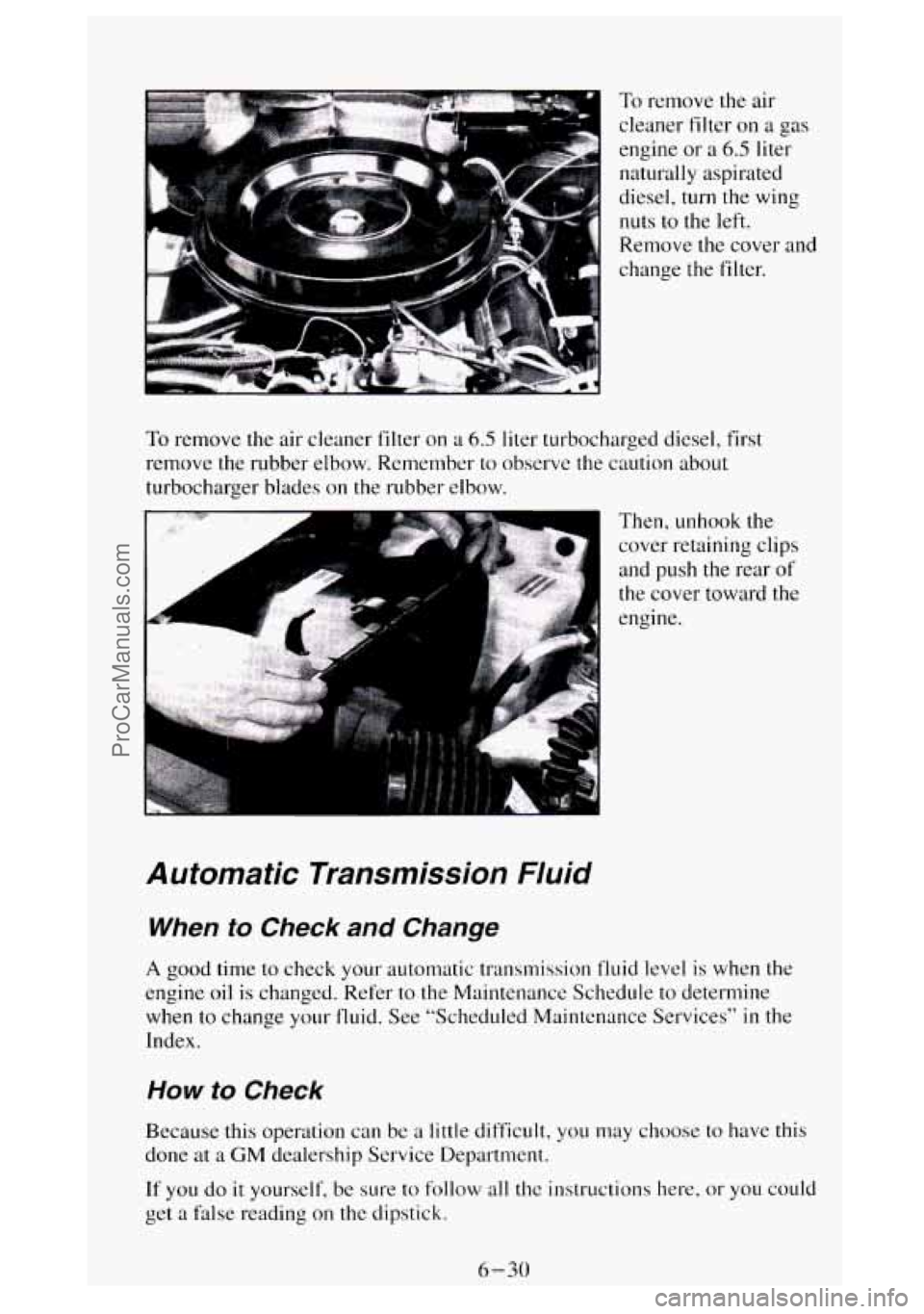
.-. -1 To remove the air
cleaner filter on
a gas
engine or a 6.5 liter
naturally aspirated
diesel,
turn the wing
nuts to the left.
Remove the cover and
change the filter.
Then, unhook the
cover retaining clips
and push the rear
of
the cover toward the
engine.
Automatic Transmission Nuid
When to Check and Change
A good time to check your automatic transmission fluid level is when the
engine oil is changed. Refer
to the Maintenance Schedule to determine
when to change your fluid. See “Scheduled Maintenance Services”
in the
Index.
How to Check
Because this operation can be a little difficult, you may choose to have this
done at
a GM dealership Service Department.
If you do it yourself, be SLIK to follow all the instructions here, or you could
get a false reading on the dipstick.
6 - 30
ProCarManuals.com
Page 283 of 404
How to Add Fluid
Refer to the Maintenance Schedule to determine what kind of transmission
fluid
to use. See “Recommended Fluids and Lubricants” in the Index.
If the fluid level is low, add
only enough of the proper fluid to bring the
level up to the COLD area for a cold check or the HOT area for a hot check.
It doesn’t take much tluid, generally less than a pint. Don’t overfill. We
recommend you use only fluid labeled DEXRON@-111 or DEXRON@-IIE,
because fluids with that label are made especially for your automatic
transmission. Damage caused by fluid other than
DEXRON@-Ill or
DEXRON@-IIE is not covered by your new vehicle warranty.
After adding fluid, recheck the fluid level as described under “How to
Check.”
When the correct fluid level is obtained, push the dipstick back in all
the way; then flip the handle down to lock the dipstick in place.
Manual Fluid
When to Check
A good time to have it checked is when the engine oil is changed. However,
the fluid
in your manual transmission doesn’t require changing.
How to Check
Because this operation can be a little difficult, you may choose to have this
done at a
GM dealership Service Department.
If you do it yourself, be sure to follow all the instructions here, or you could
get
a false reading.
NOTICE:
Too much or too little fluid can damage your transmission. Too
much can mean that some of the fluid could come out and fall on
hot engine parts or exhaust system, starting a fire. Be sure to get
an accurate reading if
you check your transmission fluid.
Check the fluid level only when your engine is off, the vehicle is parked on
a level place and the transmission is cool enough for you to rest your fingers
on the transmission case.
6-33
ProCarManuals.com
Page 367 of 404
5. AIR CLEANER FILTER REPLACEMENT* - Replace at every
30,000 miles (50 000 km) or more often under dusty conditions. Ask
your dealer for the proper replacement intervals for your driving
conditions.
6. FRONT WHEEL BEARING REPACK (2-WHEEL DRIVE
ONLY)
- Clean and repack the front wheel bearings at each brake
relining, or at
the specified interval, whichever comes first.
7. TRANSMISSION SERVICE’/-
Automatic Transmission
- Change the transmission fluid and filter
every
15,000 miles (25 000 km) for vehicles under 8,600 GVWR or
every 12,000 miles
(20 000 km) for vehicles over 8,600 GVWR if the
vehicle is mainly driven under one or more
of these conditions:
In heavy city traffic.
0 Where the outside temperature regularly reaches 90°F (32°C) or
0 In hilly or mountainous terrain.
higher.
Frequent
trailer pulling.
Uses such as taxi, police, delivery or other commercial service.
If the vehicle
is not used mainly under any of these conditions, change
the fluid and filter every
30,000 miles (50 000 km) for vehicles under
8,600
GVWR or every 24,000 miles (40 000 km) for vehicles over
8,600 GVWR see “Automatic Transmission Fluid”
in the Index for
more information.
Manual Transmission - Transmission fluid does not require periodic
changing.
8. CDRV SYSTEM INSPECTION* - Check the Crankcase
Depression Regulator Valve System for any worn, plugged or collapsed
hoses. Have the system checked as described in the Service Manual.
9. FUEL FILTER REPLACEMENT*$ - Replace the fuel filter at the
specified interval or sooner if clogged.
?A fluid loss
in these systems may indicate a problem. Have them
inspected and repaired at once.
:i: An Emission Control Service
$The California Air Resources Board bas determined that the failure to
perform this maintenance item will not
nullify the emission warranty or
limit recall liability prior to the completion
of the vehicle useful life.
General Motors, however, urges that all recommended maintenance
services be performed at the indicated intervals and the maintenance be
recorded.
7-19
ProCarManuals.com
Page 371 of 404
Owner Checks and Services
Listed below are owner checks and services which should be made at the
time period specified to help ensure proper safety, emission performance,
and dependability
of your vehicle.
Be sure any necessary repairs are completed at once. Whenever any fluids
or lubricants are added to your vehicle, make sure they are
the proper ones,
as shown
in this Section.
At Least Once a Month
Tire inflation pressure check - Check the tires for proper inflation. If
they are low, inflate them to the level specified on the Certification/Tire
label. See “Loading Your Vehicle” or “Inflation-Tire Pressure”
in the Index.
At Least Once a Year
Key lock cylinder lubrication - Lubricate key lock cylinders with engine
oil. See
the “Recommended Fluid and Lubricants” chart in this section.
Transmission neutral or clutch start switch operation -
1. Before you start, be sure you have enough room around the vehicle.
2. Firmly apply both the manual parking brake and the regular brake. See
“Brakes” and “Parking Brake”
in the Index. Do not use the accelerator
pedal.
3. Be ready to turn off the engine immediately if it starts.
4. On automatic transmission vehicles, try to start the engine in each gear.
The starter should work only
in “P’ (Park) or “N” (Neutral).
On manual transmission vehicles, put the shift lever
in “N” (Neutral), push
the clutch down halfway, and try to start the engine. The starter should work
only when the clutch
is pushed down all the way to the floor.
Steering column lock operation - While parked, try to turn the key to
LOCK in each gear shift position.
With an automatic transmission, the key should
turn to LOCK only when
the gear shift
is in “P” (Park).
7-23
ProCarManuals.com