change time GMC SIERRA 1994 User Guide
[x] Cancel search | Manufacturer: GMC, Model Year: 1994, Model line: SIERRA, Model: GMC SIERRA 1994Pages: 404, PDF Size: 20.91 MB
Page 258 of 404
If the light comes on at any other time, use this chart.
“Water in Fuel” Light Chart
Problem
Light comes on intermittently.
Light stays on:
1. At temperatures above
freezing.
2. At temperatures below
freezing.
Recommended Action
Drain water from fuel filter.
Drain fuel filter immediately. If no
water
can be drained and light stays
on, see your dealer for assistance.
Drain fuel filter immediately. If no
water can be drained
- water may
be frozen. Open the air bleed valve
to check
for fuel pressure. If no fuel
pressure is present, replace the
fuel
filter.
3. Immediately after refueling - Fuel tank purging required. See
large amount of water possibly your dealer for assistance.
pumped into fuel tank.
Hesitation or “flat” performance at high speed or during hard acceleration
may be an indication of premature fuel filter plugging due
to dirty or
contaminated fuel, The filter element may need to be changed
if this
happens. See your dealer for assistance.
NOTICE:
If you drive when this warning light is on, you can damage y\
our
fuel injection system and your engine. If the light comes on right
after you refuel,
it means water was pumped into your fuel tank.
Turn off your engine immediately. Then, have the water drained \
at once.
To drain water:
1. Stop and park the vehicle in a safe place. Turn off the engine and apply
the parking brake.
2. Remove the fuel tank cap.
3. Place a fuel-resistant container under the filter drain hose.
6-8
ProCarManuals.com
Page 261 of 404
A CAUTION:
Diesel fuel is flammable. It could start a fire if it gets on hot
engine parts. You could be burned. Don’t let too much fuel flow
from the air bleed valve, and wipe up any spilled fuel with
a
cloth.
3. Close the air bleed valve.
4. Turn the ignition key to “Start” for 10 to 15 seconds at a time until your
engine starts.
Fuel Filter Replacement (Diesel Engines)
If you want to change the fuel filter yourself, here’s how to do it:
Before you remove the filter, drain any water that may have collected in the
fuel filter or filter head. See “Water in Fuel” earlier in this section to find
out how to remove water from the fuel system.
Then, drain
fuel from the filter by opening the air bleed valve and the water
drain valve. This prevents the fuel from spilling as
you replace the filter.
Drain the fuel into
a fuel-resistant container and dispose of it properly.
A CAUTION:
Diesel fuel is flammable. It could start a fire if something ignites
it, and you could be burned. Don’t let it get on hot engine parts,
and keep matches or other ignition sources away.
I. Turn off the engine and apply the parking brake.
2. Take off the fuel tank cap. This releases vacuum in the tank.
3. The filter is located at the rear of the intake manifold.
6-11
ProCarManuals.com
Page 273 of 404
Engine Oil Additives
Don’t add anything to your oil. Your GM dealer is ready to advise if you
think something should be added.
When to Change Engine Oil
See if any one of these is true for you:
Most trips are less than 4 miles (6 km).
It’s below freezing outside and most trips are less than 10 miles
(16 km).
The engine is at low speed most of the time (as in door-to-door
delivery, or
in stop-and-go traffic).
You tow a trailer often.
Most trips are through dusty places.
The vehicle is frequently operated off-road.
If any one
of these is true for your vehicle, then you need to change your oil
and-filter every 3,000 miles (5 000 km) or 3 months - whichever comes
first.
Light Duty Emissions:
If none of them is true, change the oil every 7,500 miles (12 500 km) or
12 months
- whichever comes first. Change the filter at the first oil change
and at every other oil change after that.
Heavy Duty Emissions:
If none of them is true, change the oil every 6,000 miles (10 000 km) or
12 months - whichever comes first. Change the filter at the first oil change
and at every other oil change after that if mileage determines when you
change
your oil. If time determines when you change your oil, change the
filter each time you change your oil.
Engine Coolant Heater (Engine Block Heater)
An engine coolant heater can be a big help if you have to park outside in
very cold weather, 0°F (- 18°C) or colder. If your vehicle has this option,
see “Engine Coolant Heater
” in the Index.
6-23
ProCarManuals.com
Page 274 of 404
What to Do with Used Oil
Did you know that used engine oil contains certain elements that may be
unhealthy for your skin and could even cause cancer? Don't let used
oil stay
on your skin for very long. Clean your skin and nails with soap and water,
or
a good hand cleaner. Wash or properly throw away clothing or rags
containing used engine oil. (See
the manufacturer's warnings about the use
and disposal of oil products.)
Used oil can be a real threat
to the environment. If you change your own oil,
be sure t.o drain all free-tlowing
oil from the filter before disposal. Don't
ever dispose of
oil by putting it in the trash, pouring it on the ground, into
sewers, or into streams or bodies of water. Instead, recycle it by taking it to
a place that collects used oil. If you have a problem properly disposing of
your used oil, ask your dealer, a service station or a local recycling center
for help.
Engine Oil (Diesel Engines)
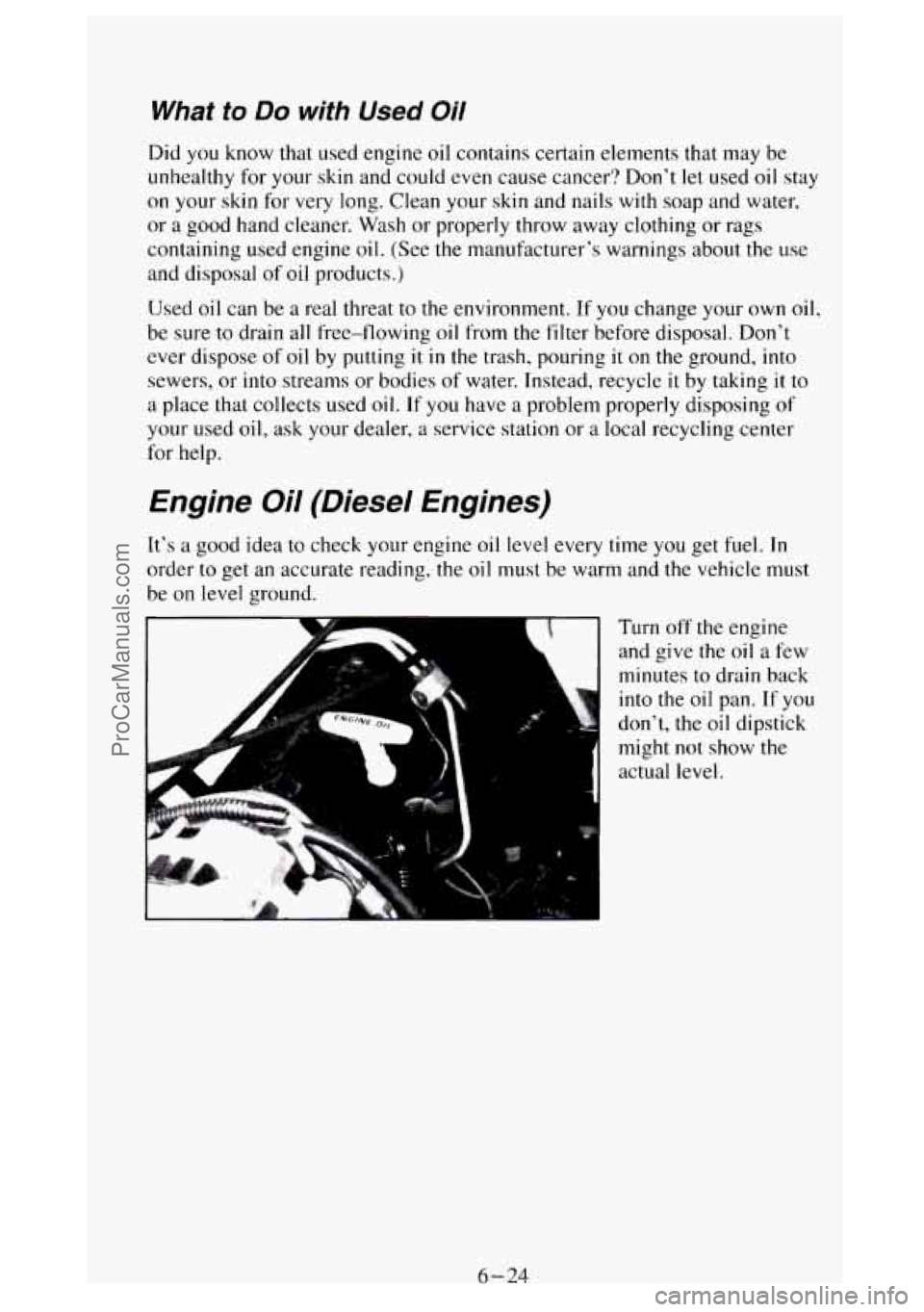
It's a good idea to check your engine oil level every time you get fuel. In
order
to get an accurate reading, the oil must be warm and the vehicle must
be
on level ground.
Turn off
the engine
and give the oil
a few
minutes to drain back
into
the oil pan. If you
don't, the
oil dipstick
might
not show-the
actual
level.
5-24
ProCarManuals.com
Page 278 of 404
This doughnut-shaped logo (symbol) is used on most oil containers to help
you select the correct oil.
You should look for this on
the oil container, and use only those oils that
display
the logo.
GM Goodwrench@ oil
(in Canada, GM Engine Oil) meets all the
requirements for your vehicle.
Engine Oil Additives
Don’t add anything to your oil. Your GM dealer is ready to advise if you
think something should be added.
When to Change Engine Oil
See if any one of these is true for you:
0 Most trips are less than 4 miles (6 km).
0 It’s below freezing outside and most trips are less than 10 miles
(16 km).
0 The engine is at low speed most of the time (as in door-to-door
delivery, or in stop-and-go traffic).
0 You tow a trailer often.
0 Most trips are through dusty places.
The vehicle is frequently operated off-road.
If any
of these is true for your vehicle, then you need to change your oil and
filter
every 2,500 miles (4 000 km) or 3 months - whichever comes first.
If
none of them is true, change the oil and filter every 5,000 miles
(8 000 km) or 12 months - whichever comes first.
What to Do with Used Oil
Did you know that used engine oil contains certain elements that may be
unhealthy for
your skin and could even cause cancer‘? Don’t let used oil stay
on your
skin for very long. Clean your skin and nails with soap and water,
or a good hand cleaner. Wash or properly throw away clothing or rags
containing used engine oil. (See the manufacturer’s warnings about the use
and disposal
of oil products.)
Used
oil can be a real threat to the environment. If you change your own oil,
be sure
to drain all free-flowing oil from the filter before disposal. Don’t
ever dispose
of oil by putting it in the trash, pouring it on the ground, into
sewers, or into streams or bodies
of water. Instead, recycle it by taking it to
a place that collects used oil. If you have
a problem properly disposing of
your used
oil, ask your dealer, a service station or a local recycling center
for help.
6-28
ProCarManuals.com
Page 280 of 404
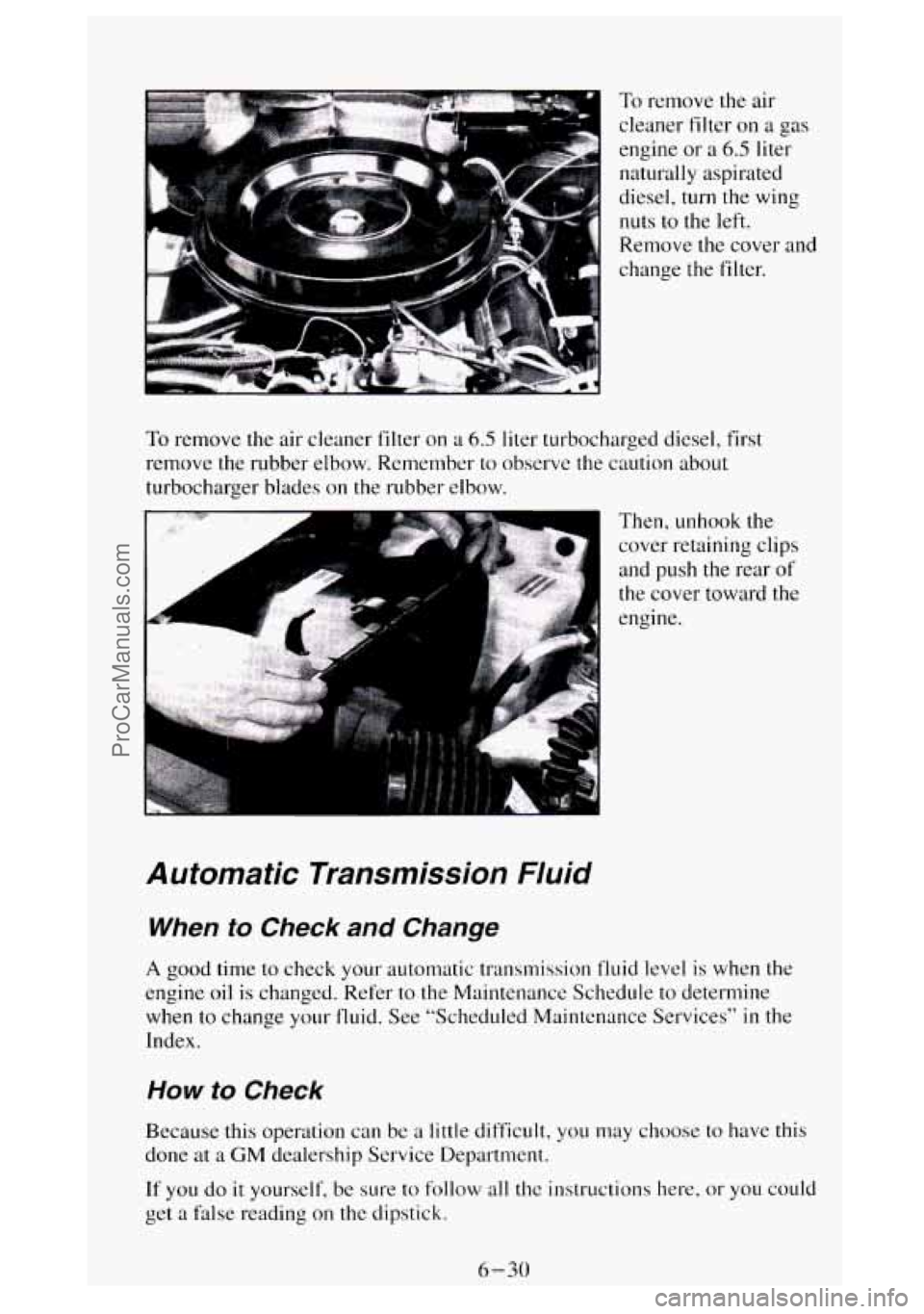
.-. -1 To remove the air
cleaner filter on
a gas
engine or a 6.5 liter
naturally aspirated
diesel,
turn the wing
nuts to the left.
Remove the cover and
change the filter.
Then, unhook the
cover retaining clips
and push the rear
of
the cover toward the
engine.
Automatic Transmission Nuid
When to Check and Change
A good time to check your automatic transmission fluid level is when the
engine oil is changed. Refer
to the Maintenance Schedule to determine
when to change your fluid. See “Scheduled Maintenance Services”
in the
Index.
How to Check
Because this operation can be a little difficult, you may choose to have this
done at
a GM dealership Service Department.
If you do it yourself, be SLIK to follow all the instructions here, or you could
get a false reading on the dipstick.
6 - 30
ProCarManuals.com
Page 283 of 404
How to Add Fluid
Refer to the Maintenance Schedule to determine what kind of transmission
fluid
to use. See “Recommended Fluids and Lubricants” in the Index.
If the fluid level is low, add
only enough of the proper fluid to bring the
level up to the COLD area for a cold check or the HOT area for a hot check.
It doesn’t take much tluid, generally less than a pint. Don’t overfill. We
recommend you use only fluid labeled DEXRON@-111 or DEXRON@-IIE,
because fluids with that label are made especially for your automatic
transmission. Damage caused by fluid other than
DEXRON@-Ill or
DEXRON@-IIE is not covered by your new vehicle warranty.
After adding fluid, recheck the fluid level as described under “How to
Check.”
When the correct fluid level is obtained, push the dipstick back in all
the way; then flip the handle down to lock the dipstick in place.
Manual Fluid
When to Check
A good time to have it checked is when the engine oil is changed. However,
the fluid
in your manual transmission doesn’t require changing.
How to Check
Because this operation can be a little difficult, you may choose to have this
done at a
GM dealership Service Department.
If you do it yourself, be sure to follow all the instructions here, or you could
get
a false reading.
NOTICE:
Too much or too little fluid can damage your transmission. Too
much can mean that some of the fluid could come out and fall on
hot engine parts or exhaust system, starting a fire. Be sure to get
an accurate reading if
you check your transmission fluid.
Check the fluid level only when your engine is off, the vehicle is parked on
a level place and the transmission is cool enough for you to rest your fingers
on the transmission case.
6-33
ProCarManuals.com
Page 299 of 404
Brake Adjustment
Every time you make a brake stop, your disc brakes adjust for wear.
If your brake pedal goes down farther than normal, your rear drum brakes
may need adjustment. Adjust them by backing up and firmly applying
the
brakes a few times.
Replacing Brake System Parts
The braking system on a modern vehicle is complex. Its many parts have to
be of top quality and work well together if the vehicle is to have really good
braking. Vehicles we design and test have top-quality
GM brake parts in
them, as your vehicle does when it is new. When you replace parts of your
braking system
- for example, when your brake linings wear down and
you have to have new ones put
in - be sure you get new genuine GM
replacement parts. If you don’t, your brakes may no longer work properly.
For example,
if someone puts in brake linings that are wrong for your
vehicle, the balance between your front and rear brakes can change, for
the
worse. The braking performance you’ve come to expect can change in many
other ways if someone puts in the wrong replacement brake parts.
Other Maintenance Hems
Front Suspension and Steering Linkage
Your maintenance schedule will tell you how often to lubricate the fittings.
See “Recommended Fluids and Lubricants”
in the Index for the proper
lubricant to use.
Front Wheel Bearings
Your vehicle has front wheel bearings that must be cleaned and repacked.
Your maintenance schedule
will tell you how often this must be done.
Front Shock Absorbers
The front shock absorbers of your vehicle do many things. They help the
vehicle ride smoothly and also control
the travel of the suspension system.
When the shock absorbers are serviced, any replacement shock absorbers
must be
the same as the original equipment shock absorbers in both
extended length and strength.
NOTICE:
If you use shock absorbers that are not the same as the original
shock absorbers, the shock absorbers
or suspension system
could be damaged.
6-49
ProCarManuals.com
Page 341 of 404
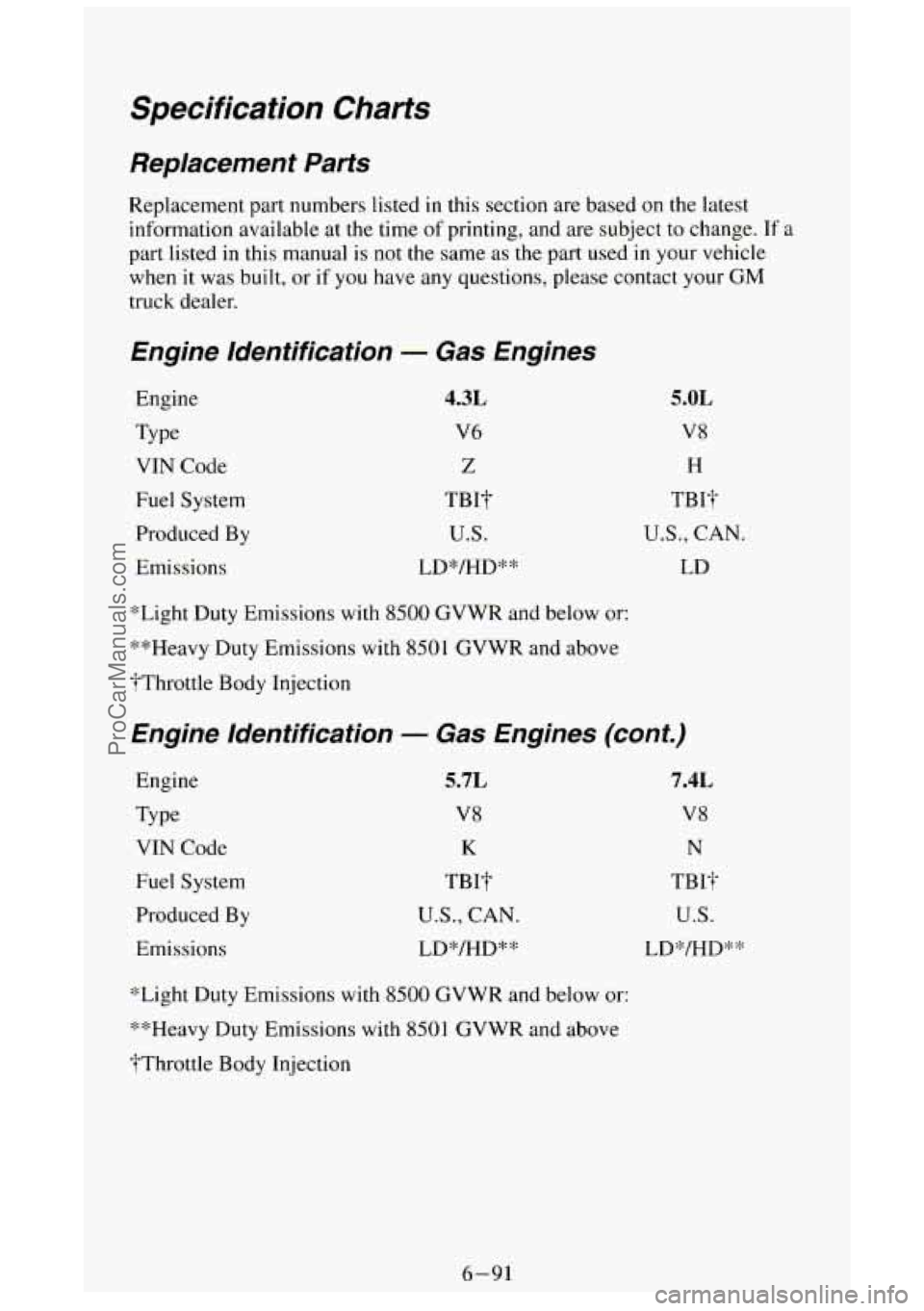
Specification Charts
Replacement Parts
Replacement part numbers listed in this section are based on the latest
information available at the time
of printing, and are subject to change. If a
part listed in this manual is not the same as the part used in your vehicle
when
it was built, or if you have any questions, please contact your GM
truck dealer.
Engine Identification - Gas Engines
Engine
Type
VIN Code
Fuel System
Produced By
Emissions 4.3L
V6
z
TBI?
U.S.
LD*/HD**
5.0L
V8
H
TB
I?
U.S., CAN.
LD
"Light Duty Emissions with
8500 GVWR and below or:
**Heavy Duty Emissions with
8501 GVWR and above
?Throttle Body Injection
Engine Identification - Gas Engines (cont.)
Engine
Type
VIN Code
Fuel System
Produced By
Emissions 5.7L
V8
K
TB I?
U.S., CAN.
LD4:/HD**
*Light Duty Emissions with
8500 GVWR and below or:
*:kHeavy Duty Emissions with 8501 GVWR and above
?Throttle Body Injection
6-91
ProCarManuals.com
Page 366 of 404
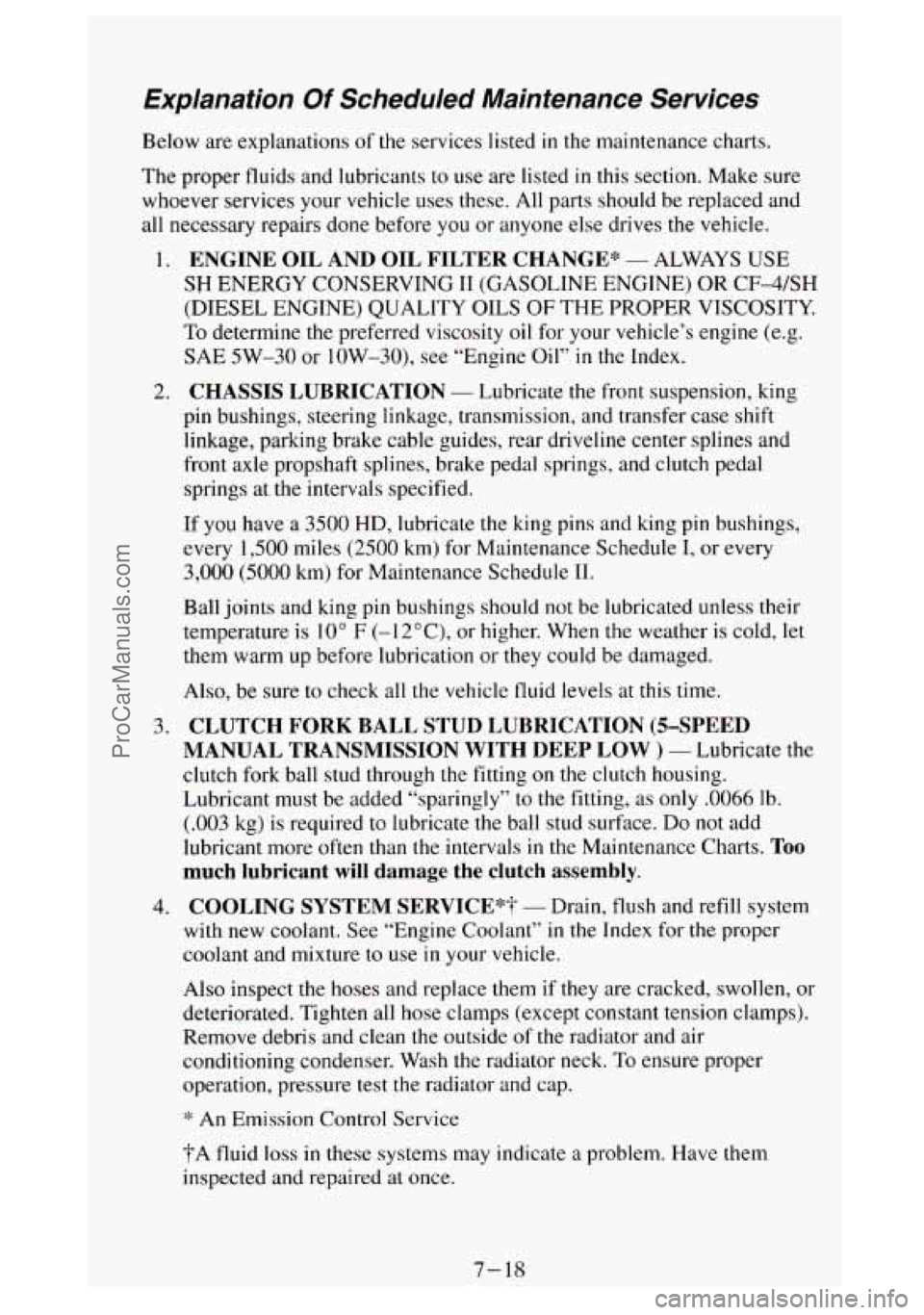
Explanation Of Scheduled Mainienance Services
Below are explanations of the services listed in the maintenance charts.
The proper fluids and lubricants to use are listed in this section. Make sure
whoever services your vehicle uses these. All parts should be replaced and
all necessary repairs done before you or anyone else drives the vehicle.
1. ENGINE OIL AND OIL FILTER CHANGE“‘ - ALWAYS USE
SJ3 ENERGY CONSERVING I1 (GASOLINE ENGINE) OR CF-4/SH
(DIESEL ENGINE) QUALITY OILS
OF THE PROPER VISCOSITY.
To determine the preferred viscosity oil for your vehicle’s engine (e.g.
SAE 5W-30 or 10W-30), see “Engine Oil”
in the Index.
2. CHASSIS LUBRICATION - Lubricate the front suspension, king
pin bushings, steering linkage, transmission, and transfer case shift
linkage, parking brake cable guides, rear driveline center splines and
front axle propshaft splines, brake pedal springs, and clutch pedal
springs at the intervals specified.
If you have a 3500
HD, lubricate the king pins and king pin bushings,
every
1,500 miles (2500 km) for Maintenance Schedule I, or every
3,000 (5000 km) for Maintenance Schedule 11.
Ball joints and king pin bushings should not be lubricated unless their
temperature
is 10” F (-12”C), or higher. When the weather is cold, let
them warm up before lubrication or
they could be damaged.
Also, be sure
to check all the vehicle fluid levels at this time.
3.
CLUTCH FORK BALL STUD LUBRICATION (5-SPEED
MANUAL TRANSMISSION WITH DEEP LOW
) - Lubricate the
clutch fork ball stud through the fitting
on the clutch housing.
Lubricant must be added “sparingly” to
the fitting, as only .0066 lb.
(.003 kg) is required to lubricate the ball stud surface. Do not add
lubricant more often than the intervals
in the Maintenance Charts. Too
much lubricant will damage the clutch assembly.
4. COOLING SYSTEM SERVICE”’? - Drain, flush and refill system
with new coolant. See “Engine Coolant” in the Index for
the proper
coolant and mixture to use
in your vehicle.
Also inspect the hoses and replace them
if they are cracked, swollen, or
deteriorated. Tighten all hose clamps (except constant tension clamps).
Remove debris and clean the outside of the radiator and air
conditioning condenser. Wash the radiator neck.
To ensure proper
operation, pressure test.
the radiator and cap.
* An Emission Control Service
?A fluid
loss in these systems may indicate a problem. Have them
inspected and repaired at once.
7-18
ProCarManuals.com