cooling GMC SIERRA 1994 User Guide
[x] Cancel search | Manufacturer: GMC, Model Year: 1994, Model line: SIERRA, Model: GMC SIERRA 1994Pages: 404, PDF Size: 20.91 MB
Page 288 of 404
What to use
Refer to the Maintenance Schedule to determine what kind of lubricant to
use. See “Recommended Fluids and Lubricants”
in the Index.
Engine Coolant
The following explains your cooling system and how to add coolant when it
is low. If you have a problem with engine overheating, see “Engine
Overheating”
in the Index.
The proper coolant for your vehicle
will:
Give freezing protection down to -20 OF (-29”C), or -34°F (-37°C) in
Canada and for vehicles with the cold climate option.
Give boiling protection up to 258 OF ( 125 O C).
Protect against rust and corrosion.
Help keep the proper engine temperature.
Let the warning lights and gages work as they should.
What to Use
Use a mixture of one-half clean wuter (preferably distilled) and one-half
antifreeze that meets
“GM Specification 6038-M,” which won’t damage
aluminum parts.
You can also use a recycled coolant conforming to “GM
Specification 6038-M” with a complete coolant flush and refill. If you use
this mixture, you don’t need to add anything else.
6-38
ProCarManuals.com
Page 289 of 404
I NOTICE:
If you use an improper coolant mix, your engine could overheat
and be badly damaged.
The repair cost wouldn’t be covered by
your warranty.
Too much water in the mix can freeze and crack
the engine, radiator, heater core and other parts.
Some conditions, such as air trapped in the cooling system, can affect the
coolant level
in the radiator. Check the coolant level when the engine is cold
and follow the steps under “Adding Coolant” for the proper way to add
coolant.
If you have to add coolant more than four times a year, have your dealer
check your cooling system.
If you use the proper coolant, you don’t have to add extra
inhibitors or additives which claim to improve the system. These
can be harmful.
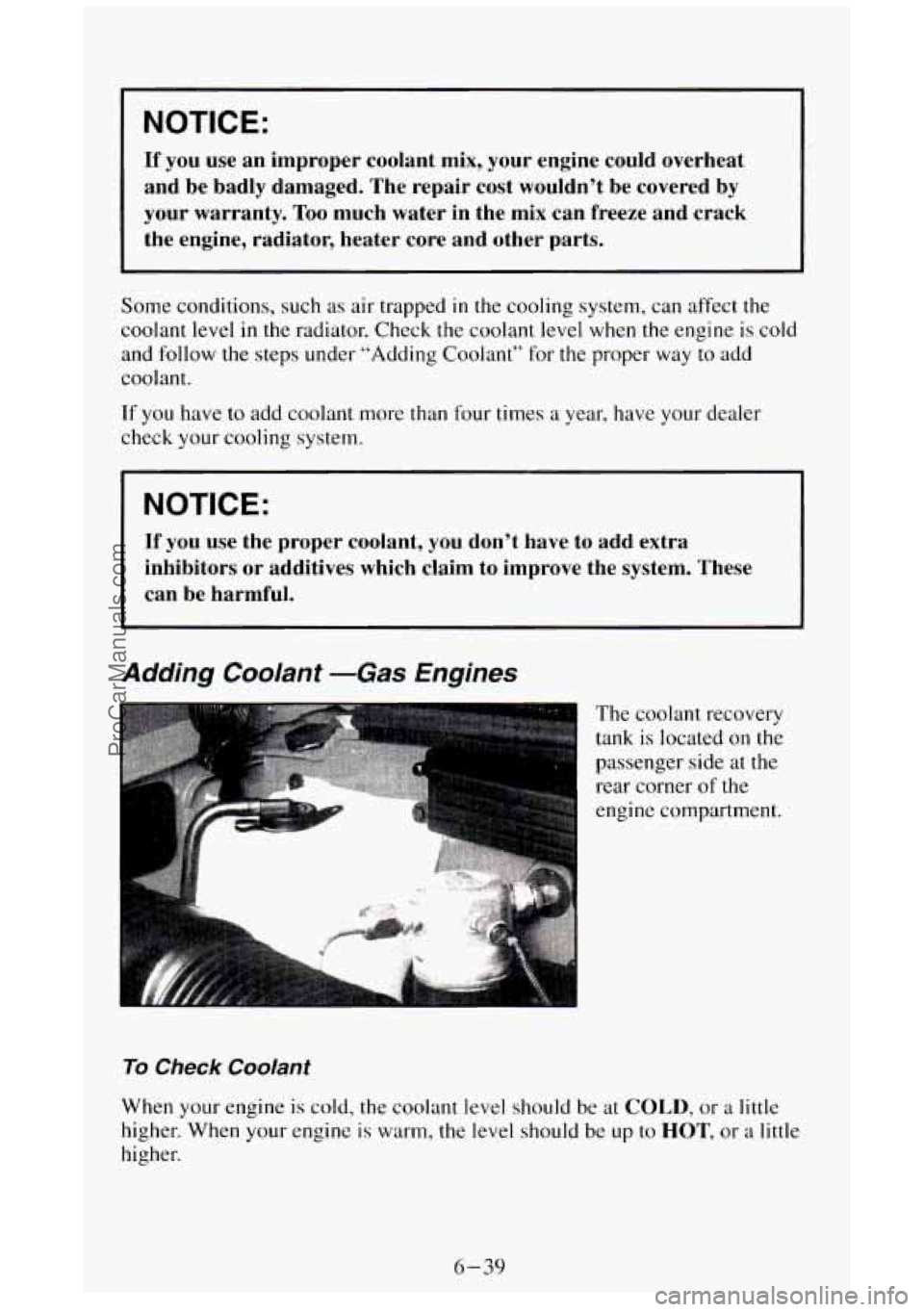
Adding Coolant -Gas Engines
To Check Coolant
The coolant recovery
tank
is located on the
passenger side at the
rear corner
of the
engine compartment.
When your engine
is cold, the coolant level should be at COLD, or a little
higher. When
your engine is warm, the level should be up to HOT, or a little
higher.
6-39
ProCarManuals.com
Page 293 of 404
NOTICE:
Your surge tank pressure cap is a unique 15 psi (105 kPa)
pressure-type cap for use with surge tank cooling systems only.
It must be tightly installed to prevent coolant
loss and possible
engine damage from overheating. Be sure the arrows on the cap
line up with the top tube
of the coolant surge tank.
Thermostat
Engine coolant temperature is controlled by a thermostat in the engine
coolant system. The thermostat stops
the flow of coolant through the
radiator
until the coolant reaches a preset temperature.
When
you replace your thermostat, an AC" thermostat is recommended.
Power Steering Fluid
NOTICE:
Always turn the engine off before checking or adding power
steering fluid. The power steering pump cap is close to the fan
and other moving parts.
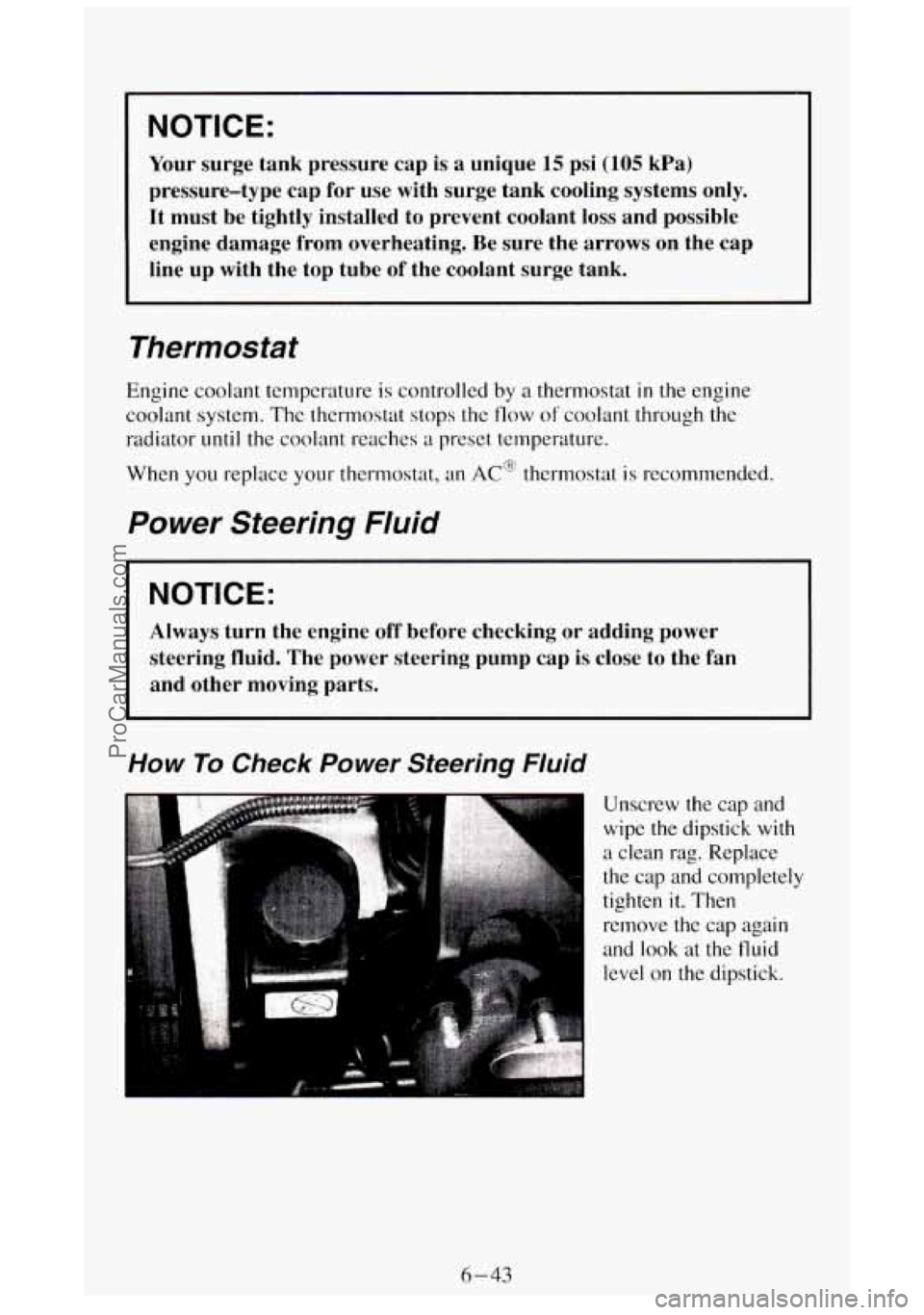
How To Check Power Steering Fluid
Unscrew the cap and
wipe the dipstick
with
a clean rag. Replace
the cap and completely
tighten it. Then
remove the cap again
and
look at the fluid
level on the dipstick.
6-43
ProCarManuals.com
Page 300 of 404
Wheel Nut Torque
For vehicle with dual wheels, wnen the vehicle, wheel or Tasteners are new,
have the torque set at
the first 100, 1,000 and 6,000 miles (1 60, 1600 and
9600 km). Use the torque specified
in the appropriate Specification Chart
later
in this section.
Single Belt Accessory Drive
If your new vehicle uses a serpentine belt, it is lighter and more durable than
systems with several belts.
The belt runs over or around the pulleys on the engine.
A tensioner may be
used
to keep the belt tight at all times. The tensioner also makes replacing
the belt easier.
If you need to replace the belt, be sure to get the correct
replacement belt. Your dealership or parts supplier can help you with this.
The Accessory Drive belt Routing label on your vehicle will show
you how
to route
the belt your vehicle uses.
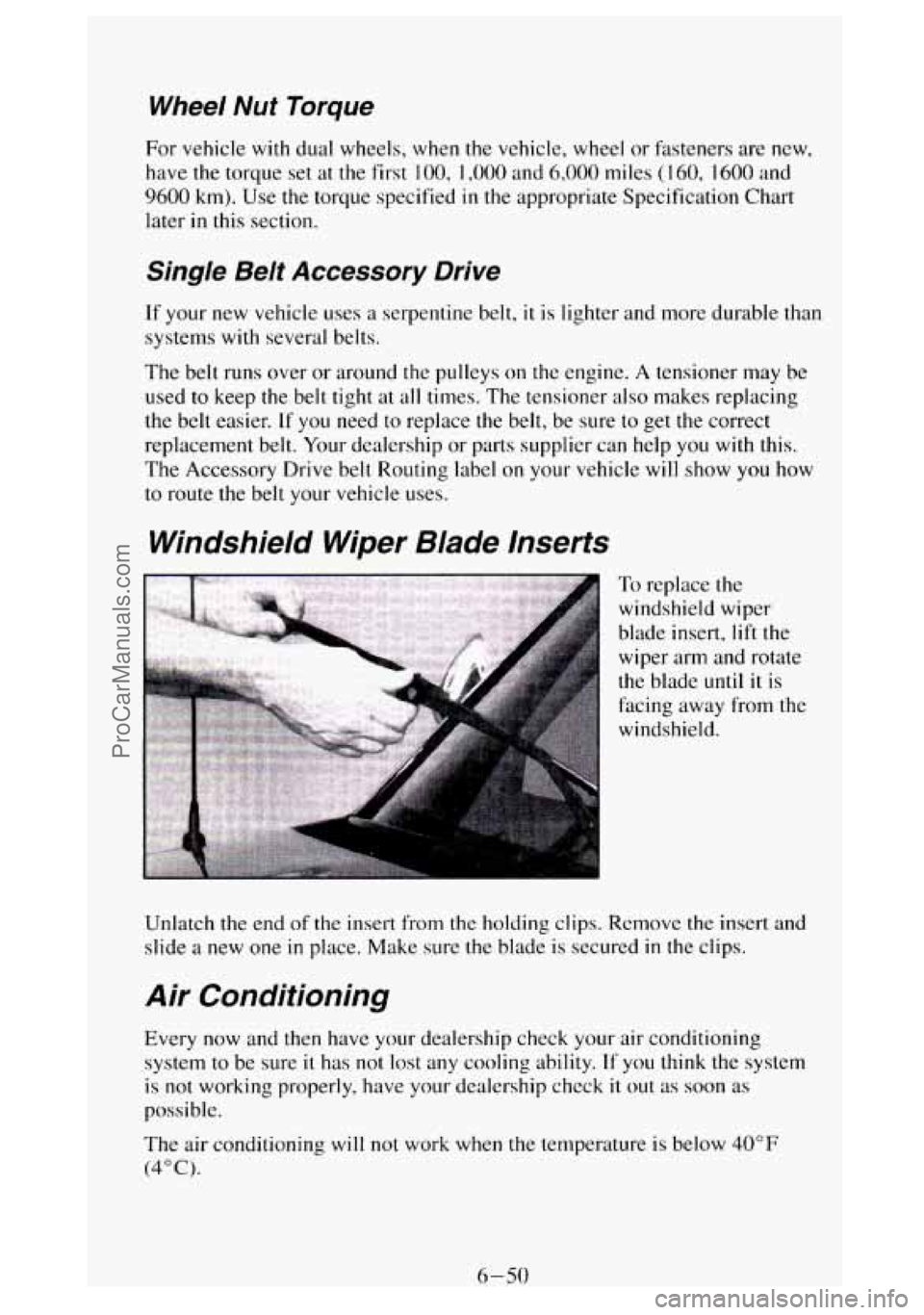
Windshield Wiper Blade Inserts
To replace the
windshield wiper
blade insert, lift the
wiper arm and rotate
the blade until
it is
facing away from the
windshield.
Unlatch
the end of the insert from the holding clips. Remove the insert and
slide a new
one in place. Make sure the blade is secured in the clips.
Air Conditioning
Every now and then have your dealership check your air conditioning
system
to be sure it has not lost any cooling ability. If you think the system
is not working properly, have your dealership check it out as soon as
possible.
The air conditioning
will not work when the temperature is below 40°F
(4°C).
6-50
ProCarManuals.com
Page 329 of 404
NOTICE:
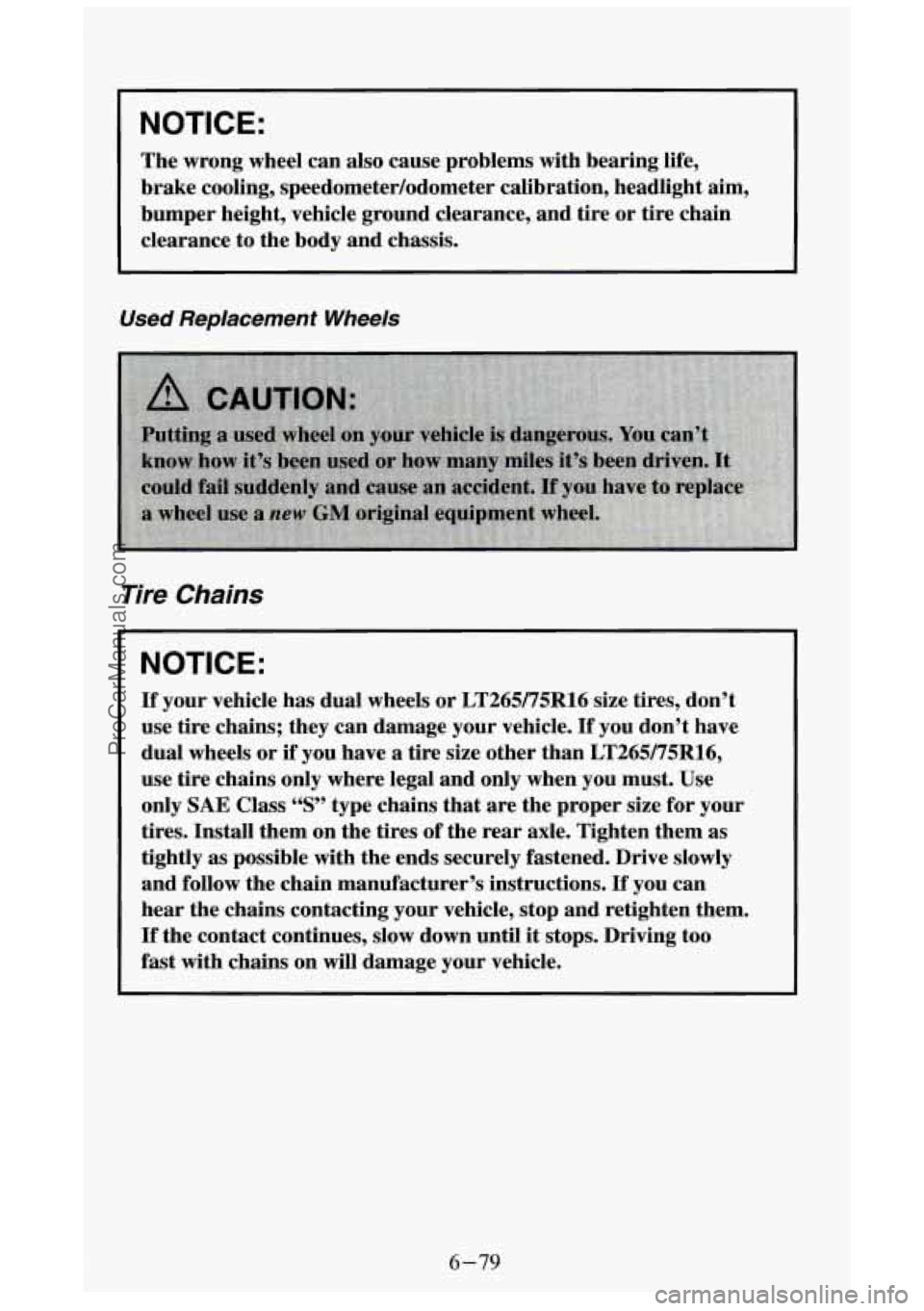
The wrong wheel can also cause problems with bearing life,
brake cooling, speedometer/odometer calibration, headlight aim,
bumper height, vehicle ground clearance, and tire or tire chain
clearance to the body and chassis.
Used Replacement Wheels
Tire Chains
NOTICE:
If your vehicle has dual wheels or LT26Y75R16 size tires, don’t
use tire chains; they can damage your vehicle.
If you don’t have
dual wheels or
if you have a tire size other than LT265/75R16,
use tire chains only where legal and only when you must. Use
only SAE Class “S” type chains that are the proper size for your
tires. Install them on the tires of the rear axle. Tighten them as
tightly
as possible with the ends securely fastened. Drive slowly
and follow the chain manufacturer’s instructions.
If you can
hear the chains contacting your vehicle, stop and retighten them.
If the contact continues, slow down until it stops. Driving too
fast with chains on will damage your vehicle.
6-79
ProCarManuals.com
Page 342 of 404
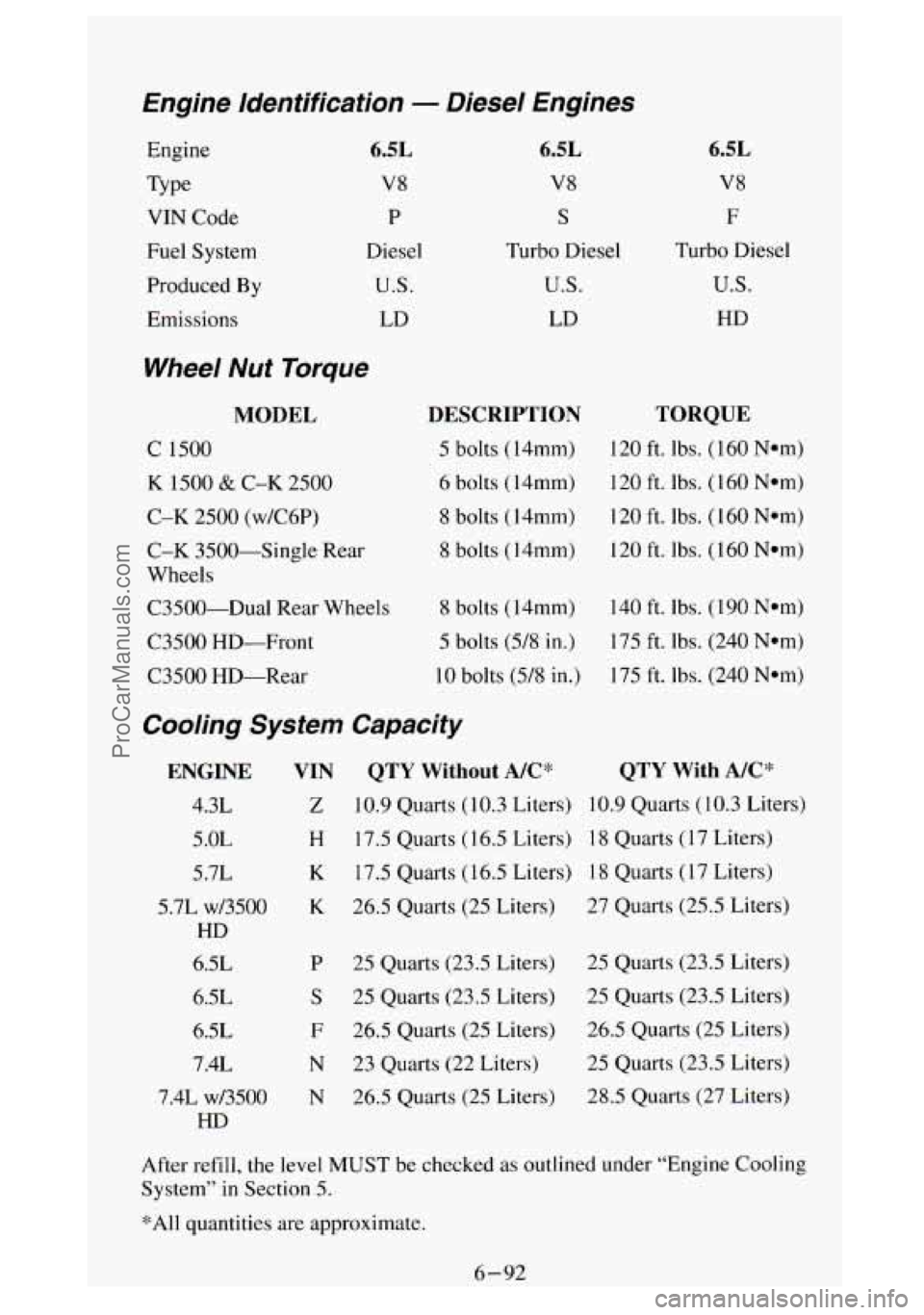
Engine ldenfificafion - Diesel Engines
Engine
Type VIN Code
Fuel System
Produced
By
Emissions
6.5L
V8
P
Diesel
U.S.
LD
Wheel Nut Torque
MODEL
C 1500
K 1500 & C-K 2500
C-K 2500 (w/C6P)
C-K 3500-Single Rear
Wheels
C3500-Dual Rear Wheels
C3500 HD-Front
C3500 HD-Rear
6.5L
V8
S
Turbo Diesel
us.
LD
DESCRIPTION
5 bolts (I41nm)
6 bolts (14mm)
8 bolts ( I4mm)
8 bolts (14mm)
8 bolts (14mm)
5 bolts (5/8 in.)
10 bolts (5/8 in.)
6.5L
V8
F
Turbo Diesel
U.S.
HD
TORQUE
120 ft. Ibs. (160 Nom)
120 ft. lbs. ( 160 Nom)
120 ft. lbs. (160 Nom)
120 ft. lbs.
(1 60 Nom)
140 ft. Ibs. (190 Nom)
175
ft. lbs. (240 Nom)
175
ft. Ibs. (240 Nom)
Cooling System Capacity
ENGINE
4.3L
VIN QTY Without A/C* QTY With AlC*
2 10.9 Quarts (10.3 Liters) 10.9 Quarts (10.3 Liters)
5 .OL H 17.5 Quarts (16.5 Liters) 18 Quarts (17 Liters)
5.7L
K 17.5 Quarts (16.5 Liters) 18 Quarts (17 Liters)
5.7L w/3500
K 26.5 Quarts (25 Liters) 27 Quarts (25.5 Liters)
HD
6.5L P 25 Quarts (23.5 Liters)
6.5L
S 25 Quarts (23.5 Liters)
6.5L
F 26.5 Quarts (25 Liters)
7.4L
N 23 Quarts (22 Liters)
7.4L
w/3500 N 26.5 Quarts (25 Liters)
HD
25 Quarts (23.5 Liters)
25 Quarts (23.5 Liters)
26.5 Quarts (25 Liters)
25 Quarts (23.5 Liters)
28.5 Quarts (27 Liters)
After refill, the level MUST be checked as outlined under “Engine Cooling
System”
in Section 5.
*All quantities are approximate.
6-92
ProCarManuals.com
Page 362 of 404
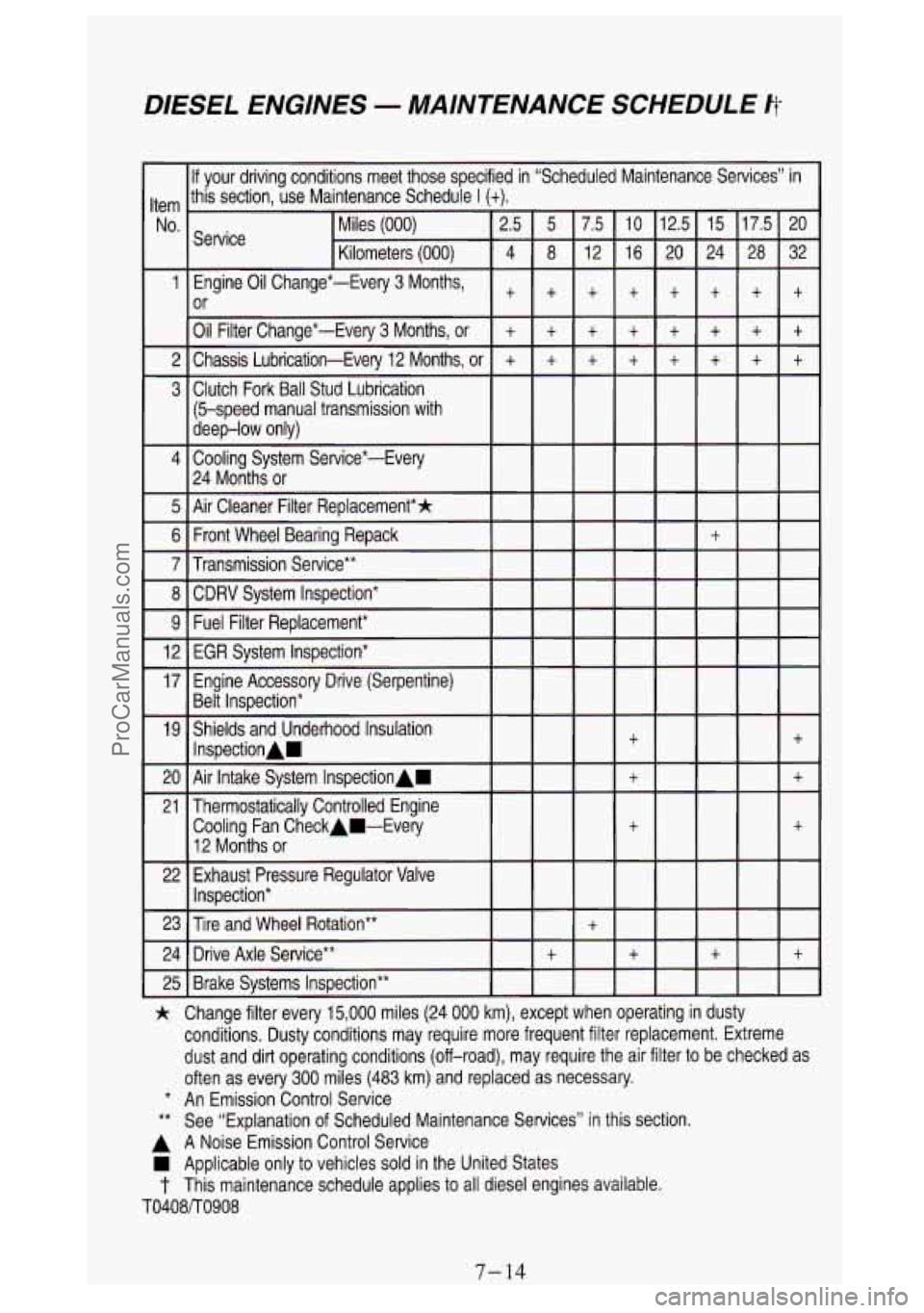
DIESEL ENGINES - MAINTENANCE SCHEDULE yf
20 Air Intake System InspectionAB t t
21 Thermostatically Controlled Engine
Cooling Fan CheckAW-Every
t t
12 Months or
Inspection*
22 Exhaust Pressure Regulator Valve
23 Tire and Wheel Rotation**
t
24 Drive Axle Service** t t t +
25 Brake Systems Inspection**
A Change filter every 15,000 miles (24 000 km), except when op\
erating
in dusty
conditions. Dusty conditions may require more frequent filter re\
placement. Extreme
dust and dirt operating conditions (off-road), may require the air \
filter to be checked as
often as every 300 miles (483 km) and replaced as necessary.
* An Emission Control Service
** See “Explanation of Scheduled Maintenance Services” in this section.
A A Noise Emission Control Service
1 Applicable only to vehicles sold in the United States
t This maintenance schedule applies to all diesel engines available.
T0408/T0908
7-14
ProCarManuals.com
Page 366 of 404
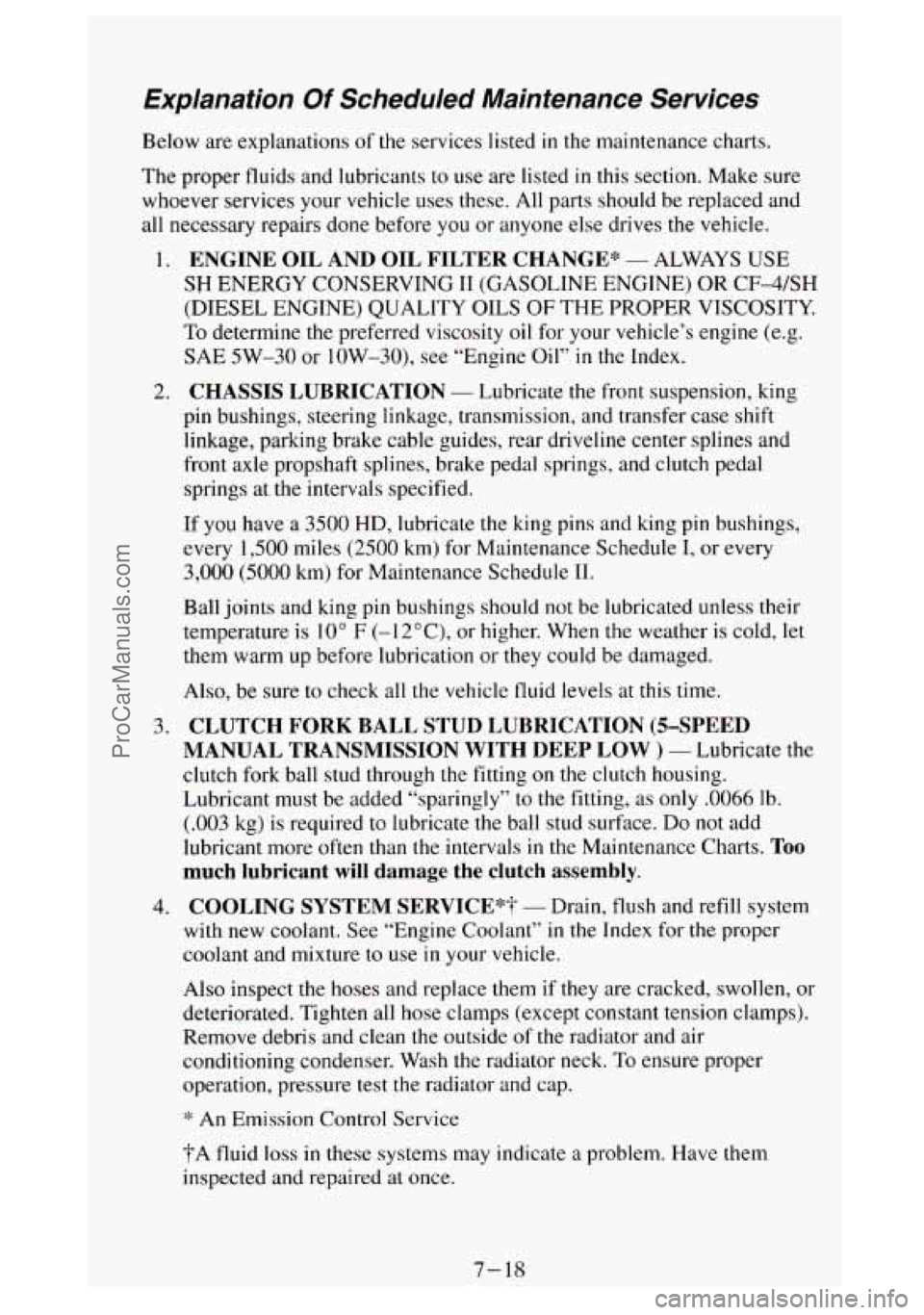
Explanation Of Scheduled Mainienance Services
Below are explanations of the services listed in the maintenance charts.
The proper fluids and lubricants to use are listed in this section. Make sure
whoever services your vehicle uses these. All parts should be replaced and
all necessary repairs done before you or anyone else drives the vehicle.
1. ENGINE OIL AND OIL FILTER CHANGE“‘ - ALWAYS USE
SJ3 ENERGY CONSERVING I1 (GASOLINE ENGINE) OR CF-4/SH
(DIESEL ENGINE) QUALITY OILS
OF THE PROPER VISCOSITY.
To determine the preferred viscosity oil for your vehicle’s engine (e.g.
SAE 5W-30 or 10W-30), see “Engine Oil”
in the Index.
2. CHASSIS LUBRICATION - Lubricate the front suspension, king
pin bushings, steering linkage, transmission, and transfer case shift
linkage, parking brake cable guides, rear driveline center splines and
front axle propshaft splines, brake pedal springs, and clutch pedal
springs at the intervals specified.
If you have a 3500
HD, lubricate the king pins and king pin bushings,
every
1,500 miles (2500 km) for Maintenance Schedule I, or every
3,000 (5000 km) for Maintenance Schedule 11.
Ball joints and king pin bushings should not be lubricated unless their
temperature
is 10” F (-12”C), or higher. When the weather is cold, let
them warm up before lubrication or
they could be damaged.
Also, be sure
to check all the vehicle fluid levels at this time.
3.
CLUTCH FORK BALL STUD LUBRICATION (5-SPEED
MANUAL TRANSMISSION WITH DEEP LOW
) - Lubricate the
clutch fork ball stud through the fitting
on the clutch housing.
Lubricant must be added “sparingly” to
the fitting, as only .0066 lb.
(.003 kg) is required to lubricate the ball stud surface. Do not add
lubricant more often than the intervals
in the Maintenance Charts. Too
much lubricant will damage the clutch assembly.
4. COOLING SYSTEM SERVICE”’? - Drain, flush and refill system
with new coolant. See “Engine Coolant” in the Index for
the proper
coolant and mixture to use
in your vehicle.
Also inspect the hoses and replace them
if they are cracked, swollen, or
deteriorated. Tighten all hose clamps (except constant tension clamps).
Remove debris and clean the outside of the radiator and air
conditioning condenser. Wash the radiator neck.
To ensure proper
operation, pressure test.
the radiator and cap.
* An Emission Control Service
?A fluid
loss in these systems may indicate a problem. Have them
inspected and repaired at once.
7-18
ProCarManuals.com
Page 369 of 404
18. EVAPORATIVE CONTROL SYSTEM (ECS) INSPECTION* -
Check all fuel and vapor lines and hoses for proper hookup, routing,
and condition. Check that
the purge valve works properly, if equipped.
Replace as needed.
19.
SHIELDS AND UNDERHOOD INSULATION
INSPECTIONAV
- Inspect shields and underhood insulation for
damage or looseness. Adjust or replace as required.
system installation
to see that gaskets are sealed properly and all hose
connections, fasteners, and other components are tight. Also check to
be sure that the air cleaner housing is properly seated, that
the cover fits
tightly, and
the wing nuts are tight. Tighten connections and fasteners
or replace damaged parts
as required.
20. AIR INTAKE SYSTEM INSPECTIONAV - Check the air intake
2 1. THERMOSTATICALLY CONTROLLED ENGINE COOLING
FAN INSPECTIONAV
- (If so equipped.) Inspect all hoses and
ducts for proper hook-up. Be sure the valve works properly.
22. EXHAUST PRESSURE REGULATOR VALVE INSPECTION”
- Check that the valve works properly. Correct any binding. Inspect
hoses for cracks, chafing
or decay. Replace parts as needed.
23. TIRE AND WHEEL ROTATION AND INSPECTION - For
proper wear and maximum tire life, rotate tires at the first
6,000 miles
( 10 000 kilometers) for Schedule I (+) or 7,500 miles (1 2 500
kilometers) for Schedule IT (0) and then every 15,000 miles (25 000
kilometers) thereafter. Follow the instructions and patterns shown in
Section 6. Check tires for uneven wear or damage. If irregular or
premature wear is apparent, check wheel alignment. Also, check or
damaged wheels. See “Tires”
in the Index for more information.
For dual wheels, whenever the vehicle, wheels, or fasteners are new,
have the wheel fastener torque set at the first
100, 1,000 and 6,000
miles (1 60, 1600 and 10 000 km).
Block the tires opposite those being removed to keep the vehicle from
rolling.
‘i: An Emission Control Service
ANoise Emission Control Service
VApplicable only to vehicles sold
in the United States
7-21
ProCarManuals.com
Page 379 of 404
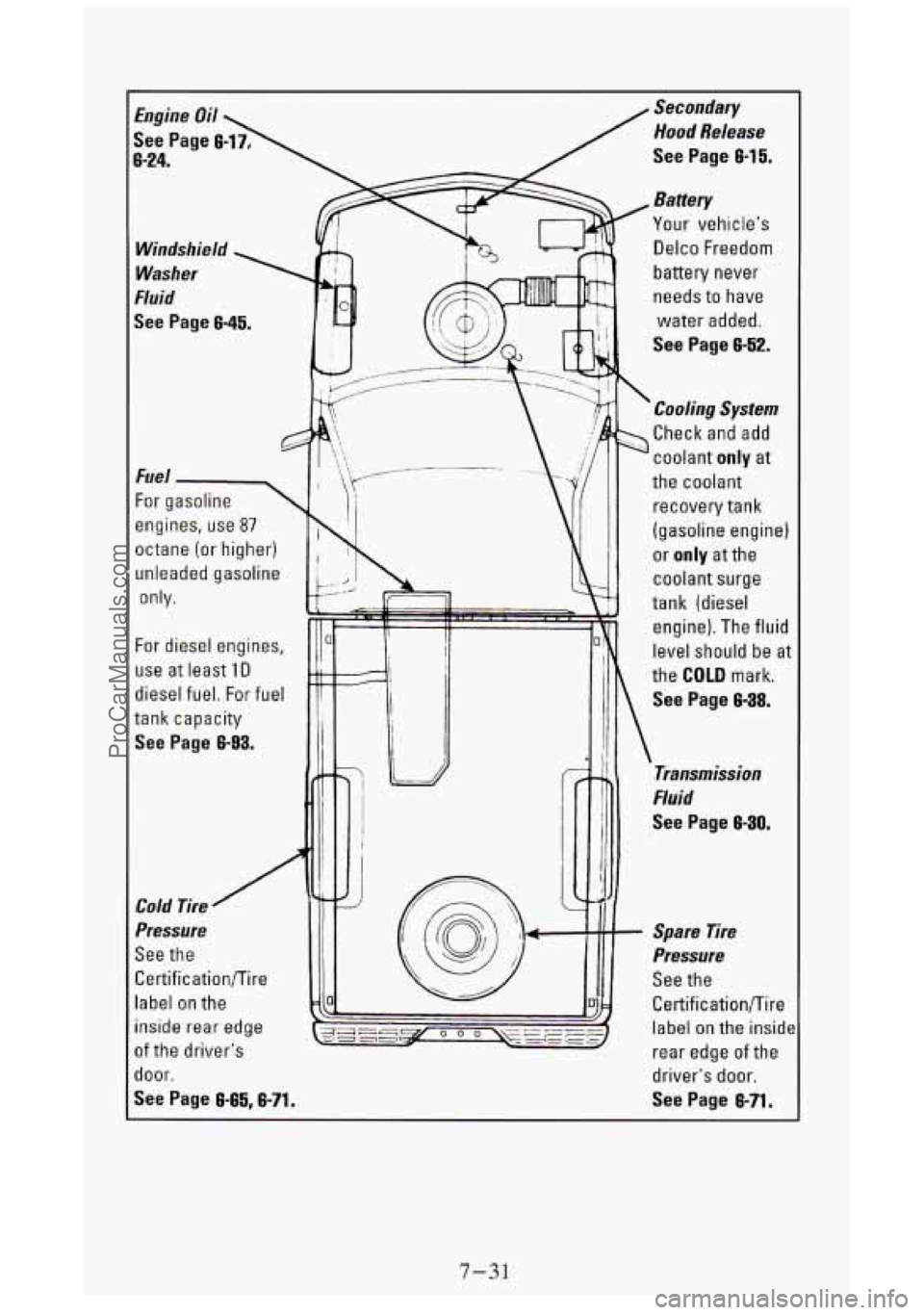
Secondary
Hood Release
See Page 6-15.
Fluid
See Page 6-45.
engines, use 87
octane (or higher)
unleaded gasoline
only.
For diesel engines,
use at least
1 D
diesel fuel. For fuel
tank capacity
See Page 6-93.
Cold Tire /
Pressure
See the
Certificationflire
label on the
inside rear edge
of the driver's
door.
See Page 6-65,6-71.
, Battery
Your vehicle's
Delco Freedom
battery never
needs to have water added.
See Page 6-52.
Cooling System
coolant only at
the coolant
recovery tank
(gasoline engine)
or
only at the
coolant surge
tank (diesel engine). The
fluid
level should be at
the COLD mark.
See Page 6-38.
3 Check and add
Transmission
Fluid
See Page 6-30.
- Spare Tire
Pressure
See the
Certificatisnflire
label on the inside
rear edge
of the
driver's door.
See Page 6-71.
7-31
ProCarManuals.com