oil pressure GMC SIERRA 1994 Owners Manual
[x] Cancel search | Manufacturer: GMC, Model Year: 1994, Model line: SIERRA, Model: GMC SIERRA 1994Pages: 404, PDF Size: 20.91 MB
Page 11 of 404
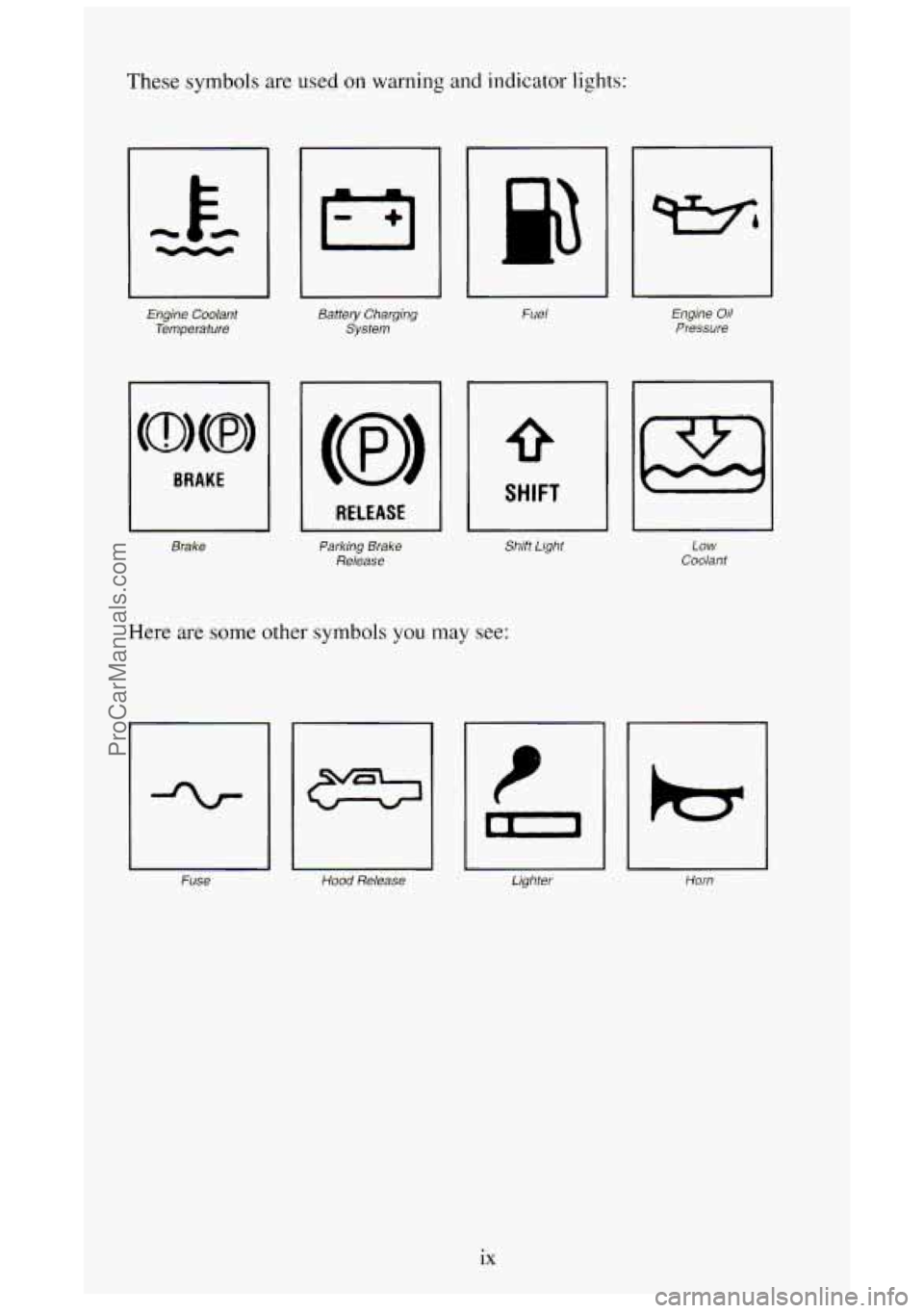
These symbols are used on warning and indicator lights:
Engine Coolant
Temperature Battery Charging
System
I I RELEASE I
Brake Parking Brake
Release
0
SHIFT
Shift Light
Here are some other symbols you may see:
Fuse
Fuel
Hood Release Lighter
I
Engine Oil
Pressure
Low Coolant
I Horn
ix
ProCarManuals.com
Page 75 of 404
4. If the engine does not start after 15 seconds of cranking, turn the
ignition key to
OFF. Wait one minute for the starter to. cool, then try
the
same steps again.
If you’re trying
to start your engine after you’ve run out of fuel, follow the
steps in “Running Out of Fuel” (see “Diesel Fuel Requirements and Fuel
System” in the Index).
When your engine
is cold, let it run for a few minutes before you move your
vehicle. This lets oil pressure build up. Your engine will sound louder
when
it’s cold.
I NOTICE:
If you’re not in an idling vehicle and the engine overheats, you
wouldn’t be there to see the coolant temperature gage. This \
could damage your vehicle. Don’t let your engine run when
you’re not
in your vehicle.
Cold Weather Starting (Diesel Engine)
The following tips will help you get good starting in cold weather.
Use
SAE 1OW-30 oil when the outside temperature drops below freezing.
When the outside temperature drops below
0°F (- 1 SOC), use your engine
coolant heater.
If you park your vehicle
in a garage, you shouldn’t need to use the coolant
heater
until the garage temperature goes below 0°F (-18OC), no matter how
cold it is outside.
To use the engine coolant heater, first turn off the engine. Then open the
hood, unwrap the electrical cord and plug it in. It uses normal house voltage
(I 10 volts), but:
2-17
ProCarManuals.com
Page 133 of 404
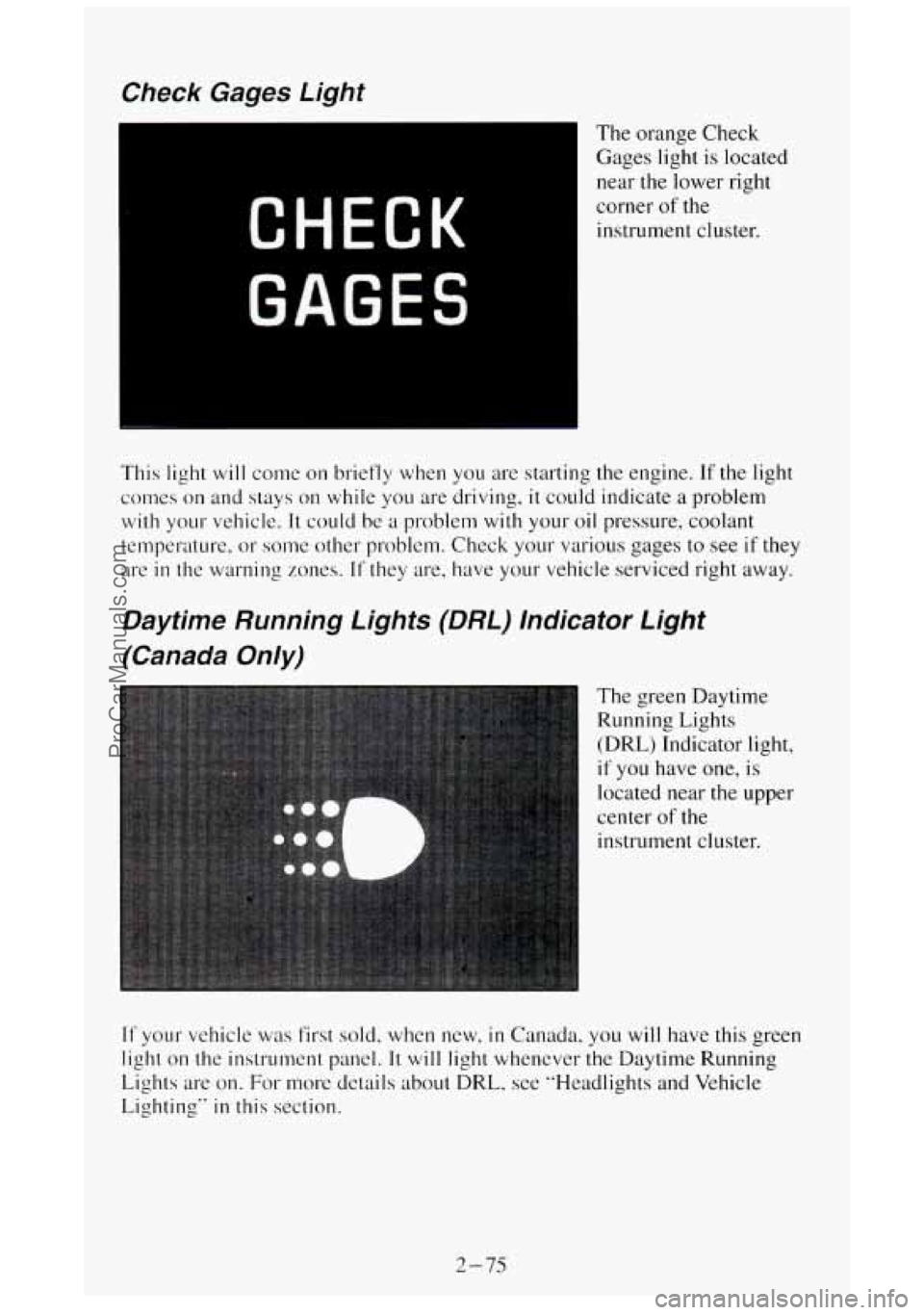
Check Gages Light
The orange Check
Gages light is located
near the lower right
corner
of the
instrument cluster.
This light
will come on briefly when you are starting the engine. If the light
comes
on and stays on while you are driving. it could indicate a problem
with your vehicle. It could be a problem with your oil pressure, coolant
temperature. or some other problem. Chcck your various gages
to see if they
are
in the warning zones. If they are, have your vehicle serviced right away.
Daytime Running Lights (DRL) Indicator Light
(Canada Only)
The green Daytime
Running Lights
(DRL) Indicator light,
if you have one, is
located near the upper
center
of the
instrument cluster.
If your vehicle was first sold. when new. in Canada, you will have this green
lighl on the instrument pancl.
It will light whenever the Daytime Running
Lights
are on. For more details about DRL, sce "Headlights and Vehicle
Lighting'.
in this section.
2-75
ProCarManuals.com
Page 138 of 404
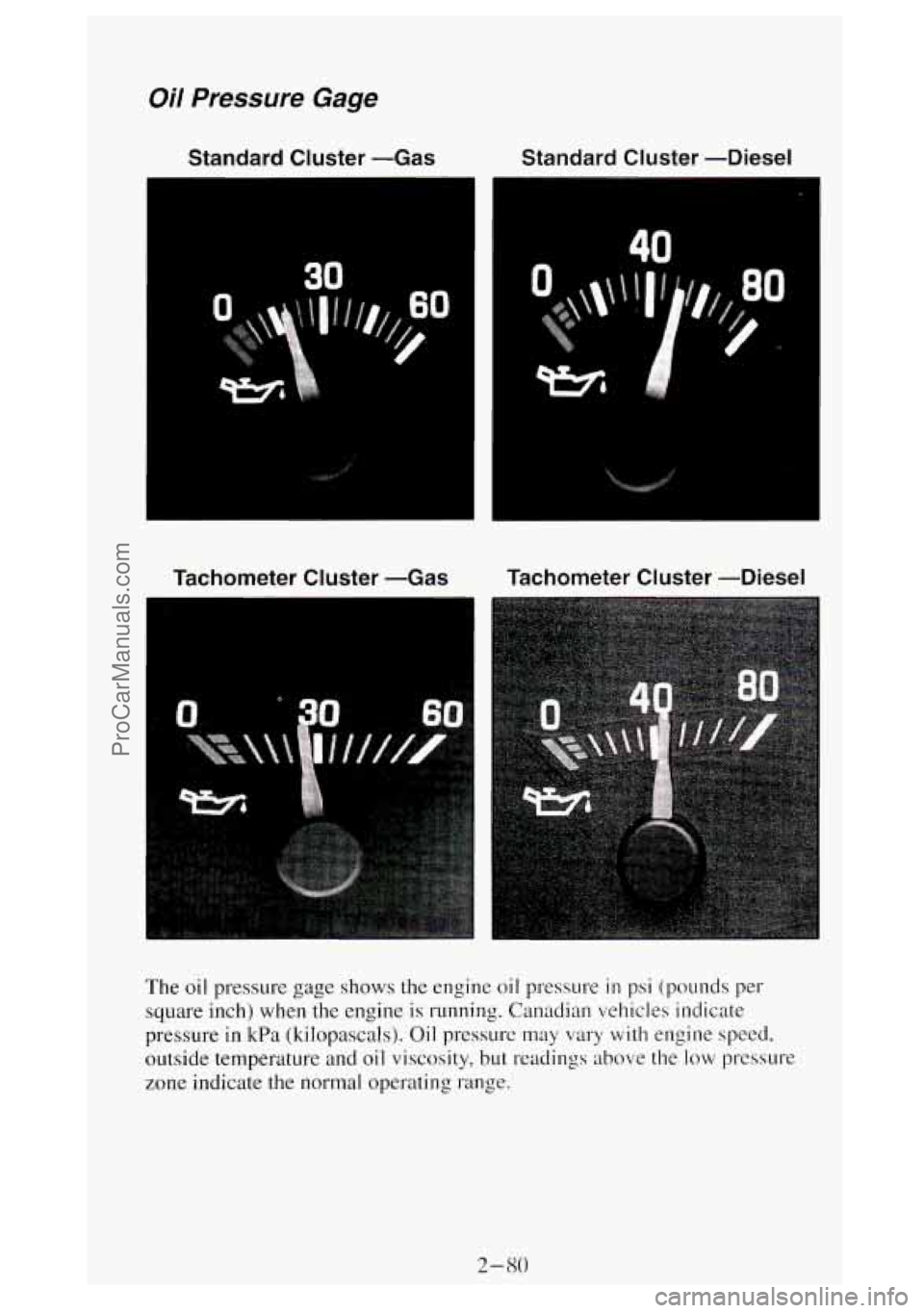
Oil Pressure Gage
Standard Cluster -Gas Standard Cluster -Diesel
30
I
Tachometer Cluster -Gas Tachometer Cluster -Diesel
The oil pressure gage shows the engine oil pressure in psi (pounds per
square inch) when the engine
is running. Canadian vehicles indicate
pressure
in kPa (kilopascals). Oil pressure may vary with engine speed,
outside temperature and
oil viscosity, but readings above the low pressure
zone indicate the normal operating range.
2- 80
ProCarManuals.com
Page 139 of 404
A reading in the low pressure zone may be caused by a dangerously low oil
level
or other problem causing low oil pressure. Check your oil as soon as
possible.
NOTICE:
Damage to your engine from neglected oil problems can be
costly and
is not covered by your warranty.
2-81
ProCarManuals.com
Page 194 of 404
Reduce your speed according to your speedometer, not to your sense of
motion. After driving for any distance at higher speeds, you may tend
to
think you are going slower than you actually are.
Before Leaving on a Long Trip
Make sure you’re ready. Try to be well rested. If you must start when you’re
not fresh
- such as after a day’s work - don’t plan to make too many
miles that first part
of the journey. Wear comfortable clothing and shoes you
can easily drive in.
Is your vehicle ready for a long trip? If you keep it serviced and maintained,
it’s ready to go.
If it needs service, have it done before starting out. Of
course, you’ll find experienced and able service experts
in Vehicle
dealerships all across
North America. They’ll be ready and willing to help if
you need it.
Here are some things you can check before a trip:
Windshield Washer Fluid: Is the reservoir full? Are all windows clean
inside and outside?
Wiper Blades: Are they in good shape‘?
Fuel, Engine Oil, Other Fluids: Have you checked all levels?
0 Lights: Are they all working? Are the lenses clean‘?
0 Tires: They are vitally important to a safe, trouble-free trip. Is the tread
good enough for long-distance driving‘? Are the tires all inflated
to the
recommended pressure‘?
0 Weather Forecasts: What’s the weather outlook along your route?
Should you delay your trip
a short time to avoid a major storm system?
0 Maps: Do you have up-to-date maps?
Highway Hypnosis
Is there actually such a condition as “highway hypnosis”? Or is it just plain
falling asleep at the wheel?
Call it highway hypnosis, lack of awareness, or
whatever.
There is something about
an easy stretch of road with the same scenery,
along with the hum of the tires on
the road, the drone of the engine, and the
rush of the wind against the vehicle that can make you sleepy. Don’t let it
happen to you! If
it does, your vehicle can leave the road in less than a
second, and you could crash and be injured.
4-30
ProCarManuals.com
Page 207 of 404
Driving On Grades
Reduce speed and shift to a lower gear before you start down a long or
steep downgrade.
If you don’t shift down, you might have to use your
brakes
so much that they would get hot and no longer work well.
On a long uphill grade, shift down and reduce your speed to around
45 mph
(70 km/h) to reduce the possibility of engine and transmission overheating.
When towing at high altitude with steep uphill grades,you need to consider
the following information. The lower atmospheric pressure at high altitude
allows your vehicles engine coolant to boil at a lower temperature than at
normal altitudes.
If you immediately turn your engine off after towing at high altitude with
steep uphill grades, your vehicle may show signs similar
to engine
overheating.
To avoid this, let your vehicle operate in a parked position with
the transmission in
“N” (Neutral) for a few minutes before you turn off the
engine. If you do get the overheat warning, see “Engine Overheating” in
the Index.
If you have an automatic transmission, you should use
“D” (or, as you need
to, a lower gear) when towing a trailer. Operating your vehicle in
“D” when
towing a trailer will minimize heat buildup and extend the life
of your
transmission.
If you have a manual transmission and
you are towing a trailer, it’s better
not to use fifth gear. Just drive in fourth gear (or, as you need to, a lower
gear).
Parking on Hills
You really should not park your vehicle, with a trailer attached, on a hill. If
something goes wrong, your rig could start
to move. People can be injured,
and both your vehicle and the trailer can be damaged.
But if you ever have to park your rig on a hill, here’s how
to do it:
1.
2.
3.
4.
5.
6.
Apply your regular brakes, but don’t shift into “P’ (Park) yet, or in gear
for a manual transmission.
Have someone place chocks under the trailer wheels.
When the wheel chocks are in place, release the regular brakes until the
chocks absorb
the load.
Re-apply the regular brakes. Then apply your parking brake, and then
shift to
“P7, (Park), or “R” (Reverse) for a manual transmission.
If
you have a four-wheel-drive vehicle, be sure the transfer case is in a
drive gear-not in
“N7 (Neutral).
Release
the regular brakes.
4-43
ProCarManuals.com
Page 221 of 404
Cooling System -Gas Engines
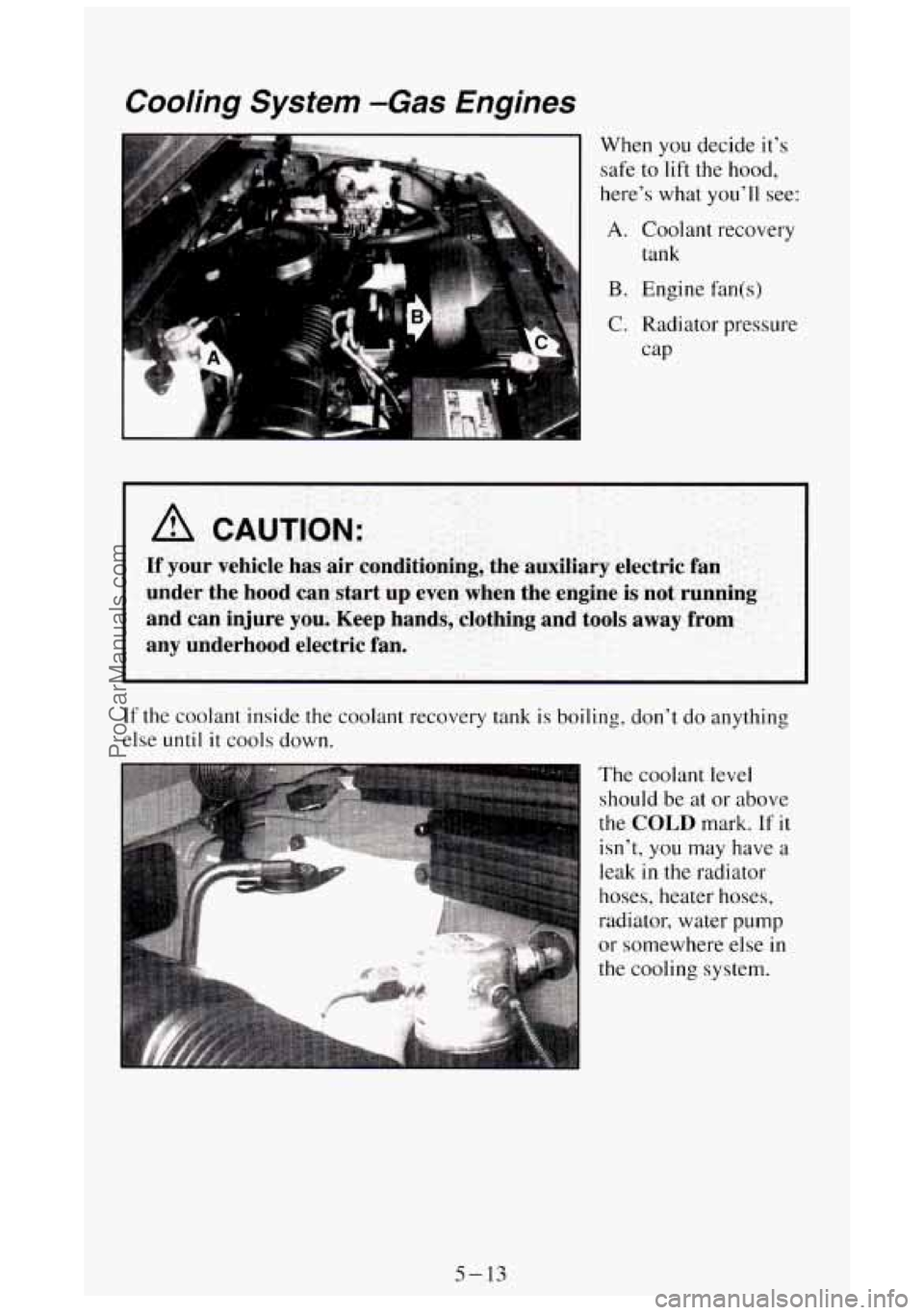
When you decide it's
safe to lift the hood,
here's what you'll see:
A. Coolant recovery
tank
B. Engine fan(s)
C. Radiator pressure
cap
A CAUTION:
If your vehicle has air conditioning, the auxiliary electric fan
under the hood can start up even when
the engine is not running
and can injure you. Keep hands, clothing and tools away from
any underhood electric fan.
If the coolant inside the coolant recovery tank is boiling, don't do anything
else until it
cools down.
The coolant level
should be at or above
the
COLD mark. If it
isn't, you may have a
leak in the radiator
hoses, heater hoses,
radiator, water
pump
or somewhere else in
the cooling system.
5-13
ProCarManuals.com
Page 332 of 404
Using Solvent-Type Cleaner on Fabric
First, see if you have to use solvent-type cleaner at all. Some spots and
stains will clean off better
with just water and mild soap.
If you need to use a solvent:
0 Gently scrape excess soil from the trim material with a clean, dull knife
or scraper. Use very little cleaner, light pressure and clean cloths
(preferably cheesecloth). Cleaning should start at the outside
of the
stain, “feathering” toward the center. Keep changing to
a clean section
of the cloth.
0 When you clean a stain from fabric, immediately dry the area with an
air hose, hair dryer, or heat lamp
to help prevent a cleaning ring. (See
the previous NOTICE.)
Fabric Protection
Your vehicle has upholstery and trim carpet that has been treated with
Scotchgard
TM Fabric Protector, a 3M product. Scotchgard TM protects fabrics
by repelling oil and water, which are the carriers of most stains. Even with
this protection, you still need to clean your upholstery and trim carpet often
to keep
it looking new.
Further information on cleaning is available by calling 1-800-433-3296
(in Minnesota, 1-800-642-6 167).
Special Cleaning Problems
Greasy or Oily Stains
Such as grease, oil, butter, margarine, shoe polish, coffee with cream,
chewing gum, cosmetic creams, vegetable oils, wax crayon, tar and asphalt.
0 Carefully scrape off excess stain.
Follow the solvent-type instructions described earlier.
0 Shoe polish, wax crayon, tar and asphalt will stain if left on a vehicle
seat fabric. They should be removed as soon as possible. Be careful,
because
the cleaner will dissolve them and may cause them to spread.
Non-Greasy Stains
Such as catsup, coffee (black), egg, fruit, fruit juice, milk, soft drinks, wine,
vomit, urine and blood.
Carefully scrape off excess stain, then sponge the soiled area with cool
water.
0 If a stain remains, follow the foam-type instructions described earlier.
6-82
ProCarManuals.com
Page 366 of 404
Explanation Of Scheduled Mainienance Services
Below are explanations of the services listed in the maintenance charts.
The proper fluids and lubricants to use are listed in this section. Make sure
whoever services your vehicle uses these. All parts should be replaced and
all necessary repairs done before you or anyone else drives the vehicle.
1. ENGINE OIL AND OIL FILTER CHANGE“‘ - ALWAYS USE
SJ3 ENERGY CONSERVING I1 (GASOLINE ENGINE) OR CF-4/SH
(DIESEL ENGINE) QUALITY OILS
OF THE PROPER VISCOSITY.
To determine the preferred viscosity oil for your vehicle’s engine (e.g.
SAE 5W-30 or 10W-30), see “Engine Oil”
in the Index.
2. CHASSIS LUBRICATION - Lubricate the front suspension, king
pin bushings, steering linkage, transmission, and transfer case shift
linkage, parking brake cable guides, rear driveline center splines and
front axle propshaft splines, brake pedal springs, and clutch pedal
springs at the intervals specified.
If you have a 3500
HD, lubricate the king pins and king pin bushings,
every
1,500 miles (2500 km) for Maintenance Schedule I, or every
3,000 (5000 km) for Maintenance Schedule 11.
Ball joints and king pin bushings should not be lubricated unless their
temperature
is 10” F (-12”C), or higher. When the weather is cold, let
them warm up before lubrication or
they could be damaged.
Also, be sure
to check all the vehicle fluid levels at this time.
3.
CLUTCH FORK BALL STUD LUBRICATION (5-SPEED
MANUAL TRANSMISSION WITH DEEP LOW
) - Lubricate the
clutch fork ball stud through the fitting
on the clutch housing.
Lubricant must be added “sparingly” to
the fitting, as only .0066 lb.
(.003 kg) is required to lubricate the ball stud surface. Do not add
lubricant more often than the intervals
in the Maintenance Charts. Too
much lubricant will damage the clutch assembly.
4. COOLING SYSTEM SERVICE”’? - Drain, flush and refill system
with new coolant. See “Engine Coolant” in the Index for
the proper
coolant and mixture to use
in your vehicle.
Also inspect the hoses and replace them
if they are cracked, swollen, or
deteriorated. Tighten all hose clamps (except constant tension clamps).
Remove debris and clean the outside of the radiator and air
conditioning condenser. Wash the radiator neck.
To ensure proper
operation, pressure test.
the radiator and cap.
* An Emission Control Service
?A fluid
loss in these systems may indicate a problem. Have them
inspected and repaired at once.
7-18
ProCarManuals.com