engine GMC SIERRA 1994 User Guide
[x] Cancel search | Manufacturer: GMC, Model Year: 1994, Model line: SIERRA, Model: GMC SIERRA 1994Pages: 404, PDF Size: 20.91 MB
Page 75 of 404
4. If the engine does not start after 15 seconds of cranking, turn the
ignition key to
OFF. Wait one minute for the starter to. cool, then try
the
same steps again.
If you’re trying
to start your engine after you’ve run out of fuel, follow the
steps in “Running Out of Fuel” (see “Diesel Fuel Requirements and Fuel
System” in the Index).
When your engine
is cold, let it run for a few minutes before you move your
vehicle. This lets oil pressure build up. Your engine will sound louder
when
it’s cold.
I NOTICE:
If you’re not in an idling vehicle and the engine overheats, you
wouldn’t be there to see the coolant temperature gage. This \
could damage your vehicle. Don’t let your engine run when
you’re not
in your vehicle.
Cold Weather Starting (Diesel Engine)
The following tips will help you get good starting in cold weather.
Use
SAE 1OW-30 oil when the outside temperature drops below freezing.
When the outside temperature drops below
0°F (- 1 SOC), use your engine
coolant heater.
If you park your vehicle
in a garage, you shouldn’t need to use the coolant
heater
until the garage temperature goes below 0°F (-18OC), no matter how
cold it is outside.
To use the engine coolant heater, first turn off the engine. Then open the
hood, unwrap the electrical cord and plug it in. It uses normal house voltage
(I 10 volts), but:
2-17
ProCarManuals.com
Page 76 of 404
NOTICE:
After you’ve used the coolant heater, be sure to store the cord in
the manner it was, to help keep it away from moving engine
parts.
If you don’t, it could be torn and damaged.
How long should you keep the coolant heater plugged in? The answer
depends on the weather,
the kind of oil you have, and some other things.
Follow this chart.
Engine Coolant Heater Usage
Viscosity/ 32°F
to 0°F
Oil Grade
(OOC to -1SOC)
SAE
1 OW-30
SAE
I5W-40
Not
Required
Not
Required
0°F to -10°F
(-18” C to -23 O C)
Two
Hours*
Two
Hours*
Below -10°F
Below -23 ” C
Eight Hours* or Overnight
Eight Hours”: or Overnight
*The times listed are minimum times. It
will not harm either the coolant
heater or the vehicle
to leave the coolant heater plugged in longer than the
times stated.
For best results
in cold weather, use Number I-D diesel fuel or a
“winterized” Number 2-D fuel.
lf Your Diesel Engine Won’t Start
If you’ve run out of fuel, look at “Running Out of Fuel” (see “Diesel Fuel
Requirements and Fuel System” in the Index).
If you’re not out of fuel, and your engine won’t start, do this:
Turn your ignition key to RUN. Make sure that the “GLOW PLUGS” light
is out. Then turn the ignition key to START.
If the light doesn’t go off, wait a few seconds, then try starting your engine
again. And, see
your dealer as soon as you can for a starting system check.
2- 18
ProCarManuals.com
Page 77 of 404
If the light comes on and then goes off and you know your batteries are
charged, but your engine still
won’t start, your vehicle needs service.
If the light does not come on when
the engine is cold, your vehicle needs
service.
If your batteries don’t have enough charge to start your engine, see
“Battery”
in the Index.
Be sure you have the right oil for your engine, and that you’ve changed the
oil at the proper times.
If you use the wrong oil, your engine may be harder
to start.
If
the engine starts, runs a short time, then stops, your vehicle needs service.
1 A CAUTION:
Do not use gasoline or starting “aids,” such as ether, in the air
intake.
They could damage your engine. There could also be a
fire, which could cause serious personal injury.
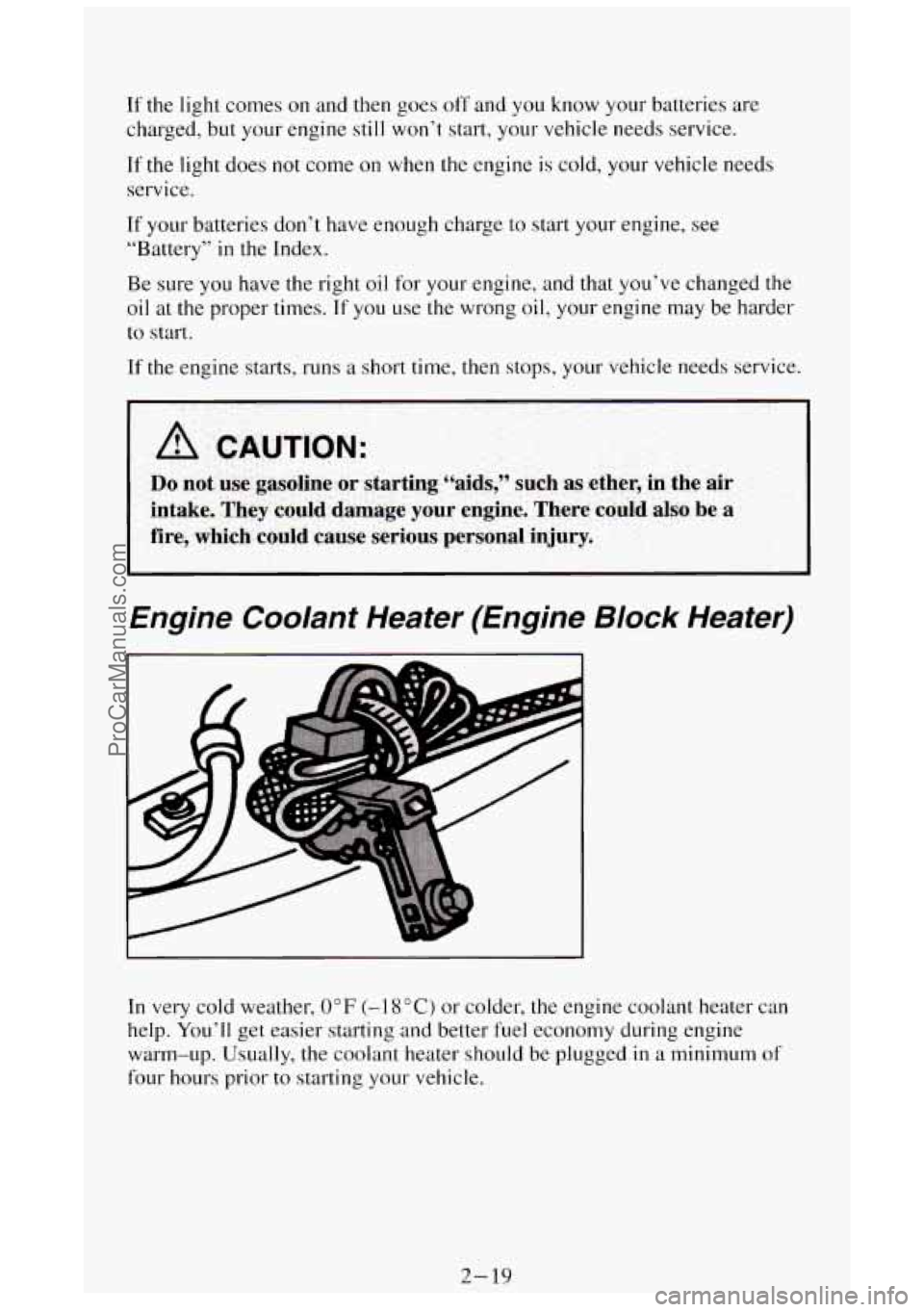
Engine Coolant Heater (Engine Block Heater)
In very cold weather, 0°F (-I 8°C) or colder, the engine coolant heater can
help. You’ll get easier starting and better fuel economy during engine
warm-up. Usually, the coolant heater should be plugged
in a minimum of
four hours prior to starting your vehicle.
2-19
ProCarManuals.com
Page 78 of 404
To use the coolant heater:
1. Turn off the engine.
2. Open the hood and unwrap the electrical cord.
3. Plug it into a normal, grounded 1 10-volt outlet.
NOTICE:
After you’ve used the coolant heater, be sure to store the \
cord as
it was before to keep it away from moving engine parts. If you
don’t, it could be damaged.
How long should you keep the coolant heater plugged in‘? The answer
depends
on the weather, the kind of oil you have, and some other things.
Instead
of trying to list everything here, we ask that you contact a GM
dealer in the area where you’ll be parking your vehicle. The dealer can give
you the best advice
for that particular area.
2-20
ProCarManuals.com
Page 79 of 404
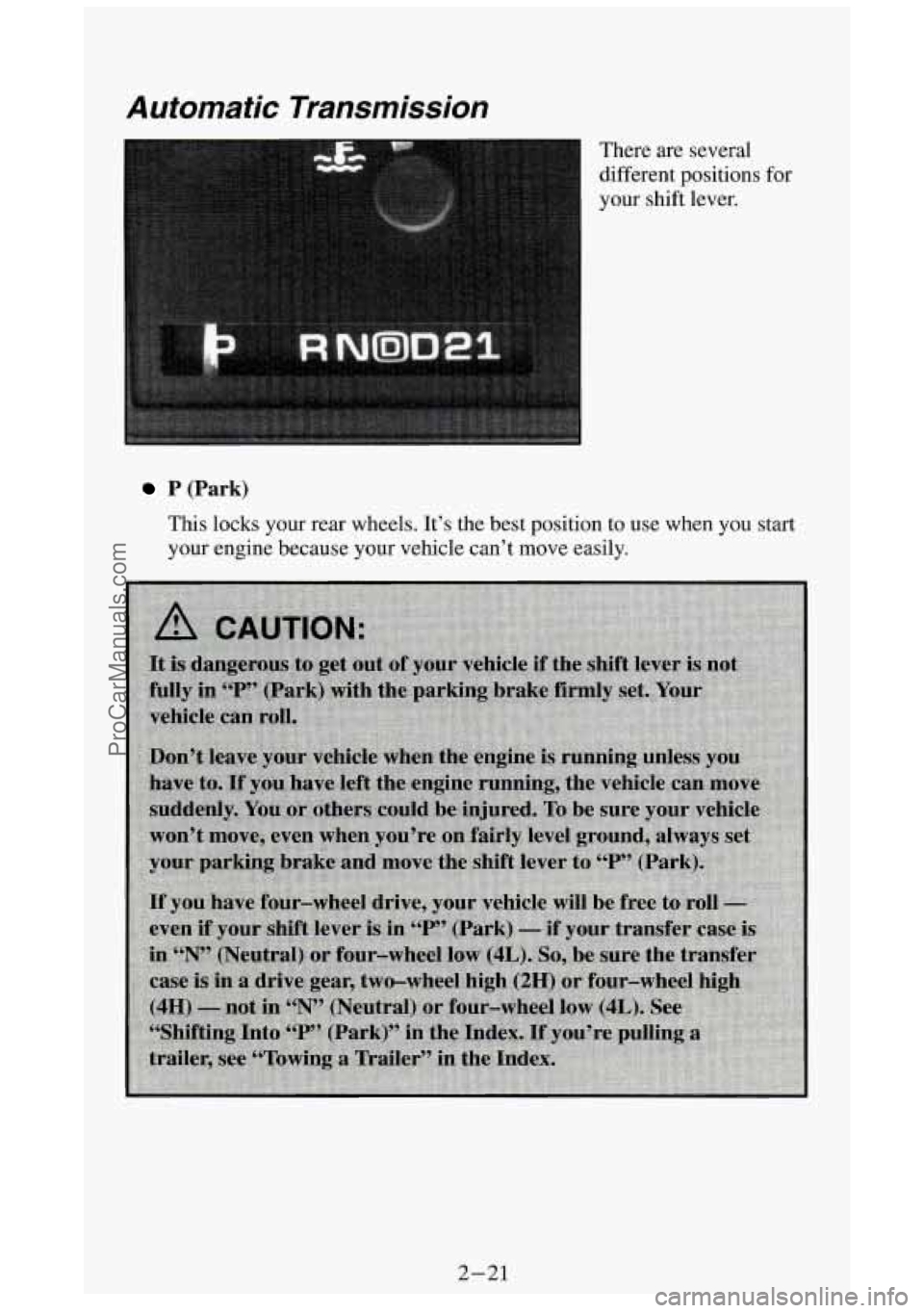
Automatic Transmission
There are several
different positions for
your shift lever.
P (Park)
This locks your rear wheels. It’s the best position to use when you start
your engine because your vehicle can’t move easily.
2-21
ProCarManuals.com
Page 80 of 404
0 R (Reverse)
Use this gear to back up.
NOTICE:
Shifting into “R” (Reverse) while your vehicle is moving
forward could damage your transmission. Shift to
“R” (Reverse)
only after your vehicle is stopped.
To rock your vehicle back and forth to get out of snow, ice or sand
without damaging your transmission, see
“If Your Stuck: In Sand, Mud,
Ice or Snow”
in the Index.
N (Neutral)
In this position, your engine doesn’t connect with the wheels. To restart
when you’re already
moving, use “N” (Neutral) only. Also, use “N”
(Neutral) when your vehicle is being towed.
NOTICE:
Damage to your transmission caused by shifting out of “P”
(Park) or “N” (Neutral) with the engine racing isn’t covered by
your warranty.
2-22
ProCarManuals.com
Page 82 of 404
I
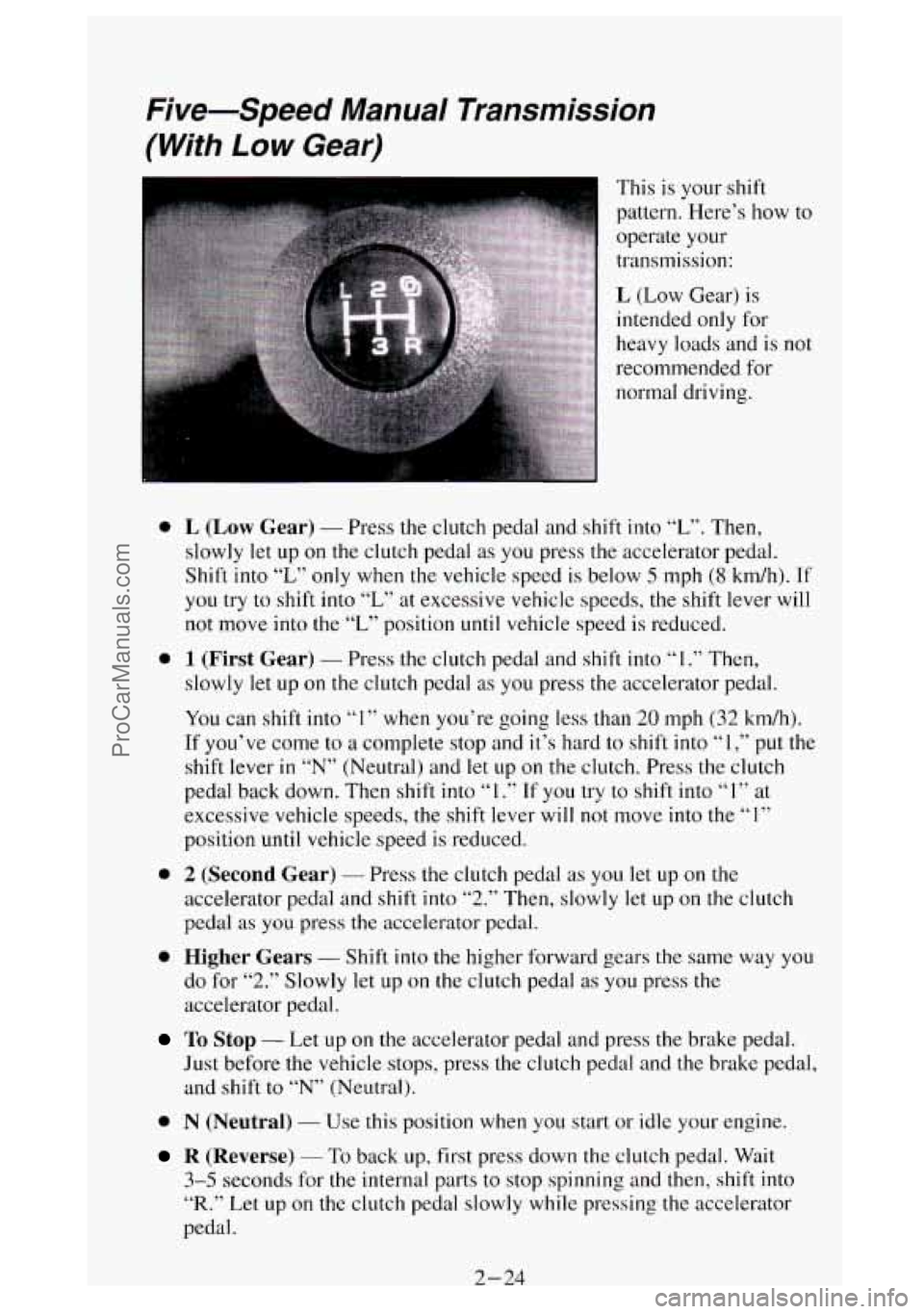
Five-Speed Manual Transmission
(With Low Gear)
This is your shift
pattern. Here’s how to
operate your
transmission:
L (Low Gear) is
intended only for
heavy loads and is not
recommended for
normal driving.
0 L (Low Gear) - Press the clutch pedal and shift into “L”. Then,
slowly let up on the clutch pedal as
you press the accelerator pedal.
Shift into
“L” only when the vehicle speed is below 5 mph (8 kdh). Tf
you try to shift into “L” at excessive vehicle speeds, the shift lever will
not move into the “L” position until vehicle speed is reduced.
0 1 (First Gear) - Press the clutch pedal and shift into “1.” Then,
slowly let up
on the clutch pedal as you press the accelerator pedal.
You can shift into “1” when you’re going less than 20 mph (32 km/h).
If you’ve come
to a complete stop and it’s hard to shift into “1,” put the
shift lever in “N” (Neutral) and let up on the clutch. Press the clutch
pedal back down. Then shift into
“I .” If you try to shift into “1” at
excessive vehicle speeds,
the shift lever will not move into the “1”
position until vehicle speed is reduced.
0 2 (Second Gear) - Press the clutch pedal as you let up on the
accelerator pedal and shift into “2.” Then, slowly let up on the clutch
pedal as
you press the accelerator pedal.
0 Higher Gears - Shift into the higher forward gears the same way you
do for
“2.” Slowly let up on the clutch pedal as you press the
accelerator pedal.
To Stop - Let up on the accelerator pedal and press the brake pedal.
Just before the vehicle stops, press the clutch pedal and the brake pedal,
and shift
to “N” (Neutral).
0 N (Neutral) - Use this position when you start or idle your engine.
R (Reverse) - To back up, first press down the clutch pedal. Wait
3-5 seconds for the internal parts to stop spinning and then, shift into
“R.” Let up on the clutch pedal slowly while pressing the accelerator
pedal.
2-24
ProCarManuals.com
Page 83 of 404
NOTICE:
Shift to “R” (Reverse) only after your vehicle is stopped.
Shifting
to “R” (Reverse) while your vehicle is moving could
damage your transmission.
Also, use Reverse, along with the parking brake, when turning off your
engine and parking your vehicle.
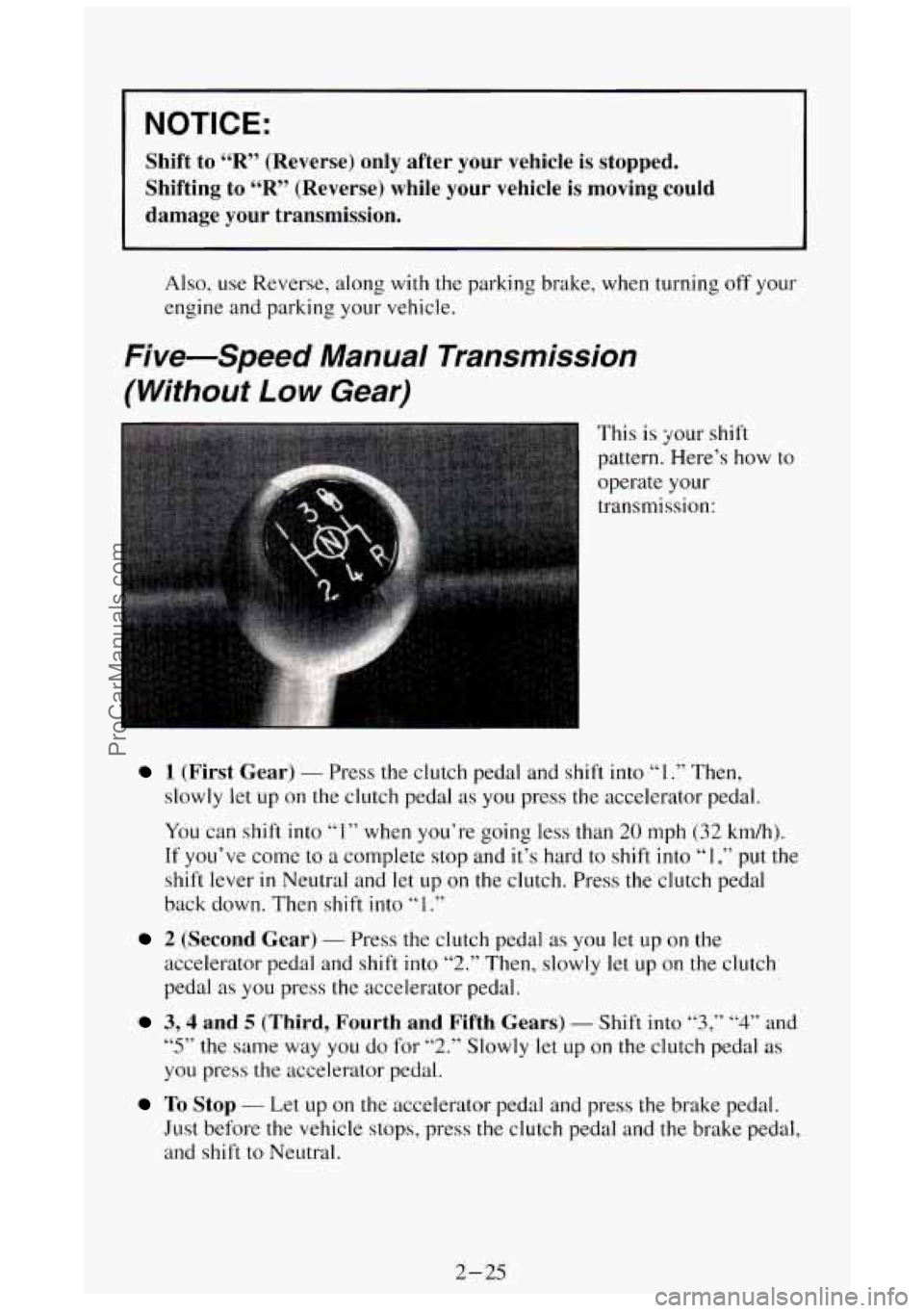
Five-Speed Manual Transmission
(Without
Low Gear)
This is your shift
pattern. Here’s how to
operate your
transmission:
1 (First Gear) - Press the clutch pedal and shift into “1 .” Then,
slowly
let up on the clutch pedal as you press the accelerator pedal.
You can shift into
“1” when you’re going less than 20 mph (32 km/h).
If you’ve come to a complete stop and it’s hard to shift into L‘ 1 ,” put the
shift lever
in Neutral and let up on the clutch. Press the clutch pedal
back down. Then shift
into LLl.”
2 (Second Gear) - Press the clutch pedal as you let up on the
accelerator pedal and shift
into “2.” Then, slowly let up on the clutch
pedal as
you press the accelerator pedal.
3,4 and 5 (Third, Fourth and Fifth Gears) - Shift into “3,” “4” and
“5” the same way you do for “2.” Slowly let up on the clutch pedal as
you press the accelerator pedal.
To Stop - Let up on the accelerator pedal and press the brake pedal.
Just before the vehicle stops, press
the clutch pedal and the brake pedal,
and shift to Neutral.
2-25
ProCarManuals.com
Page 84 of 404
R (Reverse) - To back up, first press down the clutch pedal. Wait
3-5 seconds for the internal parts to stop spinning and then, shift into
“R.” Let up on the clutch pedal slowly while pressing the accelerator
pedal.
NOTICE:
Shift to “R” (Reverse) only after your vehicle is stopped.
Shifting to
LLR” (Reverse) while your vehicle is moving could
damage your transmission.
Also, use Reverse, along with the parking brake, when turning off your
engine and parking your vehicle.
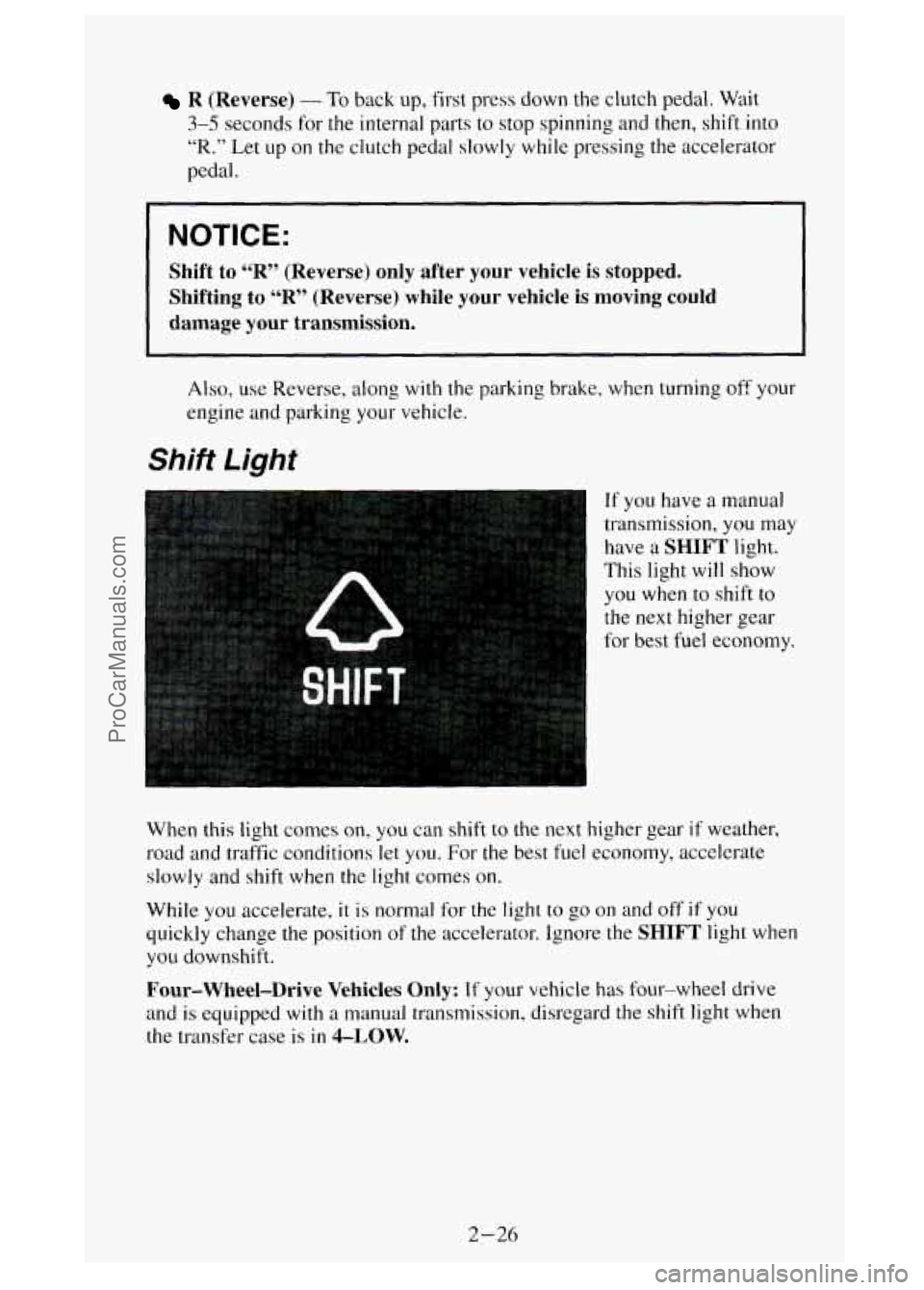
Shift Light
If you have a manual
transmission,
you may
have
a SHIFT light.
This light will show
you when
to shift to
the next higher gear
l for best fuel economy.
I
When this light comes on, you can shift to the next higher gear if weather,
road and traffic conditions let you. For
the best fuel economy, accelerate
slowly and shift when the light comes on.
While you accelerate, it
is normal for the light to go on and off if you
quickly change the position
of the accelerator. Ignore the SHIFT light when
you downshift.
Four-Wheel-Drive Vehicles Only: If your vehicle has four-wheel drive
and is equipped with
a manual transmission, disregard the shift light when
the transfer case is in 4-LOW.
2-26
ProCarManuals.com
Page 85 of 404
, th\
is chart
shows when to shift to the next higher gear for best fuel economy")
Manual Transmissions- Shift Speeds
If you have a five-speed manual transmission (with low gear), th\
is chart
shows when to shift to the next higher gear for best fuel economy.
Recommended Shift Speeds - Five Speed
Manual Transmission
with Low Gear*
Engine (VIN Code)
4.3L V6 (Z)
5.7L V8 (K)
4.3L V6 (Z)
Acceleration Shift Speed MPH (KM/H)
15 (24)
15 (24) 40 (64)
25 (40)
Cruise Shift Speed MPH (KM/H)
25-40
(40-64) 50
(80)
40 (64)
45-50
(72-80)
*L (low) is intended for use with heavy loads and is not recommended for
normal driving
If your speed drops below
20 mph (32 km/h), or if the engine is not running
smoothly, you should downshift to the next lower gear. You may have to
downshift two or more gears to keep the engine running smoothl\
y or for
good performance.
NOTICE:
If you skip more than one gear when you downshift, or if you
race the engine when you downshift, you can damage the engine,\
clutch or transmission.
2-27
ProCarManuals.com