flat tire GMC SIERRA 1994 User Guide
[x] Cancel search | Manufacturer: GMC, Model Year: 1994, Model line: SIERRA, Model: GMC SIERRA 1994Pages: 404, PDF Size: 20.91 MB
Page 241 of 404
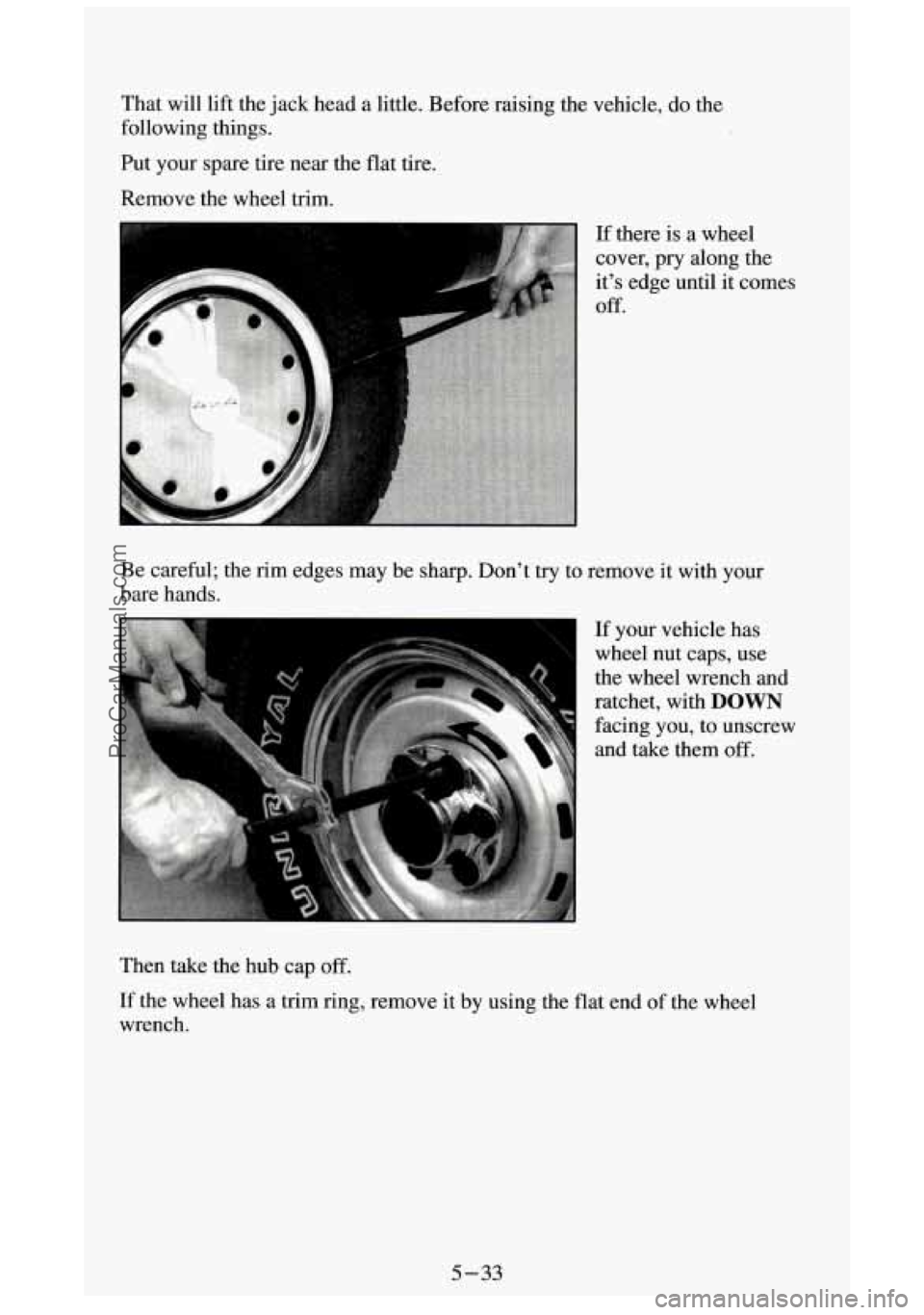
That will lift the jack head a little. Before raising the vehicle, do the
following things.
Put your spare tire near the flat tire.
Remove the wheel trim.
Be careful; the rim edges may be sharp. Don't
try to remove it with your
bare hands.
- If your vehicle has
wheel nut caps, use
the wheel wrench and
ratchet, with
DOWN
facing you, to unscrew
and take them off.
Then take the hub cap off.
If the wheel has a trim ring, remove it by using the flat end of the wheel
wrench.
5-33
ProCarManuals.com
Page 243 of 404
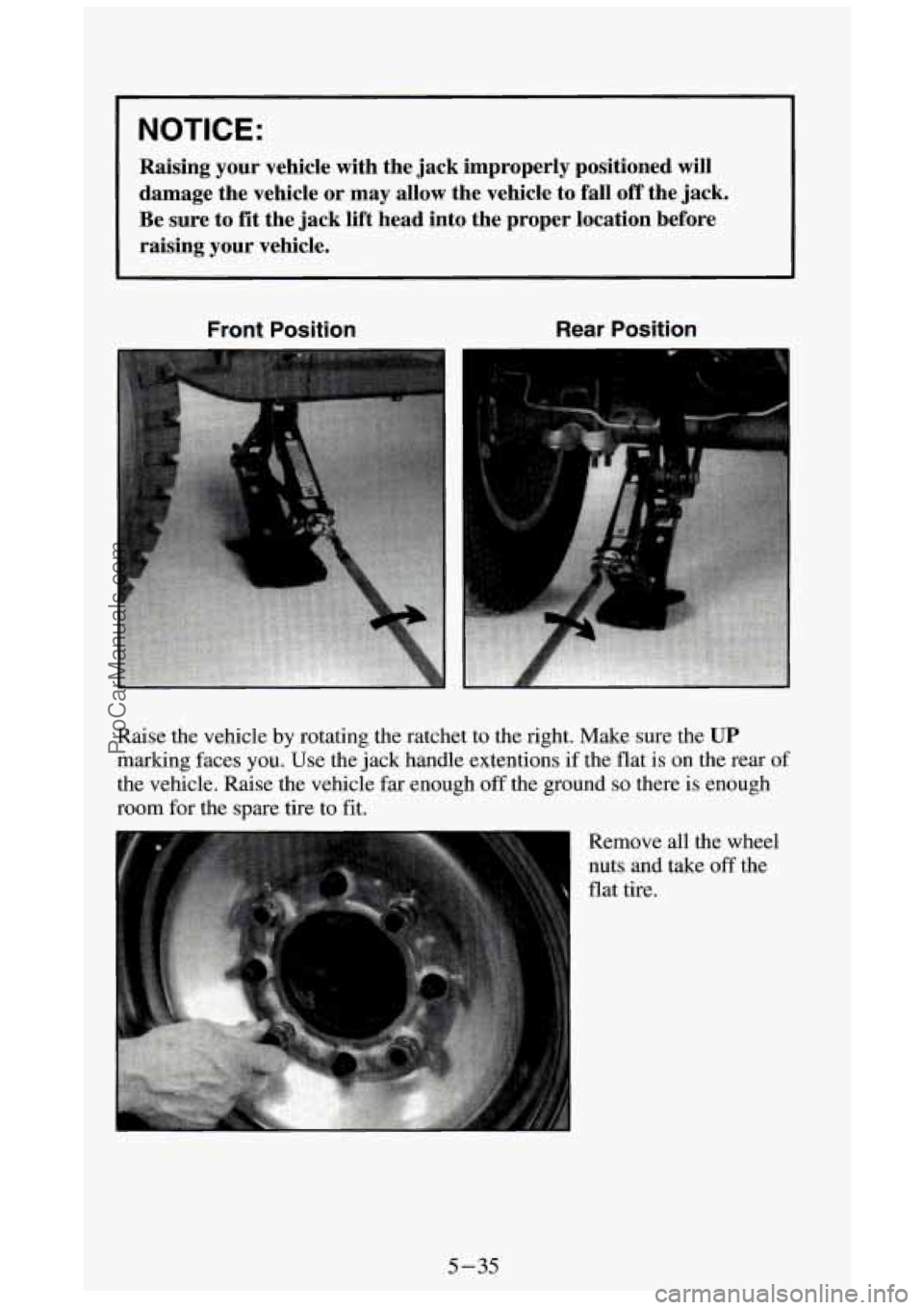
NOTICE:
Raising your vehicle with the jack improperly positioned will
damage the vehicle or may allow the vehicle to fall
off the jack.
Be sure to fit the jack lift head into the proper location before
raising your vehicle.
Front Position
I
Raise the vehicle by rotating the ratchet to the right. Make sure the UP
marking faces you. Use the jack handle extentions if the flat is on the rear of
the vehicle. Raise the vehicle far enough off the ground so there is enough
room for the spare tire to fit.
Remove all the wheel
nuts and take off the
flat tire.
5-35
ProCarManuals.com
Page 247 of 404
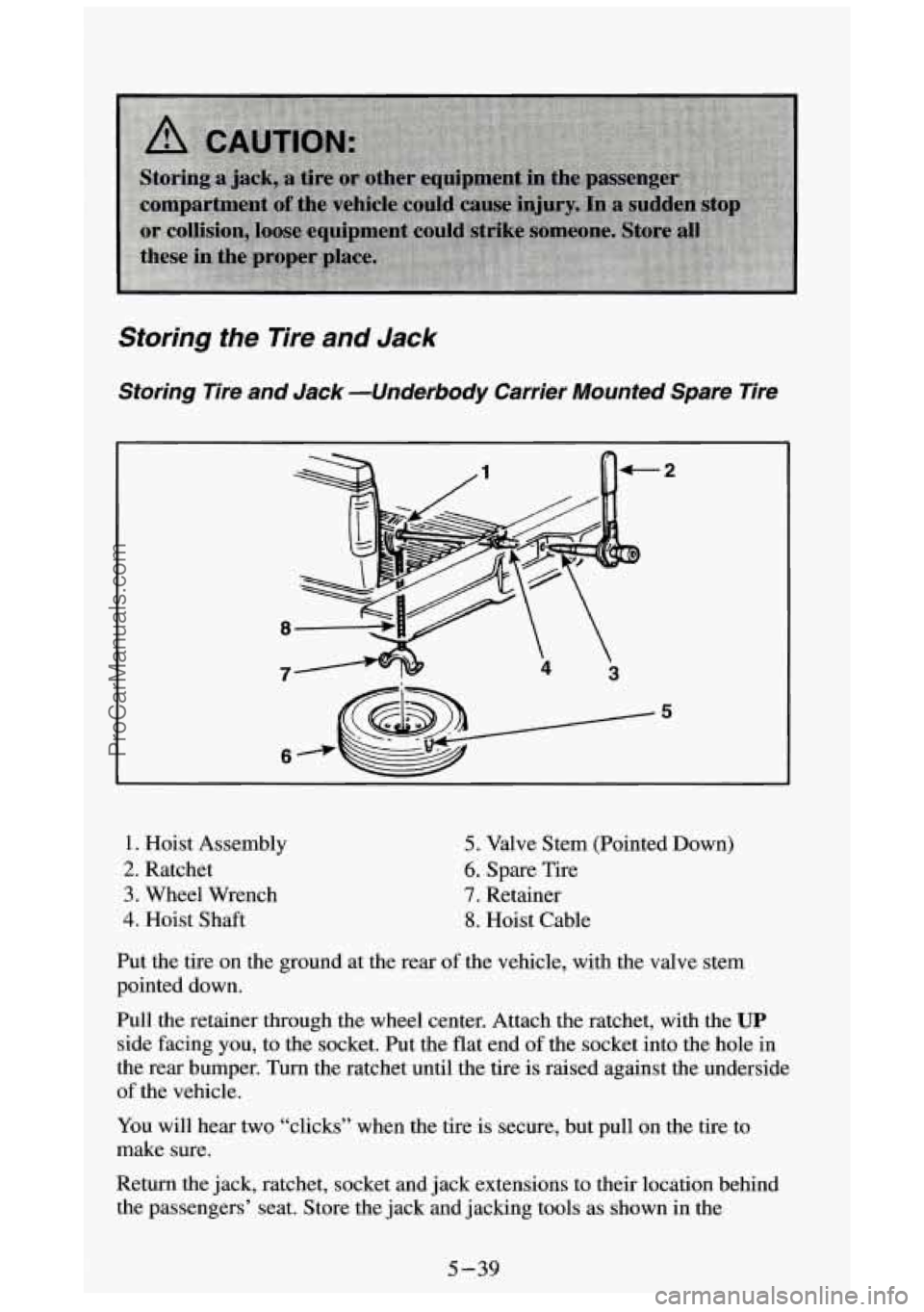
Storing the Tire and Jack
Storing Tire and Jack -Underbody Carrier Mounted Spare Tire
8
7
1. Hoist Assembly
2. Ratchet
3. Wheel Wrench
4. Hoist Shaft
5. Valve Stem (Pointed Down)
6. Spare Tire
7. Retainer
8. Hoist Cable
Put the tire on the ground at the rear of the vehicle, with the valve stem
pointed down.
Pull the retainer through the wheel center. Attach the ratchet,\
with the
UP
side facing you, to the socket. Put the flat end of the socket into the hole in
the rear bumper.
Turn the ratchet until the tire is raised against the underside
of the vehicle.
YOU will hear two “clicks” when the tire is secure, but pull on the tire to
make sure.
Return the jack, ratchet, socket and jack extensions to their location behind
the passengers’ seat. Store the jack; and jacking tools
as shown in the
5-39
ProCarManuals.com
Page 252 of 404
Checking Things Under the Hood (continued)
Windshield Washer Fluid
................................. 6-45
Brake Master Cylinder
................................... 6-46
Replacing Brake System Parts
................................ 6-49
Other Maintenance Items
.................................... 6-49
Windshield Wiper Blade Inserts
.............................. 6-50
FluidLeakCheck
.......................................... 6-51
Lubrication
............................................... 6-51
Battery .................................................. 6-52
Vehiclestorage
......................................... 6-52
Bulb Replacement
......................................... 6-53
Fuses and Circuit Breakers
.................................. 6-62
Exhaustsystem
........................................... 6-64
Loading Your Vehicle
...................................... 6-64
Tires .................................................... 6-71
Inflation-Tire Pressure
.................................. 6-71
Tire Inspection and Rotation
............................... 6-73
When it’s Time for New Tires
............................. 6-74
Buying New Tires
....................................... 6-76
Uniform Tire Quality Grading
............................. 6-77
Wheel Alignment and Tire Balance
......................... 6-78
Wheel Replacement
..................................... 6-78
Tire Chains
............................................ 6-79
Appearancecare
.......................................... 6-80
Cleaning the Inside of Your Vehicle
......................... 6-81
Cleaning the Outside
of Your Vehicle ....................... 6-84
Appearance Care Materials
.................................. 6-87
Vehicle Identification Number
................................ 6-88
Service Parts Identification
Label ............................. 6-90
Specifications Charts
..................................... 6-91
6-2
ProCarManuals.com
Page 315 of 404
Malfunction Indicator
(SERVICE ENGINE SOON) Lamp
The Malfunction Indicator (SERVICE ENGINE SOON) Lamp on your
instrument panel lets you know when
your emission system needs service.
The light
will come on briefly when you start your engine to let you know
that the system is working. If
it does not come on when you start your
engine,
or if it comes on and stays on while you’re driving, your system
may need service. Your vehicle should still be driveable, but
you should
have your system serviced right away.
Secondary Air hjection Reaction (AIR) System
You may have this system. It has a control valve that will direct air to where
it is needed. If the AIR system needs service, your Malfunction Indicator
(SERVICE ENGINE SOON) Lamp on your instrument panel will come on.
Loading Your Vehicle
SEE OWNERS MANUAL FOR ADDITIONAL INFORMATION
BlKG
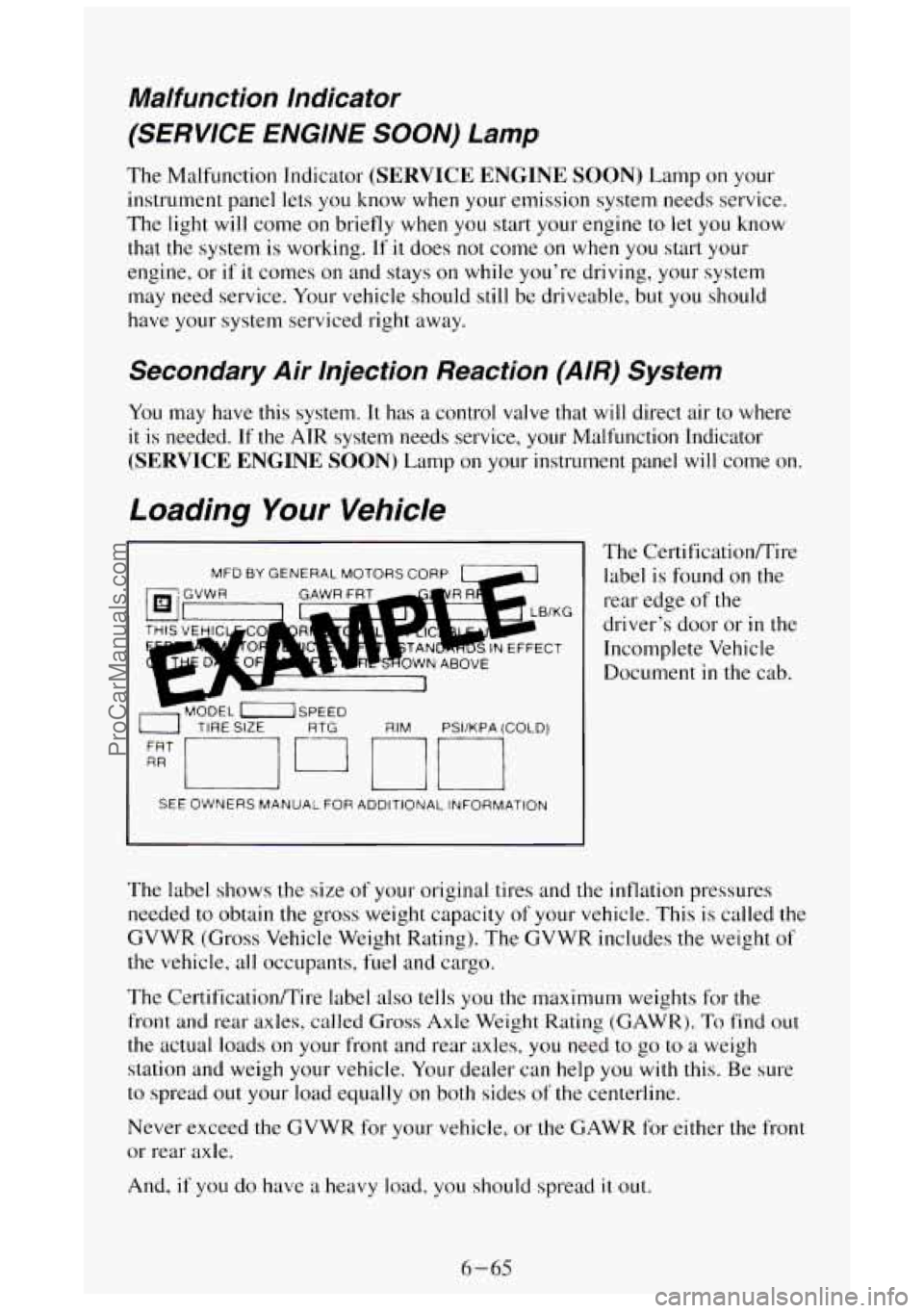
The Certification/Tire
label is found on the
rear edge of the
driver’s door or
in the
Incomplete Vehicle
Document
in the cab.
The label shows
the size of your original tires and the inflation pressures
needed to obtain the gross weight capacity of your vehicle. This is called the
GVWR (Gross Vehicle Weight Rating). The GVWR includes the weight of
the vehicle, all occupants, fuel and cargo.
The Certification/Tire label also tells
you the maximum weights for the
front and rear axles, called Gross Axle Weight Rating (GAWR). To find out
the actual loads on your front and rear axles, you need to go to a weigh
station and weigh your vehicle. Your dealer can help you
with this. Be sure
to spread out your load equally
on both sides of the centerline.
Never exceed the GVWR for your vehicle, or
the GAWR for either the front
or rear axle.
And,
if you do have a heavy load, you should spread it out.
6-65
ProCarManuals.com
Page 321 of 404
Tires
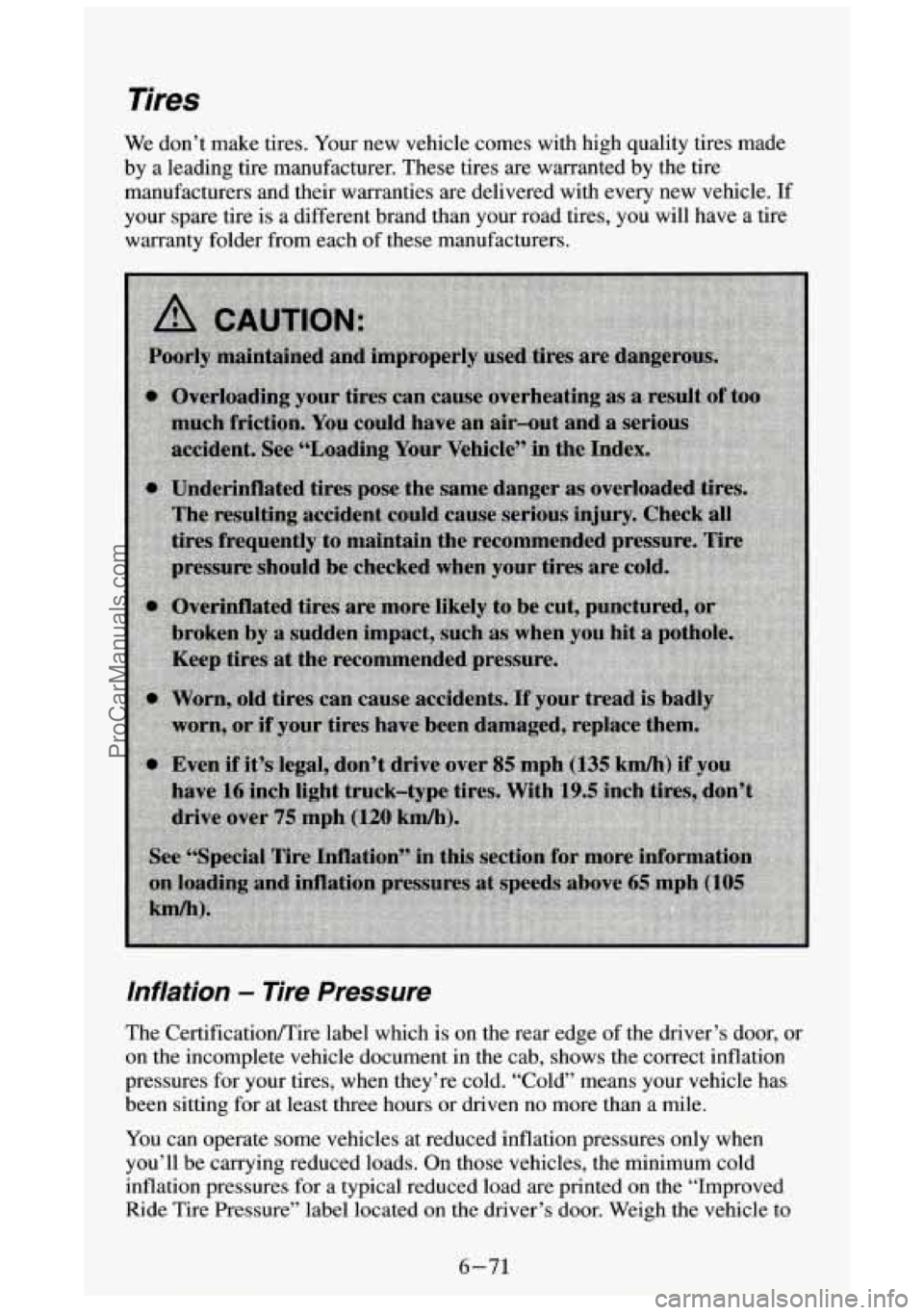
We don’t make tires. Your new vehicle comes with high quality tires made
by a leading tire manufacturer. These tires
are warranted by the tire
manufacturers and their warranties are delivered with
every new vehicle. If
your spare tire is a different brand than your road tires, you will have a tire
warranty folder from each of these manufacturers.
Inflation - Tire Pressure
The Certificatioflire label which is on the rear edge of the driver’s door, or
on the incomplete vehicle document in the cab, shows the correct inflation
pressures for your tires, when they’re cold. “Cold” means your vehicle has
been sitting for at least three hours or driven no more than a mile.
You can operate some vehicles at reduced inflation pressures only when
you’ll be carrying reduced loads. On those vehicles, the minimum cold
inflation pressures for a typical reduced load are printed on the “Improved
Ride Tire Pressure’’ label located on the driver’s door. Weigh the vehicle to
6-71
ProCarManuals.com
Page 322 of 404
find the load on each tire and see the label for the minimum cold inflation
pressures
for that load.
NOTICE:
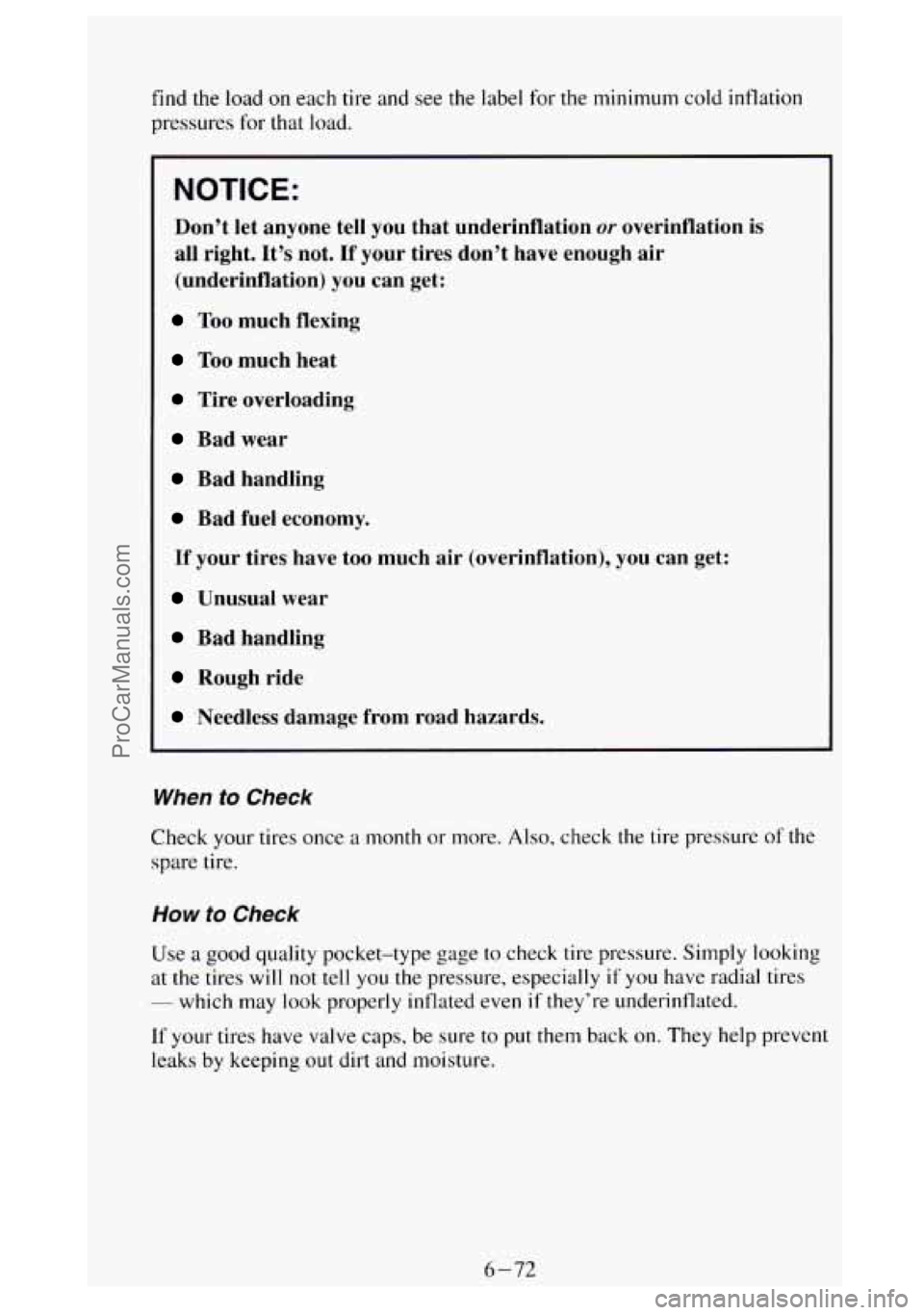
Don’t let anyone tell you that underinflation or overinflation is
all right. It’s not. If your tires don’t have enough air
(underinflation) you can get:
Too much flexing
Too much heat
Tire overloading
Bad wear
Bad handling
Bad fuel economy.
If your tires have too much air (overinflation), you can get:
Unusual wear
Bad handling
Rough ride
‘Needless damage from road hazards.
When io Check
Check your tires once a month or more. Also, check the tire pressure of the
spare tire.
How to Check
Use a good quality pocket-type gage to check tire pressure. Simply looking
at the tires
will not tell you the pressure, especially if you have radial tires
- which may look properly inflated even if they’re underinflated.
If your tires have valve caps, be sure to put them back on. They help prevent
leaks by keeping out dirt and moisture.
6-72
ProCarManuals.com
Page 323 of 404
Special Tire lnflation
If you have 16 inch tires on your vehicle, and:
- You’ll be driving for very long at speeds of 66 mph (105 km/h) to
75 mph (120
km/h) where legal, inflate tires to 10 psi (70 kPa)
more than the recommended cold inflation pressures.
- You’ll be driving for very long at speeds of 76 mph (120 km/h) to
85 mph (135
km/h) where legal, cold inflation pressures should be
increased by
10 psi (70 kPa) and you must also reduce axle load
capacity by 10%.
Do not drive over 85 mph (135 km/h) even if
it’s legal.
Inflation pressures should never exceed 10 psi (70 kPa) above the
inflation specified for the maximum load of the tire.
If you have 19.5 inch radial tires on your vehicle, and:
- You’ll be driving for very long at speeds of 66 mph (105 km/h) to
70 mph (110 km/h) where legal, inflate tires to 5 psi (35 kPa) more
than the recommended cold inflation pressures, and reduce the
axle load capacity by 4%.
- You’ll be driving for very long at speeds of 7 1 mph (1 15 km/h) to
75 mph (120
km/h) where legal, cold inflation pressures should be
increased by 5 psi (35 kPa) and you must also reduce axle \
load capacity by 12%.
Do not drive over 75 mph (120 km/h) even if
it’s legal.
Inflation pressures should never exceed 20 psi (140 kPa) above the
inflation specified for the maximum load of the tire.
Tire Inspection and Rotation
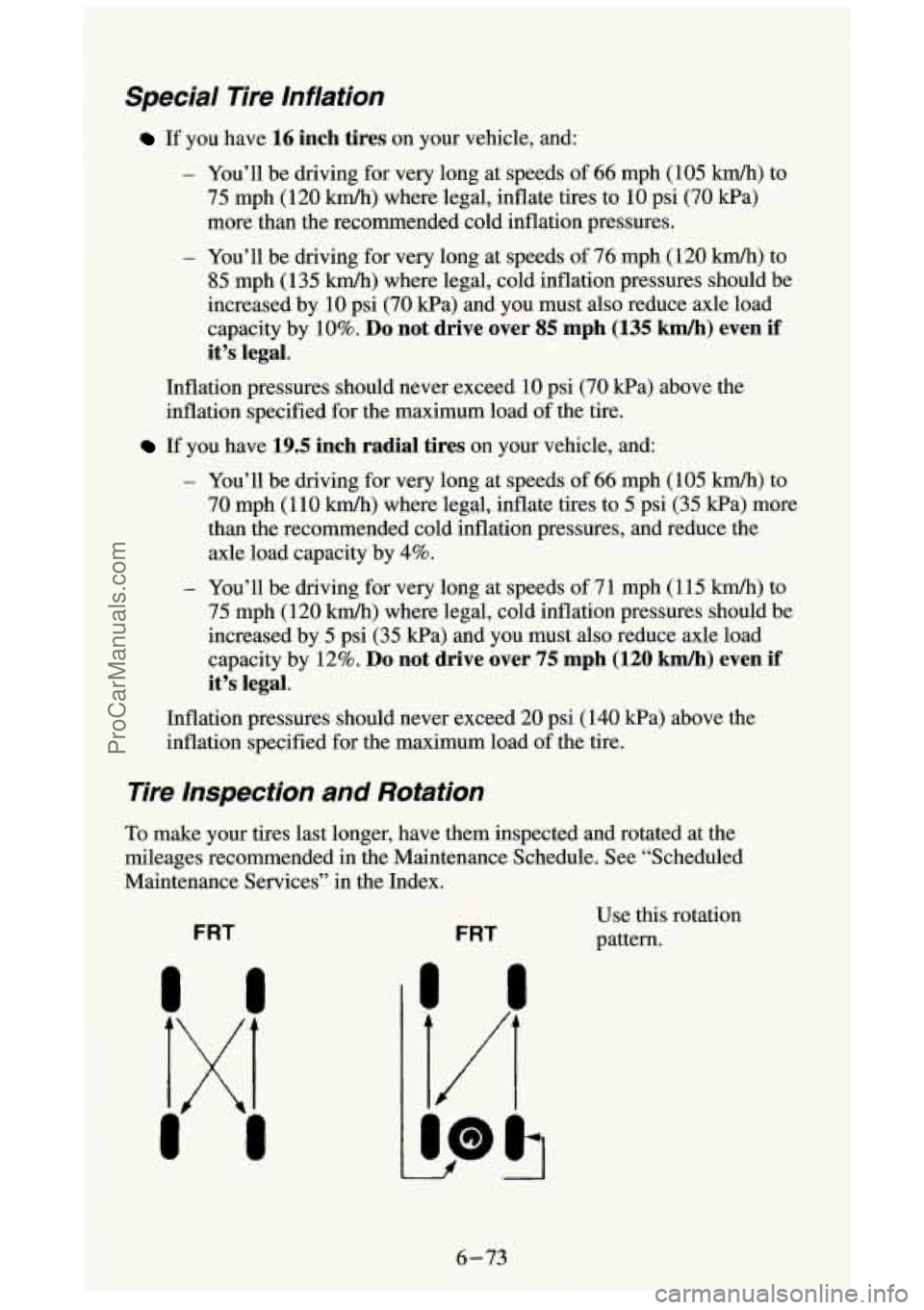
To make your tires last longer, have them inspected and rotated at the
mileages recommended in the Maintenance Schedule. See “Scheduled
Maintenance Services” in the Index.
FRT
8
FRT
Use this rotation
pattern.
4-73
ProCarManuals.com
Page 324 of 404
If your vehicle has front tires with different load ratings or tread designs
(such
as all season vs. on/off road) than the rear tires, don’t rotate your tires
front
to rear.
After the tires have been rotated, adjust the front and rear inflation pressure
as shown on the CertificatiodTire label. Make certain that all wheel nuts are
properly tightened. See “Wheel
Nut Torque” in the Index.
A CAUTION:
Rust or dirt on a wheel, or on the parts to which it is fastened,
When It’s Time for New Tires
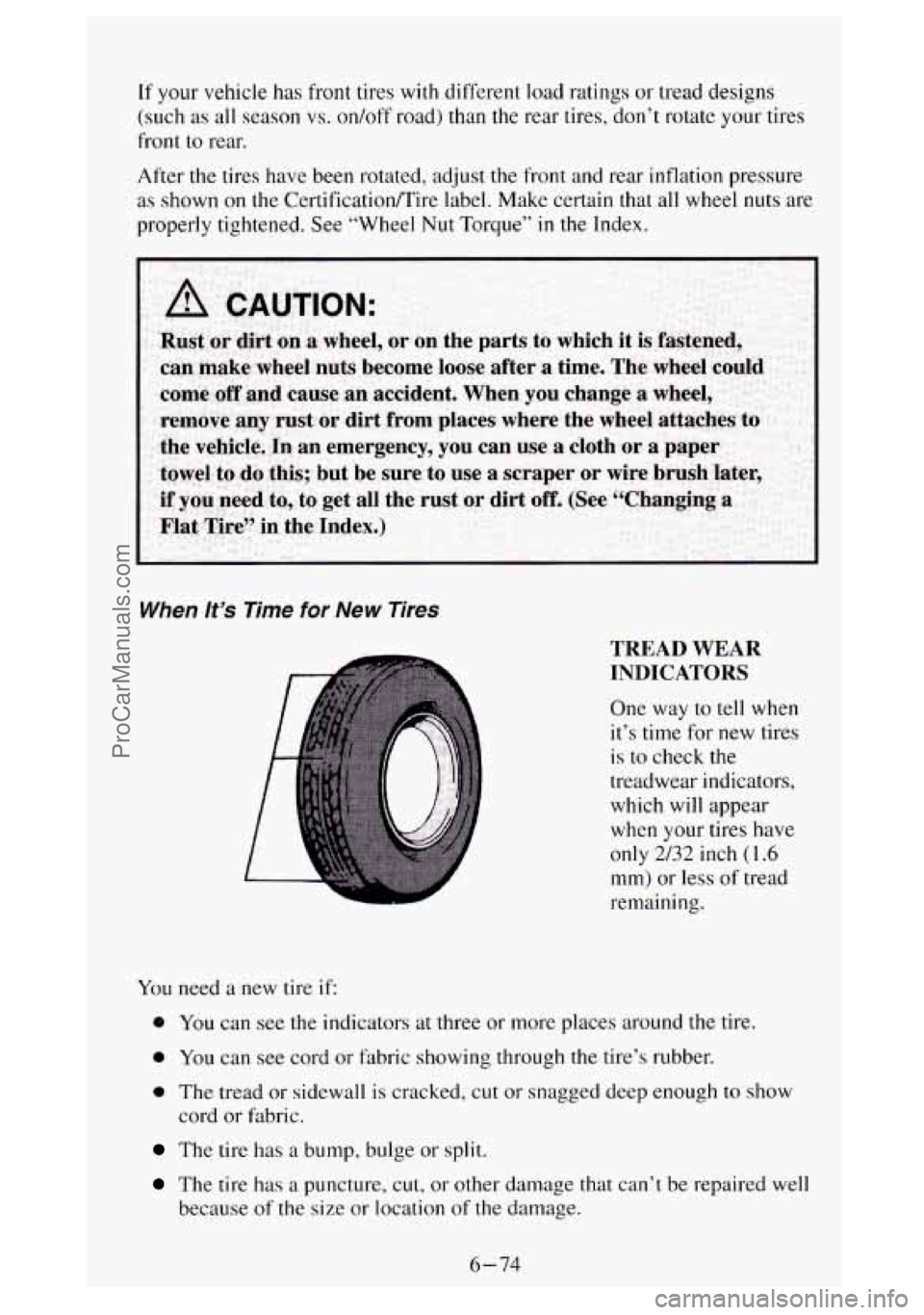
TREAD WEAR
INDICATORS
One way to tell when
it’s time for
new tires
is to check the
treadwear indicators,
which
will appear
when your tires have
only
2/32 inch (1.6
mm) or less of tread
remaining.
You need a
new tire if:
0 You can see the indicators at three or more places around the tire.
0 You can see cord or Fabric showing through the tire’s rubber.
0 The tread or sidewall is cracked, cut or snagged deep enough to show
cord or fabric.
The tire has a bump, bulge or split.
The tire has a puncture, cut, or other damage that can’t be repaired well
because
of the size or location of the damage.
6-74
ProCarManuals.com
Page 327 of 404

Uniform Tire Quality Grading
The following information relates to the system developed by the Un\
ited
States National Highway Traffic Safety Administration which grade\
s tires
by treadwear, traction and temperature performance. (This applie\
s only to vehicles sold in the United States.)
Treadwear
The treadwear grade is a comparative rating based on the wear rate of the
tire when tested under controlled conditions on a specified gov\
ernment test
course. For example, a tire graded
150 would wear one and a half (1 1/2)
times as well on the government course as a tire graded 100. The relative
performance of tires depends upon the actual conditions of their use,
however, and may depart significantly from the norm due to variations in
driving habits, service practices and differences in road charac\
teristics and
climate.
Traction -A, B, C
The traction grades, from highest to lowest are: A, B, and C. They represent
the tire’s ability to stop on wet pavement as measured under controlled
conditions on specified government test surfaces of asphalt and concrete. A
tire marked
C may have poor traction performance.
Warning: The traction grade assigned to this tire is based on braking
(straight-ahead) traction tests and does not include cornering \
(turning)
traction.
Temperature - A, B, C
The temperature grades are A (the highest), B, and C, representing the tire’s
resistance to the generation of heat and its ability to dissipate heat when
tested under controlled conditions on a specified indoor laborat\
ory test
wheel. Sustained high temperature can cause the material of the tire to
degenerate and reduce tire life, and excessive temperature can \
lead to
sudden.tire failure. The grade
C corresponds to a level of performance
which all passenger car tires must meet under the Federal Motor Vehicle
Safety Standard
No. 109. Grades B and A represent higher levels of
performance on the laboratory test wheel than the minimum required by
law.
Warning: The temperature grade for
this tire is established for a tire that is
properly inflated ad not overloaded. Excessive speed, underinflation, or
excessive loading, either separately or in combination, can cause heat
buildup and possible tire failure.
These grades are molded on the sidewalls
of passenger car tires.
6-77
ProCarManuals.com