maintenance GMC SIERRA 1994 User Guide
[x] Cancel search | Manufacturer: GMC, Model Year: 1994, Model line: SIERRA, Model: GMC SIERRA 1994Pages: 404, PDF Size: 20.91 MB
Page 266 of 404
Things that burn can get on hot engine parts and start a fire.
These include liquids like gasoline or diesel fuel, oil, coolant,
brake fluid, windshield washer and other fluids, and plastic or
rubber. You or others could be burned. Be careful not to drop or
I spill things that will burn onto a hot engine.
Before closing the hood, be sure all filler caps are on properly. Pull down
the hood and close it firmly.
Cleaning Your Diesel Engine
NOTICE:
If you spray or pour water or any other liquid on your engine
when it is warm or hot, or when it is running,
you could cause
serious damage to it.
If you ever clean the engine, clean it only
when it is cold.
Noise Control System
The following information relates to compliance with Federal noise
emission standards for vehicles
with a Gross Vehicle Weight Rating
(GVWR) of more than
10,000 pounds (4 536 kilograms). The Maintenance
Schedule booklet provides information on maintaining the noise control
system to minimize degradation
of the noise emission control system during
the life of your vehicle. The noise control system warranty
is given in your
Warranty hooklet.
These standards apply only to vehicles sold
in the United States.
6- 16
ProCarManuals.com
Page 267 of 404
Tampering With Noise Control System Prohibited
Federal law prohibits the following acts or the causing thereof:
1 . The removal or rendering inoperative by any person, other than for
purposes
of maintenance, repair or replacement, of any device or
element
of design incorporated into any new vehicle for the purpose of
noise control, prior to its sale or delivery to the ultimate purchaser or
while
it is in use; or
2. The use of the vehicle after such device or element of design has been
removed or rendered inoperative by any person.
Among those acts presumed to constitute tampering are the acts listed
below.
Insulation:
Removal of noise shields or underhood insulation.
Engine:
Removal or rendering engine speed governor (if so equipped)
inoperative
so as to allow engine speed to exceed manufacturer
specifications.
Fan and Drive:
Removal of fan clutch (if so equipped) or rendering clutch inoperative.
Removal of fan shroud (if so equipped).
Air Intake:
Removal of air cleaner silencer.
Reversing air cleaner cover.
Exhaust:
Removal of muffler and/or resonator.
Removal of exhaust pipes and exhaust pipe clamps.
Engine Oil (Except Diesel)
It’s a good idea to check your engine oil every time you get fuel. In order to
get an accurate reading, the oil must be warm and the vehicle must be on
level ground.
ProCarManuals.com
Page 279 of 404
Air Cleaner
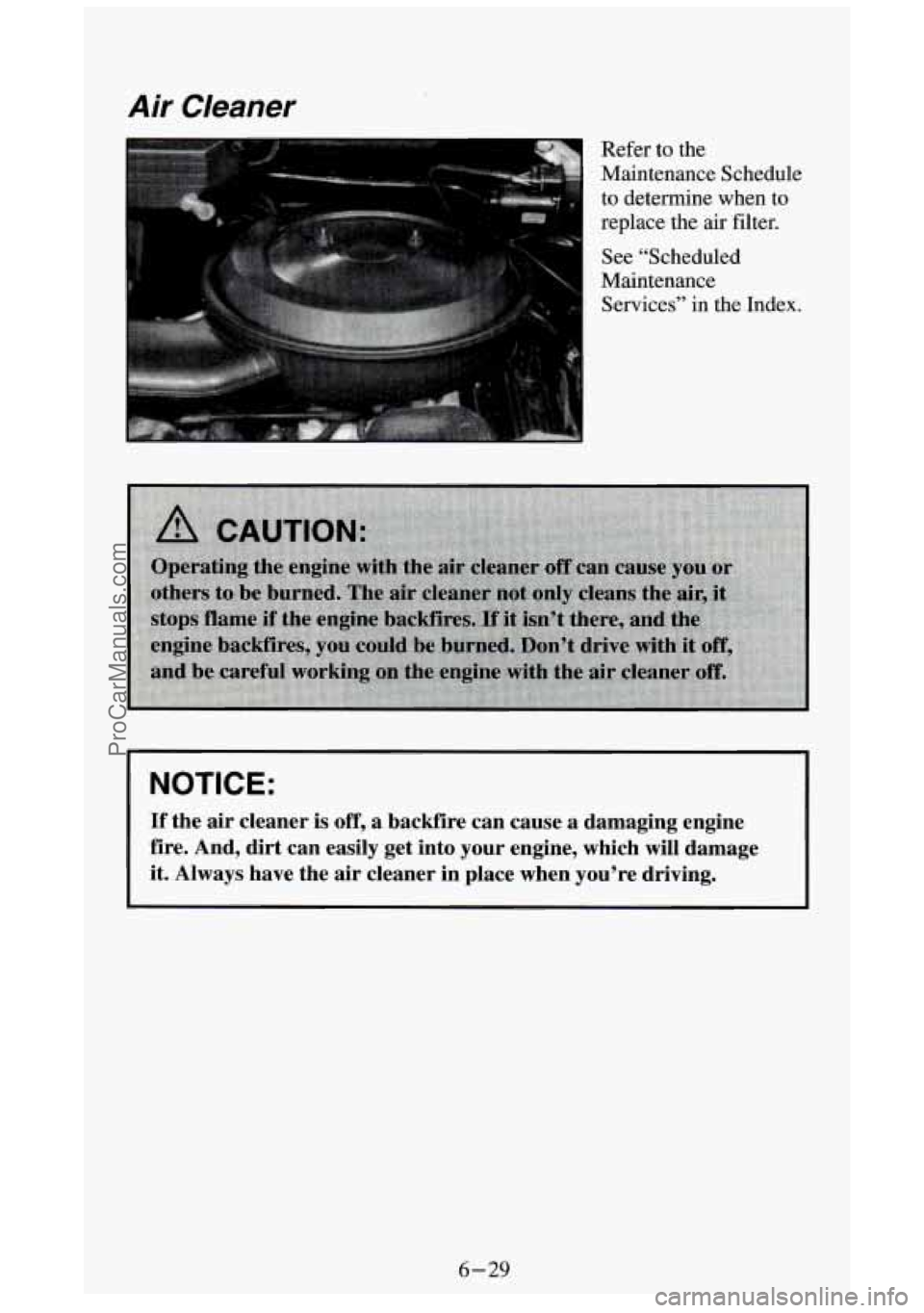
Refer to the
Maintenance Schedule
to determine when to
replace the air filter.
See “Scheduled
Maintenance Services” in the Index.
NOTICE:
If the air cleaner is off, a backfire can cause a damaging engine
fire. And, dirt can easily get into your engine, which will d\
amage
it. Always have the air cleaner in place when you’re drivin\
g.
6-29
ProCarManuals.com
Page 280 of 404
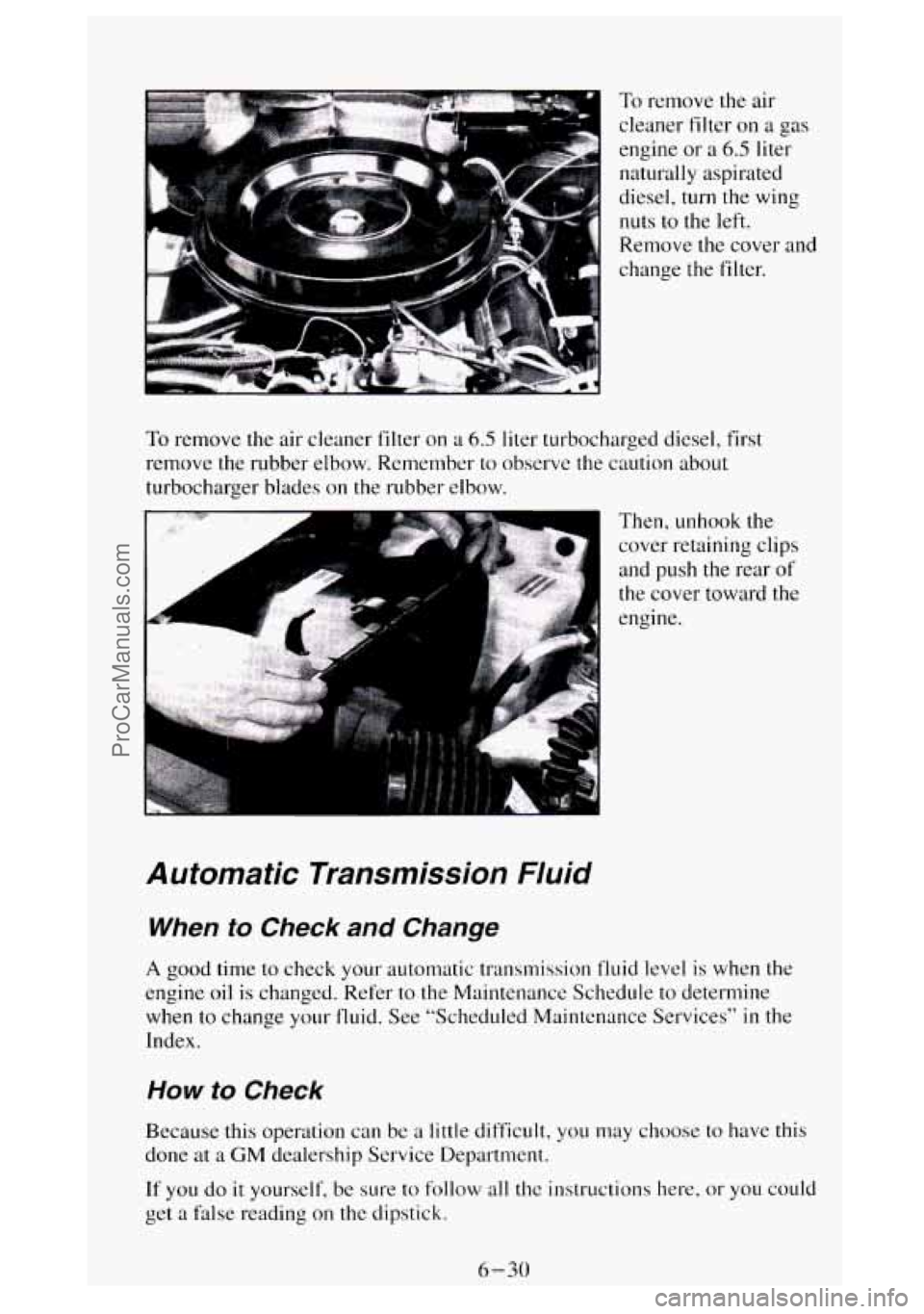
.-. -1 To remove the air
cleaner filter on
a gas
engine or a 6.5 liter
naturally aspirated
diesel,
turn the wing
nuts to the left.
Remove the cover and
change the filter.
Then, unhook the
cover retaining clips
and push the rear
of
the cover toward the
engine.
Automatic Transmission Nuid
When to Check and Change
A good time to check your automatic transmission fluid level is when the
engine oil is changed. Refer
to the Maintenance Schedule to determine
when to change your fluid. See “Scheduled Maintenance Services”
in the
Index.
How to Check
Because this operation can be a little difficult, you may choose to have this
done at
a GM dealership Service Department.
If you do it yourself, be SLIK to follow all the instructions here, or you could
get a false reading on the dipstick.
6 - 30
ProCarManuals.com
Page 283 of 404
How to Add Fluid
Refer to the Maintenance Schedule to determine what kind of transmission
fluid
to use. See “Recommended Fluids and Lubricants” in the Index.
If the fluid level is low, add
only enough of the proper fluid to bring the
level up to the COLD area for a cold check or the HOT area for a hot check.
It doesn’t take much tluid, generally less than a pint. Don’t overfill. We
recommend you use only fluid labeled DEXRON@-111 or DEXRON@-IIE,
because fluids with that label are made especially for your automatic
transmission. Damage caused by fluid other than
DEXRON@-Ill or
DEXRON@-IIE is not covered by your new vehicle warranty.
After adding fluid, recheck the fluid level as described under “How to
Check.”
When the correct fluid level is obtained, push the dipstick back in all
the way; then flip the handle down to lock the dipstick in place.
Manual Fluid
When to Check
A good time to have it checked is when the engine oil is changed. However,
the fluid
in your manual transmission doesn’t require changing.
How to Check
Because this operation can be a little difficult, you may choose to have this
done at a
GM dealership Service Department.
If you do it yourself, be sure to follow all the instructions here, or you could
get
a false reading.
NOTICE:
Too much or too little fluid can damage your transmission. Too
much can mean that some of the fluid could come out and fall on
hot engine parts or exhaust system, starting a fire. Be sure to get
an accurate reading if
you check your transmission fluid.
Check the fluid level only when your engine is off, the vehicle is parked on
a level place and the transmission is cool enough for you to rest your fingers
on the transmission case.
6-33
ProCarManuals.com
Page 284 of 404
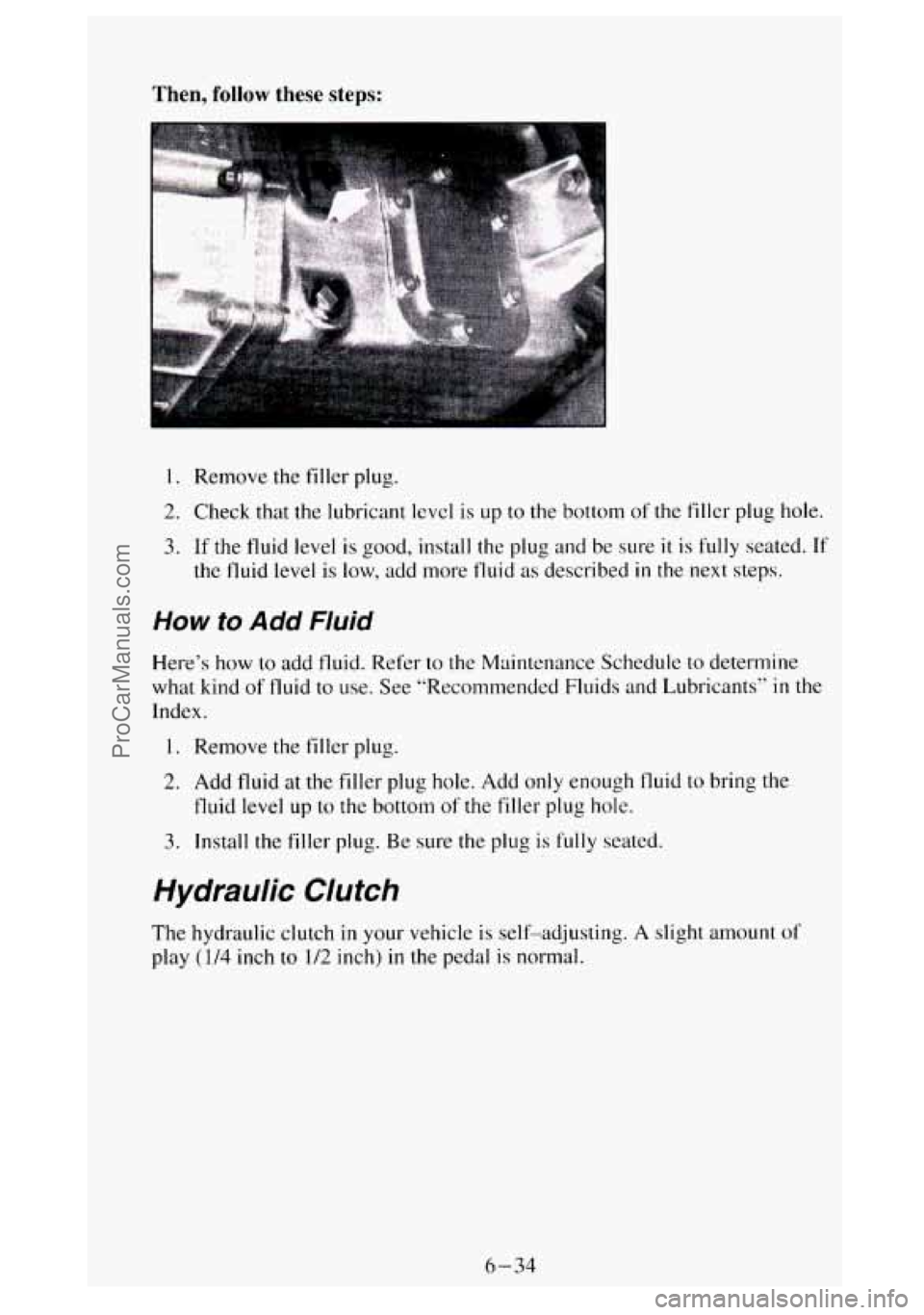
Then, follow these steps:
I. Remove the filler plug.
2. Check that the lubricant level is up to the bottom of the filler plug hole.
3. If the fluid level is good, install the plug and be sure it is fully seated. If
the fluid level is low, add more fluid as described in the next steps.
How to Add fluid
Here’s how to add fluid. Refer to the Maintenance Schedule to determine
what kind
of fluid to use. See “Recommended Fluids and Lubricants” in the
Index.
I. Remove the filler plug.
2. Add fluid at the filler plug hole. Add only enough fluid to bring the
fluid level up to
the bottom of the filler plug hole.
3. Install the filler plug. Be sure the plug is fully seated.
Hydraulic Clutch
The hydraulic clutch in your vehicle is self-adjusting. A slight amount of
play (1/4 inch to 1/2 inch) in the pedal is normal.
6-34
ProCarManuals.com
Page 285 of 404
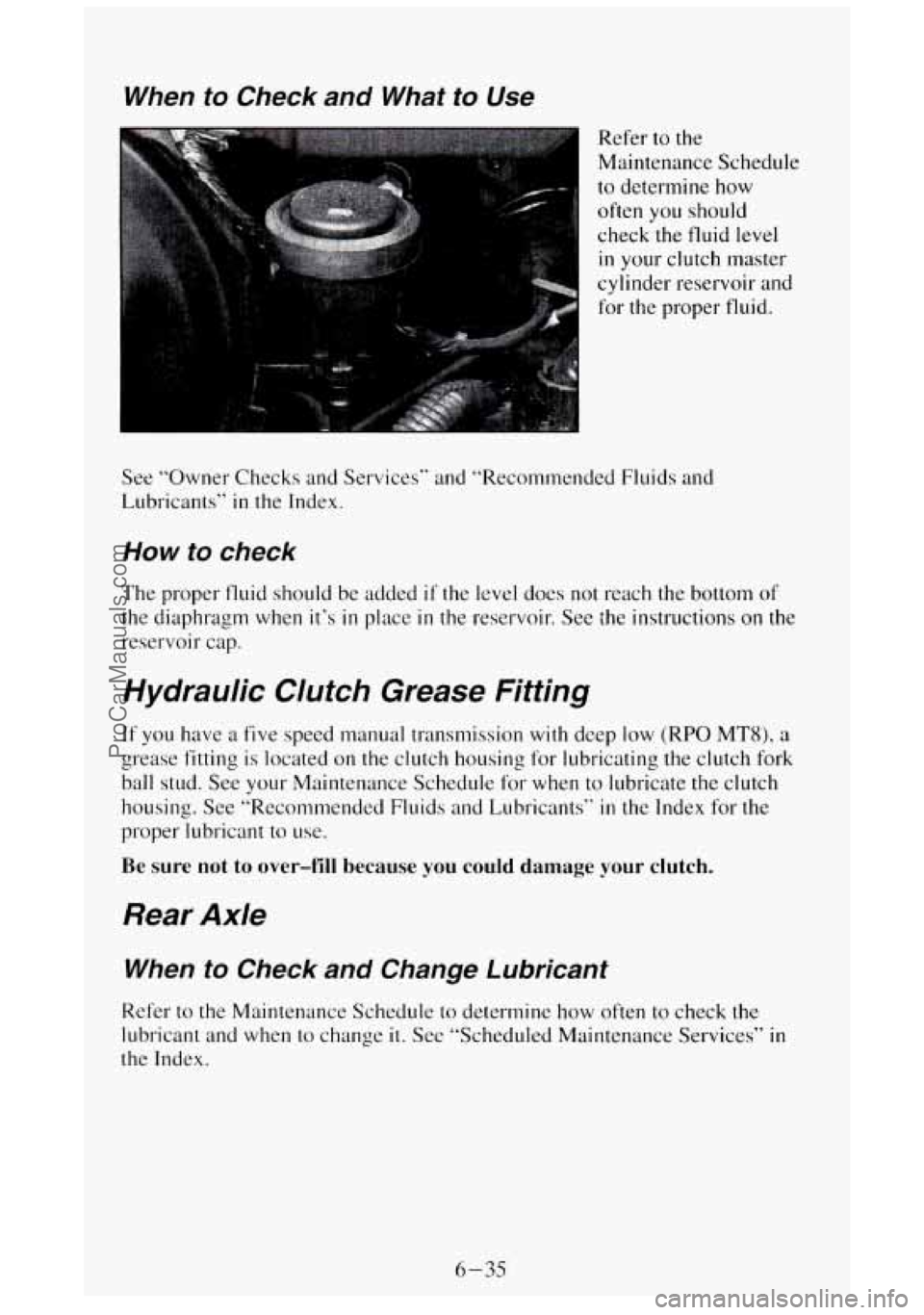
When to Check and What to Use
Refer to the
Maintenance Schedule
to determine how
often you should
check
the fluid level
in your clutch master
cylinder reservoir and
for the proper fluid.
See “Owner Checks and Services” and “Recommended Fluids and
Lubricants”
in the Index.
How to check
The proper fluid should be ridded if the level does not reach the bottom of
the diaphragm when it’s
in place in the reservoir. See the instructions on the
reservoir cap.
Hydraulic Clutch Grease Fitting
If you have a five speed manual transmission with deep low (RPO MT8), a
grease fitting is located on the clutch housing for lubricating the clutch fork
ball stud. See your Maintenance Schedule for when to lubricate the clutch
housing. See “Recommended Fluids and Lubricants”
in the Index for the
proper lubricant to
use.
Be sure not to over-fill because you could damage your clutch.
Rear Axle
When to Check and Change Lubricant
Refer to the Maintenance Schedule to determine how often to check the
lubricant and when to change
it. See “Scheduled Maintenance Services” in
the Index.
6-35
ProCarManuals.com
Page 286 of 404
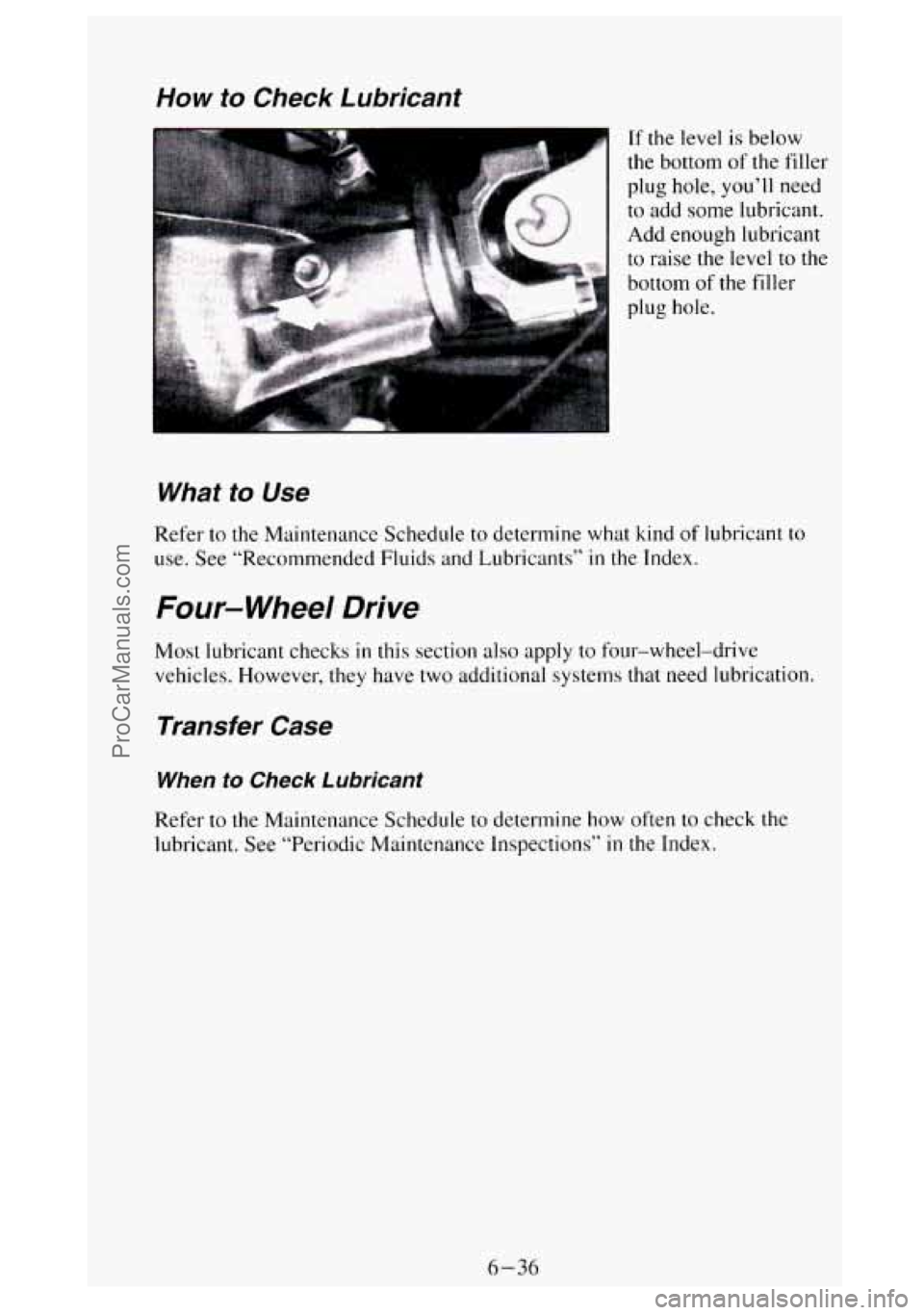
How to Check Lubricant
If the level is below
the bottom
of the filler
plug hole, you’ll need
to add some lubricant.
Add enough lubricant
to raise the level
to the
bottom of the filler
plug hole.
What to Use
Refer to the Maintenance Schedule to determine what kind of lubricant to
use. See “Recommended Fluids and Lubricants” in the Index.
Four- Wheel Drive
Most lubricant checks in this section also apply to four-wheel-drive
vehicles. However, they have two additional systems that need lubrication.
Transfer Case
When to Check Lubricant
Refer to the Maintenance Schedule to determine how often to check the
lubricant. See “Periodic Maintenance Inspections”
in the Index.
6-36
ProCarManuals.com
Page 287 of 404
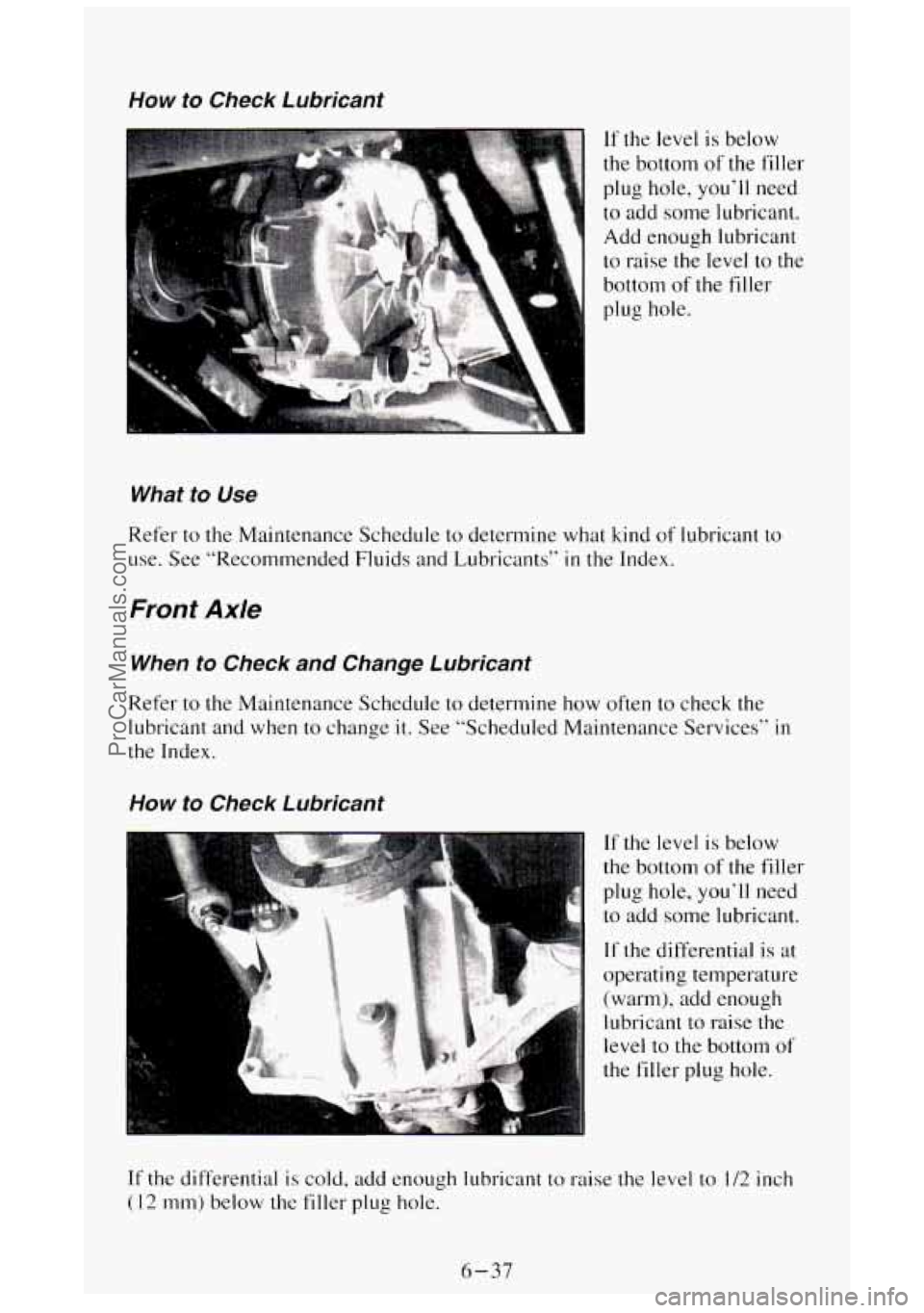
How to Check Lubricant
What to Use
- If the level is below
the
bottom of the filler
plug hole,
you’ll need
to add some lubricant.
Add enough lubricant
to raise the level to the
bottom of
the filler
plug hole.
Refer to the Maintenance Schedule to determine what kind
of lubricant to
use. See “Recommended Fluids and Lubricants” in the Index.
Front Axle
When to Check and Change Lubricant
Refer to the Maintenance Schedule to determine how often to check the
lubricant and when
to change it. See “Scheduled Maintenance Services” in
the Index.
How to Check Lubricant
If the level is below
the bottom of the filler
plug hole, you’ll need
to add some lubricant.
If the differential is at
operating temperature
(warm), add enough
lubricant
to raise the
level
to the bottom of
the filler plug hole.
If the differential is cold, add enough lubricant to raise the level to 1/2 inch
( 12 mm) below the filler plug hole.
6-37
ProCarManuals.com
Page 288 of 404
What to use
Refer to the Maintenance Schedule to determine what kind of lubricant to
use. See “Recommended Fluids and Lubricants”
in the Index.
Engine Coolant
The following explains your cooling system and how to add coolant when it
is low. If you have a problem with engine overheating, see “Engine
Overheating”
in the Index.
The proper coolant for your vehicle
will:
Give freezing protection down to -20 OF (-29”C), or -34°F (-37°C) in
Canada and for vehicles with the cold climate option.
Give boiling protection up to 258 OF ( 125 O C).
Protect against rust and corrosion.
Help keep the proper engine temperature.
Let the warning lights and gages work as they should.
What to Use
Use a mixture of one-half clean wuter (preferably distilled) and one-half
antifreeze that meets
“GM Specification 6038-M,” which won’t damage
aluminum parts.
You can also use a recycled coolant conforming to “GM
Specification 6038-M” with a complete coolant flush and refill. If you use
this mixture, you don’t need to add anything else.
6-38
ProCarManuals.com