maintenance schedule GMC SIERRA 1994 User Guide
[x] Cancel search | Manufacturer: GMC, Model Year: 1994, Model line: SIERRA, Model: GMC SIERRA 1994Pages: 404, PDF Size: 20.91 MB
Page 286 of 404
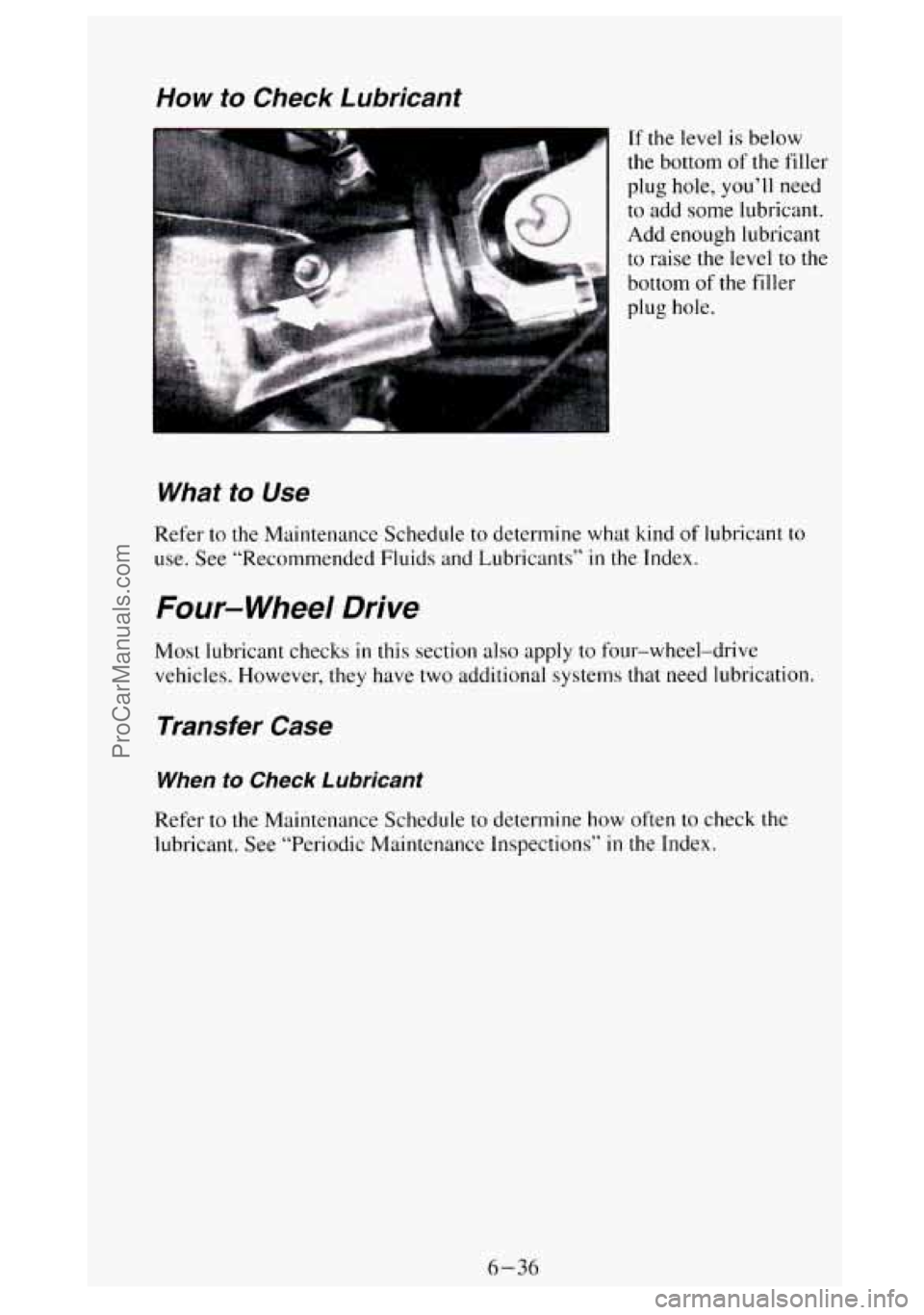
How to Check Lubricant
If the level is below
the bottom
of the filler
plug hole, you’ll need
to add some lubricant.
Add enough lubricant
to raise the level
to the
bottom of the filler
plug hole.
What to Use
Refer to the Maintenance Schedule to determine what kind of lubricant to
use. See “Recommended Fluids and Lubricants” in the Index.
Four- Wheel Drive
Most lubricant checks in this section also apply to four-wheel-drive
vehicles. However, they have two additional systems that need lubrication.
Transfer Case
When to Check Lubricant
Refer to the Maintenance Schedule to determine how often to check the
lubricant. See “Periodic Maintenance Inspections”
in the Index.
6-36
ProCarManuals.com
Page 287 of 404
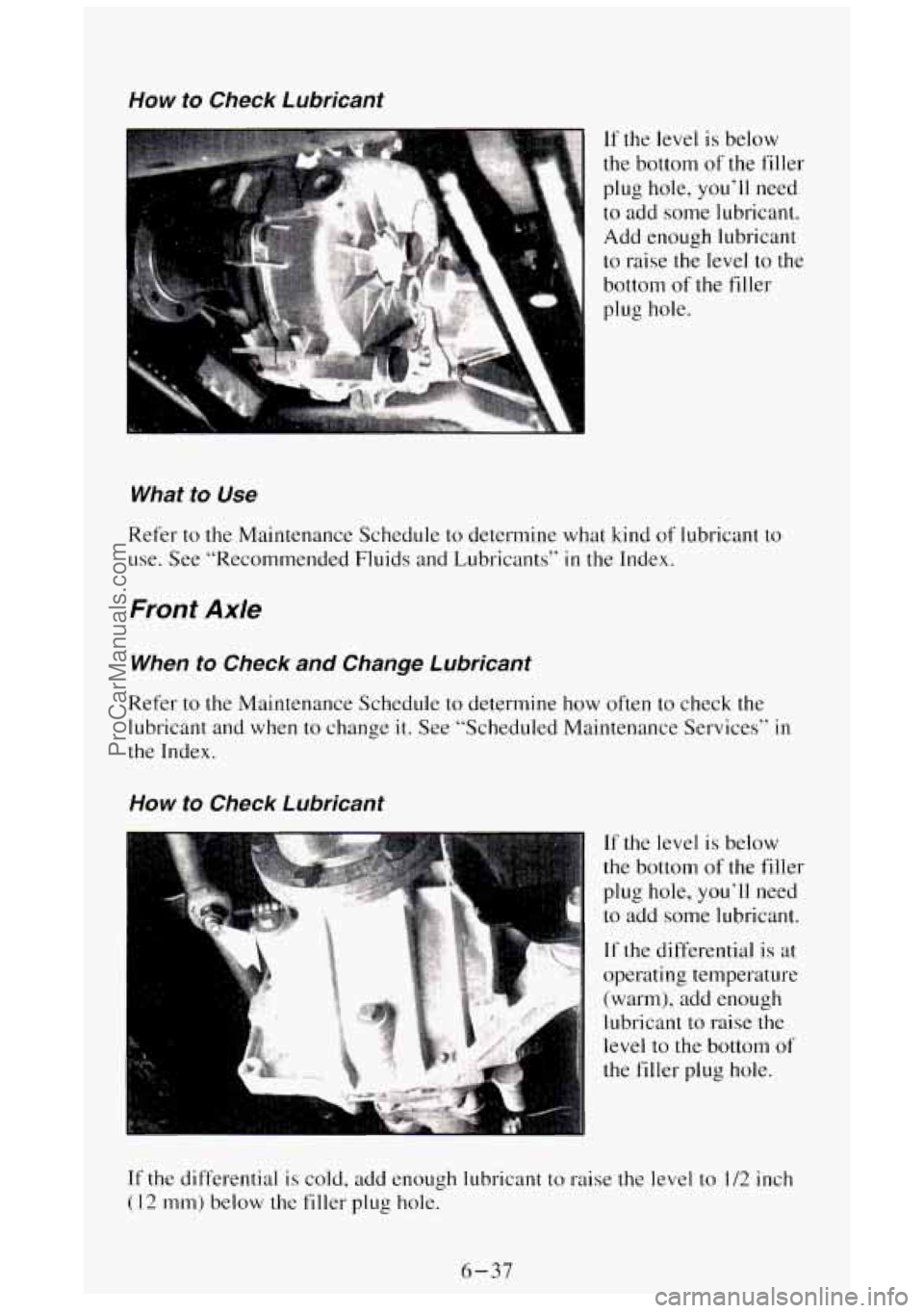
How to Check Lubricant
What to Use
- If the level is below
the
bottom of the filler
plug hole,
you’ll need
to add some lubricant.
Add enough lubricant
to raise the level to the
bottom of
the filler
plug hole.
Refer to the Maintenance Schedule to determine what kind
of lubricant to
use. See “Recommended Fluids and Lubricants” in the Index.
Front Axle
When to Check and Change Lubricant
Refer to the Maintenance Schedule to determine how often to check the
lubricant and when
to change it. See “Scheduled Maintenance Services” in
the Index.
How to Check Lubricant
If the level is below
the bottom of the filler
plug hole, you’ll need
to add some lubricant.
If the differential is at
operating temperature
(warm), add enough
lubricant
to raise the
level
to the bottom of
the filler plug hole.
If the differential is cold, add enough lubricant to raise the level to 1/2 inch
( 12 mm) below the filler plug hole.
6-37
ProCarManuals.com
Page 288 of 404
What to use
Refer to the Maintenance Schedule to determine what kind of lubricant to
use. See “Recommended Fluids and Lubricants”
in the Index.
Engine Coolant
The following explains your cooling system and how to add coolant when it
is low. If you have a problem with engine overheating, see “Engine
Overheating”
in the Index.
The proper coolant for your vehicle
will:
Give freezing protection down to -20 OF (-29”C), or -34°F (-37°C) in
Canada and for vehicles with the cold climate option.
Give boiling protection up to 258 OF ( 125 O C).
Protect against rust and corrosion.
Help keep the proper engine temperature.
Let the warning lights and gages work as they should.
What to Use
Use a mixture of one-half clean wuter (preferably distilled) and one-half
antifreeze that meets
“GM Specification 6038-M,” which won’t damage
aluminum parts.
You can also use a recycled coolant conforming to “GM
Specification 6038-M” with a complete coolant flush and refill. If you use
this mixture, you don’t need to add anything else.
6-38
ProCarManuals.com
Page 294 of 404
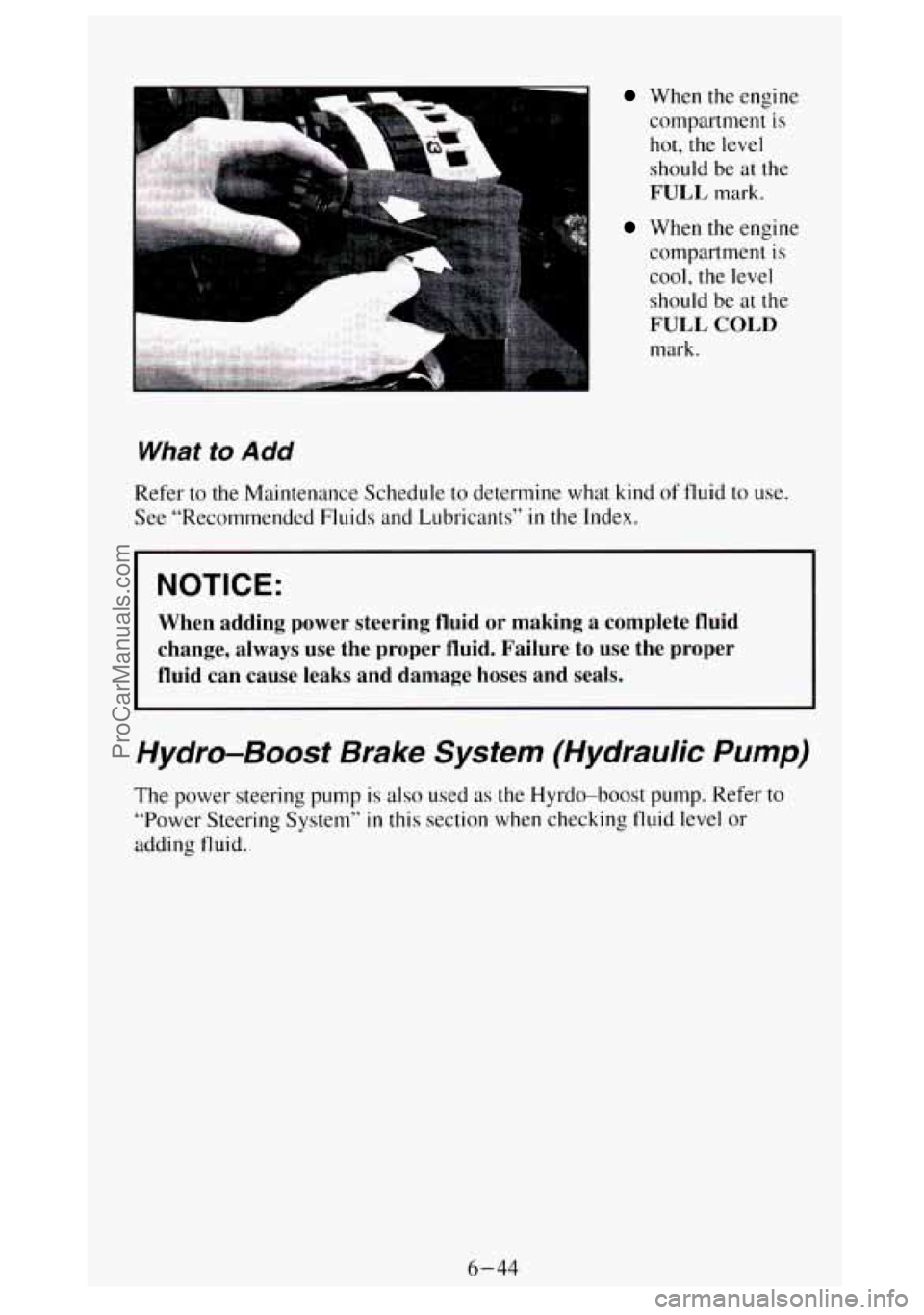
When the engine
compartment is
hot, the level
should be at the
FULL mark.
When the engine
compartment
is
cool, the level
should be at the
FULL COLD
mark.
What to Add
Refer to the Maintenance Schedule to determine what kind of fluid to use.
See “Recommended Fluids and Lubricants”
in the Index.
NOTICE:
When adding power steering fluid or making a complete fluid
change, always use the proper fluid. Failure
to use the proper
fluid can cause leaks and damage hoses and seals.
Hydro-Boost Brake System (Hydraulic Pump)
The power steering pump is also used as the Hyrdo-boost pump. Refer to
“Power Steering System”
in this section when checking fluid level or
adding tluid.
6-44
ProCarManuals.com
Page 296 of 404
Brakes
Brake Master Cylinder
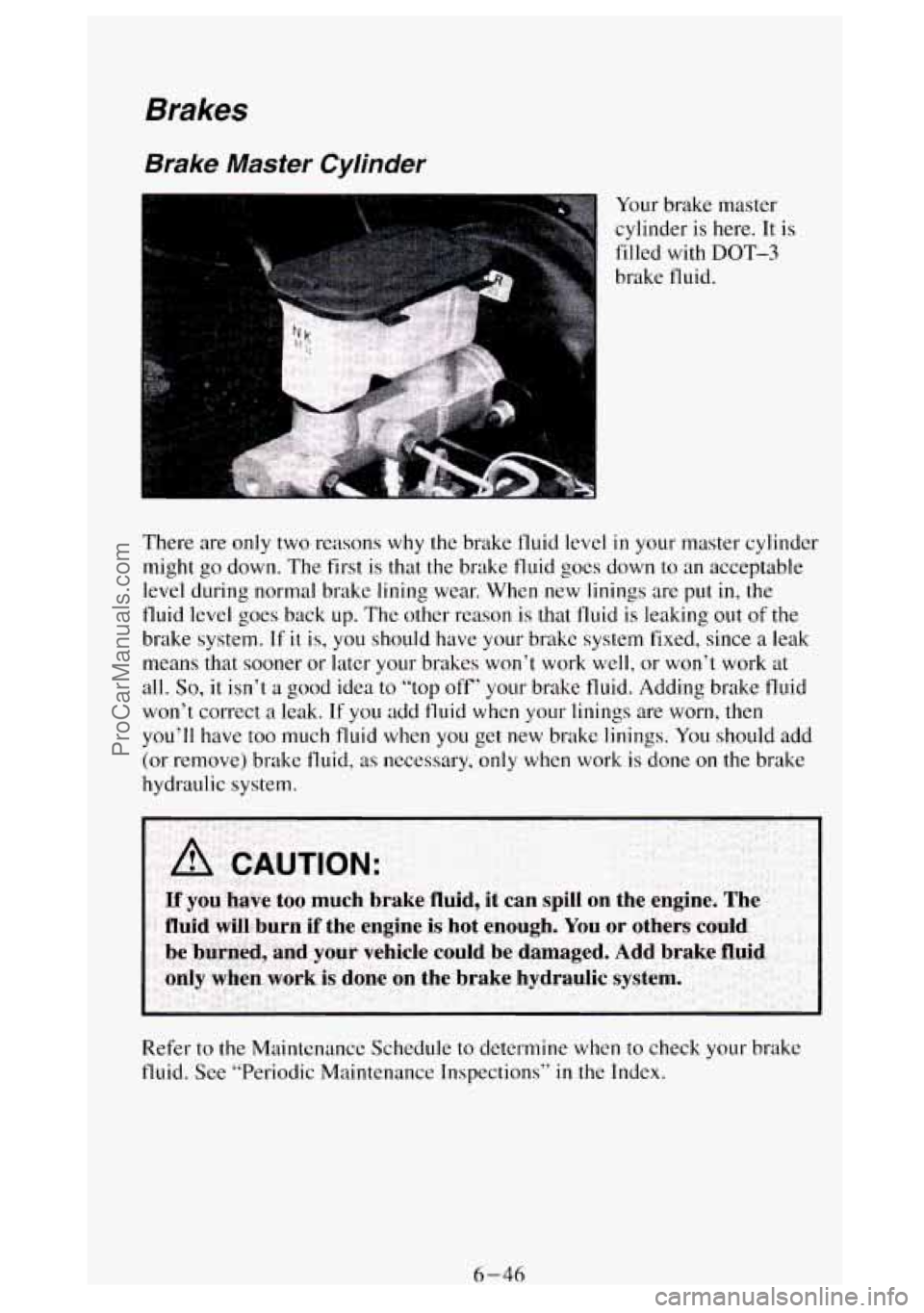
Your brake master
cylinder is here. It is
filled with
DOT-3
brake fluid.
There are only two reasons
why the brake fluid level in your master cylinder
might
go down, The first is that the brake fluid goes down to an acceptable
level during normal brake lining wear. When new linings are put in, the
fluid level goes back up. The other reason is that fluid is leaking
out of the
brake system.
If it is, you should have your brake system fixed, since a leak
means that sooner or later your brakes
won’t work well, or won’t work at
all.
So, it isn’t a good idea to “top off’ your brake fluid. Adding brake fluid
won’t correct a leak.
If you add fluid when your linings are worn, then
you’ll have
too much fluid when you get new brake linings. You should add
(or remove) brake fluid,
as necessary, only when work is done on the brake
hydraulic system.
Refer
to the Maintenance Schedule to determine when to check your brake
fluid. See “Periodic Maintenance Inspections”
in the Index.
6-46
ProCarManuals.com
Page 299 of 404
Brake Adjustment
Every time you make a brake stop, your disc brakes adjust for wear.
If your brake pedal goes down farther than normal, your rear drum brakes
may need adjustment. Adjust them by backing up and firmly applying
the
brakes a few times.
Replacing Brake System Parts
The braking system on a modern vehicle is complex. Its many parts have to
be of top quality and work well together if the vehicle is to have really good
braking. Vehicles we design and test have top-quality
GM brake parts in
them, as your vehicle does when it is new. When you replace parts of your
braking system
- for example, when your brake linings wear down and
you have to have new ones put
in - be sure you get new genuine GM
replacement parts. If you don’t, your brakes may no longer work properly.
For example,
if someone puts in brake linings that are wrong for your
vehicle, the balance between your front and rear brakes can change, for
the
worse. The braking performance you’ve come to expect can change in many
other ways if someone puts in the wrong replacement brake parts.
Other Maintenance Hems
Front Suspension and Steering Linkage
Your maintenance schedule will tell you how often to lubricate the fittings.
See “Recommended Fluids and Lubricants”
in the Index for the proper
lubricant to use.
Front Wheel Bearings
Your vehicle has front wheel bearings that must be cleaned and repacked.
Your maintenance schedule
will tell you how often this must be done.
Front Shock Absorbers
The front shock absorbers of your vehicle do many things. They help the
vehicle ride smoothly and also control
the travel of the suspension system.
When the shock absorbers are serviced, any replacement shock absorbers
must be
the same as the original equipment shock absorbers in both
extended length and strength.
NOTICE:
If you use shock absorbers that are not the same as the original
shock absorbers, the shock absorbers
or suspension system
could be damaged.
6-49
ProCarManuals.com
Page 301 of 404
Fluid Leak Check
After the vehicle has been parked for a while, inspect the surface under the
vehicle for water, oil, fuel or other fluids. Water dripping from the air
conditioning
system after it has been used is normal. If you notice fuel leaks
or fumes, the causes should be found and corrected at once.
Lubrication
Accelerator Control System
Your maintenance schedule will tell you how often the accelerator linkage
pivot points must be lubricated. See “Recommended
Fluids and Lubricants”
in the Tndex for the proper lubricant to use.
Accelerator cables and cruise control cables should not be lubricated.
Any
cab1e.s that are worn or are hard to pull should be replaced.
Hood Latches and Hood Hinge
Your maintenance schedule will tell you how often to lubricate the hood
latch and hood hinge assembly. See “Recommended Fluids and Lubricants”
in the Index for the proper lubricant to use.
Propeller Shaft Slip Splines
See your maintenance schedule to find out how often the. slip splines must
be lubricated. See “Recommended Fluids and Lubricants”
in the Index for
the proper lubricant to use.
Constant Velocity Joints
See your mamtenance schedule to find out how often the constant velocity
joints must be lubricated. See “Recommended Flui-ds and Lubricants”
in the
Index for the proper lubricant to use.
Body
Normal use of your vehicle will cause metal to metal wear at some points on
the cab and body if they are not lubricated.
For exposed surfaces, such as door checks, door lock bolts, lock striker
plates, dovetail bumper wedges, etc., a
thin film of engine oil should be
applied.
The seat adjusters and seat track should be lubricated
with chassis grease.
Door weather strips and rubber hood bumpers should be wiped clean with
a
rubber lubricant.
6-51
ProCarManuals.com
Page 302 of 404
Never use too much of any lubricant and be sure to wipe up any extra
lubricant when
you are finished.
Your maintenance schedule
will tell you how often to lubricant these items.
See “Recommended Fluids and Lubricants”
in the Index for the proper
lubricant
to use.
Lock Cylinders
To be sure your locks operate properly, they must be lubricated. Your
vehicle’s maintenance schedule will
tell you how often to lubricate them.
See “Recommended Fluids and Lubricants”
in the Index for the proper
lubricant
to use.
You should not use penetrating oils because they could wash
out the factory
installed lubricant and cause the lock
to bind. De-icers which contain
alcohol could
also wash away the lubricant, so be sure to lubricate the lock
after using
a de-icer of this type.
Tailgate Handle
The tailgate handle pivot points on your vehicle should be lubricated to keep
the handle working smoothly.
Your maintenance schedule
will tell you how often to lubricant the handle.
See “Recommended Fluids and Lubricants” in the Index for the proper
lubricant to use.
Battery
Every new GM vehicle has a Delco Freedom@ battery. You never have to
add water to
one of these. When it’s time for a new battery, we recommend
a Delco Freedom@ battery. Get one that has the catalog number shown on
the original battery’s label.
Vehicle Storage
If you’re not going to drive your vehicle for 25 days or more, take off the
black, negative (-) cable from the battery. This will help keep your battery
from running down.
6-52
ProCarManuals.com
Page 323 of 404
Special Tire lnflation
If you have 16 inch tires on your vehicle, and:
- You’ll be driving for very long at speeds of 66 mph (105 km/h) to
75 mph (120
km/h) where legal, inflate tires to 10 psi (70 kPa)
more than the recommended cold inflation pressures.
- You’ll be driving for very long at speeds of 76 mph (120 km/h) to
85 mph (135
km/h) where legal, cold inflation pressures should be
increased by
10 psi (70 kPa) and you must also reduce axle load
capacity by 10%.
Do not drive over 85 mph (135 km/h) even if
it’s legal.
Inflation pressures should never exceed 10 psi (70 kPa) above the
inflation specified for the maximum load of the tire.
If you have 19.5 inch radial tires on your vehicle, and:
- You’ll be driving for very long at speeds of 66 mph (105 km/h) to
70 mph (110 km/h) where legal, inflate tires to 5 psi (35 kPa) more
than the recommended cold inflation pressures, and reduce the
axle load capacity by 4%.
- You’ll be driving for very long at speeds of 7 1 mph (1 15 km/h) to
75 mph (120
km/h) where legal, cold inflation pressures should be
increased by 5 psi (35 kPa) and you must also reduce axle \
load capacity by 12%.
Do not drive over 75 mph (120 km/h) even if
it’s legal.
Inflation pressures should never exceed 20 psi (140 kPa) above the
inflation specified for the maximum load of the tire.
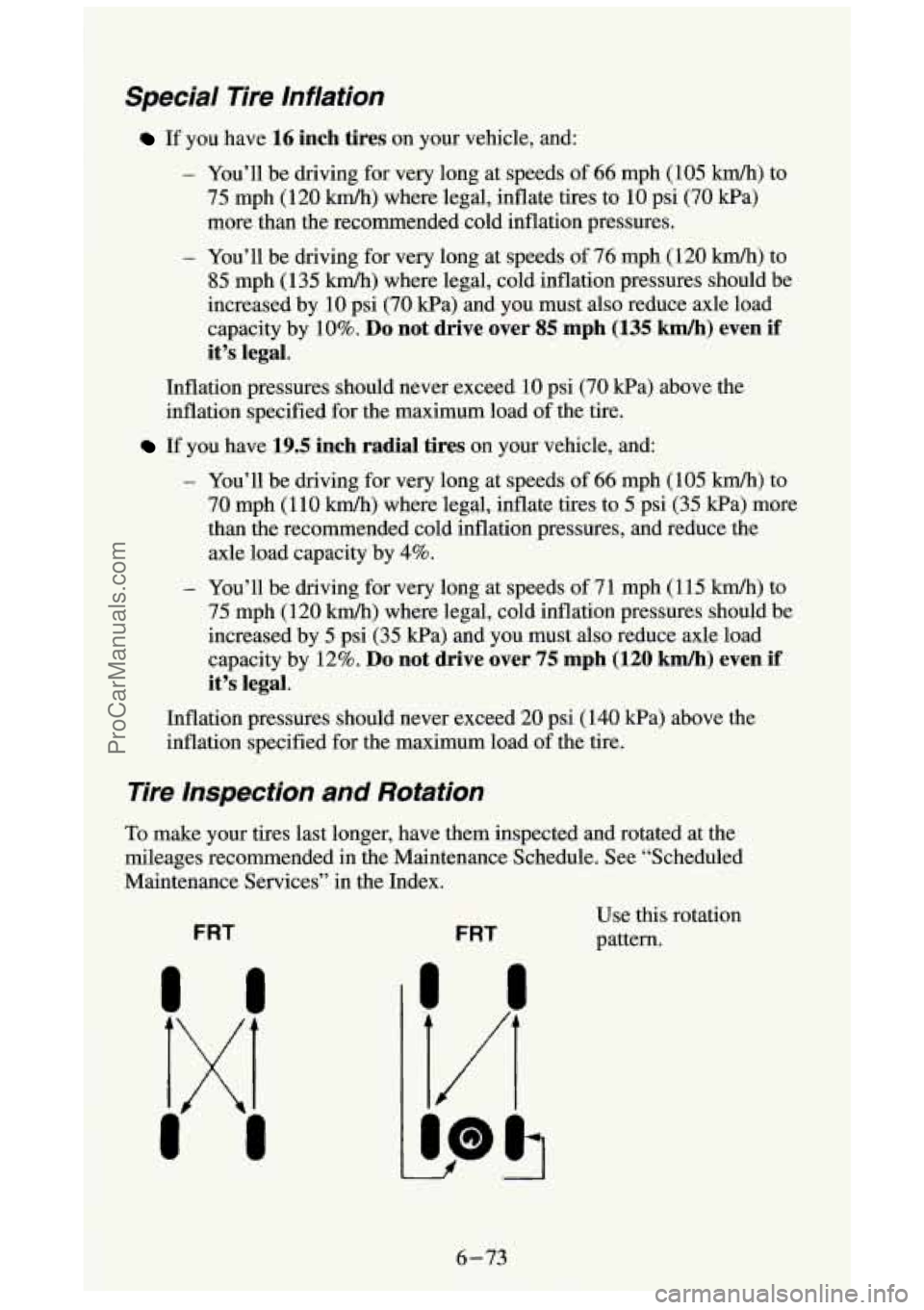
Tire Inspection and Rotation
To make your tires last longer, have them inspected and rotated at the
mileages recommended in the Maintenance Schedule. See “Scheduled
Maintenance Services” in the Index.
FRT
8
FRT
Use this rotation
pattern.
4-73
ProCarManuals.com
Page 349 of 404
Scheduled Maintenance Services
Section
This section covers the maintenance required for your General Motors
vehicle
. Your vehicle needs these services to retain it’s safety. dep\
endability.
and emission control performance
.
A Word About Maintenance .................................. 7-3
Your Vehicle and the Environment
............................. 7-3
Recording Maintenance Services
............................... 7-3
Scheduled Maintenance Services
............................... 7-4
Selecting Your Vehicle’s Maintenance Services
................. 7-4
Gasoline Engines with Light Duty Emissions
-
MaintenanceScheduleI ................................ 7-6
MaintenanceScheduleII
................................ 7-8
Maintenance Schedule I
............................... 7-10
Maintenance Schedule I1
............................. 7-12
Maintenance Schedule I
............................... 7-14
Maintenance Schedule
11 ............................... 7-16
Explanation of Scheduled Maintenance Services
............... 7-18
Owner Checks and Services
.................................. 7-22
Recommended Fluids
& Lubricants ........................... 7-25
Maintenance Record
....................................... 7-27
Service Station Checks
.... ., ................................ 7-28
Gasoline Engines with Heavy Duty Emissions
-
Diesel Engines .
Have you purchased the GM Protection Plan? The Plan supplements
the new vehicle warranties
. See your GM dealer for details .
7-1
ProCarManuals.com