turn signal GMC SIERRA 1994 User Guide
[x] Cancel search | Manufacturer: GMC, Model Year: 1994, Model line: SIERRA, Model: GMC SIERRA 1994Pages: 404, PDF Size: 20.91 MB
Page 180 of 404
When you drive over obstacles or rough terrain, keep a firm grip on the
steering wheel.
Ruts, troughs, or other surface features can jerk the wheel
out of your hands if you’re not prepared.
When
you drive over bumps, rocks, or other obstacles, your wheels can
leave
the ground. If this happens, even with one or two wheels, you can’t
control the vehicle
as well or at all.
Because you will be on an unpaved surface, it’s especially important
to
avoid sudden acceleration, sudden turns. or sudden braking.
In
a way, off-road driving requires a different kind of alertness from driving
on paved roads and highways. There are no road signs, posted speed limits
or signal lights.
You have to use your own good .judgment about what is safe
and what isn’t.
Drinking and driving can be very dangerous on any road. And this
is
certainly true for off-road driving. At the very time you need special
alertness and driving skills, your reflexes, perceptions and judgment can be
affected by even
a small amount of alcohol. You could have a serious - or
even
fatal - accident if you drink and drive or ride with a driver who has
been drinking. (See “Drunken Driving”
in the Index.)
Driving On Off-Road Hills
Off-road driving often takes you up, down, or across a hill. Driving safely
on hills requires good judgment and an understanding of what your vehicle
can and can’t do. There are some hills that simply can’t be driven, no matter
how well built the vehicle.
A CAUTION:
Many hills are simply too steep for any vehicle. If you drive up
them, you will stall.
If you drive down them, you can’t control
yorrr speed. If you drive across them, you will roll over. You
could be seriously injured or killed.
If you have any doubt about
the steepness, don’t drive the hill.
Approaching a Hill
When you approach a hill, you need to decide if it’s one of those hills that’s
just too steep to climb, descend, or cross. Steepness can be hard to judge.
Oil a very small hill, for example, there may be a smooth, constant incline
with only
a small change in elevation where you can easily see all the way
to
the top. On a large hill. the incline may get steeper as you near the top,
but
you may not see this because the crest of the hill is hidden by bushes,
grass, or shrubs.
4-16
ProCarManuals.com
Page 190 of 404

Driving in the Rain
Rain and wet roads can mean driving trouble. On a wet road y\
ou can’t stop,
accelerate or turn as well because your tire-to-road traction isn’t as good as
on dry roads. And, if your tires don’t have much tread left, \
you’ll get even
less traction.
It’s always wise to go slower and be cautious if rain starts to
fall while you are driving. The surface may get wet suddenly when \
your
reflexes
are tuned for driving on dry pavement.
The heavier the rain, the harder it
is to see. Even if your windshield wiper
blades
are in good shape, a heavy rain can make it harder to see road signs
and traffic signals, pavement markings, the edge of the road, and even
people walking.
It’s wise to keep your wiping equipment in good shape and \
keep your windshield washer tank filled. Replace your windshield wiper ins\
erts when
they show signs
of streaking or missing areas on the windshield, or when
strips
of rubber start to separate from the inserts.
4-26
ProCarManuals.com
Page 192 of 404
Some Other Rainy Weather Tips
0 Turn on your low-beam headlights - not just your parking llgnts - to
help make you more visible to others.
Besides slowing down, allow some extra following distance. And be
especially careful when you pass another vehicle. Allow yourself more
clear room ahead, and be prepared to have your view restricted by road
spray.
Have good tires with proper tread depth. (See “Tires” in the Index.)
City Driving
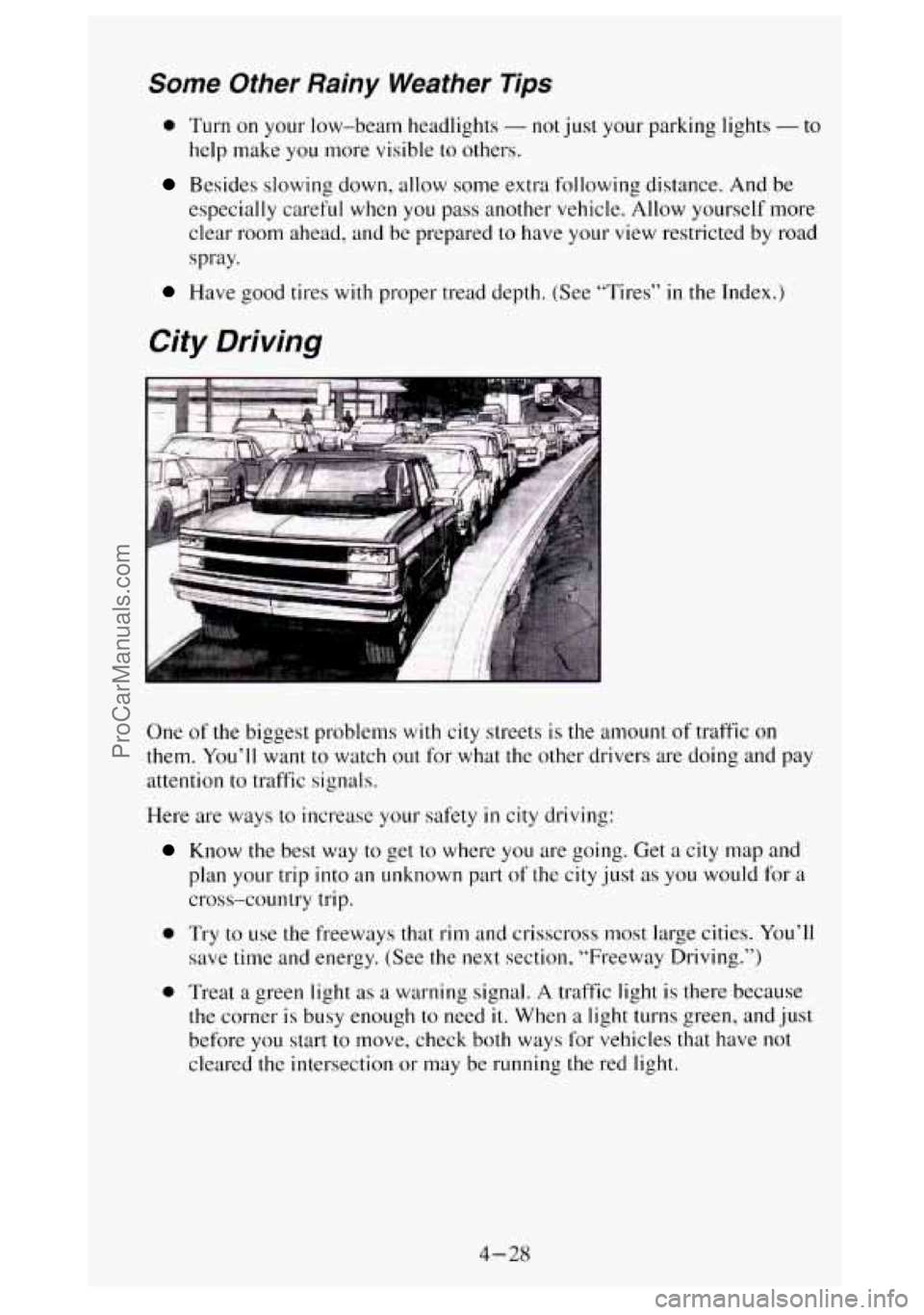
One of the biggest problems with city streets is the amount of traffic on
them. You’ll want to watch out for what the other drivers are doing and pay
attention to traffic signals.
Here are ways to increase your safety
in city driving:
Know the best way to get to where you are going. Get a city map and
plan your trip
into an unknown part of the city just as you would for a
cross-country trip.
save time and energy. (See the
next section, “Freeway Driving.”)
0 Try to use the freeways that rim and crisscross most large cities. You’ll
0 Treat a green light as a warning signal. A traffic light is there because
the corner is busy enough to need
it. When a light turns green, and just
before you start to move, check both ways for vehicles that have not
cleared the intersection or may be running the red light.
4-28
ProCarManuals.com
Page 193 of 404
Freeway Driving
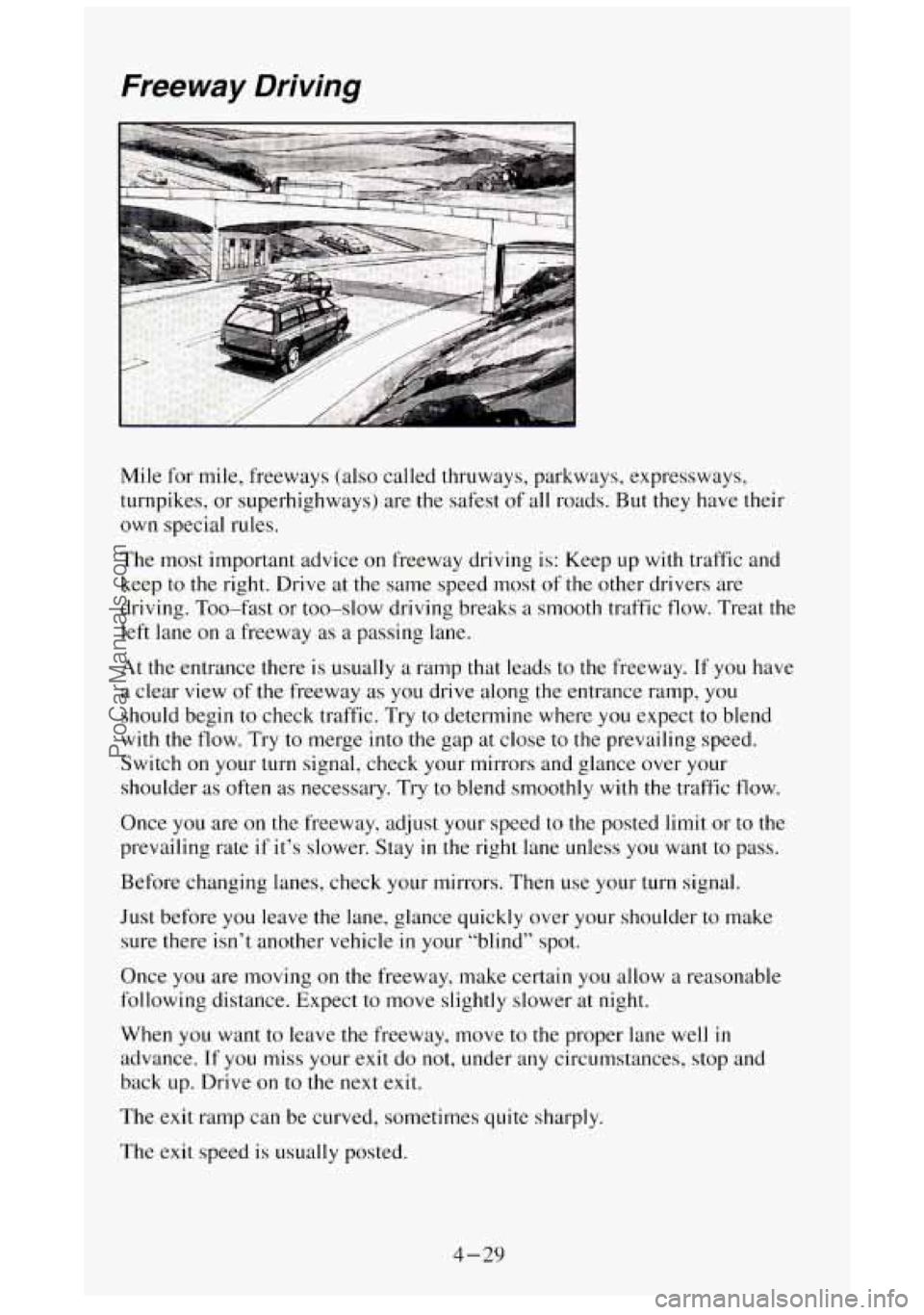
Mile for mile, freeways (also called thruways, parkways, expressways,
turnpikes, or superhighways) are the safest of all roads. But they have their
own special rules.
The most important advice on freeway driving is: Keep up with traffic and
keep to the right. Drive at the same speed most of the other drivers are
driving. Too-fat or too-slow driving breaks
a smooth traffic flow. Treat the
left lane on a freeway as a passing lane.
At the entrance there is usually a ramp that leads to the freeway.
If you have
a clear view of the freeway as you drive along the entrance ramp, you
should begin to check traffic.
Try to determine where you expect to blend
with the flow. Try to merge into the gap at close to the prevailing speed.
Switch on your turn signal, check your mirrors and glance over your
shoulder as often as necessary. Try to blend smoothly with the traffic flow.
Once
you are on the freeway, adjust your speed to the posted limit or to the
prevailing rate
if it’s slower. Stay in the right lane unless you want to pass.
Before changing lanes, check your mirrors. Then use your
turn signal.
Just before you leave the lane, glance quickly over your shoulder to make
sure there isn’t another vehicle
in your “blind” spot.
Once you are moving on the freeway, make certain you allow
a reasonable
following distance. Expect to move slightly slower at night.
When you want
to leave the freeway, move to the proper lane well in
advance. If you miss your exit do not, under any circumstances, stop and
back
up. Drive on to the next exit.
The exit ramp can be curved, sometimes quite sharply.
The exit speed is usually posted.
4-29
ProCarManuals.com
Page 206 of 404
Before you start, check the trailer hitch and platform, safety chains,
electrical connector, lights, tires and mirror adjustment. If the trailer has
electric brakes, start your
vehicle and trailer moving and then apply the
trailer brake controller by hand to be sure the brakes are working. This lets
you check your electrical connection at
the same time.
During your trip, check occasionally to be sure that the load is secure, and
that the lights and any trailer brakes are still working.
Following Distance
Stay at least twice as far behind the vehicle ahead as you would when
driving your vehicle without a trailer. This can help
you avoid situations that
require heavy braking and sudden turns.
Passing
You’ll need more passing distance up ahead when you’re towing a trailer.
And, because you’re a good deal longer, you’ll need to
go much farther
beyond the passed vehicle before
you can return to your lane.
Backing Up
Hold the bottom of the steering wheel with one hand. Then, to move the
trailer to the left, just move that hand to the
left. To move the trailer to the
right, move your hand to
the right. Always back up slowly and, if possible?
have someone guide you.
Making Turns
When you’re turning with a trailer, make wider turns than normal. Do this
so your trailer won’t strike soft shoulders, curbs, road signs, trees, or other
objects. Avoid jerky or sudden maneuvers. Signal well in advance.
Turn Signals When Towing a Trailer
When you tow a trailer, your vehicle has to have a different turn signal
flasher and extra wiring. The green arrows
on your instrument panel will
flash whenever you signal a turn or lane change. Properly hooked up, the
trailer lights will also flash, telling other drivers you’re about to turn,
change lanes or stop.
When towing a trailer, the green arrows on your instrument panel will flash
for turns even if the bulbs
on the trailer are burned out. Thus, you may think
drivers behind you are seeing your signal when
they are not. It’s important
to check occasionally
to be sure the trailer bulbs are still working.
4-42
ProCarManuals.com
Page 210 of 404
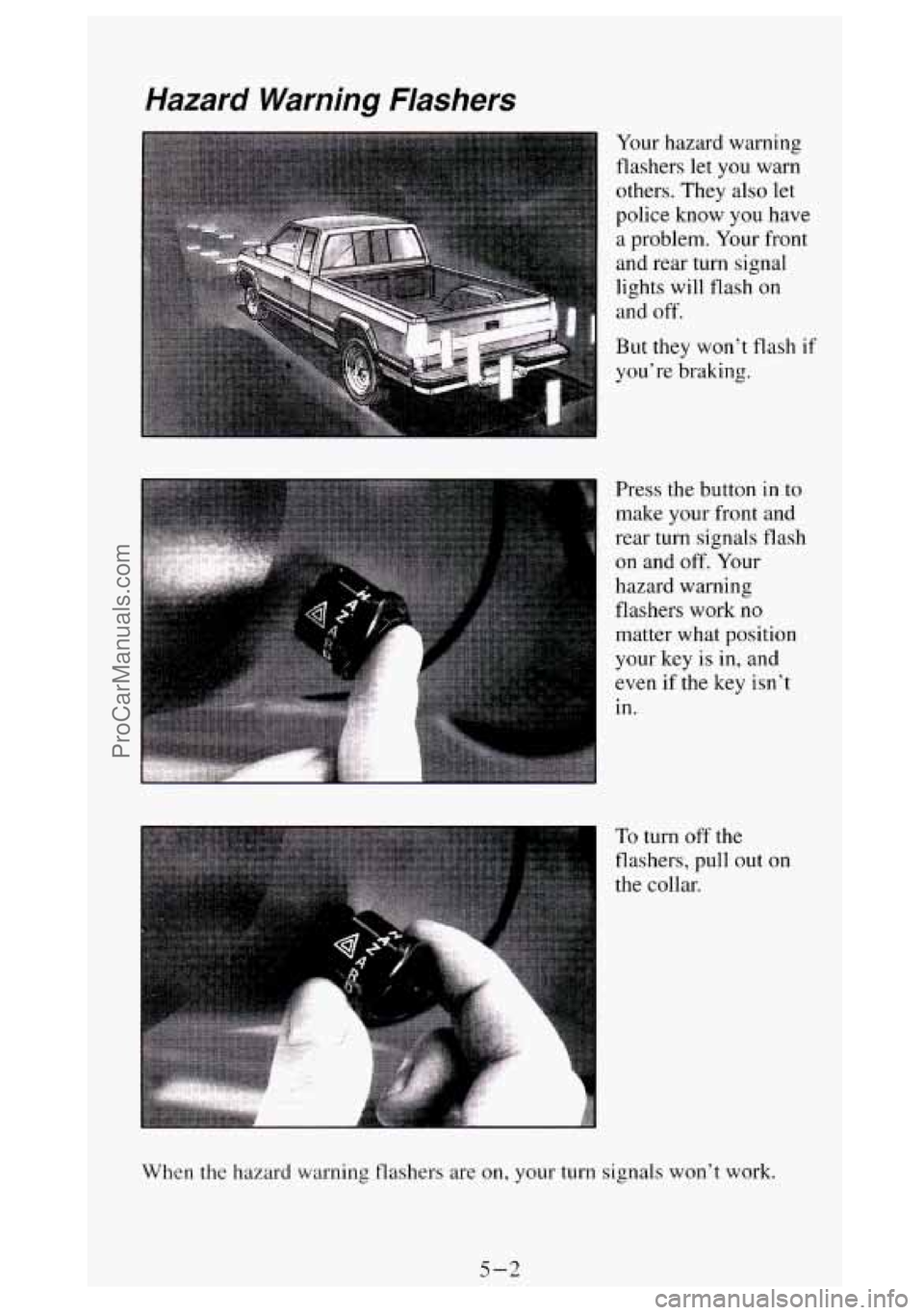
Hazard Warning Flashers
Your hazard warning
flashers let
you warn
others. They also let
police know you have
a problem. Your front
and rear turn signal
lights will
flash on
and off.
But they won’t flash if
you’re braking.
Press the button
in to
make your front and
rear turn signals flash
on and
off. Your
hazard warning
flashers work no
matter what position
your key
is in, and
even if
the key isn’t
in.
To turn off the
flashers,
pull out on
the collar.
When the hazard warning flashers are on, your turn signals won’t work.
5-2
ProCarManuals.com
Page 305 of 404
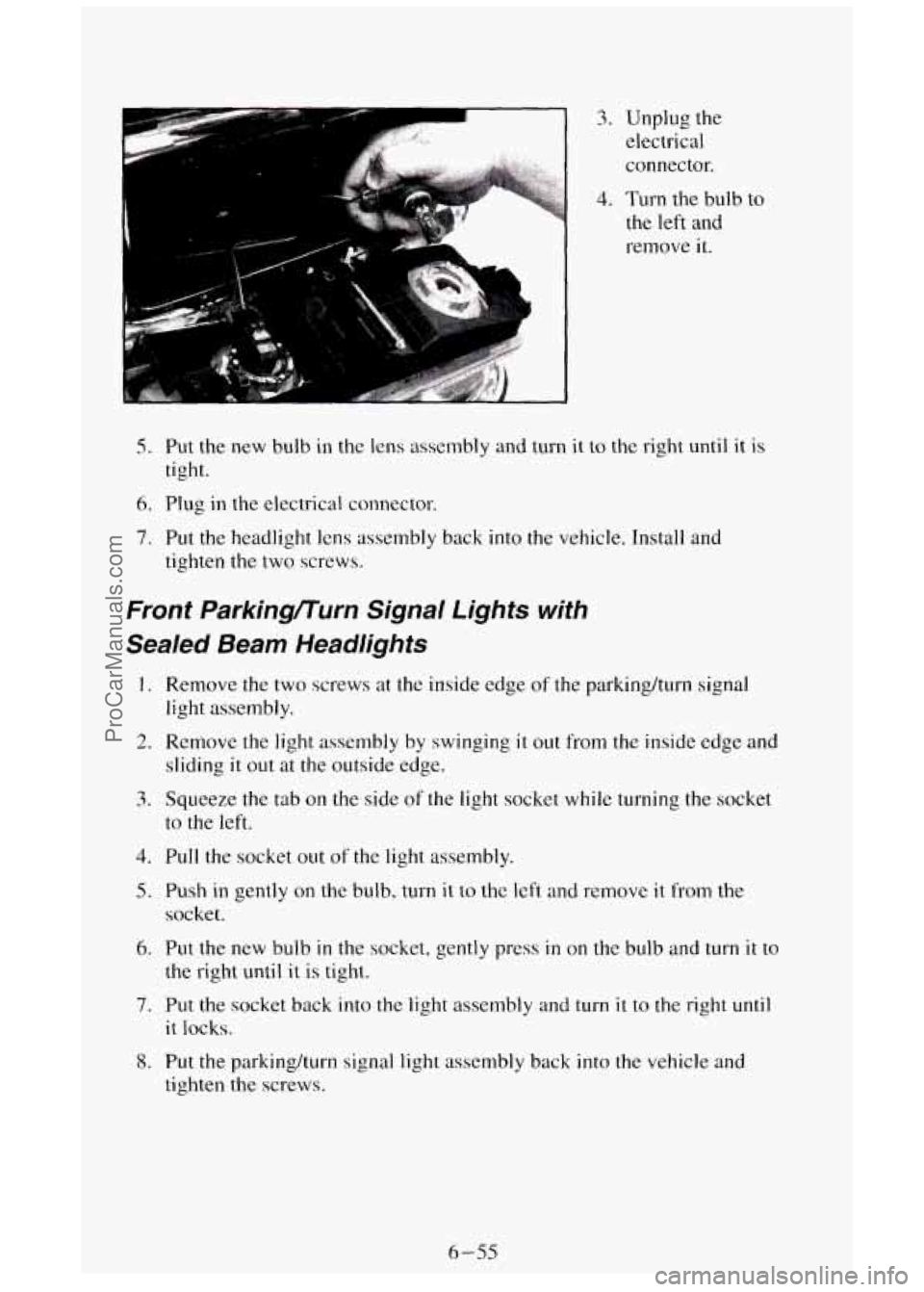
3. Unplug the
electrical
connector.
4. Turn the bulb to
the left and
i
remove it.
5. Put the new bulb in the lens assembly and turn it to the right until it is
tight.
6. Plug in the electrical connector.
7. Put the headlight lens assembly back into the vehicle. Install and
tighten the two screws.
Front Parkingflurn Signal Lights with
Sealed Beam Headlights
1. Remove the two screws at the inside edge of the parking/turn signal
2. Remove the light assembly by swinging it out from the inside edge and
3. Squeeze the tab on the side of the light socket while turning the socket
4. Pull the socket out of the light assembly.
5. Push in gently on the bulb, turn it to the left and remove it from the
6. Put the new bulb in the socket, gently press in on the bulb and turn it to
7. Put the socket back into the light assembly and turn it to the right until
8. Put the parking/turn signal light assembly back into the vehicle and
light assembly.
sliding
it out at the outside edge.
to the
left.
socket.
the right until it is tight.
it locks.
tighten the screws.
6-55
ProCarManuals.com
Page 306 of 404
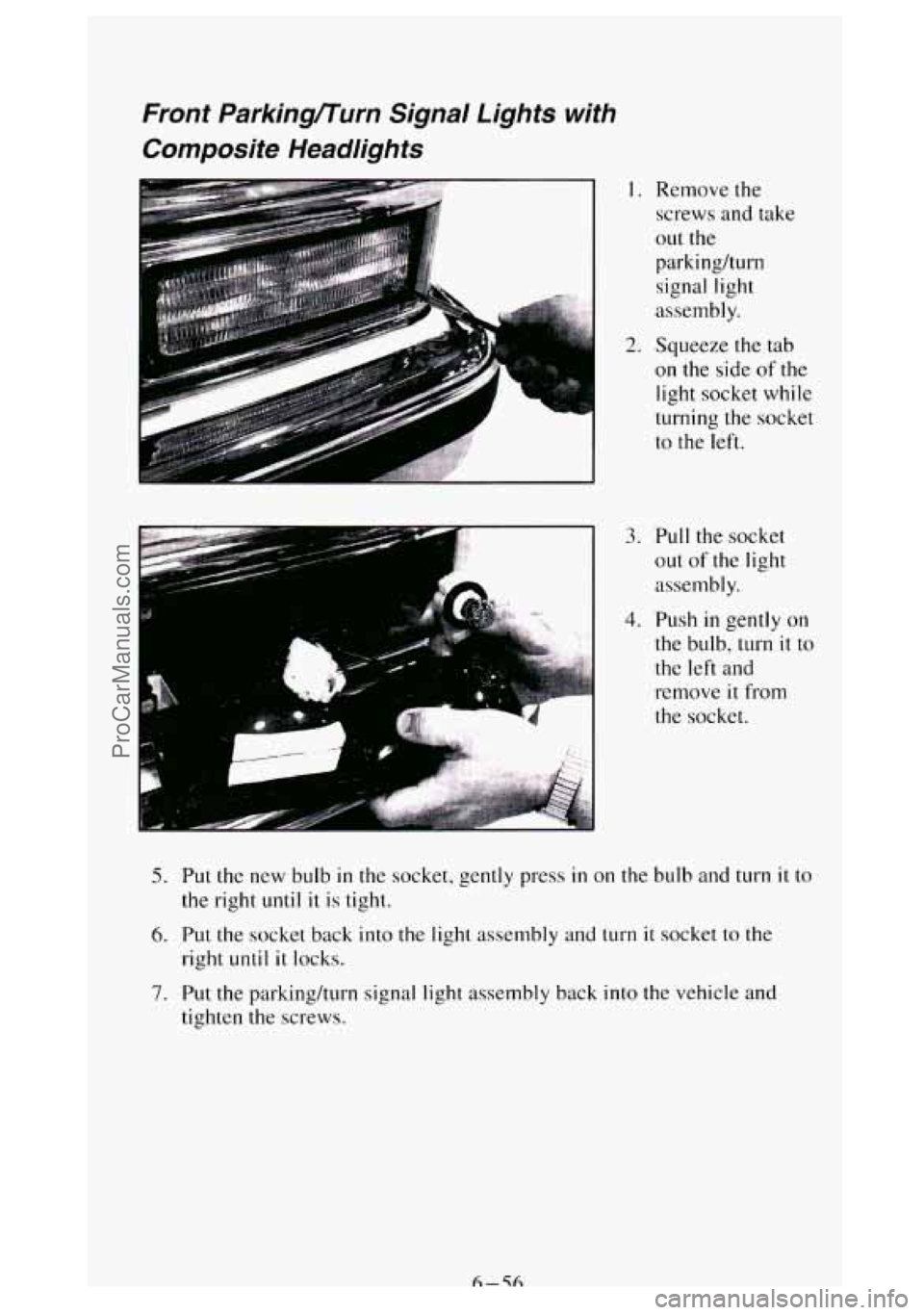
Front Parkingnurn Signal Lights with
Composite Headlights
-7
I. Remove the
screws and take
out the parkinghurn
signal light
assembly.
2. Squeeze the tab
on the side of the
light socket while
turning the socket
to the left.
3.
4.
Pull the socket
out
of the light
assembly.
Push
in gently on
the bulb, turn it to
the left and
remove
it from
the socket.
5. Put the new bulb in the socket, gently press in on the bulb and turn it to
the right
until it is tight.
6. Put the socket back into the light assembly and turn it socket to the
right
until it locks.
7. Put the parkinghrn signal light assembly back into the vehicle and
tighten the screws.
6-56
ProCarManuals.com
Page 307 of 404
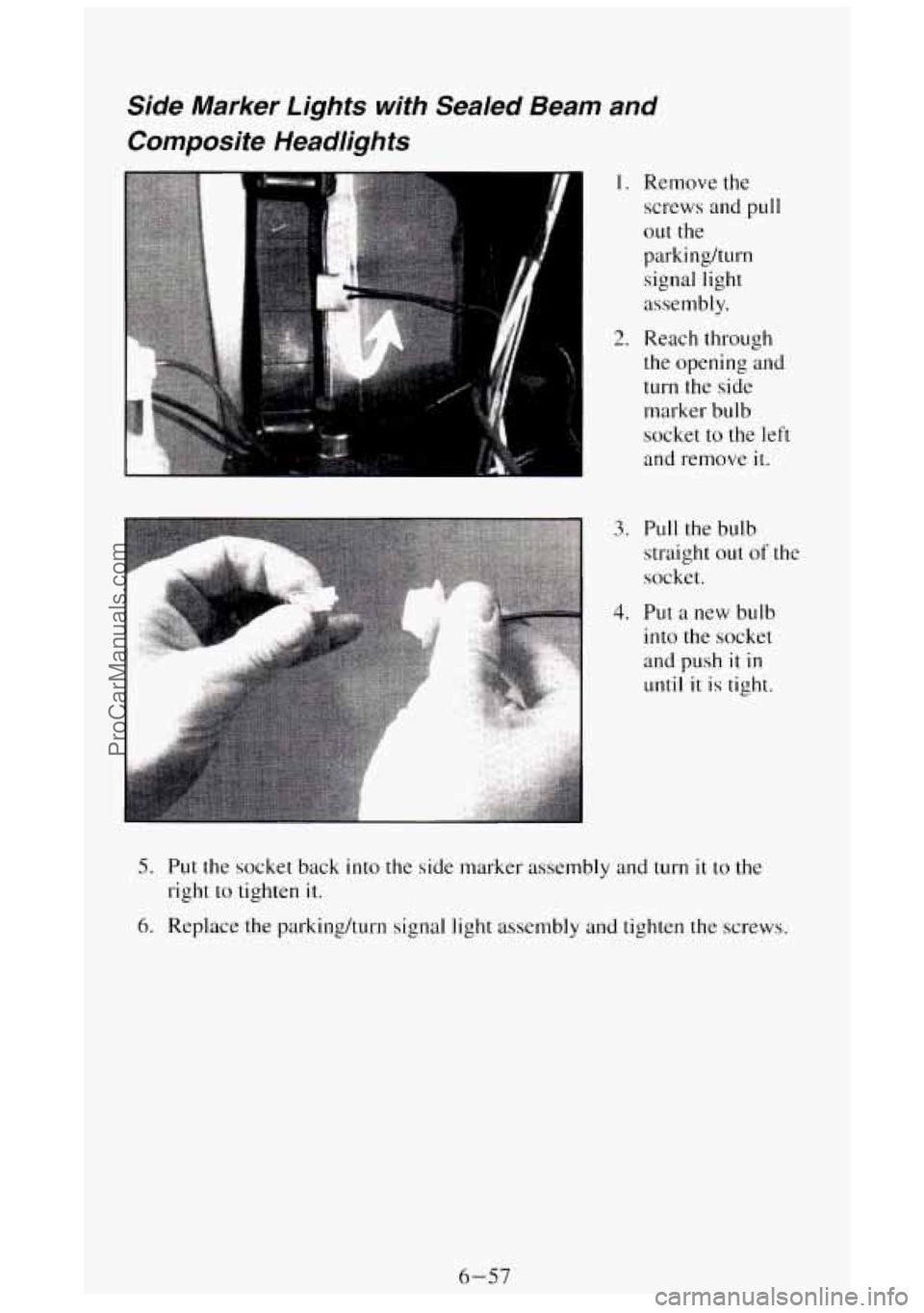
Side Marker Lights with Sealed Beam and Composite Headhghts
1. Remove the
screws and
pull
out the
parkinghrn
signal light
assembly.
2. Reach through
the opening
and
turn the side
marker bulb
socket to
the left
and remove
it.
3.
4.
Pull the bulb
straight out
of the
socket.
Put
a new bulb
into the socket
and push
it in
until
it is tight.
5. Put the socket back into the side marker assembly and turn it to the
6. Replace the parkinghurn signal light assembly and tighten the screws.
right to tighten
it.
6-57
ProCarManuals.com
Page 346 of 404
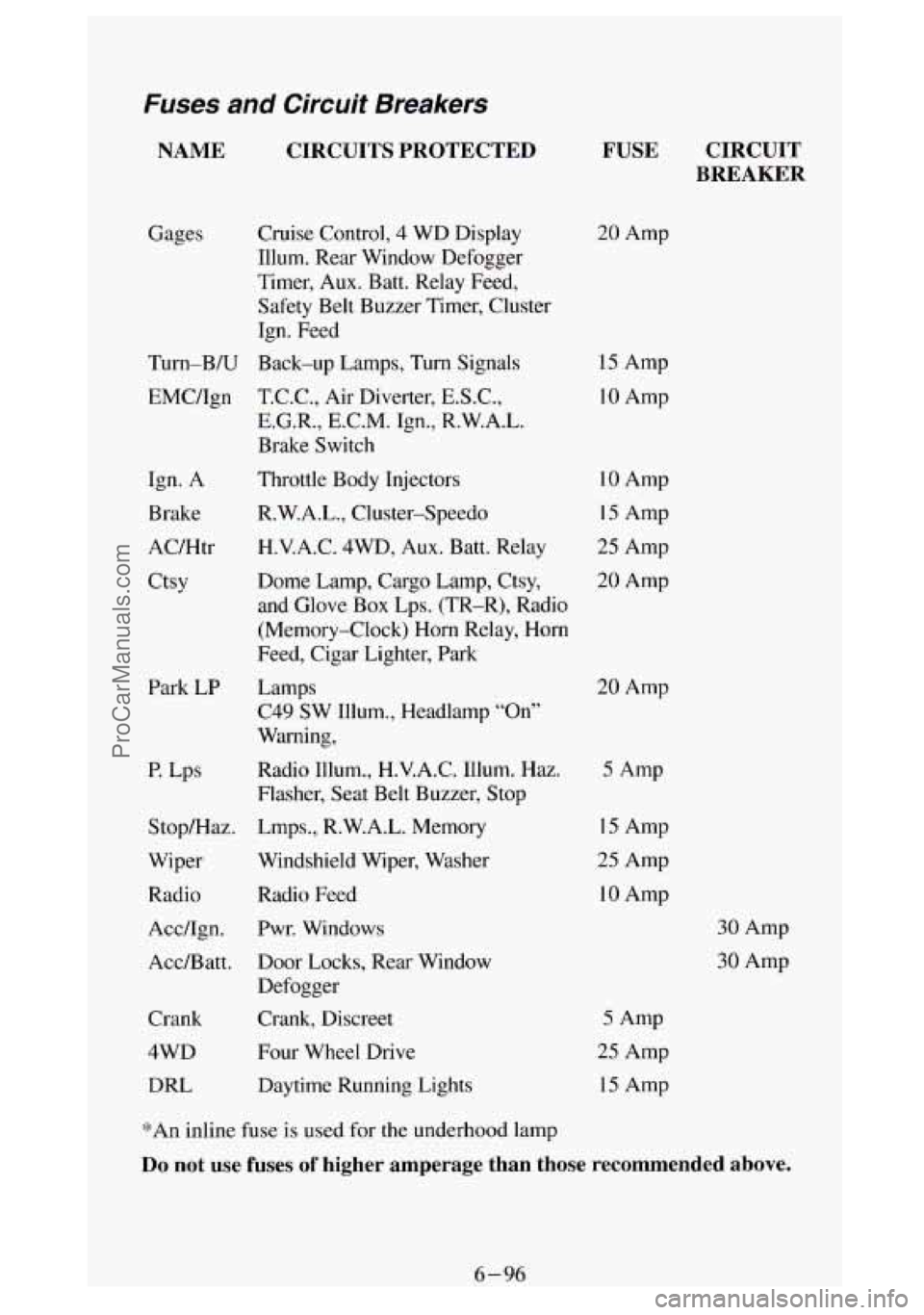
Fuses and Circuit Breakers
NAME CIRCUITS PROTECTED
Gages
Turn-B/U EMC/Ign
Ign. A
Brake
AC/Htr
Ctsy
Park LP
P. Lps
Stop/Haz.
Wiper
Radio
Acc/Ign.
Acc/Batt.
Crank
4WD
DRL
Cruise Control, 4 WD Display
Illum. Rear Window Defogger
Timer, Aux. Batt. Relay Feed,
Safety Belt Buzzer Timer, Cluster
Ign. Feed
Back-up Lamps,
Turn Signals
T.C.C., Air Diverter,
E.S.C.,
E.G.R., E.C.M. Ign., R.W.A.L.
Brake Switch
Throttle Body Injectors
R.W.A.L., Cluster-Speedo
H.V.A.C.
4WD, Aux. Batt. Relay
Dome Lamp, Cargo Lamp, Ctsy,
and Glove Box Lps. (TR-R), Radio
(Memory-Clock) Horn Relay, Horn
Feed, Cigar Lighter, Park
Lamps C49 SW Illum., Headlamp “On”
Warning,
Radio Illum., H.V.A.C. Illum. Haz.
Flasher, Seat Belt Buzzer, Stop
Lmps., R.W.A.L. Memory
Windshield Wiper, Washer
Radio Feed
Pwr. Windows
Door Locks, Rear Window
Defogger
Crank, Discreet
Four Wheel Drive
Daytime Running Lights
FUSE CIRCUIT
BREAKER
20 Amp
15 Amp
10 Amp
10 Amp
15 Amp
25 Amp
20 Amp
20 Amp
5 Amp
15 Amp
25 Amp
10 Amp
30 Amp
30 Amp
5 Amp
25 Amp
15 Amp
*An inline fuse is used
for the underhood lamp
Do not use fuses of higher amperage than those recommended above.
6-96
ProCarManuals.com