wheel GMC SIERRA 1994 User Guide
[x] Cancel search | Manufacturer: GMC, Model Year: 1994, Model line: SIERRA, Model: GMC SIERRA 1994Pages: 404, PDF Size: 20.91 MB
Page 88 of 404
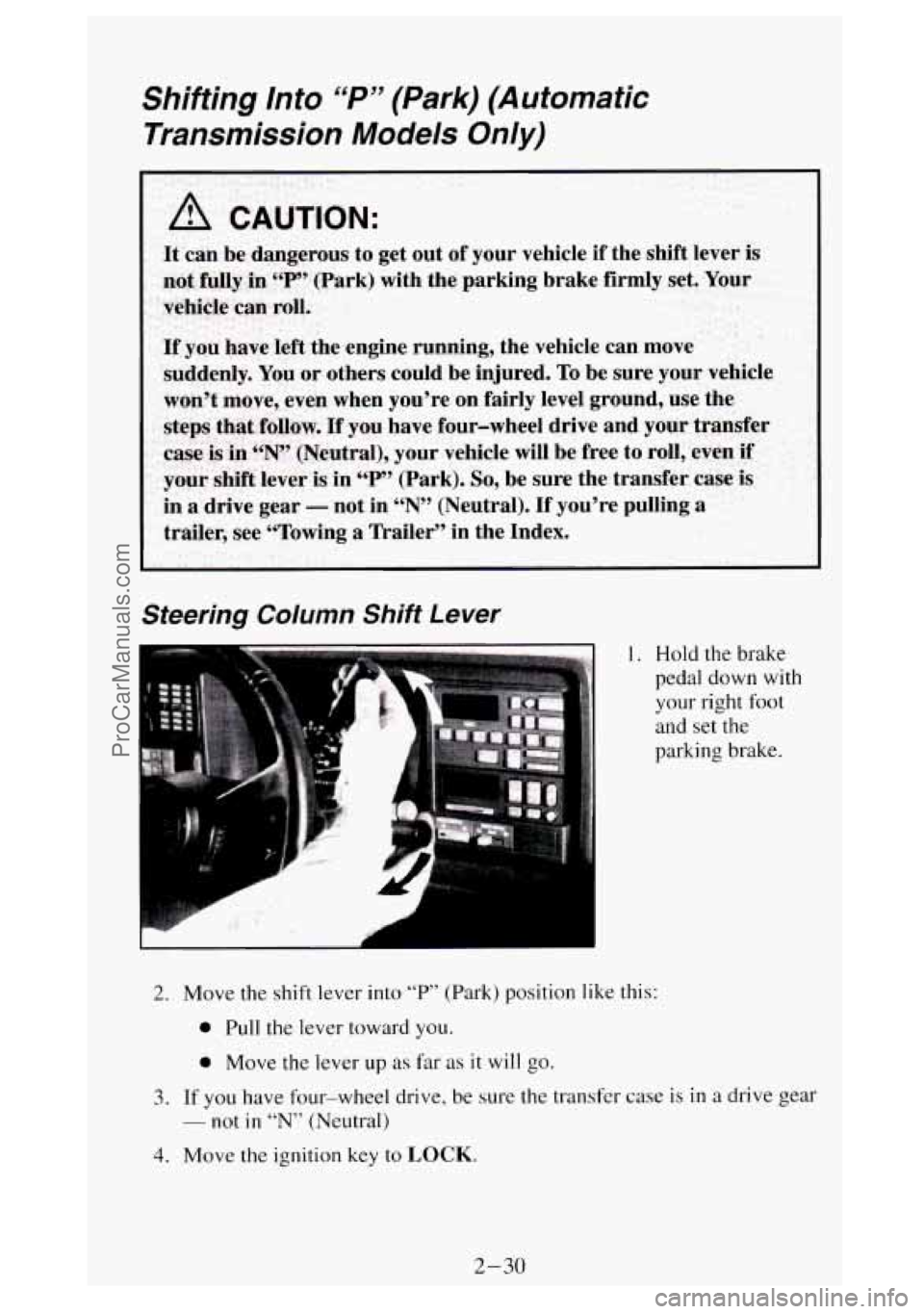
Shifting Into “P” (Park) (Automatic
Transmission Models Only)
Steering Column Shift Lever
1. Hold the brake
pedal down
with
your right foot
and set the
parking brake.
2. Move the shift lever into “P” (Park) position like this:
0 Pull the lever toward you.
0 Move the lever up as far as it will go.
3. If you have four-wheel drive, be sure the transfer case is in a drive gear
- not in “N” (Neutral)
4. Move the ignition key to LOCK.
2-30
ProCarManuals.com
Page 89 of 404
5. Remove the key and take it with you. If you can walk away from your
vehicle with
the ignition key in your hand, your vehicle is in “P”
(Park).
Leaving Your Vehic/e With the Engine Running
(Automatic Transmission Models Only)
If you have to leave your vehicle with the engine running, be sure your
vehicle is
in “P” (Park) and your parking brake is firmly set before you
leave it. If you have four-wheel drive with a manual transfer case shift
lever, be sure that the transfer case
is in a drive gear - not in “N” (Neutral).
After you’ve moved the
shift lever into the “P’ (Park) position, hold the
regular brake pedal down. Then, see if
you can move the shift lever away
from “P” (Park) without first pulling it toward
you. If you can, it means that
the shift lever wasn’t
fully locked into “P” (Park).
Torque Lock (Automatic Transmission)
If you are parking on a hill and you don’t shift your transmission into “P”
(Park) properly,
the weight of the vehicle may put too much force on the
parking pawl
in the transmission. You may find it difficult to pull the shift
lever out of
“P’ (Park). This is called “torque lock.” To prevent torque lock,
set the parking brake and then shift into “P’ (Park) properly before you
leave
the driver’s seat. To find out how, see “Shifting Into ‘P’ (Park)” in the
Index.
When you are ready to drive, move the
shift lever out of “P” (Park)
BEFORE you release the parking brake.
If “torque
lock” does occur, you may need to have another vehicle push
yours
a little uphill to take some of the pressure from the transmission, so
you can pull the shift lever out of “P’ (Park).
2-31
ProCarManuals.com
Page 90 of 404
Parking Your Vehicle
(Manual Transmission Models
Only)
Before you get out of your vehicle, put your manual transmission in “R”
(Reverse), turn off the engine, and firmly apply the parking brake.
If you have four-wheel drive, be sure your transfer case is in a drive gear.
Your vehicle could roll
if it isn’t.
If
you are parking on a hill, or if your pulling a trailer, see “Parking on
Hills” or “Towing a Trailer” in the Index.
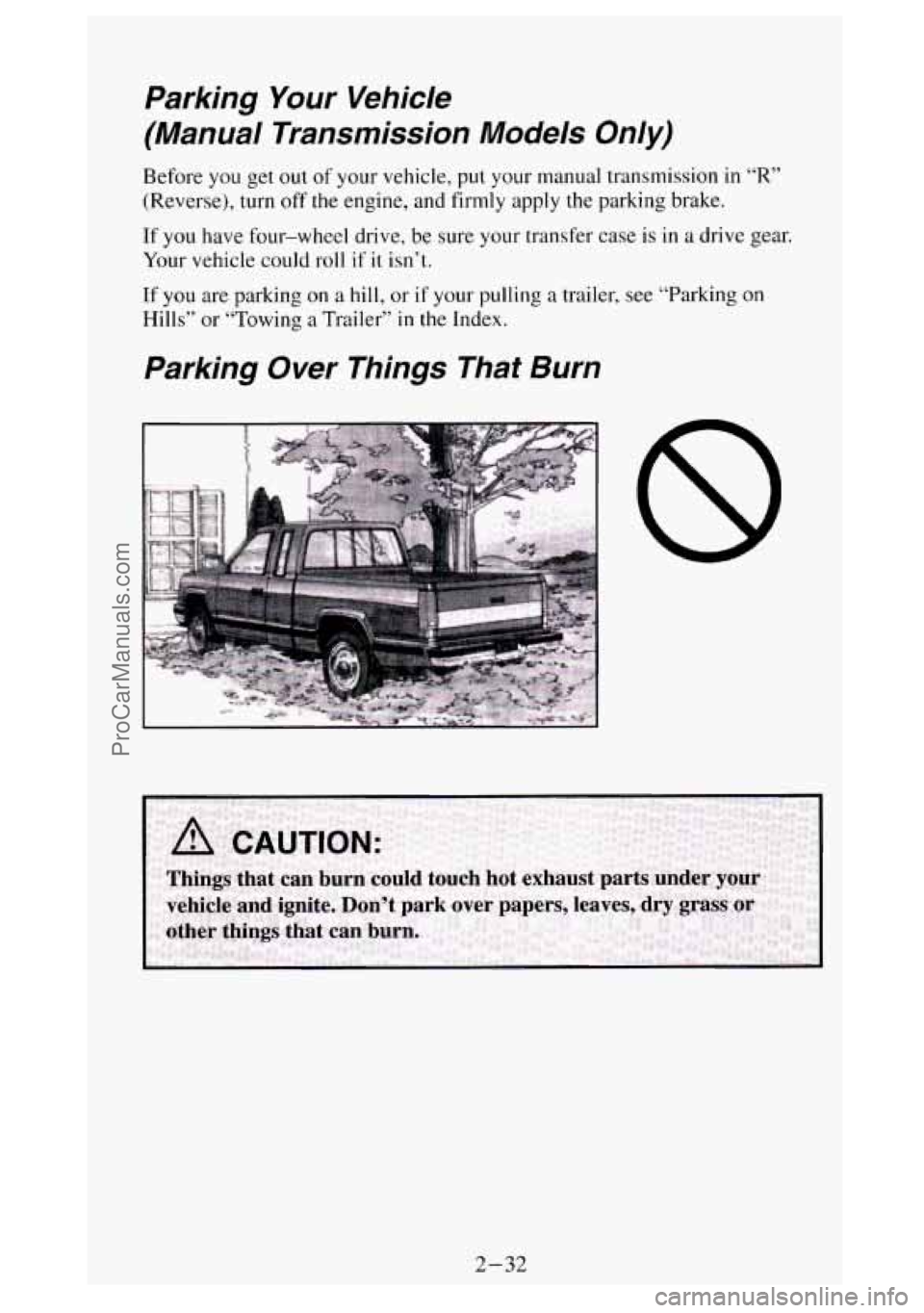
Parking Over Things That Burn
2-32
ProCarManuals.com
Page 92 of 404
If you have four-wheel drive and your transfer case is in “N” (Neutral),
your vehicle will be free to roll, even
if your shift lever is in “P” (Park). So,
be sure the transfer case is in a drive gear - not in “N” (Neutral). Follow
the proper steps to be sure your vehicle won’t move. See “Shifting Into
‘P’
(Park)’’ in the Index.
If you’re pulling a trailer, see “Towing a Trailer” in the Index.
Four- Wheel Drive
If your vehicle has four-wheel drive, you can send your engine’s driving
power to all four wheels for extra traction.
To get the most satisfixtion out
of four-wheel drive, you must be familiar with it’s operation. Read
the part
that follows before using four-wheel drive.
You should use 2H for most
normal driving conditions.
Rear-wheel antilock brakes
do not work when you shift into four-wheel
drive. Your regular brakes
will still work. When you shift back into
two-wheel drive, your rear-wheel antilock brakes will take over again.
2-34
ProCarManuals.com
Page 93 of 404

NOTICE:
Driving in the 4H or 4L positions for a long time on dry or wet
pavement could shorten the life of your vehicle’s drivetrain.\
Transfer Case
The transfer case shift
lever is on the floor to
the right of the driver.
Use this lever to shift into and out
of
An indicator near the lever shows you the transfer case settings.
The front axle portion
of the indicator
diagram will light up
when you shift into
four-wheel drive.
Some delay between shifting and the indicator’s lighting is normal.
If the
indicator light does not light
up, or if the front axle light does not go out
after you shift out
of four-wheel drive, have your dealer check your system.
2-35
ProCarManuals.com
Page 94 of 404
When your headlights or parking lights are on, rotate the dial to the right of
your headlight switch up
to brighten, or down to dim, your transfer case
indicator light.
2H (2-Wheel High): This setting is for driving in most street and highway
situations. Your front axle is not engaged
in two-wheel drive.
4H (4-Wheel High): This setting engages your front axle to help drive your
vehicle. Use
4H when you need extra traction, such as on wet or icy roads,
or in most off-road situations.
N (Neutral): Shift to this setting only when your vehicle needs to be towed
or when using a power take-off.
4L (4-Wheel Low): This setting also engages your front axle to give you
extra power, but should be used only for off-road driving.
You can shift from
2H to 4H or from 4H to 2H while the vehicle is moving.
Your front axle will engage faster if you take your foot off of the accelerator
for a few seconds after you shift.
In extremely cold weather it may be
necessary to stop or slow the vehicle to shift
out of 2H.
To shift into or out of 4L or “N” (Neutral):
Slow the vehicle to a roll, about 1-3 mph (2-5 kdh) and shift your
transmission into neutral.
0 Shift the transfer case shift lever in one continuous motion.
Don’t pause
in “N” (Neutral) as you shift the transfer case into 4L, or your
gears could clash.
Remember that driving
in 4H or 4L may reduce fuel economy. Also, driving
in four-wheel drive on dry pavement could cause your tires to wear fdster
and make your transfer case harder to shift.
Front Axle Locking Feature
The front axle locks and unlocks automatically when you shift the transfer
case. Some delay
for the axle to lock or unlock is normal. If the outside
temperature is very hot, or the vehicle has been used under hard driving
conditions, there may be
a slight delay for the axle to unlock.
Whenever you are
in four wheel drive, the rear wheel anti-lock brake
system does not operate. The regular brake system operates normally. When
you shift back into two-wheel drive, the anti-lock brake system will
operate.
2-36
ProCarManuals.com
Page 97 of 404
Horn
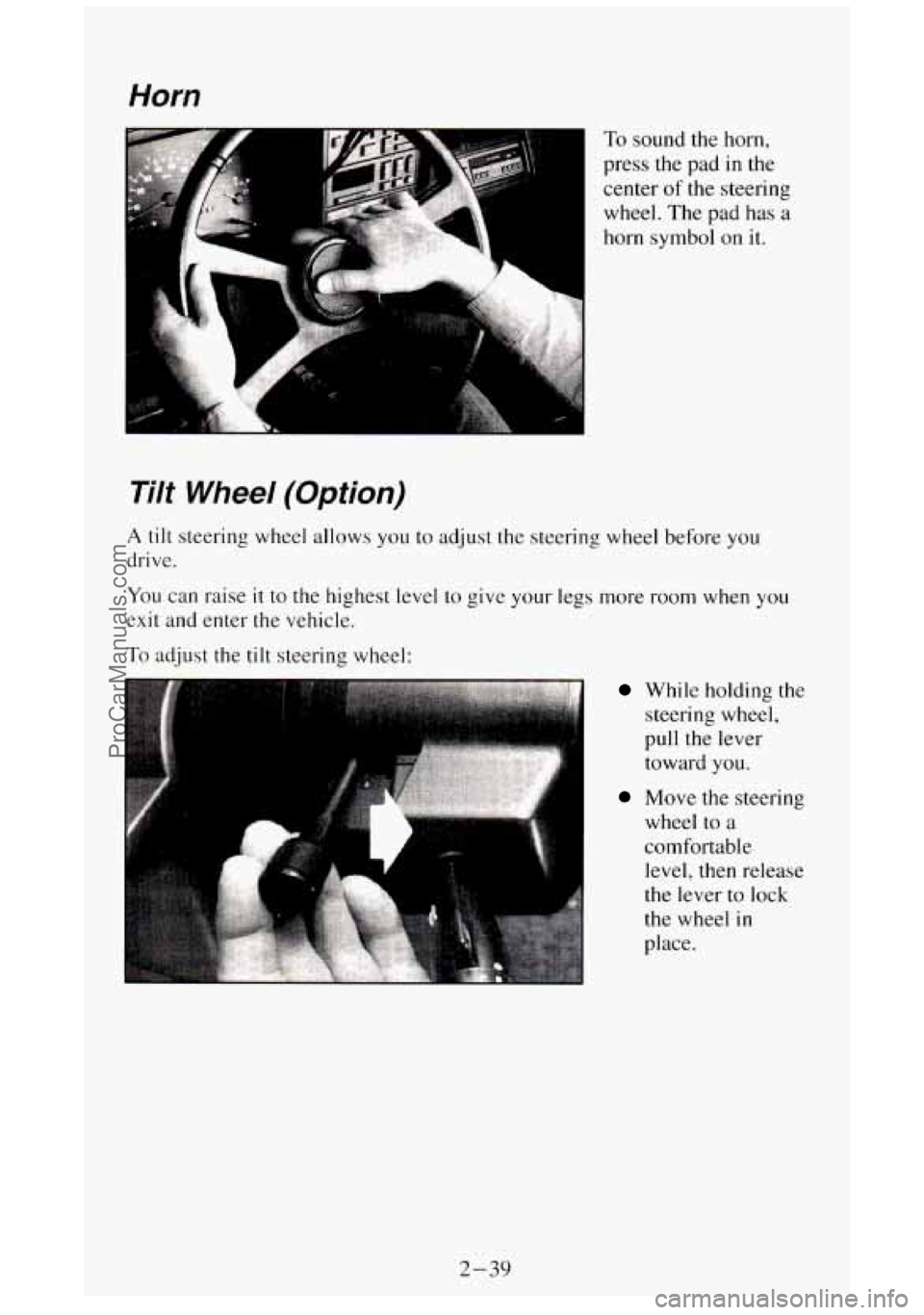
To sound the horn,
press the pad
in the
center of the steering
wheel. The pad has a
horn symbol on it.
Tilt Wheel (Option)
A tilt steering wheel allows you to adjust the steering wheel before you
drive.
You can raise it to the highest level to give your legs more room when you
exit and enter the vehicle.
To adjust the tilt steering wheel:
While holding the
steering wheel,
pull
the lever
toward you.
Move the steering
wheel
to a
comfortable level, then release
the lever
to lock
the wheel
in
place.
2-39
ProCarManuals.com
Page 128 of 404
Gages can indicate when there may be or is a problem with one of your
vehicle’s functions. Often gages and warning lights work together to let
you
know when there’s a problem with your vehicle.
When one of the warning lights comes on and stays on when you are
driving,
or when one of the gages shows there may be a problem, check the
section that tells you what to do about
it. Please follow the manual’s advice.
Waiting
to do repairs can be costly - and even dangerous. So please get to
know your warning lights and gages. They’re
a big help.
Brake System Warning Light
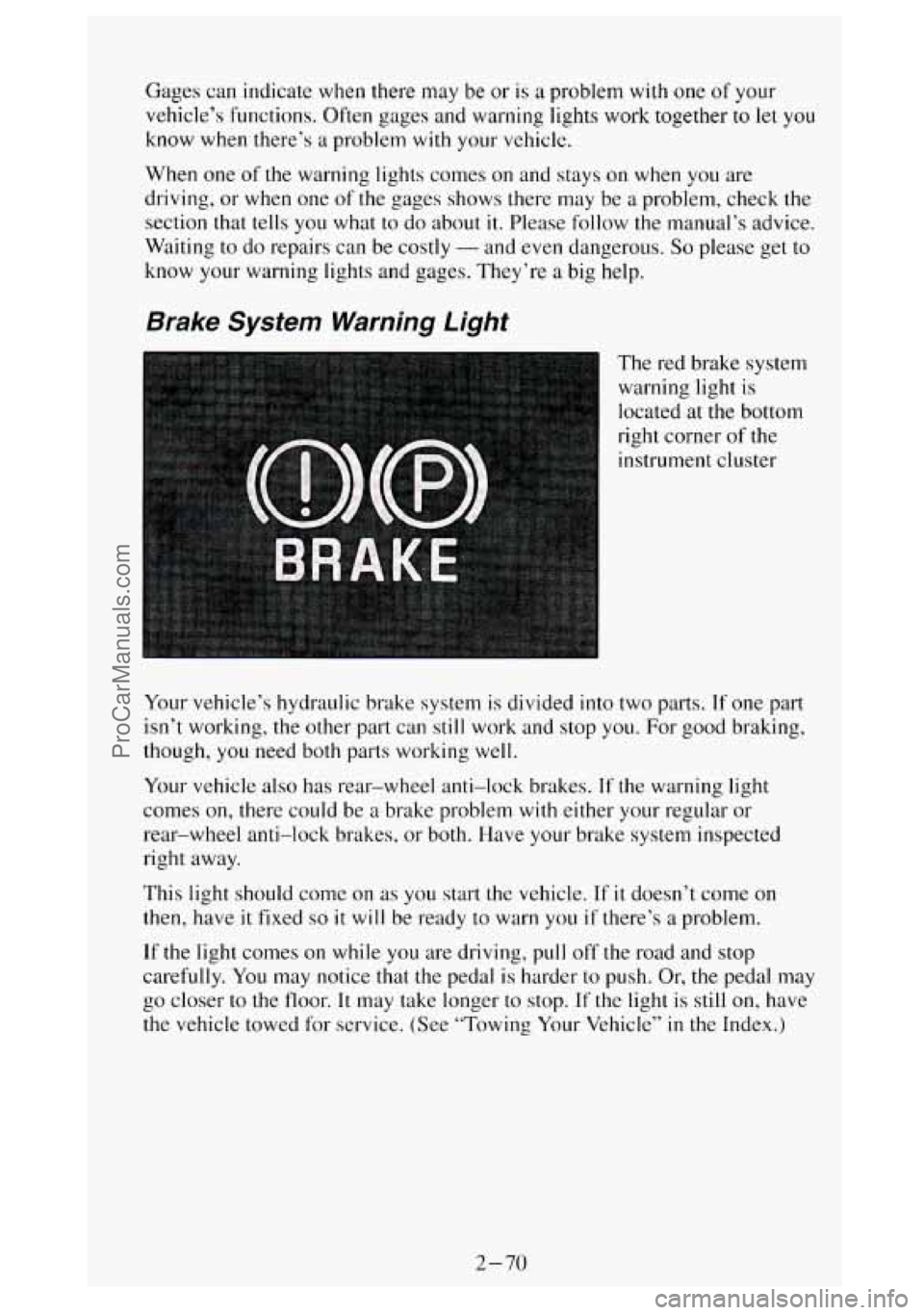
The red brake system
warning light is
located at the bottom
right corner
of the
instrument cluster
Your vehicle’s hydraulic brake system
is divided into two parts. If one part
isn’t working, the other part can still work and stop you. For good braking,
though, you need both parts working well.
Your vehicle also has rear-wheel anti-lock brakes.
If the warning light
comes on, there could be
a brake problem with either your regular or
rear-wheel anti-lock brakes, or both. Have your brake system inspected
right away.
This light should come on
as you start the vehicle. If it doesn’t come on
then, have it fixed so it will be ready to warn you if there’s a problem.
If the light comes on while you are driving, pull off the road and stop
carefully.
You may notice that the pedal is harder to push. Or, the pedal may
go closer
to the floor. It may take longer to stop. If the light is still on, have
the vehicle towed for service. (See “Towing Your Vehicle”
in the Index.)
2-70
ProCarManuals.com
Page 145 of 404

Air Vents
If your vehicle does not have air conditioning, there are air vents be\
low the
instrument panel.
- Use the handles below
your steering wheel,
with the vent symbols
on them, to open and
close the vents.
If your vehicle has air
conditioning, you will
find air vents in the center and on the sides
of your instrument
panel.
You can move the vents grilles from side to side or up and down to direct
the flow of air,
or close the vents altogether.
When you close a vent, it will increase the flow of air coming out of any
vents that are open.
3-3
ProCarManuals.com
Page 165 of 404
Your Driving and the Road
Section
Here you’ll find information about driving on different kinds of roads and in
varying weather conditions . We’ve also included many other useful tips on
driving .
Defensive Driving .......................................... 4-2
DrunkenDriving
........................................... 4-2
Control of
a Vehicle
Braking
................................................ 4-5
Steering
................................................ 4-8
Steering Tips
............................................ 4-8
Passing
............................................... 4-10
Lossofcontrol
......................................... 4-11
Off-Road Driving With Your Four-wheel Drive Vehicle
.......... 4-13
DrivingatNight
........................................... 4-24
Driving
in the Rain ........................................ 4-26
CityDriving
.............................................. 4-28
Freeway Driving
.......................................... 4-29
Hill and Mountain Roads ....................... ......... 4-31
WinterDriving
............................................ 4-33
Power Winches
........................................... 4-36
PowerTake-Off
........................................... 4-37
TowingaTrailer
........................................... 4-38
4-1
ProCarManuals.com