ignition GMC SIERRA 1994 Owner's Manual
[x] Cancel search | Manufacturer: GMC, Model Year: 1994, Model line: SIERRA, Model: GMC SIERRA 1994Pages: 404, PDF Size: 20.91 MB
Page 132 of 404
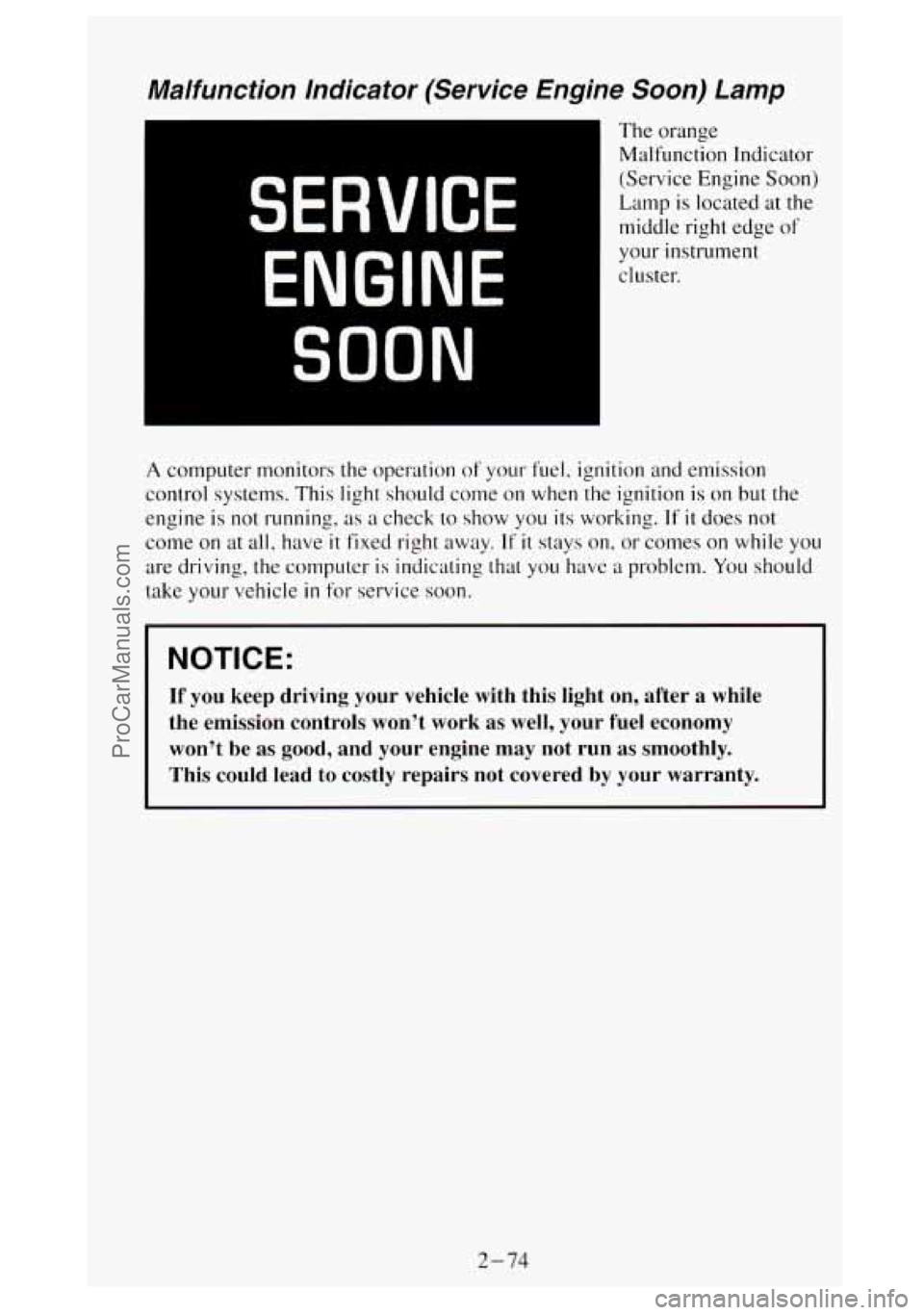
Malfunction Indicator (Service Engine Soon) Lamp
The orange
SERVICE
ENGINE
SOON
A computer monitors the operation of your fuel, ignition and emission
control systems. This light should come on when the ignition
is on but the
engine is not running,
as a check to show you its working. If it does not
come
on at all, have it fixed right away. If it stays on, or comes on while you
are driving, the computer is indicating that you have a problem. You should
take your vehicle in for service soon.
NOTICE:
If you keep driving your vehicle with this light on, after a while
the emission controls won’t work
as well, your fuel economy
won’t be as good, and your engine may not run as smoothly.
This could lead to costly repairs not covered by your warranty.
2-74
ProCarManuals.com
Page 136 of 404
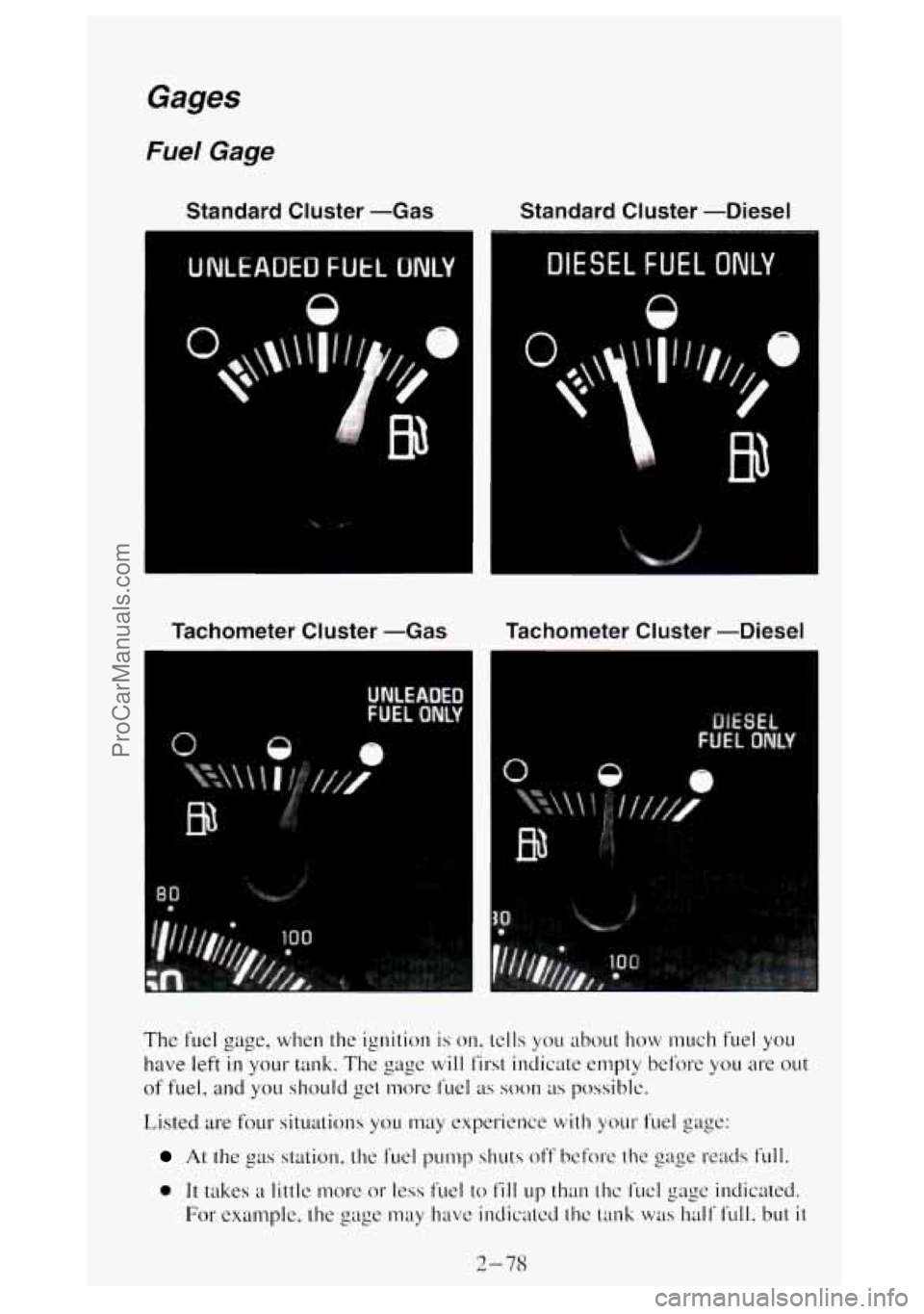
Gages
Fuel Gage
Standard Cluster -Gas Standard Cluster --Diesel
Tachometer Cluster -Gas Tachometer Cluster --Diesel
The fuel gage, when the ignition is on. tclls you about how much fuel you
have left
in your tank. The gage will first indicate empty before you are out
of fuel, and you should get Inore fuel as soon 11s possiblc.
Listed are four situations you may experience
with your fuel gage:
At the gas station. the fuel pump shuts off before the gage reads full.
0 It takes a little more or less fuel to fill up than thc I’wI gage indicated.
For example, the gage may have indicatcd thc tank was half full. but it
2-78
ProCarManuals.com
Page 137 of 404
actually took a little more or less than half the tank’s capacity to fill the
tank.
The gage moves a little when you turn a corner or speed up.
The gage doesn’t go back to empty when you turn off the ignition.
None of these indicate a problem with
the fuel gage.
For information on how to
fill your fuel tank, see “Fuel - Filling Your
Tank”
in the Index.
For your fuel tank capacity, see
“Fuel --Tank Capacity” in the Index.
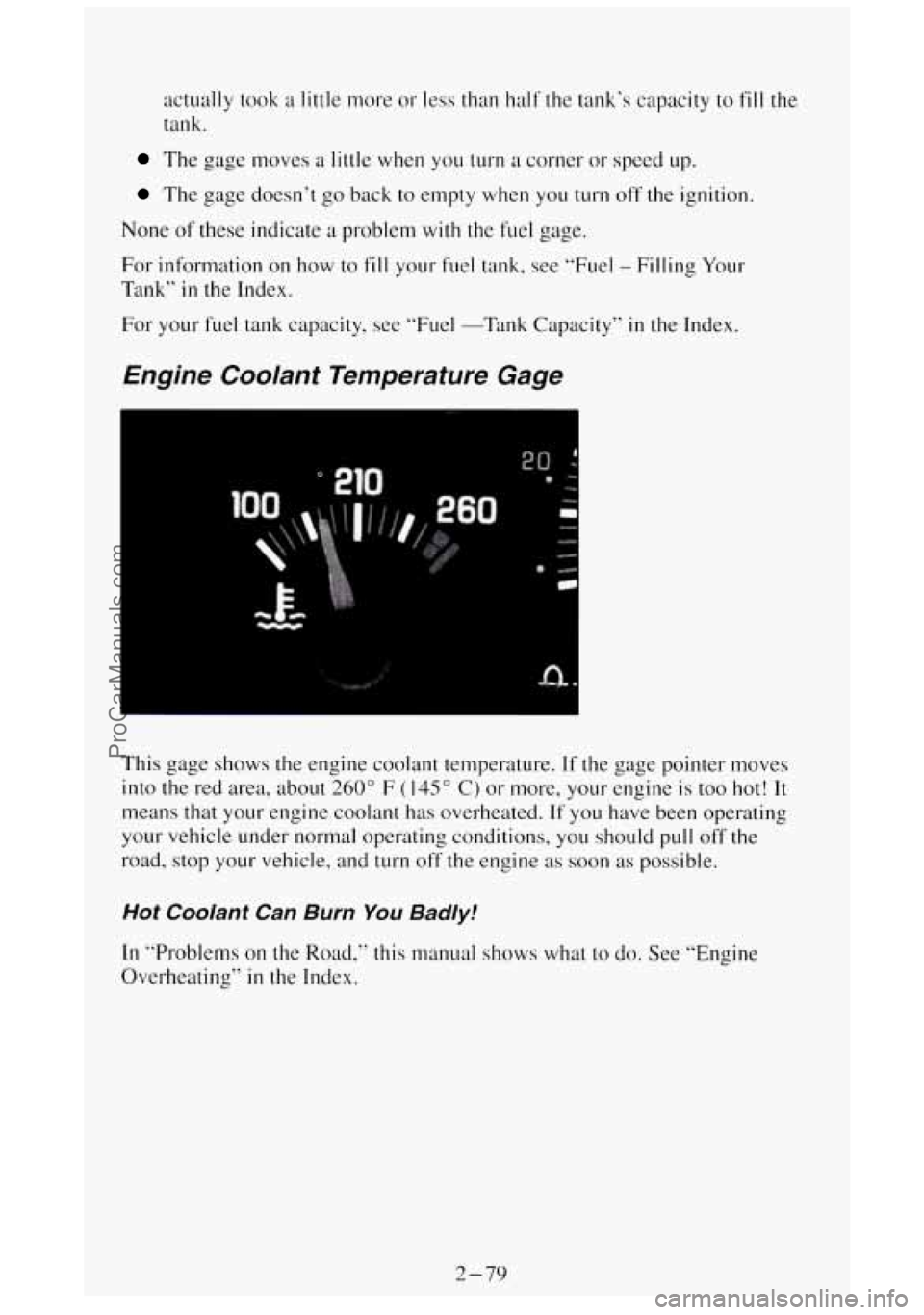
Engine Coolant Temperature Gage
This gage shows the engine coolant temperature. If the gage pointer moves
into the red area, about
260” F ( 145” C) or more, your engine is too hot! It
means that your engine coolant has overheated. If you have been operating
your vehicle under normal operating conditions, you should pull off the
road, stop
your vehicle, and turn off the engine as soon as possible.
Hot Cooianf Can Burn You Badly!
In “Problems on the Road,” this ~nanual shows what to do. See “Engine
Overheating”
in the Index.
2-79
ProCarManuals.com
Page 151 of 404
I NOTICE:
Scraping the inside of your rear window could cut and damage
the defogger. Your warranty would not cover this damage. And,
don’t put decals there, you might have to scrape them
off.
For best results, clear the window of as much snow or ice as possible first.
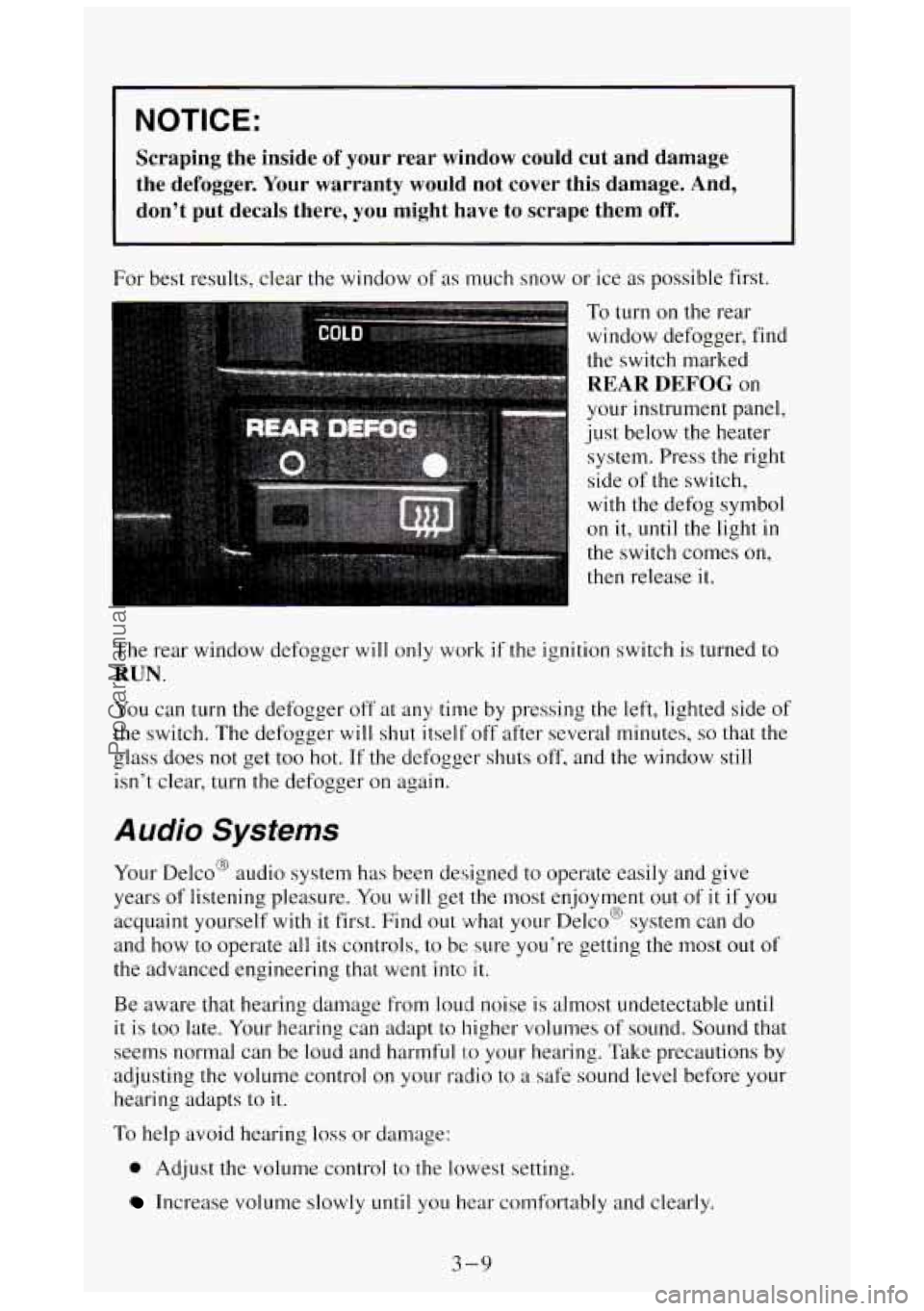
To turn on the rear
window defogger, find
the switch marked
REAR DEFOG on
your instrument panel,
just below the heater
system. Press the right
side
of the switch,
with the defog symbol
on it,
until the light in
the switch comes on,
then release
it.
The rear window defogger will only work if the ignition switch is turned to
RUN.
You can turn the defogger off at any time by pressing the left, lighted side of
the switch. The defogger will shut itself off after several minutes, so that the
isn’t clear, turn
the defogger on again.
a olass does not get too hot. If the defogger shuts off, and the window still
Audio Systems
Your Delco@ audio system has been designed to operate easily and give
years of listening pleasure.
You will get the. most enjoyment out of it if you
acquaint yourself with
it first. Find out what your Delco@ system can do
and
how to operate all its controls, to be sure you’re getting the most out of
the advanced engineering that went into
it.
Be aware that hearing damage from loud noise is almost undetectable until
it is too late. Your hearing can adapt to higher volumes of sound. Sound that
seems normal can be loud and harmful
I:O your hearing. Take precautions by
adjusting the volume control
on your radio to a safe sound level before your
hearing adapts to it.
To help avoid hearing loss or damage:
0 Adjust the volume control to the lowest setting.
Increase volume slowly until you hear comfortably and clearly.
3-9
ProCarManuals.com
Page 154 of 404
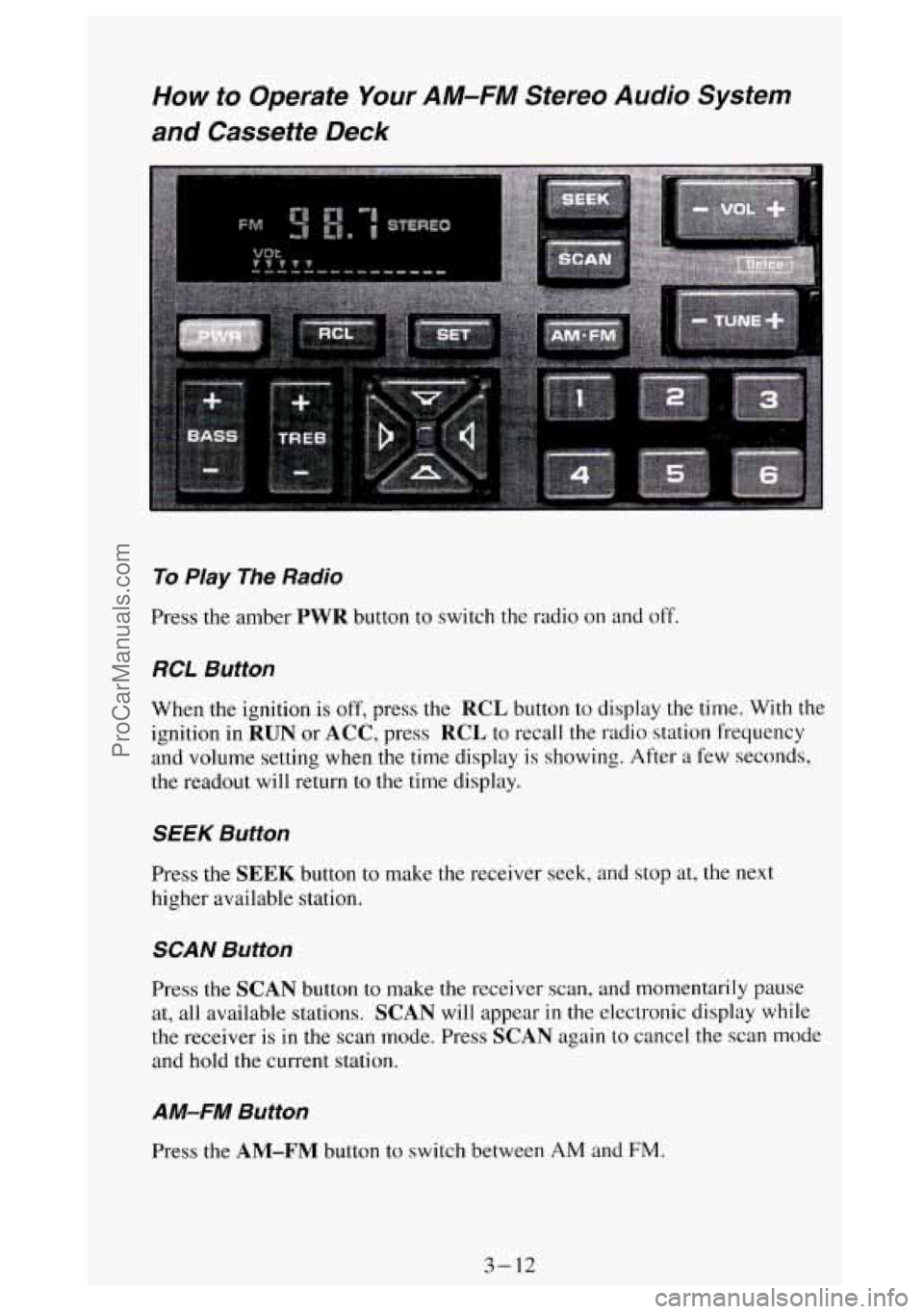
How to Operate Your AM-FM Stereo Audio System
and Cassette Deck
To Play The Radio
Press the amber PWR button to switch the radio on and off.
RCL Button
When the ignition is off, press the RCL button to display the time. With the
ignition in
RUN or ACC, press RCL to recall the radio station frequency
and volume setting when the time display is showing. After
a few seconds,
the readout will return
to the time display.
SEEK Button
Press the SEEK button to make the receiver seek, and stop at, the next
higher available station.
SCAN Button
Press the SCAN button to make the receiver scan, and momentarily pause
at, all available stations.
SCAN will appear in the electronic display while
the receiver is
in the scan mode. Press SCAN again to cancel the scan mode
and hold the current station.
AM-FM Button
Press the AM-FM button to switch between AM and FM.
3-12
ProCarManuals.com
Page 158 of 404
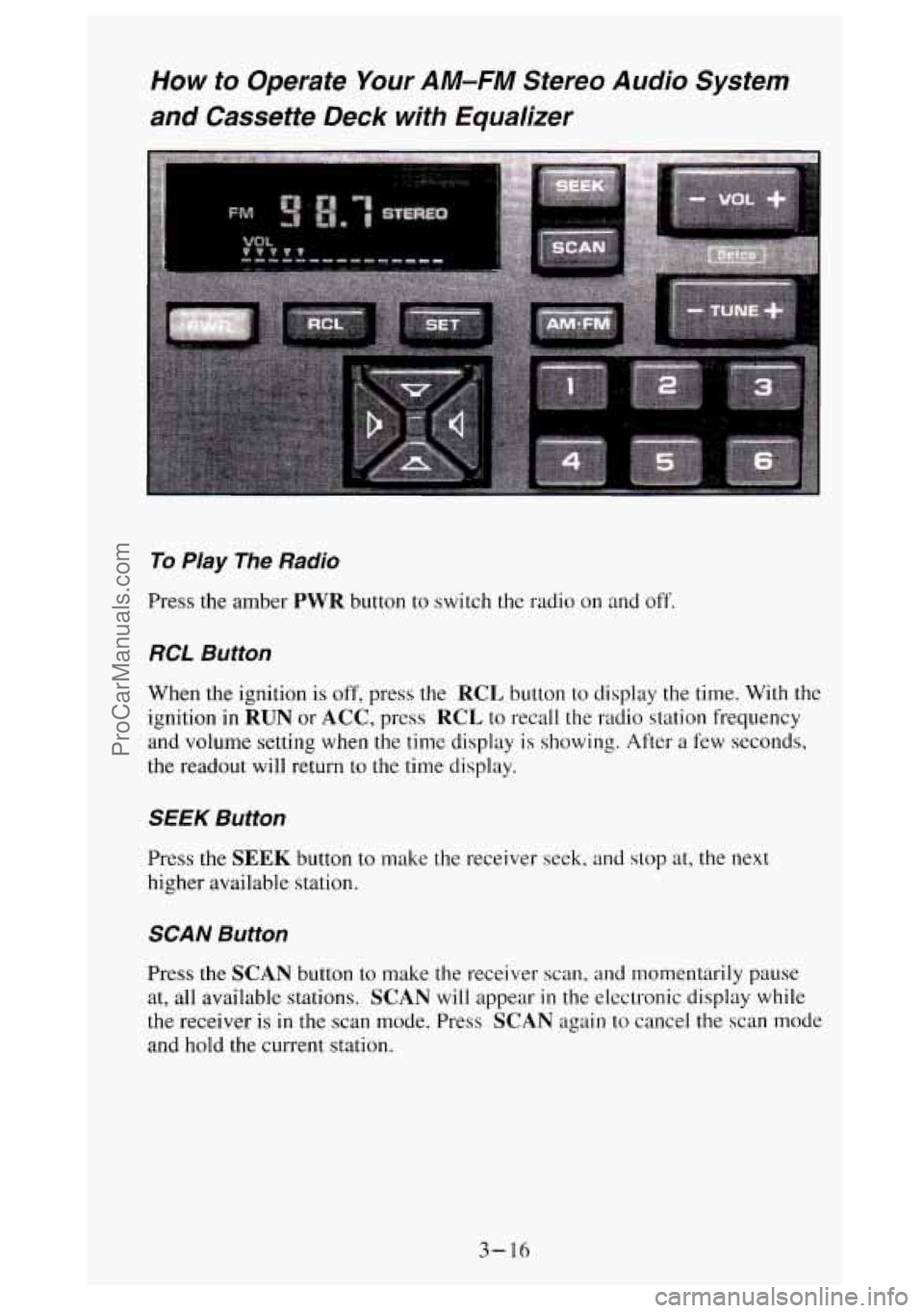
How to Operate Your AM-FM Stereo Audio System
and Cassette Deck with Equalizer
To Play The Radio
Press the amber PWR button to switch the radio on and off.
RCL Button
When the ignition is off, press the RCL button to display the time. With the
ignition
in RUN or ACC, press RCL to recall the radio station frequency
and volume setting when the time display is showing. After a few seconds,
the readout will return to
the time display.
SEEK Button
Press the SEEK button to make the receiver seek, and stop at, the next
higher available station.
SCAN Button
Press the SCAN button to make the receiver scan, and momentarily pause
at, all available stations.
SCAN will appear in the electronic display while
the receiver is
in the scan mode. Press SCAN again to cancel the scan mode
and hold the current station.
3-16
ProCarManuals.com
Page 187 of 404
Hard packed snow and ice offer the worst tire traction. On these surfxes,
it’s very easy to lose control. On wet ice, for example, the traction
is so poor
that you will have difficulty accelerating. And
if you do get moving, poor
steering and difficult braking can cause you to slide out of control.
Driving In Water
Light rain causes no special off-road driving problems. But heavy rain can
mean flash flooding, and flood waters demand extreme caution.
Find out how deep the water is before you drive through it. If it’s deep
enough to cover your wheel hubs, axles, or exhaust pipe, don’t try
it - you
probably won’t get through.
Also, water that deep can damage your axle and
other vehicle parts.
If the water isn’t too deep, then drive through it slowly. At fast speeds, water
splashes on your ignition system and your vehicle can stall. Stalling can
also
occur if you get your tailpipe under water. And, as long as your tailpipe is
under water, you’ll never be able
to start your engine. When you go through
water, remember that when your brakes get wet, it may take you longer to
stop.
If you have
a diesel engine, see “Driving Through Water (Diesel Engines)”
in the Index for more information
on driving through water.
4-23
ProCarManuals.com
Page 212 of 404
To Jump Start Your Vehicle
1. Check the other vehicle. It must have a 12-volt battery with a negative
ground system.
I NOTICE:
If the other system isn’t a 12-volt system with a negative
ground, both vehicles can be damaged.
If you have a diesel engine vehicle with two batteries (or more), you
should know before
you begin that, especially in cold weather, you may
not be able to get enough power from
a single battery in another
vehicle to start your diesel engine.
If your vehicle
has more than one battery, use the battery that’s on the
passenger side
of the vehicle - this will reduce electrical resistance.
sure the vehicle’s aren’t touching each other.
If they are, it could cause
a ground connection you don’t want. You wouldn’t be able to start your
vehicle, and the bad grounding could damage
the electrical systems.
You could be injured
if the vehicles roll. Set the parking brake firmly
on each vehicle. Put an automatic transmission
in “P” (Park) or a
manual transmission in “N” (Neutral). If you have a four-wheel-drive
vehicle, be sure
the transfer case is not in “N” (Neutral).
2. Get the vehicles
close enough
so the jumper cables can reach, but be
3. Turn off the ignition on both vehicles. Turn off all lights that aren’t
needed, and radios. This will avoid sparks and help save both batteries.
And it could save
your radio!
NOTICE:
If you leave your radio on, it could be badly damaged. The
repairs wouldn’t be covered by your warranty.
4. Open the hoods and locate the batteries. Find the positive (+) and
negative
(-) terminals on each battery.
5-4
ProCarManuals.com
Page 216 of 404
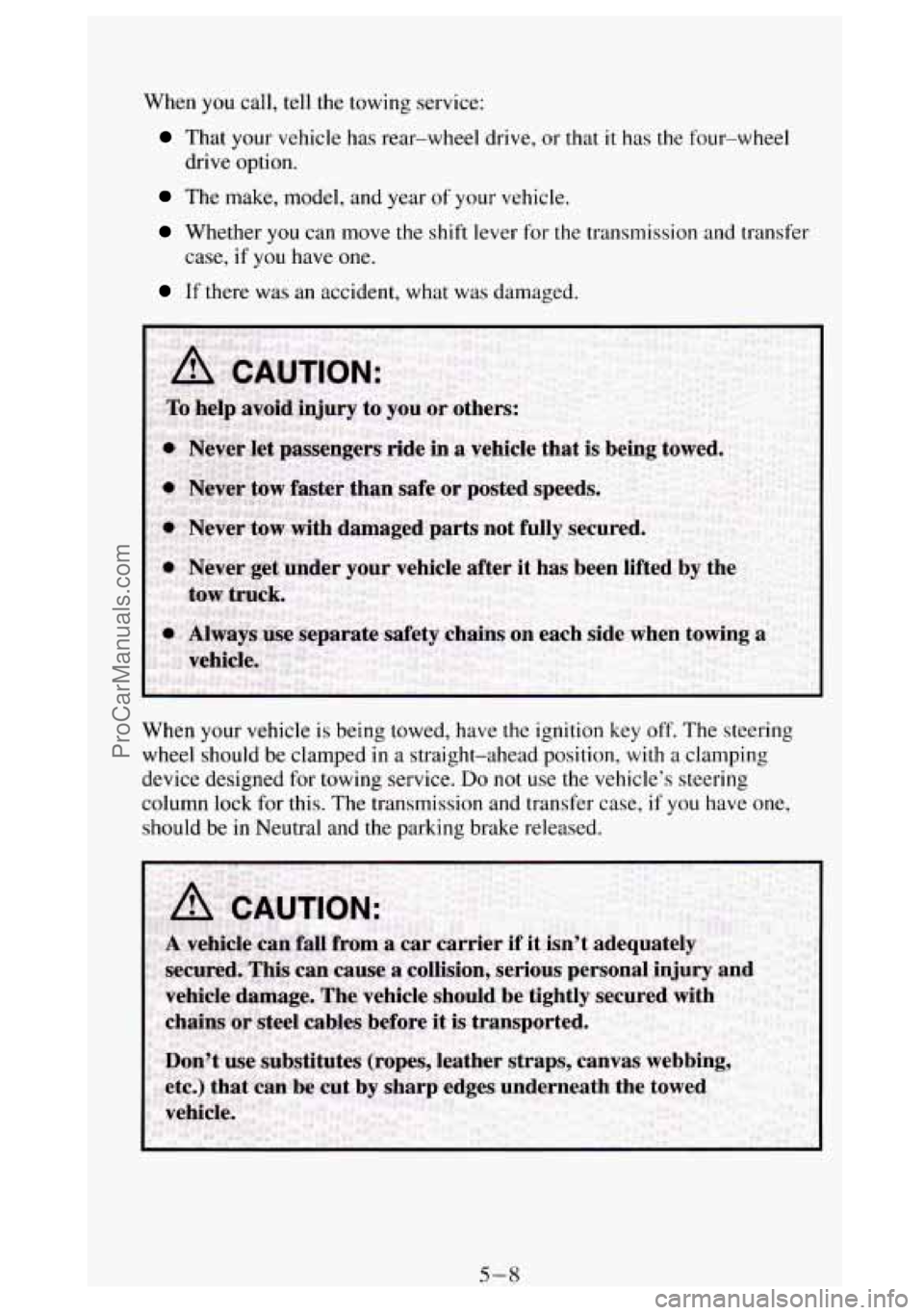
When you call, tell the towing service:
That your vehicle has rear-wheel drive, or that it has the four-wheel
drive option.
The make, model, and year of your vehicle.
Whether you can move the shift lever for the transmission and transfer
case,
if you have one.
If there was an accident, what was damaged.
1
When your vehicle is being towed, have the ignition key off. The steering
wheel should be clamped
in a straight-ahead position, with a clamping
device designed for towing service.
Do not use the vehicle’s steering
column lock for this. The transmission and transfer case,
if you have one,
should be in Neutral and
the parking brake released.
5-8
ProCarManuals.com
Page 260 of 404
~ NOTICE:
If
there is water in your diesel fuel and the weather is warm or
humid, fungus and bacteria can grow in the fuel. They can
damage your fuel system. You'll need
a diesel fuel biocide to
sterilize your fuel system. Your dealer can advise you if you ever
need this.
If your fuel tank needs to be purged to remove water, see your
dealer or
a qualified technician. Improper purging can damage
your fuel system.
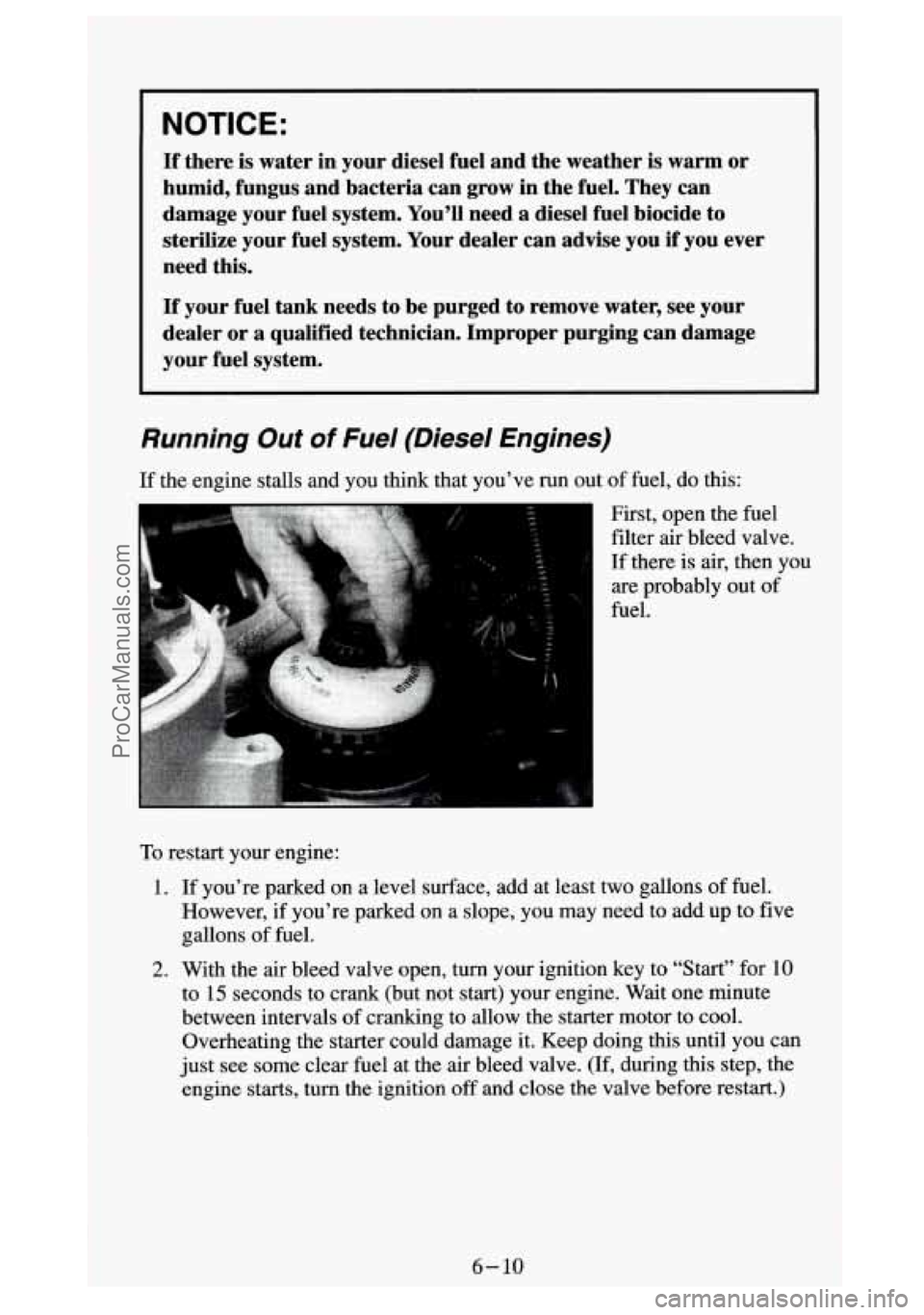
Running Out of Fuel (Diesel Engines)
If the engine stalls and you think that you've run out of fuel, do this:
First, open the fuel
filter
air bleed valve.
If there is air, then you are probably out of
fuel.
To restart your engine:
1. If you're parked on a level surface, add at least two gallons of fuel.
However, if you're parked on a slope, you may need to add up to five
gallons of fuel.
2. With the air bleed valve open, turn your ignition key to "Sta\
rt" for 10
to 15 seconds to crank (but not start) your engine. Wait one minut\
e
between intervals of cranking to allow the starter motor to cool.
Overheating the starter could damage it. Keep doing this until you can
just see some clear fuel at the air bleed valve. (If, during this ste\
p, the
engine starts, turn the ignition
off and close the valve before restart.)
6-10
ProCarManuals.com