stop start GMC SIERRA 1994 Owner's Manual
[x] Cancel search | Manufacturer: GMC, Model Year: 1994, Model line: SIERRA, Model: GMC SIERRA 1994Pages: 404, PDF Size: 20.91 MB
Page 233 of 404
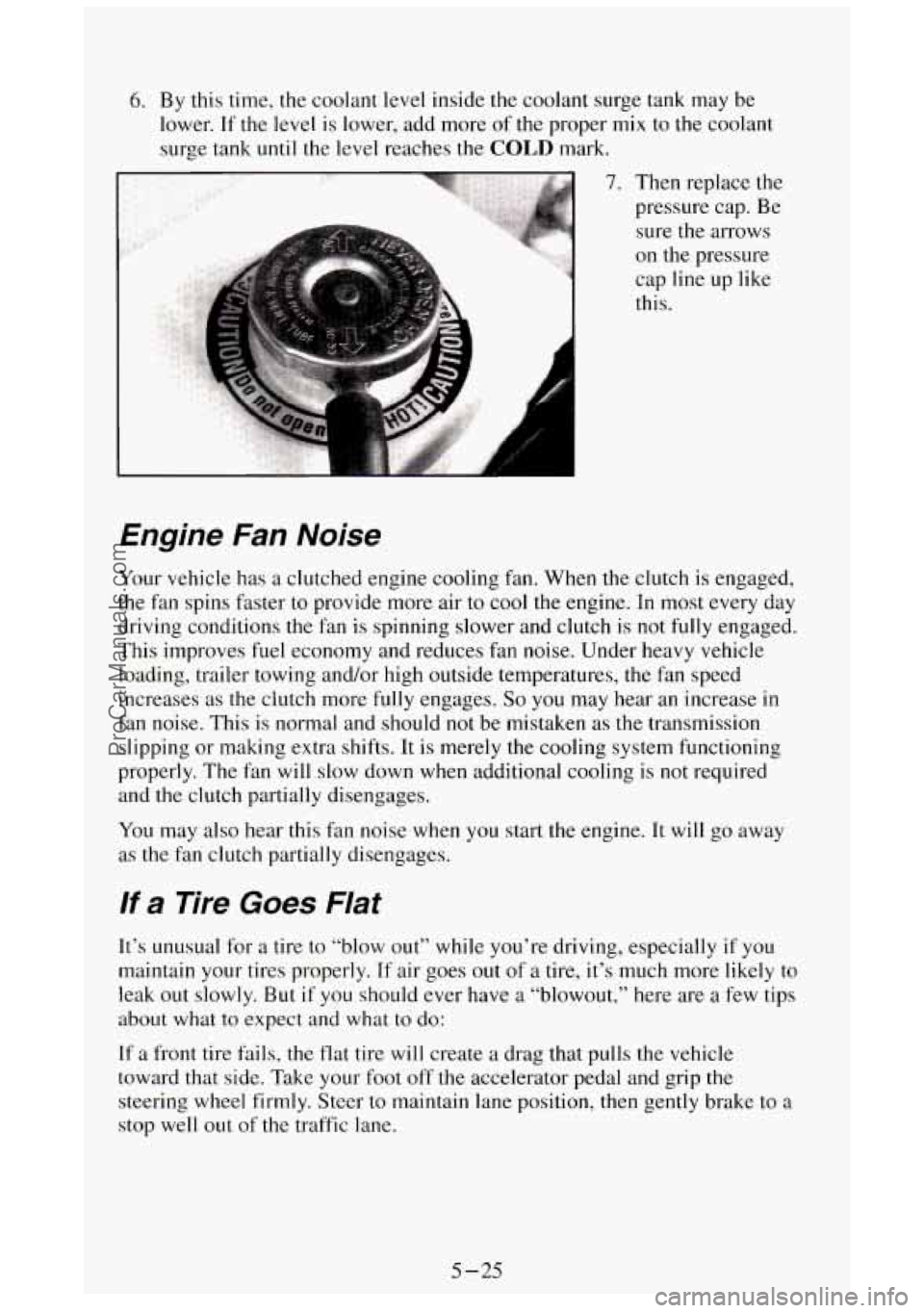
..I . ... . ;. ..
Engine Fan Noise
Your vehicle has a clutched engine cooling fan. When the clutch is engaged,
the fan spins faster
to provide more air to cool the engine. In most every day
driving conditions
the fan is spinning slower and clutch is not fully engaged.
This improves fuel economy and reduces fan noise. Under heavy vehicle
loading, trailer towing and/or high outside temperatures, the fan speed
increases as
the clutch more fully engages. So you may hear an increase in
fan noise. This is normal and should not be mistaken as the transmission
slipping or making extra shifts. It is merely the cooling system functioning
properly. The fan will slow down when additional cooling is not required
and
the clutch partially disengages.
You may also hear
this fan noise when you start the engine. It will go away
as
the fan clutch partially disengages.
If a Tire Goes Flat
It’s UfluSual for a tire to “blow out” while you’re driving, especially if you
maintain your tires properly. If air goes out of a tire, it’s much more likely to
leak
out slowly. But if you should ever have a “blowout,’’ here are a few tips
about what
to expect and what to do:
If a front tire fails, the flat tire will create a drag that pulls the vehicle
toward that side. Take your foot off
the accelerator pedal and grip the
steering wheel firmly. Steer to maintain lane position, then gently brake to a
stop well
out of the traffic lane.
5-25
ProCarManuals.com
Page 256 of 404
Fuel Requirements
NOTICE:
Diesel fuel or fuel additives not recommended in this manual
could damage your fuel system and engine. Your warranty
wouldn’t cover this damage. And:
Diesel fuel that has been mixed with engine oil could damage
your engine and emission controls. Always check with your
service station operator to make sure his diesel fuel has not
been mixed with engine oil.
If you ever run out of diesel fuel, it can be difficult to restart
your engine. “Running Out of Fuel,” later in this section, tells
you how to get it started again.
To avoid all this, try never to
let your tank get empty.
What Fuel to Use
For best results, use number 2-D diesel fuel year-round (above and below
freezing conditions) as oil companies blend number
2-D fuel to address
climate differences. Number
1-D diesel fuel may be used in below freezing
weather, however, it will produce a power and
fuel economy loss. The use
of number
1-D diesel fuel in warm or hot climates may result in stalling,
poor starting when the engine
is hot and may damage the fuel injection
system.
Diesel fuel may foam when you fill your tank. This can cause the automatic
pump nozzle to shut off, even though your tank isn’t full. If this happens,
just wait for the foaming to stop and then continue to
fill your tank.
A CAUTION:
Heat coming from the engine may cause the fuel to expand and
force the fuel out of your tank. If something ignites the fuel,
a
fire could start and people could be burned. To help avoid this,
fill your fuel tank only until the automatic nozzle shuts
off.
Don’t try to “top it off.”
6-6
ProCarManuals.com
Page 259 of 404
1
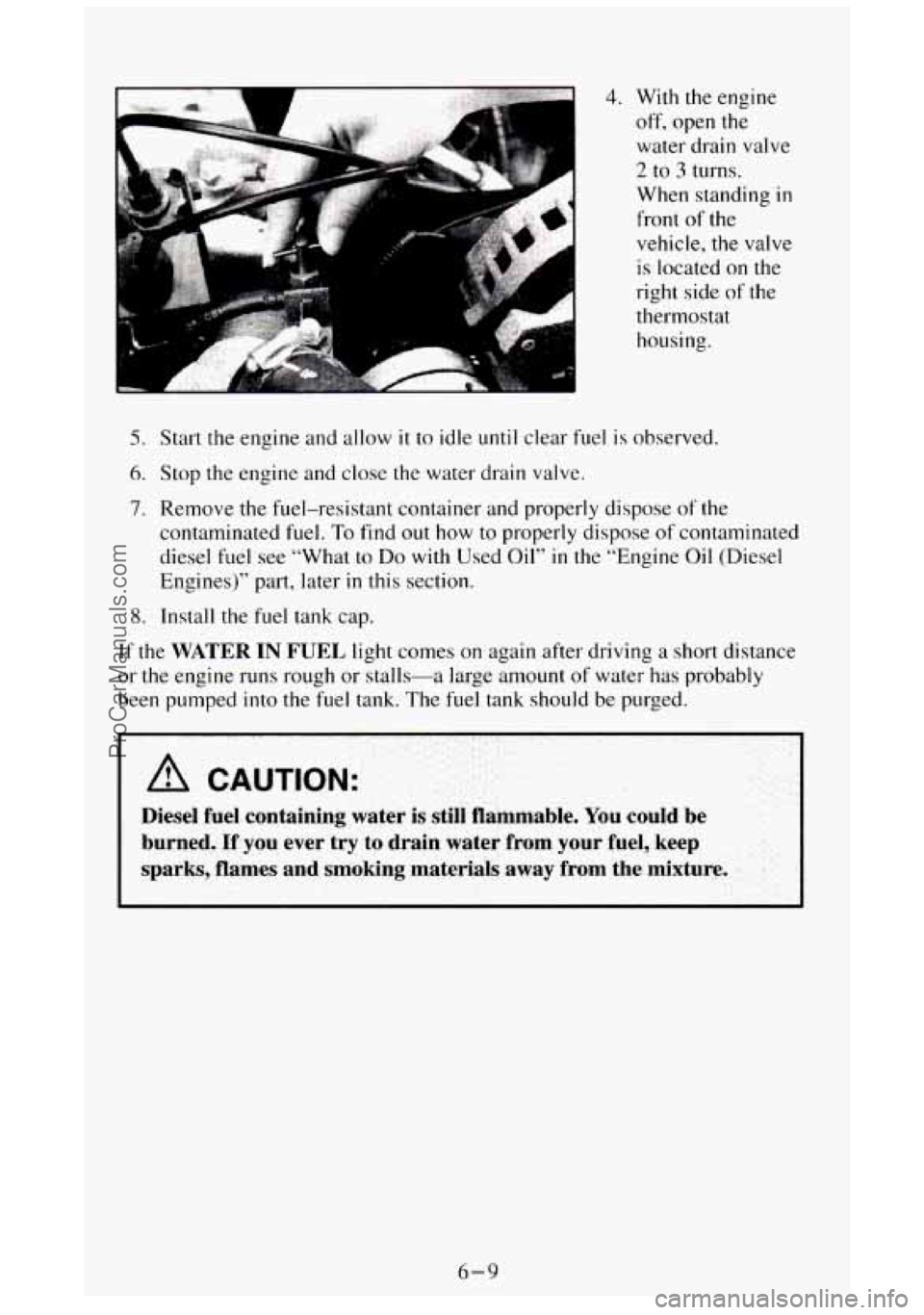
I 4. With the engine
off, open the
water drain valve
2 to 3 turns.
When standing
in
front of the
vehicle, the valve
is located on the
right side of the
thermostat
housing.
5. Start the engine and allow it to idle until clear fuel is observed.
6. Stop the engine and close the water drain valve.
7. Remove the fuel-resistant container and properly dispose of the
contaminated
fuel. To find out how to properly dispose of contaminated
diesel fuel see “What to Do with Used
Oil” in the “Engine Oil (Diesel
Engines)” part, later
in this section.
8. Install the fuel tank cap.
If the WATER IN FUEL light comes on again after driving a short distance
or
the engine runs rough or stalls-a large amount of water has probably
been pumped into the fuel tank. The
fuel tank should be purged.
A CAUTION:
Diesel fuel containing water is still flammable. You could be
burned. If
you ever try to drain water from your fuel, keep
sparks, flames
and smoking materials away from the mixture.
6-9
ProCarManuals.com