tires GMC SIERRA 1994 Owner's Manual
[x] Cancel search | Manufacturer: GMC, Model Year: 1994, Model line: SIERRA, Model: GMC SIERRA 1994Pages: 404, PDF Size: 20.91 MB
Page 237 of 404
Jack Storage
Your jack and wheel ratchet are behind the passenger seat. Turn the wing
nut to the left and remove the cover if there is one.
Spare Tire Storage-Underbody Carrier
Remember, never remove or restow a tire from or to a stowage position
under the vehicle while the vehicle is supported only by a
jack.
Spare Tire
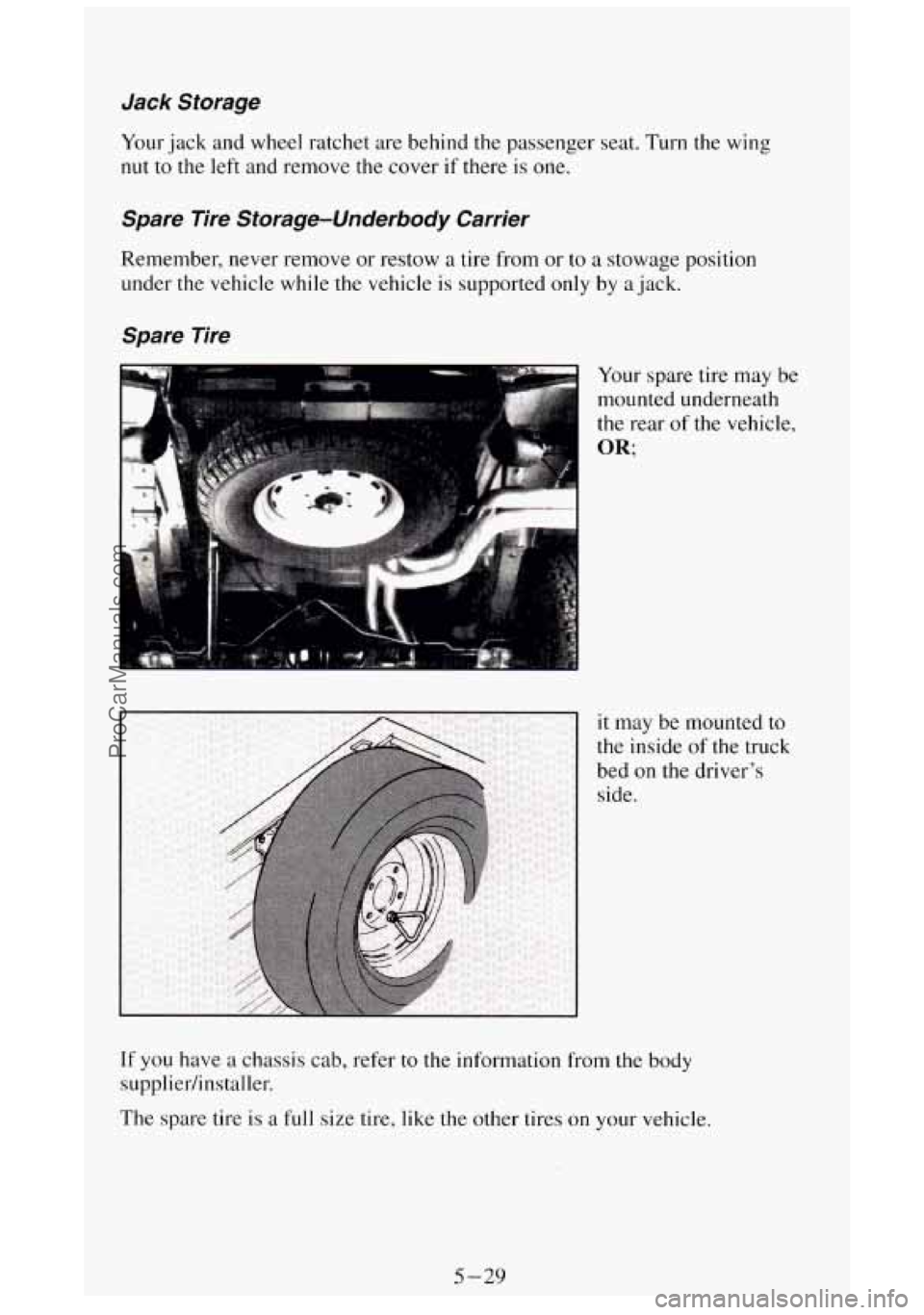
Your spare tire may be
mounted underneath
the rear
of the vehicle,
OR;
it may be mounted to
the inside
of the truck
bed on the driver’s
side.
If you have a chassis cab, refer to the information from the body
supplier/installer.
The spare tire is
a full size tire, like the other tires on your vehicle.
5-29
ProCarManuals.com
Page 249 of 404

NOTICE:
~ ~ ~~ ~~
Spinning your wheels can destroy parts of your vehicle as well\
as
the tires. If you spin the wheels too fast while shifting your back
and forth, you can destroy your
.
Rocking your vehicle to get it out:
First, turn your steering wheel left and right. That will clear the area around
your front wheels. Then shift back and forth between
“R’ (Reverse) and a
forward gear (or with a manual
, between First or Second gear and Reverse),
spinning the wheels as little as possible. Release the accelerator pedal while
you shift, and press lightly on the accelerator pedal when the\
is in gear. If
that doesn’t get you out after a few tries, you may need to be towed out. Or,
you can use your recovery hooks,
if your vehicle has them. If you do need
to be towed out, see “Towing Your Vehicle” in the Index.
Using the Recovery Hooks
If you ever get stuck in sand, mud, ice or snow, your vehicle may be
equipped with recovery hooks. The recovery hooks are provided at the front
of your vehicle. You may need to use them
if you’re stuck off-road and
need to be pulled to some place where you can continue drivin\
g.
5-41
ProCarManuals.com
Page 252 of 404
Checking Things Under the Hood (continued)
Windshield Washer Fluid
................................. 6-45
Brake Master Cylinder
................................... 6-46
Replacing Brake System Parts
................................ 6-49
Other Maintenance Items
.................................... 6-49
Windshield Wiper Blade Inserts
.............................. 6-50
FluidLeakCheck
.......................................... 6-51
Lubrication
............................................... 6-51
Battery .................................................. 6-52
Vehiclestorage
......................................... 6-52
Bulb Replacement
......................................... 6-53
Fuses and Circuit Breakers
.................................. 6-62
Exhaustsystem
........................................... 6-64
Loading Your Vehicle
...................................... 6-64
Tires .................................................... 6-71
Inflation-Tire Pressure
.................................. 6-71
Tire Inspection and Rotation
............................... 6-73
When it’s Time for New Tires
............................. 6-74
Buying New Tires
....................................... 6-76
Uniform Tire Quality Grading
............................. 6-77
Wheel Alignment and Tire Balance
......................... 6-78
Wheel Replacement
..................................... 6-78
Tire Chains
............................................ 6-79
Appearancecare
.......................................... 6-80
Cleaning the Inside of Your Vehicle
......................... 6-81
Cleaning the Outside
of Your Vehicle ....................... 6-84
Appearance Care Materials
.................................. 6-87
Vehicle Identification Number
................................ 6-88
Service Parts Identification
Label ............................. 6-90
Specifications Charts
..................................... 6-91
6-2
ProCarManuals.com
Page 298 of 404
Brake Wear
Your vehicle has front disc brakes and rear drum brakes. If you have a
C 3500 HD model, it has four-wheel disc brakes.
Disc brake pads have built-in wear indicators that make
a high-pitched
warning sound when the brake pads are worn and new pads are needed. The
sound may come and go or be heard
all the time your vehicle is moving
(except when you are pushing on the brake pedal firmly).
The brake wear warning sound means that sooner or later your
brakes won’t work well. That could lead to an accident.
When
you hear the brake wear warning sound, have your vehicle
serviced.
NOTICE:
Continuing to drive with worn-out brake pads could result in
costly brake repair.
Some driving conditions or climates may cause a brake squeal when the
brakes are first applied or lightly applied. This does not mean something is
wrong with your brakes.
If
you have rear drum brakes, they don’t have wear indicators, but if you
ever hear a rear brake rubbing noise, have
the rear brake linings inspected.
Also, the rear brake drums should be removed and inspected each time the
tires are removed for rotation or changing. When you have
the front brakes
replaced, have the rear brakes inspected, too.
Brake linings should always be replaced
as complete axle sets.
Brake Pedal Travel
See your dealer if the brake pedal does not return to normal height, or if
there is a rapid increase in pedal travel. This could be a sign of brake
trouble.
6-48
ProCarManuals.com
Page 315 of 404
Malfunction Indicator
(SERVICE ENGINE SOON) Lamp
The Malfunction Indicator (SERVICE ENGINE SOON) Lamp on your
instrument panel lets you know when
your emission system needs service.
The light
will come on briefly when you start your engine to let you know
that the system is working. If
it does not come on when you start your
engine,
or if it comes on and stays on while you’re driving, your system
may need service. Your vehicle should still be driveable, but
you should
have your system serviced right away.
Secondary Air hjection Reaction (AIR) System
You may have this system. It has a control valve that will direct air to where
it is needed. If the AIR system needs service, your Malfunction Indicator
(SERVICE ENGINE SOON) Lamp on your instrument panel will come on.
Loading Your Vehicle
SEE OWNERS MANUAL FOR ADDITIONAL INFORMATION
BlKG
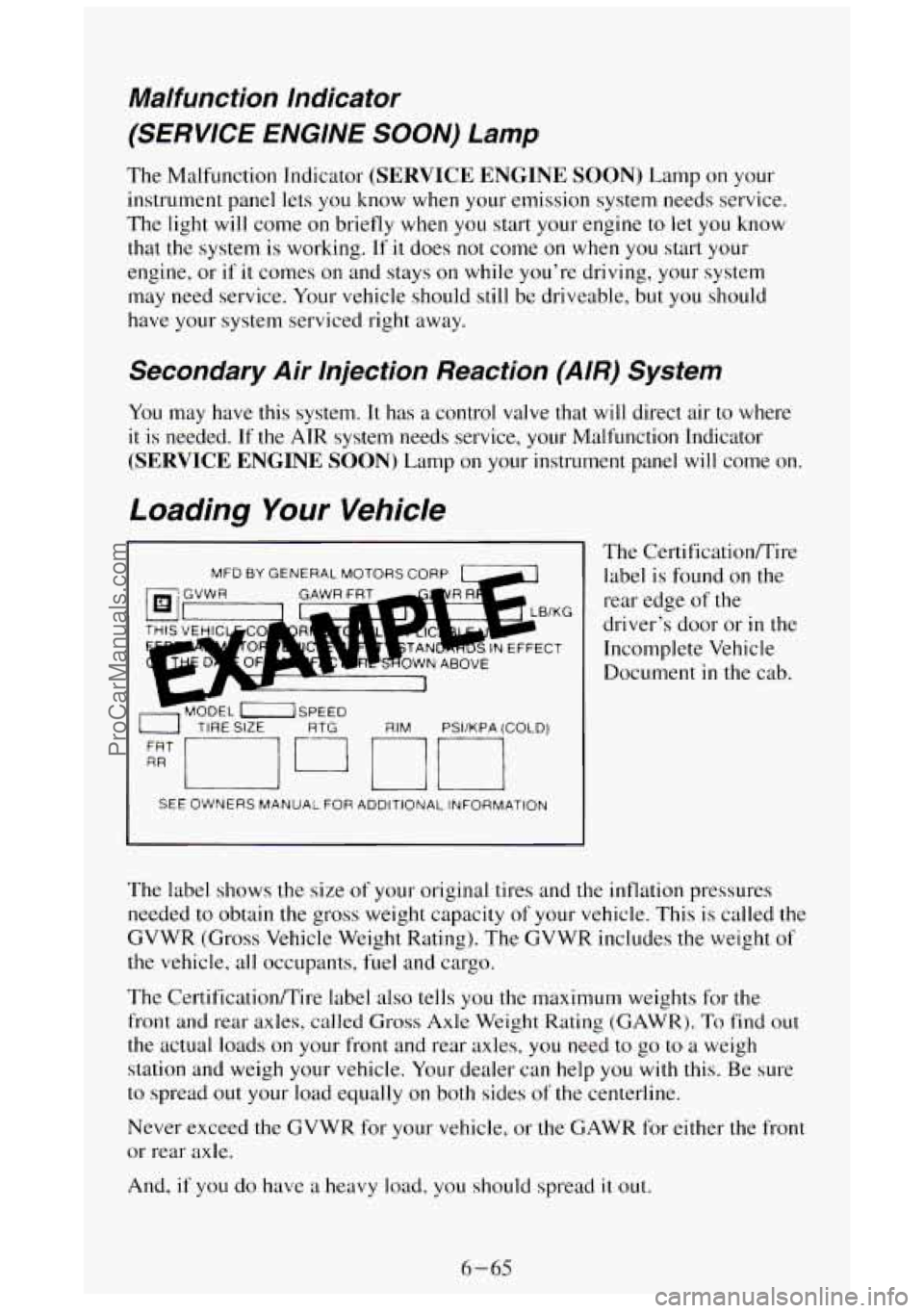
The Certification/Tire
label is found on the
rear edge of the
driver’s door or
in the
Incomplete Vehicle
Document
in the cab.
The label shows
the size of your original tires and the inflation pressures
needed to obtain the gross weight capacity of your vehicle. This is called the
GVWR (Gross Vehicle Weight Rating). The GVWR includes the weight of
the vehicle, all occupants, fuel and cargo.
The Certification/Tire label also tells
you the maximum weights for the
front and rear axles, called Gross Axle Weight Rating (GAWR). To find out
the actual loads on your front and rear axles, you need to go to a weigh
station and weigh your vehicle. Your dealer can help you
with this. Be sure
to spread out your load equally
on both sides of the centerline.
Never exceed the GVWR for your vehicle, or
the GAWR for either the front
or rear axle.
And,
if you do have a heavy load, you should spread it out.
6-65
ProCarManuals.com
Page 321 of 404
Tires
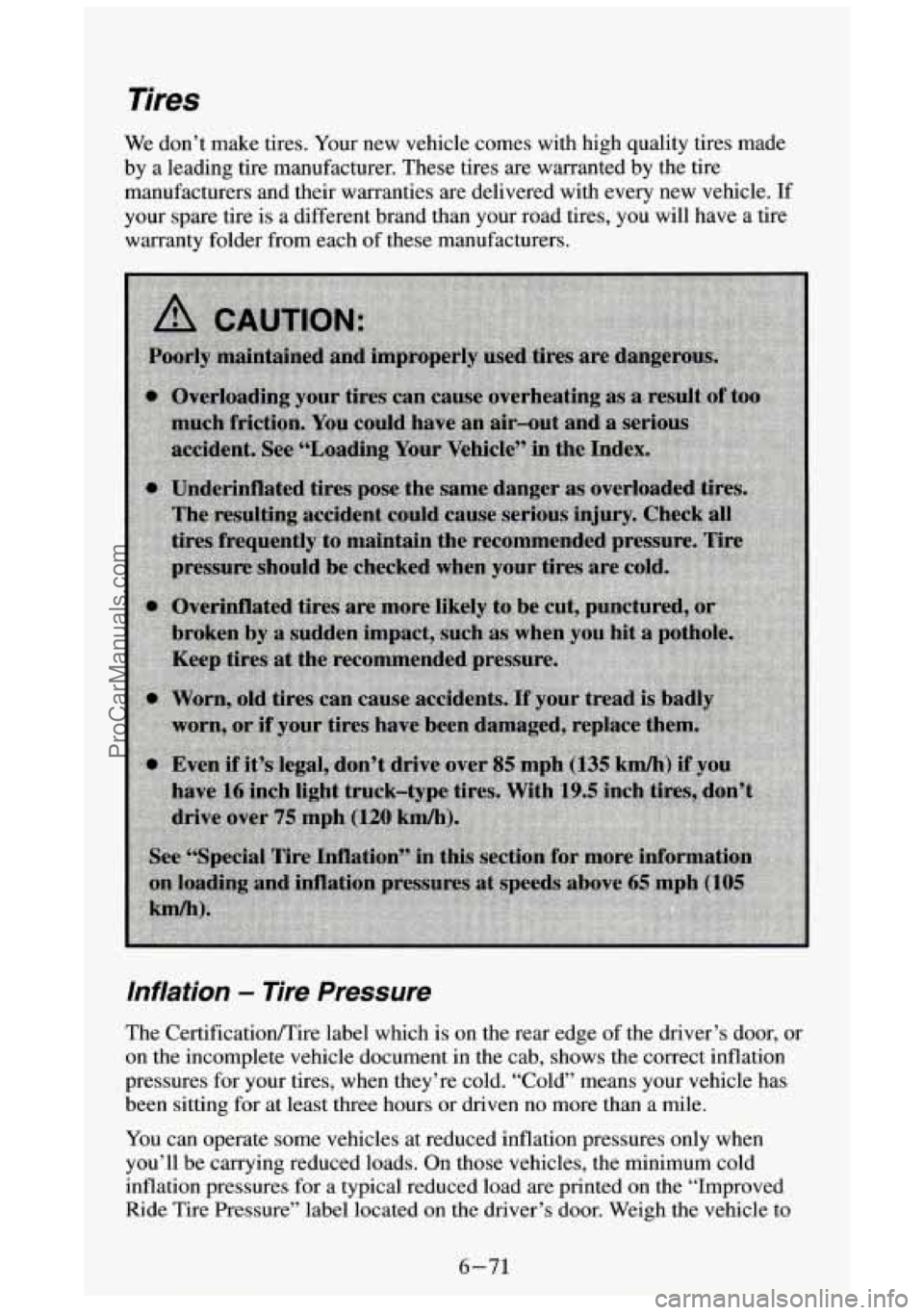
We don’t make tires. Your new vehicle comes with high quality tires made
by a leading tire manufacturer. These tires
are warranted by the tire
manufacturers and their warranties are delivered with
every new vehicle. If
your spare tire is a different brand than your road tires, you will have a tire
warranty folder from each of these manufacturers.
Inflation - Tire Pressure
The Certificatioflire label which is on the rear edge of the driver’s door, or
on the incomplete vehicle document in the cab, shows the correct inflation
pressures for your tires, when they’re cold. “Cold” means your vehicle has
been sitting for at least three hours or driven no more than a mile.
You can operate some vehicles at reduced inflation pressures only when
you’ll be carrying reduced loads. On those vehicles, the minimum cold
inflation pressures for a typical reduced load are printed on the “Improved
Ride Tire Pressure’’ label located on the driver’s door. Weigh the vehicle to
6-71
ProCarManuals.com
Page 322 of 404
find the load on each tire and see the label for the minimum cold inflation
pressures
for that load.
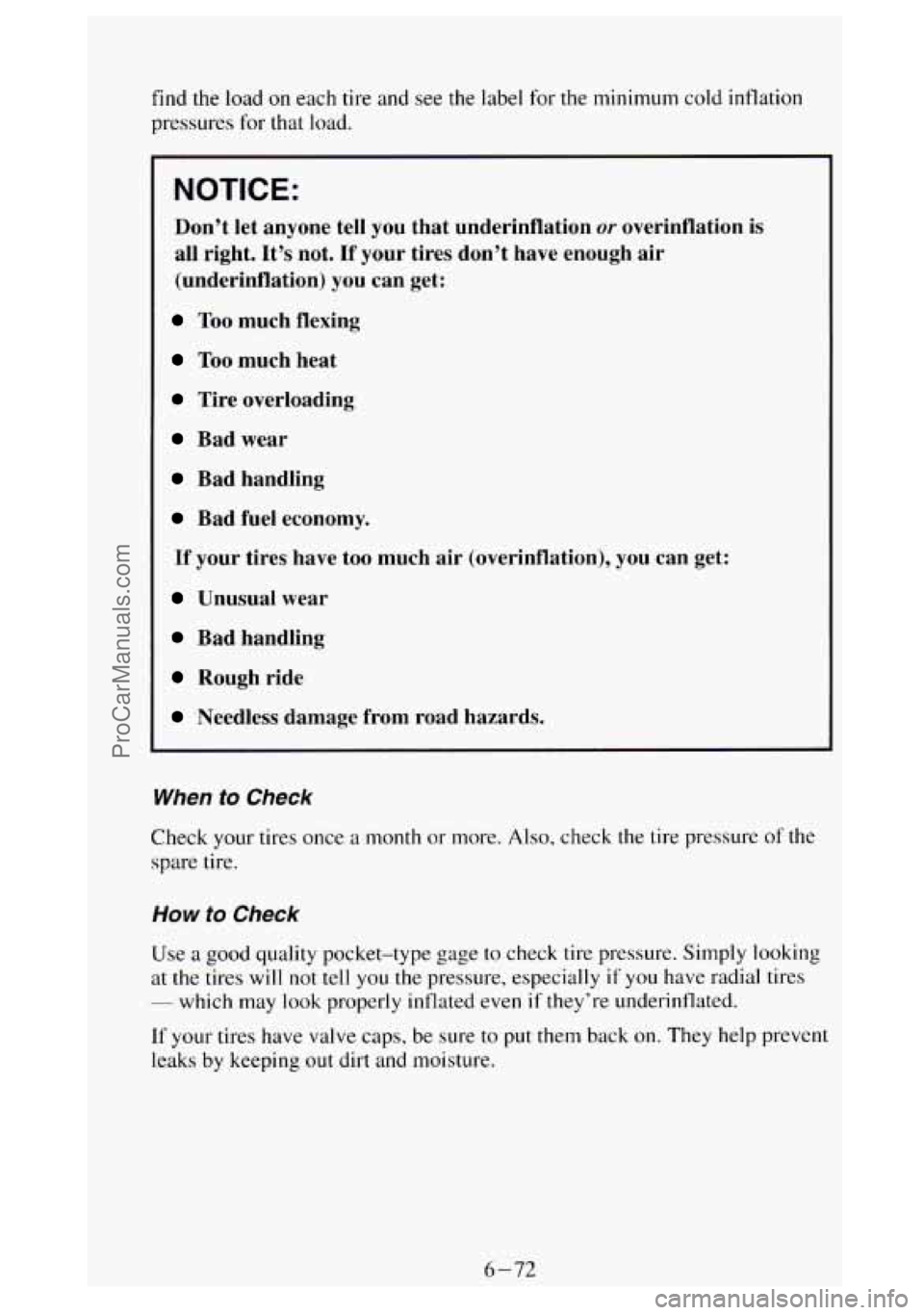
NOTICE:
Don’t let anyone tell you that underinflation or overinflation is
all right. It’s not. If your tires don’t have enough air
(underinflation) you can get:
Too much flexing
Too much heat
Tire overloading
Bad wear
Bad handling
Bad fuel economy.
If your tires have too much air (overinflation), you can get:
Unusual wear
Bad handling
Rough ride
‘Needless damage from road hazards.
When io Check
Check your tires once a month or more. Also, check the tire pressure of the
spare tire.
How to Check
Use a good quality pocket-type gage to check tire pressure. Simply looking
at the tires
will not tell you the pressure, especially if you have radial tires
- which may look properly inflated even if they’re underinflated.
If your tires have valve caps, be sure to put them back on. They help prevent
leaks by keeping out dirt and moisture.
6-72
ProCarManuals.com
Page 323 of 404
Special Tire lnflation
If you have 16 inch tires on your vehicle, and:
- You’ll be driving for very long at speeds of 66 mph (105 km/h) to
75 mph (120
km/h) where legal, inflate tires to 10 psi (70 kPa)
more than the recommended cold inflation pressures.
- You’ll be driving for very long at speeds of 76 mph (120 km/h) to
85 mph (135
km/h) where legal, cold inflation pressures should be
increased by
10 psi (70 kPa) and you must also reduce axle load
capacity by 10%.
Do not drive over 85 mph (135 km/h) even if
it’s legal.
Inflation pressures should never exceed 10 psi (70 kPa) above the
inflation specified for the maximum load of the tire.
If you have 19.5 inch radial tires on your vehicle, and:
- You’ll be driving for very long at speeds of 66 mph (105 km/h) to
70 mph (110 km/h) where legal, inflate tires to 5 psi (35 kPa) more
than the recommended cold inflation pressures, and reduce the
axle load capacity by 4%.
- You’ll be driving for very long at speeds of 7 1 mph (1 15 km/h) to
75 mph (120
km/h) where legal, cold inflation pressures should be
increased by 5 psi (35 kPa) and you must also reduce axle \
load capacity by 12%.
Do not drive over 75 mph (120 km/h) even if
it’s legal.
Inflation pressures should never exceed 20 psi (140 kPa) above the
inflation specified for the maximum load of the tire.
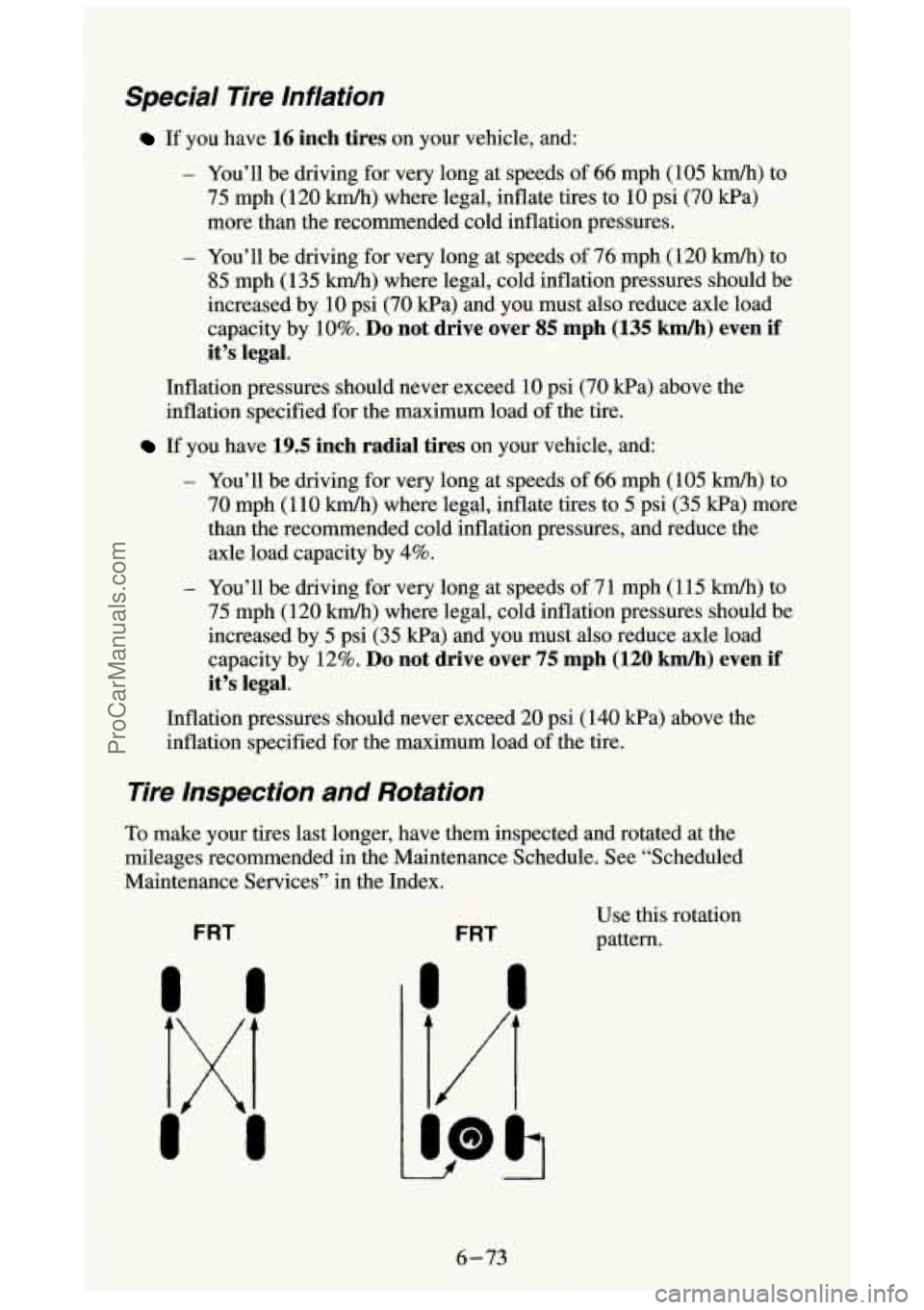
Tire Inspection and Rotation
To make your tires last longer, have them inspected and rotated at the
mileages recommended in the Maintenance Schedule. See “Scheduled
Maintenance Services” in the Index.
FRT
8
FRT
Use this rotation
pattern.
4-73
ProCarManuals.com
Page 324 of 404
If your vehicle has front tires with different load ratings or tread designs
(such
as all season vs. on/off road) than the rear tires, don’t rotate your tires
front
to rear.
After the tires have been rotated, adjust the front and rear inflation pressure
as shown on the CertificatiodTire label. Make certain that all wheel nuts are
properly tightened. See “Wheel
Nut Torque” in the Index.
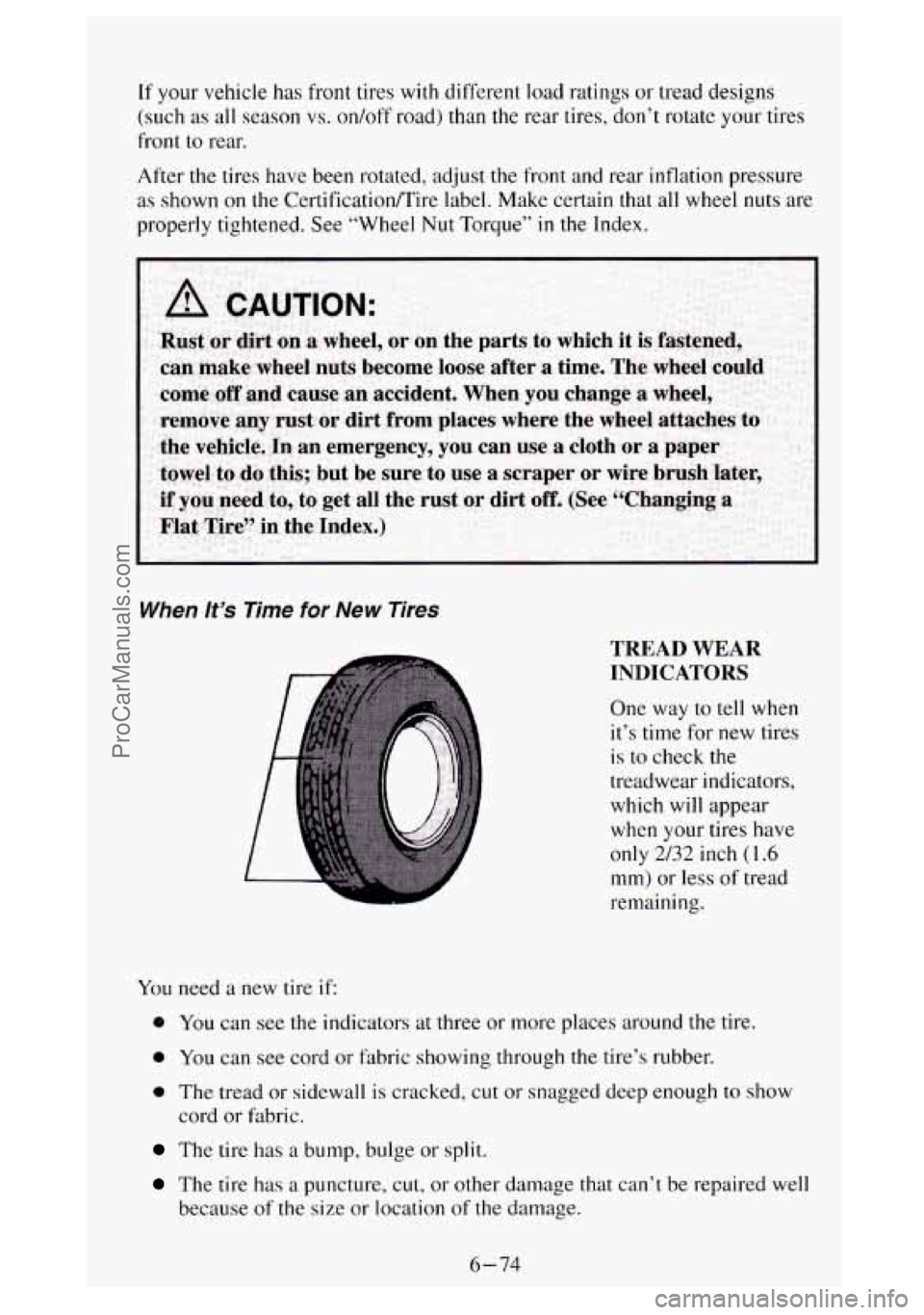
A CAUTION:
Rust or dirt on a wheel, or on the parts to which it is fastened,
When It’s Time for New Tires
TREAD WEAR
INDICATORS
One way to tell when
it’s time for
new tires
is to check the
treadwear indicators,
which
will appear
when your tires have
only
2/32 inch (1.6
mm) or less of tread
remaining.
You need a
new tire if:
0 You can see the indicators at three or more places around the tire.
0 You can see cord or Fabric showing through the tire’s rubber.
0 The tread or sidewall is cracked, cut or snagged deep enough to show
cord or fabric.
The tire has a bump, bulge or split.
The tire has a puncture, cut, or other damage that can’t be repaired well
because
of the size or location of the damage.
6-74
ProCarManuals.com
Page 325 of 404
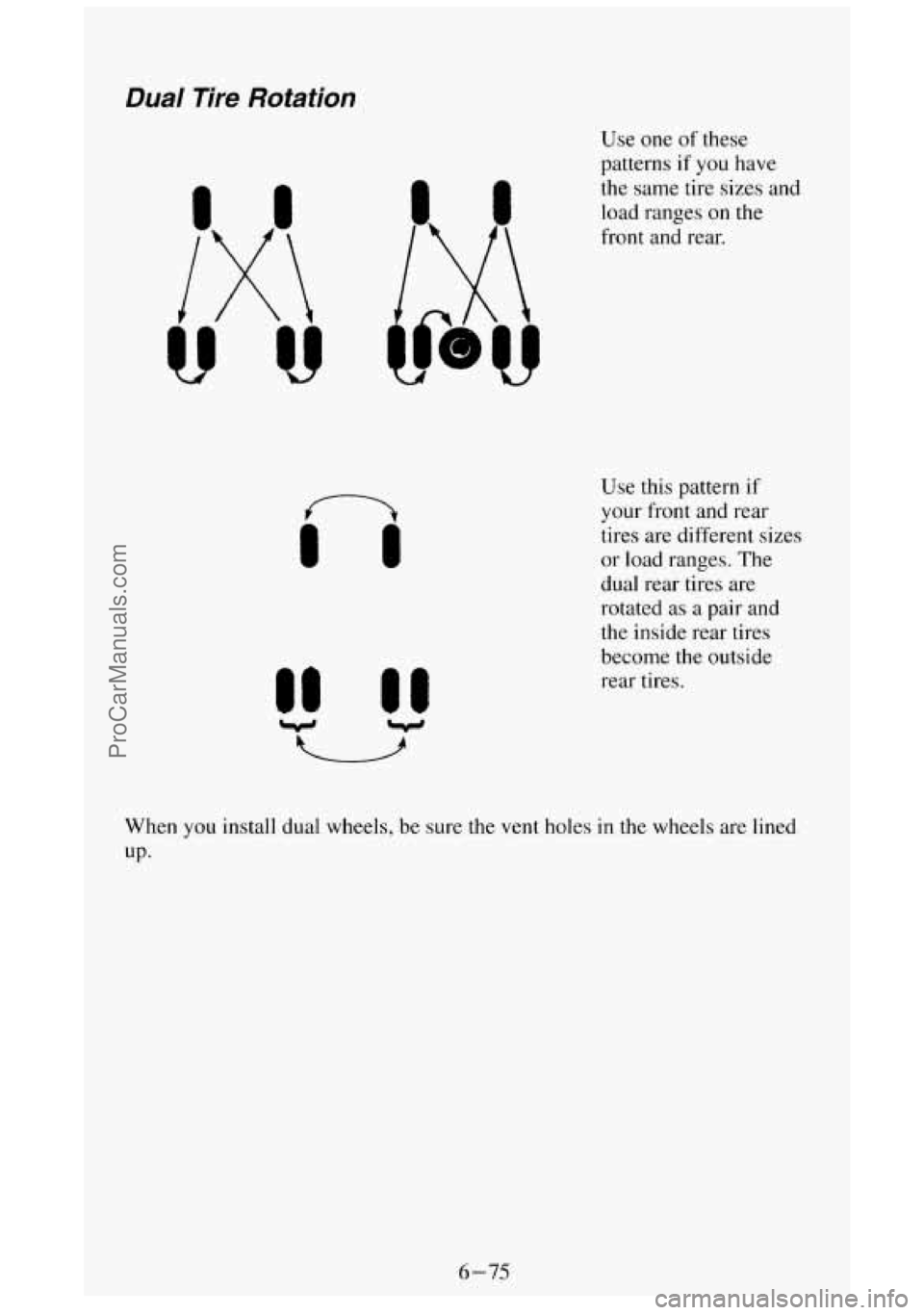
Dual Tire Rotation
n
Use one of these
patterns if you have
the same tire sizes and
load ranges on
the
front and rear.
Use
this pattern if
your front and rear
tires are different sizes
or load ranges. The
dual rear tires are
rotated
as a pair and
the inside rear tires
become the outside
rear tires.
When you install dual wheels, be sure
the vent holes in the wheels are lined
UP.
6-75
ProCarManuals.com