oil GMC SIERRA 1994 Service Manual
[x] Cancel search | Manufacturer: GMC, Model Year: 1994, Model line: SIERRA, Model: GMC SIERRA 1994Pages: 404, PDF Size: 20.91 MB
Page 333 of 404
0 If an odor lingers after cleaning vomit or urine, treat the area with a
waterhaking soda solution: 1 teaspoon (5 ml) of baking soda to I cup
(250 ml) of lukewarm water.
0 If needed, clean lightly with solvent-type cleaner.
Combination Stains
Such as candy, ice cream, mayonnaise, chili sauce and unknown stains.
Carefully scrape off excess stain, then clean with cool water and allow
to dry.
0 If a stain remains, clean it with solvent-type cleaner.
Cleaning Vinyl
Use warm water and a clean cloth.
Rub with a clean, damp cloth to remove dirt. You may have to do it
more than once.
0 Things like tar, asphalt and shoe polish will stain if you don’t get them
off quickly. Use a clean cloth and a solvent-type vinyl cleaner.
Cleaning Leather
Use a soft cloth with lukewarm water and a mild soap or saddle soap.
For stubborn stains, use a mild solution of 10% isopropyl alcohol
(rubbing alcohol) and
90% water.
Never use oils, varnishes, solvent-based or abrasive cleaners, furniture
polish or shoe polish on leather.
Soiled leather should be cleaned immediately. If dirt is allowed to work
into finish,
it can harm the leather.
Cleaning the Top of the Instrument Panel
Use only mild soap and water to clean the top surfaces of the instrument
panel. Sprays containing silicones or waxes may cause annoying reflections
in the windshield and even make
it difficult to see through the windshield
under certain conditions.
6-83
ProCarManuals.com
Page 336 of 404
Aluminum Wheels (If So Equipped)
Your aluminum wheels have a protective coating similar to the painted
surface
of your vehicle. Don’t use strong soaps, chemicals, chrome polish,
abrasive cleaners or abrasive cleaning brushes on them because you could
damage this coating. After rinsing thoroughly, a wax may be applied.
NOTICE:
If you have aluminum wheels, don’t use an automatic vehicle
wash that has hard silicon carbide cleaning brushes. These
brushes can take
off the protective coating.
White Side wall Tires
Your GM dealer has a GM White Sidewall Tire Cleaner. You can use a stiff
brush with the cleaner.
Weatherstrips
Silicone grease on weatherstrips will make them last longer, seal better, and
not stick or squeak. Apply silicone grease with
a clean cloth at least every
six months. During very cold, damp weather more frequent application may
be required. (See “Recommended Fluids
& Lubricants” in the Index.)
Sheet Metal Damage
If your vehicle is damaged and requires sheet metal repair or replacement,
make sure
the body repair shop applies anti-corrosion material to the parts
repaired or replaced
to restore corrosion protection.
Foreign Material
Calcium chloride and other salts, ice melting agents, road oil and tar, tree sap,
bird droppings, chemicals from industrial chimneys, and other foreign matter
can damage your vehicle’s finish
if they remain on painted surfaces. Use
cleaners that are marked safe for painted surfaces to remove foreign matter.
Finish Damage
Any stone chips, fractures or deep scratches in the finish should be repaired
right away. Bare metal will corrode quickly and may develop into a major
repair expense.
Minor chips and scratches can be repaired with touch-up materials available
from your dealer or other service outlets. Larger areas of finish damage can
be corrected
in your dealer’s body and paint shop.
6-86
ProCarManuals.com
Page 337 of 404
Underbody Maintenance
Chemicals used for ice and snow removal and dust control can collect on
the underbody. If these are not removed, accelerated corrosion (rust) can
occur on the underbody parts such as fuel lines, frame,
floor pan, and
exhaust system even though they have corrosion protection.
At least every spring, tlush these materials from the underbody
with plain
water. Clean any areas where mud and other debris can collect. Dirt packed
in closed areas of the frame should be loosened before being flushed. Your
dealer or an underbody vehicle washing system can do this for you.
Chemical Paint Spotting
Some weather and atmospheric conditions can create a chemical fallout.
Airborne pollutants can fall upon and attack painted surfaces on your
vehicle. This damage can take two forms: blotchy, ringlet-shaped
discolorations, and small irregular dark spots etched into the paint surface.
Although no defect
in the paint job causes this, GM will repair, at no charge
to the owner, the surfaces of new vehicles damaged by this fallout condition
within 12 months or 12,000 miles (20
000 km) of purchase, whichever
comes first.
This applies
only to materials manufactured and sold by General Motors.
Bodies, body conversions or equipment
not made or sold by General Motors
are not covered.
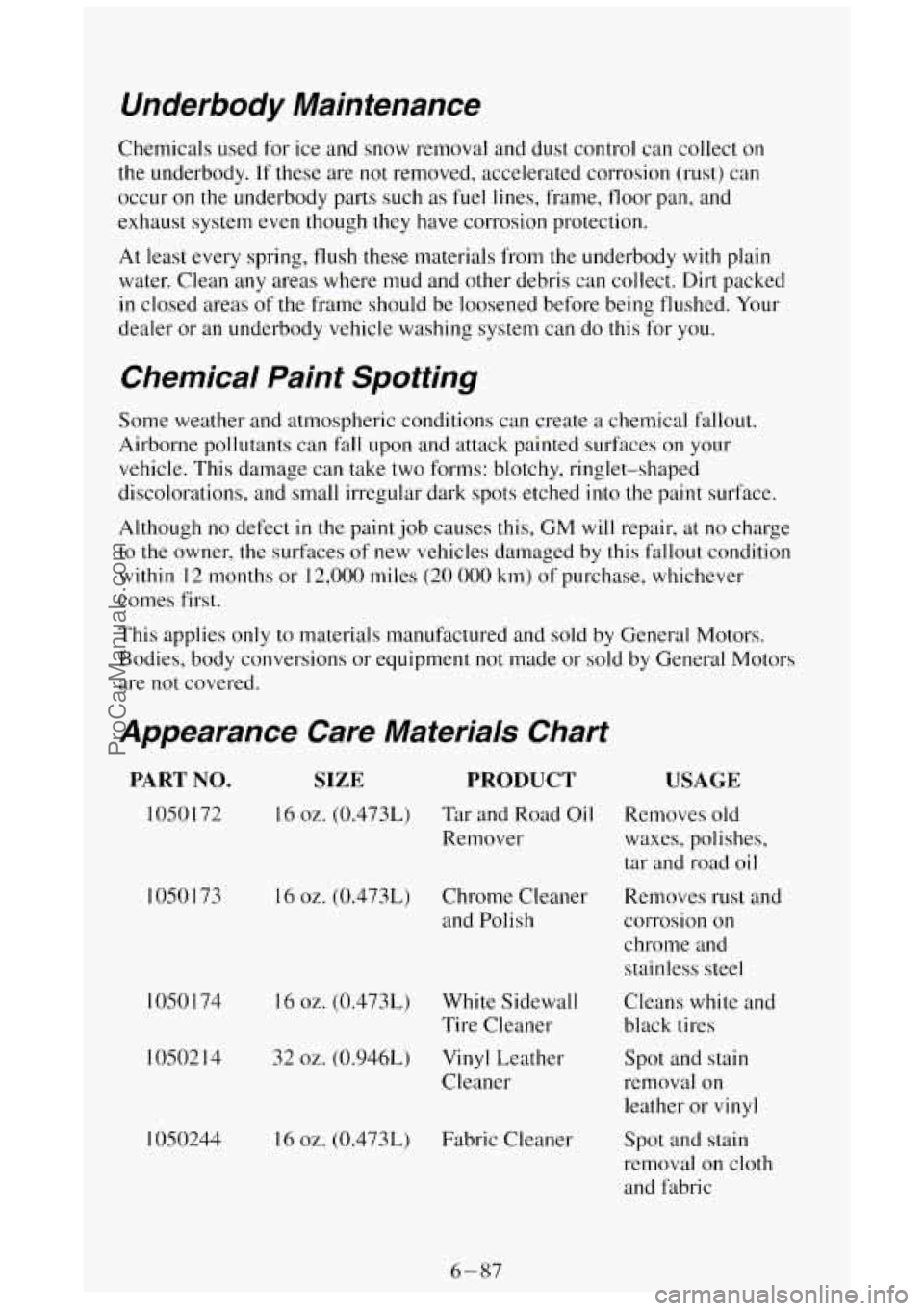
Appearance Care Materials Chart
PART NO.
1050172
I050 173
1050174 1050214
1050244
SIZE
16 oz. (0.473L)
16 oz. (0.473L)
I6
oz. (0.473L)
32
oz. (0.946L)
16 oz. (0.473L)
PRODUCT USAGE
Tar and Road Oil
Removes old
Remover waxes, polishes,
tar and road
oil
Chrome Cleaner Removes rust and
and Polish corrosion
on
chrome and
stainless steel
White Sidewall
Tire Cleaner
Vinyl Leather
Cleaner
Fabric Cleaner Cleans
white and
black tires
Spot and stain
removal on
leather or
vinyl
Spot and stain
removal on cloth
and fabric
6-87
ProCarManuals.com
Page 343 of 404
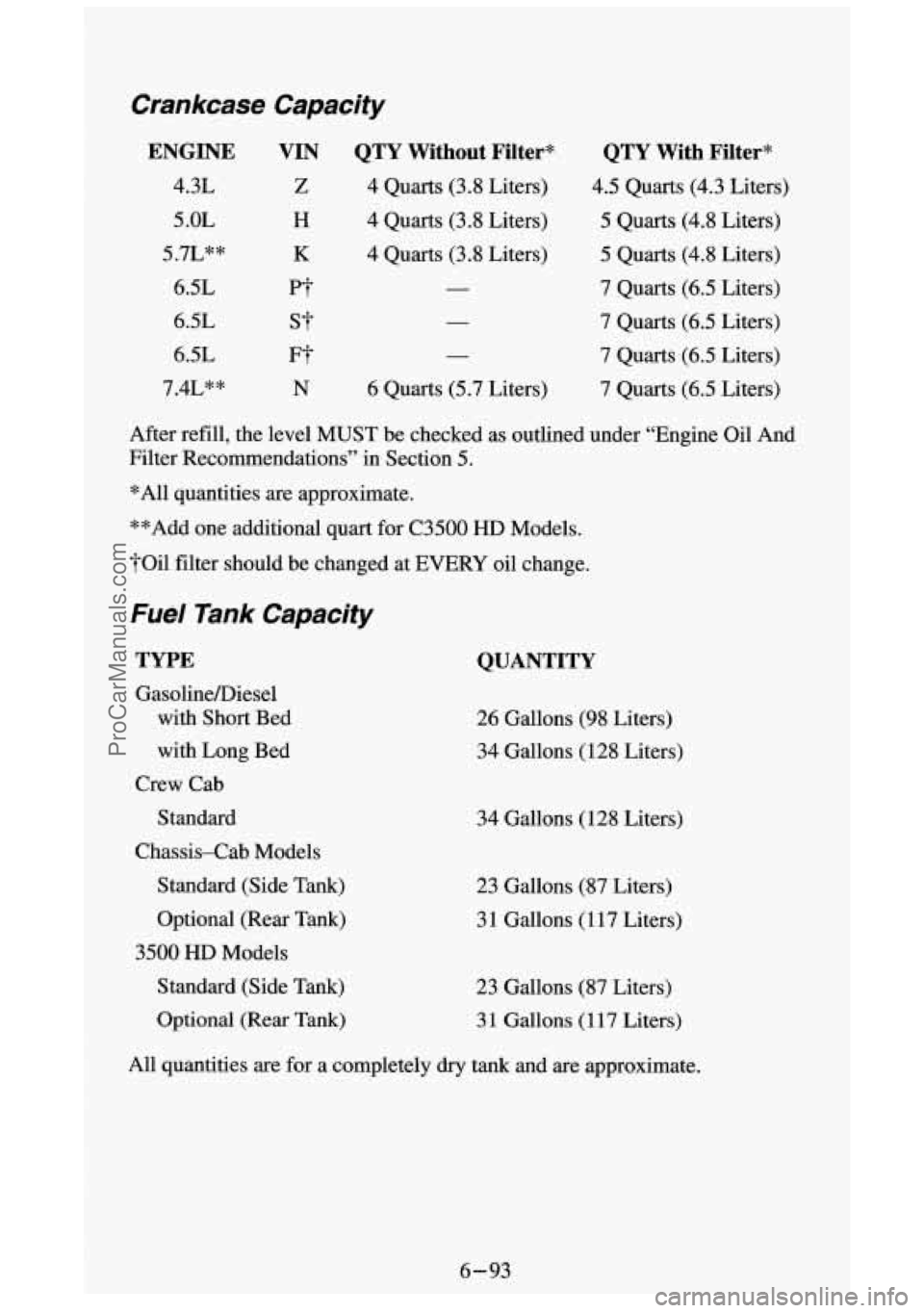
Crankcase Capacity
ENGINE VIN QTY Without Filter*
4.3L Z 4 Quarts (3.8 Liters)
5.7L**
K 4 Quarts (3.8 Liters)
5
.OL
H 4 Quarts (3.8 Liters)
6.5L
Pt -
6.5L st -
6.5L H- -
7 .a* * N 6 Quarts (5.7 Liters)
QTY With Filter*
4.5 Quarts (4.3 Liters)
5 Quarts (4.8 Liters)
5 Quarts (4.8 Liters)
7 Quarts
(6.5 Liters)
7 Quarts (6.5 Liters)
7 Quarts (6.5 Liters)
7 Quarts (6.5 Liters)
After refill, the level MUST be checked as outlined under “\
Engine Oil And
Filter Recommendations’’ in Section
5.
*All quantities are approximate.
**Add one additional quart for C3500
HD Models.
?Oil filter should be changed at EVERY oil change.
Fuel Tank Capacity
TYPE
GasolineDiesel with Short Bed
with Long Bed
Crew Cab Standard
Chassis-Cab Models Standard (Side Tank)
Optional (Rear Tank)
3500
HD Models
Standard (Side Tank)
Optional (Rear Tank)
QUANTITY
26 Gallons (98 Liters) 34 Gallons (128 Liters)
34 Gallons (128 Liters)
23 Gallons (87 Liters)
3 1 Gallons (1 17 Liters)
23 Gallons (87 Liters)
3 1 Gallons (1 17 Liters)
All quantities are for a completely
dry tank and are approximate.
I
6-93
ProCarManuals.com
Page 344 of 404
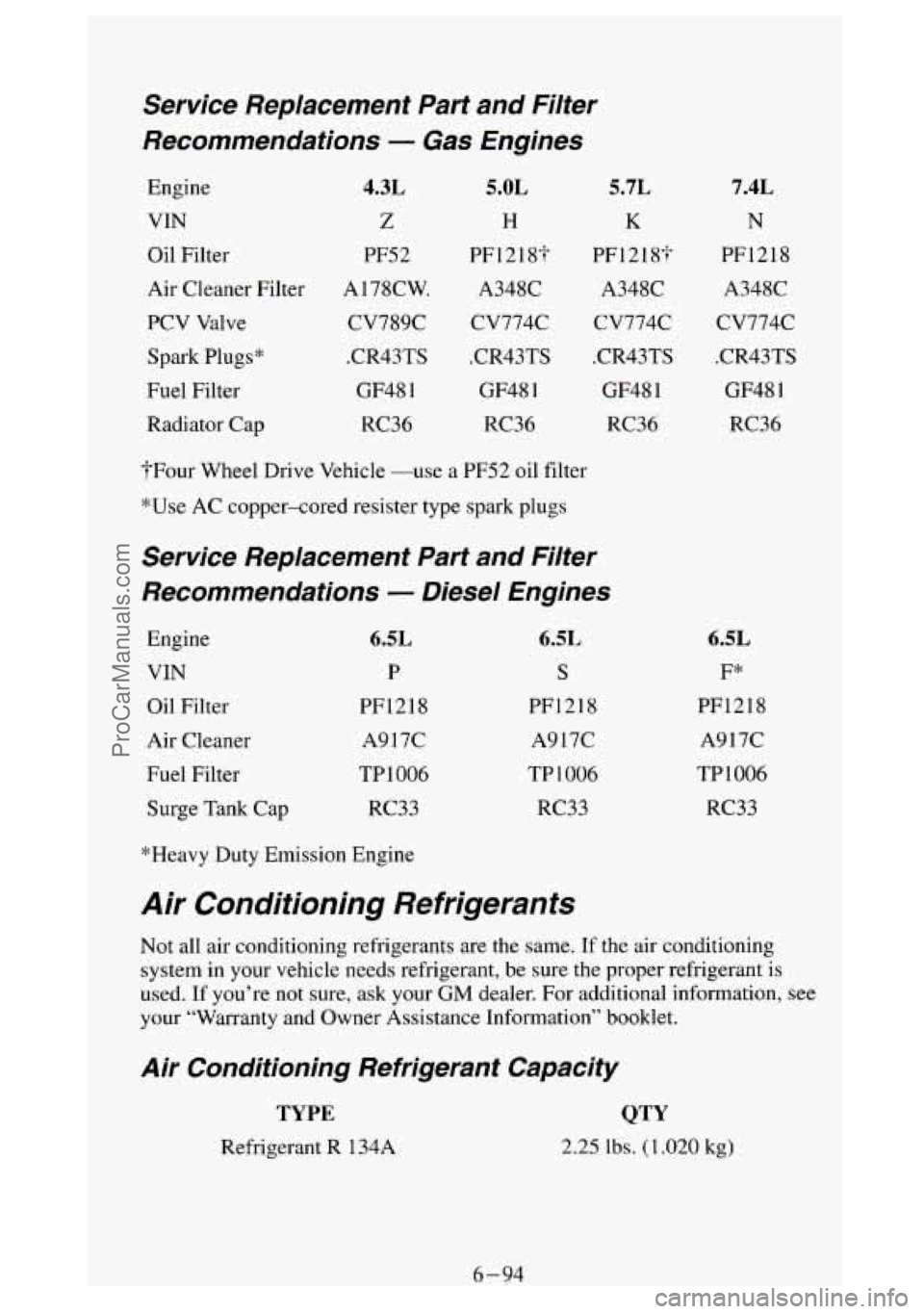
Service Replacement Part and Filter
Recommendations
- Gas Engines
Engine
VIN
Oil Filter
Air Cleaner Filter
PCV Valve
Spark Plugs*
Fuel Filter Radiator Cap
4.3L
z
PF52
A178CW. CV789C
.CR43TS
GF48
1
RC36
5.OL
H
PF1218T A348C
cv774c
.CR43TS GF48
1
RC36
5.7L
K
PF1218t A348C
cv774c
.CR43TS GF48 1
RC36
“four Wheel Drive Vehicle -use a PF52 oil filter
*Use AC copper-cored resister type spark plugs
Service Replacement Part and Filter
Recommendations
- Diesel Engines
Engine
VIN
Oil Filter
Air Cleaner
Fuel Filter Surge Tank Cap 6.5L
P
PF1218
A9 17C
TP 1006
RC33
6.5L
S
PF1218 A917C
TP 1006
RC33
7.4L
N
PF1218 A348C
cv774c
.CR43TS GF48
1
RC36
6.5L
F*
PF1218 A917C
TP 1006
RC33
“Heavy Duty Emission Engine
Air Conditioning Refrigerants
Not all air conditioning refrigerants are the same. If the air conditioning
system in your vehicle needs refrigerant, be sure the proper refrigerant is
used.
If you’re not sure, ask your GM dealer. For additional information, see
your “Warranty and Owner Assistance Information” booklet.
Air Conditioning Refrigerant Capacity
TYPE
Refrigerant R 134A
QTY
2.25 lbs. (1.020 kg)
6-94
ProCarManuals.com
Page 366 of 404
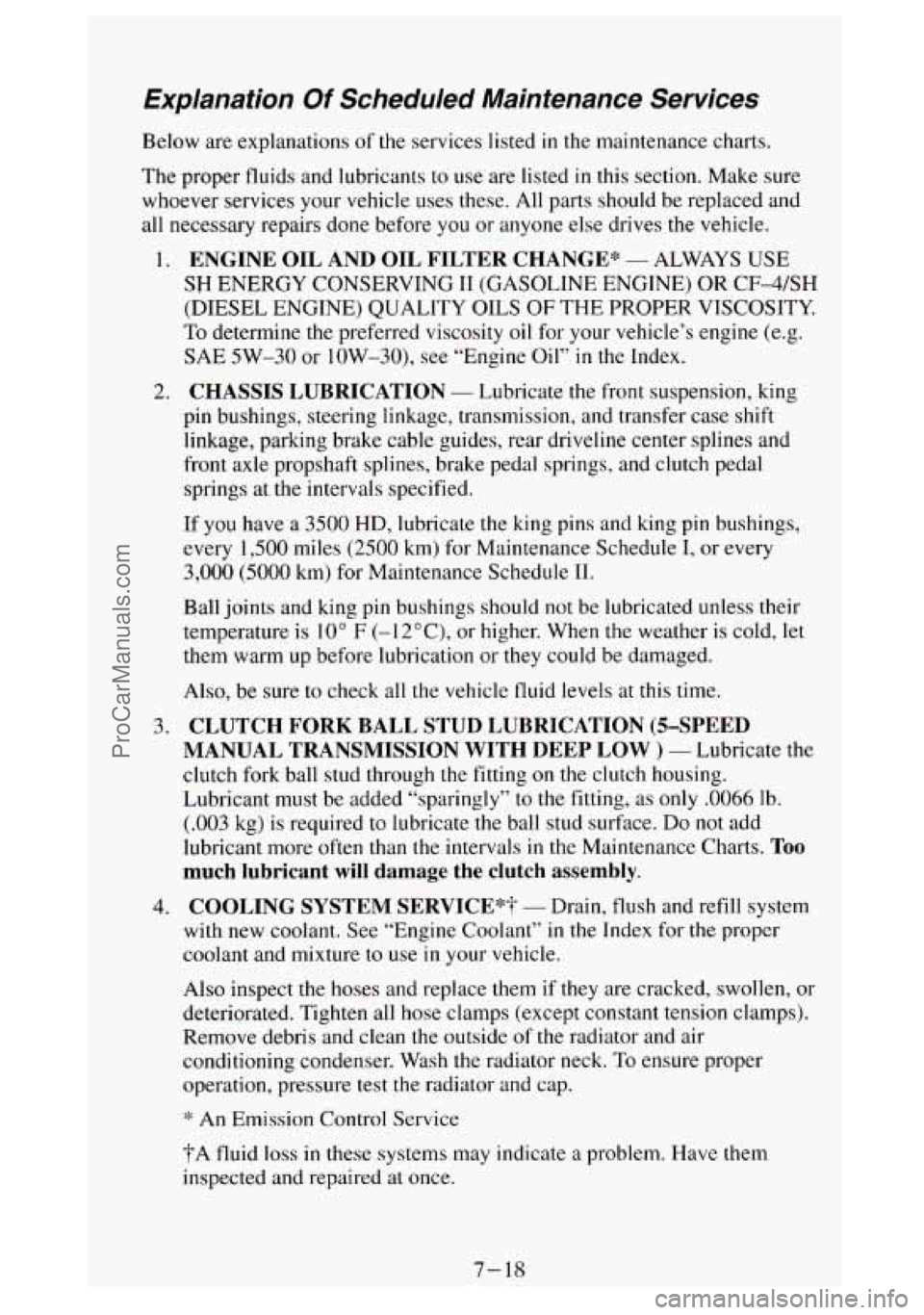
Explanation Of Scheduled Mainienance Services
Below are explanations of the services listed in the maintenance charts.
The proper fluids and lubricants to use are listed in this section. Make sure
whoever services your vehicle uses these. All parts should be replaced and
all necessary repairs done before you or anyone else drives the vehicle.
1. ENGINE OIL AND OIL FILTER CHANGE“‘ - ALWAYS USE
SJ3 ENERGY CONSERVING I1 (GASOLINE ENGINE) OR CF-4/SH
(DIESEL ENGINE) QUALITY OILS
OF THE PROPER VISCOSITY.
To determine the preferred viscosity oil for your vehicle’s engine (e.g.
SAE 5W-30 or 10W-30), see “Engine Oil”
in the Index.
2. CHASSIS LUBRICATION - Lubricate the front suspension, king
pin bushings, steering linkage, transmission, and transfer case shift
linkage, parking brake cable guides, rear driveline center splines and
front axle propshaft splines, brake pedal springs, and clutch pedal
springs at the intervals specified.
If you have a 3500
HD, lubricate the king pins and king pin bushings,
every
1,500 miles (2500 km) for Maintenance Schedule I, or every
3,000 (5000 km) for Maintenance Schedule 11.
Ball joints and king pin bushings should not be lubricated unless their
temperature
is 10” F (-12”C), or higher. When the weather is cold, let
them warm up before lubrication or
they could be damaged.
Also, be sure
to check all the vehicle fluid levels at this time.
3.
CLUTCH FORK BALL STUD LUBRICATION (5-SPEED
MANUAL TRANSMISSION WITH DEEP LOW
) - Lubricate the
clutch fork ball stud through the fitting
on the clutch housing.
Lubricant must be added “sparingly” to
the fitting, as only .0066 lb.
(.003 kg) is required to lubricate the ball stud surface. Do not add
lubricant more often than the intervals
in the Maintenance Charts. Too
much lubricant will damage the clutch assembly.
4. COOLING SYSTEM SERVICE”’? - Drain, flush and refill system
with new coolant. See “Engine Coolant” in the Index for
the proper
coolant and mixture to use
in your vehicle.
Also inspect the hoses and replace them
if they are cracked, swollen, or
deteriorated. Tighten all hose clamps (except constant tension clamps).
Remove debris and clean the outside of the radiator and air
conditioning condenser. Wash the radiator neck.
To ensure proper
operation, pressure test.
the radiator and cap.
* An Emission Control Service
?A fluid
loss in these systems may indicate a problem. Have them
inspected and repaired at once.
7-18
ProCarManuals.com
Page 370 of 404
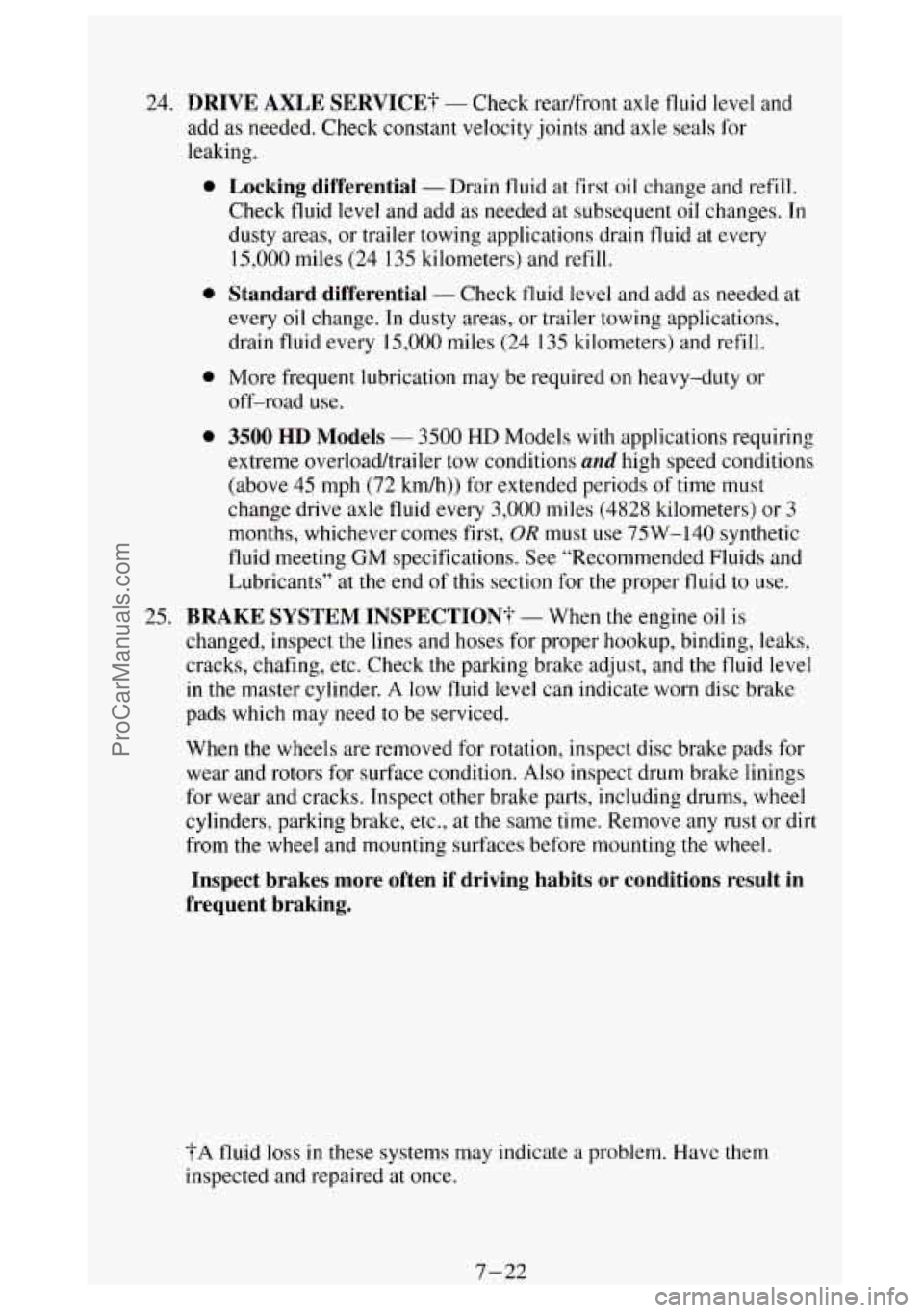
24. DRIVE AXLE SERVICE? - Check readfront axle fluid level and
add
as needed. Check constant velocity joints and axle seals for
leaking.
0
0
0
0
Locking differential - Drain fluid at first oil change and refill.
Check fluid level and add
as needed at subsequent oil changes. In
dusty areas, or trailer towing applications drain fluid at every
15,000 miles (24 135 kilometers) and refill.
Standard differential - Check fluid level and add as needed at
every
oil change. In dusty areas, or trailer towing applications,
drain fluid every
15,000 miles (24 I35 kilometers) and refill.
More frequent lubrication may be required on heavy-duty or
off-road use.
3500 HD Models - 3500 HD Models with applications requiring
extreme overload/trdiler tow conditions
and high speed conditions
(above 45 mph (72
kdh)) for extended periods of time must
change drive axle fluid every
3,000 miles (4828 kilometers) or 3
months, whichever comes first, OR must use 75W-140 synthetic
fluid meeting
GM specifications. See “Recommended Fluids and
Lubricants” at the end of this section for the proper fluid to use.
25.
BRAKE SYSTEM INSPECTION-f - When the engine oil is
changed, inspect the lines and hoses for proper hookup, binding, leaks,
cracks, chafing, etc. Check the parking brake adjust, and the fluid level
in the master cylinder. A low fluid level can indicate worn disc brake
pads which may need
to be serviced.
When the wheels are removed for rotation, inspect disc brake pads for
wear and rotors for surfxe condition. Also inspect drum brake linings
for wear and cracks. Inspect other brake parts, including drums, wheel
cylinders, parking brake, etc., at the same time. Remove any
rust or dirt
from the wheel and mounting surfaces before mounting the wheel.
Inspect brakes more often if driving habits or conditions result in
frequent braking.
?A fluid loss in these systems may indicate a problem. Have them
inspected and repaired at once.
7-22
ProCarManuals.com
Page 371 of 404
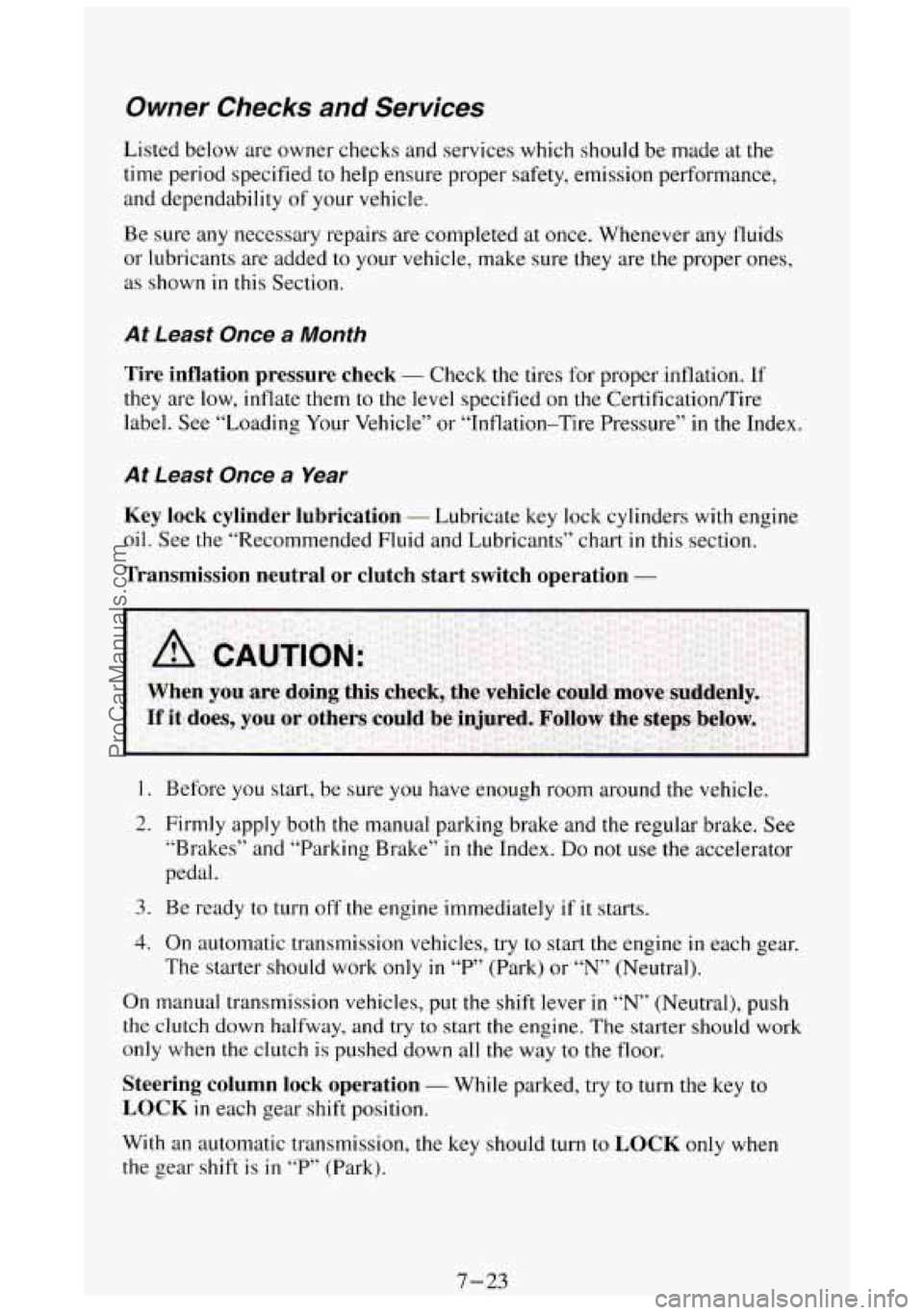
Owner Checks and Services
Listed below are owner checks and services which should be made at the
time period specified to help ensure proper safety, emission performance,
and dependability
of your vehicle.
Be sure any necessary repairs are completed at once. Whenever any fluids
or lubricants are added to your vehicle, make sure they are
the proper ones,
as shown
in this Section.
At Least Once a Month
Tire inflation pressure check - Check the tires for proper inflation. If
they are low, inflate them to the level specified on the Certification/Tire
label. See “Loading Your Vehicle” or “Inflation-Tire Pressure”
in the Index.
At Least Once a Year
Key lock cylinder lubrication - Lubricate key lock cylinders with engine
oil. See
the “Recommended Fluid and Lubricants” chart in this section.
Transmission neutral or clutch start switch operation -
1. Before you start, be sure you have enough room around the vehicle.
2. Firmly apply both the manual parking brake and the regular brake. See
“Brakes” and “Parking Brake”
in the Index. Do not use the accelerator
pedal.
3. Be ready to turn off the engine immediately if it starts.
4. On automatic transmission vehicles, try to start the engine in each gear.
The starter should work only
in “P’ (Park) or “N” (Neutral).
On manual transmission vehicles, put the shift lever
in “N” (Neutral), push
the clutch down halfway, and try to start the engine. The starter should work
only when the clutch
is pushed down all the way to the floor.
Steering column lock operation - While parked, try to turn the key to
LOCK in each gear shift position.
With an automatic transmission, the key should
turn to LOCK only when
the gear shift
is in “P” (Park).
7-23
ProCarManuals.com
Page 372 of 404
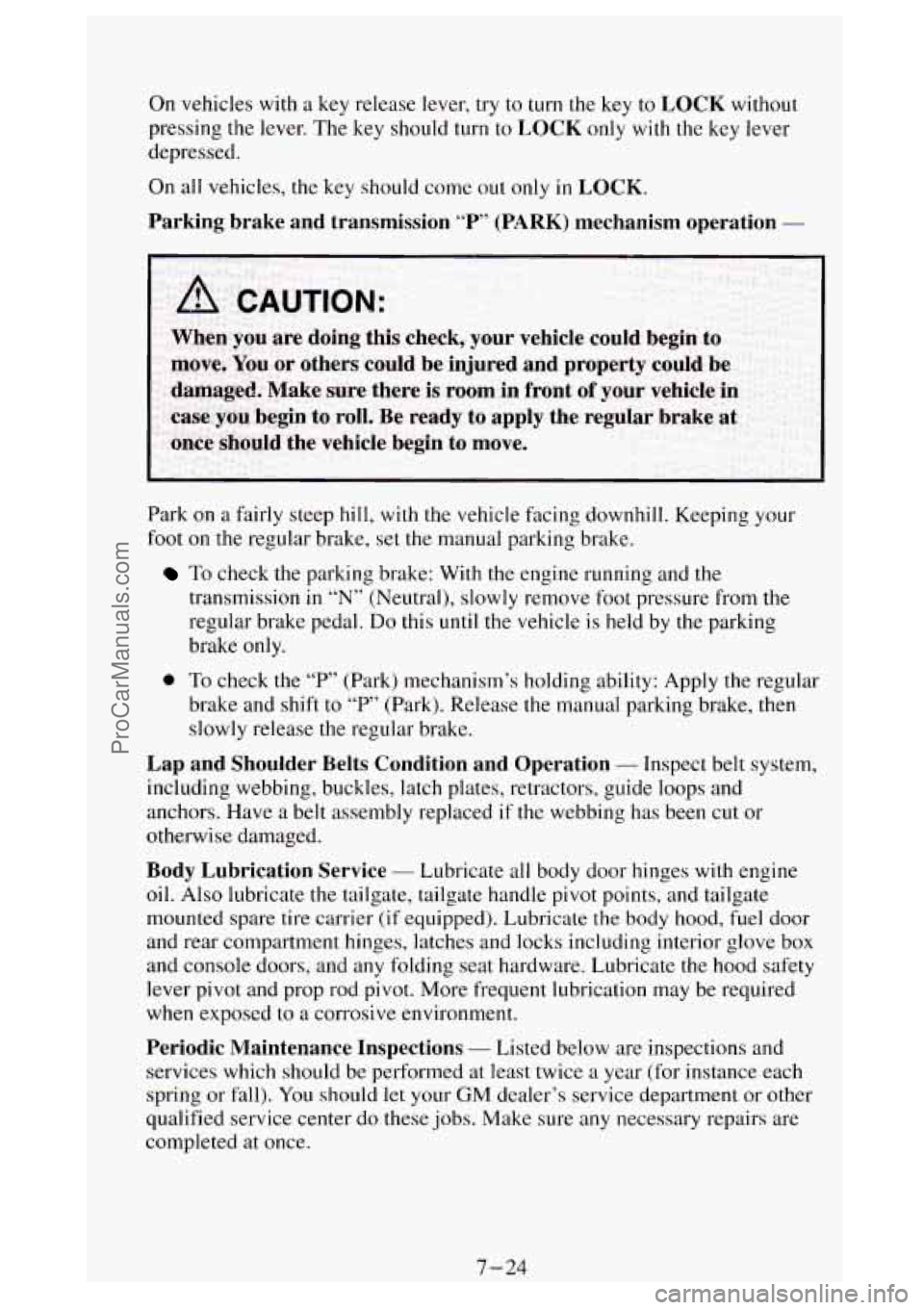
On vehicles with a key release lever, try to turn the key to LOCK without
pressing the lever. The key should turn to
LOCK only with the key lever
depressed.
On
all vehicles, the key should come out only in LOCK.
Parking brake and transmission
“P” (PARK) mechanism operation -
I
Park on a fairly steep hill, with the vehicle facing downhill. Keeping your
foot on the regular brake, set the manual parking brake.
To check the parking brake: With the engine running and the
transmission
in “N” (Neutral), slowly remove foot pressure from the
regular brake pedal. Do this until the vehicle is held by the parking
brake only.
0 To check the “P’ (Park) mechanism’s holding ability: Apply the regular
brake and shift to
“P’ (Park). Release the manual parking brake, then
slowly release the regular brake.
Lap and Shoulder Belts Condition and Operation - Inspect belt system,
including webbing, buckles, latch plates, retractors, guide loops and
anchors. Have
a belt assembly replaced if the webbing has been cut or
otherwise damaged.
Body Lubrication Service - Lubricate all body door hinges with engine
oil. Also lubricate the tailgate, tailgate handle pivot points, and tailgate
mounted spare tire carrier
(if equipped}. Lubricate the body hood, fuel door
and rear compartment hinges, latches and locks including interior glove box
and console doors, and any folding seat hardware. Lubricate the hood safety
lever pivot and prop rod pivot. More frequent lubrication may be required
when exposed to a corrosive environment.
Periodic Maintenance Inspections - Listed below are inspections and
services which should be performed at least twice
a year (for instance each
spring or fall). You should
let your GM dealer’s service department or other
qualified service center do these
jobs. Make sure any necessary repairs are
completed at once.
7-24
ProCarManuals.com
Page 373 of 404
Steering and Suspension Inspection? - Inspect front and rear suspension
and steering system for damaged, loose
or missing parts, signs of wear or
lack
of lubrication. Inspect power steering lines and hoses for proper
hook-up, binding, leaks, cracks, chafing, etc. Lubricate the steering linkage.
Accelerator Control System - On gasoline engines, lubricate the pivot at
the
TBI throttle lever stud with engine oil. Do not oil any accelerator or
cruise control cables. Replace any cables that have high effort
or excessive
wear.
Exhaust System Inspection - Inspect the complete system including the
three-way catalytic converter. Inspect the body near the exhaust system.
Look for broken, damaged, missing or out-of-position parts,
as well as,
open seams, holes, loose connections or other conditions which could cause
a heat buildup in
the floor pan or could let exhaust fumes seep into the
passenger compartments.
Drive Axle Service? - Check readfront axle fluid level and add as needed.
Check constant velocity joints and axle seals for leaking.
I-- ~ lsfer Case (Four-wheel Drive) Inspection? - Every 12 months or at
oil change intervals, check front axle and transfer case and add lubricant
when necessary. Oil the control lever pivot point and all exposed control
linkage. Check vent hose at transfer case for kinks and proper installation.
More frequent lubrication may be required
on heavy-duty or off-road use.
?'A fluid loss in these systems may indicate a problem. Have them inspected
and repaired at once.
7-25
ProCarManuals.com