change wheel GMC SIERRA 1995 User Guide
[x] Cancel search | Manufacturer: GMC, Model Year: 1995, Model line: SIERRA, Model: GMC SIERRA 1995Pages: 488, PDF Size: 26.01 MB
Page 249 of 488
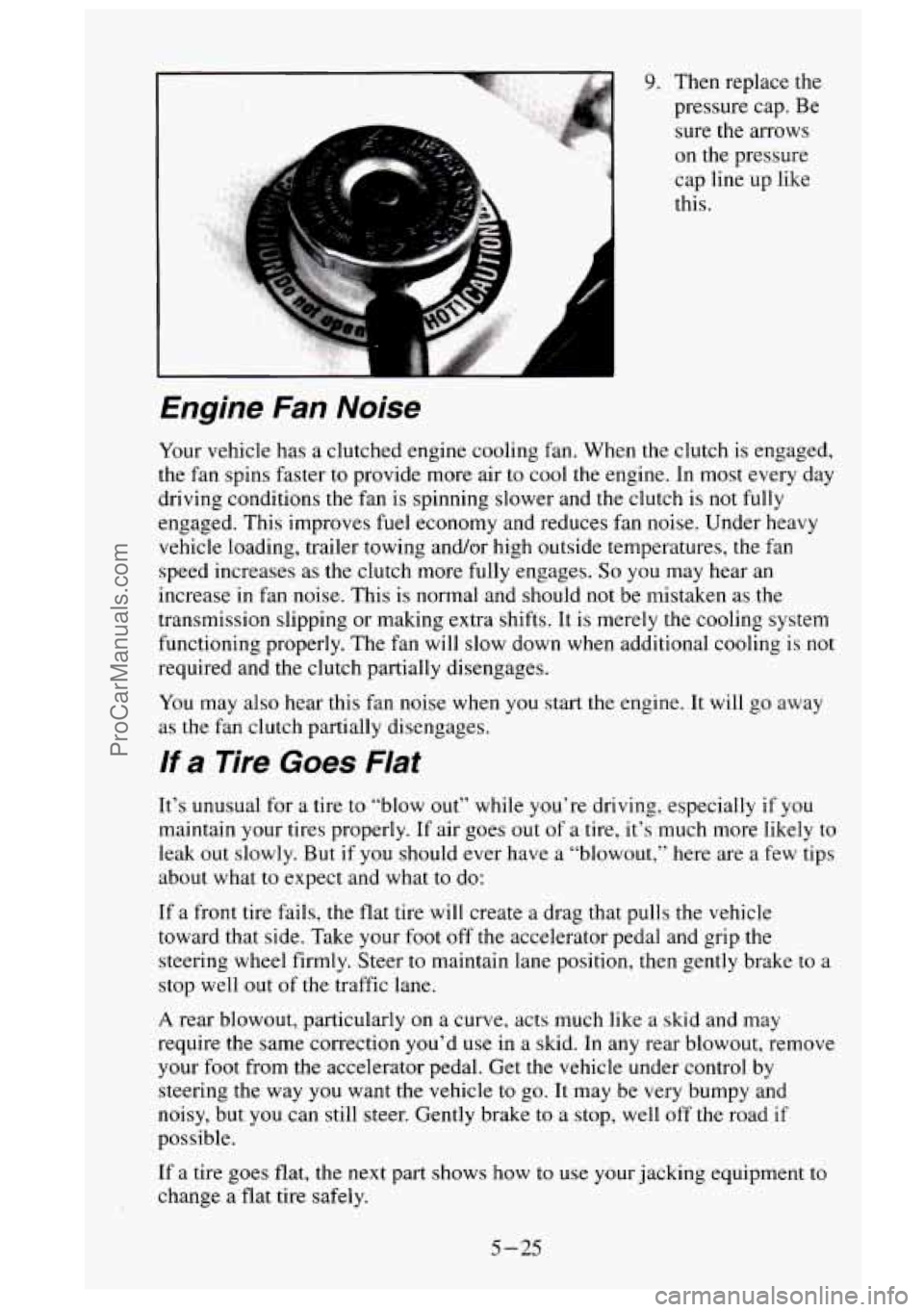
Engine Fan Noise
Your vehicle has a clutched engine cooling fan. When the clutch is engaged,
the fan spins faster
to provide more air to cool the engine. In most every day
driving conditions the fan is spinning slower and the clutch is
not fully
engaged. This improves fuel economy and reduces fan noise. Under heavy
vehicle loading, trailer towing and/or high outside temperatures, the fan
speed increases as the clutch more fully engages.
So you may hear an
increase
in fan noise. This is normal and should not be mistaken as the
transmission slipping or making extra shifts.
It is merely the cooling system
functioning properly. The fan will slow down when additional cooling is not
required and the clutch partially disengages.
You may also hear this fan noise when you start the engine. It will go away
as the
fan clutch partially disengages.
If a Tire Goes Flat
It’s unusual for a tire to “blow out” while you’re driving, especially if you
maintain your tires properly. If air goes out
of a tire, it’s much more likely to
leak out slowly. But if you should ever have a “blowout,” here are a few tips
about what to expect and what to do:
If a front tire fails, the flat tire will create a drag that pulls the vehicle
toward that side. Take your foot
off the accelerator pedal and grip the
steering wheel firmly, Steer
to maintain lane position, then gently brake to a
stop well out of
the traffic lane.
A rear blowout, particularly on a curve, acts much like a skid and may
require the same correction you’d use in a skid. In any rear blowout, remove
your
foot from the accelerator pedal. Get the vehicle under control by
steering the way
you want the vehicle to go. It may be very bumpy and
noisy, but you can still steer. Gently brake to a stop, well
off the road if
possible.
If a tire goes flat, the next part shows how to use your jacking equipment to
change a flat tire safely.
5-25
ProCarManuals.com
Page 250 of 488
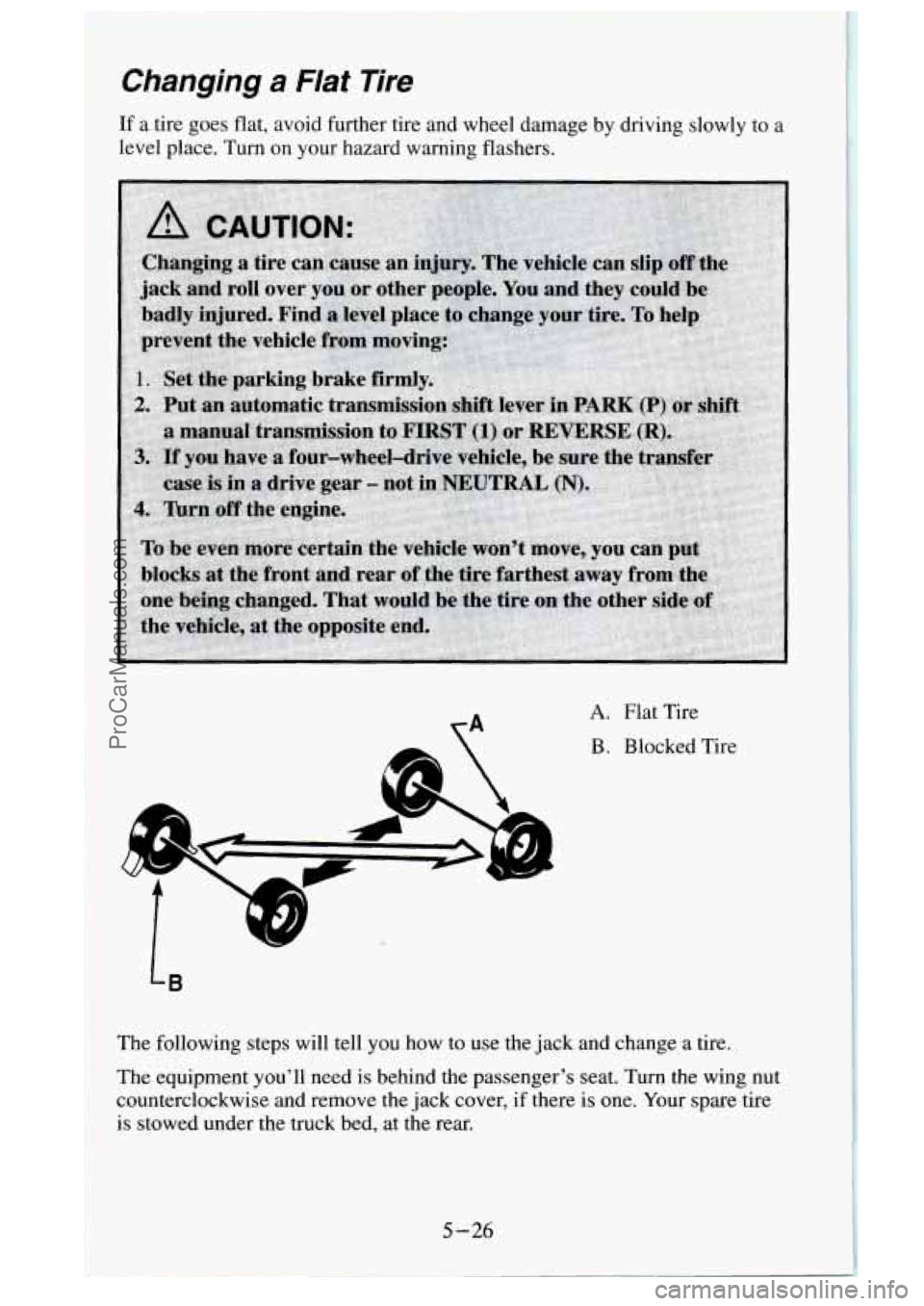
Changing a Flat Tire
If a tire goes flat, avoid further tire and wheel damage by driving slowly to a
level place. Turn on your hazard warning flashers.
A. Flat Tire
B. Blocked Tire
The following steps will tell
you how to use the jack and change a tire.
The equipment you’ll need
is behind the passenger’s seat. Turn the wing nut
counterclockwise and remove the jack cover, if there is one.
Your spare tire
is stowed under the truck bed, at the
rear.
5-26
ProCarManuals.com
Page 259 of 488
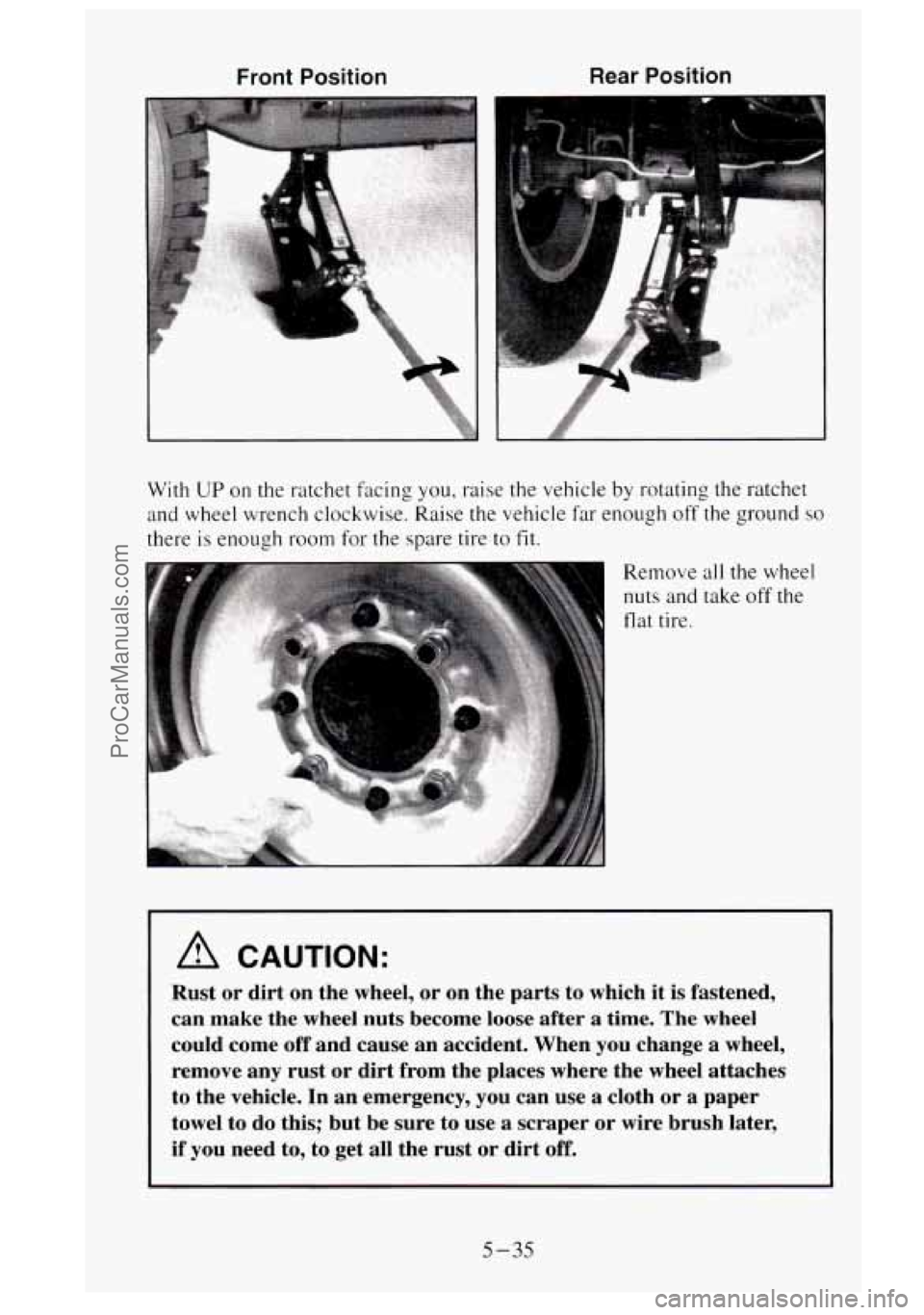
Front rosluon Rear Position
With UP on the ratchet facing you, raise the vehicle by rotating the ratchet
and wheel wrench clockwise. Raise the vehicle
far enough off the ground so
there is enough room for the spare tire to fit.
Remove
all the wheel
nuts and take
off the
flat tire,
A CAUTION:
Rust or dirt on the wheel, or on the parts to which it is fastened,
can make the wheel nuts become loose after a time. The wheel
could come
off and cause an accident. When you change a wheel,
remove any rust or dirt from the places where the wheel attaches
to the vehicle. In an emergency, you can use a cloth or a paper
towel
to do this; but be sure to use a scraper or wire brush later,
if you need to, to get all the rust or dirt off.
5-35
ProCarManuals.com
Page 299 of 488
What to Use
Refer to the Maintenance Schedule to determine what kind of lubricant to
use. See “Recommended Fluids and Lubricants”
in the Index.
C3 (3500 H.D.) Trucks Equipped with Dana Rear Axle
Additional rear axle scheduled maintenance is required on 3500 H.D.
models equipped with Dana rear axles when they are driven under the
following conditions:
0 Extreme loading (at or near GVWR) or trailer towing, and:
Operation above 45 mph for extended periods of time
Vehicles used
in any of these conditions require the rear axle lubricant (SAE
8OW-90 - GL-5) be changed every 3 months or 3,000 miles, whichever
comes first.
To reduce required maintenance, SAE 75W-140 synthetic gear lubricant
may be used. With the use of synthetic
SAE 75W-140 lubricant, the fluid
change intervals may be increased to 30,000 miles. Before using SAE
75W-140, it is important to drain and flush the axle with clean mineral
based (non-synthetic) axle lubricant. Fluid capacity is 4.12 qts. (3.9L).
Four- Wheel Drive
Most lubricant checks in this section also apply to four-wheel-drive
vehicles. However, they have two additional systems that need lubrication.
Transfer Case
When to Check Lubricant
Refer to the Maintenance Schedule to determine how often to check the
lubricant. See “Periodic Maintenance Inspections”
in the Index.
6-33
ProCarManuals.com
Page 360 of 488
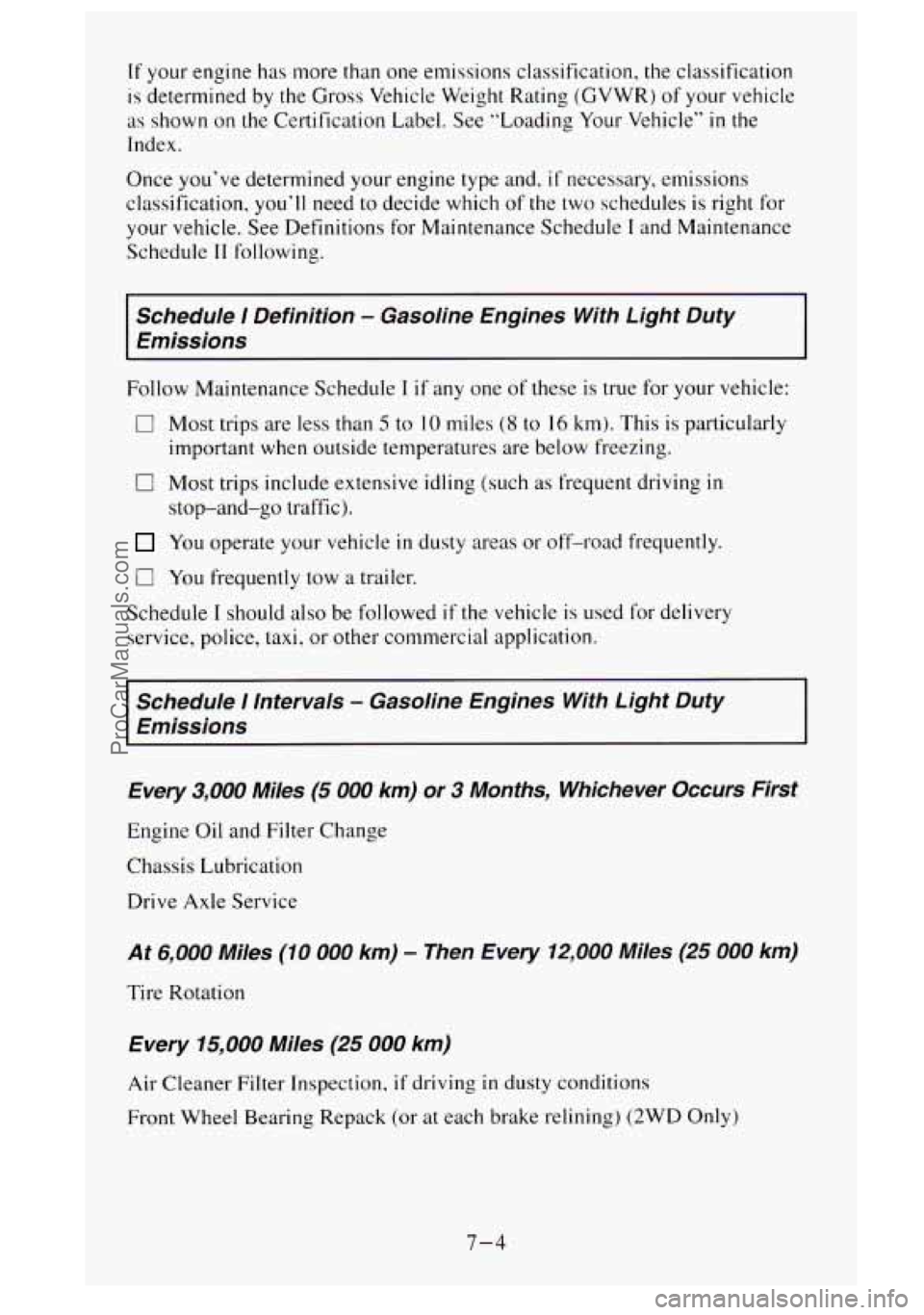
If your engine has more than one emissions classification, the classification
is determined by the Gross Vehicle Weight Rating (GVWR) of your vehicle
as shown on the Certification Label. See “Loading Your Vehicle”
in the
Index.
Once you’ve determined your engine type and,
if necessary, emissions
classification, you’ll need to decide which of the two schedules is right for
your vehicle. See Definitions for Maintenance Schedule
I and Maintenance
Schedule
I1 following.
Schedule I Definition - Gasoline Engines With Light Duty
Emissions
Follow Maintenance Schedule I if any one of these is true for your vehicle:
iII Most trips are less than 5 to 10 miles (8 to 16 km). This is particularly
important when outside temperatures are below freezing.
0 Most trips include extensive idling (such as frequent driving in
stop-and-go traffic).
You operate your vehicle in dusty areas or off-road frequently.
0 You frequently tow a trailer.
Schedule
I should also be followed if the vehicle is used for delivery
service, police, taxi, or other commercial application.
Schedule I Intervals - Gasoline Engines With Light Duty
Emissions
Every
3,000 Miles (5 000 km) or 3 Months, Whichever Occurs First
Engine Oil and Filter Change
Chassis Lubrication
Drive Axle Service
At 6,000 Miles (10 000 km) - Then Every 12,000 Miles (25 000 km)
Tire Rotation
Every 75,000 Miles (25 000 km)
Air Cleaner Filter Inspection, if driving in dusty conditions
Front Wheel Bearing Repack
(or at each brake relining) (2WD Only)
7-4
ProCarManuals.com
Page 363 of 488
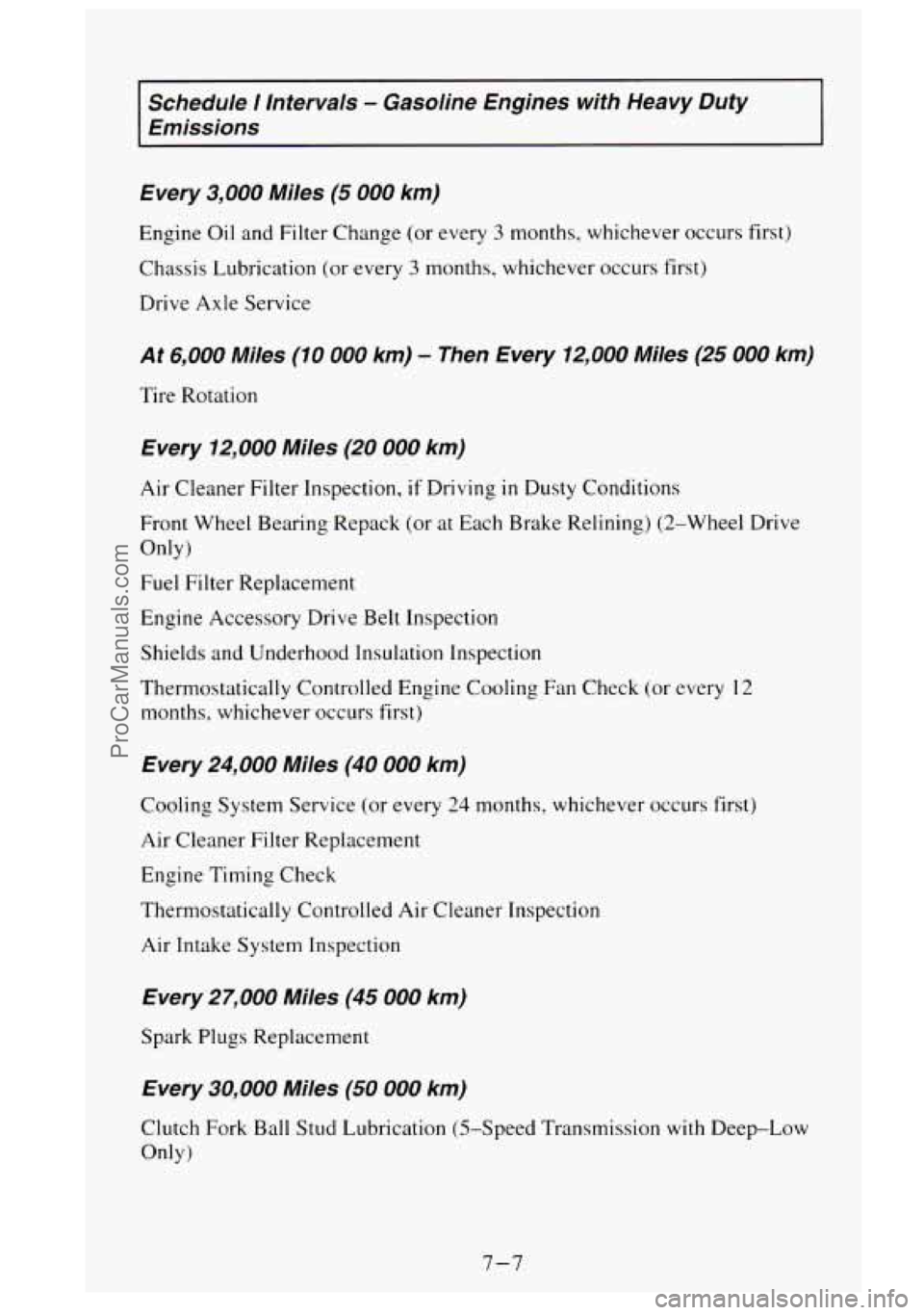
Schedule I Intervals - Gasoline Engines with Heavy Duty
Emissions
Every
3,000 Miles (5 000 km)
Engine Oil and Filter Change (or every 3 months, whichever occurs first)
Chassis Lubrication (or every
3 months, whichever occurs first)
Drive Axle Service
At 6,000 Miles (10 000 km) - Then Every 12,000 Miles (25 000 km)
Tire Rotation
Every 12,000 Miles (20 000 km)
Air Cleaner Filter Inspection, if Driving in Dusty Conditions
Front Wheel Bearing Repack (or at Each Brake Relining) (2-Wheel Drive
Only
1
Fuel Filter Replacement
Engine Accessory Drive Belt Inspection
Shields
and Underhood Insulation Inspection
Thermostatically Controlled Engine Cooling Fan Check (or every
12
months, whichever occurs first)
Every 24,000 Miles (40 000 km)
Cooling System Service (or every 24 months, whichever occurs first)
Air Cleaner Filter Replacement
Engine Timing Check
Thermostatically Controlled Air Cleaner Inspection
Air Intake System Inspection
Every 27,000 Miles (45 000 km)
Spark Plugs Replacement
Every 30,000 Miles (50 000 km)
Clutch Fork Ball Stud Lubrication (%Speed Transmission with Deep-Low
Only)
7-7
ProCarManuals.com
Page 366 of 488
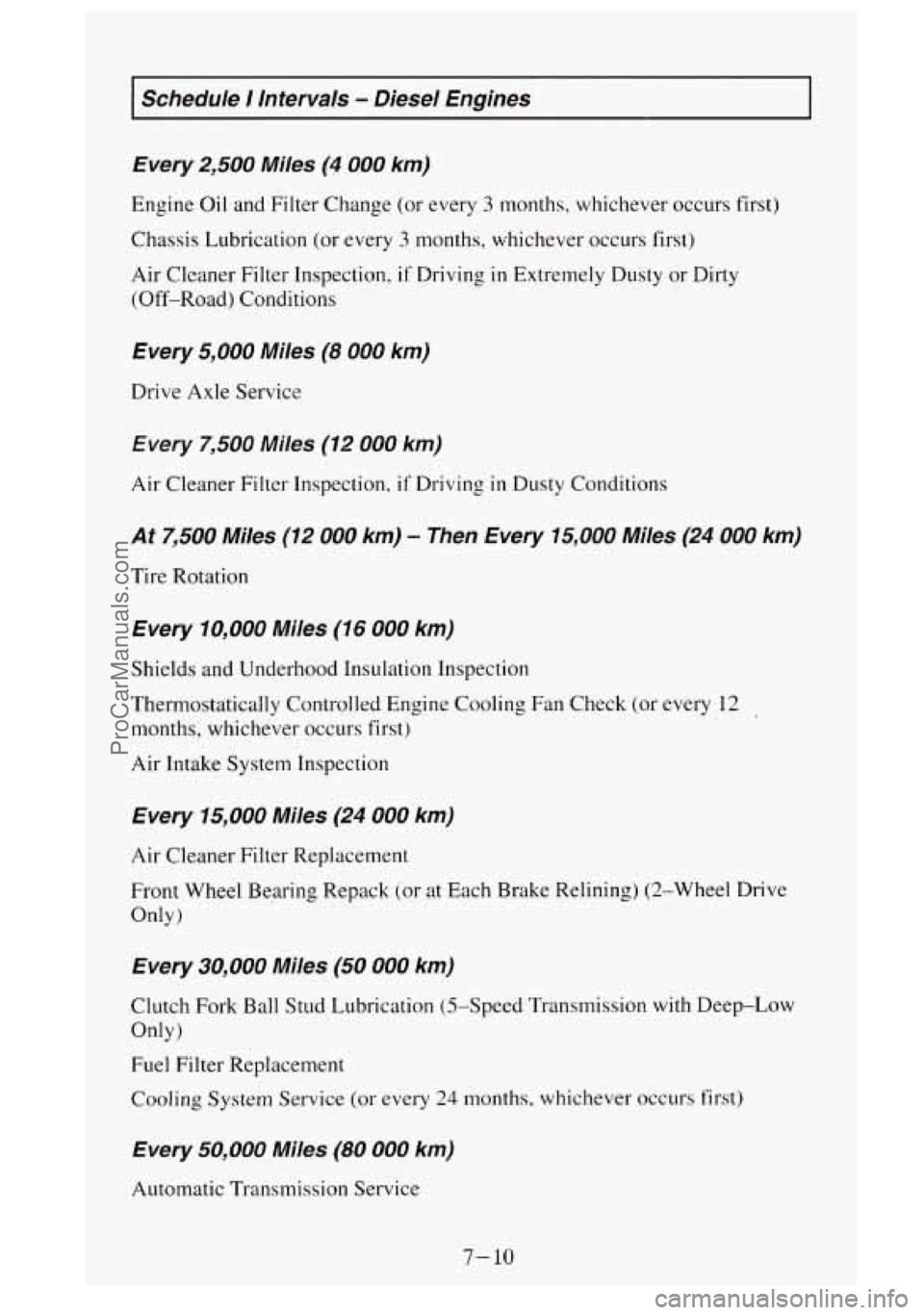
I Schedule I Intervals - Diesel Engines I
Every 2,500 Miles (4 000 km)
Engine Oil and Filter Change (or every 3 months, whichever occurs first)
Chassis Lubrication (or every
3 months, whichever occurs first)
Air Cleaner Filter Inspection.
if Driving in Extremely Dusty or Dirty
(Off-Road) Conditions
Every 5,000 Miles (8 000 km)
Drive Axle Service
Every 7,500 Miles (12 000 km)
Air Cleaner Filter Inspection, if Driving in Dusty Conditions
At 7,500 Miles (12 000 km) - Then Every 15,000 Miles (24 000 km)
Tire Rotation
Every 10,000 Miles (I 6 000 km)
Shields and Underhood Insulation Inspection
Thermostatically Controlled Engine Cooling Fan Check (or every
12
months, whichever occurs first)
Air Intake System Inspection
Every 15,000 Miles (24 000 km)
Air Cleaner Filter Replacement
Front Wheel Bearing Repack
(or at Each Brake Relining) (2-Wheel Drive
Only j
Every 30,000 Miles (50 000 km)
Clutch Fork Ball Stud Lubrication (%Speed Transmission with Deep-Low
Only:)
Fuel Filter Replacement
Cooling
System Service (or every 24 months, whichever occurs first)
Every 50,000 Miles (80 000 km)
Automatic Transmission Service
7- 10
ProCarManuals.com
Page 367 of 488
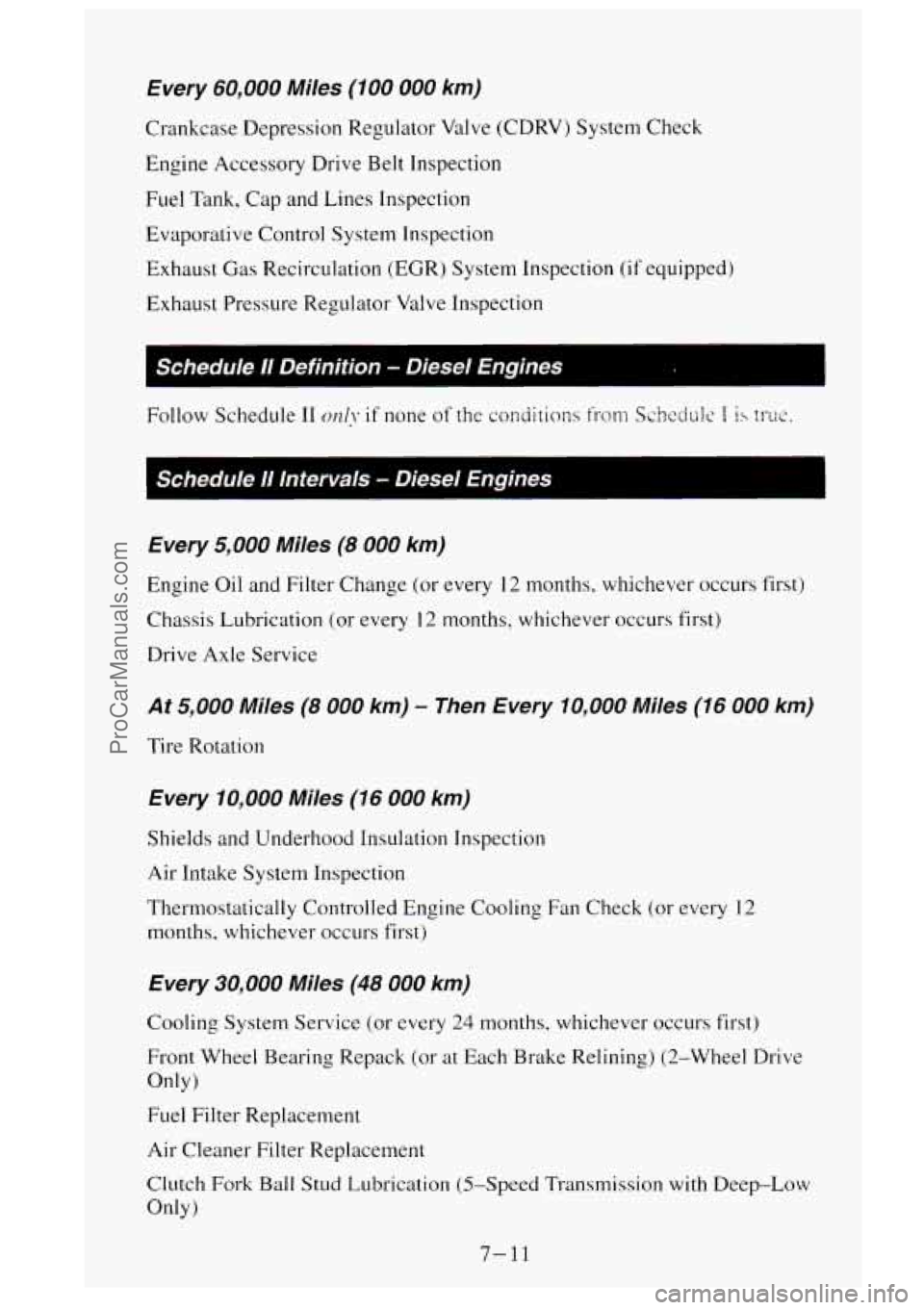
Every 60,000 Miles (100 000 km)
Crankcase Depression Regulator Valve (CDRV) System Check
Engine Accessory Drive Belt Inspection
Fuel Tank, Cap and Lines Inspection
Evaporative Control System Inspection
Exhaust Gas Recirculation (EGR) System Inspection
(if equipped)
Exhaust Pressure Regulator Valve Inspection
I Schedule 11 Definition - Diesel Engines
Follow Schedule II on!\- if none ofrhe conditions i'wm Schcdtilc I Is truc.
--
I Schedule I1 lntervals - Diesel Engines 1
Every 5,000 Miles (8 000 km)
Engine Oil and Filter Change (or every 12 months, whichever occurs first)
Chassis Lubrication
(or every 12 months, whichever occurs first)
Drive Axle Service
At 5,000 Miles (8 000 km) - Then Every 10,000 Miles (16 000 km)
Tire Rotation
Every 10,000 Miles (16 000 km)
Shields and Underhood insulation Inspection
Air Intake System Inspection
Thermostatically Controlled Engine Cooling Fan Check (or every
I2
months, whichever occurs first)
Every 30,000 Miles (48 000 km)
Cooling System Service (or every 24 months, whichever occurs first)
Front Wheel Bearing Repack (or
at Each Brake Relining) (2-Wheel Drive
Fuel Filter Replacement
Air Cleaner Filter Replacement
Clutch Fork Ball Stud Lubrication (5-Speed Transmission with Deep-Low
Only)
Only)
7-11
ProCarManuals.com
Page 372 of 488
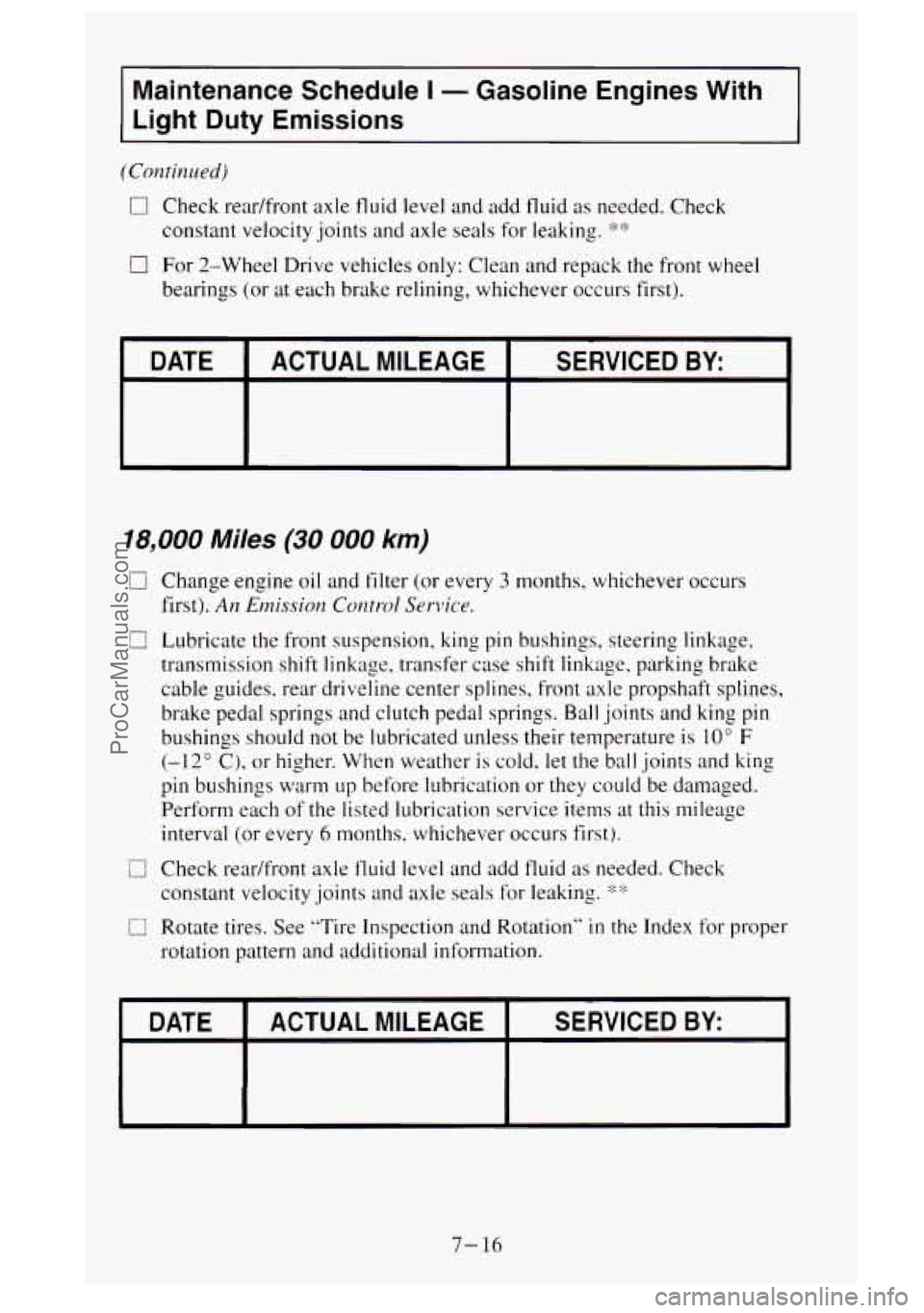
Maintenance Schedule I - Gasoline Engines With
Light Duty Emissions
(Continued)
0 Check rear/front axle fluid level and add fluid as needed. Check
constant velocity joints and axle seals for leaking.
'v'F
0 For 2-Wheel Drive vehicles only: Clean and repack the front wheel
bearings (or at each brake relining, whichever occurs first).
I H I
I DATE I ACTUALMILEAGE I SERVICED BY:
18,000 Miles (30 000 km)
ll Change engine oil and filter (or every 3 months, whichever occurs
first).
An Emission Corltrol Service.
IJ Lubricate the front suspension, king pin bushings, steering linkage,
transmission shift linkage, transfer case shift linkage, parking brake
cable guides. rear driveline center splines. front axle propshaft splines,
brake pedal springs and clutch pedal springs. Ball joints and king
pin
bushings should not be lubricated unless their temperature is 10" F
(-12" C), or higher. When weather is cold. let the ball joints and king
pin bushings warm
up before lubrication or they could be damaged.
Perform each of the listed lubrication service items at this mileage
interval (or every
6 months, whichever occurs first).
c3 Check readfront axle fluid level and add fluid as needed. Check
constant velocity joints and axle seals for leaking.
-&-'&- .> .!,
D Rotate tires. See "Tire Inspection and Rotation" in the Index for proper
rotation pattern and additional information.
DATE SERVICED BY: ACTUAL MILEAGE
7- 16
ProCarManuals.com
Page 375 of 488
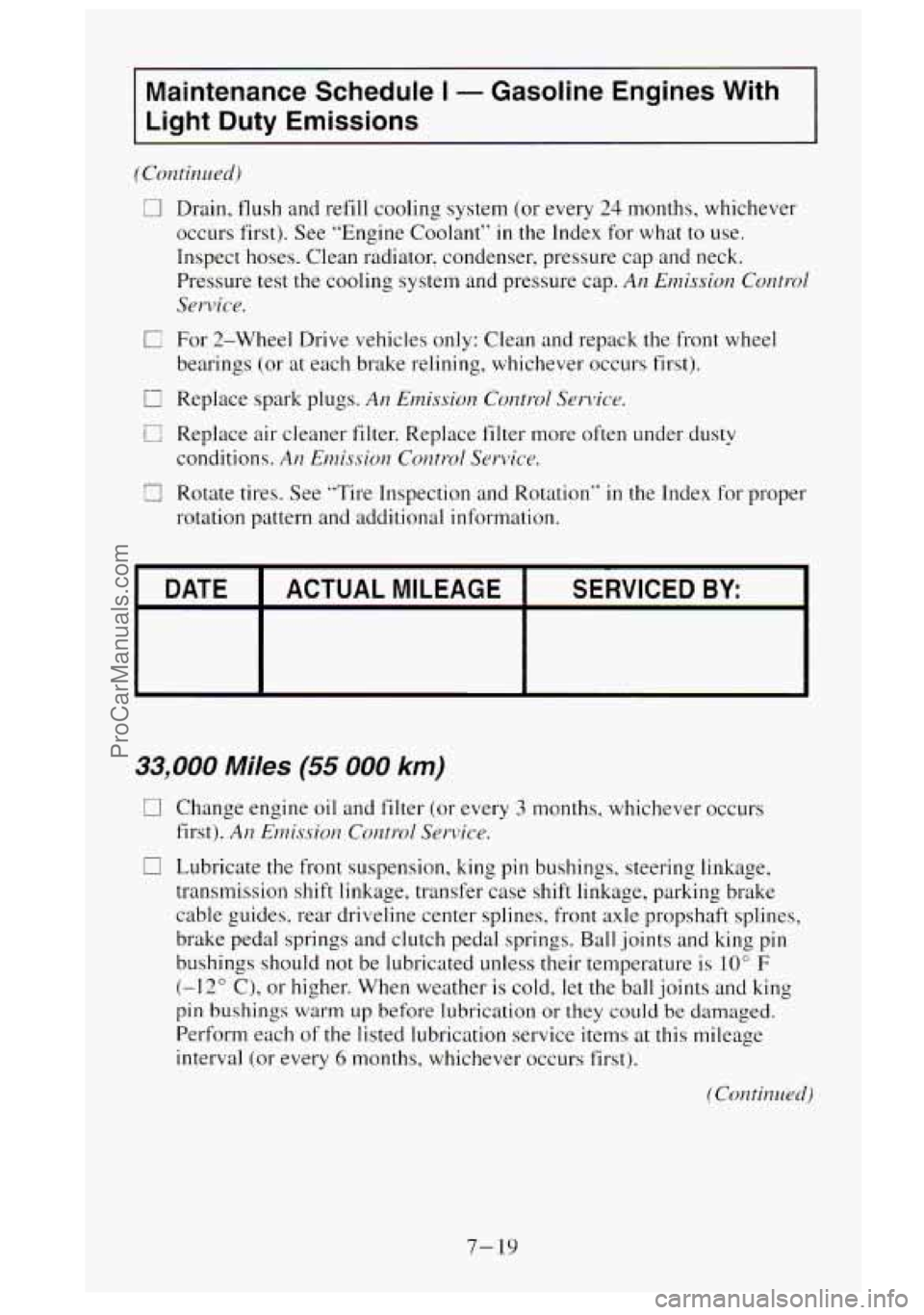
LI
c
Maintenance Schedule I - Gasoline Engines With
Light Duty Emissions
(Contimed)
Drain, flush and refill cooling system (or every 24 months, whichever
occurs first). See "Engine Coolant''
in the lndex for what to use.
Inspect hoses. Clean radiator. condenser. pressure cap and neck.
Pressure test
the cooling system and pressure cap. An Emission Control
Service.
For 2-Wheel Drive vehicles only: Clean and repack the front wheel
bearings (or at each brake relining, whichever occurs first).
Replace spark plugs.
An E~~zissior~ Corztrol Ser-vice.
Replace air cleaner filter. Replace filter more often under dusty
conditions.
An Emission Cor~tr-01 Service.
Rotate tires. See "Tire Inspection and Rotation" in the lndex for proper
rotation pattern and additional information.
I DATE I ACTUAL MILEAGE I SERVICED BY:
33,000 Miles (55 000 km)
0 Change engine oil and filter (or every 3 months, whichever occurs
first).
An Er7rissiou Contmi Service.
0 Lubricate the front suspension, king pin bushings, steering linkage,
transmission shift linkage, transfer case shift linkage, parking brake
cable guides, rear driveline center splines, front axle propshaft splines,
brake pedal springs and clutch pedal springs.
Ball joints and king pin
bushings should not be lubricated unless their temperature is
10" F
(-I 2" C), or higher. When weather is cold, let the ball joints and king
pin bushings warm up before lubrication or they could be damaged.
Perform
each of the listed lubrication service items at this mileage
interval (or every
6 months, whichever occurs first).
ProCarManuals.com