four wheel drive GMC SIERRA 1995 User Guide
[x] Cancel search | Manufacturer: GMC, Model Year: 1995, Model line: SIERRA, Model: GMC SIERRA 1995Pages: 488, PDF Size: 26.01 MB
Page 186 of 488
Driving Guidelines
Off-Road Driving with Your Four-wheel Drive
Vehicle
This off-road guide is for vehicles that have four-wheel drive.
Also, see “Anti-Lock Brakes”
in the Index.
If your vehicle doesn’t have four-wheel drive, you shouldn’t drive off-road
unless you’re
on a level, solid surface.
Off-road driving can be great fun. But it does have some definite hazards.
The greatest of these
is the terrain itself.
“Off-roading” means you’ve left the great North American road system
behind. Traffic lanes aren’t marked. Curves aren’t banked. There are no
road signs. Surfaces can
be slippery. rough, uphill or downhill. In short,
you’ve gone right back to nature.
Off-road driving involves some new skills. And that’s why it’s very
important that
you read this guide. You’ll find many driving tips and
suggestions. These will help make your off-road driving safer and more
enjoyable.
Before You Go Off-Roading
There are some things to do before you go out. For example, be sure to have
all necessary maintenance and service work done. Check to make sure all
underbody shields
(if so equipped) are properly attached. Be sure you read
all the information about your four-wheel drive vehicle in this manual.
Is
there enough fuel? Is the spare tire fully inflated? Are the fluid levels up
where they should be? What are
the local laws that apply to off-roading
where you’ll be driving?
If you don’t know, you should check with law
enforcement people in the area. Will you be
on someone’s private land? If
so, be sure to get the necessary permission.
Loading Your Vehicle for Off-Road Driving
There are some important things to remember about how to load your
vehicle.
The heaviest things should be on the load floor and forward of your
rear axle. Put heavier items as far forward
as you can.
doesn’t toss things around.
Be sure the load is secured properly, so driving on the off-road terrain
4- 12
ProCarManuals.com
Page 209 of 488
Power Take-Off (PTO)
NOTICE:
If you have a PTO that will exceed 35 horsepower installed on
your vehicle, it could damage the transfer case or transmission.
When having
a PTO installed on your vehicle, make sure that it
will not exceed 35 horsepower.
Before using a power take-off, refer to the manufacturer’s or installer’s
instructions.
NOTICE:
Using a PTO while operating in one place before the vehicle has
reached normal operating temperature can damage the transfer
case or transmission.
If you will be using the PTO while
operating in one place, drive and warm up the vehicle before
using the PTO.
To engage a power take-off
1. Set the parking brake.
2. Shift the transmission into NEUTRAL (N).
3. Hold the clutch pedal down and engage the power take-off.
I NOTICE:
Using a PTO for more than four hours without driving your
vehicle can damage the transfer case or transmission.
If using a
PTO for more than four hours without dr$ving your vehicle,
drive your vehicle for
a while to allow the transfer case and
transmission to cool.
If you are going to drive the vehicle, shift the transmission into the gear
you want. Then shift the transfer case into the range you want (if you
have four-wheel drive), apply the regular brakes and release the
parking brake.
4. Release the clutch (and the regular brakes) as you normally would.
When you release the clutch, the power take-off will start.
4-35
ProCarManuals.com
Page 222 of 488
When towing at high altitude on steep uphill grades, consider the following:
Engine coolant will boil at a lower temperature than at normal altitudes. If
you turn your engine off immediately after towing at high altitude on steep
uphill grades, your vehicle
may show signs similar to engine overheating.
To avoid this, let the engine run while parked (preferably on level ground)
with the automatic transmission
in PARK (Pj (or the manual transmission
out
of gear and the parking brake applied) for a few minutes before turning
the engine off.
If you do get the overheat warning, see “Engine
Overheating”
in the Index.
Parking on Hills
You really should not park your vehicle, with a trailer attached, on a hill. If
something goes wrong, your rig could start to move. People can be injured,
and both your vehicle and the trailer can be damaged.
But
if you ever have to park your rig on a hill, here’s how to do it:
1.
2.
3.
4.
5.
6.
Apply your regular brakes, but don’t shift into PARK (P) yet, or in gear
for a manual transmission.
Have someone place chocks under the trailer wheels.
When the wheel chocks are
in place, release the regular brakes until the
chocks absorb the load.
Re-apply the regular brakes. Then apply your parking brake, and then
shift
to PARK (P), or REVERSE (Rj for a manual transmission.
If you have
a four-wheel-drive vehicle, be sure the transfer case is in a
drive gear-not in NEUTRAL
(N).
Release the regular brakes.
A CAUTION:
It can be dangerous to get out of your vehicle if the shift lever is
not fully in
PARK (P) with the parking brake firmly set. Your
vehicle can rofl.
If you have Ieft the engine running, the vehicle can move
suddenly. You or others could be injured.
To be sure your vehicle
won’t move, even when you’re on fairly level ground, use the
steps that follow.
If you have four-wheel drive and your transfer case is in
NEUTRAL (N), your vehicle will be free to roll, even if your
shift lever is in
PARK (P). So, be sure the transfer case is in a
drive gear
- not in NEUTRAL (N).
4-48
ProCarManuals.com
Page 228 of 488
You could be injured if the vehicles roll. Set the parking brake firmly
on each vehicle. Put an automatic transmission in PARK (P) or a
manual transmission in NEUTRAL (N). If you have a
four-wheel-drive vehicle, be sure the transfer case is not in NEUTRAL
(N).
3. Turn off the ignition on both vehicles. Turn off all lights that aren’t
needed, and radios. This
will avoid sparks and help save both batteries.
And it could save your radio!
NOTICE:
If you leave your radio on, it could be badly damaged. The
repairs wouldn’t be covered by your warranty.
4. Open the hoods and locate the batteries. Find the positive (+) and
negative
(-) terminals on each battery.
A CAUTION:
Using a match near a battery can cause battery gas to explode.
People have been hurt doing this, and some have been blinded.
Use
a flashlight if you need more light.
Be sure the batteries have enough
water. You don’t need to add
water to the Delco Freedom@ battery (or batteries) installed in
every new
GM vehicle. But if a battery has filler caps, be sure
the right amount of fluid is there.
If it is low, add water to take
care
of that first. If you don’t, explosive gas could be present.
Battery fluid contains acid that can burn you. Don’t get
it on
you.
ff you accidentally get it in your eyes or on your skin, flush
the place with water and get medical help immediately.
5. Check that the jumper cables don’t have loose or missing insulation. If
they do,
you could get a shock. The vehicles could be damaged, too.
Before you connect the cables, here are some basic things you should
know. Positive
(+) will go to positive (+) and negative (-) will go to
negative
(-) or a metal engine part. Don’t connect (+) to (-) or you’ll
get
a short that would damage the battery and maybe other parts, too.
5-4
ProCarManuals.com
Page 231 of 488
To wing Your Vehicle
Try to have your GM dealer or a professional towing service tow your
vehicle. They can provide the right equipment and know how to tow
it
without damage.
If your vehicle has been changed since
it was factory-new. by adding such
things like fog lamps, aero skirting,
or special tires and wheels, these things
could be damaged during towing.
Before you do anything,
turn on the hazard warning flashers.
When you call, tell the towing service:
0 That your vehicle has rear-wheel drive, or that it has the four-wheel
drive option.
The make, model, and year of your vehicle.
0 Whether you can move the shift lever for the transmission and transfer
case,
if you have one.
If there was an accident. what was damaged.
A CAUTION:
To help avoid injury to you or others:
Never let passengers ride in a vehicle that is being towed.
0 Never tow faster than safe or posted speeds.
0 Never tow with damaged parts not fuIly secured.
0 Never get under your vehicle after it has been lifted by the
tow truck.
0 Always use separate safety chains on each side when towing a
vehicle.
0 For pickups (except cab chassis models), use T-hooks on front
. of vehicle, J-hooks on rear.
For cab chassis models, use J-hooks on front and rear of
vehicle.
When your vehicle is being towed, have the ignition key off. The steering
wheel should be clamped
in a straight-ahead position, with a clamping
device designed for towing, service.
Do not use the vehicle’s steering
column lock for this. The transmission and transfer case, if
you have one,
should be
in NEUTRAL (N) and the parking brake released.
5-7
ProCarManuals.com
Page 232 of 488
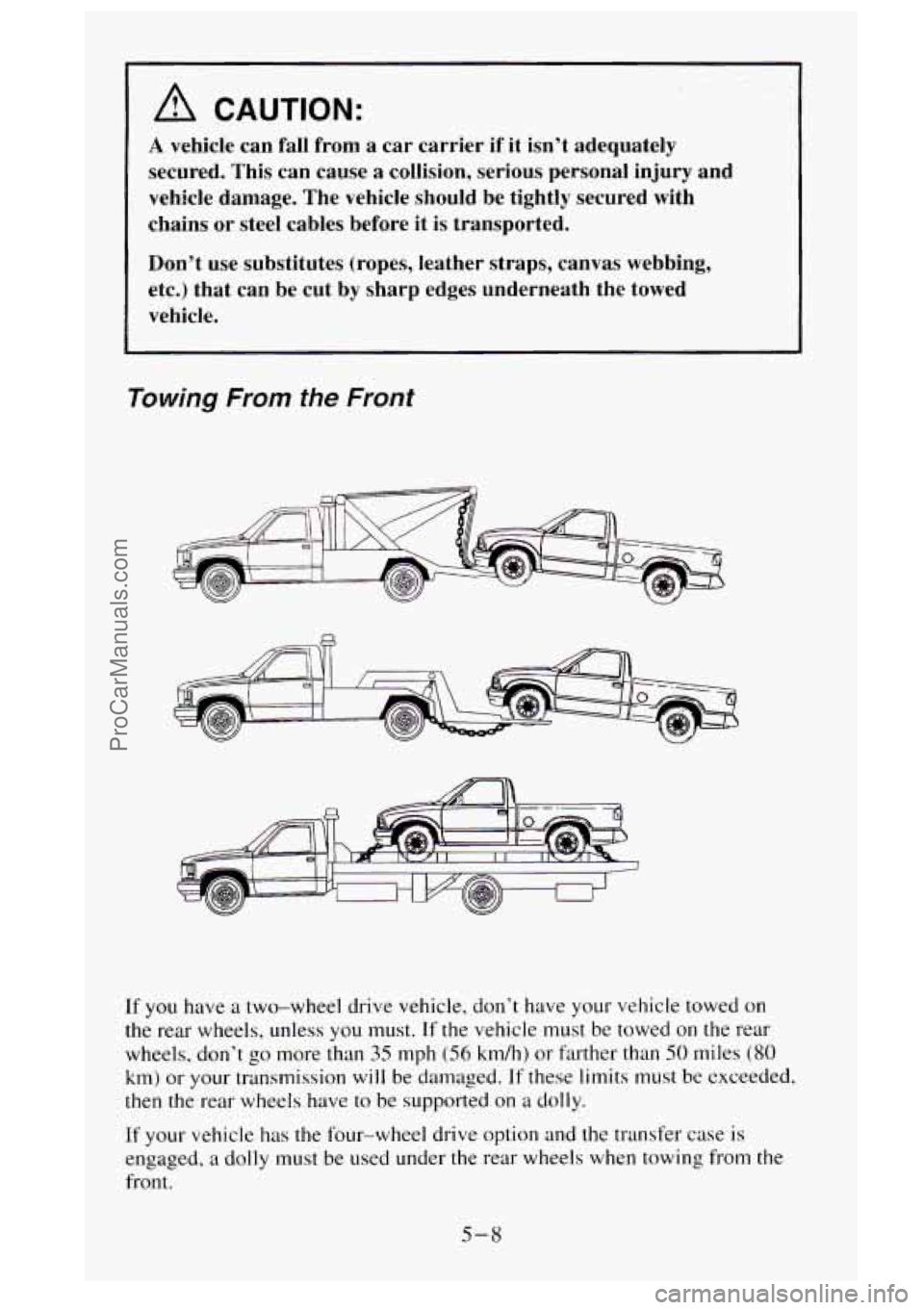
A CAUTION:
A vehicle can fall from a car carrier if it isn’t adequately
secured. This can cause
a collision, serious personal injury and
vehicle damage. The vehicle should be tightly secured with
chains or steel cables before it is transported.
Don’t use substitutes (ropes, leather straps, canvas webbing,
etc.) that can be cut by sharp edges underneath the towed
vehicle.
Towing From the Front
If you have a two-wheel drive vehicle, don’t have your vehicle towed on
the rear wheels, unless
you must. If the vehicle must be towed on the rear
wheels, don’t
go more than 35 mph (56 km/h) or farther than 50 miles (80
km) or your transmission will be damaged. If these limits must be exceeded,
then
the rear wheels have to be supported on a dolly.
If your vehicle has the four-wheel drive option and
the transfer case is
engaged, a dolly must be used under the rear wheels when towing from the
front .
5-8
ProCarManuals.com
Page 299 of 488
What to Use
Refer to the Maintenance Schedule to determine what kind of lubricant to
use. See “Recommended Fluids and Lubricants”
in the Index.
C3 (3500 H.D.) Trucks Equipped with Dana Rear Axle
Additional rear axle scheduled maintenance is required on 3500 H.D.
models equipped with Dana rear axles when they are driven under the
following conditions:
0 Extreme loading (at or near GVWR) or trailer towing, and:
Operation above 45 mph for extended periods of time
Vehicles used
in any of these conditions require the rear axle lubricant (SAE
8OW-90 - GL-5) be changed every 3 months or 3,000 miles, whichever
comes first.
To reduce required maintenance, SAE 75W-140 synthetic gear lubricant
may be used. With the use of synthetic
SAE 75W-140 lubricant, the fluid
change intervals may be increased to 30,000 miles. Before using SAE
75W-140, it is important to drain and flush the axle with clean mineral
based (non-synthetic) axle lubricant. Fluid capacity is 4.12 qts. (3.9L).
Four- Wheel Drive
Most lubricant checks in this section also apply to four-wheel-drive
vehicles. However, they have two additional systems that need lubrication.
Transfer Case
When to Check Lubricant
Refer to the Maintenance Schedule to determine how often to check the
lubricant. See “Periodic Maintenance Inspections”
in the Index.
6-33
ProCarManuals.com
Page 310 of 488
Brake Wear
Your vehicle has front disc brakes and rear drum brakes. If you have a C
3500 HD model, it has four-wheel disc brakes.
Disc brake pads have built-in wear indicators that make
a high-pitched
warning sound when the brake pads are worn and new pads are needed. The
sound may come and
go or be heard all the time your vehicle is moving
(except when you are pushing on the brake pedal firmly).
I A CAUTION:
The brake wear warning sound means that sooner or later your
brakes won’t work well. That could lead to an accident. Whe\
n
you hear the brake wear warning sound, have your vehicle
serviced.
NOTICE:
Continuing to drive with worn-out brake pads could result in
costly brake repair.
Some driving conditions or climates may cause a brake squeal when the
brakes are first applied or lightly applied. This does not mean something is
wrong with your brakes.
If you have rear drum brakes, they don’t have wear indicators, but if you
ever hear
a rear brake rubbing noise, have the rear brake linings inspected.
Also, the rear brake drum should be removed and inspected each time the
tires are removed for rotation
or changing. When you have the front brakes
replaced, have the rear brakes inspected, too.
Brake linings should always be replaced as complete axle sets.
Brake Pedal Travel
See your dealer if the brake pedal does not return to normal height, or if
there is a rapid increase in pedal travel. This could be a sign of brake
trouble.
6-44
ProCarManuals.com
Page 350 of 488
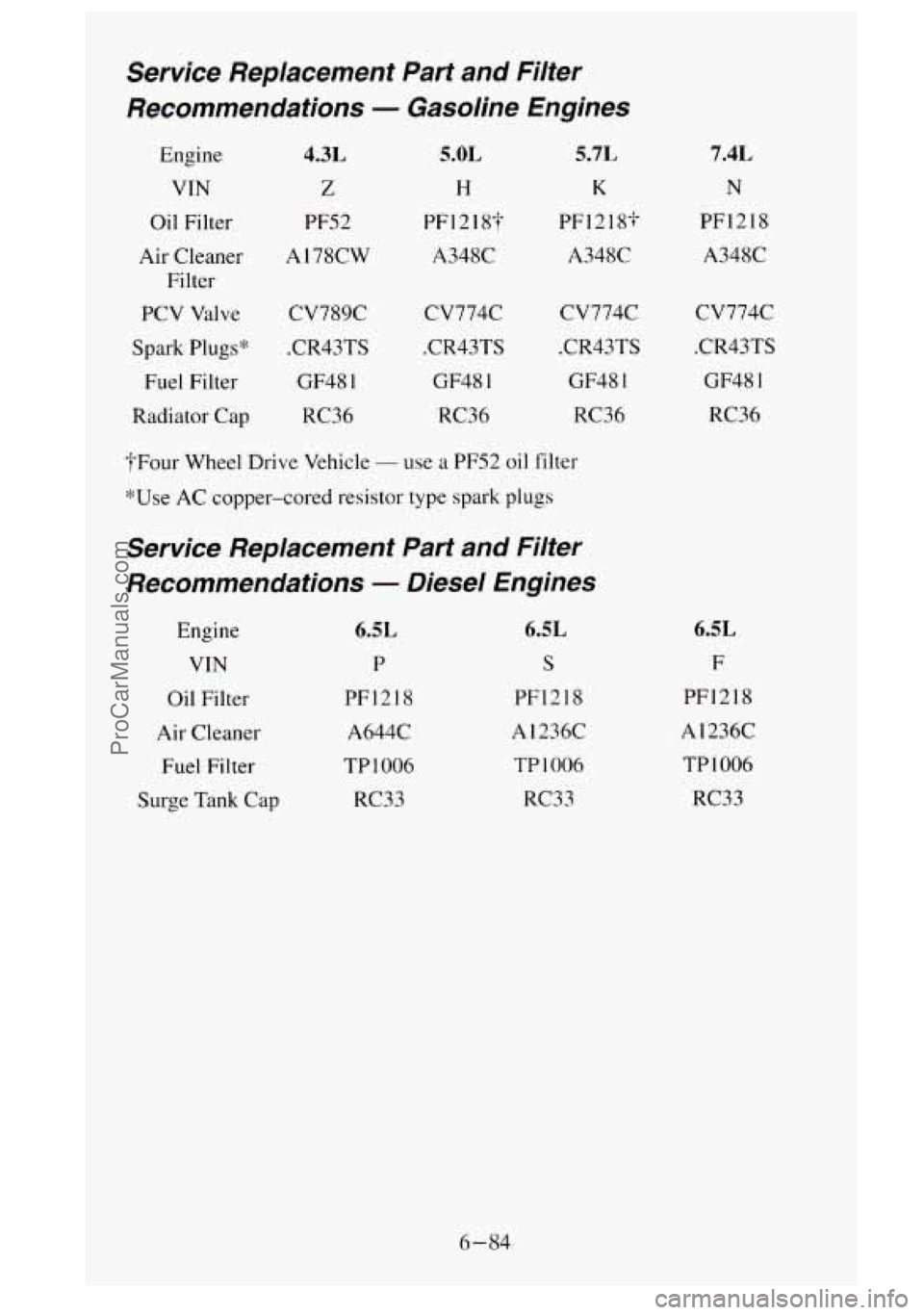
Service Replacement Part and Filter
Recommendations
- Gasoline Engines
Engine 4.3L
VTN Z
Oil Filter PFS2
Air Cleaner
A 178CW
Filter
PCV Valve CV789C
Spark
Plugs* .CR43TS
Fuel Filter GF48
1
Radiator Cap
RC36
5.0L
H
PF12183-
A348C
cv774c
.CR43TS
GF48
1
RC36
5.7L
K
PF1218q A348C
cv774c
.CR43TS GF38
1
RC36
+Four Wheel Drive Vehicle
- use a PFS2 oil filter
Wse AC copper-cored resistor type spark plugs
Service Replacement Part and Filter
Recommendations
- Diesel Engines
Engine 6.5L 6.5L
VIN P S
Oil Filter PF1218
PF1218
Air Cleaner A644C
A 1236C
Fuel Filter TP
1006 TP
1 006
Surge
Tank Cap RC33 RC33
7.41
N
PF1218
A348C
cv774c
.CR43TS GF48
I
RC36
6.51
F
PF1218
A 1236C
TP
I006
RC33
6-84
ProCarManuals.com
Page 355 of 488
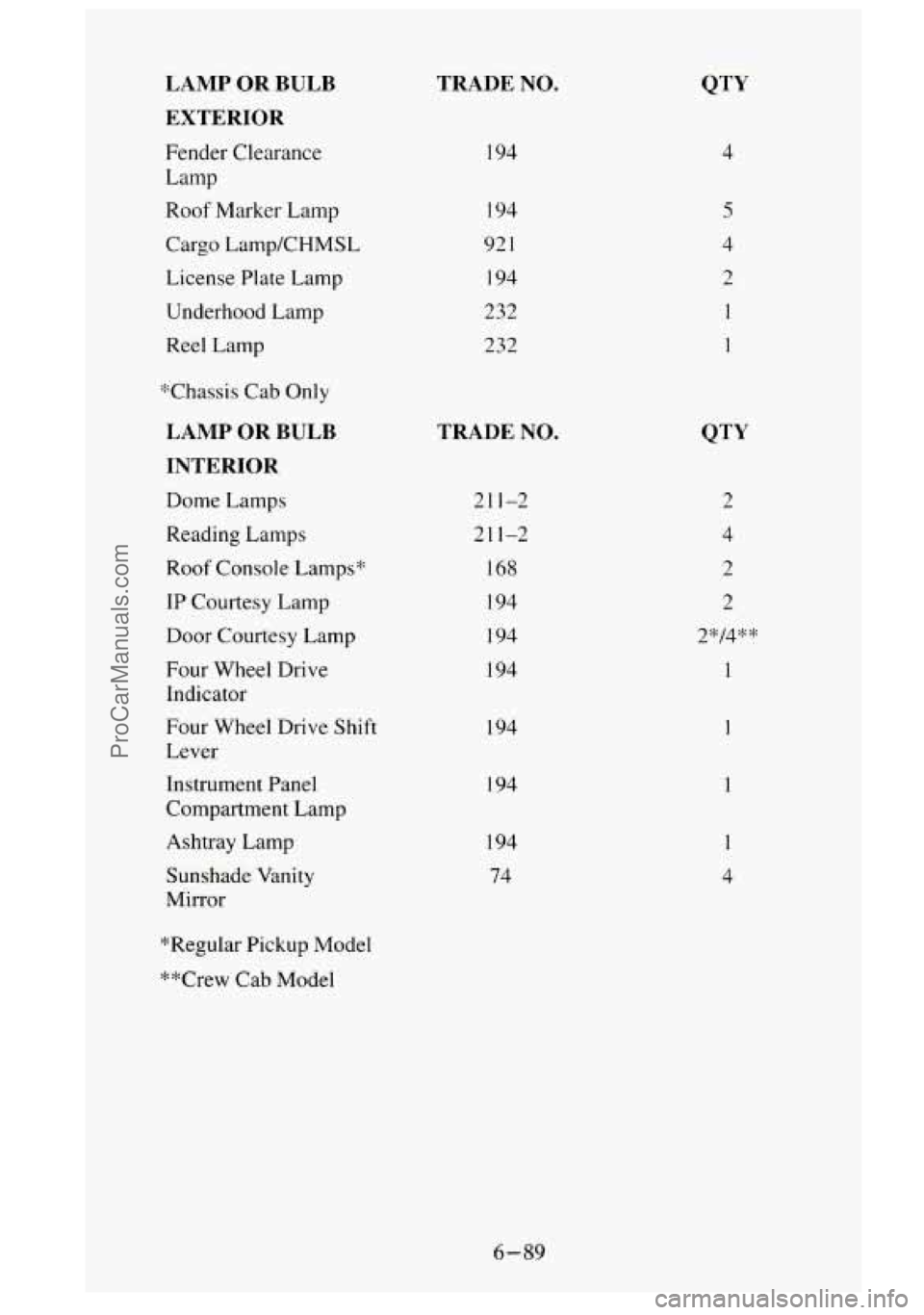
LAMP OR BULB EXTERIOR
Fender Clearance
Lamp
Roof Marker Lamp
Cargo Lamp/CHMSL License Plate Lamp
Underhood Lamp
Reel Lamp
Thassis Cab Only
LAMP OR BULB
INTERIOR
Dome Lamps
Reading Lamps
Roof Console Lamps:':
IP Courtesy Lamp
Door Courtesy Lamp
Four Wheel Drive
Indicator
Four Wheel Drive
Shift
Lever
Instrument Panel
Compartment Lamp
Ashtray Lamp
Sunshade Vanity
Mirror
TRADE NO.
I94
I94
92
I
I94
232
232
TRADE NO.
211-2
21 1-2
168
I94
194
194
194
194
194
74 4
2
4
2
1
1
1
1
4
"Regular Pickup Model
**Crew Cab Model
6-89
ProCarManuals.com