four wheel drive GMC SIERRA 1995 Owners Manual
[x] Cancel search | Manufacturer: GMC, Model Year: 1995, Model line: SIERRA, Model: GMC SIERRA 1995Pages: 488, PDF Size: 26.01 MB
Page 87 of 488
NOTICE:
Shift to REVERSE (R) only after your vehicle is stopped.
Shifting to REVERSE
(R) while your vehicle is moving could
damage
your transmission.
Also, use REVERSE (R), along with the parking brake, when turning
off your engine and parking your vehicle.
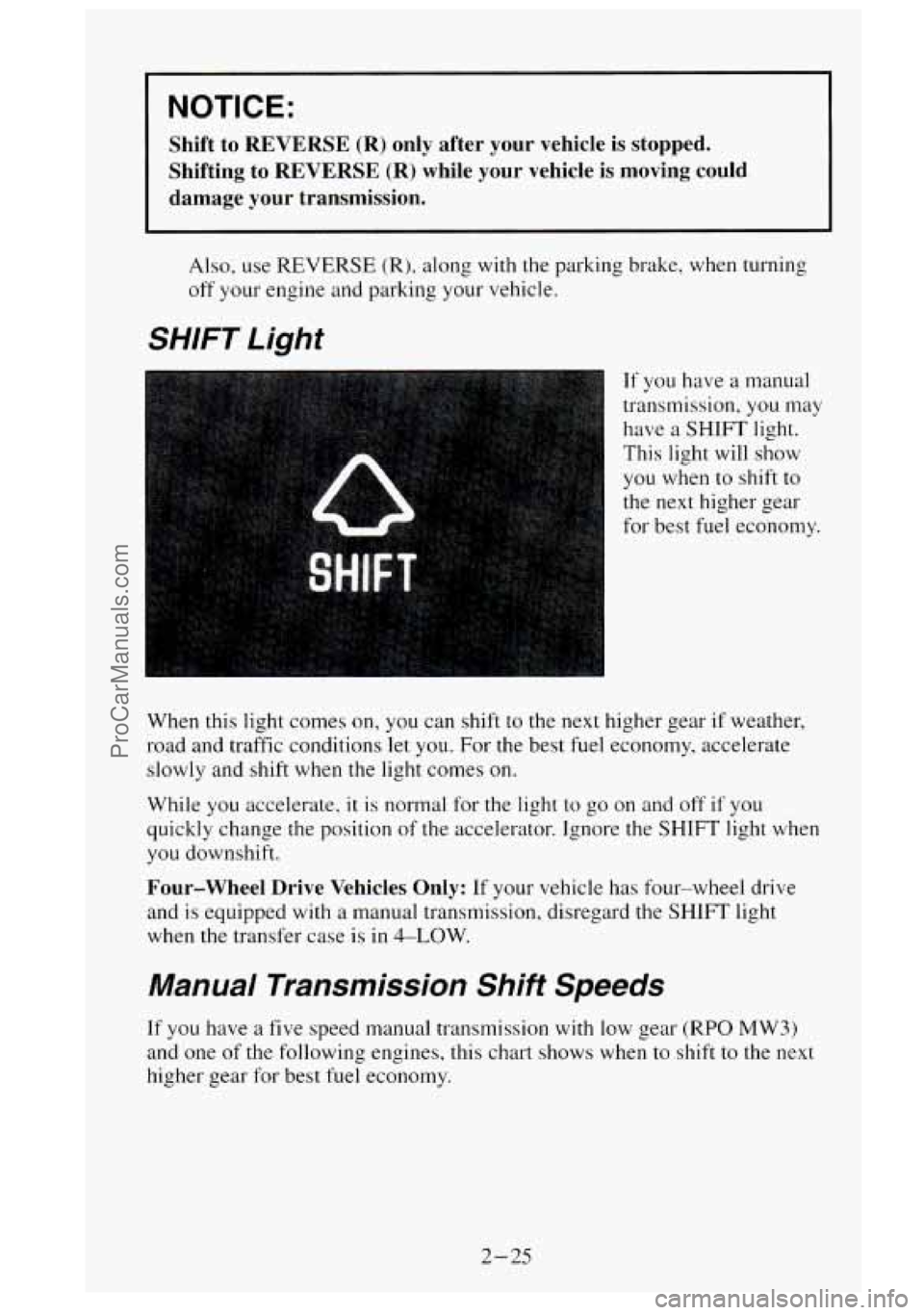
SHIFT Light
If you have a manual
transmission, you may
have
a SHIFT light.
This light will show
you when
to shift to
the
next higher gear
for best
fuel economy.
When this light comes on, you can shift to the
next higher gear if weather,
road and traffic conditions let you.
For the best fuel economy, accelerate
slowly and shift when the light comes on.
While you accelerate,
it is normal for the light to go on and off if you
quickly change the position of the accelerator. Ignore the
SHIFT light when
you downshift.
Four-wheel Drive Vehicles Only: If your vehicle has four-wheel drive
and is equipped with a manual transmission, disregard the
SHIFT light
when
the transfer case is in 4-LOW.
Manual Transmission Shift Speeds
If you have a five speed manual transmission with low gear (RPO MW3)
and one of the following engines, this chart shows when to shift to the next
higher gear for best fuel economy.
2-25
ProCarManuals.com
Page 91 of 488
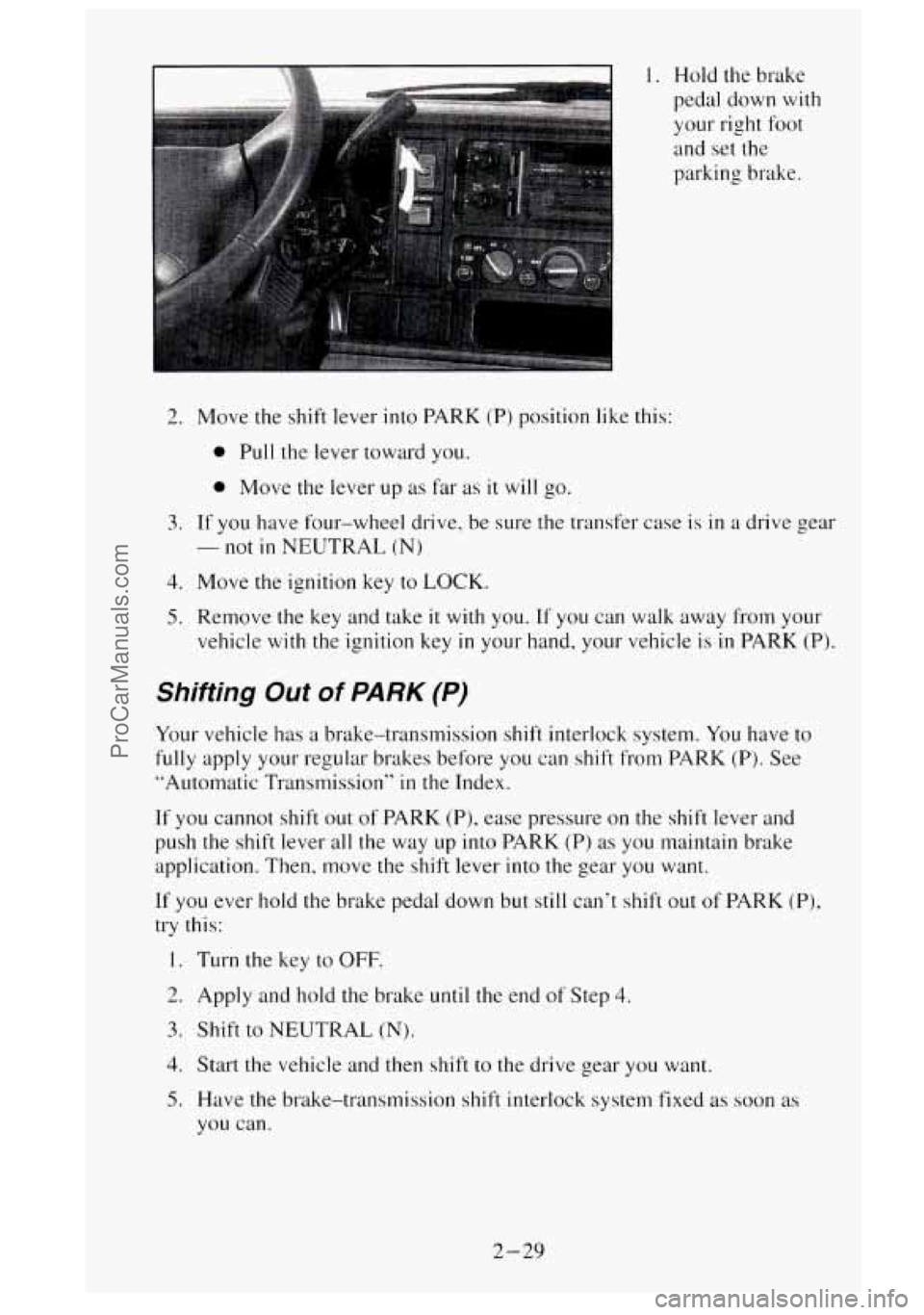
I. Hold the brake
pedal down
with
your right foot
and set the
parking brake.
2. Move the shift lever into PARK (P) position like this:
0 Pull the lever toward you.
0 Move the lever up as far as it will go.
3. If you have four-wheel drive, be sure the transfer case is in a drive gear
- not in NEUTRAL (N)
4. Move the ignition key to LOCK.
5. Remove the key and take it with you. If you can walk away from your
vehicle
with the ignition key in your hand, your vehicle is in PARK (P).
Shifting Out of PARK (P)
Your vehicle has a brake-transmission shift interlock system. You have to
fully apply your regular brakes before you can shift from PARK (P). See
“Automatic Transmission”
in the Index.
If you cannot shift out of PARK (P), ease pressure on the shift lever and
push the shift lever all the way up into PARK (P) as you maintain brake
application. Then, move the shift lever into the gear you want.
If you ever hold the brake pedal down but still can’t shift out of PARK (P),
try this:
1. Turn the key to OFF.
2. Apply and hold the brake until the end of Step 4.
3. Shift to NEUTRAL (N).
3. Start the vehicle and then shift to the drive gear you want.
5. Have the brake-transmission shift interlock system fixed as soon as
you can.
2-29
ProCarManuals.com
Page 92 of 488
Leaving Your Vehicle With the Engine Running
(Automatic Transmission Models
Only)
A CAUTION:
It can be dangerous to leave your vehicle with the engine
running. Your vehicle could move suddenly if the shift lever
is
not fully in PARK (P) with the parking brake firmly set. If you
have four-wheel drive with a manual transfer case shift lever
and your transfer case is in
NEUTRAL (N), your vehicle will be
free to roll, even if your shift lever is in PARK
(P). So be sure the
transfer case
is in a drive gear - not in NEUTRAL (N). And, if
you leave the vehicle with the engine running, it could overheat
and even catch fire.
You or others could be injured. Don’t leave
your vehicle with the engine running unless you have to.
If you have to leave your vehicle with the engine running, be sure your
vehicle is in PARK (P) and your parking brake is firmly set before you leave
it. After you’ve moved the shift lever into the PARK (P) position, hold the
regular brake pedal down. Then. see
if you can move the shift lever away
from PARK (P) without first pulling
it toward you.
If
you can, it means that the shift lever wasn’t fully locked into PARK (P).
Torque Lock (Automatic Transmission)
If you are parking on a hill and you don’t shift your transmission into PARK
(P) properly, the weight of the vehicle may put too much force on the
parking pawl in the transmission.
You may find it difficult to pull the shift
lever out of PARK (P). This is called “torque lock.” To prevent torque lock,
set the parking brake and then shift into PARK (P) properly before you
leave the driver’s seat.
To find out how, see “Shifting Into PARK (P)” in the
Index.
When you are ready to drive, move the shift lever out
of PARK (P) before
you release the parking brake.
If “torque lock” does occur, you may need to have another vehicle push
yours
a little uphill to take some of the pressure from the transmission, so
you can pull the shift lever out of PARK (P).
2-30
ProCarManuals.com
Page 93 of 488
Parking Your Vehicle (Manual Transmission
Models Only)
Before you get out of your vehicle, put your manual transmission in
REVERSE (R), turn off the engine, and firmly apply the parking brake.
If you have four-wheel drive, be sure your transfer case is in a drive gear.
Your vehicle could roll if it isn't.
If you are parking on
a hill, or if your pulling a trailer, see "Parking on
Hills" or '"Towing a Trailer" in the Index.
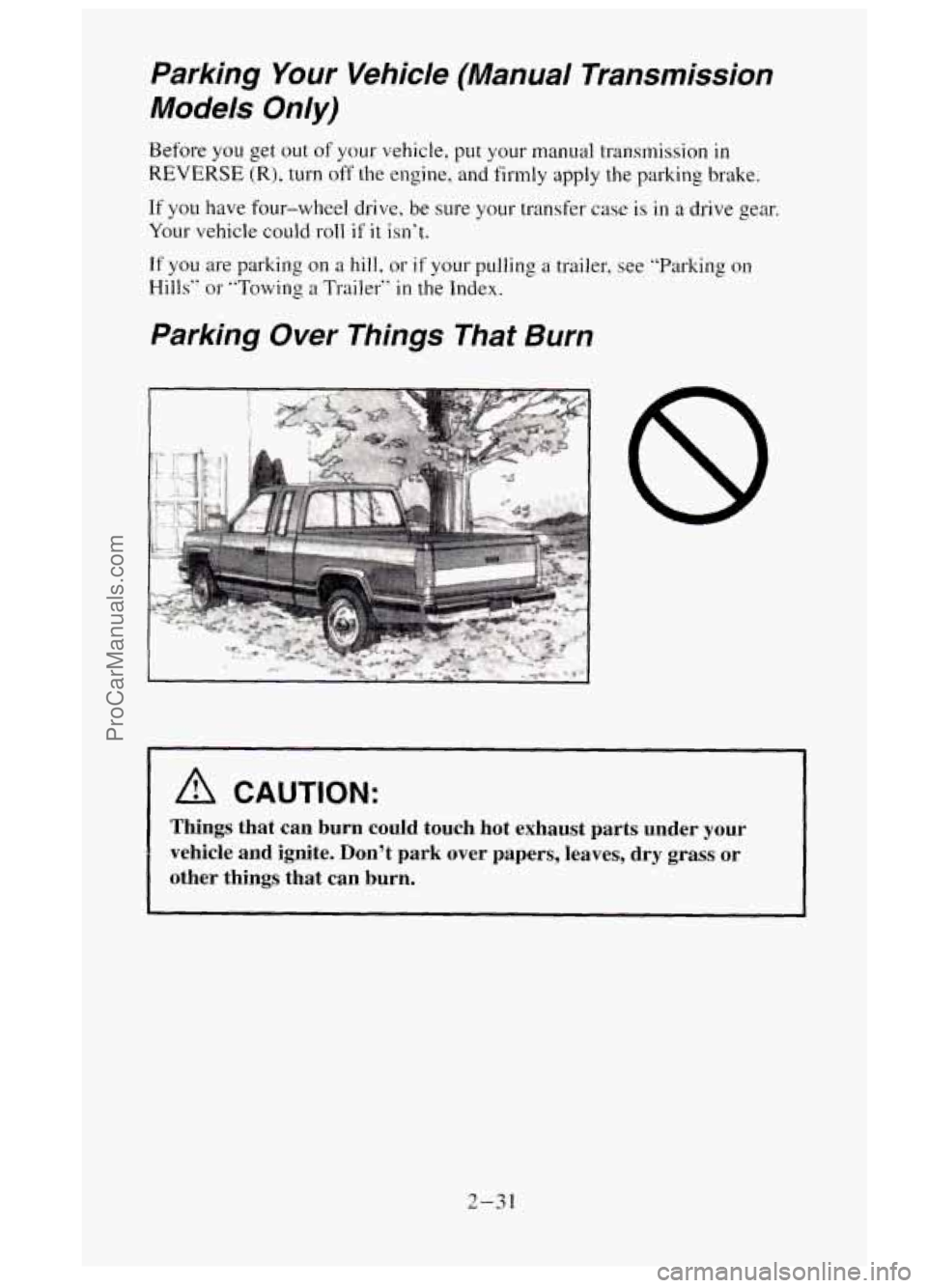
Parking Over Things That Burn
1 A CAUTION:
Things that can burn could touch hot exhaust parts under your \
vehicle and ignite. Don't park over papers, leaves, dry grass
or
other things that can burn.
2-31
ProCarManuals.com
Page 95 of 488
A CAUTION:
Idling the engine with the air system control off could allow
dangerous exhaust into your vehicle (see the earlier Caution
under “Engine Exhaust”).
Also, idling in a closed-in place can let deadly carbon monoxide
~ (CO) into your vehicle even if the fan switch is at the highest
setting. One place this can happen is a garage. Exhaust
- with
CO - can come in easily. NEVER park in a garage with the
engine running.
Another closed-in place can be
a blizzard. (See “Blizzard” in the
Index.)
A CAUTION:
It can be dangerous to get out of your vehicle if the shift lever is
not fully in PARK
(P) with the parking brake firmly set. Your
vehicle can roll. Don’t leave your vehicle when the engine
is
running unless you have to. If you’ve left the engine running, the
vehicle can move suddenly. You or others could be injured.
To be
sure your vehicle won’t move, even when you’re on fairly level
ground, always set your parking brake and move the shift lever
to PARK
(P).
If you have four-wheel drive and your transfer case is in NEUTRAL (N),
your vehicle
will be free to roll, even if your shift lever is in PARK (P). So,
be sure the transfer case is in a drive gear - not in NEUTRAL (N). Always
set your parking brake. Follow the proper steps to be sure your vehicle
won’t move. See “Shifting Into PARK
(P)“ in the Index.
If you’re pulling a trailer. see ”Towing a Trailer“ in the Index.
Four- Wheel Drive
If your vehicle has four-wheel drive, you can send your engine‘s driving
power
to all four wheels for extra traction. To get the most satisfaction out
of four-wheel drive, you must be familiar with it’s operation. Read the part
that follows before using four-wheel drive.
You should use 2-WHEEL
HIGH (2H) for most normal driving conditions.
2-33
ProCarManuals.com
Page 96 of 488
NOTICE:
Driving in the 4-WHEEL HIGH (4H) or 4-WHEEL LOW (4,)
positions for a long time on dry or wet pavement could shorten
the life of your vehicle’s drivetrain.
NOTICE:
Changing your vehicle’s body height can damage your vehicle’s
suspension, drivetrain, or other vehicle components. It
may also
affect the
way your vehicle handles, and the function of your
vehicle’s safety features.
Do not change your vehicle’s height
from the original design specifications.
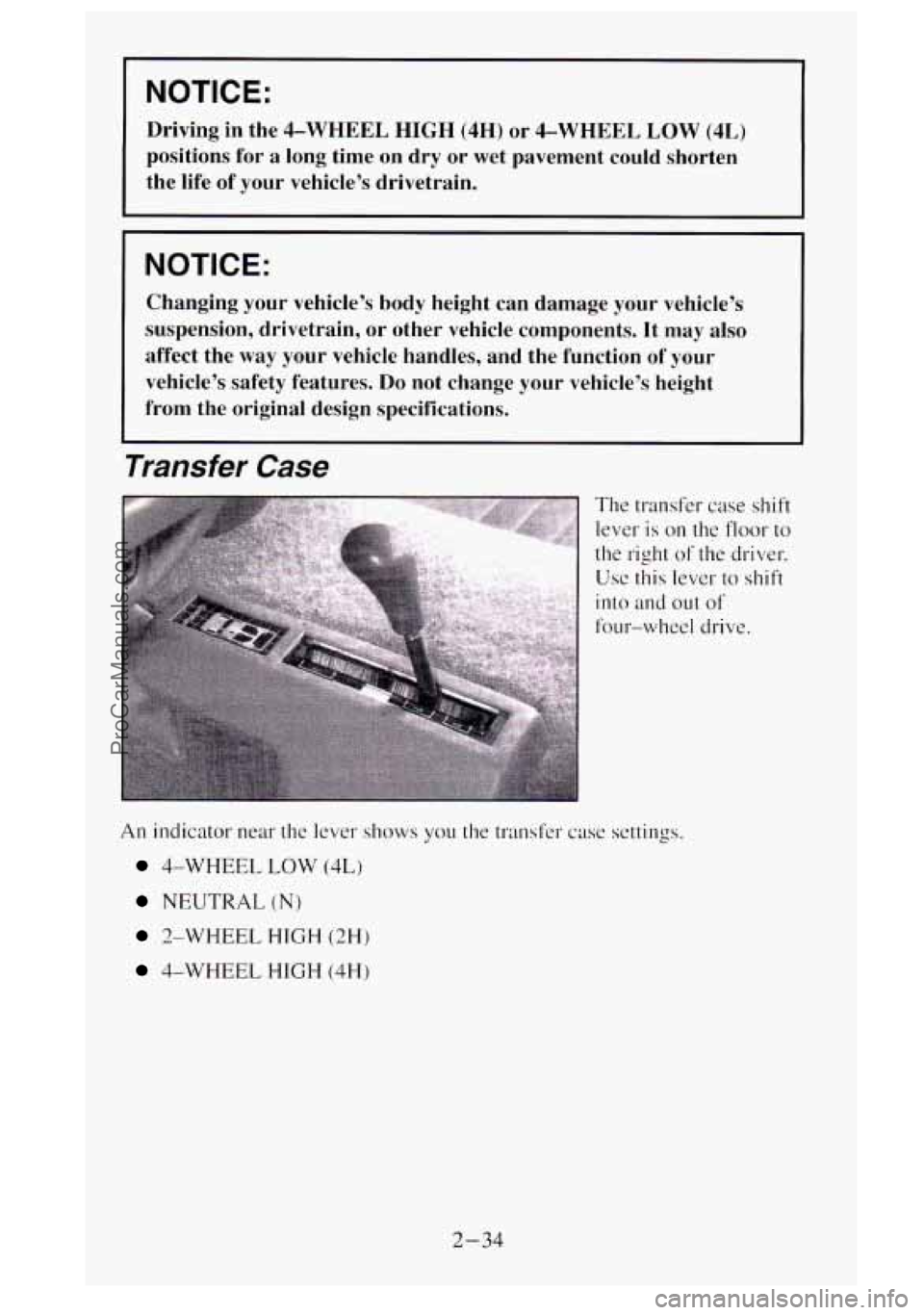
Transfer Case
The transfer case shift
lever
is on the floor to
the right of the driver.
Use
this lever to shift
into and
out of
four-whcel drive.
An indicator near the lever shows you the transfer case settings.
4-WHEEL LOW (4L)
NEUTRAL (N)
2-WHEEL HIGH (2H)
4-WHEEL HIGH (4H)
2-34
ProCarManuals.com
Page 97 of 488
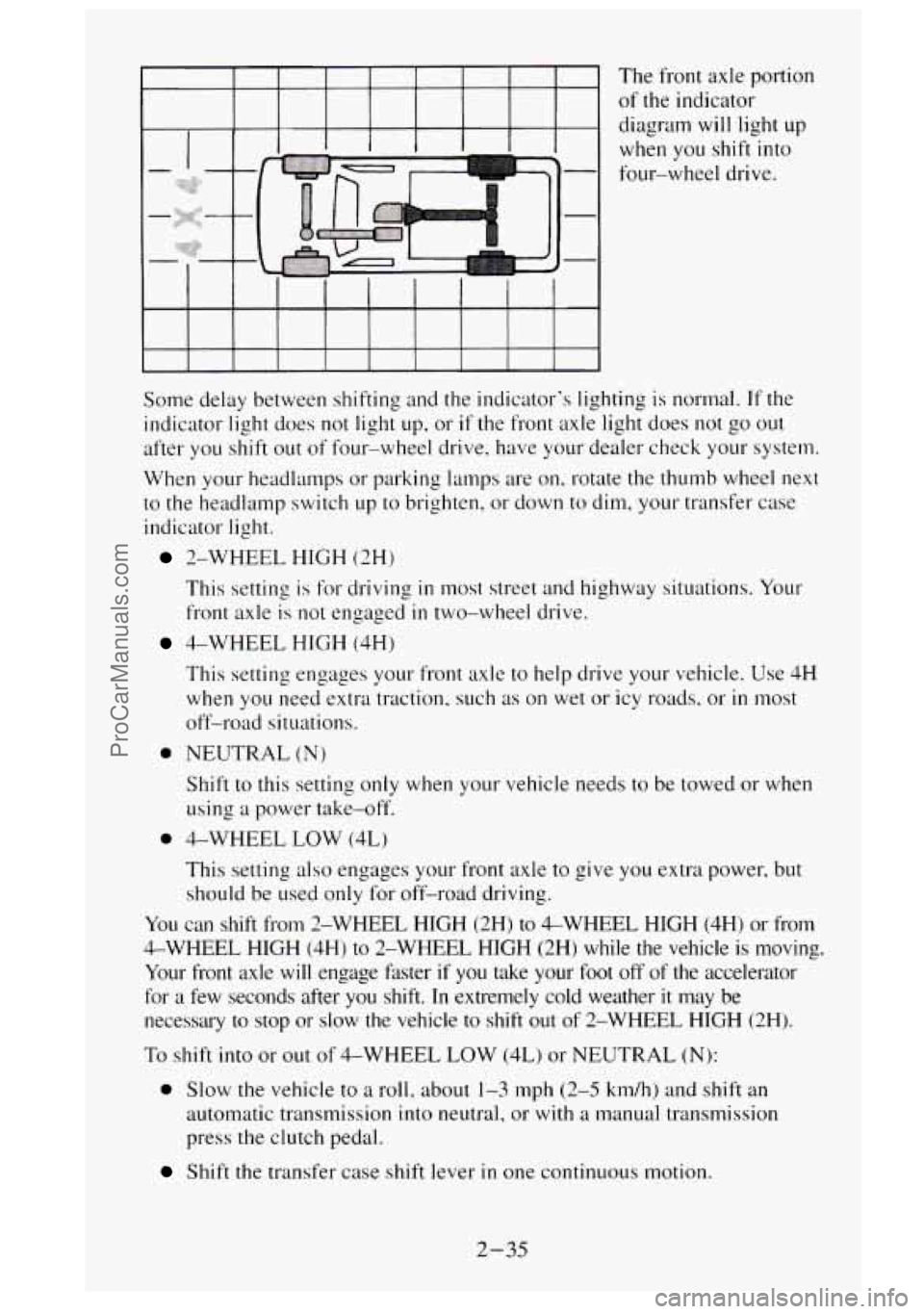
The from axle portion
of the indicator
diagram will light
up
when you shift into
four-wheel drive.
Some delay between shifting and the indicator's lighting is normal.
If the
indicator light does not light
up, or if the front axle light does not go out
after you shift out of four-wheel drive. have your dealer check your system.
When your headlamps or parking lamps are
on, rotate the thumb wheel next
to the headlamp switch up to brighten, or down to dim, your transfer case
indicator light.
2-WHEEL HIGH (2H)
This setting is for driving
in most street and highway situations. Your
front axle is not engaged
in two-wheel drive.
4-WHEEL HIGH (4H)
This setting engages your front axle to help drive your vehicle. Use
4H
when you need extra traction, such as on wet or icy roads. or in most
off-road situations.
0 NEUTRAL (N)
Shift to this setting only when your vehicle needs to be towed or when
using
a power take-off.
0 4-WHEEL LOW (4L)
This setting also engages your front axle to give you extra power, but
should be used only for off-road driving.
You can shift from 2-WHEEL HIGH (2H)
to &WHEEL HIGH (4H) or from
4-WHEEL HIGH (4H) to 2-WHEEL HIGH (2Hj while the vehicle is moving.
Your front axle
will engage faster if you take your foot off of the accelerator
for a few seconds after you shift.
In extremely cold weather it may be
necessary
to stop or slow the vehicle to shift out of 2-WHEEL HIGH (2H).
To shift
into or out of 4-WHEEL LOW (4L) or NEUTRAL (N):
0 Slow the vehicle to a roll. about 1-3 mph (2-5 km/h) and shift an
automatic transmission into neutral,
or with a manual transmission
press the clutch pedal.
Shift the transfer case shift lever in one continuous motion.
2-35
ProCarManuals.com
Page 98 of 488
Don’t pause in NEUTRAL (N) as you shift the transfer case into 4-WHEEL
LOW (4L), or your gears could clash.
Remember that driving in
&WHEEL HIGH (4H) or 4-WHEEL LOW (4L) may
reduce fuel economy.
Also, driving in four-wheel drive on dry pavement could
cause your tires
to wear faster and make your transfer case harder to shift.
Front Axle Locking Feature
The front axle locks and unlocks automatically when you shift the transfer
case. Some delay for the axle to lock or unlock is normal. If the outside
temperature is very hot, or the vehicle has been used under hard driving
conditions, there may be a slight delay for the axle to unlock.
Windows
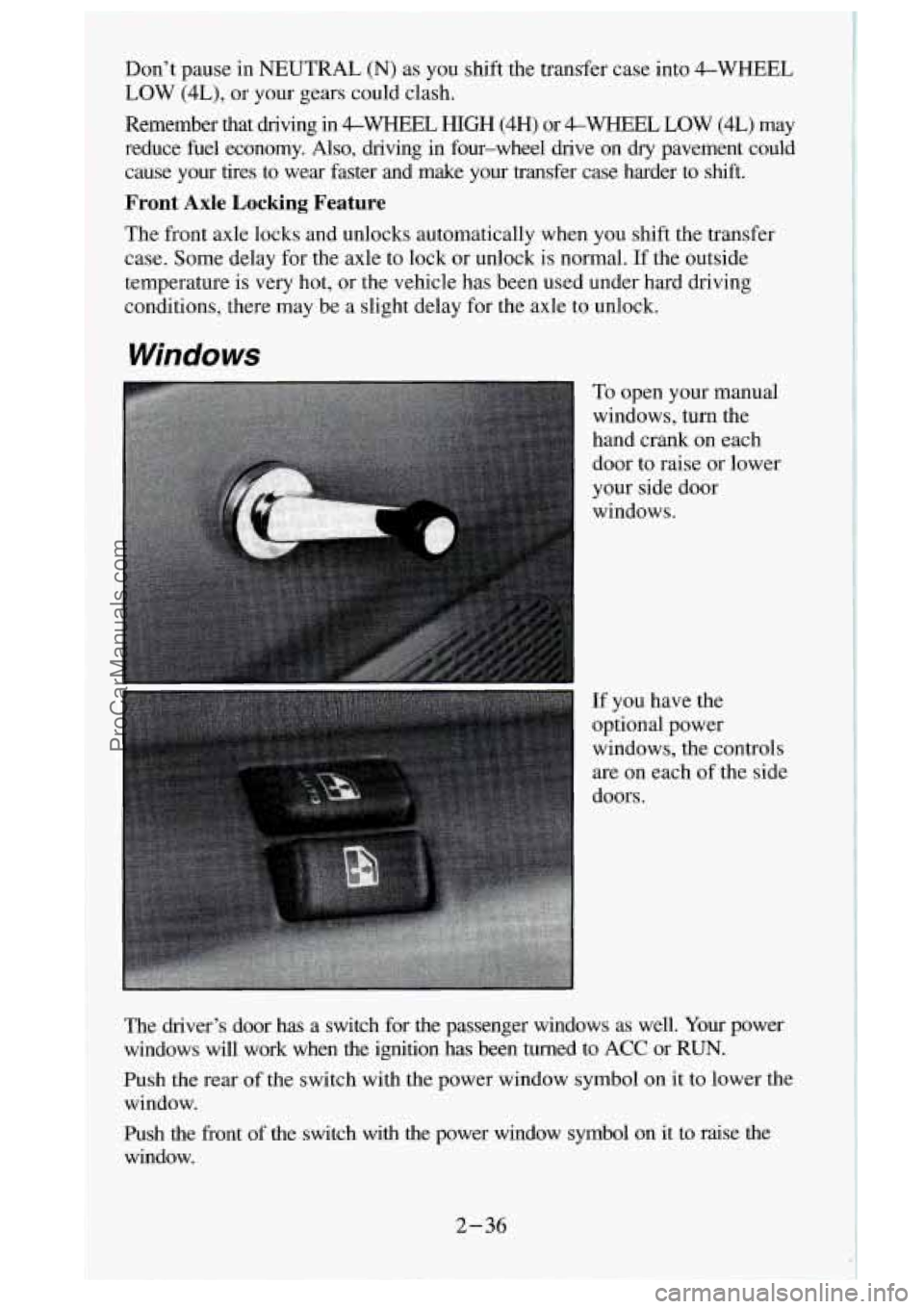
To open your manual
windows, turn the
hand crank on each
door to raise or lower
your side door
windows.
If you have the
optional power
windows, the controls
are on each of the side
doors.
The driver’s door has a switch for the passenger windows as well.
Your power
windows will work when the ignition has been turned to ACC or RUN.
Push the rear
of the switch with the power window symbol on it to lower the
window.
Push the front of the switch with the power window symbol on
it to raise the
window.
2-36
ProCarManuals.com
Page 110 of 488
To Erase Speed Memory
When you turn off' the Cruise Control or the ignition. your Cruise Control
set speed memory
is erased.
Headlamps and Vehicle Lighting
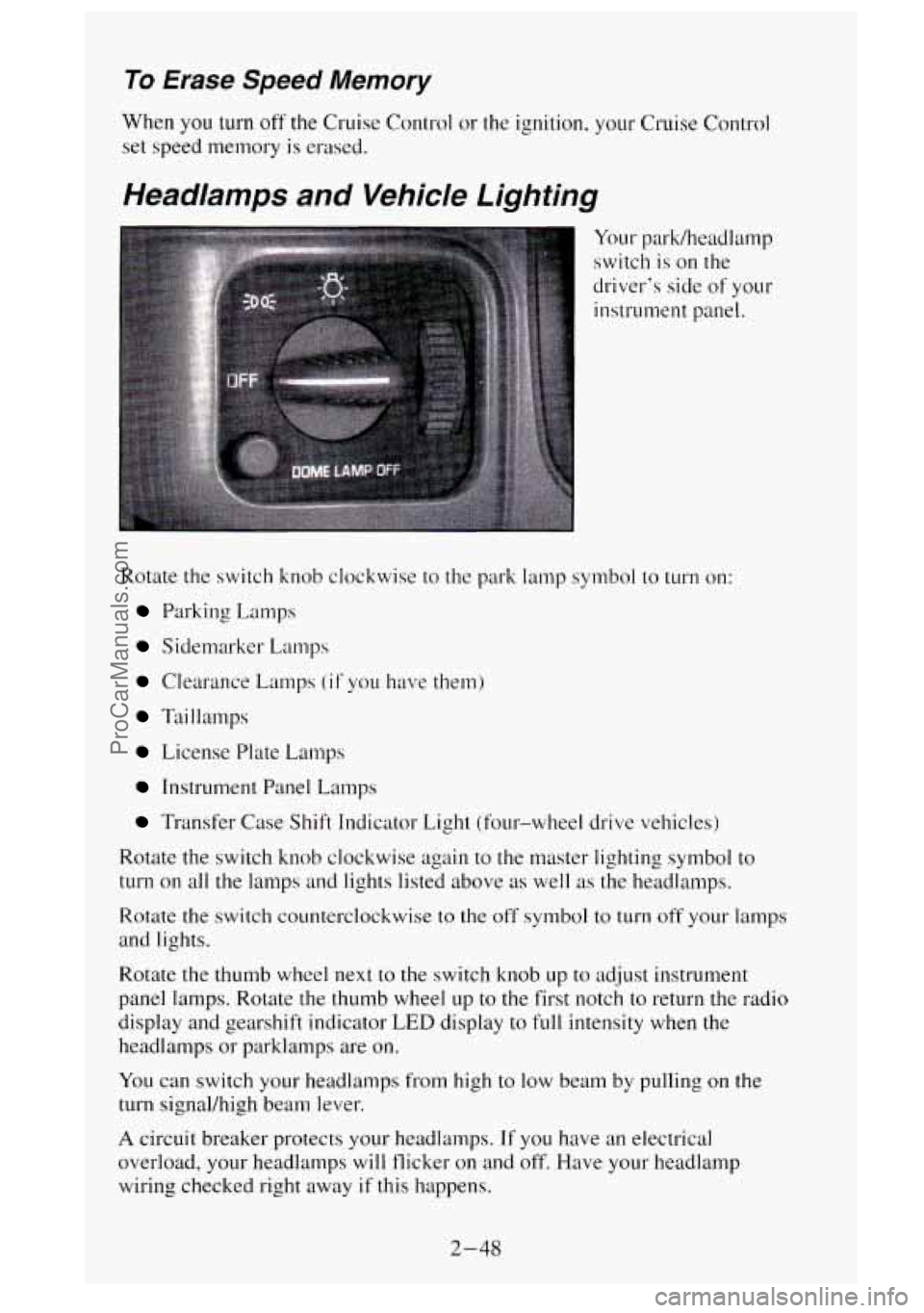
Your park/headlamp
switch is on the
driver's side of your
instrument panel.
Rotate the switch knob clockwise to the park lamp symbol to
turn on:
Parking Lamps
Sidemarker Lamps
Clearance Lamps (if you have them)
Taillamps
License Plate L.amps
Instrument Panel Lamps
Transfer Case Shift Indicator Light (four-wheel drive vehicles)
Rotate the switch knob clockwise again to the master lighting symbol to
turn on all the lamps and lights listed above as well as the headlamps.
Rotate the switch counterclockwise to the off symbol to turn off your lamps
and lights.
Rotate the thumb wheel next to the switch knob up
to adjust instrument
panel lamps. Rotate
the thumb wheel up to the first notch to return the radio
display and gearshift indicator
LED display to full intensity when the
headlamps or parklamps are
on.
You can switch your headlamps from high to low beam by pulling on the
turn signal/high beam lever.
A circuit breaker protects your headlamps. If you have an electrical
overload, your headlamps will flicker on and off. Have your headlamp
wiring checked right away if this happens.
2-48
ProCarManuals.com
Page 181 of 488
Remember: Anti-lock doesn’t change the time you need to get your foot up
to the brake pedal. If you get too close to the vehicle in front of you, you
won’t have time
to apply your brakes if that vehicle suddenly slows or
stops. Always leave enough room up ahead to stop, even though
you have
anti-lock brakes.
To Use Anti-Lock
Don’t pump the brakes. Just hold the brake pedal down and let anti-lock
work for you. You may feel the brakes vibrate, or you may notice some
noise, but this is normal. On vehicles
with four-wheel drive, your anti-lock
brakes work at all times
- whether you are in two-wheel drive or
four-wheel drive.
Braking in Emergencies
Use your anti-lock braking system when you need to. With anti-lock, you
can steer and brake at the same time. In many emergencies, steering can
help you more than even the very best braking.
Steering
Power Steering
If you lose power steering assist because the engine stops or the system is
not functioning, you can steer but it will take much more effort.
Steering Tips
Driving on Curves
It’s important to take curves at a reasonable speed.
A lot of the “driver lost control’’ accidents mentioned on the news happen
on curves. Here’s why:
Experienced driver or beginner, each of
us is subject to the same laws of
physics when driving on curves. The traction of the tires against the road
surface makes
it possible for the vehicle to change its path when you turn
the front wheels.
If there’s no traction, inertia will keep the vehicle going in
the same direction. If you’ve ever tried to steer
a vehicle on wet ice, you’ll
understand this.
The traction
you can get in a curve depends on the condition of your tires
and the road surface, the angle at which the curve is banked, and your
speed. While you’re
in a curve, speed is the one factor you can control.
4-7
ProCarManuals.com