light GMC SIERRA 1995 User Guide
[x] Cancel search | Manufacturer: GMC, Model Year: 1995, Model line: SIERRA, Model: GMC SIERRA 1995Pages: 488, PDF Size: 26.01 MB
Page 79 of 488
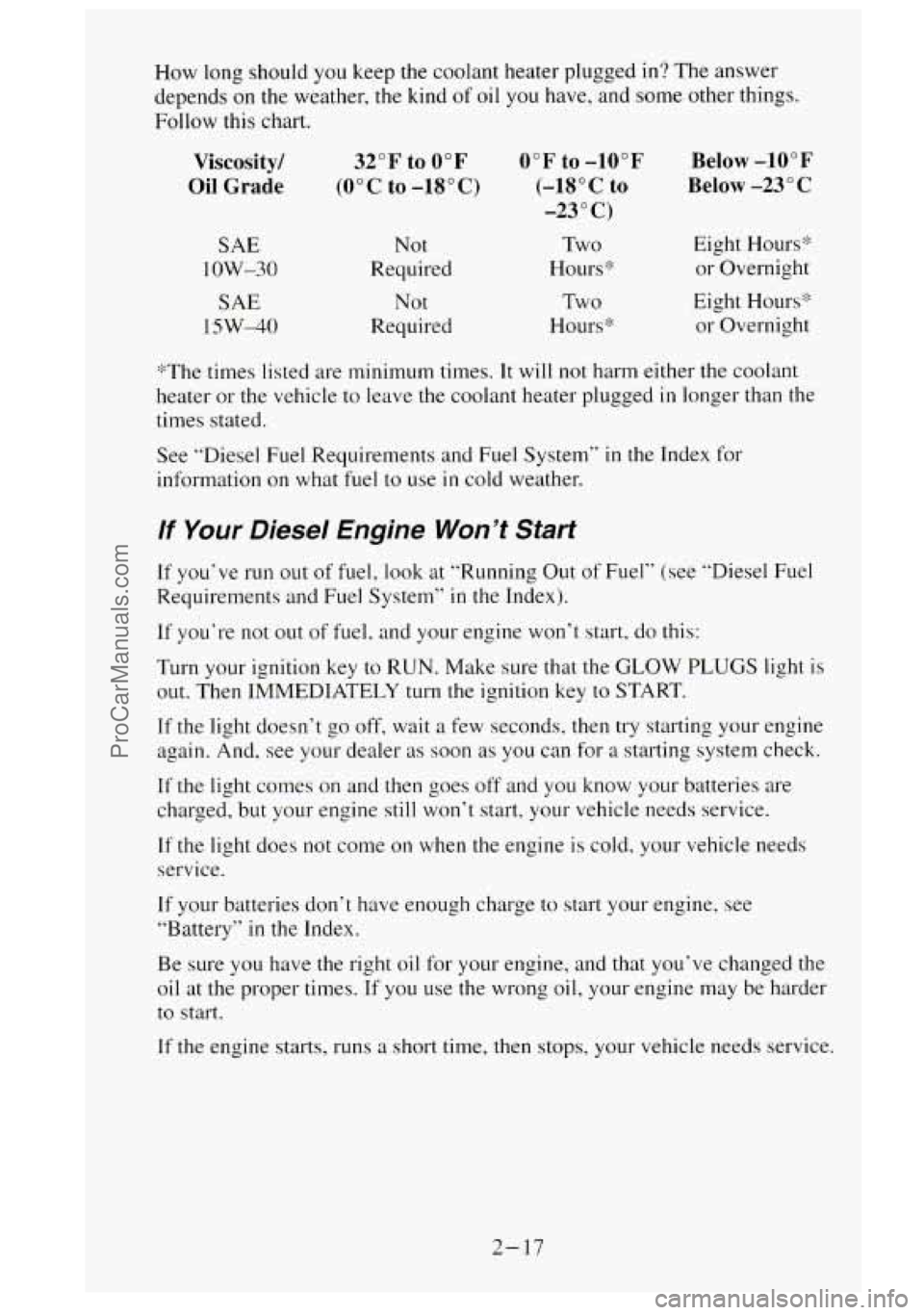
How long should you keep the coolant heater plugged in? The answer
depends on the weather,
the kind of oil you have, and some other things.
Follow this chart.
Viscosity/
Oil Grade
SAE
1 OW-30
SAE
15W-40
32°F to 0°F
(0°C to -18°C)
Not
Required
Not
Required
0°F to -10°F
(-18OC
to
-23 O C)
Two
Hours:!:
Two
Hours‘%
Below -10°F
Below -23”
C
Eight Hours’>
or Overnight
Eight Hours* or Overnight
’%The times listed are minimum times.
It will not harm either the coolant
heater or the vehicle to leave
the coolant heater plugged in longer than the
times stated.
See “Diesel Fuel Requirements and Fuel System’’
in the Index for
information
on what fuel to use in cold weather.
If Your Diesel Engine Won’t Start
If you‘ve run out of fuel, look at “Running Out of Fuel” (see “Diesel Fuel
Requirements and Fuel System”
in the Index).
If you‘re not out of fuel, and your engine won’t start, do this:
Turn your ignition key to RUN. Make sure that the GLOW PLUGS light is
out. Then IMMEDIATELY turn the ignition key to START.
If the light doesn’t go off, wait a few seconds, then try starting your engine
again. And, see your dealer as soon as
you can for a starting system check.
If the light comes on and then goes off and you know your batteries are
charged, but your engine still won’t start, your vehicle needs service.
If the light does not come on when the engine is cold, your vehicle needs
service.
If your batteries don‘t have enough charge to start your engine, see
“Battery”
in the Index.
Be sure you have the right oil for your engine, and that you’ve changed the
oil at the proper times. If you use the wrong
oil, your engine may be harder
to start.
If the engine starts, runs a short time, then stops, your vehicle needs service.
2- 17
ProCarManuals.com
Page 87 of 488
NOTICE:
Shift to REVERSE (R) only after your vehicle is stopped.
Shifting to REVERSE
(R) while your vehicle is moving could
damage
your transmission.
Also, use REVERSE (R), along with the parking brake, when turning
off your engine and parking your vehicle.
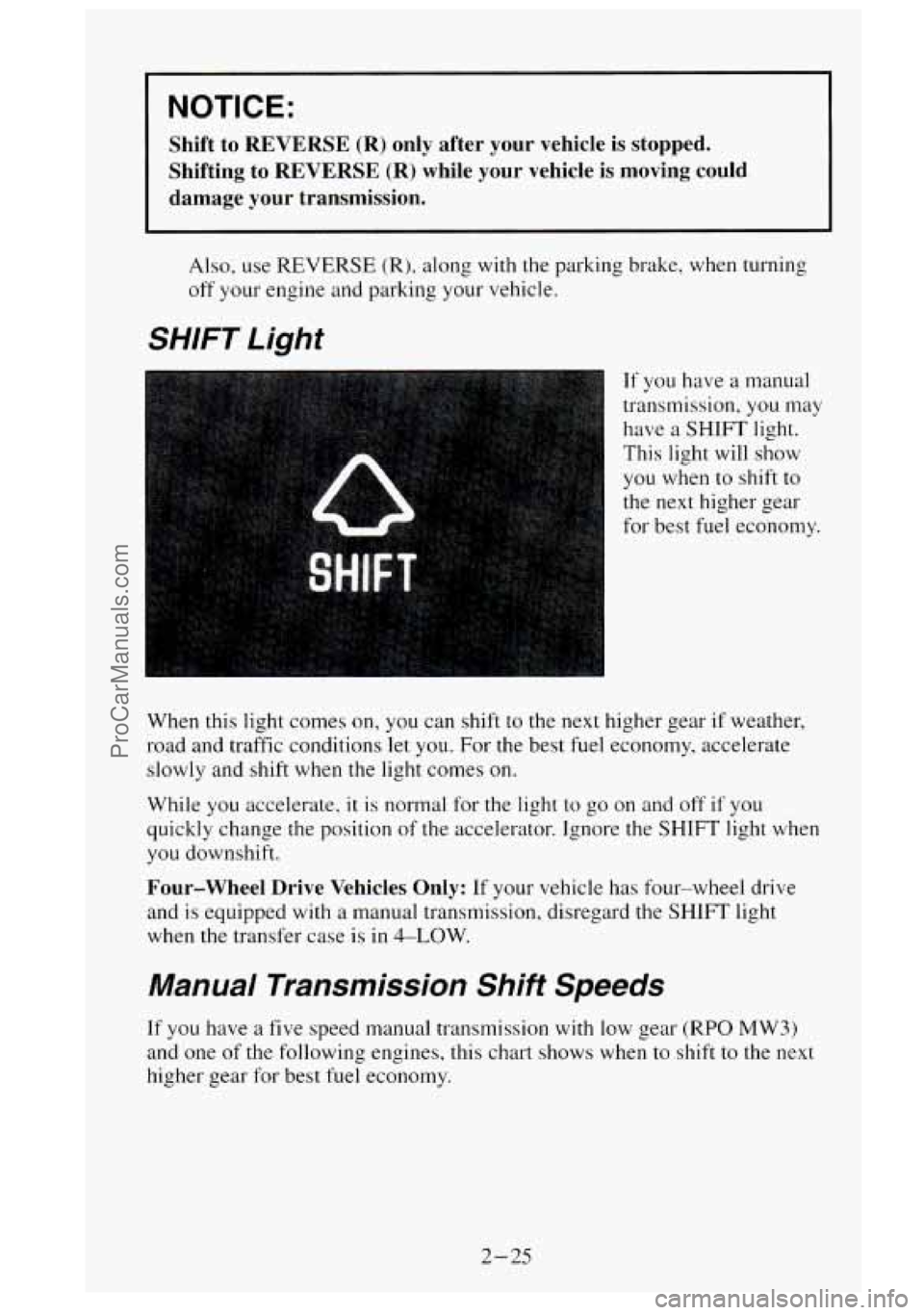
SHIFT Light
If you have a manual
transmission, you may
have
a SHIFT light.
This light will show
you when
to shift to
the
next higher gear
for best
fuel economy.
When this light comes on, you can shift to the
next higher gear if weather,
road and traffic conditions let you.
For the best fuel economy, accelerate
slowly and shift when the light comes on.
While you accelerate,
it is normal for the light to go on and off if you
quickly change the position of the accelerator. Ignore the
SHIFT light when
you downshift.
Four-wheel Drive Vehicles Only: If your vehicle has four-wheel drive
and is equipped with a manual transmission, disregard the
SHIFT light
when
the transfer case is in 4-LOW.
Manual Transmission Shift Speeds
If you have a five speed manual transmission with low gear (RPO MW3)
and one of the following engines, this chart shows when to shift to the next
higher gear for best fuel economy.
2-25
ProCarManuals.com
Page 89 of 488
Locking Rear Axle
If you have this feature. your rear axle can give you additional traction on
snow, mud, ice, sand or gravel. It works like a standard axle most
of the
time. but when one
of the rear wheels has no traction and the other does, the
locking feature will allow the wheel with traction to move the vehicle.
Parking Brake
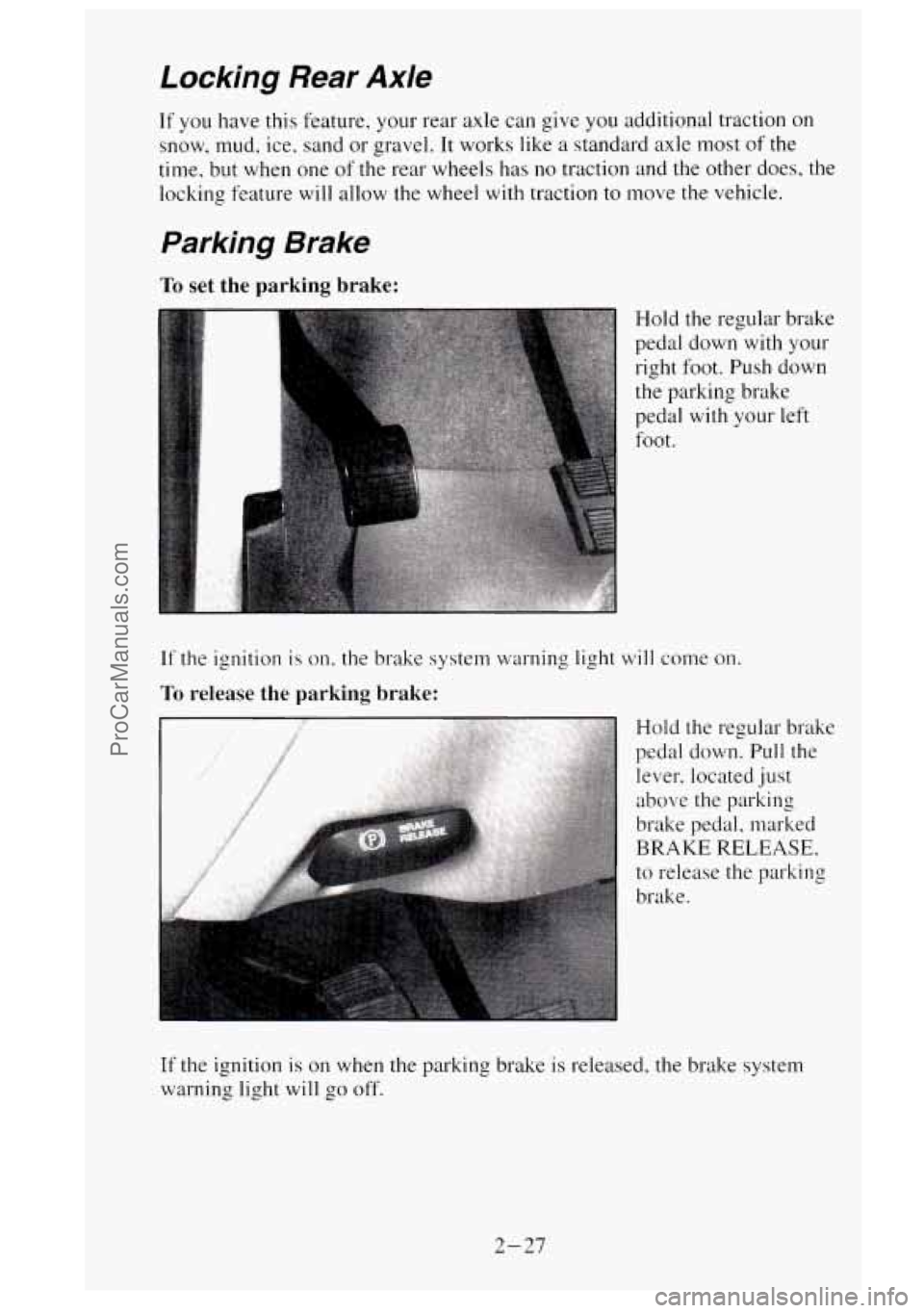
To set the parking brake:
Hold the regular brake
pedal down with your
right foot. Push down
the parking brake
pedal with your left
foot.
If the ignition is on. the brake system warning light will come on.
To release the parking brake:
Hold the regular brake
pedal down. Pull the
lever. located just
above the parking
brake pedal, marked
BRAKE RELEASE,
to release the parking
brake.
If the ignition is on when the parking brake is released, the brake system
warning light will go off.
2-27
ProCarManuals.com
Page 97 of 488
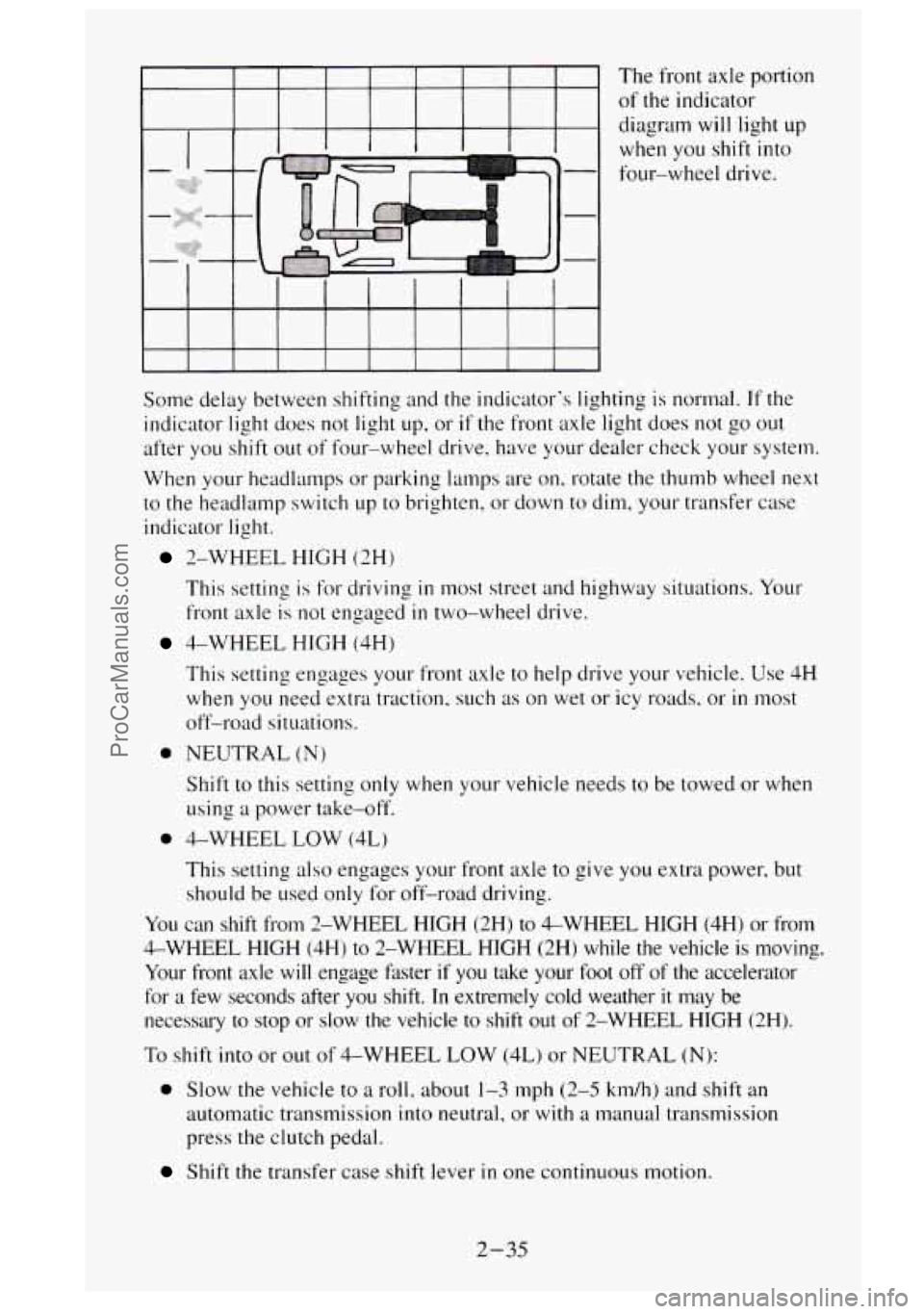
The from axle portion
of the indicator
diagram will light
up
when you shift into
four-wheel drive.
Some delay between shifting and the indicator's lighting is normal.
If the
indicator light does not light
up, or if the front axle light does not go out
after you shift out of four-wheel drive. have your dealer check your system.
When your headlamps or parking lamps are
on, rotate the thumb wheel next
to the headlamp switch up to brighten, or down to dim, your transfer case
indicator light.
2-WHEEL HIGH (2H)
This setting is for driving
in most street and highway situations. Your
front axle is not engaged
in two-wheel drive.
4-WHEEL HIGH (4H)
This setting engages your front axle to help drive your vehicle. Use
4H
when you need extra traction, such as on wet or icy roads. or in most
off-road situations.
0 NEUTRAL (N)
Shift to this setting only when your vehicle needs to be towed or when
using
a power take-off.
0 4-WHEEL LOW (4L)
This setting also engages your front axle to give you extra power, but
should be used only for off-road driving.
You can shift from 2-WHEEL HIGH (2H)
to &WHEEL HIGH (4H) or from
4-WHEEL HIGH (4H) to 2-WHEEL HIGH (2Hj while the vehicle is moving.
Your front axle
will engage faster if you take your foot off of the accelerator
for a few seconds after you shift.
In extremely cold weather it may be
necessary
to stop or slow the vehicle to shift out of 2-WHEEL HIGH (2H).
To shift
into or out of 4-WHEEL LOW (4L) or NEUTRAL (N):
0 Slow the vehicle to a roll. about 1-3 mph (2-5 km/h) and shift an
automatic transmission into neutral,
or with a manual transmission
press the clutch pedal.
Shift the transfer case shift lever in one continuous motion.
2-35
ProCarManuals.com
Page 98 of 488
Don’t pause in NEUTRAL (N) as you shift the transfer case into 4-WHEEL
LOW (4L), or your gears could clash.
Remember that driving in
&WHEEL HIGH (4H) or 4-WHEEL LOW (4L) may
reduce fuel economy.
Also, driving in four-wheel drive on dry pavement could
cause your tires
to wear faster and make your transfer case harder to shift.
Front Axle Locking Feature
The front axle locks and unlocks automatically when you shift the transfer
case. Some delay for the axle to lock or unlock is normal. If the outside
temperature is very hot, or the vehicle has been used under hard driving
conditions, there may be a slight delay for the axle to unlock.
Windows
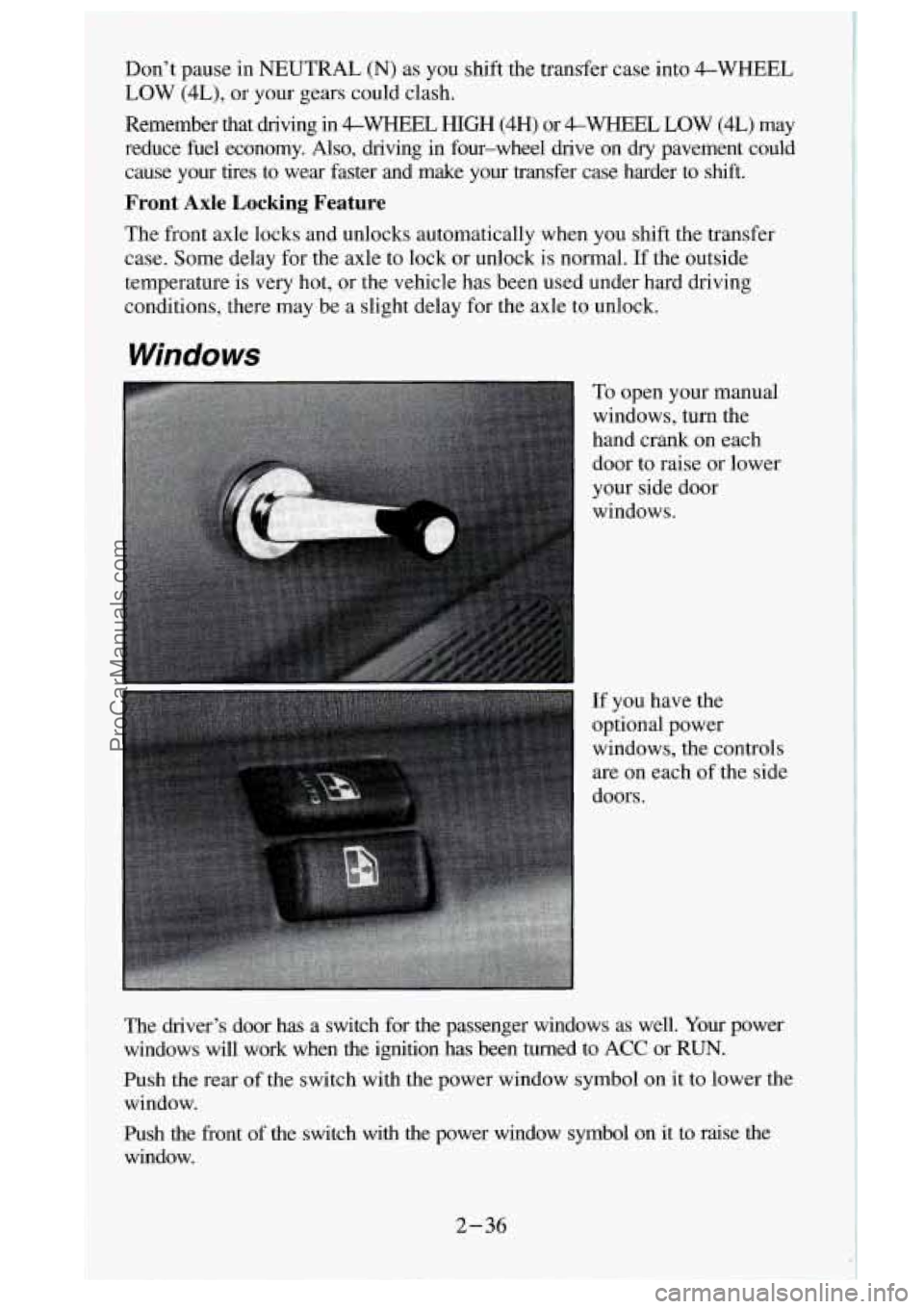
To open your manual
windows, turn the
hand crank on each
door to raise or lower
your side door
windows.
If you have the
optional power
windows, the controls
are on each of the side
doors.
The driver’s door has a switch for the passenger windows as well.
Your power
windows will work when the ignition has been turned to ACC or RUN.
Push the rear
of the switch with the power window symbol on it to lower the
window.
Push the front of the switch with the power window symbol on
it to raise the
window.
2-36
ProCarManuals.com
Page 99 of 488
The driver’s window switch also has an “express down” feature that allows
the window to lower without holding the switch. Press and hold the side
of
the window switch marked AUTO for one second to activate the \
express
down mode. The express down mode can be cancelled at any time by
pressing the opposite side of the switch. To open the window part way,
lightly tap the switch until the window is at the desired pos\
ition.
If you have a Crew Cab and power windows, the power window switch has a
lock-ut feature.
This feature prevents the rear windows from operating when
the front drivers-side switch is in the lock-out position. When the switch is
moved out of the lock-out position, the rear power windows will operate again.
Sliding Rear Window (Option)
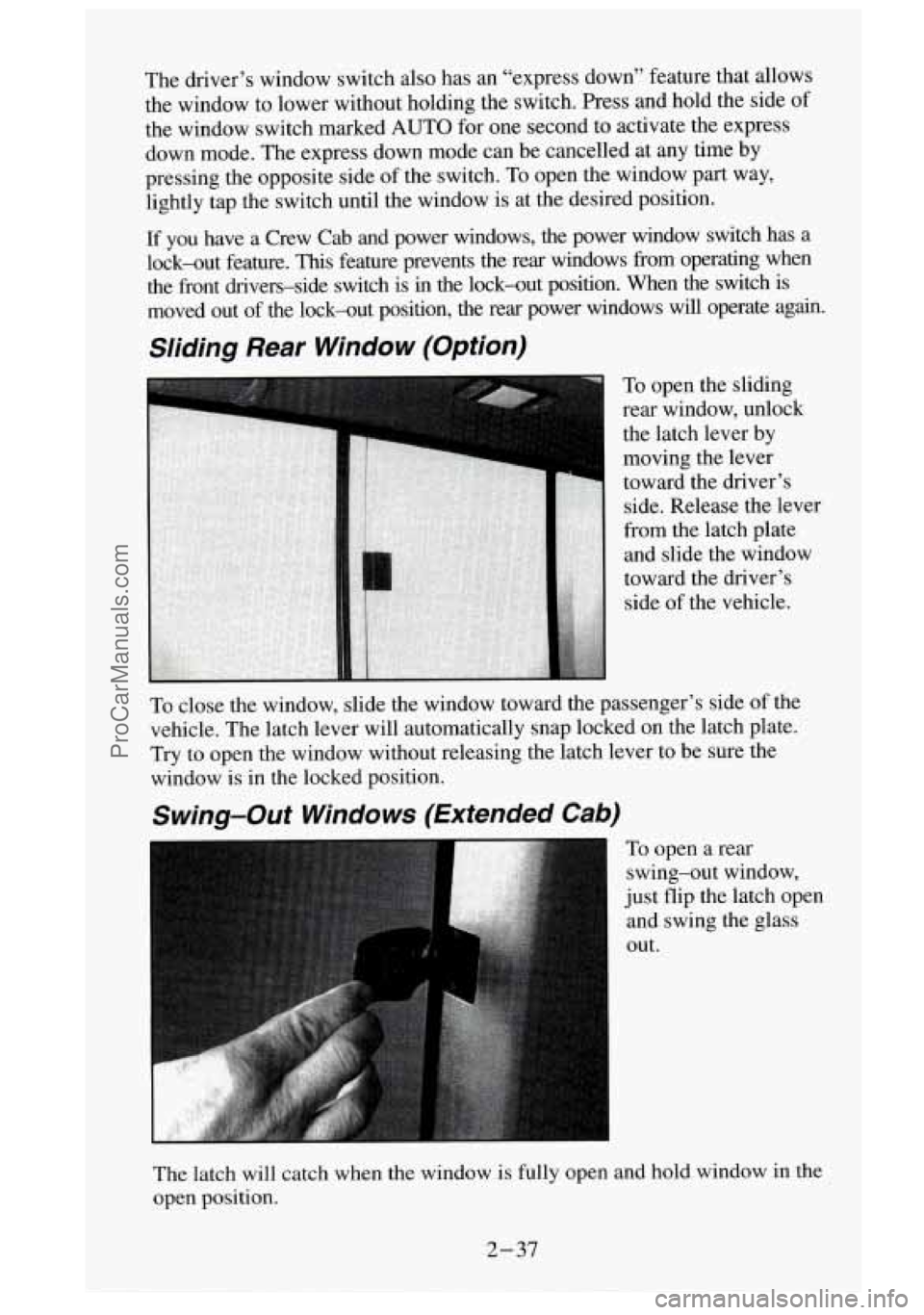
To open the sliding
rear window, unlock
the latch lever by
moving the lever
toward the driver’s side. Release the lever
from the latch plate
and slide the window
toward the driver’s
side of the vehicle.
To close the window, slide the window toward the passenger’s side of the
vehicle. The latch lever will automatically snap locked on the latch plate. \
Try to open the window without releasing the latch lever to be su\
re the
window is in the locked position.
Swing-Out Windows (Extended Cab)
To open a rear
swing-out window,
just flip the latch open
and swing the glass
out.
The latch will catch when the window is fully open and hold window in the
open position.
2-37
ProCarManuals.com
Page 103 of 488
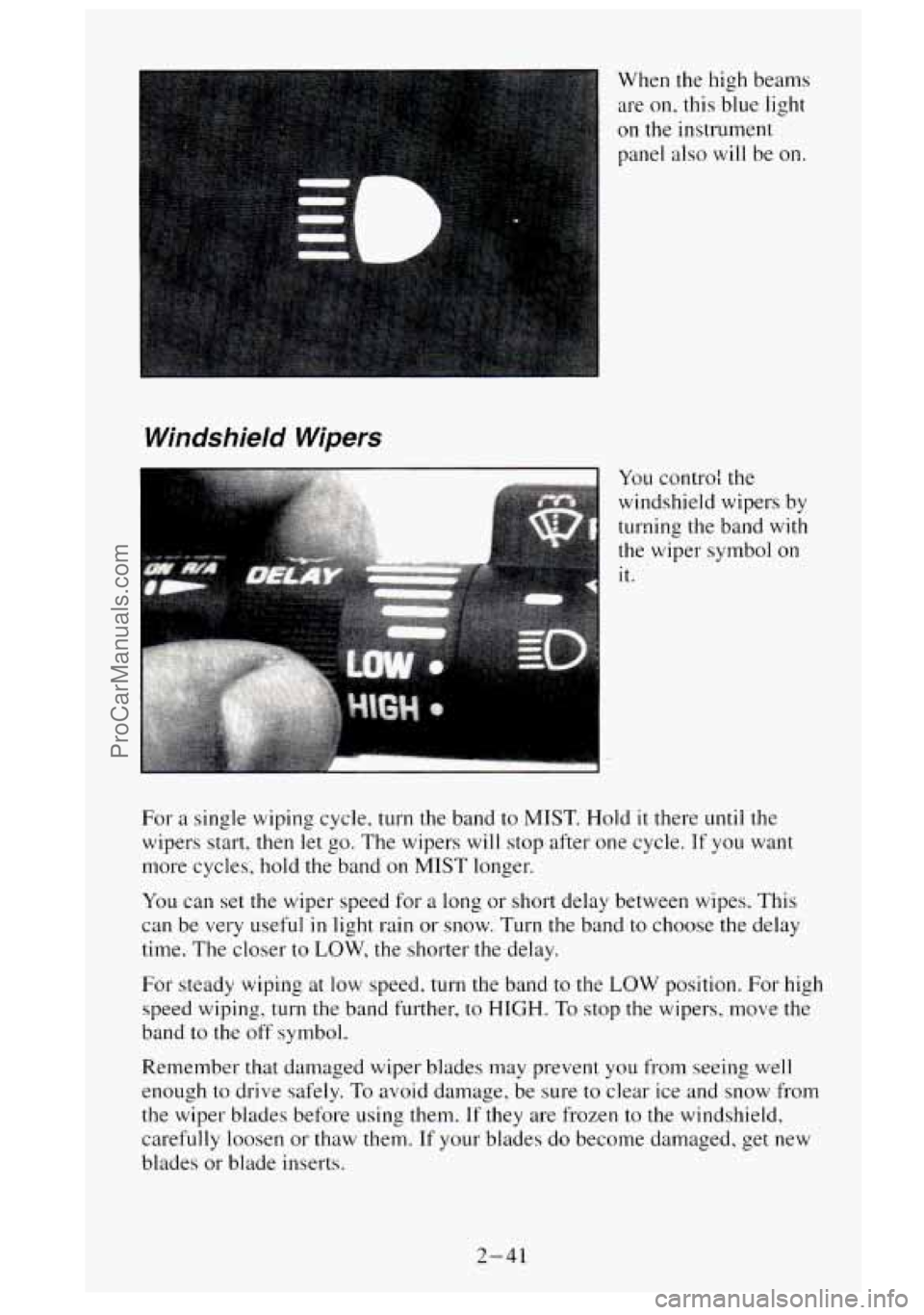
When the high beams
are
on. this blue light
on the instrument
panel also
will be on.
Windshield Wipers
You contro: the
windshield wipers by
turning the band with
the wiper symbol
on
it.
..... ".. .... ~..
For a single wiping cycle, turn the band to MIST. Hold it there until the
wipers start, then let
go. The wipers will stop after one cycle. If you want
more cycles, hold the band
on MIST longer.
You can set the wiper speed for a long or short delay between wipes. This
can be very useful in light rain
or snow. Turn the band to choose the delay
time. The closer to LOW, the shorter the delay.
For steady wiping at low speed, turn the band to the LOW position. For high
speed wiping,
turn the band further, to HIGH. To stop the wipers, move the
band to the
off symbol.
Remember that damaged wiper blades may prevent you from seeing well
enough
to drive safely. To avoid damage, be sure to clear ice and snow from
the wiper blades before using them.
If they are frozen to the windshield,
carefully loosen or thaw them.
If your blades do become damaged, get new
blades or blade inserts.
2-41
ProCarManuals.com
Page 109 of 488
Using Cruise Control on Hills
How well your Cruise Control will work on hills depends upon your speed,
load. and the steepness of the hills. When going
up steep hills, you may
have to step
on the accelerator pedal to maintain your speed. If the steepness
of the hill causes the vehicle speed to drop more than 15 mph (9.4 km/h)
below the set
speed, your Cruise Control will automatically disengage.
When going downhill, you may have to brake or shift
to a lower gear to
keep your speed down. Of course, applying the brake takes you out of
Cruise Control. Many drivers find this to be too much trouble and don’t use
Cruise Control on steep hills.
To Get Out of Cruise Control
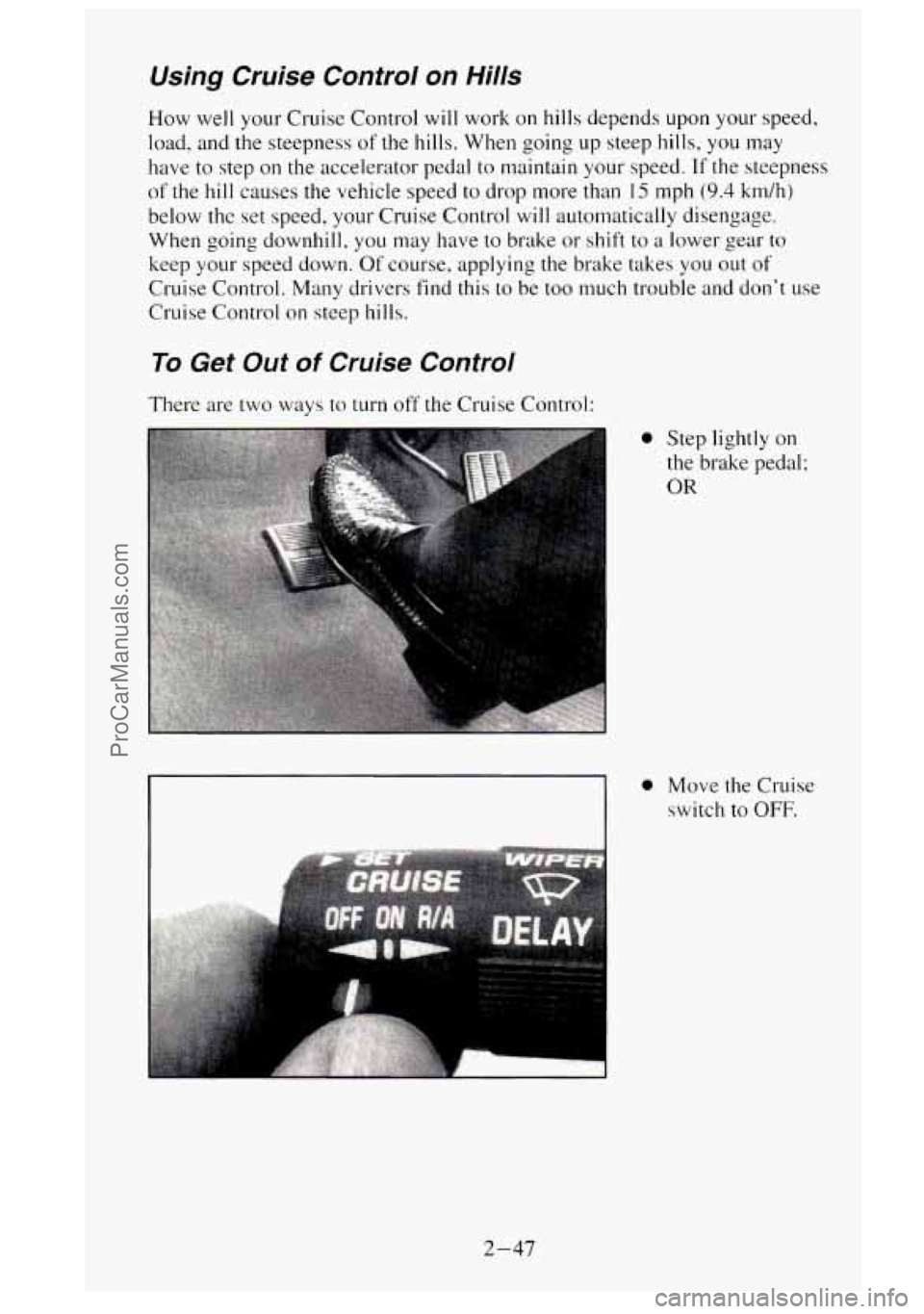
There are two ways to turn off the Cruise Control:
0 Step lightly on
the brake pedal;
OR
I I 0 Move the Cruise
I
switch to OFF.
2-47
ProCarManuals.com
Page 110 of 488
To Erase Speed Memory
When you turn off' the Cruise Control or the ignition. your Cruise Control
set speed memory
is erased.
Headlamps and Vehicle Lighting
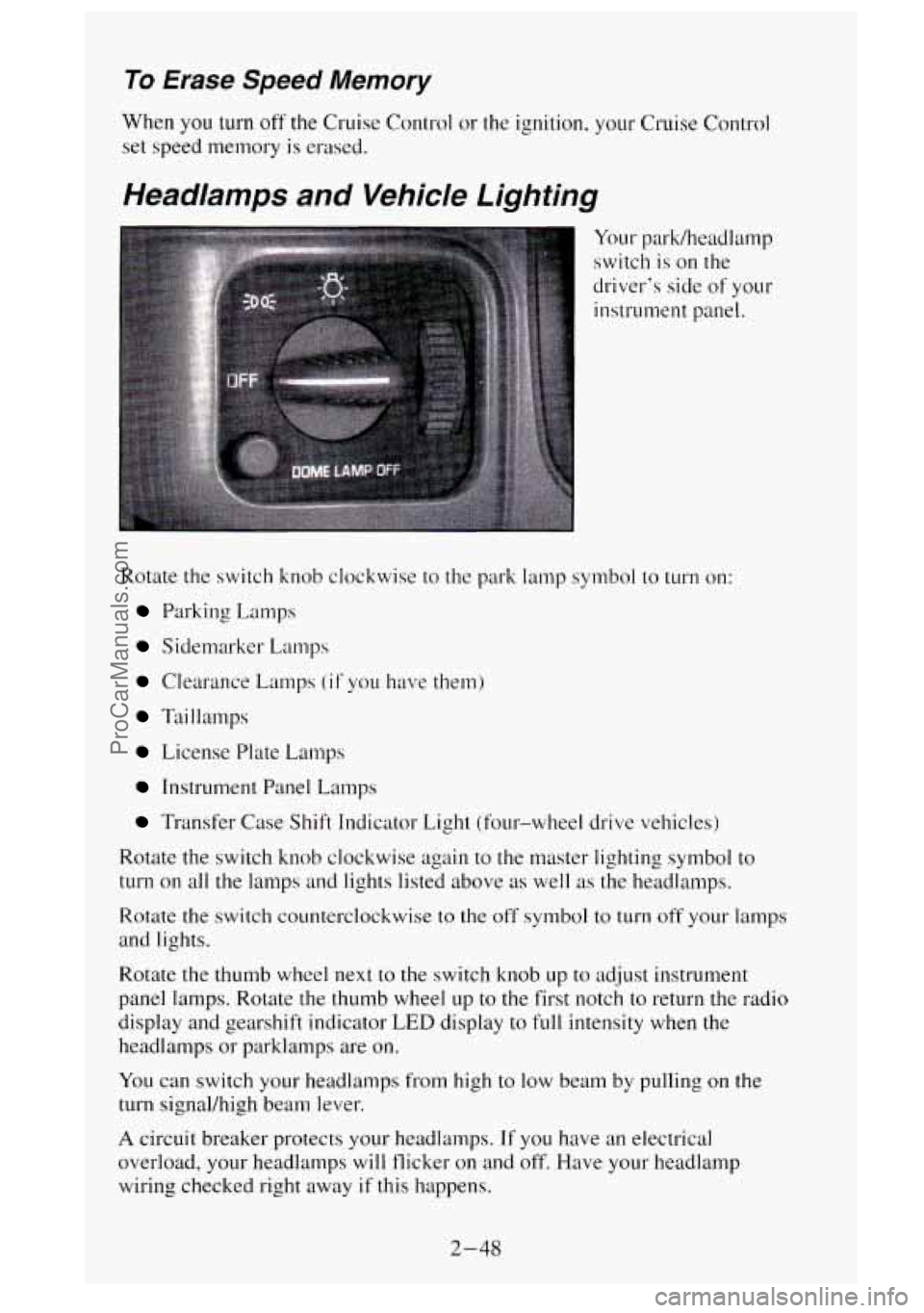
Your park/headlamp
switch is on the
driver's side of your
instrument panel.
Rotate the switch knob clockwise to the park lamp symbol to
turn on:
Parking Lamps
Sidemarker Lamps
Clearance Lamps (if you have them)
Taillamps
License Plate L.amps
Instrument Panel Lamps
Transfer Case Shift Indicator Light (four-wheel drive vehicles)
Rotate the switch knob clockwise again to the master lighting symbol to
turn on all the lamps and lights listed above as well as the headlamps.
Rotate the switch counterclockwise to the off symbol to turn off your lamps
and lights.
Rotate the thumb wheel next to the switch knob up
to adjust instrument
panel lamps. Rotate
the thumb wheel up to the first notch to return the radio
display and gearshift indicator
LED display to full intensity when the
headlamps or parklamps are
on.
You can switch your headlamps from high to low beam by pulling on the
turn signal/high beam lever.
A circuit breaker protects your headlamps. If you have an electrical
overload, your headlamps will flicker on and off. Have your headlamp
wiring checked right away if this happens.
2-48
ProCarManuals.com
Page 111 of 488
Headlamps-On Reminder
A buzzer will sound when your hedamps are turned on and your ignition
is
in OFF, LOCK or ACC. If you need to use your headlamps when the
ignition switch is
in OFF, LOCK or ACC, the buzzer can be turned off by
turning the thumb wheel next to the park/headlamp switch all the way
down.
Fog Lamps
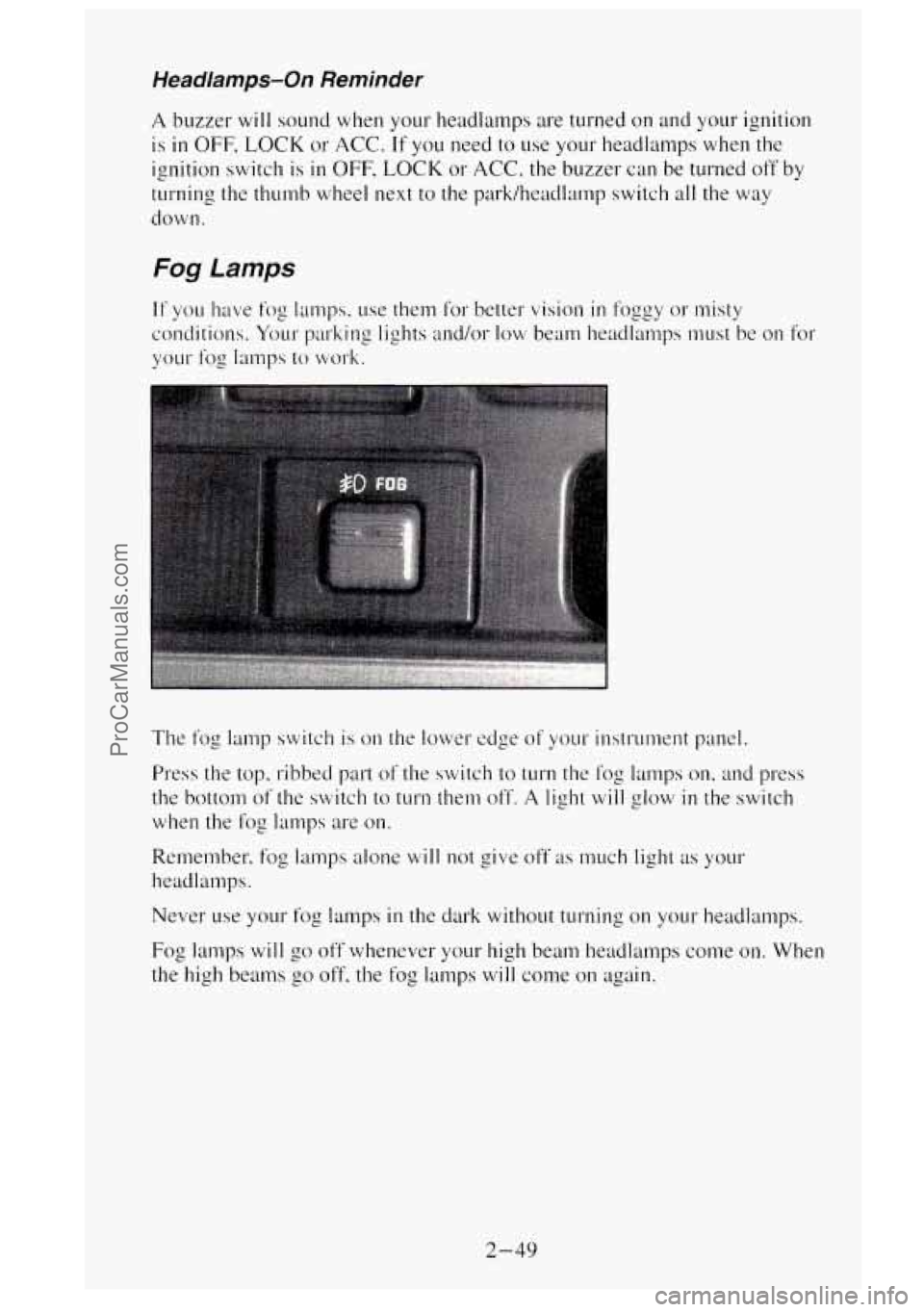
The fog lamp switch is on the lower edge of your instrument panel.
Press the top, ribbed part
of the switch to turn the thg lamps on, and press
the bottom of the switch to
turn them off. A light will glow in the switch
when the
fog lamps are on.
Remember, fog lamps alone will not give off as much light as your
headlalnps.
Never
use your fog lamps in the dark without turning on your headlamps.
Fog
lamps will go off whenever your high beam headlamps come on. When
the high
beams go off. the fog lamps will come on again.
2-49
ProCarManuals.com