maintenance schedule GMC SIERRA 1995 User Guide
[x] Cancel search | Manufacturer: GMC, Model Year: 1995, Model line: SIERRA, Model: GMC SIERRA 1995Pages: 488, PDF Size: 26.01 MB
Page 300 of 488
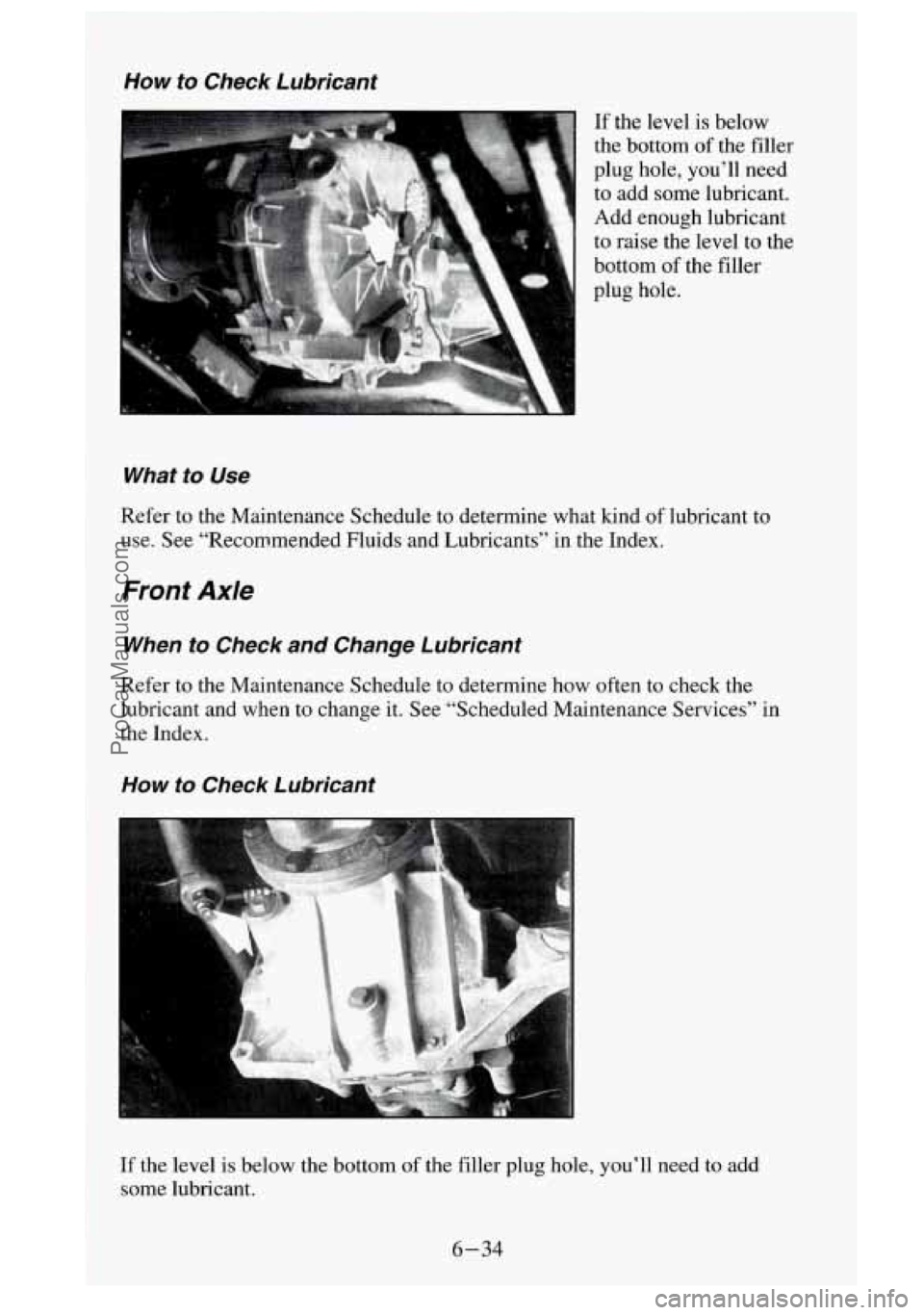
How to Check Lubricant
What to Use
If the level is below
the bottom
of the filler
plug hole, you’ll need
to add some lubricant.
Add enough lubricant
to raise the level
to the
bottom of the
filler
plug hole.
Refer to the Maintenance Schedule to determine what kind of lubricant to
use. See “Recommended Fluids and Lubricants” in the Index.
Front Axle
When to Check and Change Lubricant
Refer to the Maintenance Schedule to determine how often to check the
lubricant and when to change it. See “Scheduled Maintenance Services”
in
the Index.
How to Check Lubricant
If the level is below the bottom of the filler plug hole, you’ll need to add
some lubricant.
6-34
ProCarManuals.com
Page 301 of 488
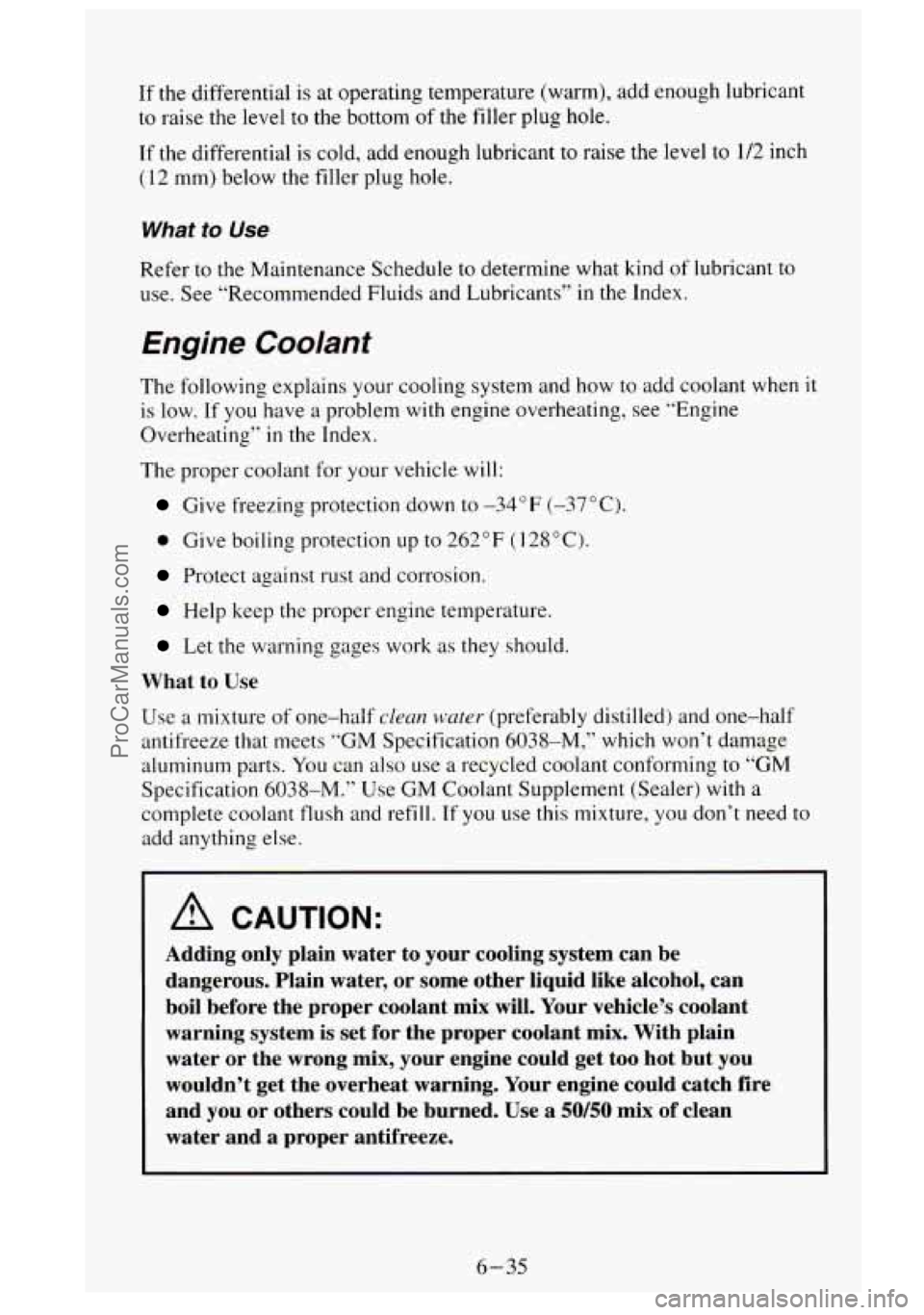
If the differential is at operating temperature (warm), add enough lubricant
to raise the level to the bottom
of the filler plug hole.
If the differential is cold, add enough lubricant to raise the level to
1/2 inch
( 12 mm) below the filler plug hole.
What to Use
Refer to the Maintenance Schedule to determine what kind of lubricant to
use. See “Recommended Fluids and Lubricants” in the Index.
Engine Coolant
The following explains your cooling system and how to add coolant when it
is low. If you have a problem with engine overheating, see “Engine
Overheating”
in the Index.
The proper coolant for your vehicle will:
Give freezing protection down to -34°F (-37°C).
0 Give boiling protection up to 262°F (128°C).
Protect against rust and corrosion.
Help keep the proper engine temperature.
Let the warning gages work as they should.
What to Use
Use a mixture of one-half cleun water (preferably distilled) and one-half
antifreeze that meets “GM Specification 6038-M,” which won’t damage
aluminum parts.
You can also use a recycled coolant conforming to “GM
Specification 6038-M.” Use GM Coolant Supplement (Sealer) with a
complete coolant flush and refill. If you use this mixture. you don’t need to
add anything else.
A CAUTION:
Adding only plain water to your cooling system can be
dangerous. Plain water, or some other liquid like alcohol, can
boil before the proper coolant mix will. Your vehicle’s coolant
warning system
is set for the proper coolant mix. With plain
water or the wrong mix, your engine could get too hot but
you
wouldn’t get the overheat warning. Your engine could catch fire
and you or others could be burned. Use
a 50/50 mix of clean
water and
a proper antifreeze.
6-35
ProCarManuals.com
Page 307 of 488
What to Add
Refer to the Maintenance Schedule to determine what kind of' tluid to use
See "Recommended Fluids and Lubricants"
in the Index.
NOTICE:
When adding power steering fluid or making a complete fluid
change, always use the proper fluid. Failure to use
the proper
fluid can cause leaks and damage hoses and seals.
Hydro-Boost Brake System (Hydraulic Pump)
The power steering pump is also used as the Hydro-boost pump. Refer to
"Power Steering System''
in this section when checking fluid level or
adding fluid.
Windshield Washer Fluid
What to Use
When you need windshield washer fluid, be sure to read the manuhcturer's
instructions before use.
If you will be operating your vehicle in an area
where the temperature
may fall below freezing, use a fluid that has
sufficient protection against freezing.
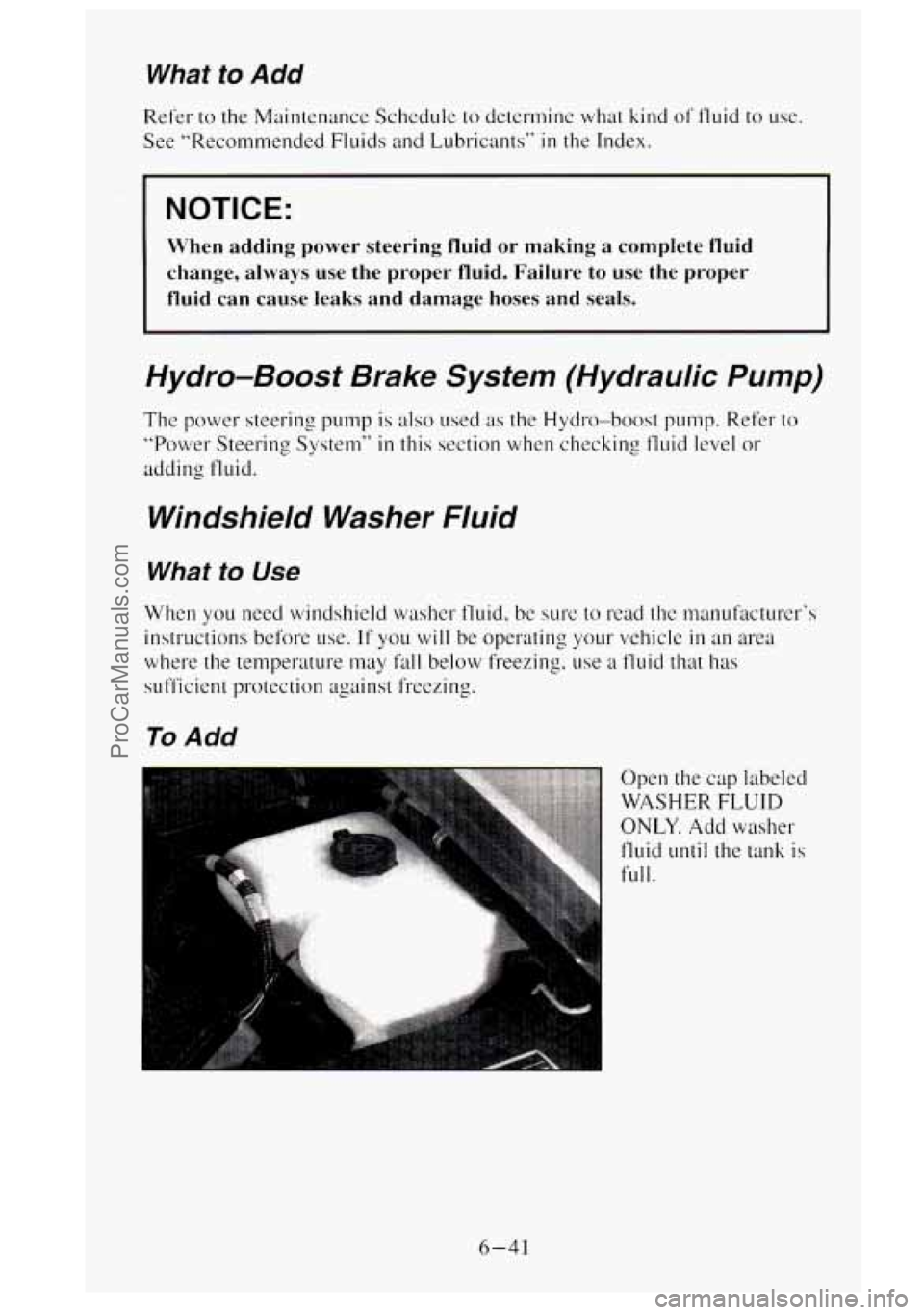
To Add
Open the cap labeled
WASHER FLUID
ONLY. Add washer
fluid
until the tank is
full.
6-41
ProCarManuals.com
Page 309 of 488
(or remove) brake fluid, as necessary, only when work is done on the brake
hydraulic system.
A CAUTION:
If you have too much brake fluid, it can spill on the engine. The
fluid will burn
if the engine is hot enough. You or others could
be burned, and your vehicle could be damaged. Add brake fluid
only when work is done on the brake hydraulic system.
Refer to the Maintenance Schedule to determine when to check your brake
fluid. See “Periodic Maintenance Inspections”
in the Index.
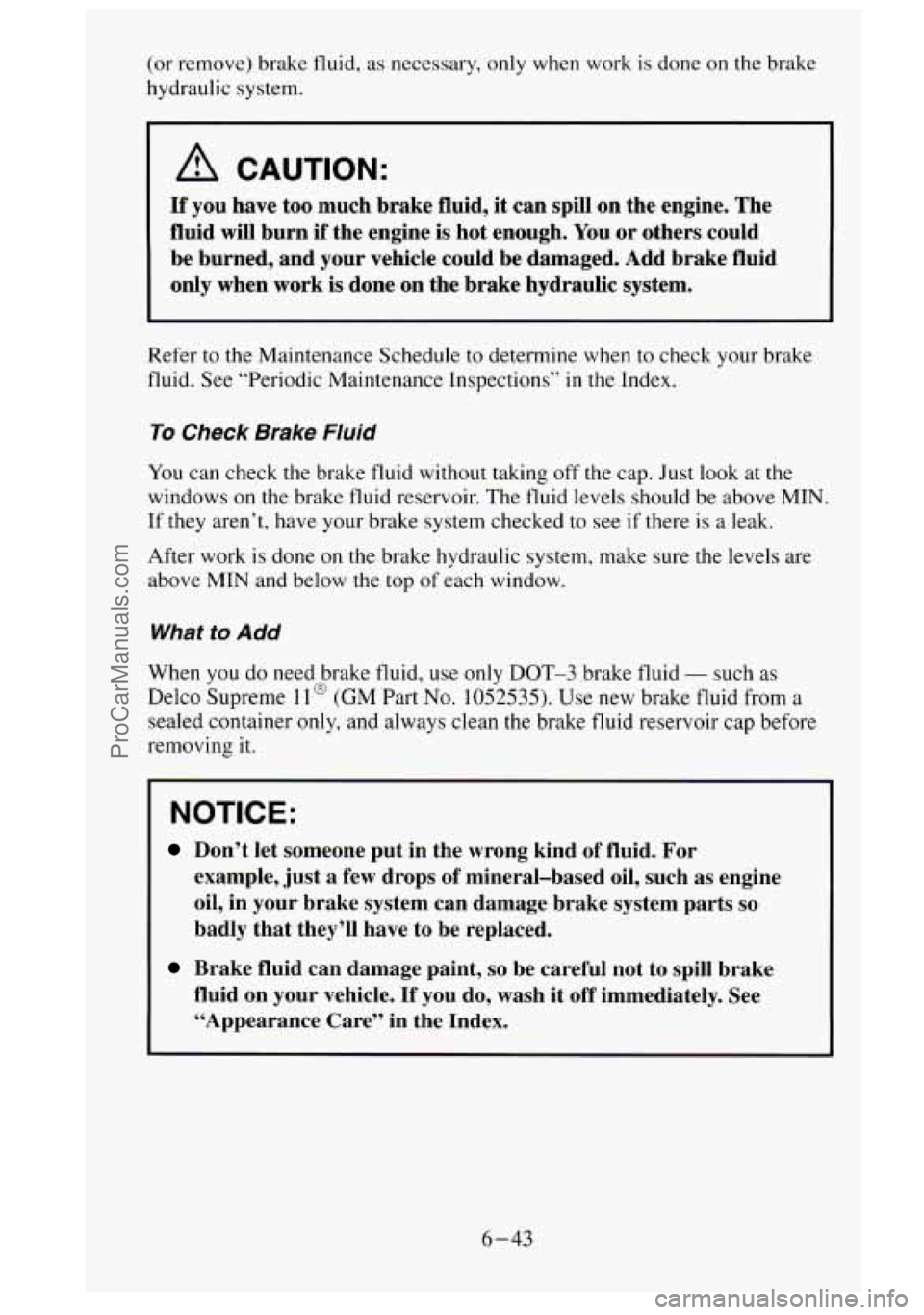
To Check Brake Fluid
You can check the brake fluid without taking off the cap. Just look at the
windows on the brake fluid reservoir. The fluid levels should be above MIN.
If they aren’t, have your brake system checked to see if there is a leak.
After work
is done on the brake hydraulic system, make sure the levels are
above MIN and below the top
of each window.
What to Add
When you do need brake fluid, use only DOT-3 brake fluid - such as
Delco Supreme 11
@ (GM Part No. 1052535). Use new brake fluid from a
sealed container only, and always clean the brake fluid reservoir cap before
removing it.
NOTICE:
Don’t let someone put in the wrong kind of fluid. For
example, just
a few drops of mineral-based oil, such as engine
oil, in your brake system can damage brake system parts
so
badly that they’ll have to be replaced.
Brake fluid can damage paint, so be careful not to spill brake
fluid on your vehicle.
If you do, wash it off immediately. See
“Appearance Care” in the Index.
6-43
ProCarManuals.com
Page 312 of 488
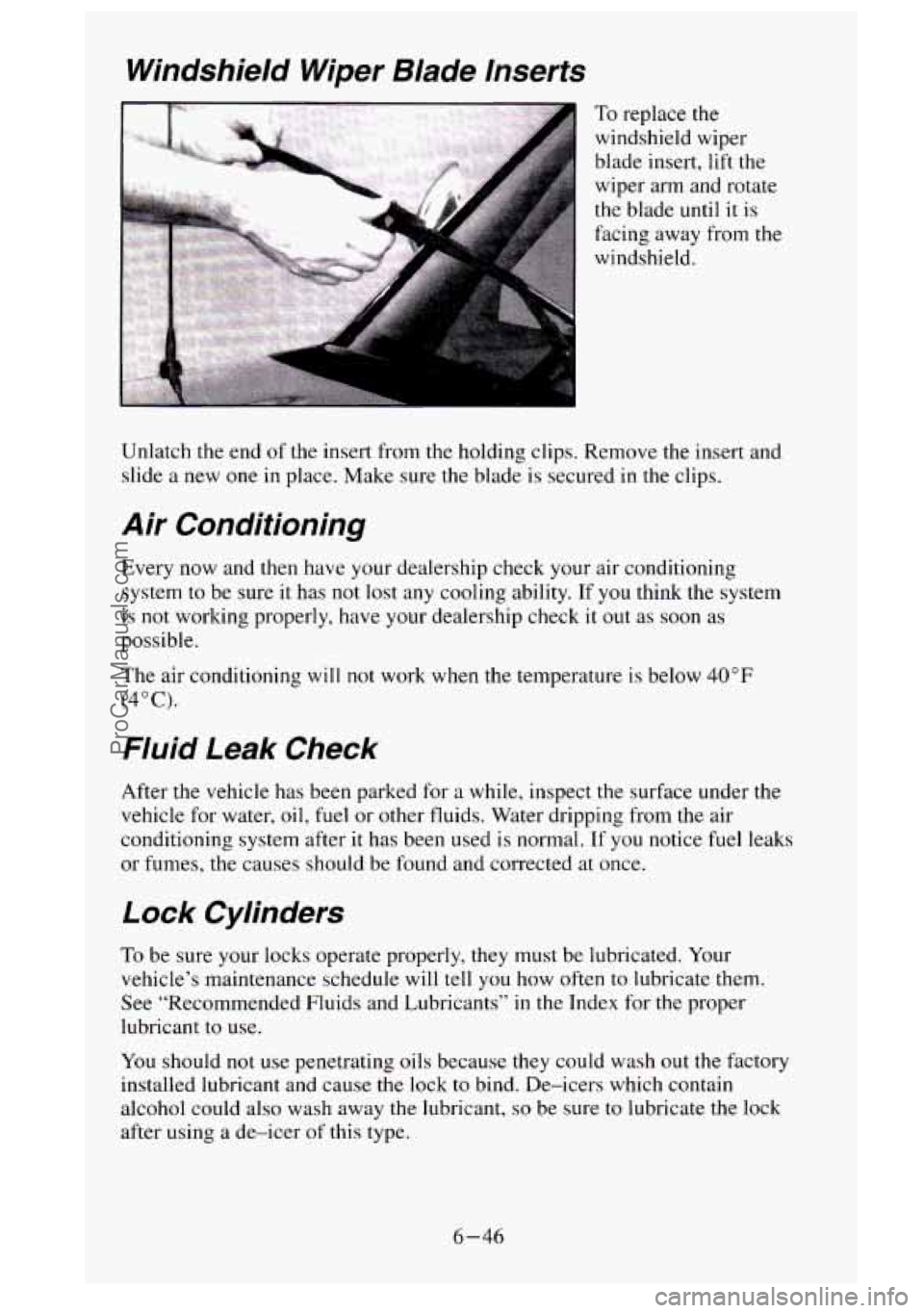
Windshield Wiper Blade Inserts
To replace the
windshield wiper
blade insert, lift
the
wiper arm and rotate
the blade until
it is
facing away from the
windshield.
Unlatch the end
of the insert from the holding clips. Remove the insert and
slide
a new one in place. Make sure the blade is secured in the clips.
Air Conditioning
Every now and then have your dealership check your air conditioning
system to be sure it
has not lost any cooling ability. If you think the system
is not working properly, have your dealership check it out as soon as
possi bleb
The air conditioning will
not work when the temperature is below 40°F
(4°C).
Fluid Leak Check
After the vehicle has been parked for a while, inspect the surface under the
vehicle for water, oil, fuel
or other fluids. Water dripping from the air
conditioning system after it has been used is normal.
If you notice fuel leaks
or fumes, the causes should be found and corrected at once.
Lock Cylinders
To be sure your locks operate properly, they must be lubricated. Your
vehicle’s maintenance schedule will tell you how often to lubricate them.
See “Recommended Fluids and Lubricants” in the Index for
the proper
lubricant to use.
You should
not use penetrating oils because they could wash out the factory
installed lubricant and cause
the lock to bind. De-icers which contain
alcohol could also
wash away the lubricant, so be sure to lubricate the lock
after using
a de-icer of this type.
6-46
ProCarManuals.com
Page 326 of 488
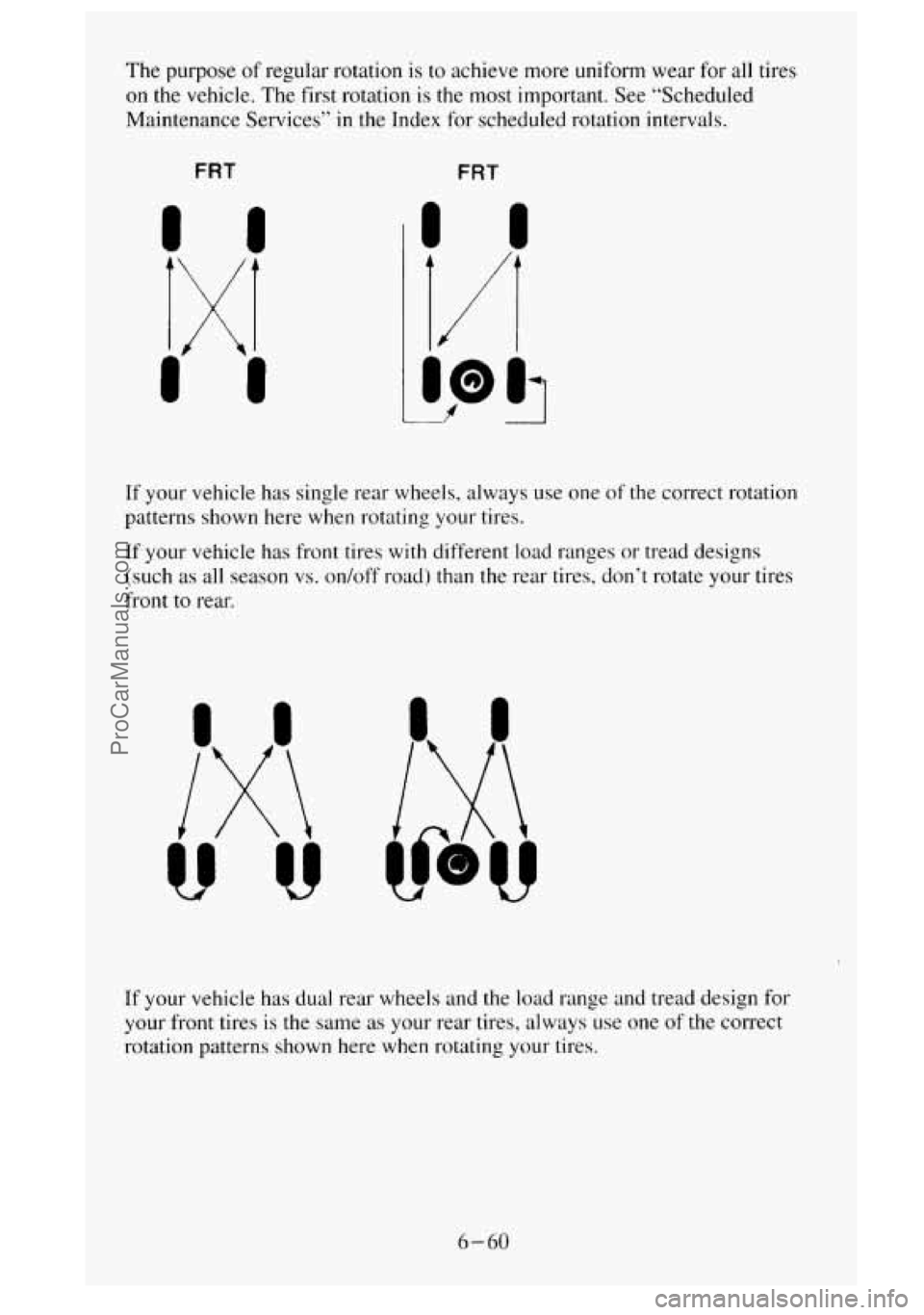
The purpose of regular rotation is to achieve more uniform wear for all tires
on the vehicle. The first rotation is the most important. See “Scheduled
Maintenance Services”
in the Index for scheduled rotation intervals.
FRT
I
II
FRT
If your vehicle has single rear wheels, always use one of the correct rotation
patterns shown here when rotating your tires.
If your vehicle has front tires with different load ranges
or tread designs
(such as all season vs. on/off road) than the rear tires. don‘t rotate your tires
front
to rear.
W v
If your vehicle has dual rear wheels and the load range and tread design for
your front tires
is the same as your rear tires, always use one of the correct
rotation patterns shown here when rotating your tires.
6-60
ProCarManuals.com
Page 357 of 488
Scheduled Maintenance Services
KEEP ENGINE OIL
AT THE PROPER
LEVEL AND CHANGE
AS RECOMMENDED
Section
This section covers the maintenance required for your vehicle. Your vehicle
needs these services to retain its safety, dependability and emission control
performance.
I protection
Plan
I
Introduction
Your Vehicle and the Environment
Proper vehicle maintenance not only helps to keep your vehicle in good
working condition, but also helps the environment. All recommended
maintenance procedures are important. Improper vehicle maintenance or the
removal
of important components can significantly affect the quality of the
air we breathe. Improper
fluid levels or even the wrong tire inflation can
increase the level of emissions from your vehicle.
To help protect our
environment, and
to help keep your vehicle in good condition, please
maintain your vehicle properly.
7-1
ProCarManuals.com
Page 358 of 488
How This Section is Organized
The remainder of this section is divided into five parts:
“Part A: Scheduled Maintenance Services” shows what to have done and
how often. Some
of these services can be complex, so unless you are
technically qualified and have the necessary equipment, you should let your
dealer’s service department or another qualified service center do these
jobs.
If you are skilled enough to do some work on your vehicle, you will
probably want to get the service information
GM publishes. See “Service
Publications”
in the Index.
“Part B: Owner Checks and Services” tells you what should be checked
whenever you stop for fuel.
It also explains what you can easily do to help
keep
your vehicle in good condition.
“Part C: Periodic Maintenance Inspections” explains important
inspections that your
GM dealer’s service department or another qualified
service center should perform.
“Part D: Recommended Fluids and Lubricants” lists some products GM
recommends to help keep your vehicle properly maintained. These products,
or their equivalents, should be used whether you do the work yourself or
have it done.
“Part E: Maintenance Record” provides a place for you to record the
maintenance performed on your vehicle. Whenever any maintenance
is
performed, be sure to write it down in this part. This will help you
determine when your next maintenance should be done.
In addition, it is a
good idea to keep your maintenance receipts. They may be needed to
qualify your vehicle for warranty repairs.
7-2
ProCarManuals.com
Page 359 of 488
Part A: Scheduled Maintenance Services
Using Your Maintenance Schedule
We at General Motors want to help you keep your vehicle in good working
condition. But we don’t know exactly how you’ll drive it. You may drive
very short distances only
a few times a week. Or you may drive long
distances all the time
in very hot, dusty weather. You may use your vehicle
in making deliveries. Or you may drive it to work, to do errands or in many
other ways.
Because
of all the different ways people use their GM vehicles, maintenance
needs varv.
You may even need more frequent checks and replacements than
you‘ll find
in the schedules in this section. So please read this section and
note how you drive. If you have any questions on how to keep your vehicle
in good condition. see your GM dealer.
This part tells you the maintenance services you should have done and
when
you should schedule them. If you go to your dealer for your service needs,
you’ll know that GM-trained and supported service people
will perform the
work using genuine
GM parts.
The proper fluids and lubricants to use are listed
in Part D. Make sure
whoever services your vehicle uses these.
All parts should be replaced and
all necessary repairs done before you or anyone else drives the vehicle.
These schedules are for vehicles that:
carry passengers and cargo within recommended limits. You will find
these limits on your vehicle’s CertificatiodTire label. See “Loading
Your Vehicle“
in the Index.
are driven on reasonable road surfxes within legal driving limits.
are driven off-road in the recommended manner. See “Off Road
Driving With Your Four-wheel Drive Vehicle”
in the Index.
use the recommended unleaded fuel. See “Fuel” in the index.
Selecting the Right Schedule
The proper maintenance schedule for your vehicle depends on which engine
you have
in your vehicle and how you use your vehicle.
Gasoline engine vehicles and diesel engine vehicles have different
maintenance requirements.
If you have a diesel engine, follow a schedule
designated for diesel engine vehicles only. If you have
a gasoline engine.
you must first determine whether your engine has
a light duty or a heavy
duty emissions classification. Follow a maintenance schedule designated
for
for your engine. See “Engine Identification” in the Index to find your
engine‘s emission classification.
c easoline engines with the emissions classification (light duty or heavy duty)
7-3
ProCarManuals.com
Page 360 of 488
If your engine has more than one emissions classification, the classification
is determined by the Gross Vehicle Weight Rating (GVWR) of your vehicle
as shown on the Certification Label. See “Loading Your Vehicle”
in the
Index.
Once you’ve determined your engine type and,
if necessary, emissions
classification, you’ll need to decide which of the two schedules is right for
your vehicle. See Definitions for Maintenance Schedule
I and Maintenance
Schedule
I1 following.
Schedule I Definition - Gasoline Engines With Light Duty
Emissions
Follow Maintenance Schedule I if any one of these is true for your vehicle:
iII Most trips are less than 5 to 10 miles (8 to 16 km). This is particularly
important when outside temperatures are below freezing.
0 Most trips include extensive idling (such as frequent driving in
stop-and-go traffic).
You operate your vehicle in dusty areas or off-road frequently.
0 You frequently tow a trailer.
Schedule
I should also be followed if the vehicle is used for delivery
service, police, taxi, or other commercial application.
Schedule I Intervals - Gasoline Engines With Light Duty
Emissions
Every
3,000 Miles (5 000 km) or 3 Months, Whichever Occurs First
Engine Oil and Filter Change
Chassis Lubrication
Drive Axle Service
At 6,000 Miles (10 000 km) - Then Every 12,000 Miles (25 000 km)
Tire Rotation
Every 75,000 Miles (25 000 km)
Air Cleaner Filter Inspection, if driving in dusty conditions
Front Wheel Bearing Repack
(or at each brake relining) (2WD Only)
7-4
ProCarManuals.com