cruise control GMC SIERRA 1995 Owners Manual
[x] Cancel search | Manufacturer: GMC, Model Year: 1995, Model line: SIERRA, Model: GMC SIERRA 1995Pages: 488, PDF Size: 26.01 MB
Page 88 of 488
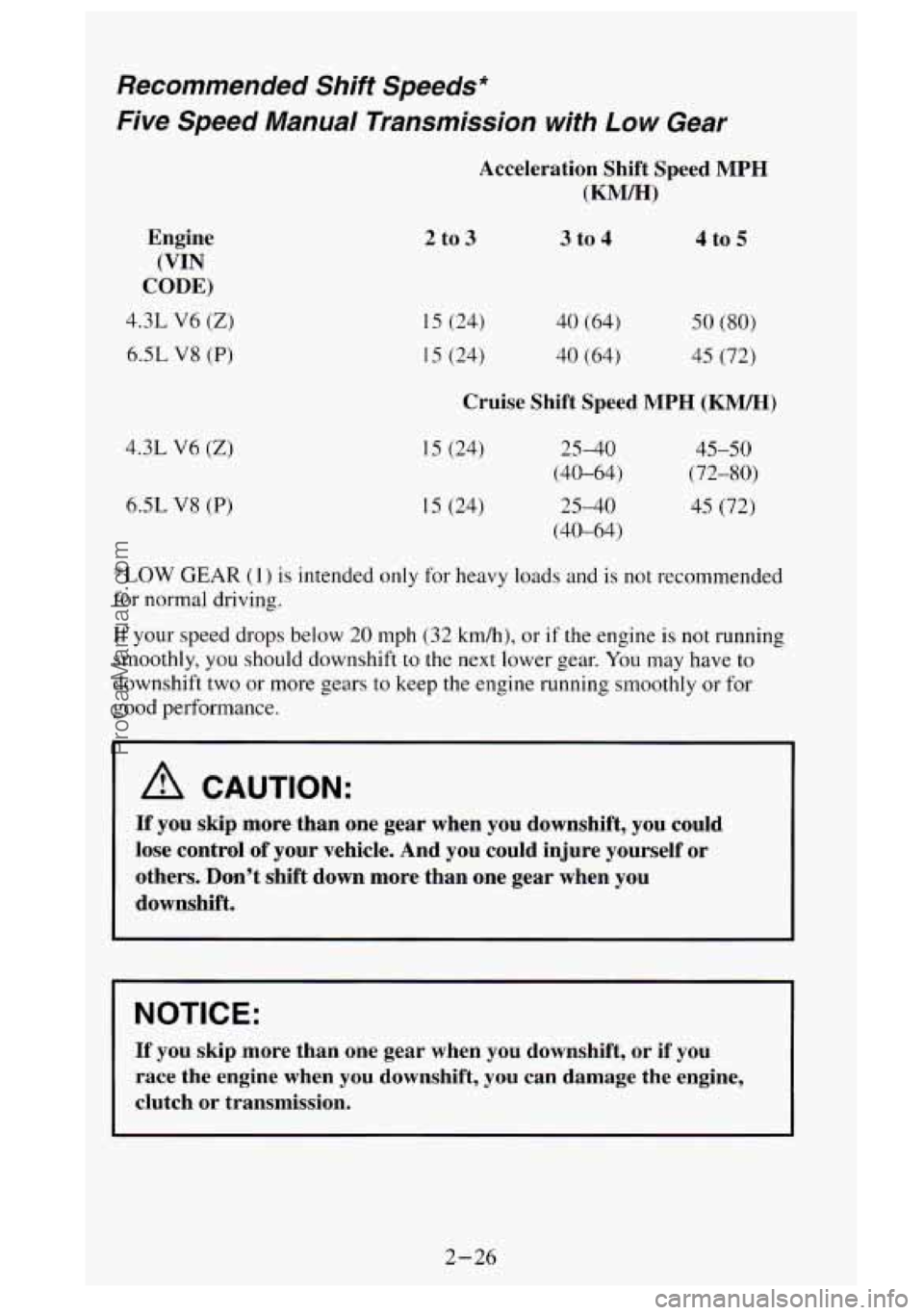
Recommended Shift Speeds*
Five
Speed Manual Transmission with Low Gear
Acceleration Shift Speed MPH
(KW)
Engine
(VIN
CODE)
4.3L V6 (Z)
6.5L V8 (P)
4.3L V6 (Z)
6.SL V8 (P)
2 to 3
15 (24)
1 5 (24)
3 to 4
40 (64)
40 (64)
4 to 5
50 (80)
45 (72)
Cruise Shift Speed MPH (KM/H)
15 (24)
I 5 (24) 25-40
(40-64)
25-40
(40-64) 45-50
(72-80)
45 (72)
*LOW GEAR (1) is intended only for heavy loads and is not recommended
for normal driving.
If your speed drops below 20 mph
(32 km/h), or if the engine is not running
smoothly,
you should downshift to the next lower gear. You may have to
downshift two
or more gears to keep the engine running smoothly or for
good performance.
A CAUTION:
If you skip more than one gear when you downshift, you could
lose control of your vehicle. And you could injure yourself or
others. Don’t shift
down more than one gear when you
downshift.
NOTICE:
If you skip more than one gear when you downshift, or if you
race the engine when you downshift, you can damage the engine,
clutch or transmission.
2-26
ProCarManuals.com
Page 101 of 488
You can also raise it to the highest level to give your legs more room when
you enter and exit the vehicle.
To tilt the wheel, hold the
steefifqj whe&l~~I-~uU the lever. Move the
steering wheel to a comfortable level, then release the lever to lock the
wheel in place.
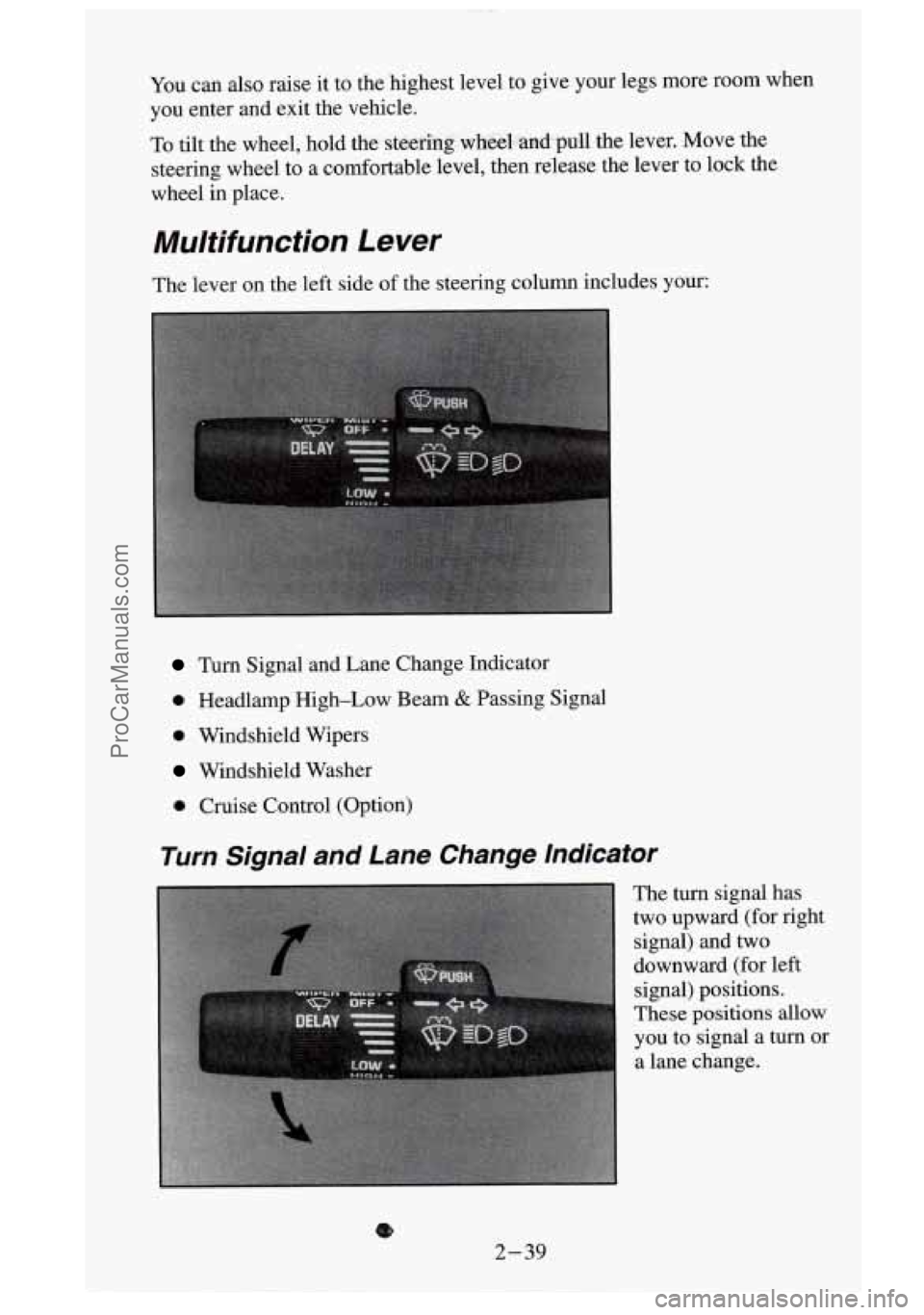
Multifunction Lever
The lever on the left side of the steering column includes your:
Turn Signal and Lane Change Indicator
0 Headlamp High-Low Beam & Passing Signal
0 Windshield Wipers
Windshield Washer
0 Cruise Control (Option)
Turn Signal and Lane Change Indicator
The turn signal has
two upward (for right
signal) and two
downward (for left
signal) positions.
These
positions allow
you to signal a turn or
a lane change.
8
2-39
ProCarManuals.com
Page 105 of 488
NOTICE:
When using concentrated washer fluid, follow the
manufacturer’s instructions for adding water.
0 Don’t mix water with ready-to-use washer fluid. Water can cause the solution to freeze and damage your washer fluid
tank and other parts of the washer system.
Also, water
doesn’t clean as well as washer fluid.
0 Fill your washer fluid tank only 3/4 full when it’s very cold.
This allows for expansion, which could damage the tank if it is
completely full.
Don’t use radiator antifreeze in your windshield washer. It
can damage your washer system and paint.
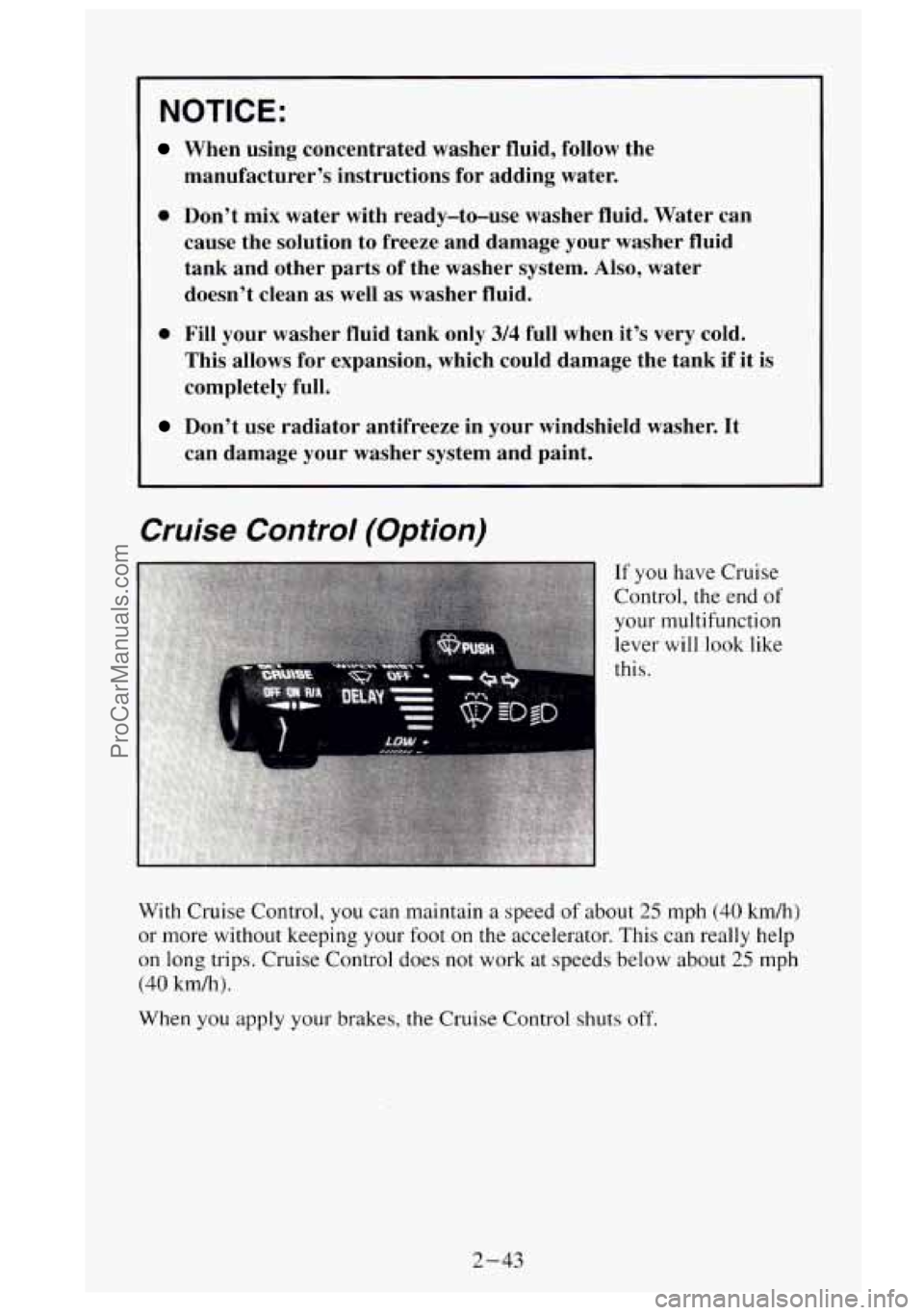
Cruise Control (Option)
If you have Cruise
Control, the end
of
your multifunction
lever
will look like
this.
With Cruise Control,
you can maintain a speed of about 25 mph (40 kdh)
or more without keeping your foot on the accelerator. This can really help
on
long trips. Cruise Control does not work at speeds below about 25 mph
(40 kmk).
When you apply your brakes, the Cruise Control shuts off.
2-43
ProCarManuals.com
Page 106 of 488
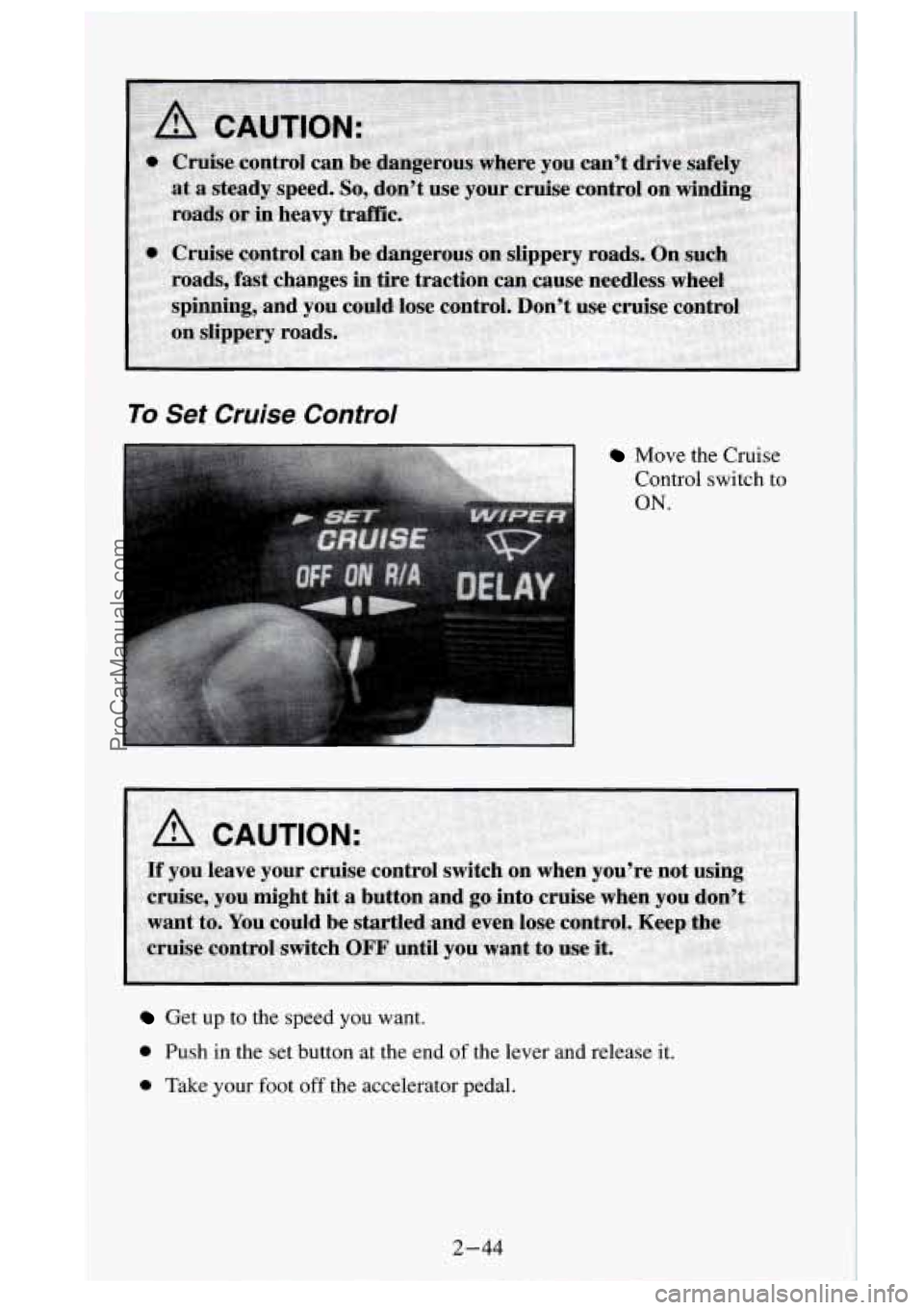
To Set Cruise Control
Move the Cruise Control switch to
ON.
Get up to the speed you want.
0 Push in the set button at the end of the lever and release it.
0 Take your foot off the accelerator pedal.
2-44
ProCarManuals.com
Page 107 of 488
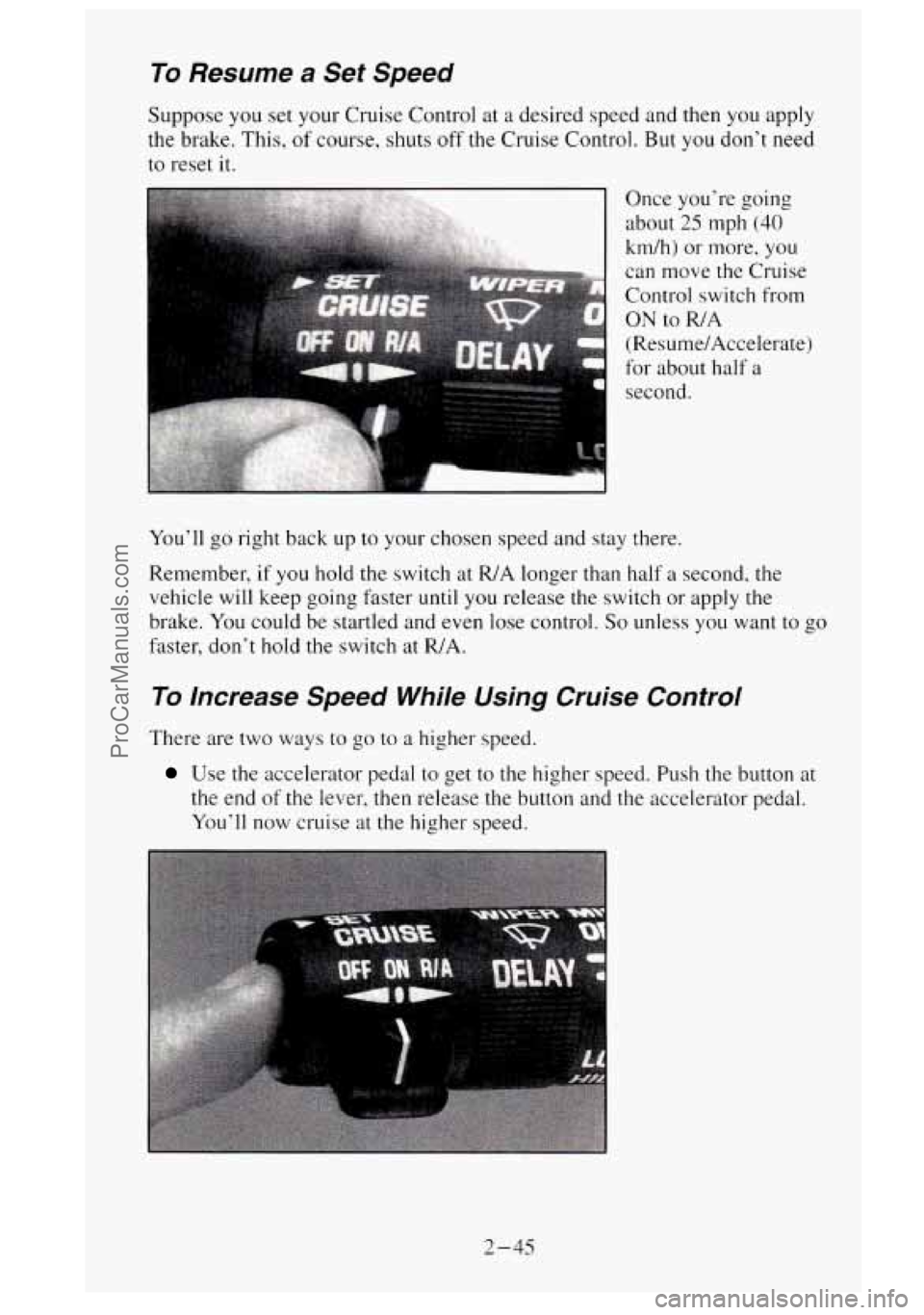
To Resume a Set Speed
Suppose you set your Cruise Control at a desired speed and then you apply
the brake. This, of course, shuts off the Cruise Control. But you don't need
to reset
it.
i second.
You'll go right back
up to your chosen speed and stay there.
Remember,
if you hold the switch at R/A longer than half a second, the
vehicle will keep going faster
until you release the switch or apply the
brake.
You could be startled and even lose control. So unless you want to go
faster, don't hold the switch at WA.
To lncrease Speed While Using Cruise Control
There are two ways to go to a higher speed.
Use the accelerator pedal to get to the higher speed. Push the button at
the end
of the lever, then release the button and the accelerator pedal.
You'll now cruise at the higher speed.
2-45
ProCarManuals.com
Page 108 of 488
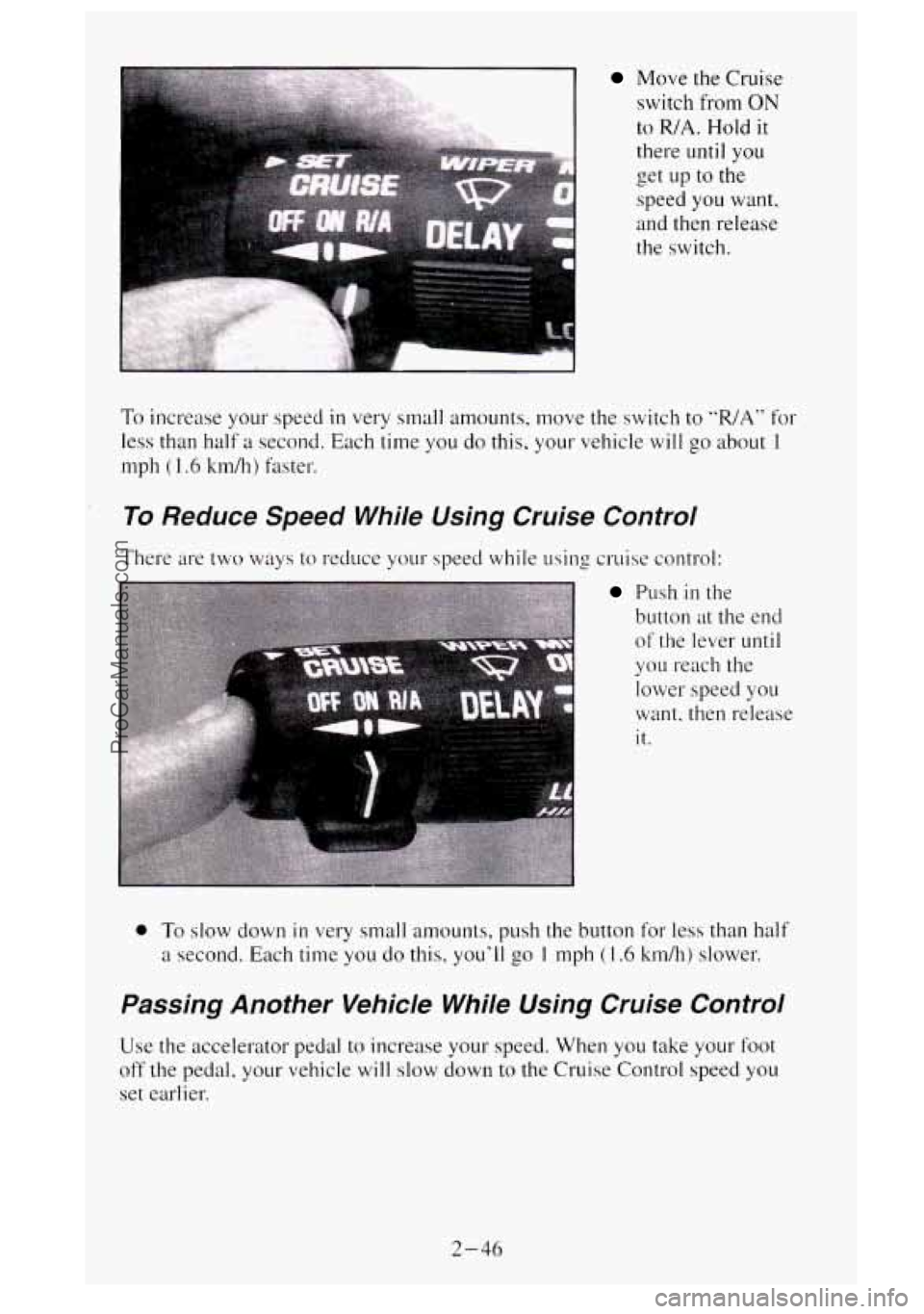
Move the Cruise
switch from
ON
to WA. Hold it
there until you
speed you want,
and then release
the switch.
u get up to the
To increase your speed in very small amounts, move the switch to "R/A" for
less than half
a second. Each time you do this, your vehicle will go about 1
mph ( 1.6 kdh) faster.
To Reduce Speed While Using Cruise Control
There are two ways to reduce your speed while using cruise control:
Push in the
button at the end
of the lever
until
you reach the
lower speed you
want, then release
It.
0 To slow down in very small amounts, push the button for less than half
a second. Each time you do this, you'll
go I rnph (1.6 km/h) slower.
Passing Another Vehicle While Using Cruise Control
Use the accelerator pedal to increase your speed. When you take your foot
off the pedal, your vehicle
will slow down to the Cruise Control speed you
set earlier.
2-46
ProCarManuals.com
Page 109 of 488
Using Cruise Control on Hills
How well your Cruise Control will work on hills depends upon your speed,
load. and the steepness of the hills. When going
up steep hills, you may
have to step
on the accelerator pedal to maintain your speed. If the steepness
of the hill causes the vehicle speed to drop more than 15 mph (9.4 km/h)
below the set
speed, your Cruise Control will automatically disengage.
When going downhill, you may have to brake or shift
to a lower gear to
keep your speed down. Of course, applying the brake takes you out of
Cruise Control. Many drivers find this to be too much trouble and don’t use
Cruise Control on steep hills.
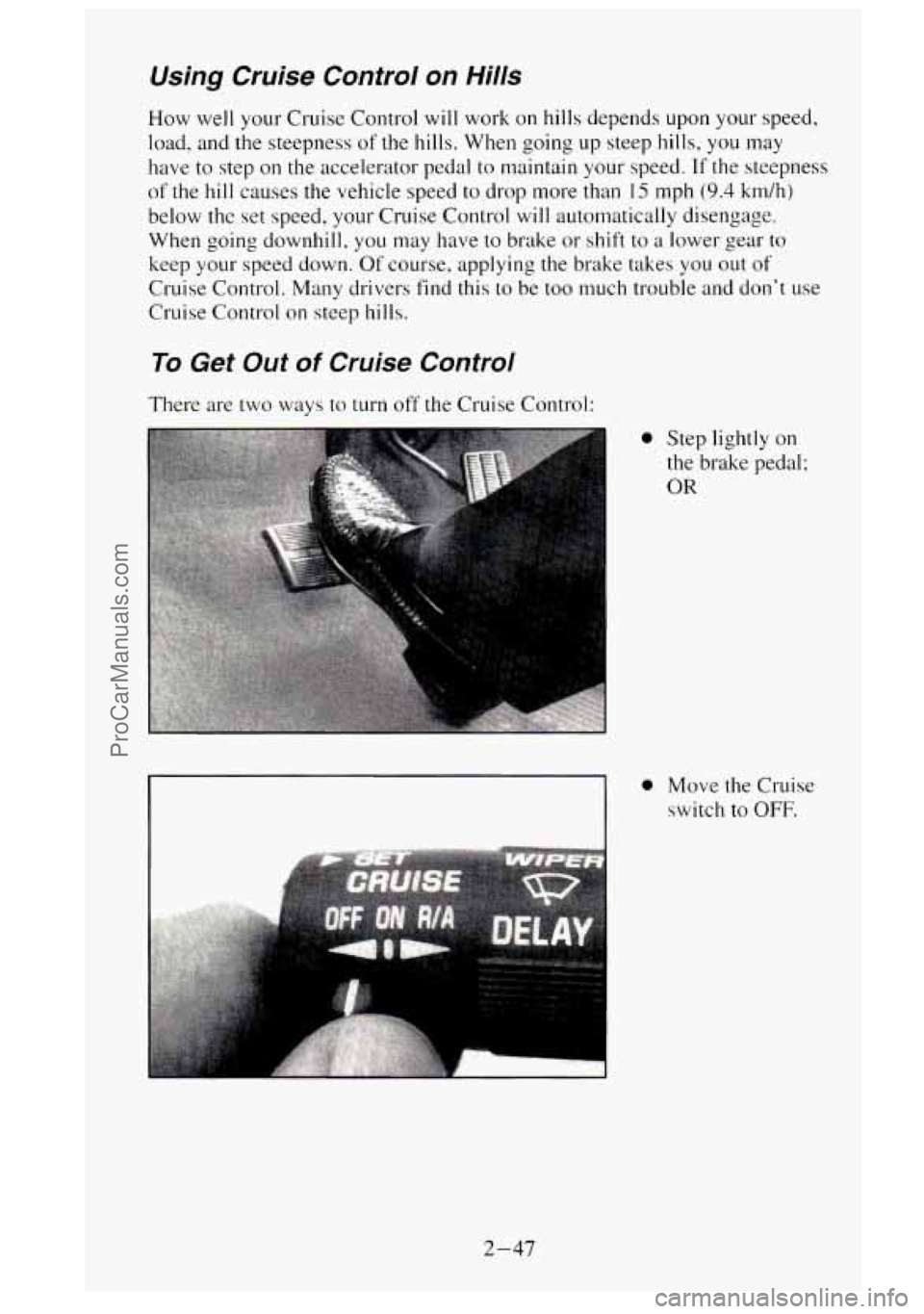
To Get Out of Cruise Control
There are two ways to turn off the Cruise Control:
0 Step lightly on
the brake pedal;
OR
I I 0 Move the Cruise
I
switch to OFF.
2-47
ProCarManuals.com
Page 110 of 488
To Erase Speed Memory
When you turn off' the Cruise Control or the ignition. your Cruise Control
set speed memory
is erased.
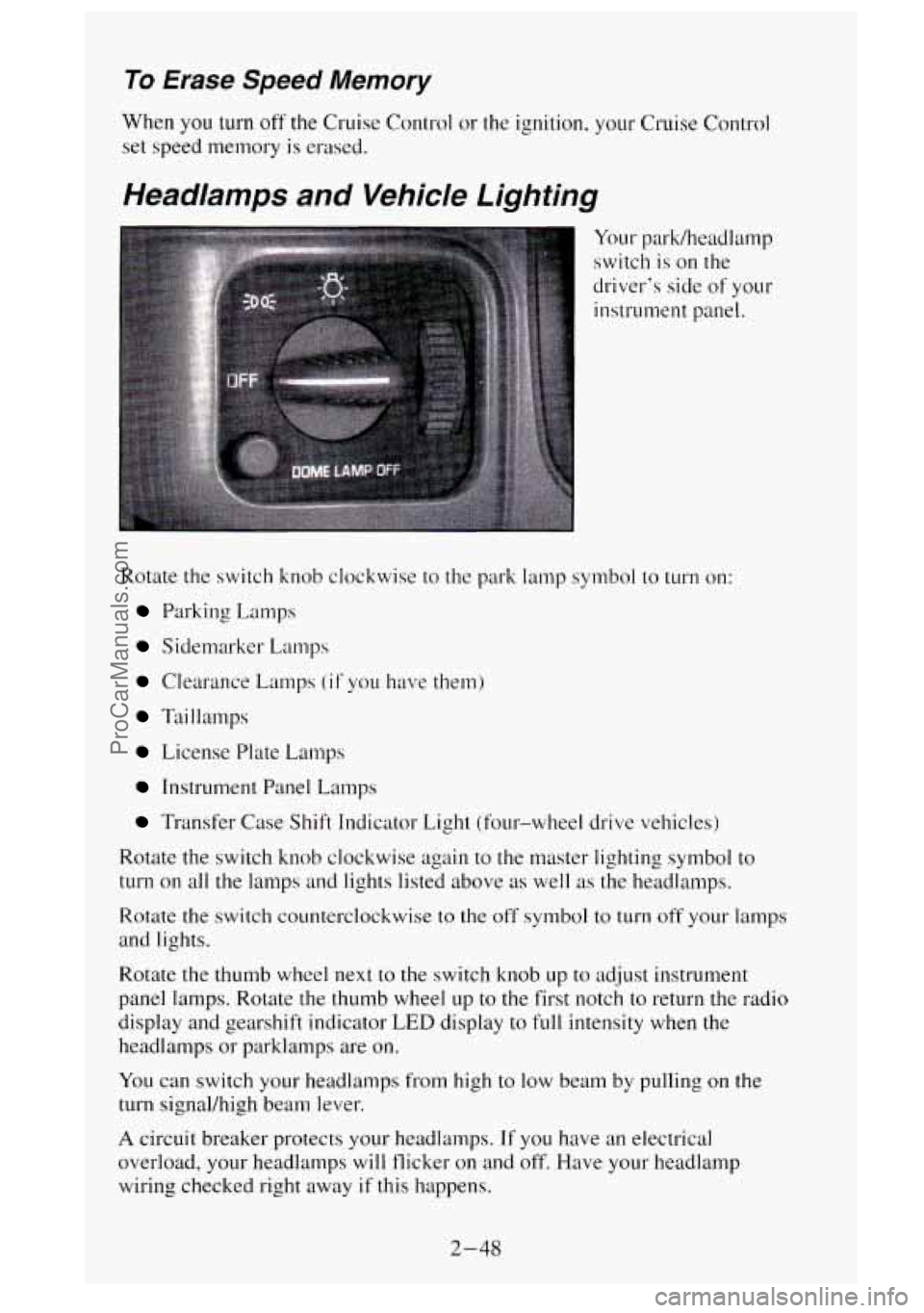
Headlamps and Vehicle Lighting
Your park/headlamp
switch is on the
driver's side of your
instrument panel.
Rotate the switch knob clockwise to the park lamp symbol to
turn on:
Parking Lamps
Sidemarker Lamps
Clearance Lamps (if you have them)
Taillamps
License Plate L.amps
Instrument Panel Lamps
Transfer Case Shift Indicator Light (four-wheel drive vehicles)
Rotate the switch knob clockwise again to the master lighting symbol to
turn on all the lamps and lights listed above as well as the headlamps.
Rotate the switch counterclockwise to the off symbol to turn off your lamps
and lights.
Rotate the thumb wheel next to the switch knob up
to adjust instrument
panel lamps. Rotate
the thumb wheel up to the first notch to return the radio
display and gearshift indicator
LED display to full intensity when the
headlamps or parklamps are
on.
You can switch your headlamps from high to low beam by pulling on the
turn signal/high beam lever.
A circuit breaker protects your headlamps. If you have an electrical
overload, your headlamps will flicker on and off. Have your headlamp
wiring checked right away if this happens.
2-48
ProCarManuals.com
Page 353 of 488
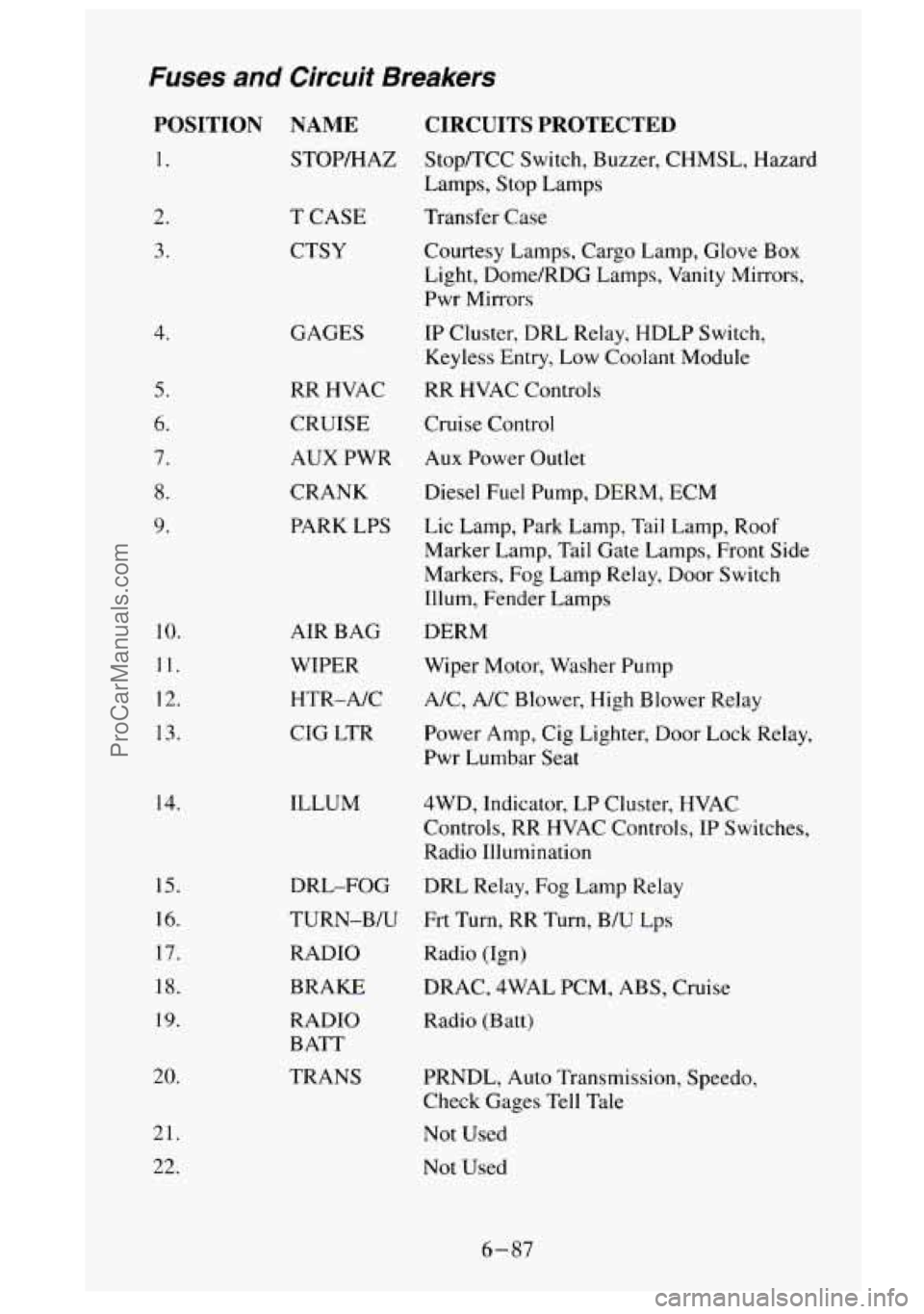
Fuses and Circuit Breakers
POSITION NAME
1. STOP/HAZ
2.
3.
4.
5.
6.
7.
8.
9.
10.
11.
12.
13.
14.
IS.
16.
17.
18.
19.
20.
21. 22.
T CASE
CTSY
GAGES
RR HVAC
CRUISE
AUX PWR
CRANK
PARK LPS
AIR BAG
WIPER HTR-A/C
CIG LTR
ILLUM
DRL-FOG
TURN-B/U RADIO
BRAKE RADIO
BATT
TRANS
CIRCUITS PROTECTED
Stop/TCC Switch, Buzzer, CHMSL, Hazard
Lamps, Stop Lamps
Transfer Case
Courtesy Lamps, Cargo Lamp, Glove Box
Light, Dome/RDG Lamps, Vanity Mirrors,
Pwr Mirrors
IP Cluster, DRL Relay, HDLP Switch,
Keyless Entry, Low Coolant Module
RR HVAC Controls
Cruise Control
Aux Power Outlet
Diesel Fuel Pump, DERM, ECM
Lic Lamp, Park Lamp, Tail Lamp, Roof
Marker Lamp, Tail Gate Lamps, Front Side
Markers, Fog Lamp Relay, Door Switch
Illum, Fender Lamps
DERM
Wiper Motor, Washer Pump
A/C, A/C Blower, High Blower Relay
Power Amp, Cig Lighter, Door Lock Relay,
Pwr Lumbar Seat
4WD, Indicator, LP Cluster, HVAC
Controls,
RR HVAC Controls, IP Switches,
Radio Illumination
DRL Relay, Fog Lamp Relay
Frt Turn, RR Turn, B/U Lps
Radio (Ign)
DRAC, 4WAL PCM, ABS, Cruise
Radio (Batt)
PRNDL, Auto Transmission, Speedo,
Check Gages
Tell Tale
Not Used
Not Used
6-87
ProCarManuals.com
Page 453 of 488
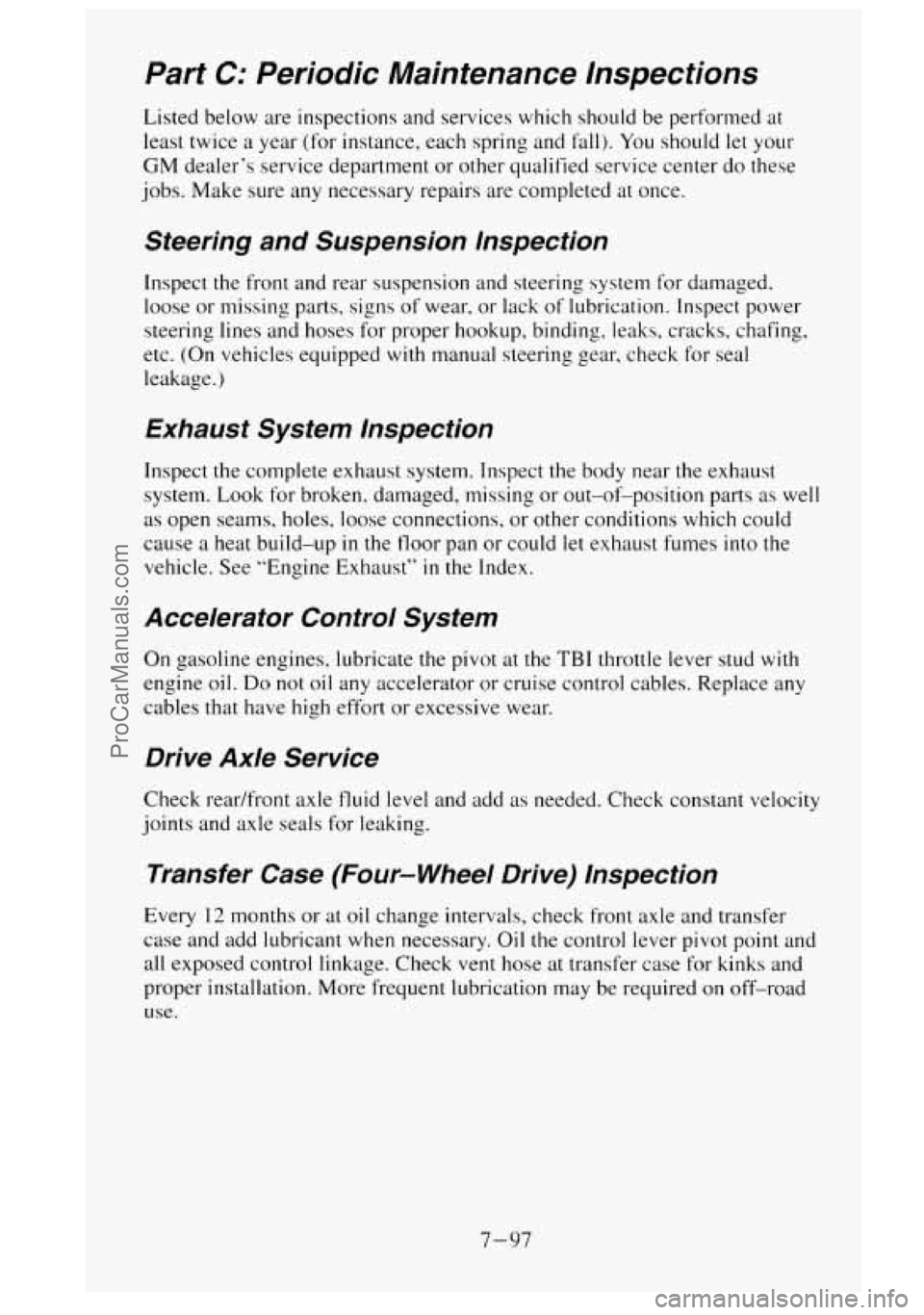
Part C: Periodic Maintenance lnspections
Listed below are inspections and services which should be performed at
least twice a year (for instance, each spring and
fall). You should let your
GM dealer’s service department or other qualified service center do these
jobs. Make sure any necessary repairs are completed at once.
Steering and Suspension Inspection
Inspect the front and rear suspension and steering system for damaged.
loose or missing parts, signs of wear,
or lack of lubrication. Inspect power
steering lines and hoses for proper hookup, binding, leaks, cracks, chafing,
etc. (On vehicles equipped with manual steering gear, check for seal
leakage.)
Exhaust System Inspection
Inspect the complete exhaust system. Inspect the body near the exhaust
system.
Look for broken. damaged, missing or out-of-position parts as well
as open seams, holes, loose connections,
or other conditions which could
cause a heat build-up
in the floor pan or could let exhaust fumes into the
vehicle. See “Engine Exhaust”
in the Index.
Accelerator Control System
On gasoline engines. lubricate the pivot at the TBI throttle lever stud with
engine
oil. Do not oil any accelerator or cruise control cables. Replace any
cables that have high effort or excessive wear.
Drive Axle Service
Check readfront axle fluid level and add as needed. Check constant velocity
Joints and axle seals for leaking.
Transfer Case (Four- Wheel Drive) Inspection
Every 12 months or at oil change intervals, check front axle and transfer
case and add lubricant when necessary. Oil the control lever pivot point and
all exposed control linkage. Check vent hose at transfer case for kinks and
proper installation. More frequent lubrication may be required on off-road
use.
7-97
ProCarManuals.com