light GMC SIERRA 1995 Repair Manual
[x] Cancel search | Manufacturer: GMC, Model Year: 1995, Model line: SIERRA, Model: GMC SIERRA 1995Pages: 488, PDF Size: 26.01 MB
Page 208 of 488
c
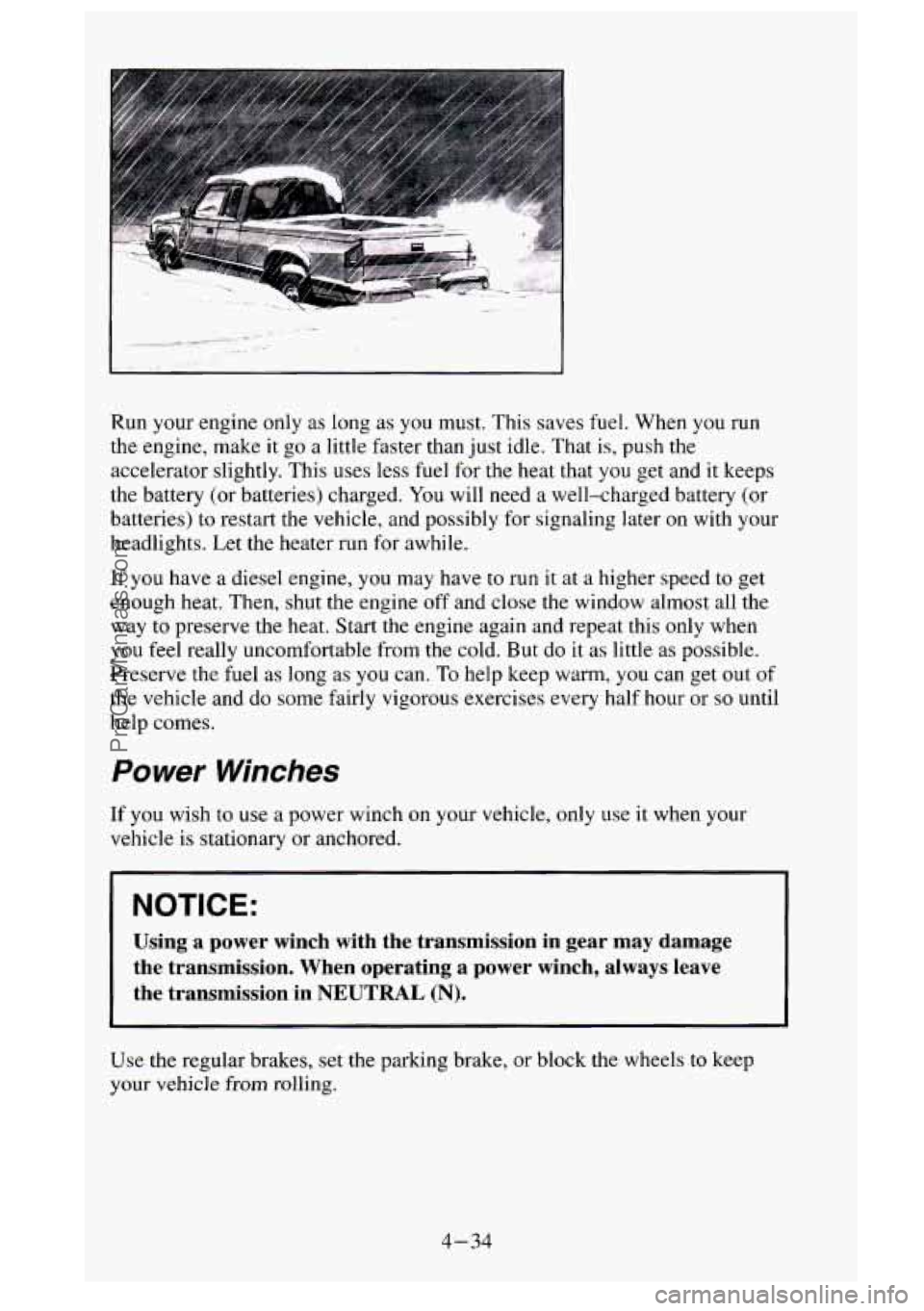
Run your engine only as long as you must. This saves fuel. When you run
the engine, make
it go a little faster than just idle. That is, push the
accelerator slightly. This uses less fuel for the heat that
you get and it keeps
the battery (or batteries) charged. You will need a well-charged battery (or
batteries) to restart the vehicle, and possibly for signaling later on with your
headlights. Let the heater run for awhile.
If you have a diesel engine, you may have to run it at a higher speed to get
enough heat. Then, shut the engine off and close the window almost all the
way
to preserve the heat. Start the engine again and repeat this only when
you feel really uncomfortable from the cold. But do it as little as possible.
Preserve the fuel as long
as you can. To help keep warm, you can get out of
the vehicle and do some fairly vigorous exercises every half hour or so until
help comes.
Power Winches
If you wish to use a power winch on your vehicle, only use it when your
vehicle
is stationary or anchored.
NOTICE:
Using a power winch with the transmission in gear may damage
the transmission. When operating a power winch, always leave
the transmission in NEUTRAL
(N).
Use the regular brakes, set the parking brake, or block the wheels to keep
your vehicle
from rolling.
4-34
ProCarManuals.com
Page 223 of 488
When You Are Ready to Leave After Parking on a Hill
1. Apply your regular brakes and hold the pedal down while you:
Start your engine:
Shift into a gear; and
Release the parking brake.
2. Let up on the brake pedal.
3. Drive slowly until the trailer is clear of the chocks.
4. Stop and have someone pick up and store the chocks.
Maintenance When Trailer Towing
Your vehicle will need service more often when you’re pulling a trailer. See
the Maintenance Schedule
for more on this. Things that are especially
important
in trailer operation are automatic transmission fluid (don’t
overfill), engine oil, axle lubricant, belt, cooling system, and brake
adjustment. Each of these is covered
in this manual, and the Index will help
you find them quickly. If you’re trailering, it’s
a good idea to review these
sections before you start your trip.
Check periodically to see that all hitch
nuts and bolts are tight.
Trailer Lighting Systems Wiring
See “Trailer Wiring Harness” in the Index.
4-49
ProCarManuals.com
Page 228 of 488
You could be injured if the vehicles roll. Set the parking brake firmly
on each vehicle. Put an automatic transmission in PARK (P) or a
manual transmission in NEUTRAL (N). If you have a
four-wheel-drive vehicle, be sure the transfer case is not in NEUTRAL
(N).
3. Turn off the ignition on both vehicles. Turn off all lights that aren’t
needed, and radios. This
will avoid sparks and help save both batteries.
And it could save your radio!
NOTICE:
If you leave your radio on, it could be badly damaged. The
repairs wouldn’t be covered by your warranty.
4. Open the hoods and locate the batteries. Find the positive (+) and
negative
(-) terminals on each battery.
A CAUTION:
Using a match near a battery can cause battery gas to explode.
People have been hurt doing this, and some have been blinded.
Use
a flashlight if you need more light.
Be sure the batteries have enough
water. You don’t need to add
water to the Delco Freedom@ battery (or batteries) installed in
every new
GM vehicle. But if a battery has filler caps, be sure
the right amount of fluid is there.
If it is low, add water to take
care
of that first. If you don’t, explosive gas could be present.
Battery fluid contains acid that can burn you. Don’t get
it on
you.
ff you accidentally get it in your eyes or on your skin, flush
the place with water and get medical help immediately.
5. Check that the jumper cables don’t have loose or missing insulation. If
they do,
you could get a shock. The vehicles could be damaged, too.
Before you connect the cables, here are some basic things you should
know. Positive
(+) will go to positive (+) and negative (-) will go to
negative
(-) or a metal engine part. Don’t connect (+) to (-) or you’ll
get
a short that would damage the battery and maybe other parts, too.
5-4
ProCarManuals.com
Page 234 of 488
Engine Overheating
YOU will find a coolant temperature gage on your vehicle instrument panel.
If
YOU have a diesel engine, you will also find a low coolant light on your
instrument panel.
lf Steam Is Coming From Your Engine
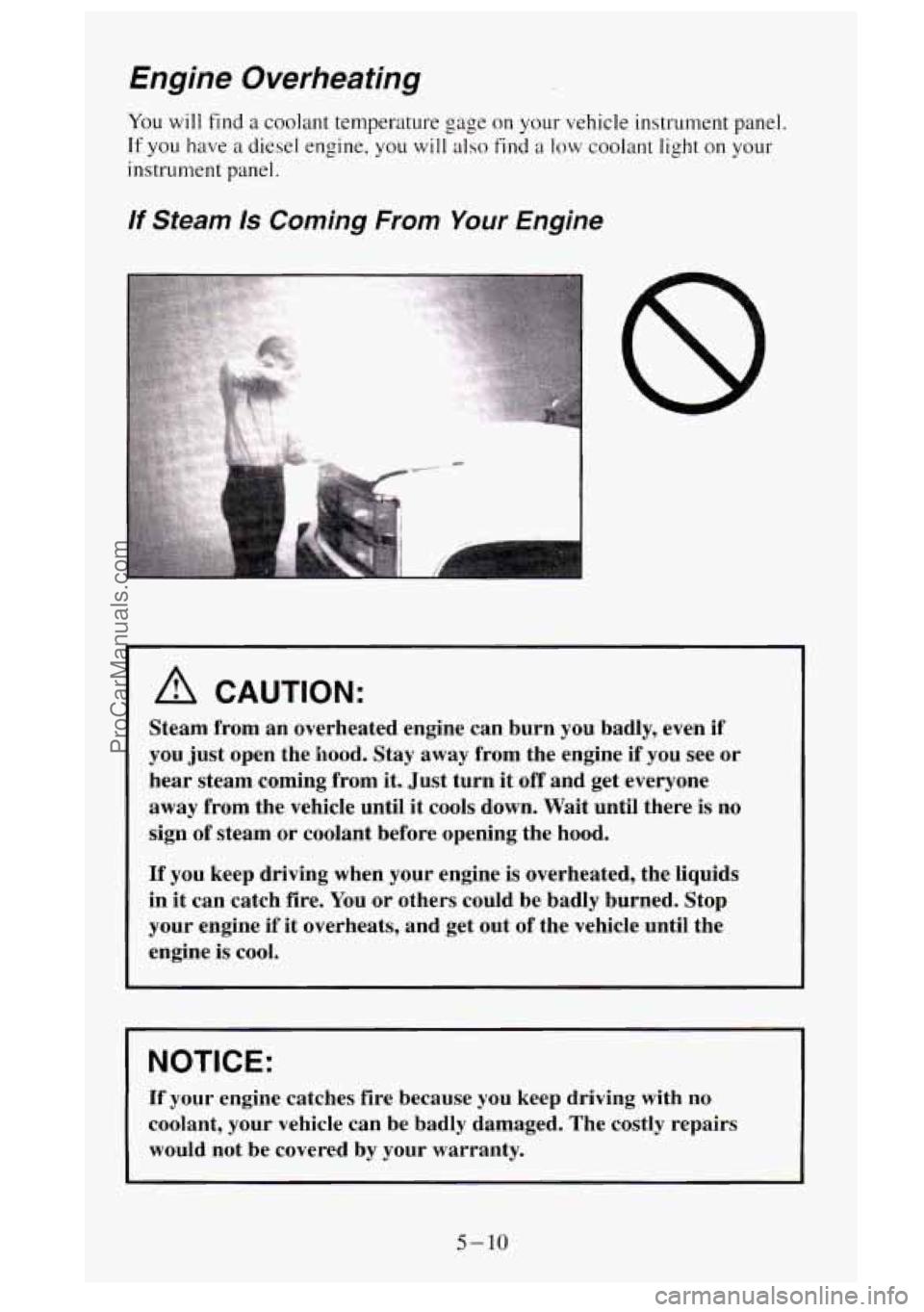
A CAUTION:
Steam from an overheated engine can burn you badly, even if
you just open the hood. Stay away from the engine if you see or
hear steam coming from it. Just turn it
off and get everyone
away from the vehicle until it cools down. Wait until there is no
sign of steam or coolant before opening the hood.
If you keep driving when your engine is overheated, the liquids
in it can catch fire. You or others could be badly burned. Stop
your engine
if it overheats, and get out of the vehicle until the
engine
is cool.
NOTICE:
If your engine catches fire because you keep driving with no
coolant, your vehicle can be badly damaged. The costly repairs
would not be covered by your warranty.
5-10
ProCarManuals.com
Page 263 of 488
If You’re Stuck: In Sand, Mud, Ice or Snow
What you don’t want to do when your vehicle is stuck is to spin your wheels
too fast. The method known as ”rocking” can help you get out when you’re
stuck, but you nlust use caution.
A CAUTION:
If you let your tires spin at high speed, they can explode and you
or others could be injured. And, the transmission or other par\
ts
of the vehicle can overheat. That could cause an engine
compartment fire or other damage. When you’re stuck, spin th\
e wheels
as little as possible. Don’t spin the wheels above 35 mph
(55 km/h) as shown on the speedometer.
I NOTICE:
Spinning your wheels can destroy parts of your vehicle as well as
the tires. If you spin the wheels too fast while shifting your
transmission back and forth, you can destroy your transmission.
For information about using tire chains on your vehicle, see “Tire Chains”
in the Index.
Rocking
your vehicle to get it out:
First. turn your steering wheel left and right. That will clear the area around
your front wheels. Then shift back and forth between REVERSE
(R) and a
forward gear (or
with a manual transmission, between FIRST (1 ) or
SECOND (2) gear and REVERSE), spinning the wheels as little as possible.
Release
the accelerator pedal while you shift, and press lightly on the
accelerator pedal when the transmission
is in gear. If that doesn’t get you
out after a few tries, you may need
to be towed out. Or, you can use your
recovery hooks,
if your vehicle has them. If you do need to be towed out.
see “Towing Your Vehicle”
in the Index.
5-39
ProCarManuals.com
Page 269 of 488
What about gasoline with blending materials that contain oxygen
(oxygenates), such
as MTBE or alcohol?
MTBE is “methyl tertiary-butyl ether.” Fuel that is no more than 15%
MTBE is fine for your vehicle.
Ethanol is ethyl or grain alcohol. Properly-blended fuel that is no more than
10% ethanol is fine for your vehicle.
Methanol is methyl or wood alcohol.
NOTICE:
Fuel that is more than 5% methanol is bad for your vehicle.
Don’t use it. It can corrode metal parts in your fuel system and
also damage plastic and rubber parts. That damage wouldn’t be
covered under your warranty. And even at
5% or less, there
must be “cosolvents” and corrosion preventers in this fuel
to
help avoid these problems.
Gasolines for Cleaner Air
Your use of gasoline with deposit control additives will help prevent
deposits from forming
in your engine and fuel system. That helps keep your
engine
in tune and your emission control system working properly. It’s good
for your vehicle, and you’ll be doing your part for cleaner air.
Many gasolines are now blended with oxygenates. General Motors
recommends that
you use gasolines with these blending materials, such as
MTBE and ethanol. By doing
so, you can help clean the air, especially in
those parts of the country that have high carbon monoxide levels.
In addition, some gasoline suppliers are now producing reformulated
gasolines. These gasolines are specially designed to reduce vehicle
emissions. General Motors recommends that
you use reformulated gasoline.
By doing
so, you can help clean the air, especially in those parts of the
country that have high ozone levels.
You should ask your service station operators if their gasolines contain
deposit control additives and oxygenates, and if they have been
reformulated
to reduce vehicle emissions.
Diesel Fuel Requirements and Fuel Sysrem
Some states and provinces have restrictions on the purchase of diesel fuel
for light-duty vehicles and require you to buy permits or pay special taxes.
Some
of these restrictions apply only to residents, and others apply to both
residents and visitors. These restrictions can change.
To learn the current
restrictions in any state or province, contact your auto club, the police or
other officials.
6-3
ProCarManuals.com
Page 271 of 488
Canadian Fuels
Diesel-powered trucks are now equipped with emission control systems that
require the use of diesel fuel with low-sulfur
(.05% by weight) content.
Both low- and higher-sulfur fuels will be available
in Canada. Only
low-sulfur diesel fuels are available
in the United States. It is important that
diesel-powered trucks are refueled with low-sulfur fuel. Use of fuels with
higher-sulfur content will affect
the function of the emission components
and may cause reduced performance, excessive smoke and unpleasant odor.
Cold Weather Operation
Follow the instructions listed previously under the heading “What Fuel to
Use.”
If you’re driving
in very toold temperatures and can’t get a “winterized”
Number
2-D that has been adapted to cold weather or a Number 1-D, you
can
use one gallon of kerosene for every two gallons of diesel fuel. Once
you add the kerosene, run your engine for several minutes
so the fuels will
mix. Add kerosene only when the temperature falls below 0°F (-1 S”C),
because the fuel economy of kerosene isn’t as good as that of diesel fuel.
NOTICE:
Never use home heating oil or gasoline in your diesel engine. \
They can cause engine damage.
In cold weather, your fuel filter may become clogged (waxed). To unclog it,
warm the filter to between
32°F and 50°F (OOC to 10°C). You won’t need
to replace
it.
Water in Fuel
Sometimes, water can be pumped into your fuel tank along with your diesel
fuel. This can happen
if a service station doesn’t regularly inspect and clean
its fuel tanks, or
if it gets contaminated fuel from its suppliers.
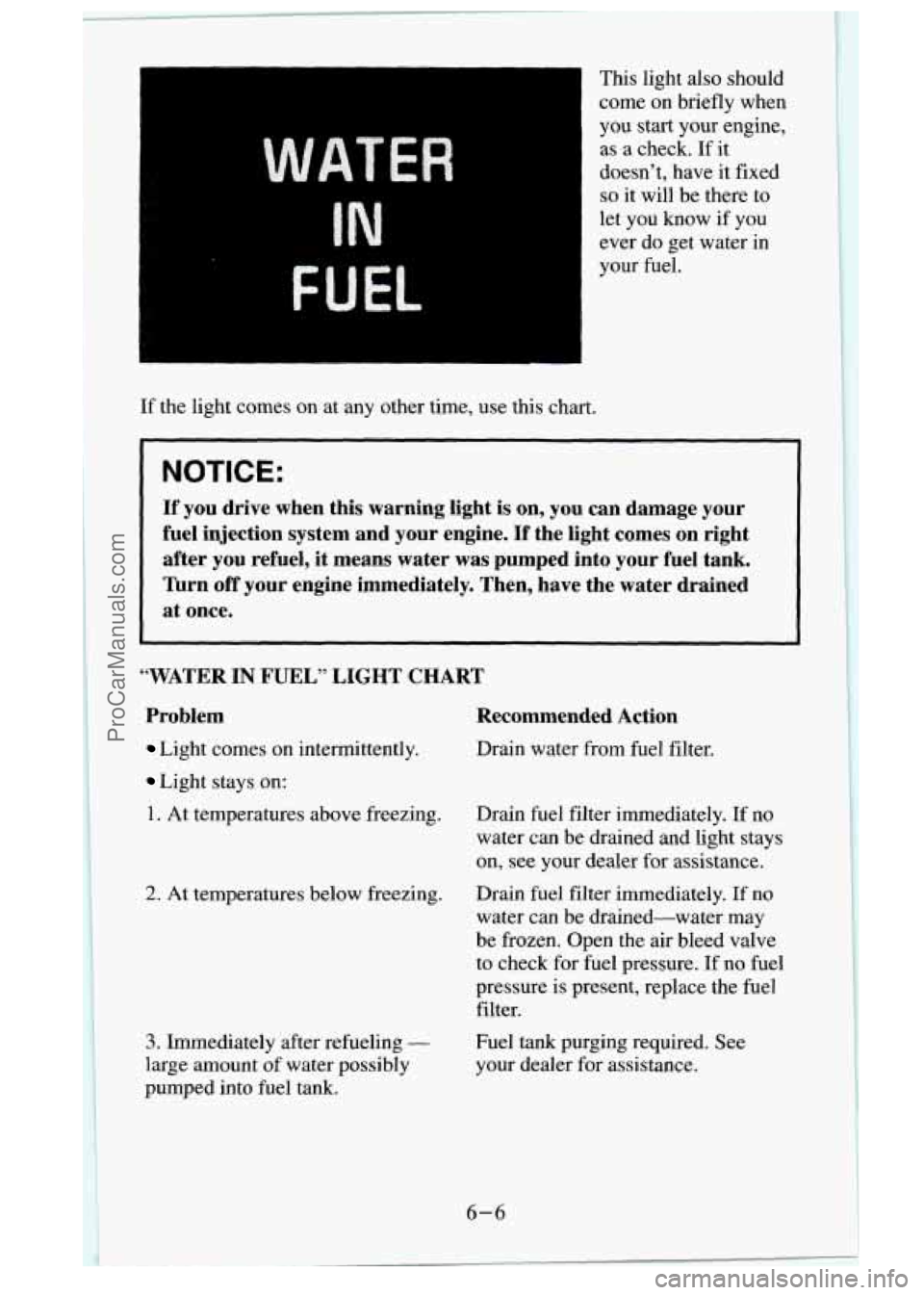
If this happens, a WATER
IN FUEL light will come on. If it does, the excess
water must be drained. Your dealer can show
you how to do this.
6-5
ProCarManuals.com
Page 272 of 488
L
WATER
IN
FUEL
If the light comes on at any other time, use this chart. This light also should
come on briefly when
you start your engine,
as
a check. If it
doesn’t, have it fixed
so it will be there to
let you know if you
ever do get water in
your fuel.
If you drive when this warning light is on, you can damage your
fuel injection system and your engine.
If the light comes on right
after you refuel,
it means water was pumped into your fuel tank.
Turn
off your engine immediately. Then, have the water drained
at once.
“WATER IN FUEL” LIGHT CHART
Problem Recommended Action
Light comes on intermittently. Drain water from fuel filter.
Light stays on:
1. At temperatures above freezing.
2. At temperatures below freezing.
3. Immediately after refueling -
large amount of water possibly
pumped into
fuel tank. Drain fuel filter
immediately.
If no
water can be drained and light stays
on, see your dealer for assistance.
Drain fuel filter immediately.
If no
water can be drained-water may
be frozen. Open the air bleed valve
to check for fuel pressure.
If no fuel
pressure is present, replace the fuel
filter.
Fuel tank purging required. See
your dealer for assistance.
6-6
ProCarManuals.com
Page 273 of 488

Hesitation or “flat” performance at high speed or during \
hard acceleration
may be an indication of premature fuel filter plugging due to dirty or
contaminated fuel. The fidter element may need to be changed
if this
happens. See your dealer for assistance.
To drain water:
1. Stop and park the vehicle in a safe place. Turn off the engine and apply
2. Remove the fuel tank cap.
the parking brake.
3. Place a
fuel-resistant container under the filter drain hose.
5.
6.
7.
8.
4. With the engine
off, open the
water drain valve
2 to 3 turns.
When standing in
front of the
vehicle, the valve
is located on the
right side of the
thermostat
housing.
Start the engine and allow it to idle until clear fuel is ob\
served.
Stop the engine and close the water drain valve.
Remove the fuel-resistant container and properly dispose of the
contaminated fuel.
To find out how to properly dispose of contaminated
diesel fuel see “What to Do with Used Oil” in the “E\
ngine Oil (Diesel
Engines)” part, later in this section.
Install the fuel tank cap.
If the WATER IN FUEL light comes on again after driving a short distance
or the engine runs rough or stalls-a large amount of water has probably
been pumped into the
fuel tank. The fuel tank should be purged.
6-7
ProCarManuals.com
Page 284 of 488
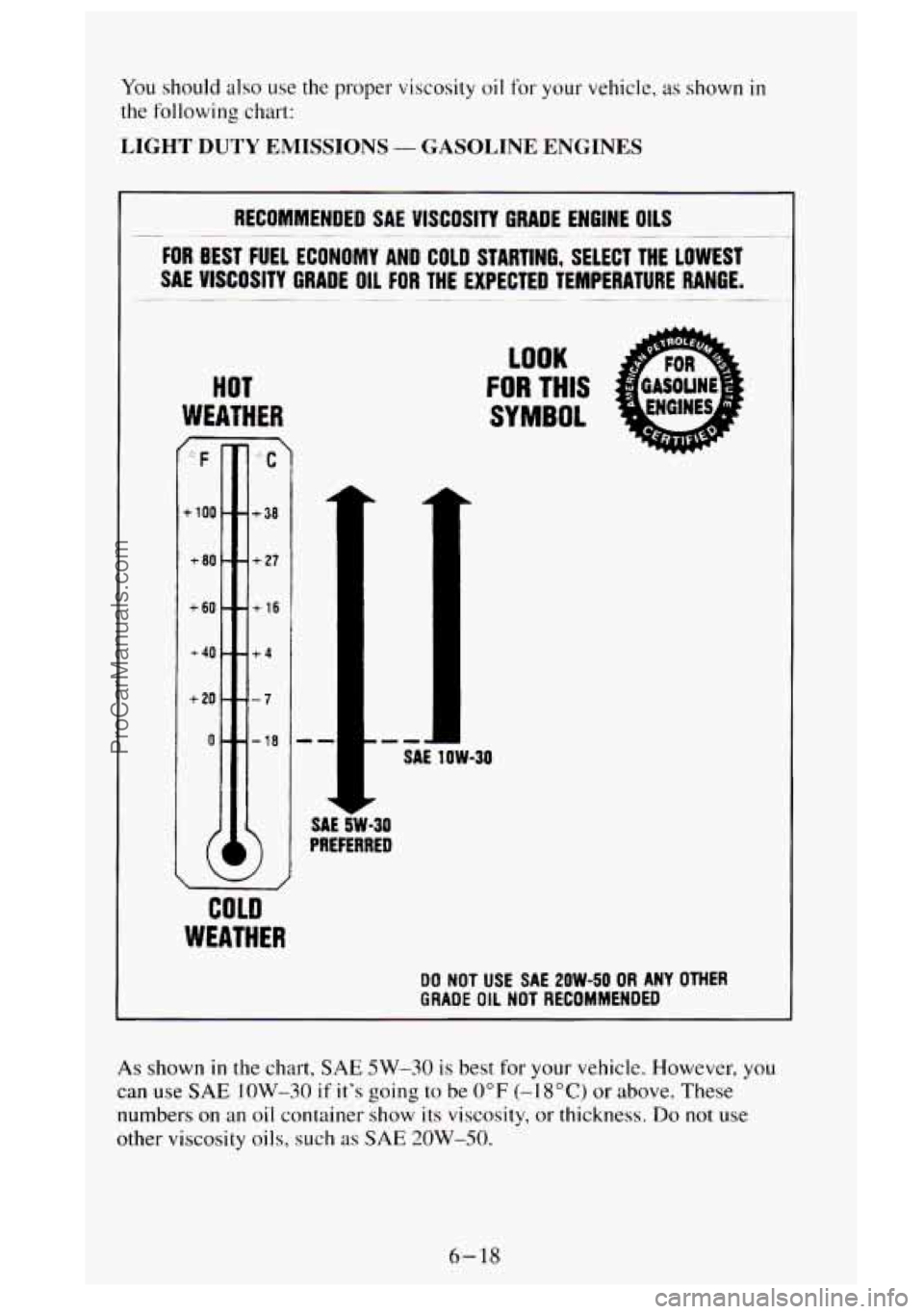
You should also use the proper viscosity oil for your vehicle, as shown in
the following chart:
LIGHT DUTY EMISSIONS - GASOLINE ENGINES
FOR BEST FUEL ECONOMY AND COLD STARTING, SELECT THE LOWEST
SAE VISCOSITY GRADE 011 FOR THE EXPECTED TEMPERATURE RANGE.
HOT
WEATHER
WEATHER
n
c
.
SAE IOW-30
L
LOOK
FOR THIS
SYMBOL
r31.
ip
L c,
SAE SW-30
PREFERRED
DO NOT USE SAE 2OW-50 OR ANY OTHER
GRADE OIL NOT RECOMMENDED
As shown in the chart, SAE 5W-30 is best for your vehicle. However, you
can use SAE IOW-30 if it’s going to be 0°F (-I 8°C) or above. These
numbers on
an oil container show its viscosity, or thickness. Do not use
other viscosity oils, such as
SAE 2OW-SO.
6-18
ProCarManuals.com