ABS GMC SIERRA 1995 Owners Manual
[x] Cancel search | Manufacturer: GMC, Model Year: 1995, Model line: SIERRA, Model: GMC SIERRA 1995Pages: 488, PDF Size: 26.01 MB
Page 121 of 488
NOTICE:
Holding a cigarette lighter in with your hand while it is heating
can make it overload, damaging the lighter and the heating
element.
Just push the lighter all the way in and let go. When it’s
done, it will pop back by itself.
L
To remove the front ashtray, pull on the front of the ashtray insert. Then
slide the insert
out of the ashtray door.
You may also have two auxiliary power outlets next to the cigarette lighter.
Use these outlets to power mobile telephones
or other de\:ices designed to
operate with vehicle electrical systems.
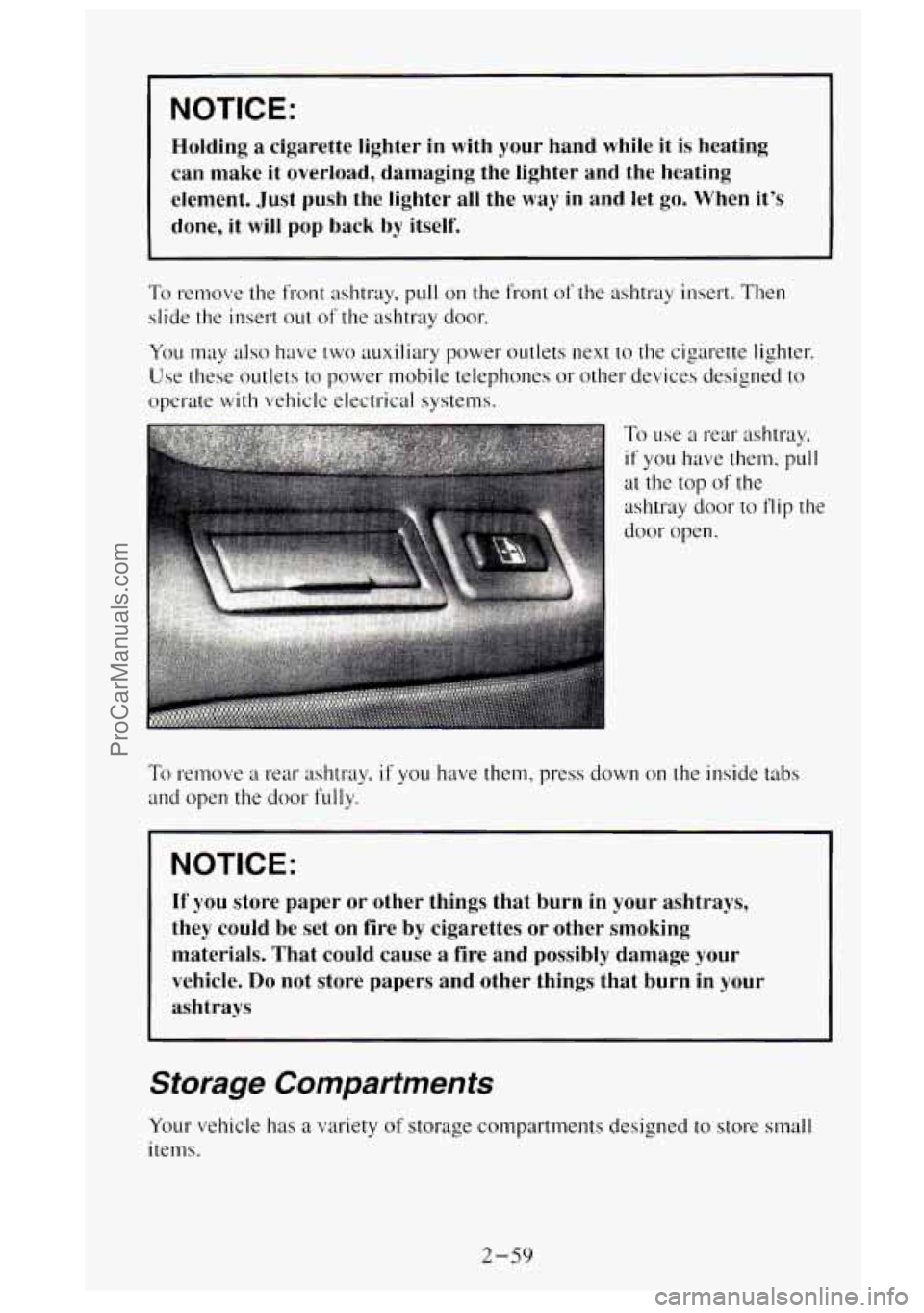
To use a rear ashtray.
if you have them. pull
at the top of the
ashtray door to flip the
door open.
To remove a rear ashtray. if you have them, press down on the inside tabs
and open the door
fully.
NOTICE:
If you store paper or other things that burn in your ashtrays,
they could be set
on fire by cigarettes or other smoking
materials. That could cause
a fire and possibly damage your
vehicle.
Do not store papers and other things that burn in your
ashtrays
Storage Compartments
Your vehicle has a variety of storage compartments designed to store small
items.
2-59
ProCarManuals.com
Page 180 of 488
Anti-Lock Brakes (ABS)
Your vehicle has an advanced electronic braking system that can help you
keep it under control. When you start your vehicle and begin to drive away,
you may hear a momentary motor or clicking noise. This is the
ABS system
testing itself.
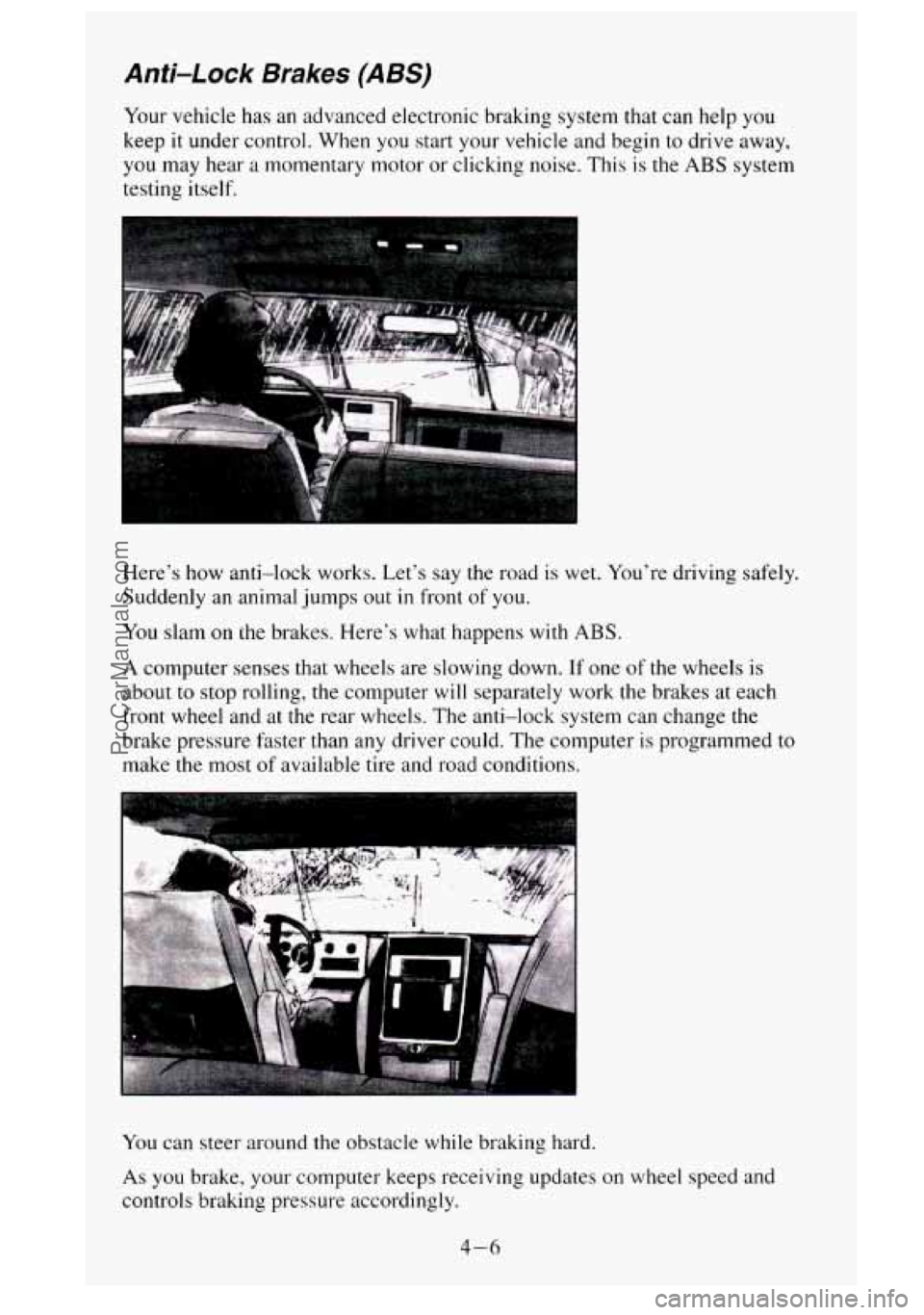
Here's how anti-lock works. Let's say the road is wet. You're driving safely.
Suddenly an animal jumps out
in front of you.
You slam on the brakes. Here's what happens with ABS.
A computer senses that wheels are slowing down. If one of the wheels is
about
to stop rolling, the computer will separately work the brakes at each
front wheel and at the rear wheels. The anti-lock system can change the
brake pressure faster than any driver could. The computer is programmed to
make the most
of available tire and road conditions.
You can steer around the obstacle while braking hard.
As you brake, your computer keeps receiving updates on wheel speed and
controls braking pressure accordingly.
4-6
ProCarManuals.com
Page 185 of 488
Try not to pass more than one vehicle at a time on two-lane roads.
Reconsider before passing the next vehicle.
0 Don’t overtake a slowly moving vehicle too rapidly. Even though the
brake lights are
not flashing, it may be slowing down or starting to turn.
If you’re being passed, make it easy for the following driver to get
ahead
of you. Perhaps you can ease a little to the right.
Loss of Control
Let’s review what driving experts say about what happens when the three
control systems (brakes, steering and acceleration) don’t have enough
friction where the tires meet the road
to do what the driver has asked.
In any emergency, don’t give up. Keep trying
to steer and constantly seek an
escape route or area of less danger.
Skidding
In a skid, a driver can lose control of the vehicle. Defensive drivers avoid
most skids by taking reasonable care suited
to existing conditions, and by
not “overdriving” those conditions. But skids are always possible.
The three types of skids correspond to your vehicle’s three control systems.
In the braking skid your wheels aren’t rolling. In the steering or cornering
skid, too much speed or steering in
a curve causes tires to slip and lose
cornering force. And
in the acceleration skid too much throttle causes the
driving wheels to spin.
A cornering skid and an acceleration skid are best handled by easing your
foot off the accelerator pedal.
If your vehicle starts to slide, ease your foot
off the accelerator pedal and
quickly steer the way you want the vehicle
to go. If you start steering
quickly enough, your vehicle may straighten out. Always be ready for
a
second skid if it occurs.
Of course, traction is reduced when water, snow, ice, gravel, or other
material is on
the road. For safety, you’ll want to slow down and adjust your
driving to these conditions. It is important to slow down on slippery
surfaces because stopping distance will be longer and vehicle control more
limited.
While driving on a surface
with reduced traction, try your best to avoid
sudden steering, acceleration. or braking (including engine braking
by
shifting to a lower gear). Any sudden changes could cause the tires to slide.
You may not realize the surface is slippery until your vehicle
is skidding.
Learn
to recognize warning clues - such as enough water, ice or packed
snow
on the road to make a “mirrored surface” - and slow down when you
have any doubt.
Remember:
Any anti-lock brake system (ABS) helps avoid only the braking
skid.
4-13
ProCarManuals.com
Page 222 of 488
When towing at high altitude on steep uphill grades, consider the following:
Engine coolant will boil at a lower temperature than at normal altitudes. If
you turn your engine off immediately after towing at high altitude on steep
uphill grades, your vehicle
may show signs similar to engine overheating.
To avoid this, let the engine run while parked (preferably on level ground)
with the automatic transmission
in PARK (Pj (or the manual transmission
out
of gear and the parking brake applied) for a few minutes before turning
the engine off.
If you do get the overheat warning, see “Engine
Overheating”
in the Index.
Parking on Hills
You really should not park your vehicle, with a trailer attached, on a hill. If
something goes wrong, your rig could start to move. People can be injured,
and both your vehicle and the trailer can be damaged.
But
if you ever have to park your rig on a hill, here’s how to do it:
1.
2.
3.
4.
5.
6.
Apply your regular brakes, but don’t shift into PARK (P) yet, or in gear
for a manual transmission.
Have someone place chocks under the trailer wheels.
When the wheel chocks are
in place, release the regular brakes until the
chocks absorb the load.
Re-apply the regular brakes. Then apply your parking brake, and then
shift
to PARK (P), or REVERSE (Rj for a manual transmission.
If you have
a four-wheel-drive vehicle, be sure the transfer case is in a
drive gear-not in NEUTRAL
(N).
Release the regular brakes.
A CAUTION:
It can be dangerous to get out of your vehicle if the shift lever is
not fully in
PARK (P) with the parking brake firmly set. Your
vehicle can rofl.
If you have Ieft the engine running, the vehicle can move
suddenly. You or others could be injured.
To be sure your vehicle
won’t move, even when you’re on fairly level ground, use the
steps that follow.
If you have four-wheel drive and your transfer case is in
NEUTRAL (N), your vehicle will be free to roll, even if your
shift lever is in
PARK (P). So, be sure the transfer case is in a
drive gear
- not in NEUTRAL (N).
4-48
ProCarManuals.com
Page 311 of 488
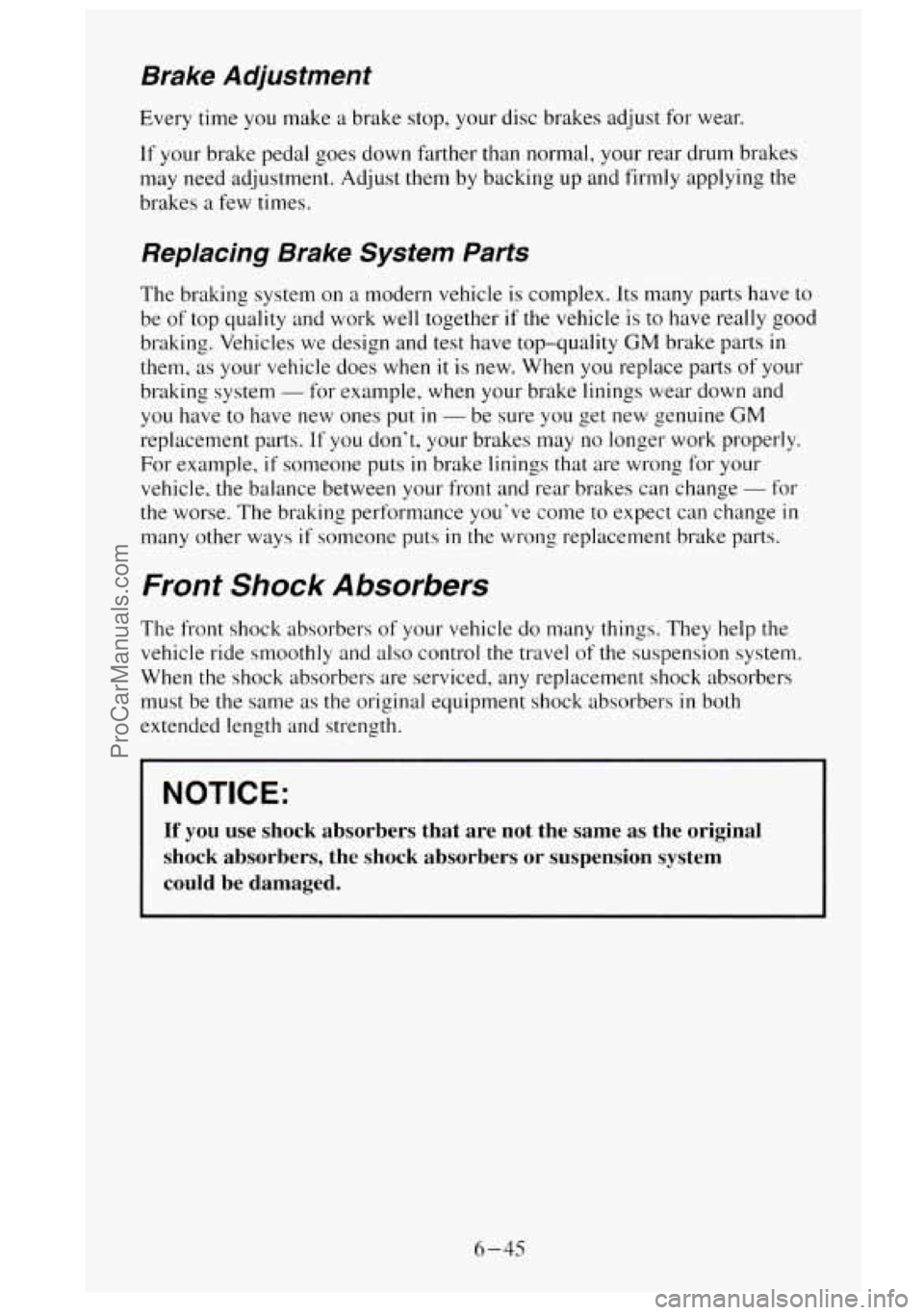
Brake Adjustment
Every time you make a brake stop, your disc brakes adjust for wear.
If your brake pedal goes down farther than normal, your rear drum brakes
may need adjustment. Adjust them by backing
up and firmly applying the
brakes
a few times.
Replacing Brake System Parts
The braking system on a modeffl VEShicle is complex. Its many parts have to
be of top quality and work well together if the vehicle
is to have really good
braking. Vehicles we design and test have top-quality
GM brake parts in
them, as your vehicle does when it is new. When you replace parts of your
braking system
- for example, when your brake linings wear down and
you have to have new ones put
in - be sure you get new genuine GM
replacement parts. If you don't, your brakes may no longer work properly.
For example, if someone puts in brake linings that are wrong for your
vehicle, the balance between your front and rear brakes can change
- for
the worse. The braking performance you've come to expect can change
in
many other ways if someone puts in the wrong replacement brake parts.
Front Shock Absorbers
The front shock absorbers of your vehicle do many things. They help the
vehicle ride smoothly and
also control the travel of the suspension system.
When the shock absorbers are serviced, any replacement shock absorbers
must be the same as the original equipment shock absorbers
in both
extended length and strength.
I NOTICE:
If you use shock absorbers that are not the same as the original
shock absorbers, the shock absorbers
or suspension system
could be damaged.
6-45
ProCarManuals.com
Page 353 of 488
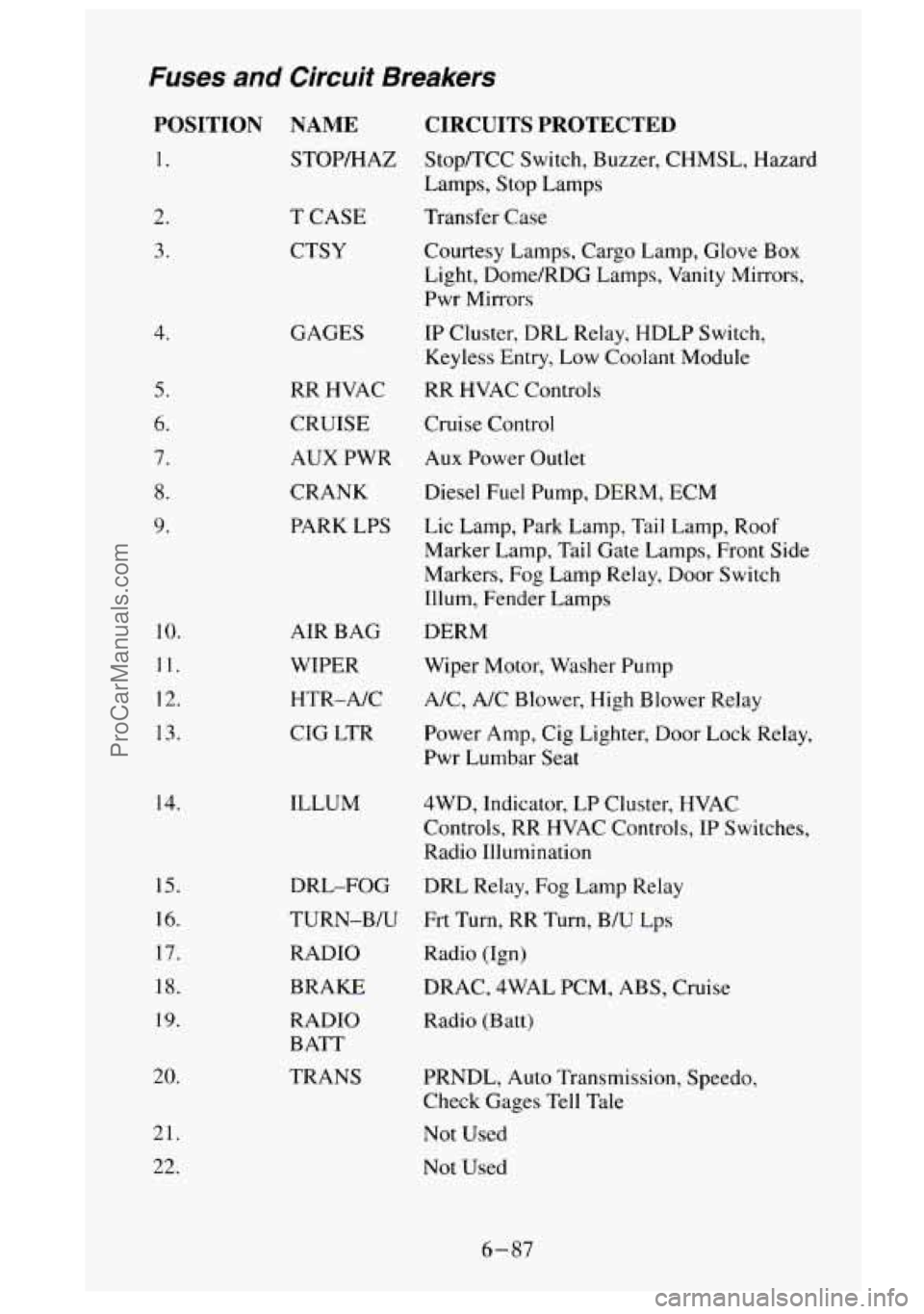
Fuses and Circuit Breakers
POSITION NAME
1. STOP/HAZ
2.
3.
4.
5.
6.
7.
8.
9.
10.
11.
12.
13.
14.
IS.
16.
17.
18.
19.
20.
21. 22.
T CASE
CTSY
GAGES
RR HVAC
CRUISE
AUX PWR
CRANK
PARK LPS
AIR BAG
WIPER HTR-A/C
CIG LTR
ILLUM
DRL-FOG
TURN-B/U RADIO
BRAKE RADIO
BATT
TRANS
CIRCUITS PROTECTED
Stop/TCC Switch, Buzzer, CHMSL, Hazard
Lamps, Stop Lamps
Transfer Case
Courtesy Lamps, Cargo Lamp, Glove Box
Light, Dome/RDG Lamps, Vanity Mirrors,
Pwr Mirrors
IP Cluster, DRL Relay, HDLP Switch,
Keyless Entry, Low Coolant Module
RR HVAC Controls
Cruise Control
Aux Power Outlet
Diesel Fuel Pump, DERM, ECM
Lic Lamp, Park Lamp, Tail Lamp, Roof
Marker Lamp, Tail Gate Lamps, Front Side
Markers, Fog Lamp Relay, Door Switch
Illum, Fender Lamps
DERM
Wiper Motor, Washer Pump
A/C, A/C Blower, High Blower Relay
Power Amp, Cig Lighter, Door Lock Relay,
Pwr Lumbar Seat
4WD, Indicator, LP Cluster, HVAC
Controls,
RR HVAC Controls, IP Switches,
Radio Illumination
DRL Relay, Fog Lamp Relay
Frt Turn, RR Turn, B/U Lps
Radio (Ign)
DRAC, 4WAL PCM, ABS, Cruise
Radio (Batt)
PRNDL, Auto Transmission, Speedo,
Check Gages
Tell Tale
Not Used
Not Used
6-87
ProCarManuals.com
Page 473 of 488
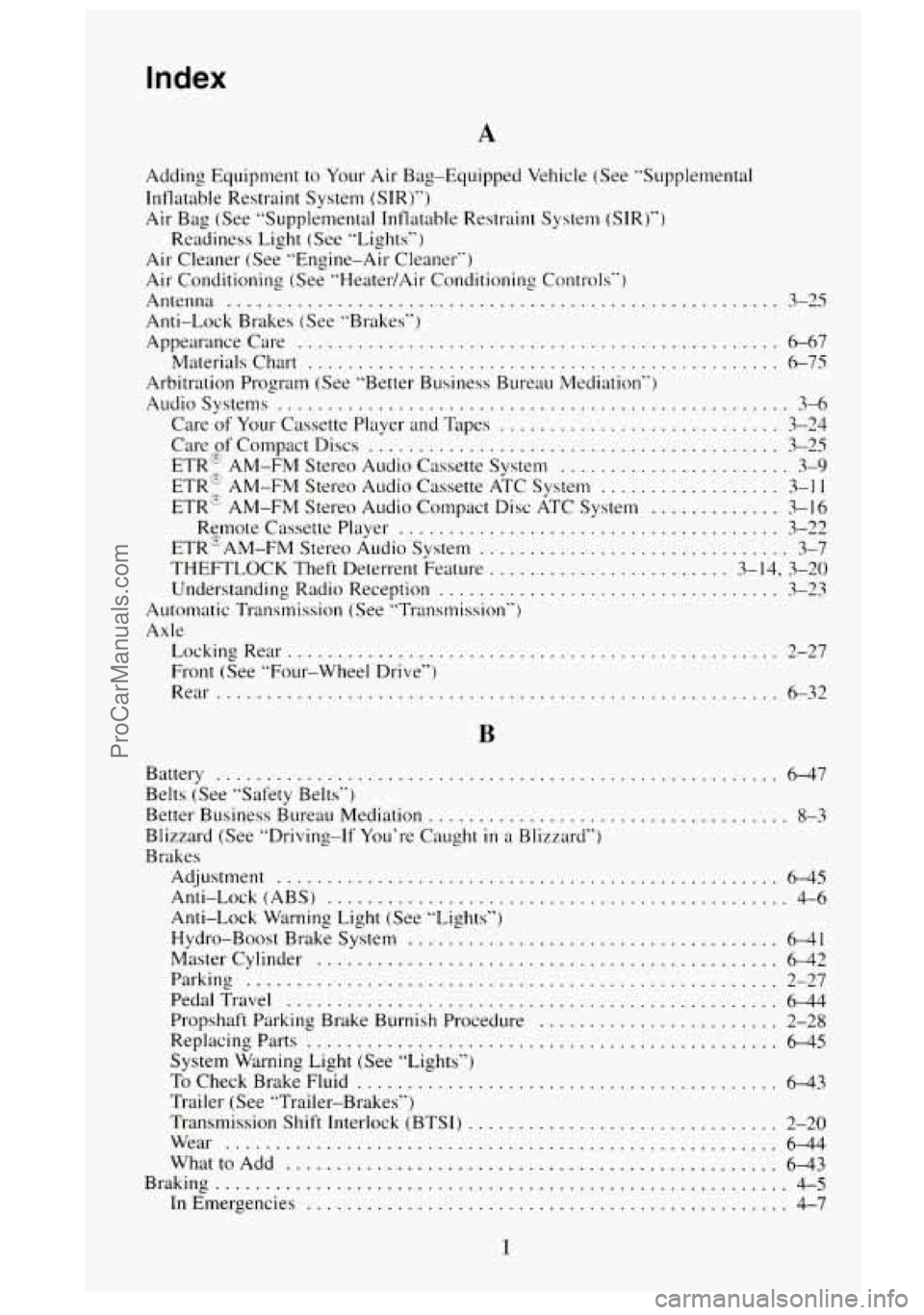
Index
A
Adding Equipment to Your Air Bag-Equipped Vehicle (See "Supplemental
Intlatable Restraint System (SIR)")
Air Bag (See "Supplemental Intlatable Restrain1 System (SIR)")
Air Cleaner (See "Engine-Air Cleaner")
Air Conditioning (See "HeatedAir Conditioning Controls")
Antenna
....................................................... 3-25
Readiness Light
(See "Lights")
Anti-Lock Brakes (See "Brakes")
Appearance Care
................................
Materials Chart ..............................
Arbitration Program (See "Better Business Bureau Media
Audio Systems
.................................
................ 6-67
................. 6-75
. tion")
.................. 3-6
Care of Your Cassette Player and Tapes ............................ 3-24
Care_of Compact Discs
......................................... 3-25
ETR: AM-FM Stereo Audio Cassette System
....................... 3-9
ETRf AM-FM Stereo Audio Cassette ATC System
.................. 3-11
ETR'?' AM-FM Stereo Audio Compact Disc ATC System ............. 3-16
Rcmote Cassette Player
...................................... 3-22
ETR&AM-FM Stereo Audio System
............................... 3-7
THEFTLOCK Theft Deterrent Feature
........................ 3- 14. 3-20
Understanding Radio Reception .................................. 3-23
Automatic Transmission (See "Tnlnsmission")
Axle LockingRea r
................................................. 2-27
Front (See "Four-Wheel Drive")
Rear
........................................................ 6-32
B
Battery ........................................................ 6-47
Belts (See "Safety Belts")
Better Business Bureau Mediation
.................................... 8-3
Blizzard (See "Driving-If You're Caught
in a Blizzard")
Brakes Adjustment
.................................................. 6-45
Anti-Lock (ABS)
.............................................. 4-6
Anti-Lock Warning Light (See "Lights")
Hydro-Boost Brake System
..................................... 6-41
Master Cylinder .............................................. 6-42
Parking
..................................................... 2-27
PedalTravel
................................................. 644
Propshaft Parking Brake Burnish Procedure
........................ 2-28
Replacingparts
............................................... 6-45
System Warning Light (See *'Lights")
To Check Brake Fluid .......................................... 6-43
Trailer (.See "Trailer-Brakes")
Transmission Shift Interlock
(BTSI) ............................... 2-20
Wear
....................................................... 6-44
WhattoAdd
................................................. 643
Braking ......................................................... 4-5
In Emergencies ................................................ 4-7
1
ProCarManuals.com
Page 481 of 488
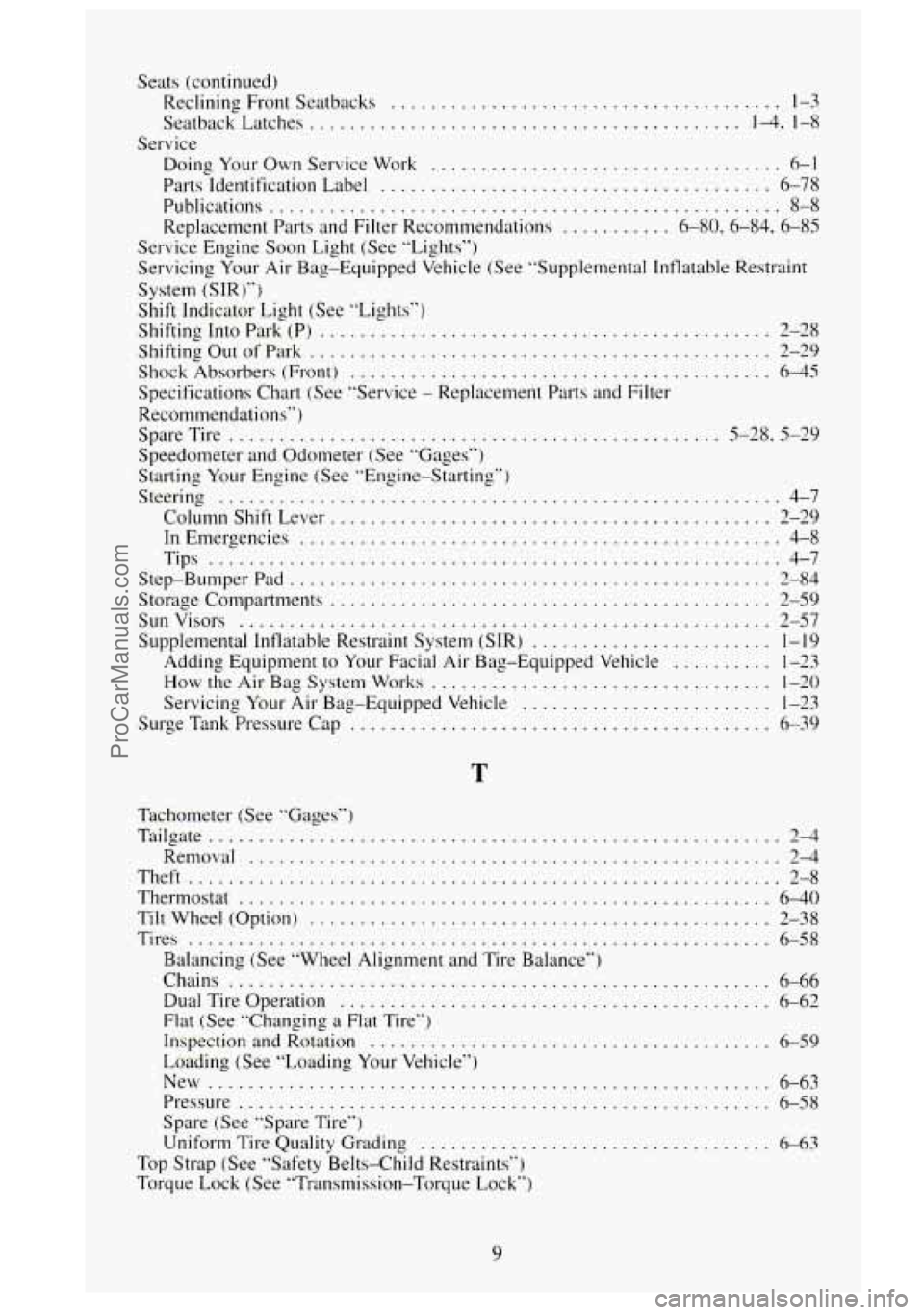
Seats (continued) Reclining Front Seatbacks
....................................... 1-3
Seatback Latches
........................................... 14. 1-8
Doing Your Own Service Work ................................... 6-1
Parts Identification Label
.....................
Service
Publications
.................................
Replacement Parts and Filter Recommendations ....
Service Engine Soon Light (See “Lights”)
Servicing Your Air Bag-Equipped Vehicle (See “Supple
System (SIR)”)
Shift Indicator Light (See *‘Lights“)
Shifting Into Park (P)
...........................
Shifting Out of Park .............................
Shock Absorbers (Front) .........................
.................. 6-78
.................. 8-8
....... 6-80.6-84,6-85
:r nental Inflatable Restraint
................. 2-28
................. 2-29
................. 6-45
Specifications Chart (See “Service . Replacement Parts and Filter
Recommendations“) SpareTire
................................................. 5-28.5-29
Speedometer and Odometer (See “Gages”)
Starting Your Engine (See ”Engine-Starting”)
Steering
........................................................ 4-7
Column Shift Lever
............................................ 2-29
InEmergencies
................................................ 4-8
Tips
......................................................... 4-7
Step-Bumperpad ................................................ 2-84
Storage Compartments
............................................ 2-59
Sunvisors
..................................................... 2-57
Supplemental Inflatable Restraint System (SIR)
........................ 1-19
Adding Equipment to Your Facial Air Bag-Equipped Vehicle
.......... 1-23
How the Air Bag System Works .................................. 1-20
Servicing Your Air Bag-Equipped Vehicle
......................... 1-23
Surge Tank Pressure Cap
.......................................... 6-39
T
Tachometer (See “Gages”)
Tail~ate
......................................................... 2-4
Removal ..................................................... 2-4
TIleft ........................................................... 2-8
Thermostat
..................................................... 6-40
Tilt Wheel (Option) .............................................. 2-38
Tires
.......................................................... 6-58
Balancing (See “Wheel Alignment and Tire Balance”)
Chains
...................................................... 6-66
Dual Tire Operation ........................................... 6-62
Flat (See ”Changing
a Flat Tire”)
Inspection and Rotation
........................................ 6-59
Loading (See “Loading Your Vehicle”)
New
........................................................ 6-63
Pressure
..................................................... 6-58
Spare (See ”Spare Tire”)
Uniform Tire Quality Grading
................................... 6-63
Top Strap (See “Safety Belts-Child Restraints“)
Torque Lock (See “Transmission-Torque Lock“)
9
ProCarManuals.com