key GMC SIERRA 1996 User Guide
[x] Cancel search | Manufacturer: GMC, Model Year: 1996, Model line: SIERRA, Model: GMC SIERRA 1996Pages: 404, PDF Size: 21.57 MB
Page 72 of 404
NOTICE:
If your key seems stuck in LOCK and you can’t
turn it, be sure it is
all the way in. If it is, then
turn the steering wheel left and right while
you
turn the key hard. But turn the key only with
your hand. Using a tool to force it could break
the key or the ignition switch.
If none of this
works, then your vehicle needs service.
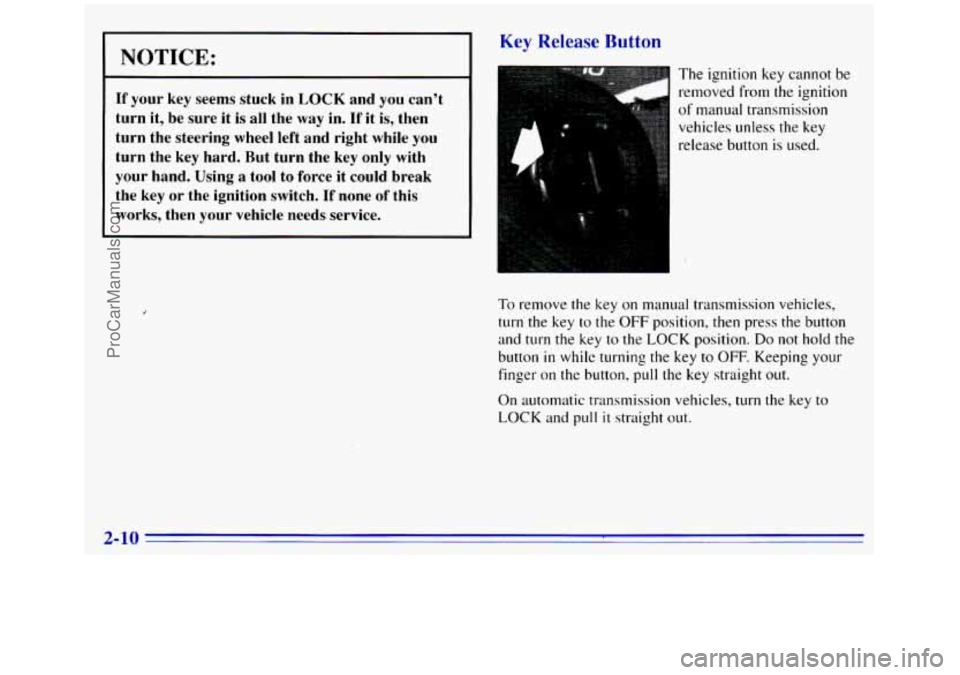
Key Release Button
The ignition key cannot be
removed from the ignition
of manual transmission
vehicles unless the key
release button
is used.
To remove the key on manual transmission vehicles,
turn the key to the
OFF position, then press the button
and
turn the key to the LOCK position. Do not hold the
button
in while turning the key to OFF. Keeping your
finger on the button,
pull the key straight out.
On automatic transmission vehicles, turn the key to
LOCK and
pull it straight out.
2-10
ProCarManuals.com
Page 73 of 404
Starting Your Gasoline Engine
If you have a diesel engine, see “Starting Your Diesel
Engine”
in the Diesel Engine Supplement.
Automatic transmission
Move your shift lever to PARK (P) or NEUTRAL (N).
Your engine won’t start in any other position -- that’s a
safety feature.
To restart when you’re already moving,
use NEUTRAL
(N) only.
NOTICE:
Don’t try to shift to PARK (P) if your vehicle is
moving.
If you do, you could damage the
transmission. Shift to
PARK (P) only when your
vehicle is stopped.
Manual transmission
The gear selector should be in NEUTRAL (N). Hold the
clutch pedal
to the floor and start the engine. Your
vehicle won’t start if the clutch pedal is not all the way
down
-- that’s a safety feature.
1. Without pushing the accelerator pedal, turn your
ignition key to START. When the engine starts,
let
go of the key. The idle speed will go down as your
engine gets warm.
NOTICE:
Holding your key in START for longer than
15 seconds at a time will cause your battery to be
drained much sooner. And the excessive heat can
damage your starter motor.
2. If it doesn’t start right away, hold your key in
START. If it doesn’t start in 10 seconds, push the
accelerator pedal
all the way down for five more
seconds, or
until it starts.
2-11
ProCarManuals.com
Page 74 of 404
3. If your engine still won’t start (or starts but then
stops), wait
15 seconds and start over.
When the engine starts, let
go of the key and the
accelerator pedal.
I NOTICE:
Your engine is designed to work with the
electronics in your vehicle.
If you add electrical
parts or accessories,
you could change the way
the engine operates. Before adding electrical
equipment, check with your dealer.
If you don’t,
your engine might not perform properly.
If you ever have to have your vehicle towed, see
the part
of this manual that tells how to do it
without damaging your vehicle. See “Towing
Your Vehicle” in the Index.
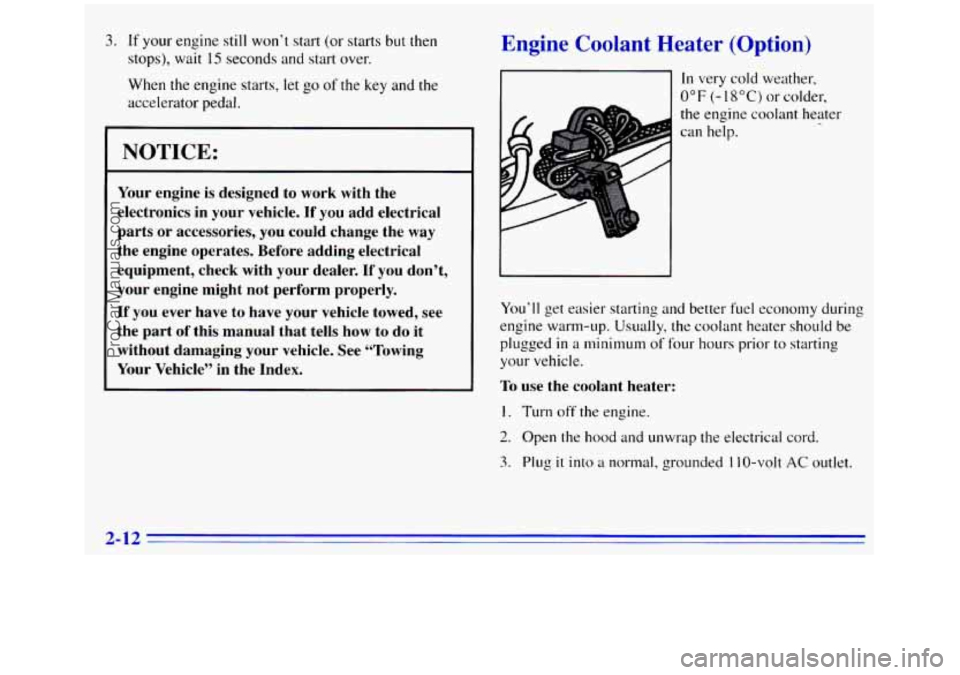
Engine Coolant Heater (Option)
-
In very cold weather,
0°F (-18°C) or colder,
the engine coolant heater
can help.
You’ll get easier starting and better fuel economy during
engine warm-up. Usually, the coolant heater
should be
pl~~gged in a minimum of four hours prior to starting
your vehicle.
To use the coolant heater:
1. Turn off the engine.
2. Open the hood and unwrap the electrical cord.
3. Plug it into a normal, grounded 110-volt AC outlet.
2-12
ProCarManuals.com
Page 75 of 404
..
Plugging the cord into an ungrounded outlet
could cause an electrical shock. Also, the wrong
kind of extension cord could overheat and cause
a fire.
You could be seriously injured. Plug the
cord into a properly grounded three-prong 110-volt
AC outlet. If the cord won't reach, use a
heavy-duty three-prong extension cord rated for
at least
15 amps.
3. After you've used the coolant heater, be sure to
store
the cord as it was before to keep it away
from moving engine parts.
If you don't. it could
be damaged.
How long should you keep the coolant heater plugged
in'? The answer depends on the outside temperature, the
kind of oil you have, and some other things. Instead of
trying to list everything here, we ask that you contact
your GM dealer in the area where you'll be parking your
vehicle. The dea1e.r can give
you the best advice for that
particular area.
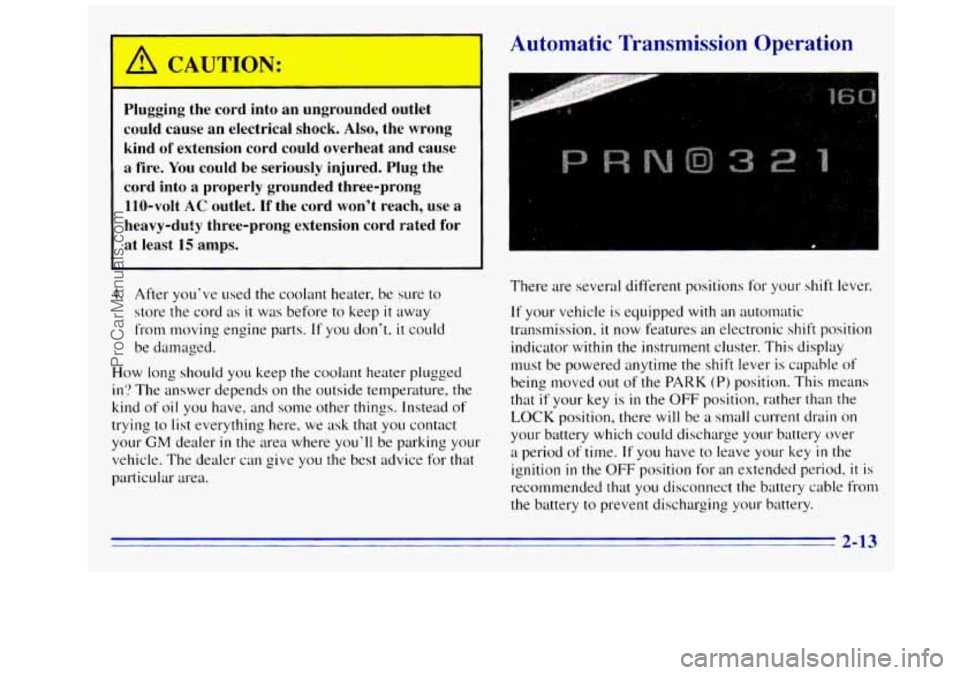
Automatic Transmission Operation
There are several different positions for your- shift lever.
If your vehicle is equipped with an automatic
transmission,
it now features an electronic shift position
indicator
within the instrument cluster. This display
must be powered anytime the shift lever is capable
of
being moved out of the PARK (P) position. This means
that
if your key is in the OFF position, rather than the
LOCK position, there will be a small current drain on
your battery which could discharge your battery over
a period of time. If you have to leave your key in the
ignition
in the OFF position for an extended period, it is
recommended that you disconnect the battery cable from
the battery
to prevent discharging your battery.
ProCarManuals.com
Page 89 of 404
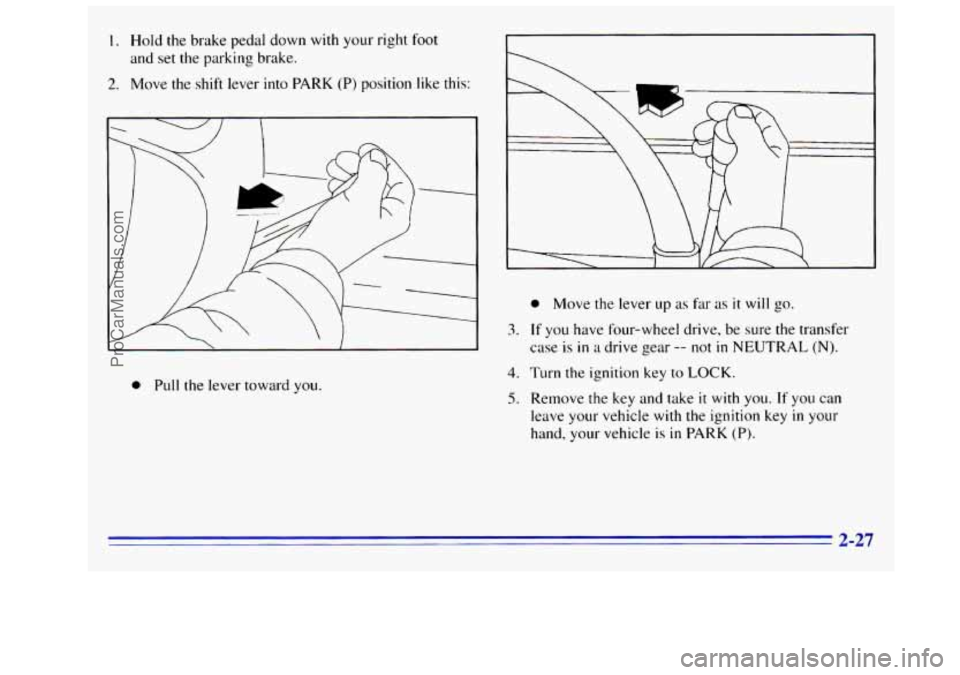
I. Hold the brake pedal down with your right foot
and set the parking brake.
2. Move the shift lever into PARK (P) position like this:
3.
0 Pull the lever toward you.
4.
5.
0 Move the lever up as fa- as it will go.
If you have four-wheel drive, be sure the transfer
case is
in a drive gear -- not in NEUTRAL (N).
Turn the ignition key to LOCK.
Remove the key and take it with you. If you can
leave your vehicle with
the ignition key in your
hand, your vehicle
is in PARK (P).
2-27
ProCarManuals.com
Page 101 of 404
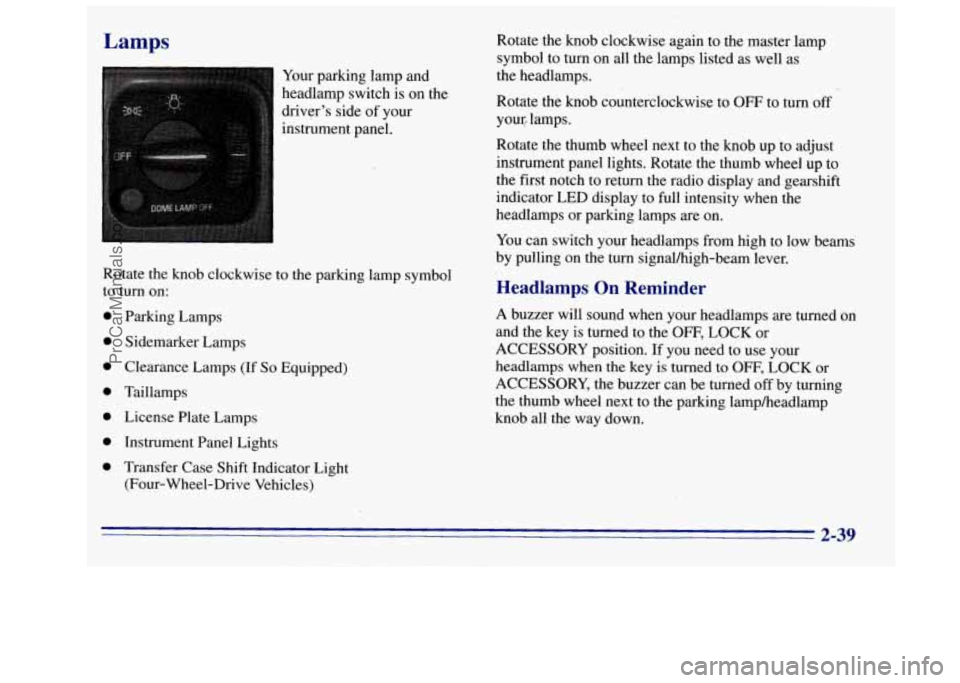
Lamps
Your parking lamp and
headlamp switch is on the
driver's side of your
instrument panel.
0
0
0
0
0
0
0
Parking Lamps
Sidemarker Lamps
Clearance Lamps
(If So Equipped)
Taillamps
License Plate Lamps Instrument Panel Lights
Transfer Case Shift Indicator Light
(Four-Wheel-Drive Vehicles) Rotate the knob clockwise again
to the master lamp
symbol to turn on all the lamps listed as well as
the headlamps.
Rotate the knob counterclockwise to
OFF to turn off
your, lamps.
Rotate the thumb wheel next
to the knob up 'to adjust
instrument panel lights. Rotate the thumb wheel up to
the first notch to return the radio display and gearshift
indicator LED display to full intensity when the
headlamps or parking lamps are on.
You can switch your headlamps from high to low beams
by pulling on the
turn signalhigh-beam lever.
Headlamps On Reminder
A buzzer will sound when your headlamps are turned on
and the key is turned to the
OFF, LOCK or
ACCESSORY position.
If you need to use your
headlamps when the key is turned to
OFF, LOCK or
ACCESSORY, the buzzer can be turned off by turning
the thumb wheel next to the parking lampheadlamp
knob all the way down.
2-39
ProCarManuals.com
Page 120 of 404
Warning Lights, Gages and Indicators
This part describes the warning lights and gages that
may be on your vehicle. The pictures will help
you
locate them.
Warning lights and gages can signal
that something is
wrong before it becomes serious enough to cause an
expensive repair or replacement. Paying attention to
your warning lights and gages could also save
you or
others from injury.
Warning lights come on when there may be
or is a
problem with one of your vehicle’s functions.
As you
will see in the details on the next few pages, some
warning lights come
on briefly when you start the
engine just
to let you know they’re working. If you are
familiar with this section, you should not be alarmed
when this happens.
Gages can indicate when there may be or is a problem
with one
of your vehicle’s functions. Often gages and
warning lights work together
to let you know when
there’s a problem with your vehicle. When
one of the warning lights comes on and stays on
when
you are driving, or when one of the gages shows
there may be a problem, check the section that
tells you
what to do about it. Please follow this manual’s advice.
Waiting to do repairs can be costly
-- and even
dangerous.
So please get to know your warning lights
and gages. They’re a big help.
Safety Belt Reminder Light
When the key is turned to RUN or START, a tone will
come on for about eight seconds to remind people
to
fasten their safety belts, unless the driver’s safety belt is
already buckled.
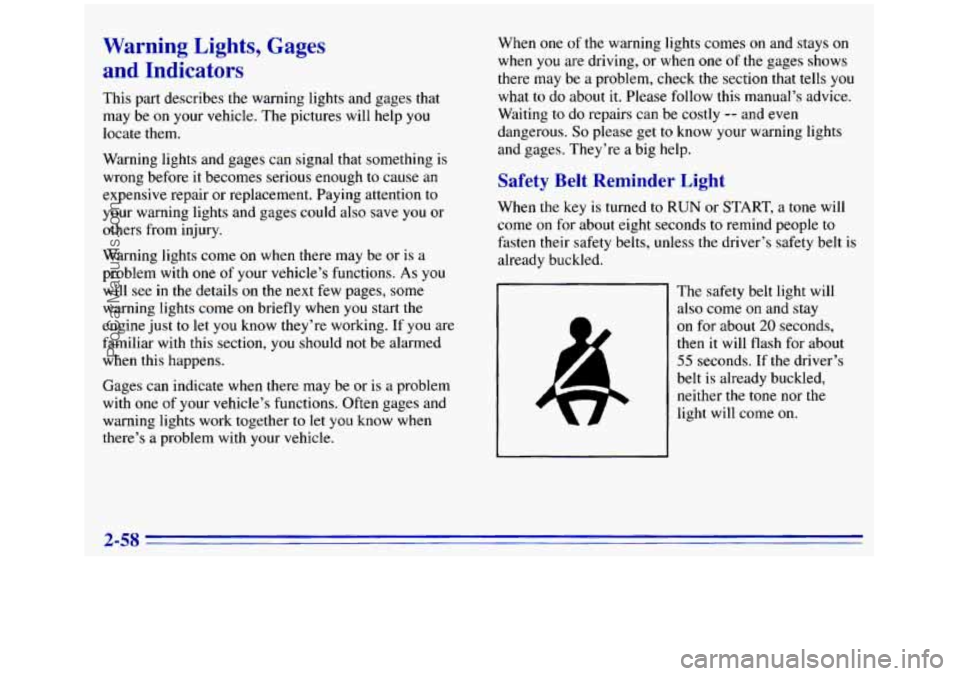
-
The safety belt light will
on for about 20 seconds,
also
come
on and stay
then
it will flash for about
belt is already buckled,
55 seconds. If the driver’s
neither the tone nor
the
light will come on.
2-58
-
ProCarManuals.com
Page 123 of 404
Brake System Warning Light r
Your vehicle’s hydraulic brake system is divided into
two
parts. If one part isn’t working, the other part can
still work and stop you. For good braking, though, you
need both parts working well.
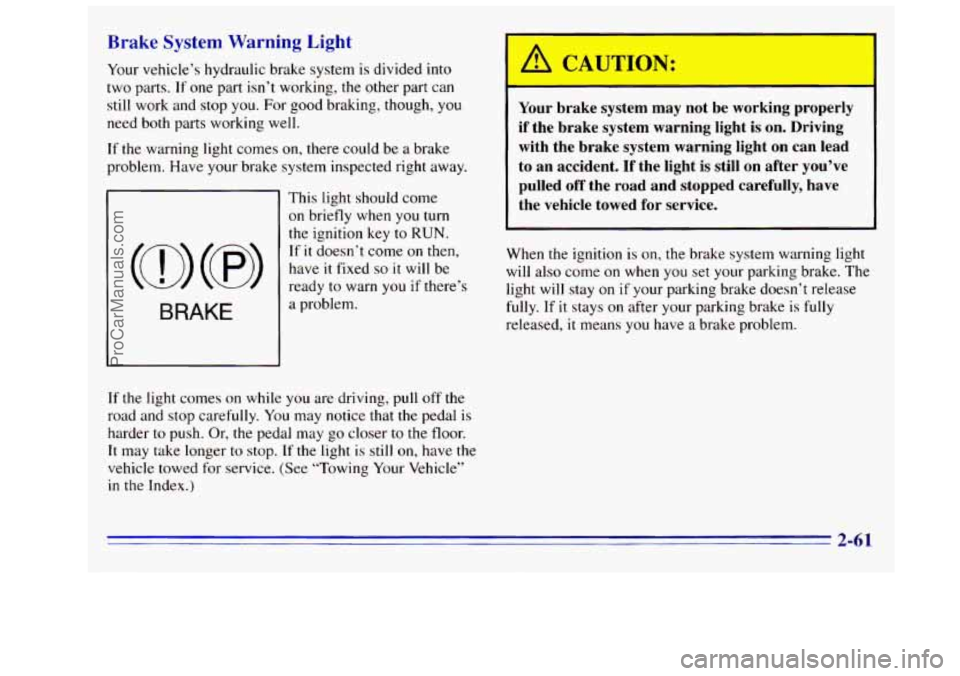
If the warning light comes on, there could be a brake
problem. Have your brake system inspected right away.
BRAKE
This light should come
on briefly when
you turn
the ignition key to
RUN.
If it doesn’t come on then,
have
it fixed so it will be
ready to
warn you if there’s
a problem.
If the light comes on while you are driving, pull off the
road and stop carefully. You may notice that the pedal is
harder to push. Or, the pedal may go closer to the floor.
It may take longer to stop. If
the light is still on, have the
vehicle towed for service. (See “Towing Your Vehicle”
in the Index.)
I! CAUTION:
Your brake system may not be working properly
if the brake system warning light is on. Driving
with the brake system warning light on can lead
to an accident. If the light
is still on after you’ve
pulled
off the road and stopped carefully, have
the vehicle towed for service.
When the ignition is on, the brake system warning light
will also come on when you set your parking brake. The
light will stay on if your parking brake doesn’t release
fully.
If it stays on after your parking brake is fully
released,
it means you have a brake problem.
2-61
ProCarManuals.com
Page 124 of 404
ANTI -
LOCK
Qnti-Lock Brake System Warning Light
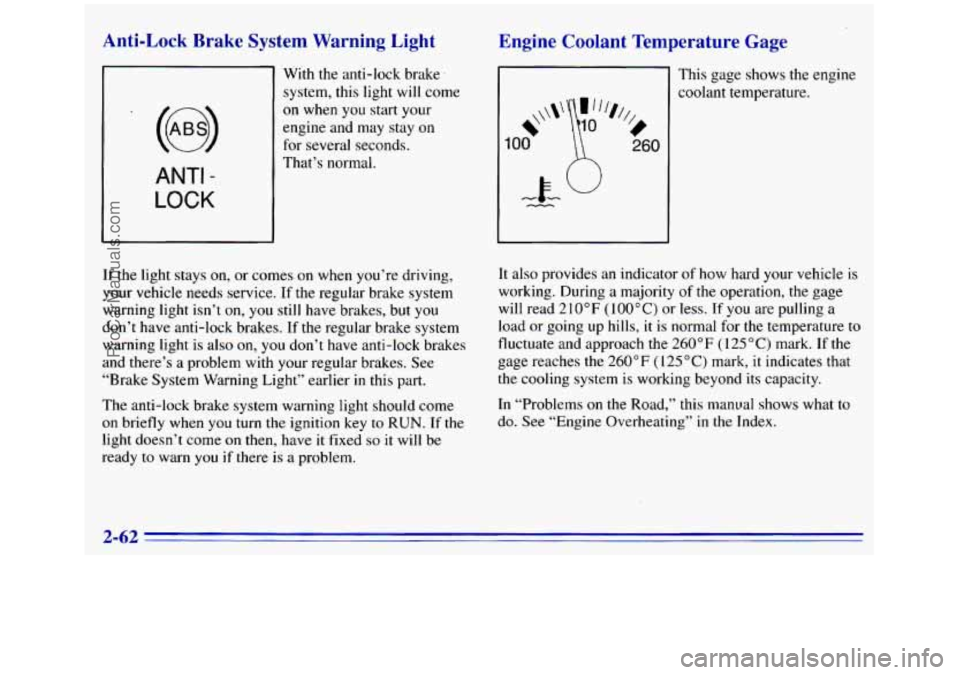
With the anti-lock brake.
system, this light will come
on when
you start your
engine and may stay on
for several seconds.
That’s normal.
If the light stays on, or comes on when you’re driving,
your vehicle needs service.
If the regular brake system
warning light isn’t on,
you still have brakes, but you
don’t have anti-lock brakes.
If the regular brake system
warning light is also on, you don’t have anti-lock brakes
and there’s
a problem with your regular brakes. See
“Brake System Warning Light” earlier
in this part.
The anti-lock brake system warning light should come
on briefly when you turn the ignition key to RUN. If the
light doesn’t come on then, have it fixed so it will be
ready to warn
you if there is a problem.
Engine Coolant Temperature Gage
I This gage shows the engine
~ coolant temperature.
It also provides an indicator of how hard your vehicle is
working. During a majority of the operation, the gage
will read 210°F
(100°C) or less. If you are pulling a
load or going up hills, it is normal for the temperature to
fluctuate and approach the 260°F ( 125 “C) mark. If the
gage reaches the 260°F
(I 25 “C) mark, it indicates that
the cooling system is working beyond its capacity.
In “Problems
on the Road,” this manual shows what to
do. See “Engine Overheating” in the Index.
2-62
ProCarManuals.com
Page 126 of 404
If the Light Is Flashing If the Light Is On Steady
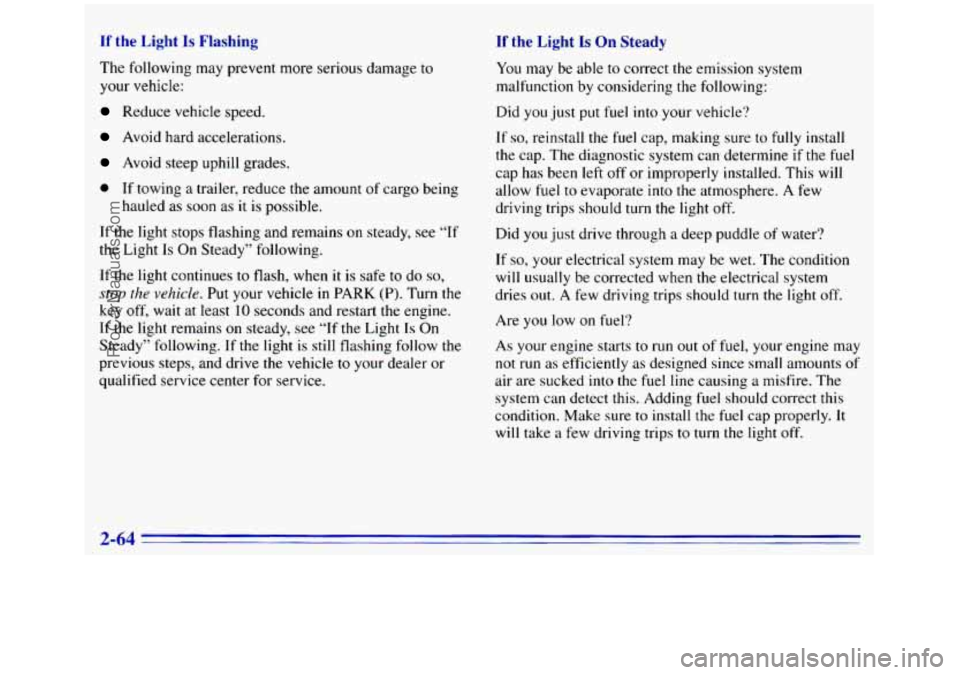
The following may prevent more serious damage to
your vehicle:
Reduce vehicle speed.
Avoid hard accelerations.
Avoid steep uphill grades.
0 If towing a trailer, reduce the amount of cargo being
hauled
as soon as it is possible.
If the light stops flashing and remains
on steady, see “If
the Light
Is On Steady” following.
If the light continues to flash, when it is safe to do so,
stop the vehicle. Put your vehicle in PARK (P). Turn the
key off, wait at least
10 seconds and restart the engine.
If the light remains
on steady, see “If the Light Is On
Steady” following.
If the light is still flashing follow the
previous steps, and drive the vehicle
to your dealer or
qualified service center for service.
You may be able to correct the emission system
malfunction by considering the following:
Did you just put fuel
into your vehicle?
If so7 reinstall the fuel cap, making sure to fully install
the cap. The diagnostic system can determine if the fuel
cap has been left off or improperly installed. This will
allow fuel to evaporate into
the atmosphere. A few
driving trips should turn the light off.
Did
you just drive through a deep puddle of water?
If so, your electrical system may be wet. The condition
will
usually be corrected when the electrical system
dries out.
A few driving trips should turn the light off.
Are you low on fuel?
As your engine starts to run out of fuel, your engine may
not run as efficiently as designed since small amounts of
air are sucked into the fuel line causing a misfire. The
system can detect this. Adding fuel should correct this
condition. Make
sure to install the fuel cap properly. it
will take a few driving trips to turn the light off.
2-64
ProCarManuals.com