parking brake GMC SIERRA 1996 Owner's Manual
[x] Cancel search | Manufacturer: GMC, Model Year: 1996, Model line: SIERRA, Model: GMC SIERRA 1996Pages: 404, PDF Size: 21.57 MB
Page 215 of 404
To engage a PTO:
1. Set the parking brake.
2. Shift the transmission into NEUTRAL (Nj.
3. Hold the clutch pedal down and engage the PTO.
NOTICE:
Using a PTO for more than four hours without
driving your vehicle can damage the transfer case
or transmission. If using a PTO for more than
four hours without driving your vehicle, drive
your vehicle for
a while to allow the transfer case
and transmission
to cool.
If you are going to drive the vehicle, shift the
transmission
into the gear you want. Then shift the
transfer case
into the range you want (if you have
four-wheel drive), apply the regular brakes and
release the parking brake.
4. Release the clutch (and the regular brakes) as you
normally would. When you release the clutch, the
PTO will start.
Using a Transfer Case Mounted Power
Take-Off
(Manual Transmission)
1. Set the parking brake,
2. Shift the transfer case into NEUTRAL (N).
3. Hold the clutch pedal down. If the vehicle will
remain
in the same place, shift the transmission into
the highest gear.
4. Engage the PTO.
If you are going to drive the vehicle, shift the
transmission into the gear
you want. Then shift the
transfer case
into the range you want, apply the
regular brakes and release the parking brake.
5. Release the clutch (and the regular brakes) as you
nor~nally would. When you release the clutch, the
PTO will start.
4-61
ProCarManuals.com
Page 216 of 404
Using a Transfer Case Mounted Power
Take-Off (Automatic Transmission)
1.
2.
3.
4.
5.
6.
Set the parking brake.
Shift the transfer case into NEUTRAL
(N).
Shift the transmission into NEUTRAL (N).
Engage the PTO.
If you are going to drive the vehicle, shift the
transfer case
into the range yo11 want. Then apply the
regular brakes and release the parking brake.
Shift the transmission to
THIRD (3) to start the PTO.
Release the regular brakes to drive the vehicle.
Step-Bumper Pad
If your vehicle has a rear step bumper, it may
be equipped with
a rear step pad at the center of
the bumper.
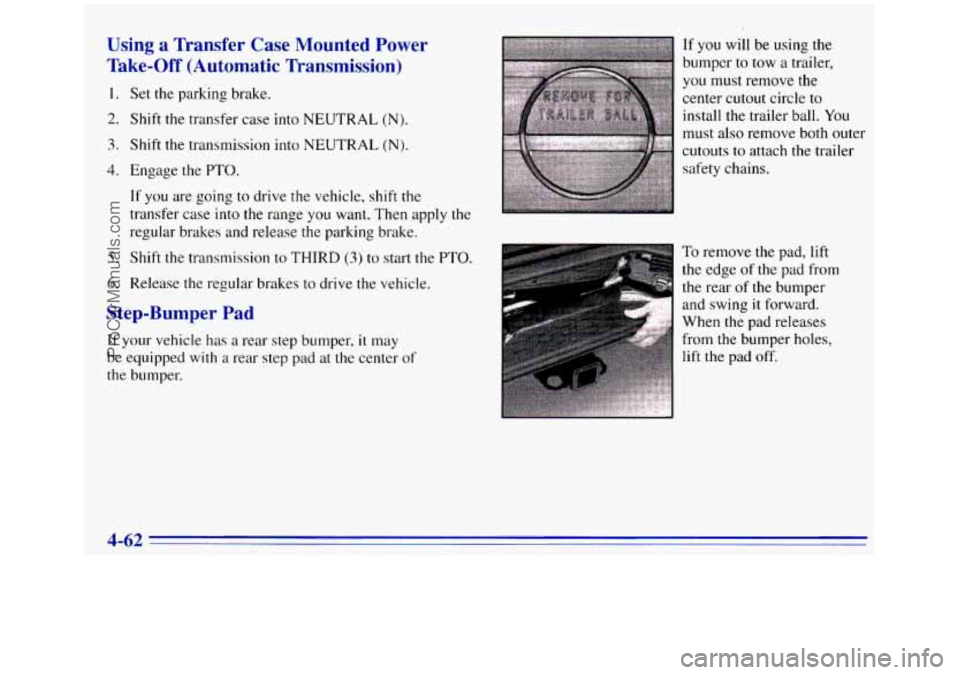
If you will be using the
bumper to
tow a trailer,
you must remove the
center cutout circle
to
install the trailer ball. You
must also remove both outer
cutouts to attach the trailer
safety chains.
To remove the pad, lift
the edge of
the pad from
the rear
of the bumper
and swing
it forward.
When
the pad releases
from
the bumper holes,
lift the pad off.
4-62
ProCarManuals.com
Page 219 of 404
2. Get the vehicles close enough so the jumper cables
can reach, but be sure the ve.hicles aren’t touching
each other.
If they are, it could cause a ground
connection you don’t want. You wouldn’t be able to
start
your vehicle, and the bad grounding could
damage the electrical systems.
To avoid the possibility
of the vehicles rolling,
set the parking brake firmly on both vehicles
involved
in the jump start procedure. Put an
automatic transmission
in PARK (P) or a manual
transmission
in NEUTRAL (N). If you have a
four-wheel-drive vehicle, be sure the transfer
case is not in NEUTRAL
(N).
3. Turn off the ignition on both vehicles. Unplug
unnecessary accessories plugged into the cigarette
lighter or accessory power outlets,
if you have this
option. Turn
off all lamps that aren’t needed as well
as radios. This will avoid sparks and help save both
batteries.
In addition, it could save your radio!
NOTICE:
I
~~~ ~
If you leave your radio on, it could be badly
damaged. The repairs wouldn’t be covered by
your warranty.
4. Open the hoods and locate the batteries. Find
the positive
(+) and negative (-) terminals 011
each battery.
A CAUTION:
If your vehicle has air conditioning, the auxiliary
electric fan under the hood can start up even
when the engine
is not running and can injure
you. Keep hands, clothing and tools
away from
any underhood electric fan.
5-3
ProCarManuals.com
Page 224 of 404
/A CAUTION:
To help avoid injury to you or others:
0
0
e
0
0
0
0
Never let passengers ride in a vehicle that is
being towed.
Never tow faster than safe
or posted speeds.
Never tow with damaged parts not
fully secured.
Never get under your vehicle after it has
been lifted by the tow truck.
Always use separate safety chains on each
side when towing a vehicle.
For pickups (except cab chassis models),
use T-hooks on front of vehicle, J-hooks
on rear.
For cab chassis models, use J-hooks on
front and rear of vehicle.
I A CAUTION:
A vehicle can fall from a car carrier if it isn’t
adequately secured. This can cause
a collision,
serious personal injury and vehicle damage. The
vehicle should be tightly secured with chains or
steel cables before it is transported.
Don’t use substitutes (ropes, leather straps,
canvas webbing, etc.) that can be cut by sharp
edges underneath the towed vehicle.
When your vehicle
is being towed, have the ignition
key in the OFF position. The steering wheel should be
clamped in a straight-ahead position,
with a clamping
device designed
for towing service. Do not use the
vehicle’s steering column lock for this. The transmission
and transfer case,
if you have one, should be in
NEUTRAL (N) and the parking brake released.
Don’t have your vehicle towed
on the drive wheels
unless
you must. If the vehicle must be towed on the
drive wheels, be sure to follow the speed and distance
restrictions later
in this section or your transmission will
be damaged.
If these limitations must be exceeded, then
the drive wheels have to be supported on
a dolly.
5-8
ProCarManuals.com
Page 237 of 404
Changing a Flat Tire
If a tire goes flat, avoid further tire and wheel damage
by driving slowly to a level place. Turn on your hazard
warning
flashers.
Changing a tire can cause an injury. The vehicle
can slip
off the jack and roll over you or other
people.
You and they could be badly injured.
Find a level place to change your tire.
To help
prevent the vehicle from moving:
1. Set the parking brake firmly.
2. Put an automatic transmission shift lever in
PARK (P) or shift a manual transmission to
FIRST (1) or REVERSE: (K).
3. If you have a four-wheel-drive vehicle,
be sure the transfer case is
in a drive
gear
-- not in NEUTRAL (N).
4. Turn off the engine.
CAUTION: (Continued)
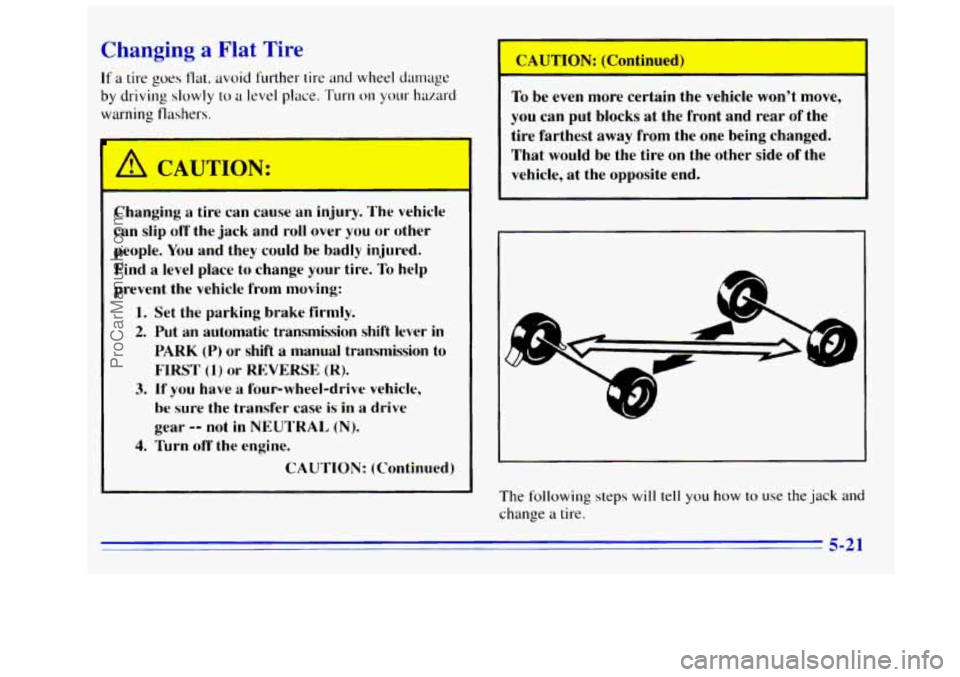
To be even more certain the vehicle won't move,
you can put blocks at the front and rear of the
tire farthest away from the one being changed.
That would be the tire on the other side of the
vehicle, at the opposite end.
The following
steps will tell you how to use the jack and
change a tire.
5-21
ProCarManuals.com
Page 270 of 404
Checking Transmission Fluid Hot
Get the vehicle warmed up by driving about 15 miles
(24 km) when outside temperatures are above 50°F
(10°C). If it's colder than 50°F (lO"C), drive the
vehicle
in DRIVE (D) until the engine temperature
gage moves and then remains steady for
10 minutes.
Then
follow the hot check procedures.
Checking Transmission Fluid Cold
A cold check is made after the vehicle has been sitting
for eight hours or more with the engine off and is used
only
as a reference. Let the engine run at idle for five
minutes
if outside temperatures are 50°F (10°C) or
more. If it's colder than 50°F (lO"C), you may have to
idle the engine longer. Should
the fluid level be low
during a cold check, you nwst perform a hot check
before adding fluid. This will give you
a more accurate
reading
of the fluid level.
Checking the Fluid Hot or Cold
0 Park your vehicle on a level place. Keep the
engine running.
With the parking brake applied, place the shift lever
in PARK (P).
-,
With your foot on the brake pedal, move the shift
lever through each gear range, pausing for about three
seconds
in each range. Then, position the shift
lever
in PARK (P).
Let the engine run at idle for three minutes or more.
Then, without shutting off the engine, follow these steps:
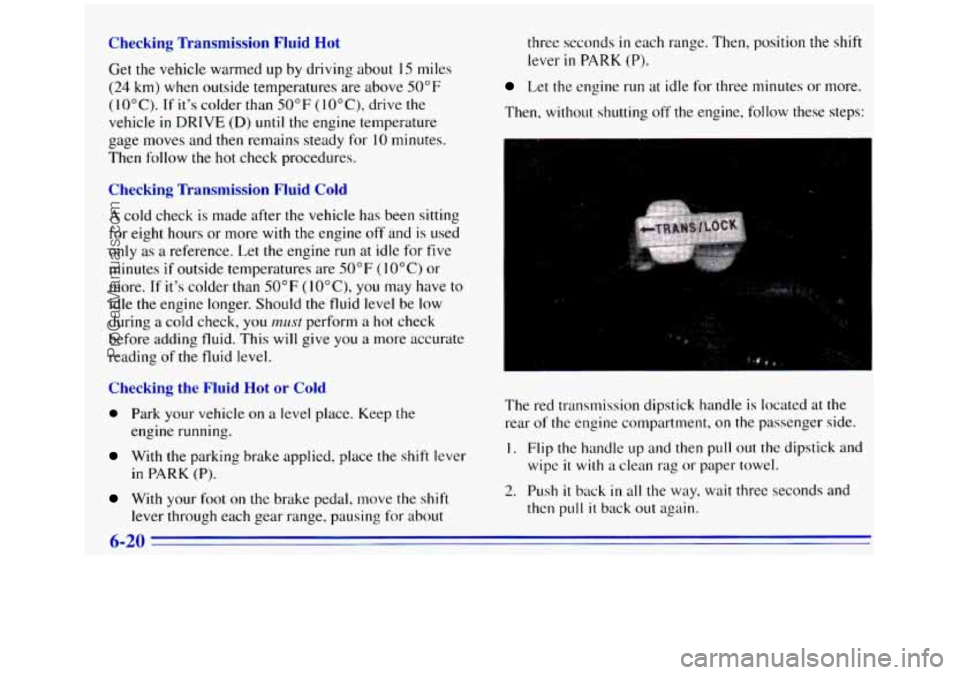
The red transmission dipstick handle
is located at the
rear
of the engine compartment, on the passenger side.
I. Flip the handle up and then pull out the dipstick and
wipe
it with a clean rag or paper towel.
2. Push it back in all the way, wait three seconds and
then pull
it back out again.
6-20
ProCarManuals.com
Page 332 of 404
Short TripKity Maintenance Schedule -- Gasoline Engines
The services shown in this schedule up to 100,000 miles
(1 66 000 km) should be performed after 100,000 miles
(166 000 km) at the same intervals.
Footnotes
T The U.S. Environmental Protection Agency or the
California Air Resources Board has determined that
the failure to perform this maintenance item will
not
nullify the emission warranty or limit recall liability
prior
to the completion of the vehicle‘s useful life.
We, however, urge that all recommended
maintenance services be performed at the indicated
intervals and the maintenance be recorded.
# Lubricate the front suspension, kingpin bushings,
steering linkage, transmission shift linkage, transfer
case shift linkage, parking brake cable guides, rear
driveline center splines, front axle propshaft splines
and brake pedal springs. Ball joints and kingpin
bushings should not be lubricated unless their
temperature is 10°F
(- 12°C) or higher, or they
could be damaged.
:f: :1:
0
0
0
e
Drive axle service:
Locking Differential
-- Drain fluid and refill at first
engine
oil change. At subsequent oil changes, check
fluid level and add fluid as needed. If driving in
dusty areas or towing a trailer, drain fluid and refill
every 15,000 miles
(25 000 km).
Standard Differential -- Check fluid level and add
fluid
as needed at every oil change. If driving in
dusty areas or towing a trailer, drain fluid and refill
every
I5,OOO miles (25 000 km).
More frequent lubrication may be required for
heavy-duty or off-road
use.
3500 HD Models with applications requiring extreme
overload/trailer towing conditions and high-speed
(above
45 mph or 70 kmh) conditions for extended
periods
of time must have the drive axle fluid changed
evey
30,000 miles (50 000 km). See “Recommended
Fluids and Lubricants’’
in this section.
7-6
ProCarManuals.com
Page 355 of 404
Long Tripmighway Maintenance Schedule -- Gasoline Engines I
The services shown in this schedule up to 100,000 miles
(1 66 000 km) should be performed after 100,000 miles
(166 000 km) at the same intervals.
Footnotes
j- The U.S. Environmental Protection Agency or the
California Air Resources Board has determined that
the failure
to perform this maintenance item will not
nullify the emission warranty or limit recall liability
prior
to the completion of the vehicle’s useful life.
We, however, urge that all recommended
maintenance services be performed at
the indicated
intervals and the maintenance be recorded.
# Lubricate the front suspension, kingpin bushings,
steering linkage, transmission shift linkage, transfer
case shift linkage, parking brake cable guides, rear
driveline center splines, front axle propshaft splines
and brake pedal springs. Ball joints and kingpin
bushings should not be lubricated unless their
temperature is
10°F (- 12°C) or higher, or they
could be damaged.
‘k‘k Drive axle service:
a
e
e
a
Locking Differential -- Drain fluid and refill at first
engine
oil change. At subsequent oil changes, check
fluid level and add fluid as needed.
If driving in
dusty areas or towing a trailer, drain fluid and refill
every 15,000 miles
(25 000.km).
Standard Differential
-- Check fluid level and add
fluid
as needed at every engine oil change. If driving
in dusty areas or towing a trailer, drain fluid and
refill every
15,000 miles (25 000 km).
More frequent lubrication may be required for
heavy-duty or off-road use.
3500 HD Models with applications requiring extreme
overloadtrailer towing conditions and high-speed
(above
45 mph or 70 kmh) conditions for extended
periods
of time must have the drive axle fluid changed
every
30,000 miles (50 000 km). See ”Recommended
Fluids and Lubricants”
in this section.
I
ProCarManuals.com
Page 370 of 404
Starter Switch Check When
you are doing this check, the vehicle could
move suddenly.
If it does, you or others could be
injured. Follow the steps below.
1.
2.
3.
Before you start, be sure you have enough room
around the vehicle.
Firmly apply both the parking brake
(see “Parking
Brake” in the Index if necessary) and the regular brake.
NOTE: Do not use the accelerator pedal, and be
ready
to turn off the engine immediately if it starts.
On automatic transmission vehicles, try
to start the
engine in each gear. The starter should work only in
PARK (P) or NEUTRAL (N). If the starter works in
any other position, your vehicle needs service.
On manual transmission vehicles, put the shift lever
in NEUTRAL (N), push.the clutch down halfway
and
try to start the engine. The starter should work
only when the clutch is pushed down
all the way to
the floor.
If the starter works when the clutch isn’t
pushed all the way down, your vehicle needs service.
Brake-Transmission Shift Interlock (BTSI)
Check (Automatic Transmission)
I A CAUTION:
When you are doing this check, the vehicle could
move suddenly.
If it does, you or others could be
injured. Follow the steps below.
1.
2.
3.
Before you start, be sure you have enough
room around the vehicle. It should be parked
on
a level surface.
Firmly apply the parking brake (see “Parking Brake”
in the Index if necessary).
NOTE: Be ready to
apply the regular brake
immediately
if the vehicle begins to move.
With the engine off,
turn the key to the RUN
position, but don’t start the engine. Without applying
the regular brake, try
to move the shift lever out of
PARK (P) with normal effort. If the shift lever moves
out of PARK
(P), your vehicle’s BTSI needs service.
7-44
ProCarManuals.com
Page 371 of 404
Steering Column Lock Check
While parked, and with
the parking brake set, try to turn
the key
to LOCK in each shift lever position.
With an automatic transmission, the key should turn
With a manual transmission, the key should turn
to LOCK only when the shift lever is in PARK (P).
to LOCK only when the shift lever is in
REVERSE
(R).
On vehicles with a key release button, try to turn the key
to LOCK without pressing the button. The key should
turn to LOCK
only when you press the key button.
On all vehicles, the key should come out
only in LOCK. Parking Brake and Automatic Transmission
PARK
(P) Mechanism Check
I CAUTION:
When
you are doing this check, your vehicle
could begin to move.
You or others could be
injured and property could be damaged.
Make
sure there is room in front of your vehicle in case
it begins to roll. Be ready to apply the regular
brake at once should the vehicle begin to move.
Park
on a fairly steep hill, with the vehicle facing
downhill. Keeping your foot
on the regular brake, set
the parking brake.
0 To check the parking brake: With the engine running
and transmission in NEUTRAL
(N), slowly remove
foot pressure from the regular brake pedal.
Do this
until the vehicle
is held by the parking brake only.
To check the PARK (P) mechanism’s holding ability:
With the engine running, shift
to PARK (P). Then
release all brakes.
7-45
--- -
ProCarManuals.com