service GMC SIERRA 1996 Service Manual
[x] Cancel search | Manufacturer: GMC, Model Year: 1996, Model line: SIERRA, Model: GMC SIERRA 1996Pages: 404, PDF Size: 21.57 MB
Page 285 of 404
NOTICE:
0
0
Using the wrong fluid can badly damage
brake system parts. For example,.just a few
drops of mineral-based oil, such
as engine
oil,
in your brake system can damage brake
system parts
so badly that they’ll have to be
replaced. Don’t let someone put in the
wrong kind of fluid.
If you spill brake fluid on your vehicle’s
painted surfaces, the paint finish can be
damaged. Be careful not to spill brake
fluid on your vehicle.
If you do, wash it
off immediately. See &‘Appearance Care”
in
the Index.
Brake Wear
If you have a C 3500 HD model, it has four-wheel
disc brakes.
Disc brake pads have built-in wear indicators that
make a high-pitched warning sound when the brake
pads are worn and
new pads are needed. The sound
may come and
go or be heard all the time your vehicle
is moving (except when you are pushing on the brake
pedal firmly).
A’ CAUTION:
I
The brake wear warning sound means that
sooner or later your brakes won’t work well.
That could lead to an accident. When you hear
the brake wear warning sound, have your vehicle serviced.
6-35
ProCarManuals.com
Page 298 of 404
Tires
We don’t make tires. Your new vehicle comes with
high-quality tires made by a leading tire manufacturer.
If you ever have questions about your tire warranty and
where
to obtain service, see your GM Warranty bookJet
for details. Poorly maintained and improperly used tires
are dangerous.
0
0
0 0
Overloading your tires can cause overheating
as a result of too much friction. You could
have an airout and a serious accident. See
“Loading Your Vehicle”
m the Index.
Underinflated tires pose the same danger as
overloaded tires. The resulting accident
could cause serious injury. Check all tires
frequently to maintain the recommended pressure. Tire pressure should be checked
when your tires are cold.
Overinflated tires are more likely to
be
cut, punctured or broken by a sudden
impact
-- such as when you hit a pothole.
Keep tires at the recommended pressure.
Worn, old tires can cause accidents.
If your
tread is badly worn, or if your tires have
been damaged, replace them.
ProCarManuals.com
Page 300 of 404
How to Check
Use a good quality pocket-type gage to check tire
pressure.
You can’t tell if your tires are properly inflated
simply by looking at them. Radial tires may
look
properly inflated even when they’re underinflated.
Be sure
to put the valve caps back on the valve
stems. They help prevent leaks
by keeping out dirt
.and moisture.
Tire Inspection and Rotation
Tires should be inspected every 6,000 to 8,000 miles
(10 000 to 13 000 km) for any signs of unusual wear. If
unusual wear
is present, rotate your tires as soon as
possible and check wheel alignment. Also check for
damaged tires or wheels. See “When It’s Time for New
Tires” and ‘‘Wheel Replacement” later
in this section for
more information.
If your vehicle has dual rear wheels,
also see “Dual ‘Tire Operation” later
in this section.
I
FRT FRT
I
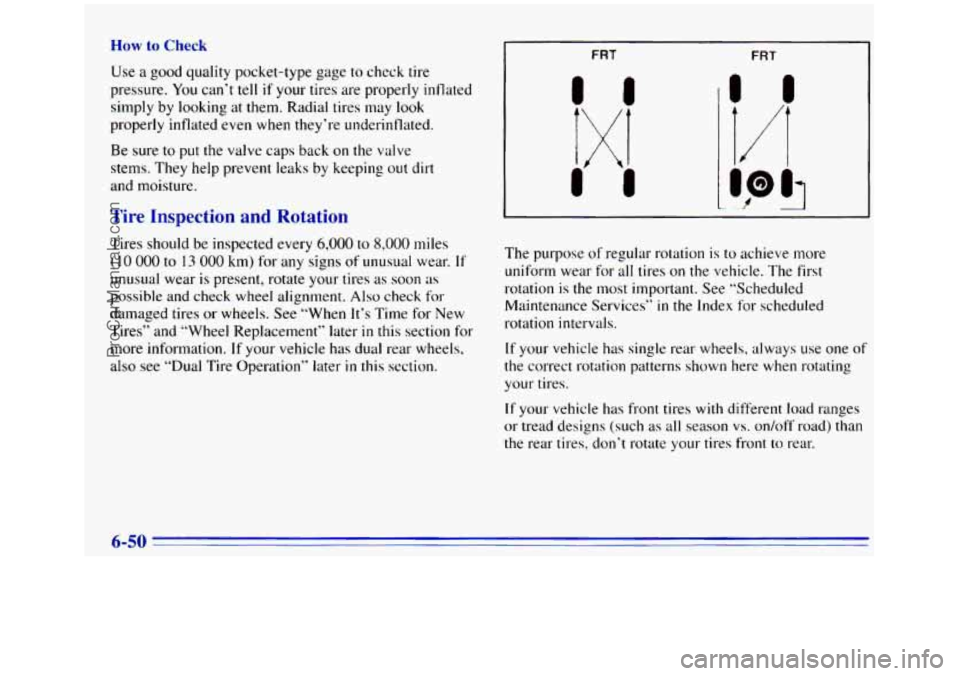
The purpose of regular rotation is to achieve more
uniform wear for all tires on the vehicle. The first
rotation
is the most important. See “Scheduled
Maintenance Services”
in the Index for scheduled
rotation intervals.
If
your vehicle has single rear wheels, always use one of
the correct rotation patterns
shown here when rotating
your tires.
If your vehicle has front [Ires with different load ranges
or tread designs (such as all season vs. on/off road) than
the rear tires, don’t rotate your tires front to rear.
6-50
ProCarManuals.com
Page 303 of 404
Dual Tire Operation
When the vehicle is new, or whenever a wheel, wheel
bolt or wheel nut is replaced, check the wheel nut torque
after
100, 1,000 and 6,000 miles ( 160, I 600 and IO 000
km) of driving. For proper torque, see "Wheel Nut
Torque" in the Index.
The outer tire on a dual wheel setup generally wears
faster than the inner tire. Your tires will wear more
evenly and last longer
if you rotate the tires periodically.
If you're going to be doing a lot of driving on
high-crown roads,
you can reduce tire wear by adding
5 psi (35 kPa) to the tire pressure in the outer tires. Be
sure to return to the recommended pressures when no
longer driving under those conditions. See "Changing
a
Flat Tire" in the Index for more information.
A CAUTION:
I
If you operate your vehicle with a tire that is
badly underinflated, the tire can overheat. An
overheated tire can lose air suddenly or catch fire.
You or others could be injured. Be sure
all tires
(including the spare, if any) are properly inflated.
Buying New Tires
To find out what kind and size of tires you need, look at
the Certificntion/Tire label.
Tlze tires installed
on your vehicle when it was new had
a Tire Performance Criteria Specification (TPC Spec)
number
on each tire's sidewall. When you get new tires,
get ones
with that same TPC Spec number. That way
your vehicle
will continue to have tires that are designed
to give proper endurance, handling, speed rating,
traction, ride and other things during normal service
on
your vehicle. If your tires have an all-season tread
design,
the TPC number will be followed by an "MS"
(for mud and snow).
If you ever replace your tires with those not having a
TPC
Spec number, make sure they are the same size,
load range, speed rating and construction type
(bias,
bias-belted or radial) as your original tires.
6-53
ProCarManuals.com
Page 304 of 404
-
A CAUTION:
Mixing tires could cause you to lose control while
driving.
If you mix tires of different sizes or types
(radial and bias-belted tires), the vehicle may not
handle properly, and you could have a crash.
Using tires of different sizes may also cause
damage to your vehicle.
Be sure to use the same
size and type tires on all wheels.
Uniform Tire Quality Grading
The following information relates to the system
developed by the United States National Highway
Traffic Safety Administration, which grades tires
by
treadwear, traction and temperature performance.
(This applies only to vehicles sold in the United States.)
The grades are molded on the sidewalls of most
passenger car tires. The Uniform Tire Quality Grading
system does
not apply to deep tread, winter-type snow
tires, space-saver or temporary
use spare tires, tires with
nominal rim diameters
of IO to 12 inches (25 to 30 cm),
or to some limited-production tires. While
the tires available on General Motors passenger
cars and light trucks may vary with respect to these
grades,
they must also conform to Federal safety
requirements and additional General Motors Tire
Performance Criteria (TPC) standards.
Treadwear
The treadwear grade is a comparative rating based on
the wear rate of the tire when tested under controlled
conditions on
a specified government test course. For
example. a tire graded 150 would wear one and a half
(1 1/2) times as well on the government course as a tire
upon the actual conditions of their use, however, and
may depart significantly from
the norm due to variations
in driving habits, service practices and differences in
road characteristics and climate.
E at-aded 100. The relative performance of tires depends
Traction -- A, B, C
The traction grades, from highest to lowest, are A, B, and
C, and they represent
the tire’s ability to stop on wet
pavement as measured under controlled conditions on
specified government test surfaces
of asphalt and concrete.
A tire marked C may have poor traction performance.
Warning: The traction grade assigned
to this, tire is based
on braking (straightahead) traction tests and does not
include cornering (turning) traction.
6-54
ProCarManuals.com
Page 314 of 404
Aluminum or Chrome Wheels
(If So Equipped)
Keep your wheels clean using a soft clean cloth with
mild soap and water. Rinse with clean water. After
rinsing thoroughly, dry with a soft clean towel. A wax
may then be applied.
The surface of these wheels is similar to the painted
surface
of your vehicle. Don’t use strong soaps,
chemicals, abrasive polishes, abrasive cleaners or
abrasive cleaning brushes
on them because you could
damage
the surface. You may use chrome polish on
chrome wheels, but avoid any painted surface
of the
wheel, and buff
off immediately after application.
Don’t take your vehicle through an automatic
vehicle wash that. has silicon carbide
tire cleaning
brushes. These brushes can also damage
the surface
of these wheels.
Tires
To clean your tires, use a stiff brush with a tire cleaner.
NOTICE:
When applying a tire dressing always take care to
wipe
off any overspray or splash from all painted
surfaces on the body
or wheels of the vehicle.
Petroleum-based products may damage the paint
finish.
Sheet Metal Damage
If your vehicle is damaged and requires sheet metal
repair or replacement, make sure the body repair shop
applies anti-corrosion material
to the parts repaired or
replaced
to restore corrosion protection.
Finish Damage
Any stone chips, fractures or deep scratches in the finish
should be repaired right away. Bare metal will corrode
quickly and may develop into
a major repair expense.
Minor chips and scratches can be repaired with touch-up
materials available from
your dealer or other service
outlets. Larger areas
of finish damage can be corrected
in your dealer’s body and paint shop.
6-64 .~
ProCarManuals.com
Page 317 of 404
Vehicle Identification Number (VIN)
ENGlNEA996 7 - ASSEMBLY
CODE MODEL YEAR PLANT
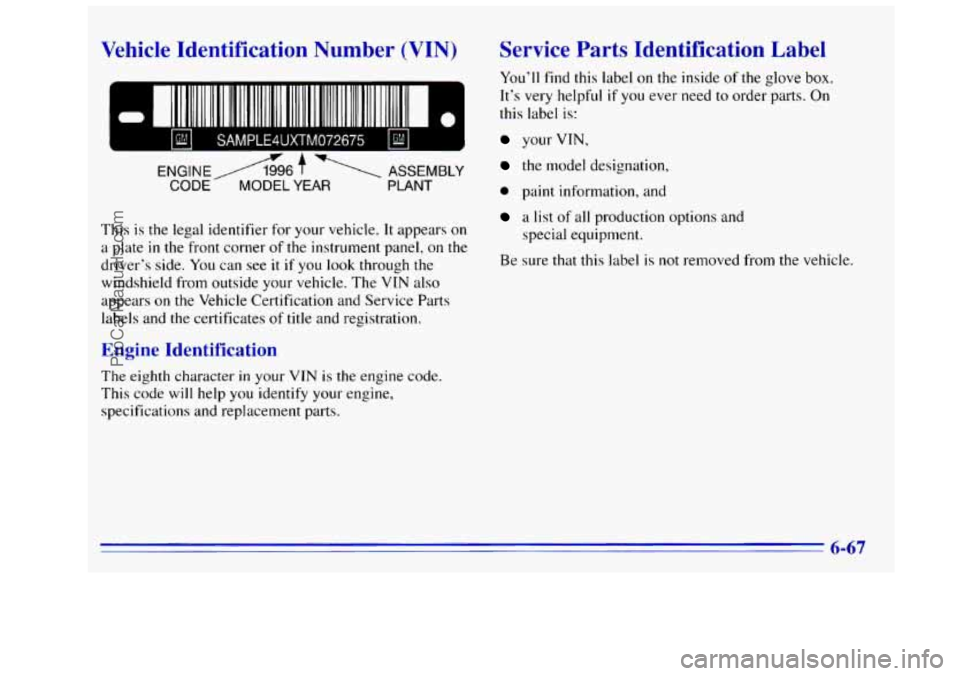
This is the legal identifier for your vehicle. It appears on
a plate in the front corner of the instrument panel, on the
driver’s side.
You can see it if you look through the
windshield from outside your vehicle. The
VIN also
appears on the Vehicle Certification and Service Parts
labels and
the certificates of title and registration.
Engine Identification
The eighth character in your VIN is the engine code.
This code will help
you identify your engine,
specifications and replacement parts.
Service Parts Identification Label
You’ll find this label on the inside of the glove box.
It’s very helpful if you ever need to order parts. On
this label
is:
your VIN,
the model designation,
0 paint information, and
a list of all production options and
special equipment.
Be sure that this label
is not removed from the vehicle.
6-67
ProCarManuals.com
Page 325 of 404
Wheels and Tires
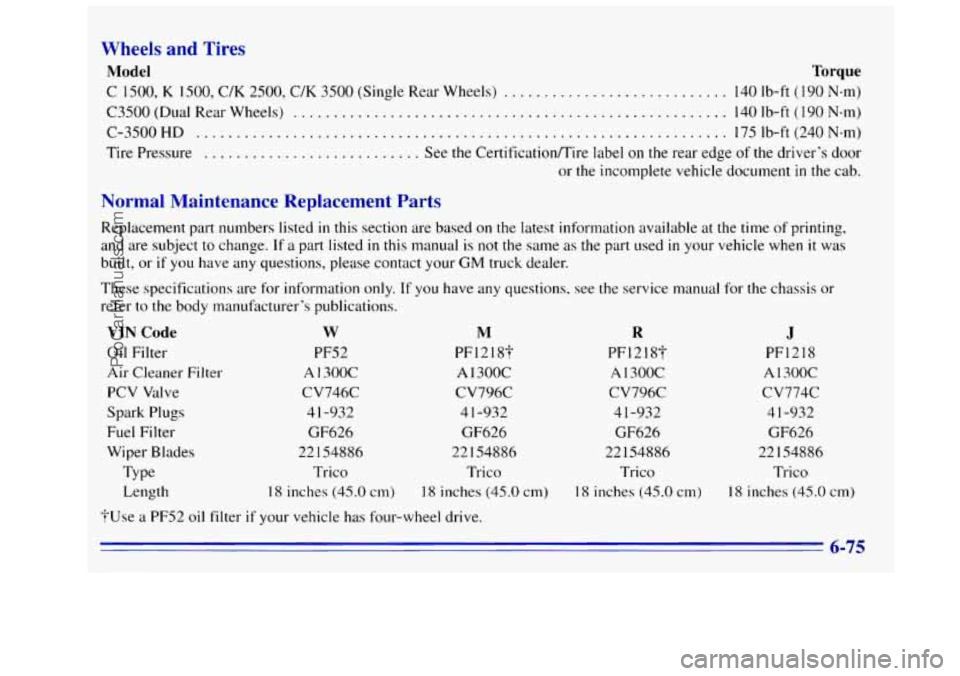
Model Torque
C 1500, K 1500, C/K 2500, C/K 3500 (Single Rear Wheels) ............................ 140 Ib-ft (190 N-m)
C3500 (Dual
Rear Wheels) ...................................................... 140 Ib-ft (190 N-m)
Tire Pressure ........................... See the Certificationflire label on the rear edge of the driver's door
or the incomplete vehicle document in the cab.
C-3500HD
.................................................................. 175Ib-ft(240N-m)
Normal Maintenance Replacement Parts
Replacement part numbers listed in this section
are based on the latest information available at the time of printing,
and are subject to change.
If a part listed in this manual is not the same as the part used in your vehicle when it was
built, or
if you have any questions, please contact your GM truck dealer.
These specifications are
for information only. If you have any questions. see the service manual for the chassis or
refer
to the body manufacturer's publications.
VIN Code w M
Oil Filter PF52
PF1218T
Air
Cleaner Filter A 1300C A 1300C
PCV Valve CV746C CV796C
Spark Plugs 4 1-932 4 1-932
Fuel Filter GF626
GF626
Wiper Blades 22 154886 221 54886
Type Trico Trico
Length
18 inches (45.0 cm) 18 inches (45.0 cm)
?Use a PF52 oil filter if your vehicle has four-wheel drive.
R
PF1218T
A 130OC
CV796C
4 1-932
GF626
22 154886
Trico
18 inches (45.0 cm)
J
PF1218
A
1300C
cv774c
41 -932
GF626
22 154886
Trico
18 inches (45.0 cm)
6-75
ProCarManuals.com
Page 327 of 404
Section 7 Maintenance Schedule
I IMPORTANT: I
KEEP ENGINE OIL
AT THE PROPER
LEVEL AND CHANGE AS
RECOMMENDED
This section covers the maintenance required for your
vehicle. Your vehicle needs these services to retain its
safety, depe.ndability and emission control performance.
7- 1
Protection
Plan
Introduction
Your Vehicle and the Environment
Proper vehicle maintenance not only helps to keep your
vehicle
in good working condition. but also helps the
environment.
All 1-ecommended maintenance procedures
are important. Improper vehicle maintenance can even affect the quality of the air we breathe. Improper fluid
levels or the wrong
tire inflation can increase the level
of emissions fr6m your vehicle. To help protect our
environlnent, and to keep your vehicle in good
condition, please maintain your vehicle properly.
ProCarManuals.com
Page 328 of 404
How This Section is Organized
The remainder of this section is divided into five parts:
“Part A: Scheduled Maintenance Services’’ shows
what to
have done and how often. Some of these
services can be complex, so unless you are technically
qualified and have
the necessary equipment, you should
let
your dealer’s service department or another qualified
service center do these jobs.
Performing ma~ntenance worK on a vehicle can
be dangerous. In trying to do
some jobs, you can
be seriously injured.
Do your own maintenance
work only
if you have the required know-how
and the proper tools and equipment for the
job.
If you have any doubt, have a qualified technician do the work.
If you are skilled enough to do some work on your
vehicle, you will probably want to get the service
information
GM publishes. See “Service and Owner
Publications”
in the Index.
“Part B: Owner Checks and Services” tells you
what should be checked whenever you stop for fuel.
It
also explains what you can easily do to help keep your
vehicle
in good condition.
“Part C: Periodic Maintenance Inspections”
explains important inspections that your GM dealer’s
service department
or another qualified service center
should perform.
“Part D: Recommended Fluids and Lubricants”
lists some products GM recommends to help keep your
vehicle properly maintained. These products, or their
equivalents, should be used whether you do the work
yourself or have
it done.
“Part E: Maintenance Record” provides a place
for you to record the maintenance performed
on your
vehicle. Whenever any maintenance
is perf‘ormed, be
sure to write
it down in this part. This will help you
determine when your
next maintenance should be done.
In addition, it is a good idea to keep your maintenance
receipts. They may
be needed to qualify your vehicle for
warranty repairs.
7-2
ProCarManuals.com