service GMC SIERRA 1996 User Guide
[x] Cancel search | Manufacturer: GMC, Model Year: 1996, Model line: SIERRA, Model: GMC SIERRA 1996Pages: 404, PDF Size: 21.57 MB
Page 123 of 404
Brake System Warning Light r
Your vehicle’s hydraulic brake system is divided into
two
parts. If one part isn’t working, the other part can
still work and stop you. For good braking, though, you
need both parts working well.
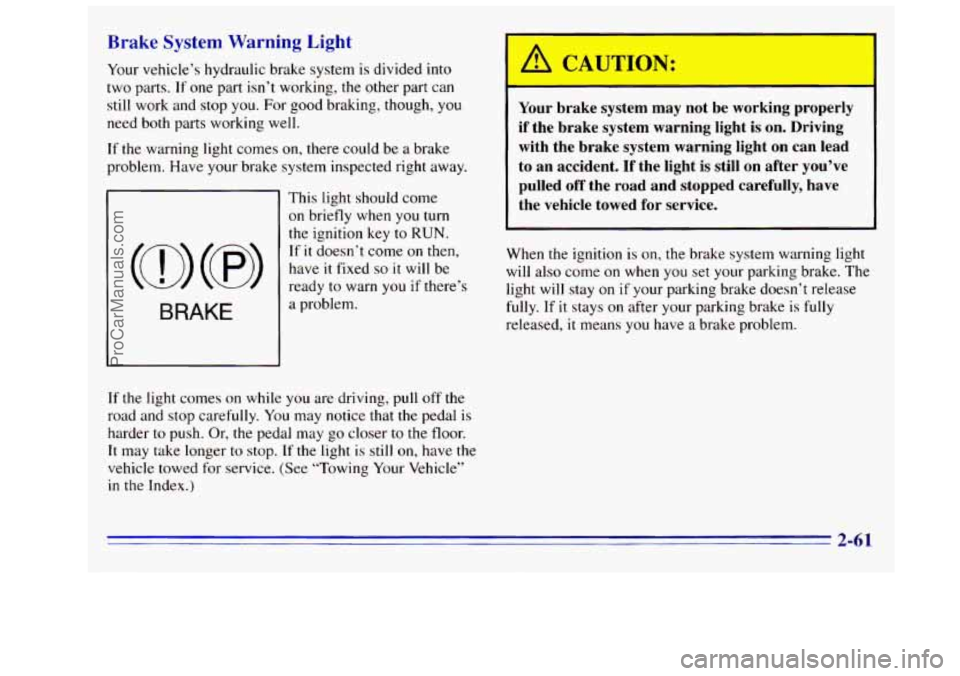
If the warning light comes on, there could be a brake
problem. Have your brake system inspected right away.
BRAKE
This light should come
on briefly when
you turn
the ignition key to
RUN.
If it doesn’t come on then,
have
it fixed so it will be
ready to
warn you if there’s
a problem.
If the light comes on while you are driving, pull off the
road and stop carefully. You may notice that the pedal is
harder to push. Or, the pedal may go closer to the floor.
It may take longer to stop. If
the light is still on, have the
vehicle towed for service. (See “Towing Your Vehicle”
in the Index.)
I! CAUTION:
Your brake system may not be working properly
if the brake system warning light is on. Driving
with the brake system warning light on can lead
to an accident. If the light
is still on after you’ve
pulled
off the road and stopped carefully, have
the vehicle towed for service.
When the ignition is on, the brake system warning light
will also come on when you set your parking brake. The
light will stay on if your parking brake doesn’t release
fully.
If it stays on after your parking brake is fully
released,
it means you have a brake problem.
2-61
ProCarManuals.com
Page 124 of 404
ANTI -
LOCK
Qnti-Lock Brake System Warning Light
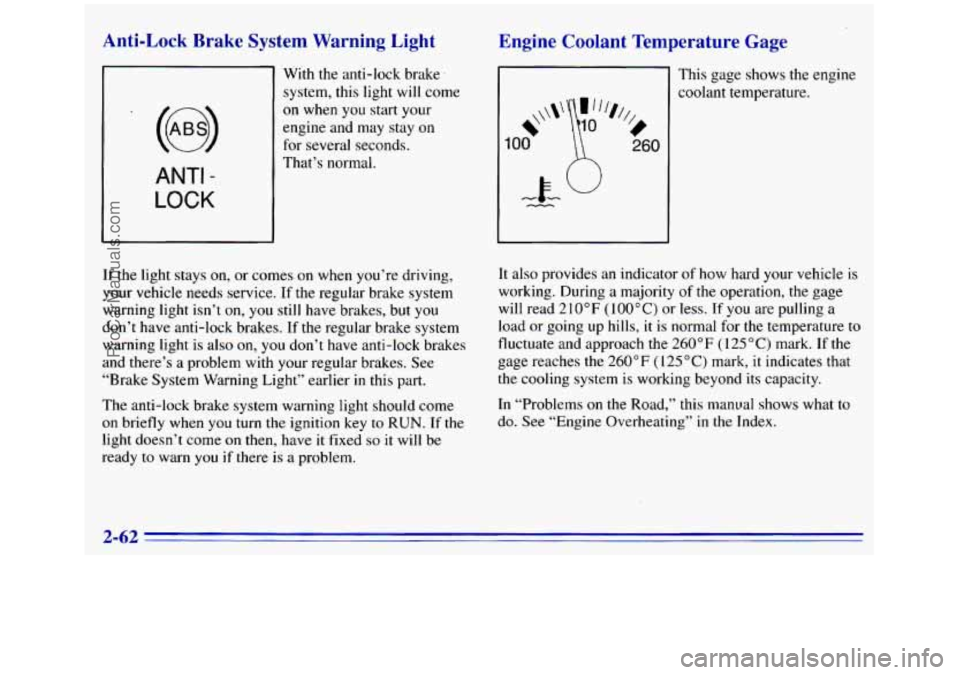
With the anti-lock brake.
system, this light will come
on when
you start your
engine and may stay on
for several seconds.
That’s normal.
If the light stays on, or comes on when you’re driving,
your vehicle needs service.
If the regular brake system
warning light isn’t on,
you still have brakes, but you
don’t have anti-lock brakes.
If the regular brake system
warning light is also on, you don’t have anti-lock brakes
and there’s
a problem with your regular brakes. See
“Brake System Warning Light” earlier
in this part.
The anti-lock brake system warning light should come
on briefly when you turn the ignition key to RUN. If the
light doesn’t come on then, have it fixed so it will be
ready to warn
you if there is a problem.
Engine Coolant Temperature Gage
I This gage shows the engine
~ coolant temperature.
It also provides an indicator of how hard your vehicle is
working. During a majority of the operation, the gage
will read 210°F
(100°C) or less. If you are pulling a
load or going up hills, it is normal for the temperature to
fluctuate and approach the 260°F ( 125 “C) mark. If the
gage reaches the 260°F
(I 25 “C) mark, it indicates that
the cooling system is working beyond its capacity.
In “Problems
on the Road,” this manual shows what to
do. See “Engine Overheating” in the Index.
2-62
ProCarManuals.com
Page 125 of 404
Malfunction Indicator Lamp (Service
- ;ine Soon Light) (Gasoline Engine)
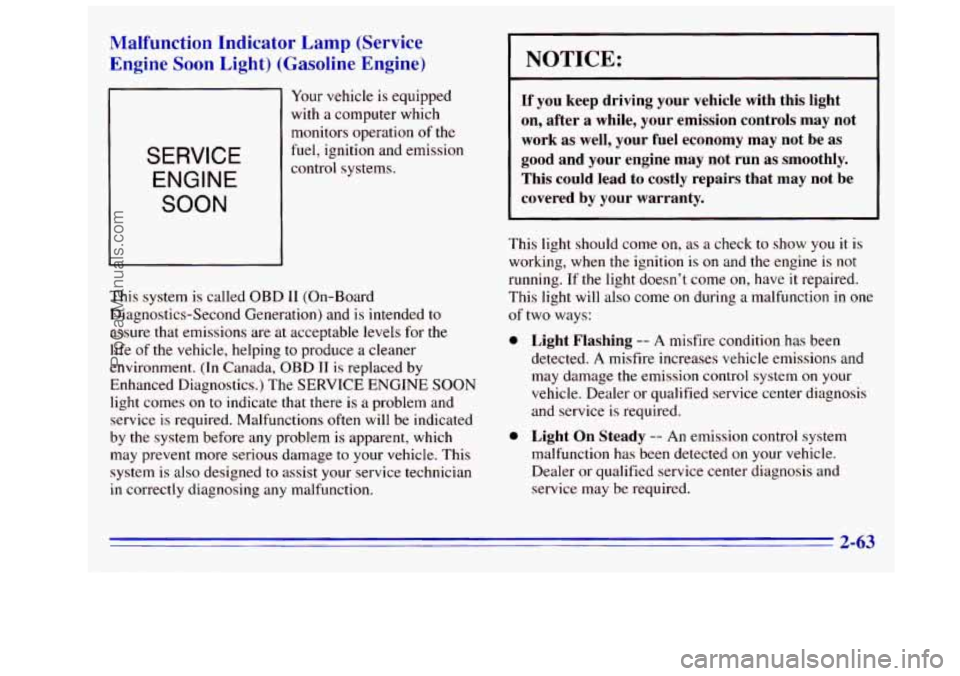
Your vehicle is equipped
with a computer which
monitors operation
of the
fuel, ignition and emission SERVICE
ENGINE
SOON
control systems.
This system
is called OBD I1 (On-Board
Diagnostics-Second Generation) and is intended to
assure that emissions are at acceptable levels for the
life of the vehicle, helping to produce a cleaner
environment. (In Canada,
OBD TI is replaced by
Enhanced Diagnostics.) The
SERVICE ENGINE SOON
light comes on to indicate that there is a problem and
service
is required. Malfunctions often will be indicated
by the system before any problem
is apparent, which
may prevent more serious damage to your vehicle. This
system is
also designed to assist your service technician
in correctly diagnosing any malfunction.
I NOTICE:
If you keep driving your vehicle with this light
on, after a while, your emission controls may not
work as well, your fuel economy may not be as
good and your engine may not run as smoothly.
This could lead
to costly repairs that may not be
covered by your warranty.
This light should come on, as a check to show you it is
working, when the ignition is
on and the engine is not
running.
If the light doesn’t come on, have it repaired.
This light will also come
on during a malfunction in one
of two ways:
0 Light Flashing -- A misfire condition has been
detected.
A misfire increases vehicle emissions and
may damage
the emission control system on your
vehicle. Dealer or qualified service center diagnosis
and service
is required.
0 Light On Steady -- An emission control system
malfunction has been detected on your vehicle.
Dealer or qualified service center diagnosis and
service may be required.
2-63
ProCarManuals.com
Page 126 of 404
If the Light Is Flashing If the Light Is On Steady
The following may prevent more serious damage to
your vehicle:
Reduce vehicle speed.
Avoid hard accelerations.
Avoid steep uphill grades.
0 If towing a trailer, reduce the amount of cargo being
hauled
as soon as it is possible.
If the light stops flashing and remains
on steady, see “If
the Light
Is On Steady” following.
If the light continues to flash, when it is safe to do so,
stop the vehicle. Put your vehicle in PARK (P). Turn the
key off, wait at least
10 seconds and restart the engine.
If the light remains
on steady, see “If the Light Is On
Steady” following.
If the light is still flashing follow the
previous steps, and drive the vehicle
to your dealer or
qualified service center for service.
You may be able to correct the emission system
malfunction by considering the following:
Did you just put fuel
into your vehicle?
If so7 reinstall the fuel cap, making sure to fully install
the cap. The diagnostic system can determine if the fuel
cap has been left off or improperly installed. This will
allow fuel to evaporate into
the atmosphere. A few
driving trips should turn the light off.
Did
you just drive through a deep puddle of water?
If so, your electrical system may be wet. The condition
will
usually be corrected when the electrical system
dries out.
A few driving trips should turn the light off.
Are you low on fuel?
As your engine starts to run out of fuel, your engine may
not run as efficiently as designed since small amounts of
air are sucked into the fuel line causing a misfire. The
system can detect this. Adding fuel should correct this
condition. Make
sure to install the fuel cap properly. it
will take a few driving trips to turn the light off.
2-64
ProCarManuals.com
Page 127 of 404
Have you recently changed brands of fuel?
If
so, be sure to fuel your vehicle with quality fuel (see
"Fuel" in the Index). Poor fuel quality will cause your
engine
not to run as efficiently as designed. You may
notice this
as stalling after start-up, stalling when you
put the vehicle into gear, misfiring, hesitaIion on
acceleration or stumbling on acceleration. (These
conditions may go away once the engine
is warmed up.)
This will be detected by
the system and cause the light
to turn on.
If
you experience this condition, change the fuel brand
you use.
It will require at least one full tank of the
proper fuel to turn the light off.
If none of the above steps have made the light turn off,
have
your dealer or qualified service center check the'
vehicle. Your dealer has the proper test equipment and
diagnostic
tools to fix any mechanical or electrical
problems
that may have developed.
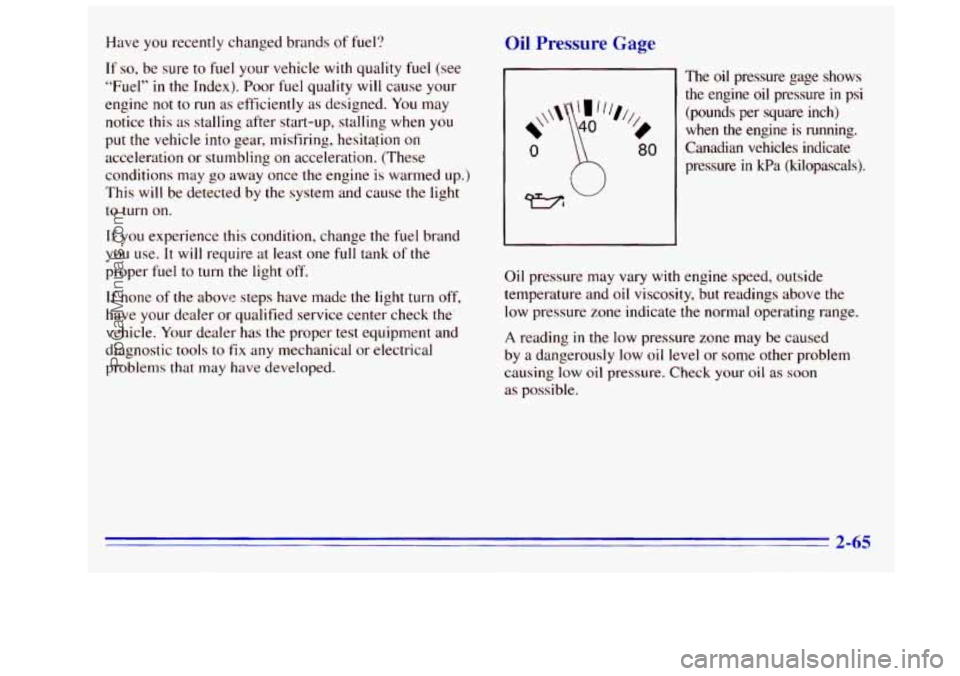
Oil Pressure Gage
0 \ 80
The oil pressure gage shows
the engine oil pressure in psi
(pounds per square inch)
when the engine is running.
Canadian vehicles indicate pressure in
Wa (kilopascals).
Oil pressure may vary with engine speed, outside
temperature and
oil viscosity, but readings above the
low pressure zone indicate the normal operating range.
A reading in the low pressure zone may be caused
by a dangerously low oil level or some other problem
causing low oil pressure. Check your
oil as soon
as possible.
ProCarManuals.com
Page 128 of 404
/A CAUTION: l!,L- .
Don’t keep driving if the oil pressure is low. If
you do, your engine can become so hot that it
catches fire.
You or others could be burned.
Check
your oil as soon as possible and have your
vehicle serviced.
I NOTICE:
Damage to your engine from neglected oil
problems can be costly and
is not covered by your
warranty.
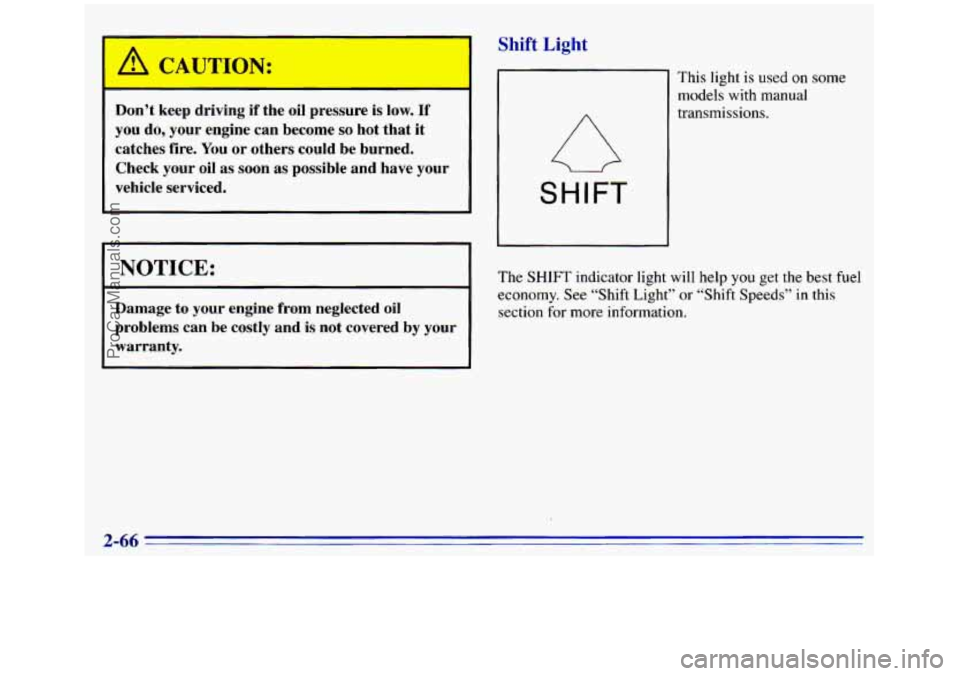
Shift Light
SHIFT
This light is used on some
models
with manual
transmissions.
The
SHIFT indicator light will help you get the best fuel
economy. See “Shift Light” or “Shift Speeds”
in this
section for more information.
2-66
ProCarManuals.com
Page 129 of 404
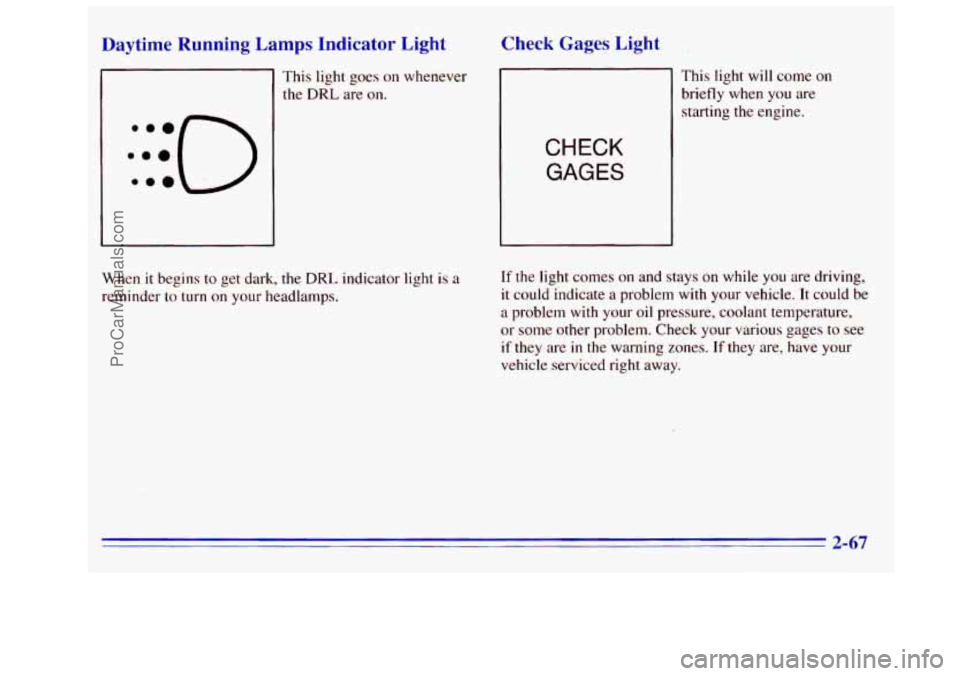
Daytime Running Lamps Indicator Light Check Gages Light
This light goes on whenever
the DRL are on.
CHECK
GAGES
This light will come on
briefly when you are
starting
the engine.
When
it begins to get dark, the DRL indicator light is a
reminder to turn
on your headlamps.
If the light comes on and stays on w.hile you are driving,
it could indicate a problem with your vehicle. It could be
a problem with your oil pressure, coolant temperature,
or some other problem. Check your various gages to see
if they are in the warning zones. If they are, have your
vehicle serviced right away.
2-67
ProCarManuals.com
Page 154 of 404

Care of Your Cassette Tape Player
A tape player that is not cleaned regularly can cause
reduced sound quality, ruined cassettes
or a damaged
mechanism. Cassette tapes should be stored in their
cases away from contaminants, direct sunlight and
extreme heat. If they aren’t,
they may not operate
properly or may cause failure
of the tape player.
Your tape player should be cleaned regularly after every
50 hours of use. Your radio may display CLN to indicate
that
you have used your tape player for 50 hours without
resetting the tape clean timer.
If you notice a reduction in
sound quality, try a known good cassette to see if the tape
or the tape player is at fault. If this other cassette has no
improvement
in sound quality, clean the tape player.
Cleaning may be done with a scrubbing action,
non-abrasive cleaning cassette with pads which scrub
the tape head as the hubs
of the cleaner cassette turn. It
is normal for the cassette to eject while cleaning because
your unit is equipped with
a cut tape feature. To
temporarily override this feature (for one insertion), turn
the radio off and press and hold TAPE AUX until the
tape symbol flashes on the display, then insert
the
cassette again. Insert the cassette at least three times to
ensure thorough cleaning. A scrubbing action cleaning
cassette
is available through your GM dealer.
You may also choose a non-scrubbing action, wet-type
cleaner which uses a cassette with
a fabric belt to clean the
tape head. This type
of cleaning cassette will not eject. It
may not clean as thoroughly as the scrubbing type cleaner.
Cassettes are subject
to wear and the sound quality may
degrade over time. Always make sure that
the cassette
tape
is in good condition before you have your tape
player serviced.
Care of Your Compact Discs
Handle discs carefully. Store them in their original cases
or other protective cases and away from direct sunlight
and dust.
If the surface of a disc is soiled, dampen a
clean, soft cloth in
a mild, neutral detergent solution and
clean
it, wiping from the center to the edge.
Be sure never
to touch the signal surface when handling
discs. Pick up discs by grasping the outer edges or the
edge of the hole and the outer edge.
Fixed Mast Antenna
The fixed mast antenna can withstand most vehicle
washes without being damaged.
If the mast should ever
become slightly bent, you can straighten
it out by hand.
If the mast is badly bent,
as it might be by vandals, you
should replace it.
Check every once in a while to be sure the mast is still
tightened to the cowl.
3-24
ProCarManuals.com
Page 168 of 404
Before You Go Off-Roading
There are some things to do before you go out. For
example,
be sure to have all necessary maintenance and
service work done. Check
to make sure all underbody
shields (if
so equipped) are properly attached. Be sure
you read all the information about your four-wheel-drive
vehicle in
this manual. Is there enough fuel? Is the spare
tire fully inflated? Are
the fluid levels up where they
should be? What are the local laws that apply
to
off-roading where you’ll be driving? If you don’t know,
you should check with law enforcement people in the
area. Will you be on someone’s private land? If so, be
sure to get the necessary permission.
Loading Your Vehicle for Off-Road Driving
There are some important things to remember about
how
to load your vehicle.
The heaviest things should be on the load floor and
forward
of your rear axle. Put heavier items as far
forward
as you can.
Be sure the load is secured properly, so driving on
the off-road terrain doesn’t toss things around.
4 CAUTION: ‘ ’
0
0
e
Cargo on the load floor piled higher than
the seatbacks can be thrown forward
during a sudden stop.
You or your
passengers could be injured. Keep cargo
below the top of the seatbacks.
Unsecured cargo
on the load floor can
be tossed about when driving over rough
terrain.
You or your passengers can
be struck by flying objects. Secure the
cargo properly. Heavy
loads on the roof raise the vehicle’s
center of gravity, making it more likely to
roll over.
You can be seriously or fatally
injured if the vehicle rolls over. Put heavy
loads inside the cargo area, not on the roof.
Keep cargo in the cargo
area as far forward
and low as possible.
You’ll find other important information
in this manual.
See “Vehicle Loading,” “Luggage Carrier” and “Tires”
in the Index.
4-14
ProCarManuals.com
Page 182 of 404
Dr g at I
Remove any brush or debris that has collected on the
underbody, chassis or under the hood. These
accumulations can be a fire hazard.
After operation
in mud or sand, have the brake linings
cleaned
and checked. These substances can cause
glazing and uneven braking. Check the body structure,
steering, suspension, wheels, tires and exhaust system
for damage. Also, check the fuel lines and cooling
system for any leakage.
Your vehicle
will require more frequent service due to
off-road use. Refer
to the Maintenance Schedule for
additional information.
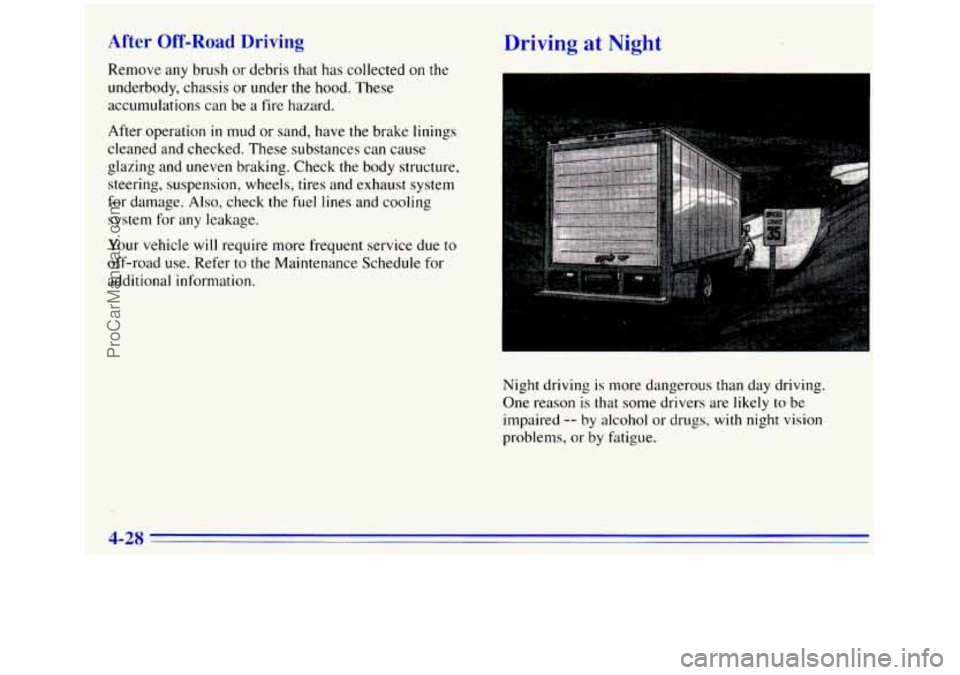
Night driving
is more dangerous than day driving.
One reason
is that some drivers are likely to be
impaired
-- by alcohol or drugs, with night vision
problems, or by fatigue.
4-28
ProCarManuals.com