fuse GMC SIERRA 1996 Owners Manual
[x] Cancel search | Manufacturer: GMC, Model Year: 1996, Model line: SIERRA, Model: GMC SIERRA 1996Pages: 404, PDF Size: 21.57 MB
Page 7 of 404
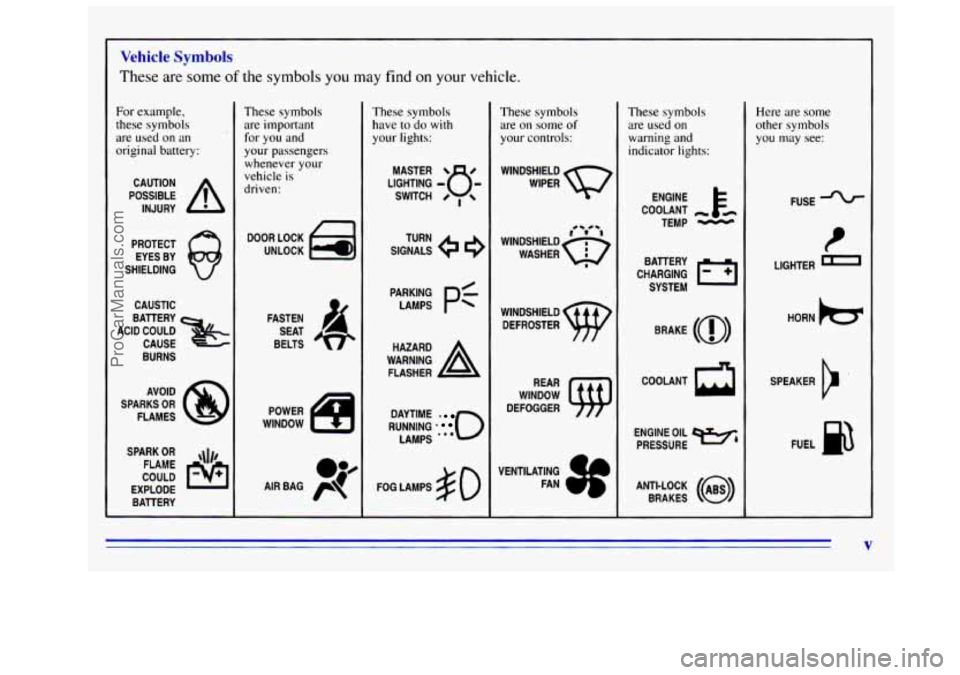
Vehicle Symbols
These are some of the symbols you may find on your vehicle.
For example,
these symbols
are used on an
original battery:
POSSIBLE A
CAUTION
INJURY
PROTECT EYES BY
SHIELDING
CAUSTIC
ACID COULD BATTERY
CAUSE
BURNS
These symbols
are important
for you and
your passengers
whenever your
vehicle is
driven:
DOOR LOCK
UNLOCK
FASTEN SEAT
BELTS
These symbols
have
to do with
your lights:
SIGNALS e e3
TURN
WARNING
A
HAZARD
FLASHER
These symbols are
on some of
your controls:
WINDSHIELD
DEFROSTER
These symbols are used on
warning and
indicator lights:
COOLANT
TEMP
-
CHARGING I-1
BAllERY
SYSTEM
BRAKE
(0)
Here are some
other symbols
you may see:
FUSE
LIGHTER
AVOID
SPARKS
OR
FLAMES
SPARK
OR ,\I/,
COULD FLAME
EXPLODE BATTERY POWER
WINDOW RUNNING
0
DAYTIME -
LAMPS '*'
FOG LAMPS # 0
VENTILATING
FAN
1
-3
COOLANT a
ENGINE OIL e,
PRESSURE HORN
)tr
SPEAKER v
FUEL B
V
ProCarManuals.com
Page 9 of 404
Section 1 Seats and Restraint Systems
Here you’ll find information about the seats in your
vehicle and how to use your safety belts properly.
You
can also learn about some things you should not do with
air bags and safety belts.
Seats and Seat Controls
This section tells you about the seats -- how to adjust
them, and fold them
up and down. It also tells you about
reclining front seatbacks and head restraints.
Mar--a1 Front Seat
CAUTION:
You can lose control of the vehicle if you try to
adjust
a manual driver’s seat while the vehicle is
moving. The sudden movement could startle and
confuse you, or
make you push a pedal when you
don’t want to. Adjust the driver’s seat only when
the vehicle
is not moving.
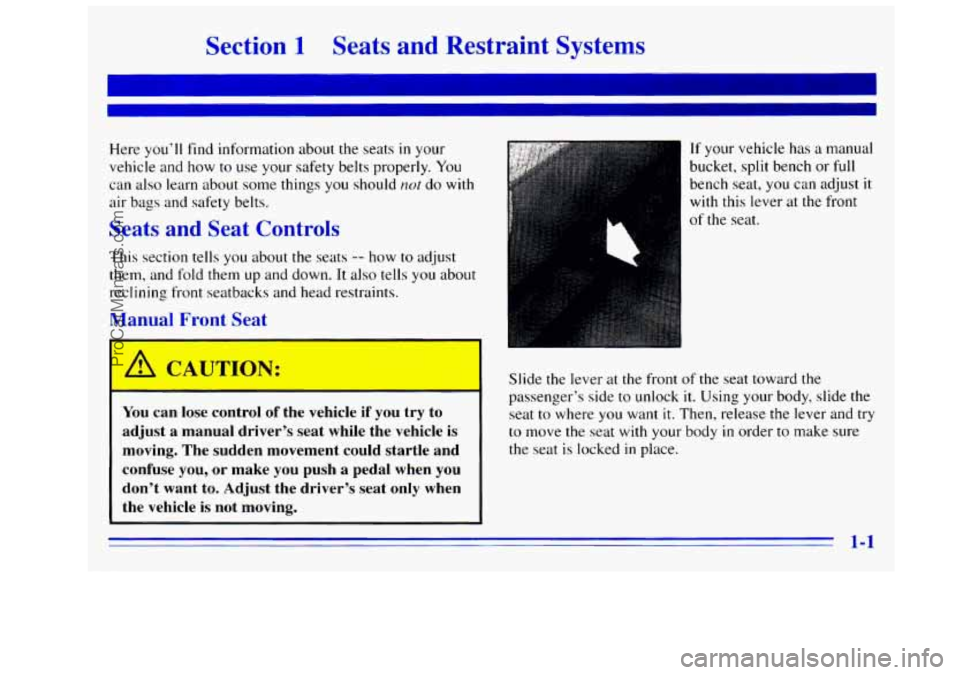
If your vehicle has a manual
bucket, split bench
or full
bench seat,
you can adjust it
with this lever at the front
of the seat.
~
I
Slide the lever at the front of the seat toward the
passenger’s side to unlock
it. Using your body, slide the
seat
to where you want it. Then, release the lever and try
to move the seat with your body
in order to make sure
the seat
is locked in place.
1-1
ProCarManuals.com
Page 96 of 404
’hrn Signal and Lane Change Signals
The turn signal has two upward (for right) and two
downward (for left) positions. These po.sitions allow you
to signal a turn
or a lane change.
To signal a turn, move the lever all the way up or
down. When the turn is finished, the lever will
return automatically.
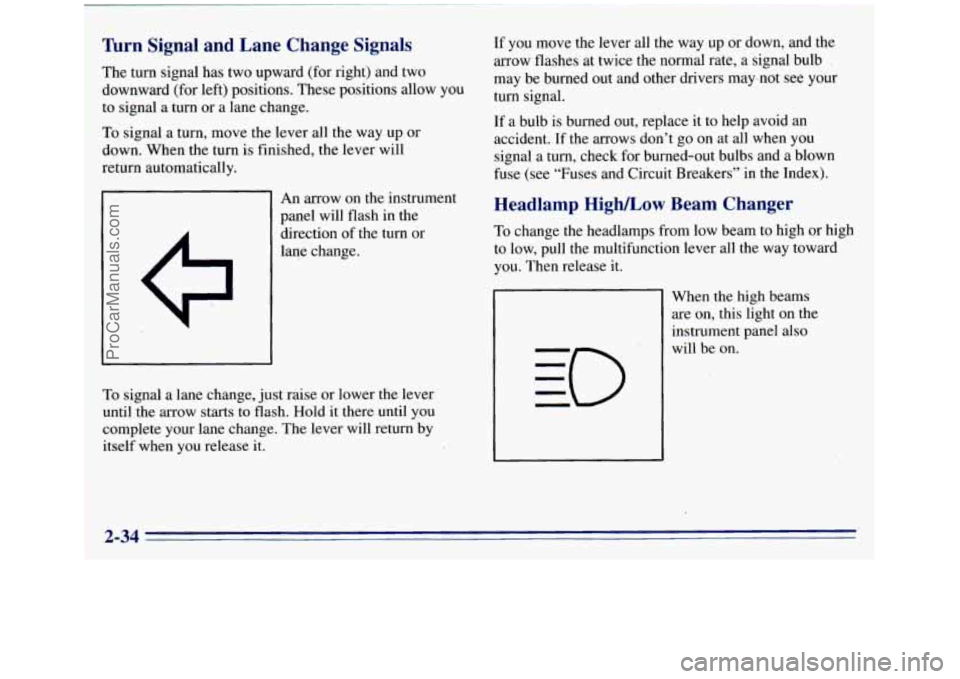
An arrow
on the instrument
panel will flash in the
direction of the turn or
lane change.
To signal a lane change, just raise or lower the lever
until.the arrow starts
to flash. Hold it there until you
complete your lane change. The lever will return by
itself when you release
it.
.,
If you move the lever all the way up or down, and the
arrow flashes at twice the normal rate, a signal bulb
may be burned out and other drivers may
.ot see your
turn signal.
If a bulb is burned out, replace it to help avoid an
accident. If the arrows don’t go on at all when you
signal a turn, check for burned-out bulbs and a blown
fuse (see “Fuses and Circuit Breakers” in the Index).
Headlamp HighLow Beam Changer
To change the headlamps from low beam to high or high
to low, pull
the multifunction lever all the way toward
you. Then release it.
When
the high beams
are
on, this light on the
instrument panel also will be
on.
ProCarManuals.com
Page 117 of 404
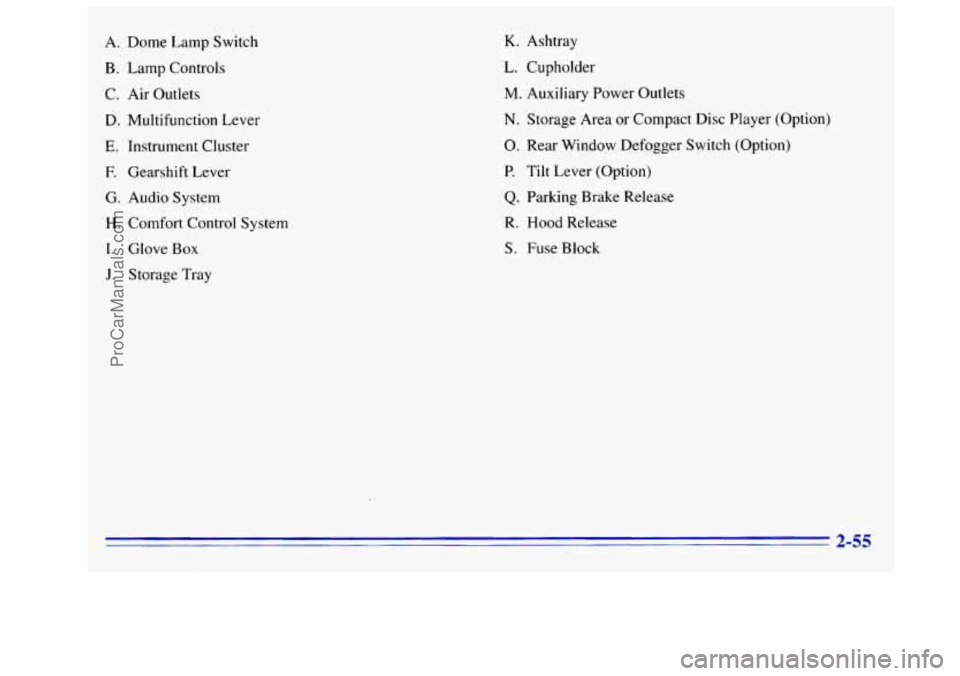
A. Dome Lamp Switch
B. Lamp Controls
C.
Air Outlets
D. Multifunction Lever
E. Instrument Cluster
E Gearshift Lever
G. Audio System
H. Comfort Control System
I. Glove Box
J. Storage Tray
K. Ashtray
L. Cupholder
M. Auxiliary Power Outlets
N. Storage Area or Compact Disc Player (Option)
0. Rear Window Defogger Switch (Option)
P. Tilt Lever (Option)
Q. Parking Brake Release
R. Hood Release
S. Fuse Block
2-55
ProCarManuals.com
Page 169 of 404
Environmental Concerns
Off-road driving can provide wholesome and satisfying
recreation. However,
it also raises environmental
concerns.
GM recognizes these concerns and urges
every off-roader to follow these basic rules for
protecting the environment:
a
e
e
a
0
Always use established trails, roads and areas that
have been specially set aside for public off-road
recreational driving; obey all posted regulations.
Avoid any driving practice that could damage the
environment
-- shrubs, flowers, trees, grasses -- or
disturb wildlife (this includes wheel-spinning,
breaking down trees
or unnecessary driving through
streams or over soft ground).
Always carry a litter bag
-- make sure all refuse is
removed from any campsite before leaving.
Take extreme
care with open fires (where permitted),
camp stoves and lanterns.
Never park your vehicle over dry grass or other
combustible materials that could catch fire from the
heat
of the vehicle’s exhaust system.
Traveling to Remote Areas
It makes sense to plan your trip, especially when going
to a remote area. Know
the terrain and plan your route.
You are much less likely to get bad surprises. Get
accurate maps
of trails and terrain. Try to learn of any
blocked or closed roads.
It’s also a good idea to travel
with at least one other
vehicle.
If something happens to one of them, the other
can help quickly.
Does your vehicle have a winch?
If so, be sure to read
the winch instructions.
In a remote area, a winch can be
handy
if you get stuck. But you’ll want to know how to
use
it properly.
Gett.ing Familiar with Off-Road Driving
It’s a good idea to practice in an area that’s safe and
close to home before you go into the wilderness.
Off-road driving does require some new and different
driving skills. Here’s what
we mean.
Tune
your senses to different kinds of signals. Your
eyes,
for example, need to constantly sweep the terrain
for unexpected obstacles.
Your ears need to listen for
unusual tire or engine
sounds. With your arms, hands,
feet and body, you’ll need to respond to vibrations and
vehicle bounce.
ProCarManuals.com
Page 252 of 404
Your vehicle has an air bag system. Before attempting to
do your own service work, see “Servicing Your Air
Bag-Equipped Vehicle” in the Index.
You should keep,a record with all parts receipts and list
the mileage and the date
of any service work you
perform. See “Maintenance Record” in the Index.
You can be injured and your vehicle could be
damaged if you try to do service work on a
vehicle without knowing enough about
it.
0 Be sure you have sufficient knowledge,
experience, and the proper replacement
parts and tools before you attempt any
vehicle maintenance task.
0 Be sure to use the proper nuts, bolts and
other’ fasteners. “English” and “metric”
fasteners can be easily confused. If
you use
the wrong fasteners, parts can later break
or fall off.
You could be hurt.
Fuel (Gasoline Engine)
If your vehicle has a diesel engine, see “Diesel Fuel
Requirements and Fuel System” in the Diesel Engine Supplement. For vehicles with gasoline engines, please
read-this.
Use regular unleaded gasoline rated at
87 octane
or higher. At a minimum, it should meet specifications
ASTM D4814
in the United States and CGSB 3.5-M93
in Canada. Improved gasoline specifications have
been developed by the American Automobile
Manufacturers Association (AAMA) for better vehicle
performance and engine protection. Gasolines meeting
the AAMA specification could provide improved
driveability and emission control system protection
compared
to other gasolines. I
Be sure the posted octane is at least 87. If the octane is
less than
87, you may get a heavy knocking noise when
you drive. If it’s bad enough, it can damage your engine.
If you’re using fuel rated at
87 octane or higher and you
still hear heavy knocking, your engine needs service.
But don’t worry if you hear a little pinging noise when
you’re accelerating or driving up a
hill. That’s normal,
and you don’t have to buy a higher octane fuel to get rid
of pinging. It’s the heavy, constant knock that means
you have
a problem.
6-2
ProCarManuals.com
Page 259 of 404
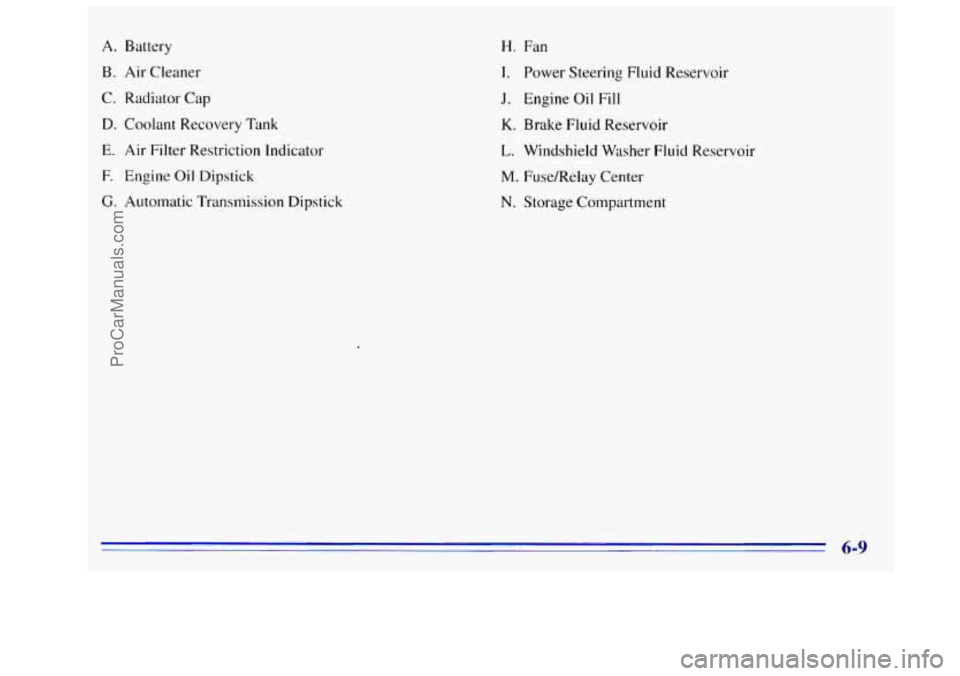
A. Battery
B. Air Cleaner
C. Radiator Cap
D. Coolant Recovery Tmk
E. Air Filter Restriction Indicator
E Engine Oil Dipstick
G. Automatic Transmission Dipstick
H. Fan
I. Power Steering Fluid Reservoir
J. Engine Oil Fill
K. Brake Fluid Reservoir
L. Windshield Washer Fluid Reservoir
M. FuseIRelay Center
N. Storage Compartment
ProCarManuals.com
Page 260 of 404
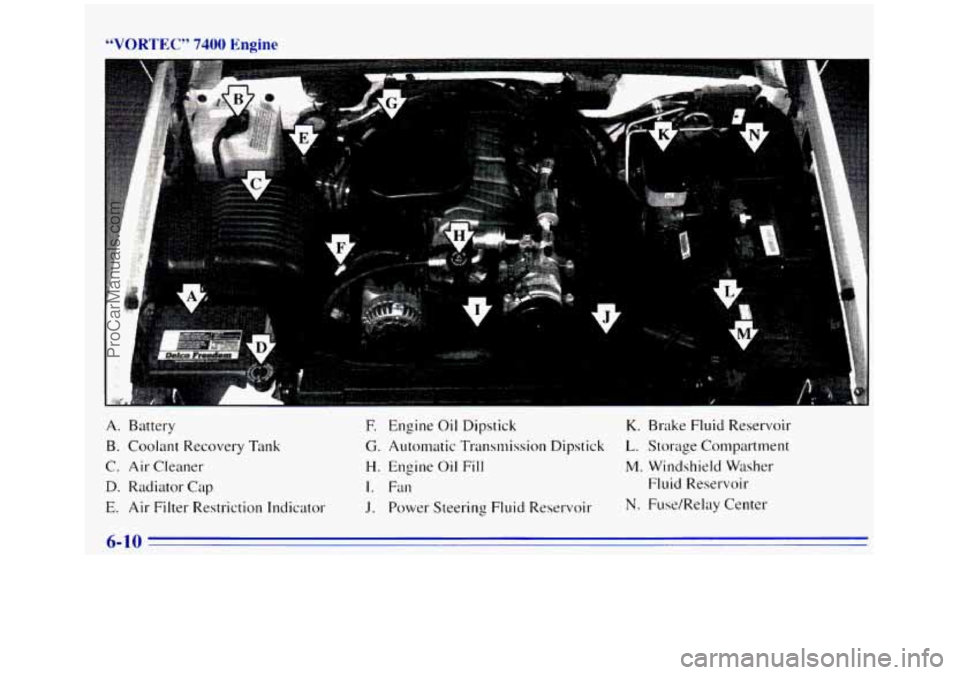
“VORTEC” 7400 Engine
I
A. Battery
B. Coolant Recovery Tank
C. Air Cleaner
D. Radiator Cap
E. Air Filter Restriction Indicator
E Engine Oil Dipstick K. Brake Fluid Reservoir
G. Automatic Transmission Dipstick L. Storage Compartment
H. Engine Oil Fill M. Windshield Washer
I. Fan Fluid
Reservoir
J. Power Steering Fluid Reservoir Ne Fuse/RelaY Center
ProCarManuals.com
Page 318 of 404
Electrical System
Ac . .-On Electrical Equipment
NOTICE:
Don’t add anything electrical to your vehicle unless
you check with your dealer first. Some electrical
equipment can damage your vehicle and the
damage wouldn’t be covered
by your warranty.
Some add-on electrical equipment can keep other
components from working as they should.
Your vehicle has an air bag system. Before attempting to
add anything electrical to your vehicle, see “Servicing
Your Air Bag-Equipped Vehicle”
in the Index.
Headlamps
The headlamp wiring is protected by an internal circuit
breaker. An electrical overload
will cause the lamps to
go on and off, or in some cases to remain off. If this
happens, have your headlamp wiring checked right away.
Windshield Wipers
The windshield wiper motor is protected by a circuit
breaker and a fuse.
If the motor overheats due to heavy
snow, etc., the wiper will stop
until the motor cools. If
the overload is caused by some electrical problem and
not snow, etc., be sure to get it fixed.
Power Windows and Other Power Options
Circuit breakers protect the power windows and other
power accessories. When the current
load is too heavy,
the circuit breaker opens and closes, protecting the
circuit
until the problem is fixed or goes away.
6-68
ProCarManuals.com
Page 319 of 404
Fu ~ ~ s and Circuit Breakers
The wiring circuits in your vehicle are protected from
short circuits by a combination of
fuses, circuit breakers
and fusible thermal links. This greatly reduces the
chance
of fires caused by electrical problems.
Look at the silver-colored band inside the fuse. If the
band is broken or melted, replace the fuse. Be sure
you
replace a bad fuse with a new one of the identical size
and rating.
If you ever have a problem on the road and don’t have a
spare fuse,
you can borrow one that has the same
amperage.
Just pick some feature of your vehicle that
you can get along without -- like the radio or cigarette
lighter
-- and use its fuse, if it is the correct amperage.
Replace
it as soon as you can.
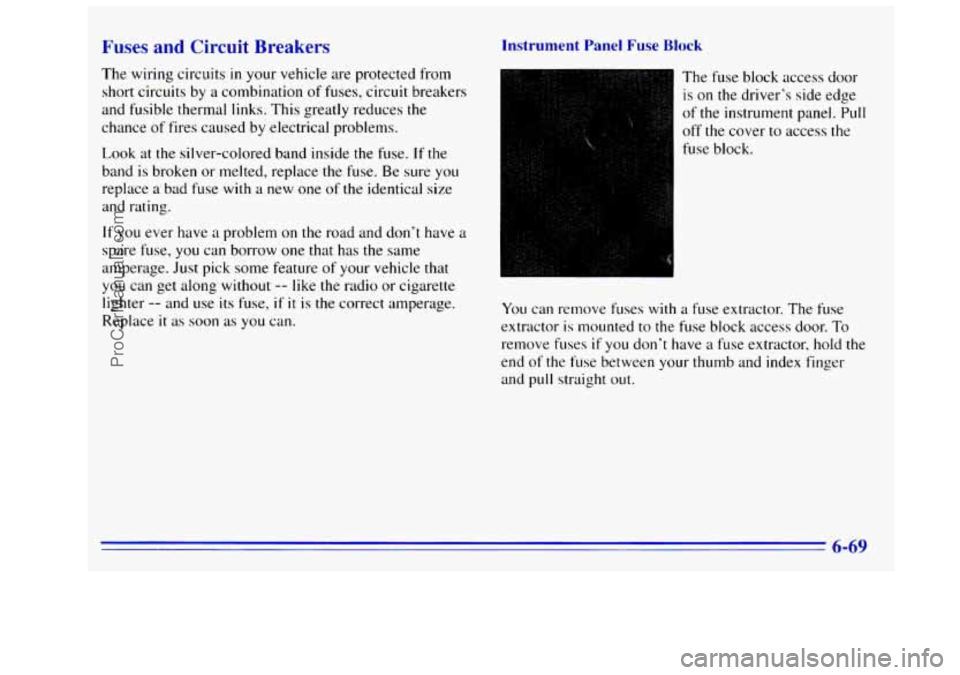
Instrument Panel Fuse Block
The fuse block access door
is on the driver’s side edge
of the instrument panel. Pull
off the cover
to access the
fuse block.
You can remove fuses with a fuse extractor. The fuse
extractor
is mounted to the fuse block access door. To
remove fuses if you don’t have a fuse extractor, hold the
end of the fuse between your thumb and index finger
and
pull straight out.
ProCarManuals.com