ignition GMC SIERRA 1996 Owners Manual
[x] Cancel search | Manufacturer: GMC, Model Year: 1996, Model line: SIERRA, Model: GMC SIERRA 1996Pages: 404, PDF Size: 21.57 MB
Page 34 of 404
I
Servicing Your Air Bag-Equipped Vehicle
1 The air bag affects how your vehicle should be serviced.
There
are parts of the air bag system in several places
around your vehicle. You don’t want
the system to
inflate while someone is working on your vehicle. Your
GM dealer and the service manual have information
about servicing your vehicle and the air bag system.
To
purchase a service manual, see “Service and Owner
Publications” in the Index.
For up to two minutes after the ignition key
is
turned off and the battery is disconnected, an air
bag can still inflate during improper service. You
can be injured if you are close to an air bag when
it inflates. Avoid wires wrapped with yellow tape,
or yellow connectors. They are probably part of
the
air bag system. Be sure to follow proper
service procedures, and make sure the person
performing work for you is qualified to do
so.
~~ ~~ ~~
The air bag system does not need regular maintenance.
Adding Equipment to Your Air
Bag-Equipped Vehicle
Q: If I add a push bumper or a bicycle rack to the
front
of my vehicle, will it keep the air bag from
working properly?
A: As long as the push bumper or bicycle rack is
attached to your vehicle
so that the vehicle’s basic
structure isn’t changed, it’s not likely to keep the
.I air bags from wor@ng properly in a crash.
What if
I add a snow plow? Will it keep the air
bag from working properly?
A: We’ve designed our air bag systems to work
properly under a wide range of conditions,
including snow plowing with vehicles equipped
with the optional Snow Plow Prep Package
(RPO VYU). But don’t change or defeat the
snow plow’s “tripping mechanism.” If you do,
it
can damage your snow plow and your vehicle,
and it may cause an air bag inflation.
1-26
ProCarManuals.com
Page 63 of 404
Section 2 Features and Controls
Here you can learn .about the many standard and
optional features on your vehicle, and information
on
starting, shifting and braking. Also explained are the
instrument panel and the warning systems that tell you if
everything is working properly
-- and what to do if you
have a problem.
Keys
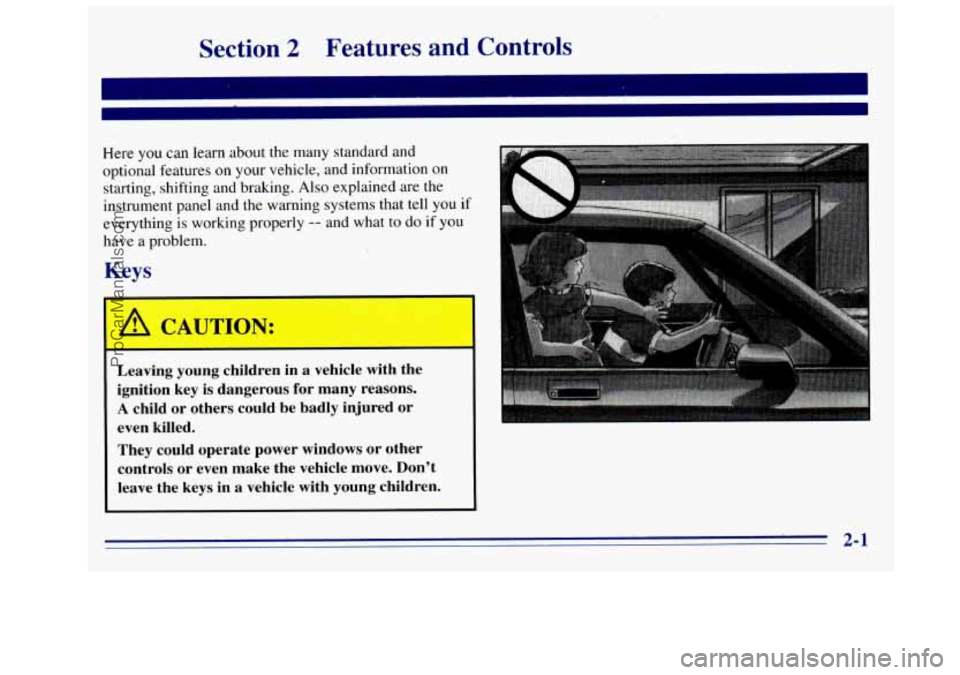
Leaving young children in a vehicle with the
ignition key is dangerous for many reasons.
A child or others could- be badly injured or
even killed.
They could operate power windows or other
controls
or even make the vehicle move. Don’t
leave the keys in a vehicle with young children.
2-1
ProCarManuals.com
Page 64 of 404
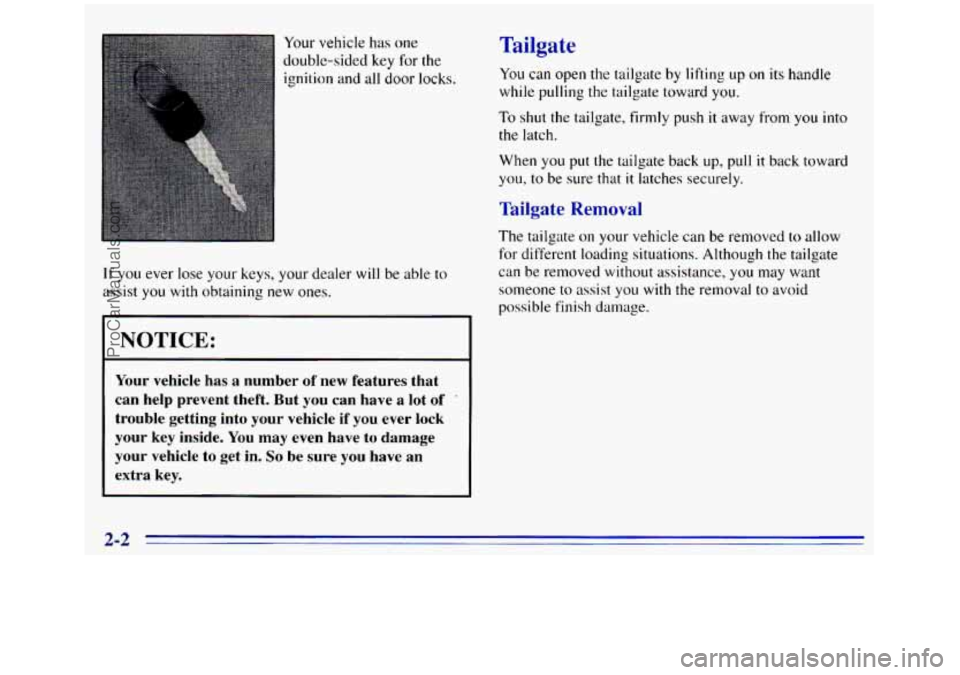
Your vehicle has one
double-sided key for the
ignition and all door locks.
If you ever lose your keys, your dealer will be able to
assist
you with obtaining new ones.
NOTICE:
Your vehicle has a number of new features that
can help prevent theft. But you can have a lot of
.
trouble getting into your vehicle if you ever lock
your key inside. You may even have to damage
your vehicle to get in.
So be sure you have an
extra key.
Tailgate
You can open the tailgate by lifting up on its handle
while
pulling t.he tailgate toward you.
To shut the tailgate, firmly push it away from you into
the latch.
When
you put the tailgate back up, pull it back towara
you, to be sure that it latches securely.
Tailgate Removal
The tailgate on your vehicle can be removed to allow
for different loading situations. Although the tailgate
can be removed without assistance,
you may want
someone to assist you
with the removal to avoid
possible finish damage.
2-2
ProCarManuals.com
Page 68 of 404
Operation
To unlock the driver’s door, press the UNLOCK button.
If you press this button again within five seconds, all the
doors (except the rear seat access door)
will unlock.
Press the
LOCK button to lock all the doors (except the
rear seat access door).
When the UNLOCK button is pressed, the interior dome
lamps are turned on for
40 seconds or until the ignition
is activated.
When the LOCK button is pressed, the interior lamps
are turned on for
a few seconds if the doors are closed.
If the LOCK but.ton is pressed when a door is open, the
interior lamps
will stay on for a few seconds after the
door
is closed.
Matching Transmitter(s) To Your Vehicle
Each key chain transmitter is coded to prevent another
transmitter from unlocking your vehicle.
If a transmitter
is lost or stolen, a replacement can be purchased through
your dealer. Remember to bring any remaining
transmitters
with you when you go to your dealer. When
the dealer matches
the replacement transmitter to your
vehicle, any remaining transmitters must also be
matched. Once the new transmitter
is coded, the lost
transmitter will
not unlock your vehicle. Each vehicle
can have only two transmitters matched to
it.
Battery Replacement
Under normal use. the batteries in your key chain
transmitter should last
about two years.
You can tell the batteries are weak
if the transmitter
won’t work at the normal range
in any location. If you
have to get close to your vehicle before the transmitter
works,
it’s probably time to change the batteries.
Use two Duraeell@ batteries type
DL2014, or a
similar type.
2-6
ProCarManuals.com
Page 69 of 404
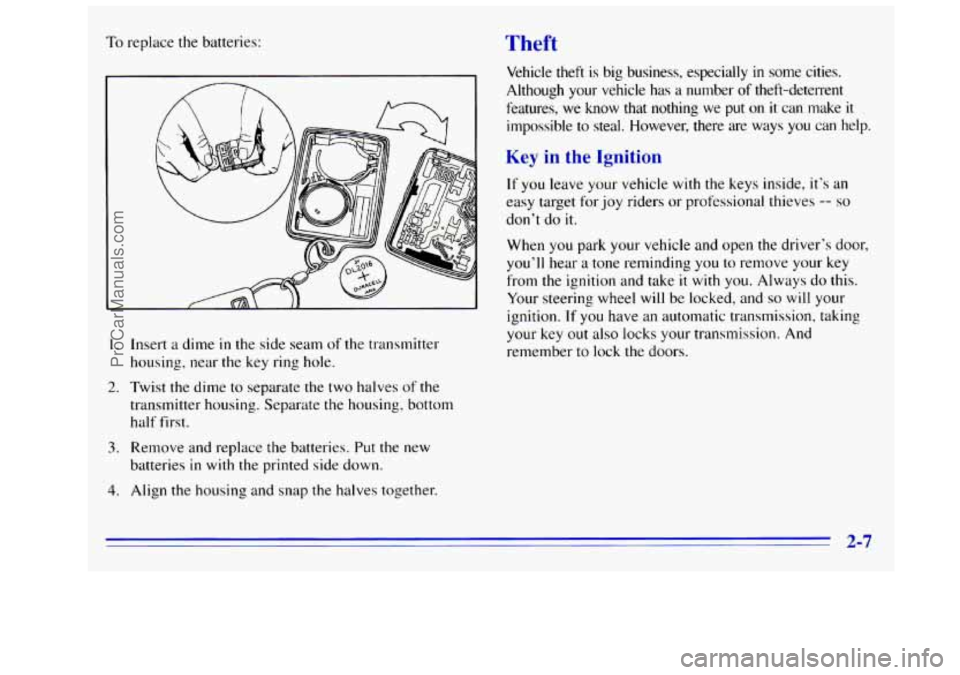
To replace the batteries: rheft
1. Insert a dime in the side seam of the transmitter
housing, near
the key ring hole.
2. Twist the dime to separate the two halves of the
transmitter housing. Separate the housing, bottom
half first.
3. Remove and replace the batteries. Put the new
batteries
in with the printed side down.
4. Align the housing and snap the halves together. Vehicle theft is big business, especially
in some cities.
Although your vehicle has
a number of theft-deterrent
features, we know that nothing
we put on it can make it
impossible to steal. However, there are ways you can help.
Key in the Ignition
If you leave your vehicle with the keys inside, it’s an
easy target for joy riders or professional thieves
-- so
don’t do
it.
When you park your vehicle and open the driver’s door,
you’ll hear a tone reminding you to remove your key
from the ignition and take
it with you. Always do this.
Your steering wheel
will be locked, and so will your
ignition.
If you have an automatic transmission, taking
your key out also locks
your transmission. And
remember to lock
the doors.
2-7
ProCarManuals.com
Page 70 of 404
Parking at Night New Vehicle “Break-In”
Park in a lighted spot, close all windows and lock your
vehicle. Remember
to keep your valuables out of sight.
Put
them in a storage area, or take them with you.
Parking Lots
If you park in a lot where someone will be watching
your vehicle, it’s best
to lock it up and take your keys.
But what if you have to leave your ignition key? What if
you have to leave something valuable in your vehicle?
0 Put your valuables in a storage area, like your
glove
box.
0 Lock all the doors except the driver‘s.
NOTICE:
Your modern vehicle doesn’t need an elaborate
“break-in.” But it
will perform better in the long
run
if you follow these guidelines:
0
0
0
0
Keep your speed at 55 mph (88 km/h) or
less for the first
500 miles (804 km).
Don’t drive at any one speed
-- fast or
slow
-- for the first 500 miles (804 km).
Don’t make full-throttle starts.
Avoid making hard stops for the
first
200 miles (322 km) or so. During this time
your new brake linings aren’t yet broken
in. Hard stops with new linings can mean
premature wear and earlier replacement.
Follow this breaking-in guideline every
time you get new brake linings.
Don’t tow a trailer during break-in.
See “Towing
a Trailer” in the Index for
more information.
2-8
ProCarManuals.com
Page 71 of 404
Ignition Positions
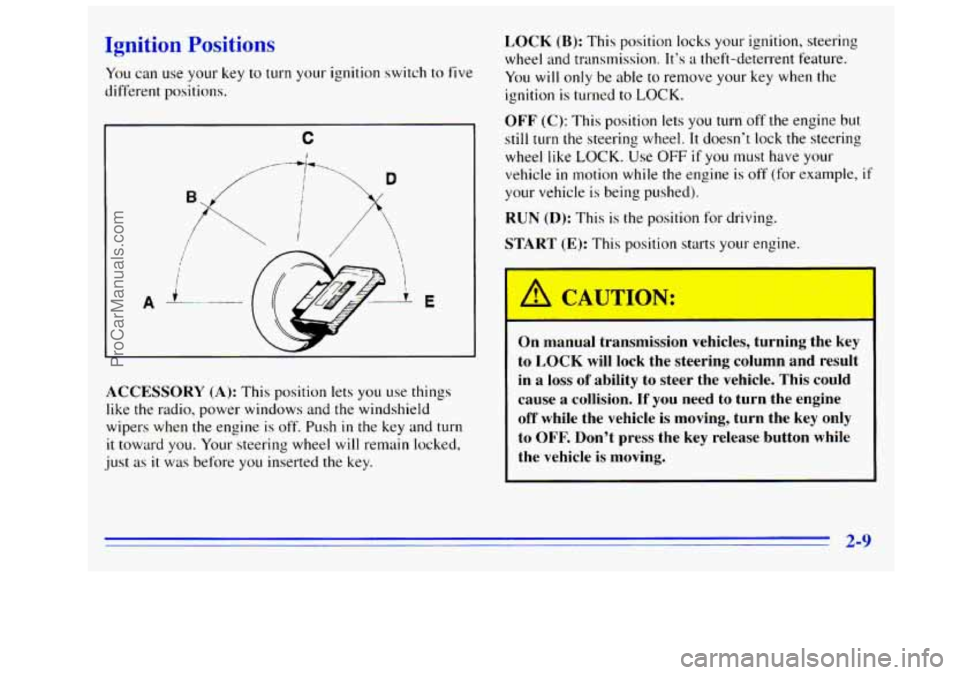
You can use your Key to turn your ignition switch to five
different positions.
C
1
E
W
LCCESSORY (A): This position lets you use things
like the radio, power windows and the windshield
wipers when the engine is off. Push
in the key and turn
it toward you. Your steering wheel will remain locked,
just
as it was before you inserted the key. LOCK
(B): This
position locks your ignition, steering
wheel
and transmission. It's a theft-deterrent feature.
You will only be able to remove your key when the
ignition is turned to
LOCK.
OFF (C): This position lets you turn off the engine but
still
turn the steering wheel. It doesn't lock the steering
wheel like
LOCK. Use OFF if you must have your
vehicle in motion while the engine is off (for example, if
your vehicle is being pushed).
RUN
(D): This is the position for driving.
START
(E): This position starts your engine.
I
I A CAUTION:
On manual transmission vehicles, turning the key
to LOCK will lock the steering column and result
in
a loss of ability to steer the vehicle. This could
cause
a collision. If you need to turn the engine
off' while the vehicle is moving, turn the key only
to
OFF. Don't press the key release button while
the vehicle is moving.
ProCarManuals.com
Page 72 of 404
NOTICE:
If your key seems stuck in LOCK and you can’t
turn it, be sure it is
all the way in. If it is, then
turn the steering wheel left and right while
you
turn the key hard. But turn the key only with
your hand. Using a tool to force it could break
the key or the ignition switch.
If none of this
works, then your vehicle needs service.
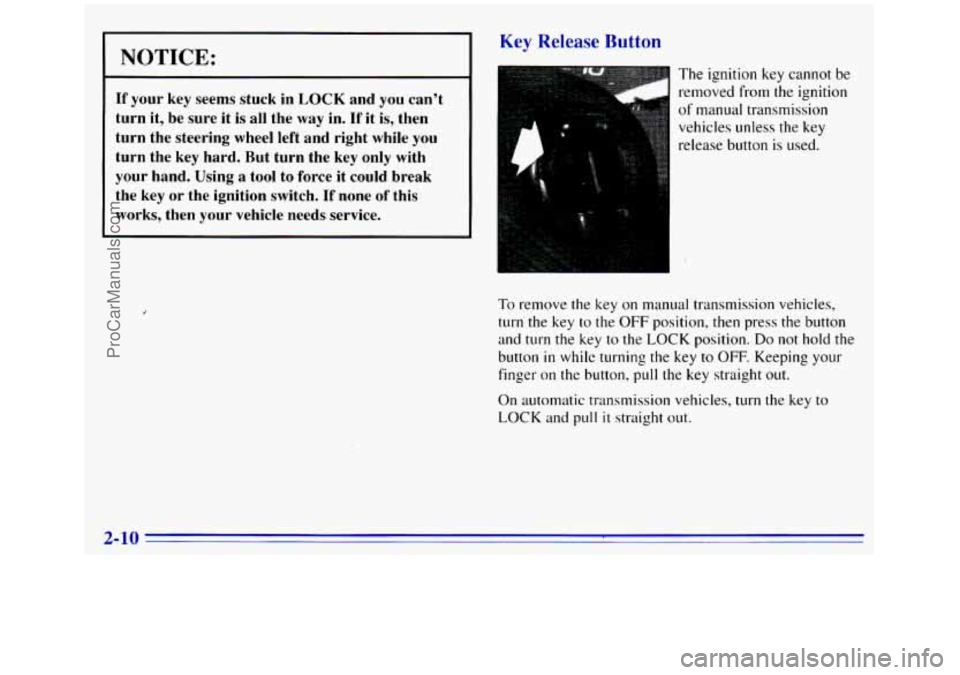
Key Release Button
The ignition key cannot be
removed from the ignition
of manual transmission
vehicles unless the key
release button
is used.
To remove the key on manual transmission vehicles,
turn the key to the
OFF position, then press the button
and
turn the key to the LOCK position. Do not hold the
button
in while turning the key to OFF. Keeping your
finger on the button,
pull the key straight out.
On automatic transmission vehicles, turn the key to
LOCK and
pull it straight out.
2-10
ProCarManuals.com
Page 73 of 404
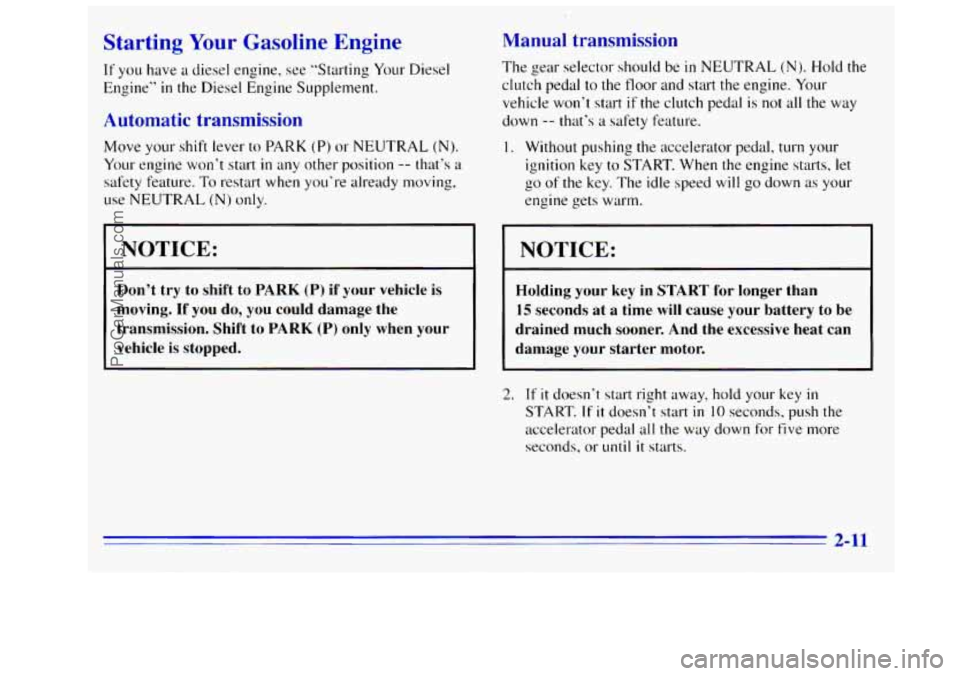
Starting Your Gasoline Engine
If you have a diesel engine, see “Starting Your Diesel
Engine”
in the Diesel Engine Supplement.
Automatic transmission
Move your shift lever to PARK (P) or NEUTRAL (N).
Your engine won’t start in any other position -- that’s a
safety feature.
To restart when you’re already moving,
use NEUTRAL
(N) only.
NOTICE:
Don’t try to shift to PARK (P) if your vehicle is
moving.
If you do, you could damage the
transmission. Shift to
PARK (P) only when your
vehicle is stopped.
Manual transmission
The gear selector should be in NEUTRAL (N). Hold the
clutch pedal
to the floor and start the engine. Your
vehicle won’t start if the clutch pedal is not all the way
down
-- that’s a safety feature.
1. Without pushing the accelerator pedal, turn your
ignition key to START. When the engine starts,
let
go of the key. The idle speed will go down as your
engine gets warm.
NOTICE:
Holding your key in START for longer than
15 seconds at a time will cause your battery to be
drained much sooner. And the excessive heat can
damage your starter motor.
2. If it doesn’t start right away, hold your key in
START. If it doesn’t start in 10 seconds, push the
accelerator pedal
all the way down for five more
seconds, or
until it starts.
2-11
ProCarManuals.com
Page 75 of 404
..
Plugging the cord into an ungrounded outlet
could cause an electrical shock. Also, the wrong
kind of extension cord could overheat and cause
a fire.
You could be seriously injured. Plug the
cord into a properly grounded three-prong 110-volt
AC outlet. If the cord won't reach, use a
heavy-duty three-prong extension cord rated for
at least
15 amps.
3. After you've used the coolant heater, be sure to
store
the cord as it was before to keep it away
from moving engine parts.
If you don't. it could
be damaged.
How long should you keep the coolant heater plugged
in'? The answer depends on the outside temperature, the
kind of oil you have, and some other things. Instead of
trying to list everything here, we ask that you contact
your GM dealer in the area where you'll be parking your
vehicle. The dea1e.r can give
you the best advice for that
particular area.
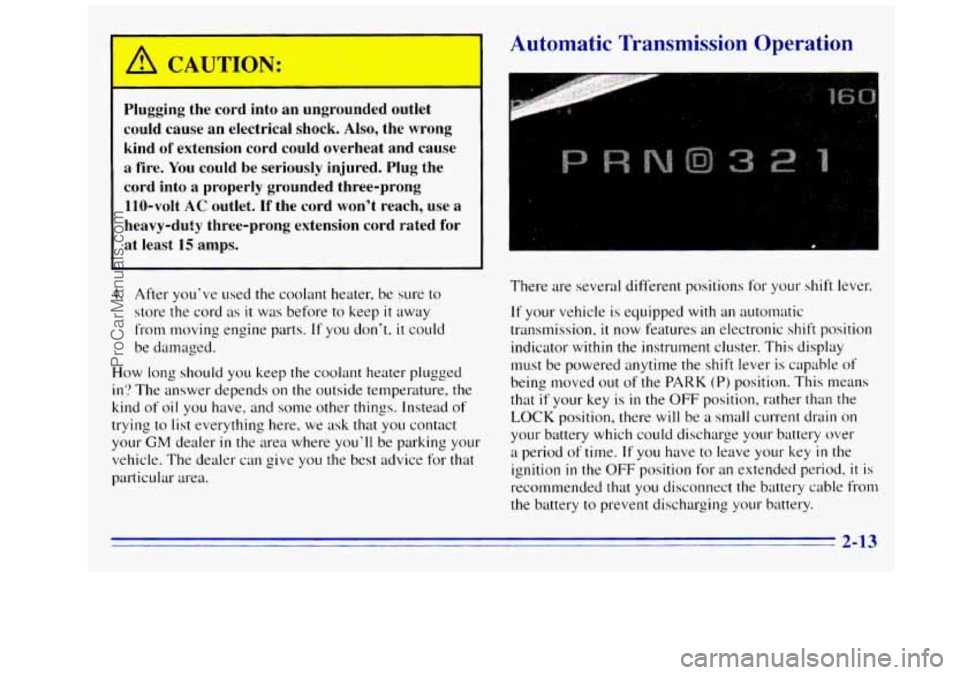
Automatic Transmission Operation
There are several different positions for your- shift lever.
If your vehicle is equipped with an automatic
transmission,
it now features an electronic shift position
indicator
within the instrument cluster. This display
must be powered anytime the shift lever is capable
of
being moved out of the PARK (P) position. This means
that
if your key is in the OFF position, rather than the
LOCK position, there will be a small current drain on
your battery which could discharge your battery over
a period of time. If you have to leave your key in the
ignition
in the OFF position for an extended period, it is
recommended that you disconnect the battery cable from
the battery
to prevent discharging your battery.
ProCarManuals.com