oil level GMC SIERRA 1996 Owners Manual
[x] Cancel search | Manufacturer: GMC, Model Year: 1996, Model line: SIERRA, Model: GMC SIERRA 1996Pages: 404, PDF Size: 21.57 MB
Page 127 of 404
Have you recently changed brands of fuel?
If
so, be sure to fuel your vehicle with quality fuel (see
"Fuel" in the Index). Poor fuel quality will cause your
engine
not to run as efficiently as designed. You may
notice this
as stalling after start-up, stalling when you
put the vehicle into gear, misfiring, hesitaIion on
acceleration or stumbling on acceleration. (These
conditions may go away once the engine
is warmed up.)
This will be detected by
the system and cause the light
to turn on.
If
you experience this condition, change the fuel brand
you use.
It will require at least one full tank of the
proper fuel to turn the light off.
If none of the above steps have made the light turn off,
have
your dealer or qualified service center check the'
vehicle. Your dealer has the proper test equipment and
diagnostic
tools to fix any mechanical or electrical
problems
that may have developed.
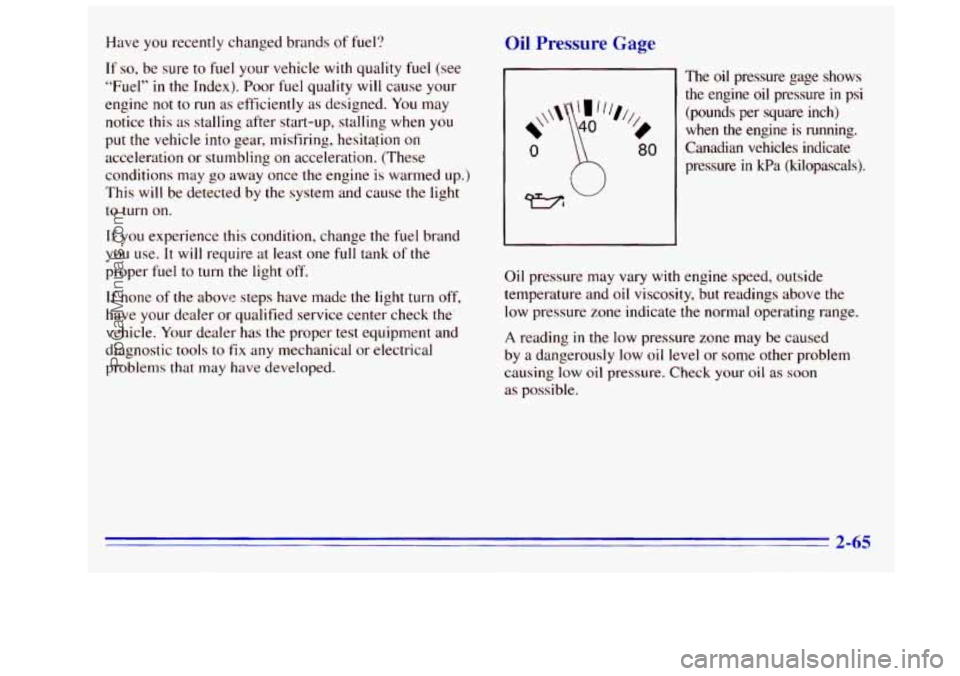
Oil Pressure Gage
0 \ 80
The oil pressure gage shows
the engine oil pressure in psi
(pounds per square inch)
when the engine is running.
Canadian vehicles indicate pressure in
Wa (kilopascals).
Oil pressure may vary with engine speed, outside
temperature and
oil viscosity, but readings above the
low pressure zone indicate the normal operating range.
A reading in the low pressure zone may be caused
by a dangerously low oil level or some other problem
causing low oil pressure. Check your
oil as soon
as possible.
ProCarManuals.com
Page 189 of 404
The exit speed is usually posted.
Reduce your speed according to your speedometer, not
to your sense of motion. After driving for any distance
at higher speeds,
you may tend to think you are going
slower than
you actually are.
Before Leaving on a Long Trip
Make sure you’re ready. Try to be well rested. If you
must start when you’re not fresh
-- such as after a day’s
work
-- don’t plan to make too many miles that first part
of the journey. Wear comfortable clothing and shoes you
can easily drive
in.
Is your vehicle ready for a long trip‘? If you keep it
serviced and maintained, it’s ready to go. If it needs
service, have it done before starting out.
Of course,
you’ll find experienced and able service experts
in GM
dealerships all across North America. They’ll be ready
and willing to help if YOLI need it.
Here are some things you can check before a trip:
0
0
0
0
0
0
0
Windshield Wnslwr FILd: Is the reservoir full? Are
all windows clean inside and outside?
Wiper Blades: Are they in good shape‘?
F~lel, Engine Oil, Other Fluids: Have you checked
all levels?
Lnmps: Are they all working? Are the lenses clean?
Tires: They are vitally important to a safe,
trouble-free trip.
Is the tread good enough for
long-distance driving? Are the tires
all inflated to the
recommended pressure?
Weather Forecasts: What’s the weather outlook
along your route? Should you delay
your trip a short
time
to avoid a major storm system?
Mqx: Do you have up-to-date maps?
ProCarManuals.com
Page 211 of 404
Turn Signals When Towing a Trailer
The green arrows on your instrument panel will flash
whenever
you signal a turn or lane change. Properly
hooked up, the trailer lamps will also flash, telling other
drivers you’re about to turn, change lanes or stop.
When towing a trailer, the green arrows
on your
instrument panel will flash for turns even
if the bulbs on
the trailer are burned out. Thus, you may
think drivers
behind
you are seeing your signal when they are not. It’s
important to check occasionally to be sure the trailer
bulbs are
still working.
Driving On Grades
Reduce speed and shift to a lower gear be~m you start
down
a long or steep downgrade. If you don’t shift
down,
you might have to use your brakes so much that
they would get hot and
no longer work well.
On a long uphill grade,
shift down and reduce your
speed
to around 45 mph (70 km/h) to reduce the
possibility
of engine and transmission overheating.
If you have an automatic transmission, you should use
THIRD
(3) (or, as you need to, a lower gear) when
towing a trailer. Operating your vehicle in THIRD
(3)
when towing a trailer will minimize heat build-up and
extend
the life of your transmission
If
you have a manual transmission and you are towing a
trailer,
it’s better not to use FIFTH (5) gear. Just drive in
FOURTH (4) gear (or, as you need to, a lower gear).
When towing at high altitude on steep uphill grades,
consider the following: Engine coolant will boil at a
lower temperature than at normal altitudes. If
you turn
your engine off‘ immediately after towing at high altitude
on steep uphill grades, your vehicle may show signs
similar
to engine overheating. To avoid this, let the
engine
run while parked (preferably on level ground)
with the automatic transmission
in PARK (P) (or the
manual transmission out
of gear and the parking brake
applied) for a few minutes before turning
the engine off.
If you do get the overheat warning, see “Engine
Overheating’’
in the Index.
ProCarManuals.com
Page 230 of 404
NOTICE:
I
I
I
Engine damage from running your engine without coolant isn’t covered by your warranty.
If there seems to be no leak, start the engine again. See
if the fan speed increases when idle speed is doubled by
pushing the accelerator pedal down.
If it doesn’t, your
vehicle needs service. Turn
off the engine.
How to Add Coolant to the Coolant
Recovery Tank
If you haven’t found a problem yet, but the coolant level
isn’t at or above the
COLD mark, add a SO/SO mixture
of ciecu? wter (preferably distilled) and DEX-COOL”
(orange-colored, silicate-free) antifreeze at the coolant
recovery tank.
(See (‘Engine Coolant” in the Index for
more information.)
I A CAUTION:
Adding only plain water to your cooling system
can be dangerous. Plain water, or some other
liquid like
alcohol, can boil before the proper
coolant mix
will. Your vehicle’s coolant warning
system
is set for the proper coolant mix. With
plain water or the wrong mix, your engine could
get too hot but you wouldn’t get the overheat
warning. Your engine could catch fire and you or
others
could be burned. Use a 50/50 mix of clean
water and
DEX-COOL TM antifreeze.
I NOTICE:
In cold weather, water can freeze and crack
the engine, radiator, heater core and other parts.
Use the recommended coolant and the proper
coolant mix.
5- 14
ProCarManuals.com
Page 262 of 404
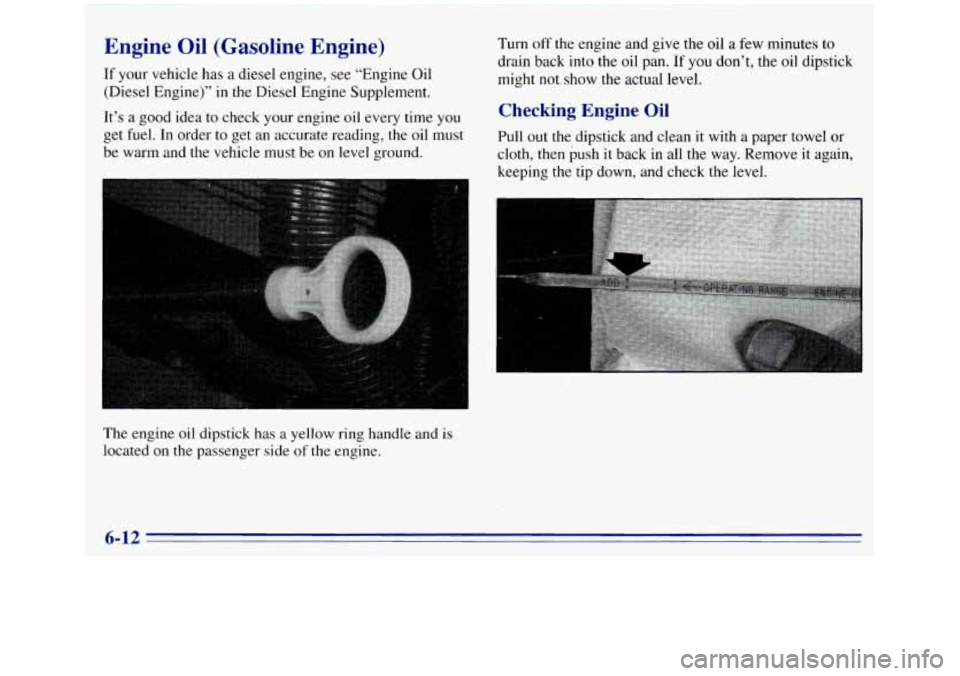
Engine Oil (Gasoline Engine)
If your vehicle has a diesel engine, see “Engine Oil
(Diesel Engine)” in the Diesel Engine Supplement.
It’s a good idea to check your engine oil every time you
get fuel. In order to get an accurate reading, the
oil must
be warm and the vehicle must
be on level ground. Turn
off the
engine and give the oil a few minutes to
drain back into the oil pan.
If you don’t, the oil dipstick
might not.show the actual level.
Checking Engine Oil
Pull out the dipstick and clean it with a paper towel or
cloth, then
push it back in all the way. Remove it again,
keeping the tip down, and check the level.
The engine oil dipstick has a yellow ring handle and is
located on the passenger side
of the engine.
6-12
ProCarManuals.com
Page 263 of 404
When to Add Oil
If the oil is at or below the ADD mark, then you'll need
to add some oil. But you must use the right kind. This
part explains what kind
of oil to use. For crankcase
capacity, see "Capacities and Specifications"
in the Index
NOTICE:
Don't add too much oil. If your engine has so
much oil that the oil level gets above the upper
mark that shows the proper operating range,
your engine could be damaged.
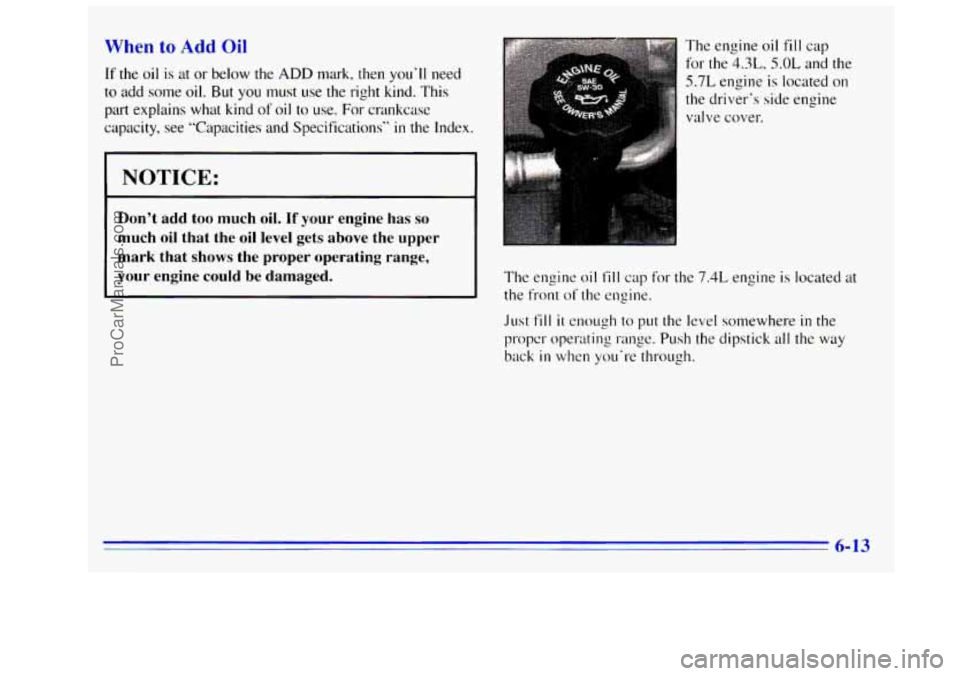
The engine oil fill cap
for the 4.3L, S.OL and the
S.7L engine is located on
the driver's side engine
valve cover.
The engine oil
fill cap for the 7.4L engine is located at
the front
of the engine.
Just fill it enough to put the level somewhere in the
proper operating range. Push the dipstick all the way
hack in when you're through.
6- 13
ProCarManuals.com
Page 269 of 404
Automatic Transmission Fluid
When to Check a1 C’ -ge
A good time to check your auromarlc transmission fluid
level
is when the engine oil is changed.
Change both the fluid and filter every
50,000 miles
(83 000 km) if the vehicle’s GVWR is over 8,600 or
if the vehicle is mainly driven under one or more of
these conditions:
In heavy city traffic where the outside temperature
regularly reaches
90°F (32°C) or higher.
0 In hilly or mountainous terrain.
0 When doing frequent trailer towing.
Uses such as found in taxi, police or delivery service.
If your vehicle’s GVWR is not over 8,600 and you do
not use your vehicle under any of these conditions, the
fluid and filter
do not require changing.
See “Scheduled Maintenance Services’’
in the Index.
How to Check
Because this operation can be a little difficult, you
may choose to have this done at your GM dealership
Service Department. If
you do it yourself,
be sure to follow all the instructions
here, or
you could get a false reading on the dipstick.
NOTICE:
Too much or too little fluid can damage your
transmission.
Too much can mean that some of
i the fluid could come out and fall on hot engine
~ parts or exhaust system parts, starting a fire. Be
sure to get an accurate reading if you check your
transmission fluid.
Wait at least 30 minutes before checking the
transmission fluid level
if you have been driving:
When outside temperatures are above 90°F (32°C).
0 At high speed for quite a while.
In heavy traffic -- especially in hot weather.
While pulling a trailer.
To get the right reading, the fluid should be at normal
operating temperature, which
is 180°F to 200°F (82°C
to 93°C).
6-19
ProCarManuals.com
Page 272 of 404
Manual Transmission Fluid
When to Check
A good time to have it checked is when the engine
oil
is changed. However, the fluid in your manual
transmission doesn’t require changing.
How to Check
Because this operation can be a little difficult, you
may choose to have this done at your GM dealership
Service Department.
If you do it yourself, be sure to follow all the
instructions here, or you could get
a false reading.
NOTICE:
Too much or too little fluid can damage your
transmission.
Too much can mean that some of
the fluid could come out and fall on hot engine
parts or exhaust system parts, starting a fire.
Be
sure to get an accurate reading if you check your
transmission fluid.
II
Check the fluid level only when your engine is off, the
vehicle
is parked on a level place and the transmission
is cool enough for you to rest your fingers on the
transmission case.
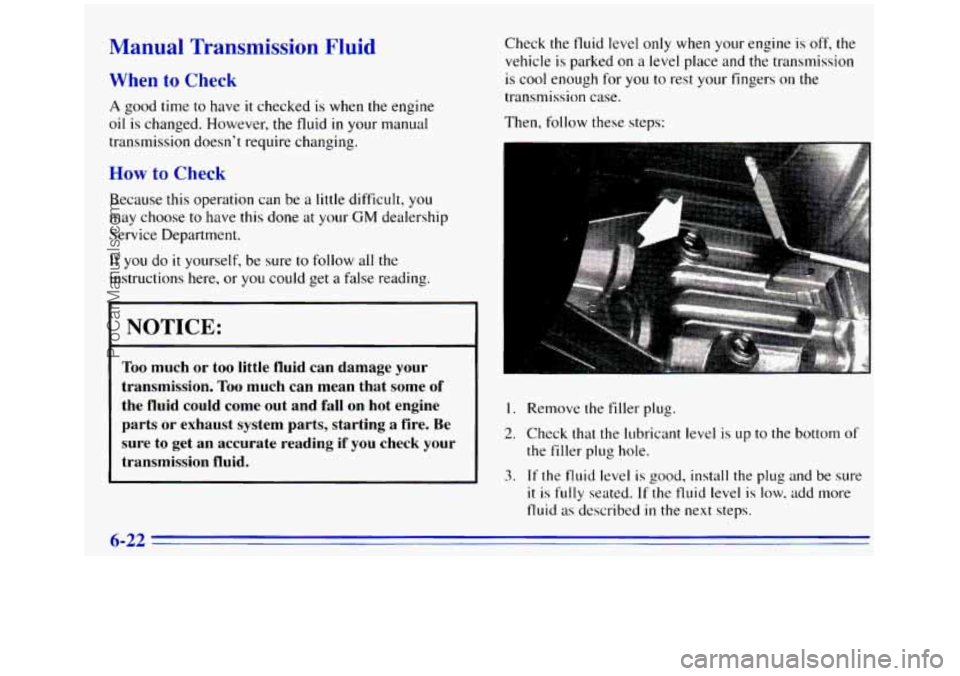
Then, follow these steps:
1. Remove the filler plug.
2. Check that the lubricant level is up to the bottom of
the filler plug hole.
3. If the fluid level is good, install the plug and be sure
it is fully seated. If the fluid level is low, add more
fluid as described in the next steps.
6-22
ProCarManuals.com
Page 327 of 404
Section 7 Maintenance Schedule
I IMPORTANT: I
KEEP ENGINE OIL
AT THE PROPER
LEVEL AND CHANGE AS
RECOMMENDED
This section covers the maintenance required for your
vehicle. Your vehicle needs these services to retain its
safety, depe.ndability and emission control performance.
7- 1
Protection
Plan
Introduction
Your Vehicle and the Environment
Proper vehicle maintenance not only helps to keep your
vehicle
in good working condition. but also helps the
environment.
All 1-ecommended maintenance procedures
are important. Improper vehicle maintenance can even affect the quality of the air we breathe. Improper fluid
levels or the wrong
tire inflation can increase the level
of emissions fr6m your vehicle. To help protect our
environlnent, and to keep your vehicle in good
condition, please maintain your vehicle properly.
ProCarManuals.com
Page 332 of 404
Short TripKity Maintenance Schedule -- Gasoline Engines
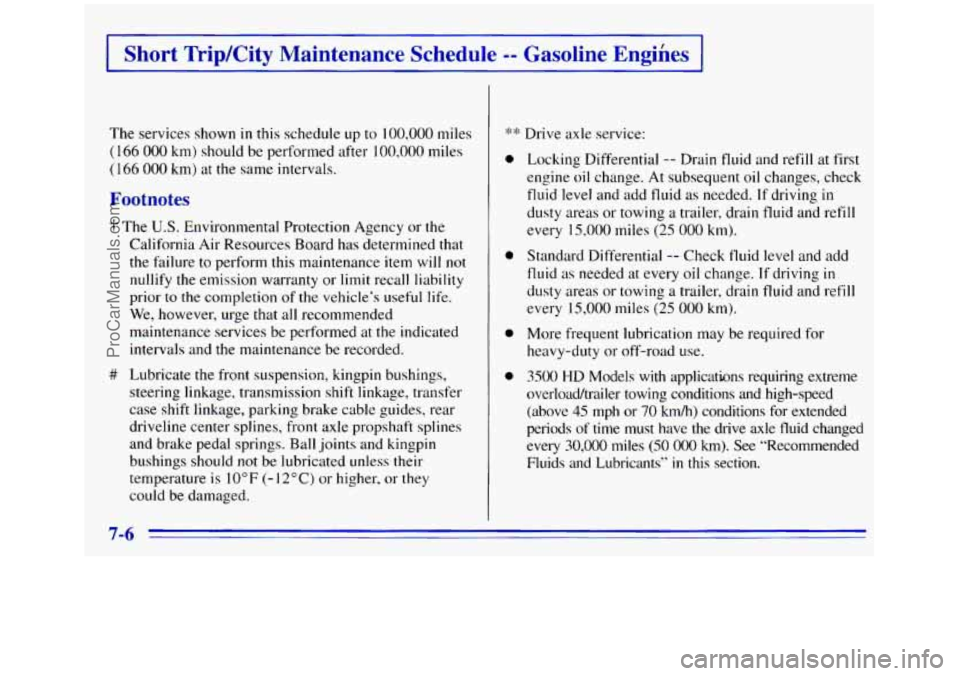
The services shown in this schedule up to 100,000 miles
(1 66 000 km) should be performed after 100,000 miles
(166 000 km) at the same intervals.
Footnotes
T The U.S. Environmental Protection Agency or the
California Air Resources Board has determined that
the failure to perform this maintenance item will
not
nullify the emission warranty or limit recall liability
prior
to the completion of the vehicle‘s useful life.
We, however, urge that all recommended
maintenance services be performed at the indicated
intervals and the maintenance be recorded.
# Lubricate the front suspension, kingpin bushings,
steering linkage, transmission shift linkage, transfer
case shift linkage, parking brake cable guides, rear
driveline center splines, front axle propshaft splines
and brake pedal springs. Ball joints and kingpin
bushings should not be lubricated unless their
temperature is 10°F
(- 12°C) or higher, or they
could be damaged.
:f: :1:
0
0
0
e
Drive axle service:
Locking Differential
-- Drain fluid and refill at first
engine
oil change. At subsequent oil changes, check
fluid level and add fluid as needed. If driving in
dusty areas or towing a trailer, drain fluid and refill
every 15,000 miles
(25 000 km).
Standard Differential -- Check fluid level and add
fluid
as needed at every oil change. If driving in
dusty areas or towing a trailer, drain fluid and refill
every
I5,OOO miles (25 000 km).
More frequent lubrication may be required for
heavy-duty or off-road
use.
3500 HD Models with applications requiring extreme
overload/trailer towing conditions and high-speed
(above
45 mph or 70 kmh) conditions for extended
periods
of time must have the drive axle fluid changed
evey
30,000 miles (50 000 km). See “Recommended
Fluids and Lubricants’’
in this section.
7-6
ProCarManuals.com