oil type GMC SIERRA 1996 Owners Manual
[x] Cancel search | Manufacturer: GMC, Model Year: 1996, Model line: SIERRA, Model: GMC SIERRA 1996Pages: 404, PDF Size: 21.57 MB
Page 154 of 404

Care of Your Cassette Tape Player
A tape player that is not cleaned regularly can cause
reduced sound quality, ruined cassettes
or a damaged
mechanism. Cassette tapes should be stored in their
cases away from contaminants, direct sunlight and
extreme heat. If they aren’t,
they may not operate
properly or may cause failure
of the tape player.
Your tape player should be cleaned regularly after every
50 hours of use. Your radio may display CLN to indicate
that
you have used your tape player for 50 hours without
resetting the tape clean timer.
If you notice a reduction in
sound quality, try a known good cassette to see if the tape
or the tape player is at fault. If this other cassette has no
improvement
in sound quality, clean the tape player.
Cleaning may be done with a scrubbing action,
non-abrasive cleaning cassette with pads which scrub
the tape head as the hubs
of the cleaner cassette turn. It
is normal for the cassette to eject while cleaning because
your unit is equipped with
a cut tape feature. To
temporarily override this feature (for one insertion), turn
the radio off and press and hold TAPE AUX until the
tape symbol flashes on the display, then insert
the
cassette again. Insert the cassette at least three times to
ensure thorough cleaning. A scrubbing action cleaning
cassette
is available through your GM dealer.
You may also choose a non-scrubbing action, wet-type
cleaner which uses a cassette with
a fabric belt to clean the
tape head. This type
of cleaning cassette will not eject. It
may not clean as thoroughly as the scrubbing type cleaner.
Cassettes are subject
to wear and the sound quality may
degrade over time. Always make sure that
the cassette
tape
is in good condition before you have your tape
player serviced.
Care of Your Compact Discs
Handle discs carefully. Store them in their original cases
or other protective cases and away from direct sunlight
and dust.
If the surface of a disc is soiled, dampen a
clean, soft cloth in
a mild, neutral detergent solution and
clean
it, wiping from the center to the edge.
Be sure never
to touch the signal surface when handling
discs. Pick up discs by grasping the outer edges or the
edge of the hole and the outer edge.
Fixed Mast Antenna
The fixed mast antenna can withstand most vehicle
washes without being damaged.
If the mast should ever
become slightly bent, you can straighten
it out by hand.
If the mast is badly bent,
as it might be by vandals, you
should replace it.
Check every once in a while to be sure the mast is still
tightened to the cowl.
3-24
ProCarManuals.com
Page 256 of 404
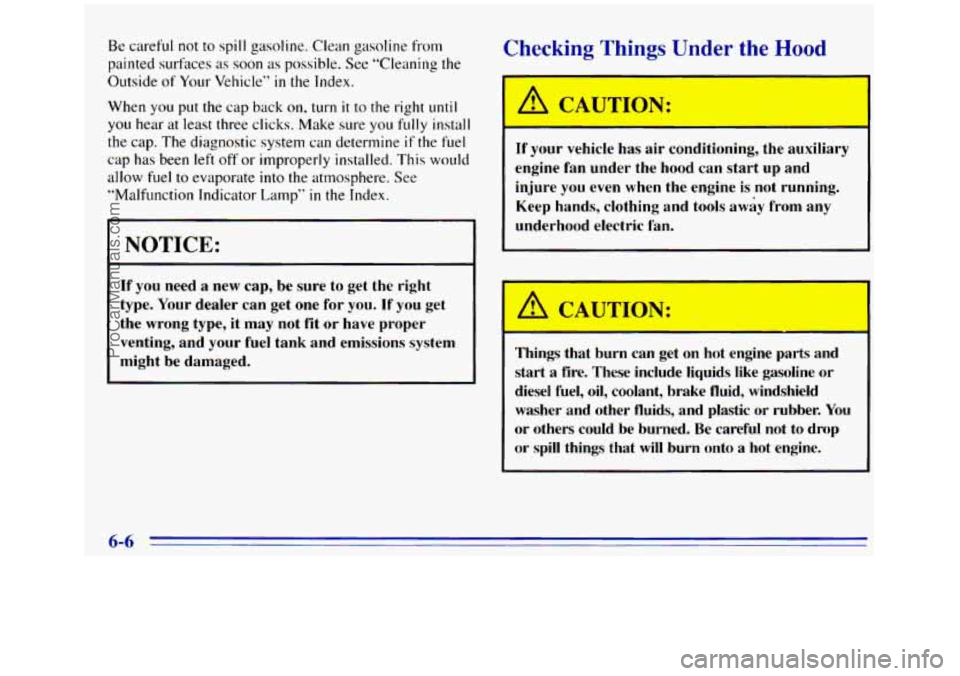
Be careful not to spill gasoline. Clean gasoline from
painted surfxes as soon
as possible. See “Cleaning the
Outside
of Your Vehicle” in the Index.
When you put the cap back
on, turn it to the right until
you hear at least three clicks. Make sure you fully install
the cap. The diagnostic system can determine if the fuel
cap has been
left off or improperly installed. This would
allow
fuel to evaporate into the atmosphere. See
“Malfunction Indicator Lamp” in the Index.
I NOTICE:
If you need a new cap, be sure to get the right
type. Your dealer can get one for you. If you get
the wrong type, it may not fit or have proper
venting, and your fuel tank and emissions system
might be damaged.
Checking Things Under the Hood
h
I ! CAUTION:
If your vehicle has air conditioning, the auxiliary
engine fan under the hood can start up and
hjure you even when the engine
is not running.
Keep hands, clothing and tools away from any
underhood electric fan.
Things that burn can get on hot engine parts and
start a fire. These include liquids like gasoline or
diesel fuel, oil, coolant, brake fluid, windshield
washer and other fluids, and plastic or rubber.
You
or others could be burned. Be careful not to drop
or spill things that will burn onto a hot engine.
6-6
ProCarManuals.com
Page 309 of 404
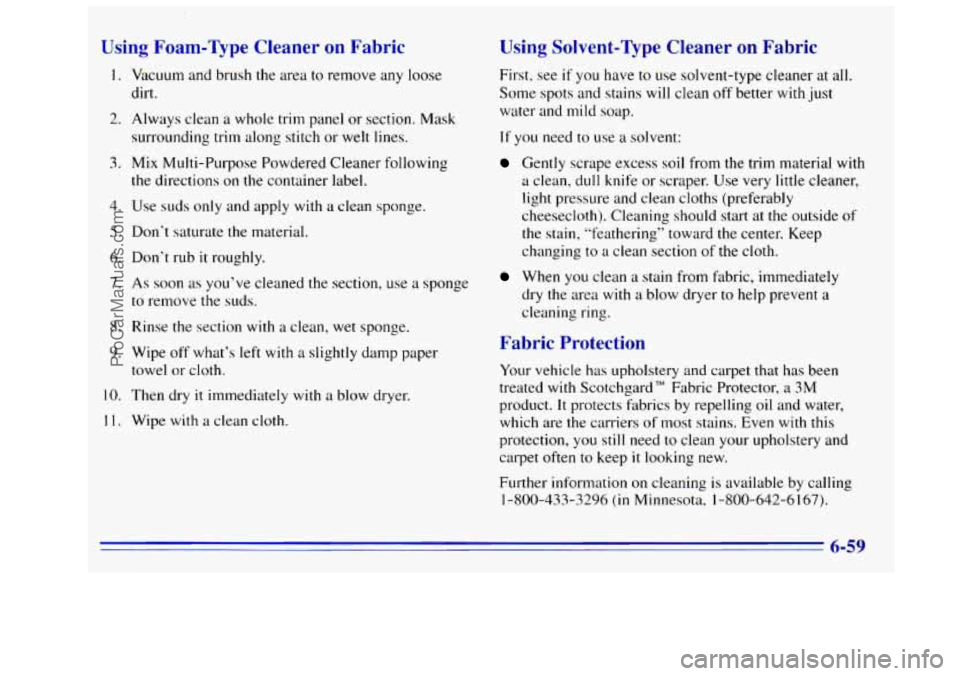
Using Foam-Type Cleaner T I ~. ~. .
1. Vacuum and brush the area to remove any loose
dirt.
2. Always clean a whole trim panel or section. Ma *
3. Mix Multi-Purpose Powdered Cleaner following
surrounding
trim along stitch or welt lines.
the directions on the container label.
4. Use suds only and apply with
a clean sponge.
5. Don’t saturate the material.
6. Don’t rub it roughly.
7. As soon as you’ve cleaned the section, use a sponge
to remove the suds.
8. Rinse the section with a clean, wet sponge.
9. Wipe off what’s left with a slightly damp paper
towel or cloth.
10. Then dry it immediately with a blow dryer.
Using Solvent-Type Cleaner on Fabric
First, see if you have to use solvent-type cleaner at all.
Some spots and stains will clean off better with just
water and mild soap.
If you need to use a solvent:
Gently scrape excess soil from the trim material with
a clean, dull knife or scraper. Use very little cleaner,
light pressure and clean cloths (preferably
cheesecloth). Cleaning should start at the outside of
the stain, “feathering” toward
the center. Keep
changing to a clean section
of the cloth.
When you clean a stain from fabric, immediately
dry the area
with a blow dryer to help prevent a
cleaning ring.
Fabric Protection
Your vehicle has upholstery and carpet that has been
treated with Scotchgard’” Fabric Protector, a
3M
product. It protects fabrics by repelling oil and water,
which are the carriers
of most stains. Even with this
protection, you still need to clean your upholstery and
carpet often to keep
it looking new.
11. Wipe with a clean cloth.
Further information
on cleaning is available by calling
1-800-433-3296 (in Minnesota, 1-800-642-61 67).
ProCarManuals.com
Page 310 of 404
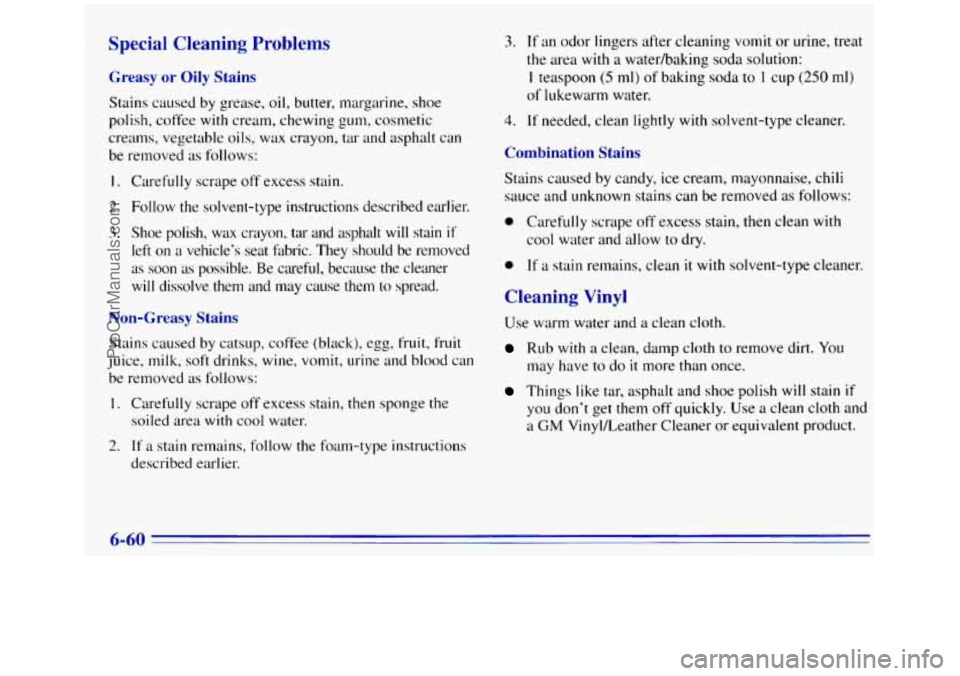
Special Cleaning Problems
Greasy or Oily Stains
Stains caused by grease, oil, butter, margarine, shoe
polish, coffee
with cream, chewing gum, cosmetic
creams, vegetable oils, wax crayon, tar and asphalt can
be removed
as follows:
1. Carefully scrape off excess stain.
2. Follow the solvent-type instructions described earlier.
3. Shoe polish, wax crayon, tar and asphalt will stain if
left on a vehicle’s seat fabric. They should be removed
as soon
as possible. Be careful, because the cleaner
will dissolve them and may cause them to spread.
Non-Greasy Stains
Stains caused by catsup, coffee (.black), egg, fruit, fruit
juice, milk, soft drinks, wine, vomit, urine and blood can
be removed
as follows:
1. Carefully scrape off excess stain, then sponge the
soiled area with cool water.
2. If a stain remains, follow the foam-type instructions
described earlier.
3. If an odor lingers after cleaning vomit or urine, treat
the area with
a waterhaking soda solution:
I teaspoon (5 ml) of baking soda to 1 cup (250 ml)
of lukewarm water.
4. If needed, clean lightly with solvent-type cleaner.
Combination Stains
Stains caused by candy, ice cream, mayonnaise, chili
sauce and
unknown stains can be removed as follows:
0 Carefully scrape off excess stain, then clean with
cool water and allow to dry.
0 If a stain remains, clean it with solvent-type cleaner.
Cleaning Vinyl
Use warm water and a clean cloth.
Rub with a clean, damp cloth to remove dirt. You
may have to do it more than once.
Things like tar, asphalt and shoe polish will stain if
you don’t get them off quickly. Use a clean cloth and
a GM VinyVLeather Cleaner or equivalent product.
6-60
ProCarManuals.com
Page 325 of 404
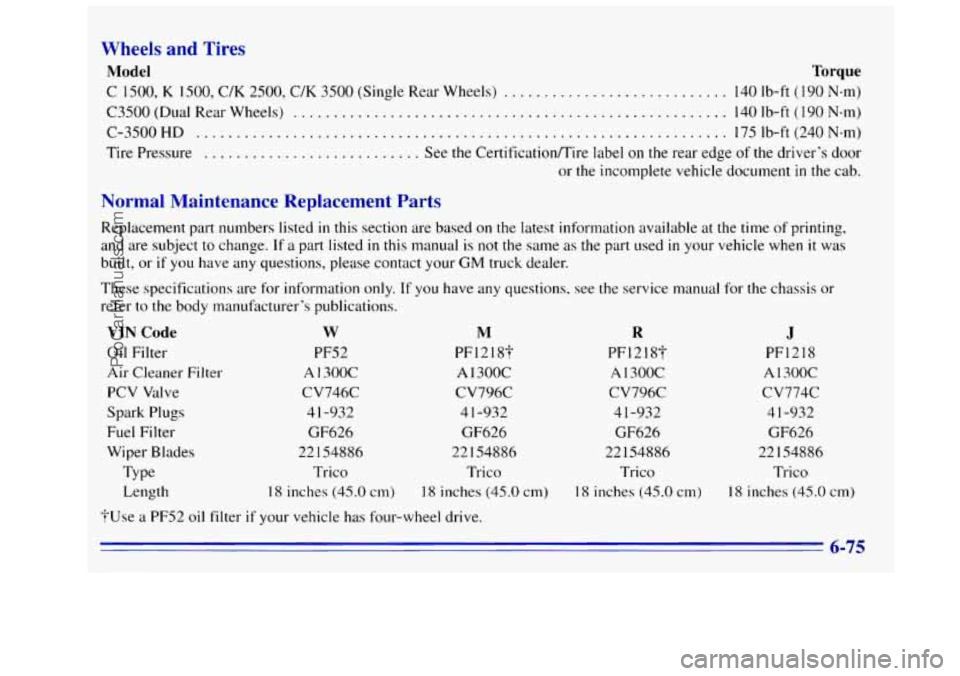
Wheels and Tires
Model Torque
C 1500, K 1500, C/K 2500, C/K 3500 (Single Rear Wheels) ............................ 140 Ib-ft (190 N-m)
C3500 (Dual
Rear Wheels) ...................................................... 140 Ib-ft (190 N-m)
Tire Pressure ........................... See the Certificationflire label on the rear edge of the driver's door
or the incomplete vehicle document in the cab.
C-3500HD
.................................................................. 175Ib-ft(240N-m)
Normal Maintenance Replacement Parts
Replacement part numbers listed in this section
are based on the latest information available at the time of printing,
and are subject to change.
If a part listed in this manual is not the same as the part used in your vehicle when it was
built, or
if you have any questions, please contact your GM truck dealer.
These specifications are
for information only. If you have any questions. see the service manual for the chassis or
refer
to the body manufacturer's publications.
VIN Code w M
Oil Filter PF52
PF1218T
Air
Cleaner Filter A 1300C A 1300C
PCV Valve CV746C CV796C
Spark Plugs 4 1-932 4 1-932
Fuel Filter GF626
GF626
Wiper Blades 22 154886 221 54886
Type Trico Trico
Length
18 inches (45.0 cm) 18 inches (45.0 cm)
?Use a PF52 oil filter if your vehicle has four-wheel drive.
R
PF1218T
A 130OC
CV796C
4 1-932
GF626
22 154886
Trico
18 inches (45.0 cm)
J
PF1218
A
1300C
cv774c
41 -932
GF626
22 154886
Trico
18 inches (45.0 cm)
6-75
ProCarManuals.com