engine GMC SIERRA 1997 Owners Manual
[x] Cancel search | Manufacturer: GMC, Model Year: 1997, Model line: SIERRA, Model: GMC SIERRA 1997Pages: 436, PDF Size: 23.38 MB
Page 313 of 436
NOTICE:
Using the wrong fluid can badly damage
brake system parts.
For example, just a few
drops of mineral-based oil, such
as engine
oil, in your brake system can damage brake
system parts
so badly that they’ll have to be
replaced. Don’t let someone put in the
wrong kind of fluid.
If you spill brake fluid on your vehicle’s
painted surfaces, the paint finish can be
damaged. Be careful not to spill brake fluid
on your vehicle. If you do, wash
it off
immediately. See “Appearance Care” in
the Index.
Brake Wear
If you have a C 3500 HD model, it has four-wheel disc
brakes without wear indicators.
If you ever hear a brake
rubbing noise, have the brake linings inspected.
If your pickup is not a
C 3500 HD model, it has front
disc brakes and rear drum brakes. Disc brake pads
(except
C 3500 HD models) have
built-in wear indicators that make a high-pitched
warning sound when the brake pads are worn and new
pads
are needed. The sound may come and go or be
heard all the time your vehicle is moving (except when
you are pushing on
the brake pedal firmly).
The brake wear warning sound means that soon
your brakes won’t work well. That could lead to
an accident. When you hear the brake wear
warning sound, have your vehicle serviced.
NOTICE:
Continuing to drive with worn-out brake pads
could result in costly brake repair.
ProCarManuals.com
Page 315 of 436
Battery
Every new vehicle has a Delco Freedom@ battery. You
never have to add water to one
of these. When it’s time
for a new battery, we recommend a Delco Freedom
battery. Get one that
has the replacement number shown
on the original battery’s label.
Vehicle Storage
If you’re not going to drive your vehicle for 25 days or more,
take
off the black, negative (-) cable from the battery.
This will help keep your battery from running down.
A CA“T1ON:
Bulb Replacement
Before you replace any bulbs, be sure that all the lamps
are off and the engine isn’t running. See “Replacement
Bulbs”
in the Index for the proper types of bulbs to use.
Halogen Bulbs
Batteries have acid that can burn you and gas
that can explode. You can be badly hurt if you
aren’t careful. See
“Jump Starting” in the Index
for tips on working around
a battery without
getting hurt.
Contact your dealer to learn how to prepare your vehicle
for longer storage periods.
Also, for your audio system, see “Theft-Deterrent
Feature”
in the Index.
-N:
Halogen bulbs have pressurized gas inside and
can burst if you drop or scratch the bulb.
You or
others could be injured. Be sure to read and
follow the instructions on the bulb package.
ProCarManuals.com
Page 345 of 436
Vehicle Identification Number (VIN)
111 111 111111 II
SAMPLE4UXVM072675 IS1 I
ENGINEA7 f 1 ASSEMBLY
CODE MODEL YEAR PLANT
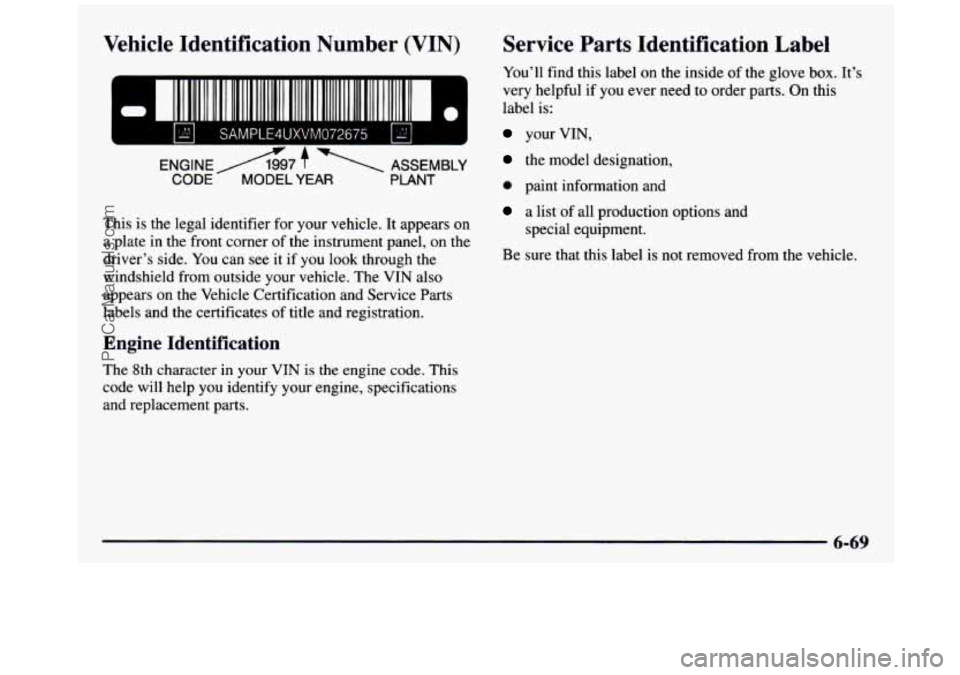
This is the legal identifier for your vehicle. It appears on
a plate in the front corner of the instrument panel, on the
driver’s side. You can see
it if you look through the
windshield from outside your vehicle. The VIN also
appears on the Vehicle Certification
and Service Parts
labels and the certificates
of title and registration.
Engine Identification
The 8th character in your VIN is the engine code. This
code will help you identify your engine, specifications
and replacement parts.
Service Parts Identification Label
You’ll find this label on the inside of the glove box. It’s
very helpful
if you ever need to order parts. On this
label is:
your VIN,
the model designation,
0 paint information and
a list of all production options and
special equipment.
Be sure that this label is not removed from the vehicle.
6-69
ProCarManuals.com
Page 348 of 436
2
3
J
D
07
U13
OiQ
03 04
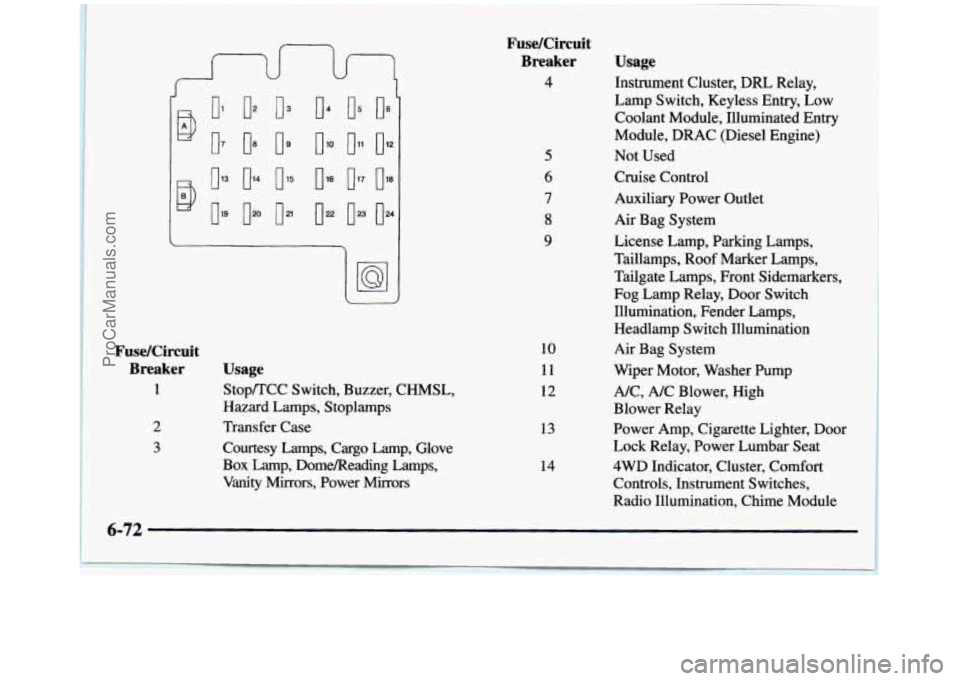
FusdCircuit Breaker Usage
1 Stop/TCC Switch, Buzzer, CHMSL,
Hazard Lamps, Stoplamps
Transfer Case
Courtesy Lamps, Cargo Lamp, Glove
Box Lamp, DomeReading Lamps,
Vanity Mirrors, Power Mirrors
FuseEircuit Breaker
4
10
11
12
13
14
Usage
Instrument Cluster, DRL Relay,
Lamp Switch, Keyless Entry, Low
Coolant Module, Illuminated Entry
Module, DRAC (Diesel Engine)
Not Used
Cruise Control
Auxiliary Power Outlet
Air Bag System
License Lamp, Parking Lamps,
Taillamps,
Roof Marker Lamps,
Tailgate Lamps, Front Sidemarkers,
Fog Lamp Relay, Door Switch
Illumination, Fender Lamps,
Headlamp Switch Illumination
Air Bag System
Wiper Motor, Washer Pump
A/C, A/C Blower, High
Blower Relay
Power Amp, Cigarette Lighter, Door
Lock Relay, Power Lumbar Seat
4WD Indicator, Cluster, Comfort
Controls, Instrument Switches,
Radio Illumination, Chime Module
6-72
ProCarManuals.com
Page 349 of 436
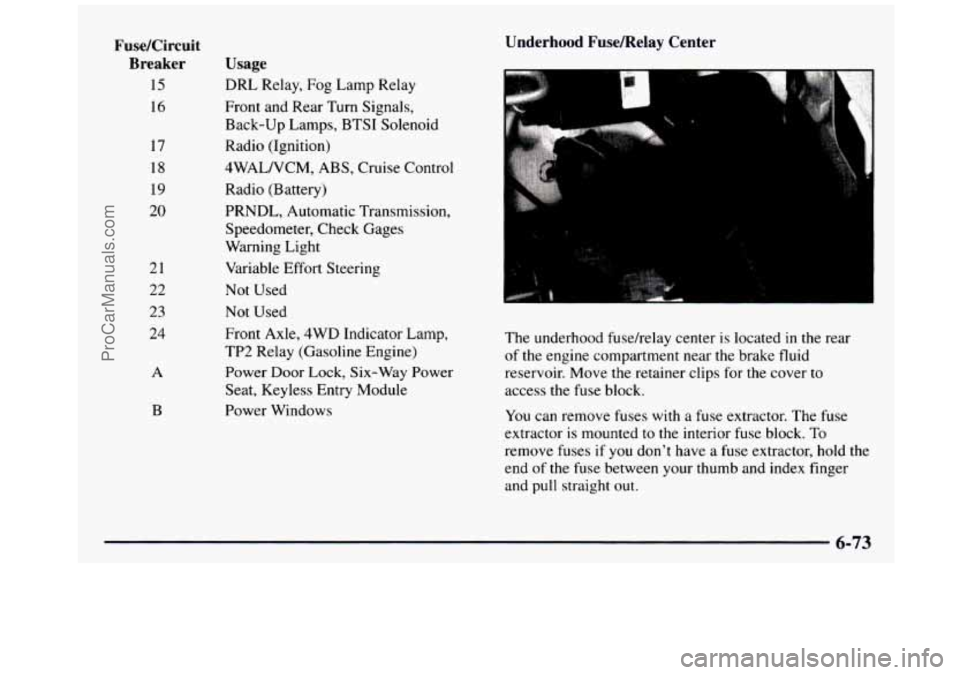
FuseKircuit Breaker
15
16
17
18
19
20
21
22
23
24
A
B
Usage
DRL Relay, Fog Lamp Relay
Front and Rear Turn Signals,
Back-up Lamps, BTSI Solenoid
Radio (Ignition)
LCWALNCM, ABS, Cruise Control
Radio (Battery)
PRNDL, Automatic Transmission, Speedometer, Check Gages
Warning Light
Variable Effort Steering
Not Used
Not Used
Front Axle, 4WD Indicator Lamp,
TP2 Relay (Gasoline Engine)
Power Door Lock, Six-Way Power
Seat, Keyless Entry Module
Power Windows
Underhood Fusemelay Center
The underhood fusehelay center is located in the rear
of the engine compartment near the brake fluid
reservoir. Move the retainer clips for the cover to
access the fuse block.
You can remove fuses with
a fuse extractor. The fuse
extractor
is mounted to the interior fuse block. To
remove fuses
if you don’t have a fuse extractor, hold the
end of the fuse between your thumb and index finger
and
pull straight out.
ProCarManuals.com
Page 350 of 436
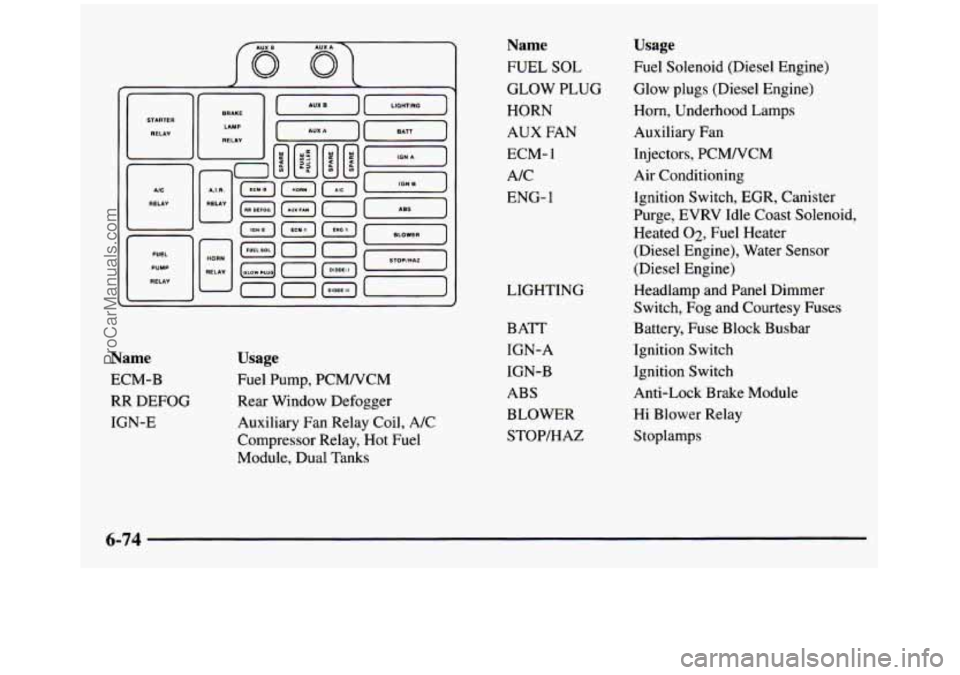
Name
ECM-B
RR DEFOG IGN-E
Usage
Fuel Pump, PCMNCM
Rear Window Defogger
Auxiliary Fan Relay Coil,
A/C
Compressor Relay, Hot Fuel
Module, Dual Tanks
Name
FUEL SOL
GLOW PLUG
HORN
AUX FAN
ECM-
1
NC
ENG-
1
LIGHTING
BATT
IGN-A
IGN-B ABS
BLOWER STOP/HAZ
Usage
Fuel Solenoid (Diesel Engine)
Glow plugs (Diesel Engine)
Horn, Underhood Lamps
Auxiliary Fan
Injectors,
PCMNCM
Air Conditioning
lgnition Switch,
EGR, Canister
Purge,
EVRV Idle Coast Solenoid,
Heated
02, Fuel Heater
(Diesel Engine), Water Sensor
(Diesel Engine)
Headlamp and Panel Dimmer
Switch,
Fog and Courtesy Fuses
Battery, Fuse Block Busbar
Ignition Switch
Ignition Switch
Anti-Lock Brake Module
Hi Blower Relay
Stoplamps
6-74
ProCarManuals.com
Page 352 of 436
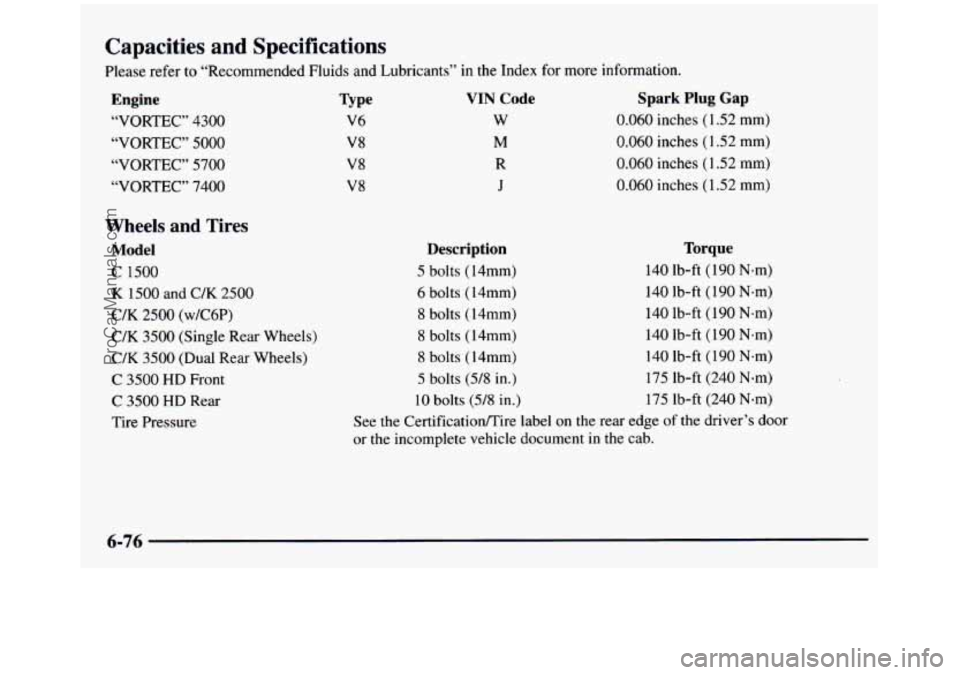
Capacities and Specifications
Please refer to “Recommended Fluids and Lubricants” in the Index for more information.
Engine Type VIN Code Spark Plug Gap
“VORTEC”
4300 V6 W 0.060 inches (1.52 mm)
“VORTEC” 5000 V8 M 0.060 inches (1.52 mm)
“VORTEC”
5700 V8 R 0.060 inches (1.52 mm)
“VORTEC” 7400
V8 J 0.060 inches (1.52 mm)
Wheels and Tires
Model
C 1500
K 1500 and C/K 2500
C/K 2500 (w/C6P)
C/K
3500 (Single Rear Wheels)
C/K 3500 (Dual Rear Wheels)
C 3500 HD Front
C 3500 HD Rear
Tire Pressure
Description Torque
5 bolts (14mm) 140 lb-ft (190 N-m)
6 bolts (14mm) 140 lb-ft ( 190 Nam)
8 bolts (14mm)
140 lb-ft ( 190 N-m)
8 bolts (14mm) 140 lb-ft ( 190 N-m)
8 bolts (14mm) 140 lb-ft ( 190 N-m)
5 bolts (5/8 in.) 175 lb-ft (240 N-m)
10 bolts (5/8 in.) 175
lb-ft (240 N-m)
See the CertificatiodTire label on the rear edge of the driver’s door
or the incomplete vehicle document
in the cab.
6-76
ProCarManuals.com
Page 354 of 436
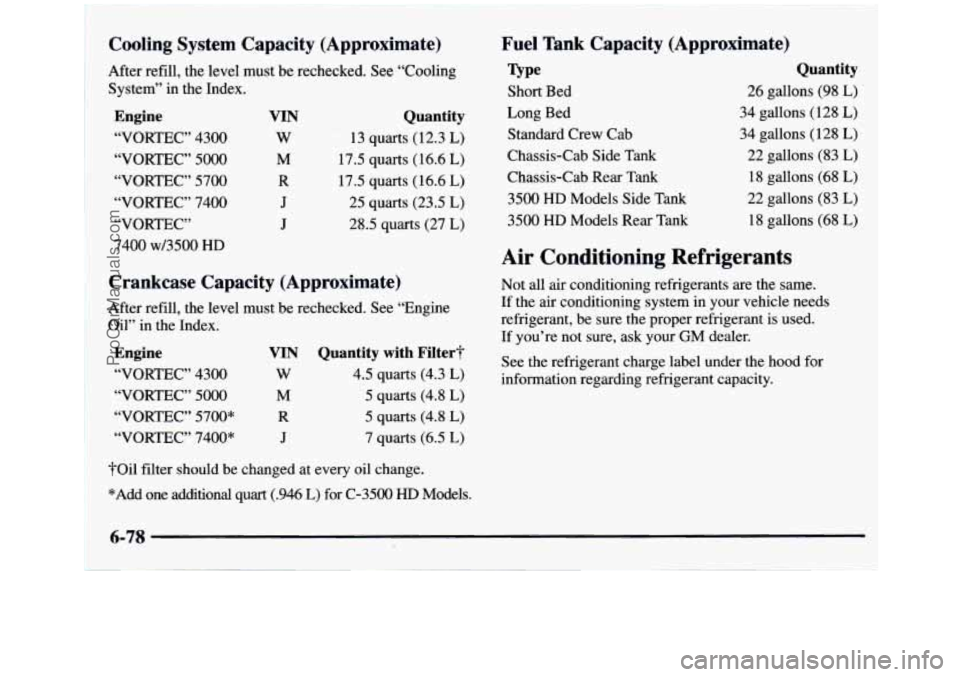
Fuel Tank Capacity (Approximate)
Type
Short Bed
Long Bed Standard Crew Cab
Chassis-Cab Side Tank
Chassis-Cab Rear Tank 3500
HD Models Side Tank
3500
HD Models Rear Tank
Cooling System Capacity (Approximate)
After refill, the level must be rechecked. See “Cooling
System” in the Index.
Engine
“VORTEC” 4300
“VORTEC”
5000
“VORTEC” 5700
“VORTEC” 7400
“VORTEC”
7400
w/3500 HD
VIN
W
M
R
J
J
Quantity
13 quarts (12.3 L)
17.5 quarts (16.6 L)
17.5 quarts (16.6 L)
25 quarts (23.5 L)
28.5 quarts (27 L)
Crankcase Capacity (Approximate)
After refill, the level must be rechecked. See “Engine
Oil” in the Index.
Engine
“VORTEC” 4300
“VORTEC”
5000
“VORTEC” 5700”
“VORTEC” 7400*
VIN
W
M
R
J
Quantity with Filter?
5 quarts (4.8 L)
5 quarts (4.8 L)
7 quarts (6.5 L)
4.5 quarts (4.3
L)
?Oil
filter should be changed at every oil change.
*Add one additional quart (.946
L) for C-3500 HD Models.
Quantity
26 gallons (98 L)
34 gallons (128 L)
34 gallons (128 L)
22 gallons (83 L)
18 gallons (68 L)
22 gallons (83 L)
18 gallons (68 L)
Air Conditioning Refrigerants
Not all air conditioning refrigerants are the same.
If the
air conditioning system in your vehicle needs
refrigerant, be sure the proper refrigerant
is used.
If you’re not sure, ask your GM dealer.
See the refrigerant charge label under the hood for
information regarding refrigerant capacity.
6-78
ProCarManuals.com
Page 356 of 436
Introduction
IMPORTANT:
KEEP ENGINE OIL
AT THE PROPER
LEVEL AND CHANGE AS
RECOMMENDED
I
Your Vehicle and the Environment
Proper vehicle maintenance not only helps to keep your
vehicle
in good working condition, but also helps the
environment. All recommended maintenance procedures
are important. Improper vehicle maintenance can
even
affect the quality of the air we breathe. Improper fluid
levels or the wrong tire inflation can increase the level
of emissions from your vehicle. To help protect our
environment, and to keep your vehicle in good
condition, please maintain your vehicle properly.
Have you purchased the GM Protection Plan? The Plan
supplements
your new vehicle warranties. See your
Warranty and Owner Assistance booklet, or your
GM dealer for details.
7-2
ProCarManuals.com
Page 358 of 436
Part A: Scheduled Maintenance
Services
Using Your Maintenance Schedule
We at General Motors want to help you keep your vehicle
in good working condition. But we don’t know exactly
how you’ll drive it.
You may drive very short distances
only
a few times a week. Or you may drive long distances
all the time in
very hot, dusty weather. You may use your
vehicle
in making deliveries. Or you may drive it to work,
to do errands or
in many other ways.
Because of all the different ways people use their GM
vehicles, maintenance needs vary. You may even need
more frequent checks and replacements than you’ll find
in
the schedules in this section. So please read this
section and note how you drive. If you have any
questions
on how to keep your vehicle in good
condition, see your GM dealer.
This part tells you the maintenance services you should
have done and when you should schedule them. If you
go to your dealer for your service needs, you’ll know
that GM-trained and supported service people will
perform the work using genuine
GM parts.
The proper fluids
and lubricants to use are listed in Part D.
Make sure whoever services your vehicle uses these. All parts should
be replaced and all necessary repairs done
before you
or anyone else drives the vehicle.
These schedules are for vehicles that:
0
0
0
0
carry passengers and cargo within recommended
limits. You will find these limits on your vehicle’s
Certificatioflire label. See “Loading Your Vehicle”
in the Index.
are driven
on reasonable road surfaces within legal
driving limits.
are driven off-road in the recommended manner. See
“Off-Road Driving With Your Four-Wheel-Drive
Vehicle’’
in the Index.
use the recommended fuel. See “Fuel”
in the Index.
Selecting the Right Schedule
First you’ll need to decide which of the two schedules is
right for your vehicle. Here’s how to decide which
schedule to follow:
Gasoline engine vehicles and diesel engine vehicles
have different maintenance requirements. If you have a
diesel engine, follow
a schedule designated for diesel
engine vehicles only.
See the Diesel Engine Supplement for diesel engine
maintenance schedules.
7-4
ProCarManuals.com