towing GMC SIERRA 1997 User Guide
[x] Cancel search | Manufacturer: GMC, Model Year: 1997, Model line: SIERRA, Model: GMC SIERRA 1997Pages: 436, PDF Size: 23.38 MB
Page 179 of 436
Section 4 Your Driving and the Road
Here you’ll find information about driving on different kinds of roads and in varying weather conditions. We’ve also
included many other useful tips on driving.
4-2 4- 3
4-6
4-6
4-9
4-1
1
4- 12
4-13
4- 14
4-27 4-29 Defensive Driving
Drunken Driving
Control
of a Vehicle
Braking
Steering
Off-Road Recovery
Passing
Loss
of Control
Driving Guidelines
Driving
at Night
Driving
in Rain and on Wet Roads 4-32
4-32
4-34
4-35
4-35
4-37
4-4
1
4-45
4-45
4-45 City Driving
Freeway Driving
Before Leaving
on a Long Trip
Highway Hypnosis
Hill and Mountain Roads
Winter Driving
Loading Your Vehicle
Camper Wiring Harness Pickup Conversion
to Chassis Cab
Towing a Trailer
4-1
ProCarManuals.com
Page 223 of 436
Trailer Recommendations
You must subtract your hitch loads from the CWR for
your vehicle. Weigh your vehicle with the trailer attached,
so that you won’t go over the GVWR or GAWR.
You’ll get
the best performance if you spread out the
weight of your load the right way, and if you choose the
correct hitch and trailer brakes.
For more information, see ‘Trailer Towing”
in the Index.
Camper Wiring Harness (If Equipped)
A five-wire harness is stored in the front stake pocket on
the driver’s side of the bed. The harness has no connector
and should be wired by
a qualified electrical technician. It
must be routed out of your vehicle and securely attached
so that it won’t be pulled or rubbed while you’re using
it. Store the harness in its original position. Wrap the
harness together and tie
it neatly so it won’t be damaged.
Pickup Conversion to Chassis Cab
General Motors is aware that some vehicle owners
may consider having the pickup box removed and a
commercial or recreational body installed. Before
you
do so, first contact the GM Zone Office for your area for
information on such conversions specific to this vehicle.
(See the “Warranty and Owner Assistance” booklet for Zone
Office.) Owners should be aware that,
as
manufactured, there are differences between a chassis
cab and a pickup with the box removed which may
affect vehicle safety. The components necessary to adapt
a pickup to permit its safe use with
a specialized body
should be installed by a body builder in accordance with
the information available from the Zone Office.
Towing a Trailer
If you don’t use the correct equipment and drive
properly, you can lose control when you pull a
trailer. For example, if the trailer is too heavy, the
brakes may not work well
-- or even at all. You
and your passengers could be seriously injured.
Pull a trailer only if you have followed all the
steps in this section.
Ask your GM dealer for
advice and information about towing a trailer with your vehicle.
4-45
ProCarManuals.com
Page 224 of 436
NOTICE:
Pulling a trailer improperly can damage your
vehicle and result in costly repairs not covered
by
your warranty. To pull a trailer correctly, follow
the advice in this part, and see your
GM dealer
for important information about towing a trailer with
your vehicle.
Every vehicle is ready for some trailer towing. If yours
was built with trailering options, as many are, it’s ready
for heavier trailers. But trailering is different than just
driving your vehicle by itself. Trailering means changes
in handling, durability and fuel economy. Successful,
safe trailering takes correct equipment, and it has
to be
used properly.
That’s the reason for this part. In it are many
time-tested, important trailering tips and safety rules.
Many
of these are important for your safety and that of
your passengers.
So please read this section carefully
before
you pull a trailer.
If You Do Decide To Pull A Trailer
If you do, here are some important points:
0
0
0
0
There are many different laws, including speed limit
restrictions, having
to do with trailering. Make sure
your
rig will be legal, not only where you live but
also where you’ll be driving.
A good source for this
information can be state
or provincial police.
Consider using
a sway control if your trailer will
weigh less than the capacity stamped on your step
bumper.
You should always use a sway control if
your trailer will weigh more than the capacity
stamped on your step bumper. You can ask
a hitch
dealer about sway controls.
Don’t tow a trailer at all during the first
500 miles
(800 km) your new vehicle is driven. Your engine,
axle or other parts could be damaged.
Then, during the first
500 miles (800 km) that you
tow a trailer, don’t drive over 50 mph (80 kmh) and
don’t make starts at full throttle. This helps your
engine and other parts of your vehicle wear in at the
heavier loads.
4-46
ProCarManuals.com
Page 225 of 436
a If you have an automatic transmission, you can tow
in OVERDRIVE (@). You may want to shift the
transmission to THIRD
(3) or, if necessary, a lower
gear selection if the transmission shifts too often
(e.g., under heavy loads and/or hilly conditions). If
you have a manual transmission and you are towing
a trailer, it’s better not to use FIFTH (5) gear. Just
drive in
FOURTH (4) gear (or, as you need to,
a lower gear).
Three important considerations have to do with weight:
the weight of the trailer,
the weight of the trailer tongue
and the weight on your vehicle’s tires.
Weight of the Trailer
How heavy can a trailer safely be?
It depends on how you plan to use your rig. For example,
speed, altitude, road grades, outside temperature and
how much your vehicle is used to pull a trailer are all
important. And, it can also depend
on any special
equipment that you have on your vehicle. Use
one of the following charts to determine how much
your vehicle can weigh, based upon your vehicle model
and options.
Maximum trailer weight is calculated assuming the
driver and one passenger are in the tow vehicle and it
has all
the required trailering equipment. The weight of
additional optional equipment, passengers and cargo in
the tow vehicle must be subtracted from the maximum
trailer weight.
Above the
2,000 lbs. (908 kg) trailer rating, the engine
oil cooler is required
on C/K-1500 and C/K-2500
models with gas engines. Refer to the Trailering Guide
for oil cooler recommendations.
Above the
5,000 lbs. (2 270 kg) trailer rating, heavy-duty
or gas shock absorbers are required on
C- 1500 models,
and heavy-duty shock absorbers or the off-road chassis
package are required on
K- 1500 models.
4-47
ProCarManuals.com
Page 232 of 436
Safety Chains
You should always attach chains between your vehicle
and your trailer. Cross the safety chains under the tongue
of the trailer so that the tongue will not drop to the road
if it becomes separated from
the hitch. Instructions
about safety chains may be provided by the hitch
manufacturer or by the trailer manufacturer. Follow the
manufacturer’s recommendation for attaching safety
chains and do not attach them to
the bumper. Always
leave just enough slack
so you can turn with your rig.
And, never allow safety chains to drag on the ground.
Trailer Brakes
If your trailer weighs more than 1,000 Ibs. (450 kg)
loaded, then it needs its own brakes
-- and they must be
adequate. Be sure
to read and follow the instructions for
the trailer brakes
so you’ll be able to install, adjust and
maintain them properly.
Your trailer brake system can tap into the vehicle’s
hydraulic brake system
only if:
The trailer parts can withstand 3,OOO psi (20 650 Wa)
of pressure.
The trailer’s brake system will use less than 0.02
cubic inch (0.3 cc) of fluid from your vehicle’s
master cylinder. Otherwise, both braking systems
won’t work well.
You could even lose your brakes.
If everything checks out this far, make the brake tap at the
port on the master cylinder that sends the fluid to the rear \
brakes. But don’t use copper tubing for this.
If you do, it
will bend and finally break off. Use steel brake tubing.
Driving with a Trailer
Towing a trailer requires a certain amount of experience.
Before setting out for the open road, you’ll want to get
to know your rig. Acquaint yourself with the feel of
handling and braking with the added weight of the
trailer. And always keep
in mind that the vehicle you are
driving is now a
good deal longer and not nearly as
responsive as your vehicle
is by itself.
Before you start, check the trailer hitch and platform
(and attachments), safety chains, electrical connector,
lamps, tires and mirror adjustment. If
the trailer has
electric brakes, start your vehicle and trailer moving and
then apply the trailer brake controller by hand to be sure
the brakes are working. This lets you check your
electrical connection at the same time.
During your trip, check occasionally to be sure that the
load is secure, and that the lamps and any trailer brakes
are still working.
4-54
ProCarManuals.com
Page 233 of 436
Following Distance Making Tt----- -
Stay at least twice as far behind the vehicle ahead as you
would when driving your vehicle without a trailer. This
can help you avoid situations that require heavy braking
and sudden turns.
Passing
You’ll need more passing distance up ahead when
you’re towing a trailer. And, because you’re a good deal
longer, you’ll need to go much farther beyond the
passed vehicle before
you can return to your lane.
Backing Up
Hold the bottom of the steering wheel with one hand.
Then, to move the trailer to the left, just move that hand
to the left.
To move the trailer to the right, move your
hand to the right. Always back up slowly and, if
possible, have someone guide you.
NOTICE:
Making very sharp turns while trailering could
cause the trailer to come in contact with the
vehicle. Your vehicle could be damaged. Avoid
making very sharp turns while trailering.
When you’re turning with a trailer, make wider turns
than normal.
Do this so your trailer won’t strike
soft shoulders, curbs, road signs, trees or other
objects. Avoid jerky or sudden maneuvers. Signal
well in advance.
ProCarManuals.com
Page 234 of 436
Turn Signals When Towing a Trailer
The arrows on your instrument panel will flash
whenever you signal a turn or lane change. Properly
hooked up, the trailer lamps will also flash, telling other
drivers you’re about to turn, change lanes or stop.
When towing a trailer, the arrows on your instrument
panel will flash for turns even if the bulbs
on the trailer
are burned out. Thus, you may think drivers behind you
are seeing your signal when they are not. It’s important
to check occasionally to be sure the trailer bulbs are
still working.
Driving On Grades
Reduce speed and shift to a lower gear before you start
down a long or steep downgrade. If you don’t shift
down,
you might have to use your brakes so much that
they would get hot and no longer work well.
On
a long uphill grade, shift down and reduce your
speed
to around 45 mph (70 km/h) to reduce the
possibility of engine and transmission overheating. If you have an automatic transmission, you can tow
in
AUTOMATIC OVERDRIVE (a). You
may want to
shift the transmission to THIRD
(3) or, if necessary, a
lower gear selection if the transmission shifts too often
(e.g., under heavy loads and/or hilly conditions).
If you have a manual transmission and you are towing a
trailer, it’s better not to use
FIFTH (5) gear. Just drive in
FOURTH
(4) gear (or, as you need to, a lower gear).
When towing at high altitude on steep uphill grades,
consider the following: Engine coolant will boil at a
lower temperature than at normal altitudes. If
you turn
your engine off immediately after towing at high altitude
on steep uphill grades, your vehicle may show signs
similar to engine overheating.
To avoid this, let the
engine run while parked (preferably on level ground)
with the automatic transmission in
PARK (P) (or the
manual transmission out of gear and the parking brake
applied) for a few minutes before turning the engine
off.
If you do get the overheat warning, see “Engine
Overheating”
in the Index.
4-56
ProCarManuals.com
Page 236 of 436
When You Are Ready to Leave After
Parkine
on a Hill
1. Apply your regular brakes and hold the pedal down
while you:
Start your engine;
Shift into a gear; and
Release the parking brake.
2. Let up on the brake pedal.
3. Drive slowly until the trailer is clear of the chocks.
4. Stop and have someone pick up and store the chocks.
Maintenance When Trailer Towing
Your vehicle will need service more often when you’re
pulling a trailer. See the Maintenance Schedule for more
on this. Things that are especially important
in trailer
operation are automatic transmission fluid (don’t
overfill), engine oil, axle lubricant, belt, cooling system
and brake adjustment. Each
of these is covered in this
manual, and
the Index will help you find them quickly.
If you’re trailering, it’s a good idea to review these
sections before you start your trip.
Trailer Wiring Harness
A seven-wire harness is stored under the rear end of
your vehicle, between
the frame rails. An electrical
connector will need to be installed at the trailer end of
the harness, by a qualified electrical technician. For
additional trailer wiring and towing information please
consult your
GM dealer. Securely attach the harness to
the trailer, then tape or strap
it to your vehicle’s frame
rail. Be sure you leave it loose enough
so the wiring
won’t bind or break when turning with the trailer, but
not
so loose that it drags on the ground. Store the
harness in its original position. Wrap the harness
together and tie
it neatly so it won’t be damaged. If you
tow
a trailer, your Center High-Mounted Stoplamp
(CHMSL) may not be properly visible from behind.
You
should select a trailer with a CHMSL on it or, if one is
not available, have one installed. See your
GM dealer
about how to connect your vehicle’s wiring
to a
trailer CHMSL.
Check periodically to see that all hitch nuts and bolts
are tight.
4-58
ProCarManuals.com
Page 241 of 436
Section 5 Problems on the Road
Here you’ll find what to do about some problems that can occur on the road.
5-2
5-3
5-3
5-8
5-1 1
Hazard Warning Flashers
Other Warning Devices
Jump Starting
Towing Your Vehicle
Engine Overheating (Gasoline Engine) Cooling
System
-- Gasoline Engines
Engine Fan Noise
If a Tire
Goes Flat
Changing
a Flat Tire
If You’re Stuck: In Sand,
Mud, Ice or Snow
5- 13
5-2 1
5-2 1
5-22
5-34
5-11
ProCarManuals.com
Page 248 of 436
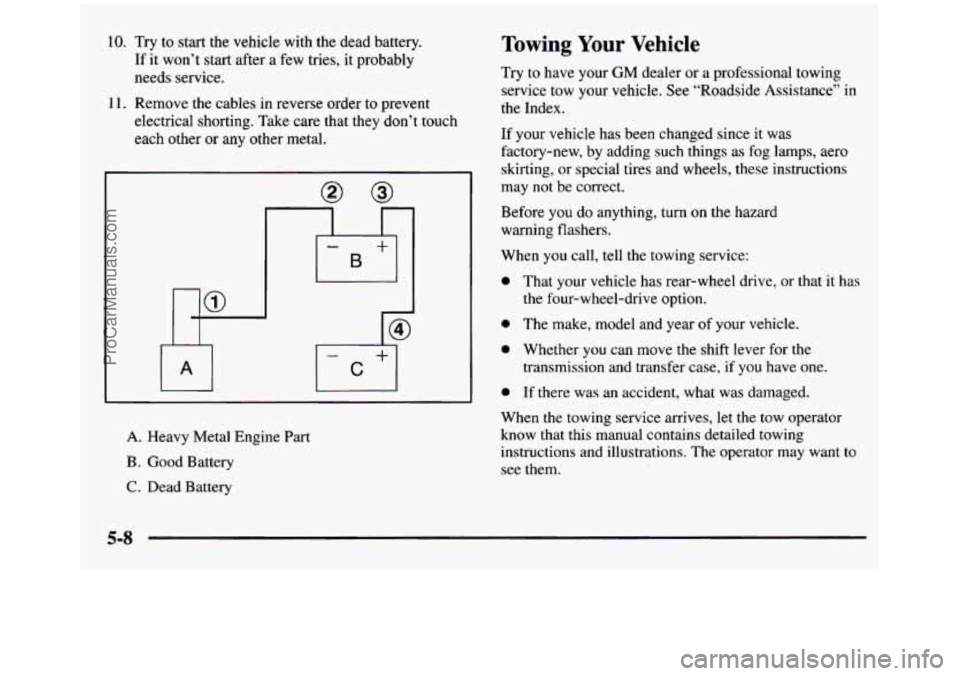
10. Try to start the vehicle with the dead battery.
If it won’t start after a few tries, it probably
needs service.
11. Remove the cables in reverse order to prevent
electrical shorting. Take care that they don’t touch
each other or any other metal.
A. Heavy Metal Engine Part
B. Good Battery
C. Dead Battery
Towing Your Vehicle
Try to have your GM dealer or a professional towing
service tow your vehicle. See “Roadside Assistance”
in
the Index.
If your vehicle has been changed since it was
factory-new, by adding such things as fog lamps, aero
skirting, or special tires and wheels, these instructions
may not be correct.
Before you do anything, turn on the hazard
warning flashers.
When you call, tell the towing service:
0 That your vehicle has rear-wheel drive, or that it has
the four-wheel-drive option.
0 The make, model and year of your vehicle.
0 Whether you can move the shift lever for the
0 If there was an accident, what was damaged.
transmission and transfer
case, if you have one.
When the towing service arrives, let the tow operator
know that this manual contains detailed towing
instructions and illustrations. The operator may want to
see them.
5-8
ProCarManuals.com