towing GMC SIERRA 1997 Owner's Manual
[x] Cancel search | Manufacturer: GMC, Model Year: 1997, Model line: SIERRA, Model: GMC SIERRA 1997Pages: 436, PDF Size: 23.38 MB
Page 249 of 436
I A CAUTION:
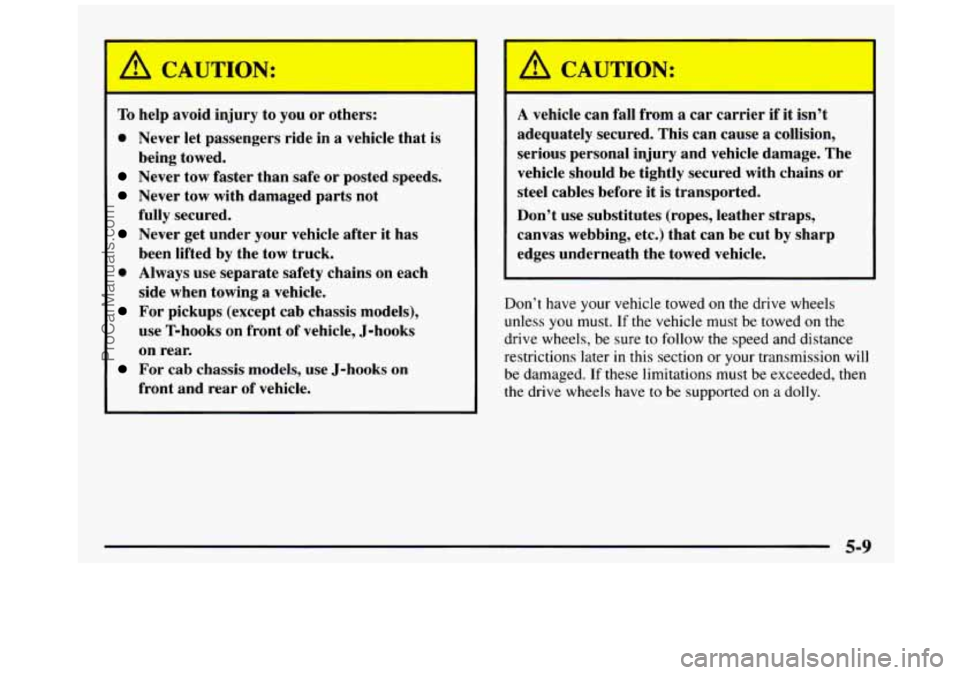
To help avoid injury to you or others:
0 Never let passengers ride in a vehicle that is
Never tow faster than safe or posted speeds.
Never tow with damaged parts not
fully secured.
Never get under your vehicle after it has
been lifted by the tow truck.
0 Always use separate safety chains on each
side when towing a vehicle.
For pickups (except cab chassis models),
use T-hooks on front of vehicle, J-hooks
on rear.
front and rear
of vehicle.
being
towed.
For cab chassis models, use J-hooks on
I [ CAUTION:
t
A vehicle can fall from a car carrier if it isn’t
adequately secured. This can cause a collision,
serious personal injury and vehicle damage. The
vehicle should be tightly secured with chains or
steel cables before
it is transported.
Don’t use substitutes (ropes, leather straps,
canvas webbing, etc.) that can be cut by sharp
edges underneath the towed vehicle.
Don’t have your vehicle towed
on the drive wheels
unless
you must. If the vehicle must be towed on the
drive wheels, be sure
to follow the speed and distance
restrictions later
in this section or your transmission will
be damaged.
If these limitations must be exceeded, then
the drive wheels have
to be supported on a dolly.
5-9
ProCarManuals.com
Page 250 of 436
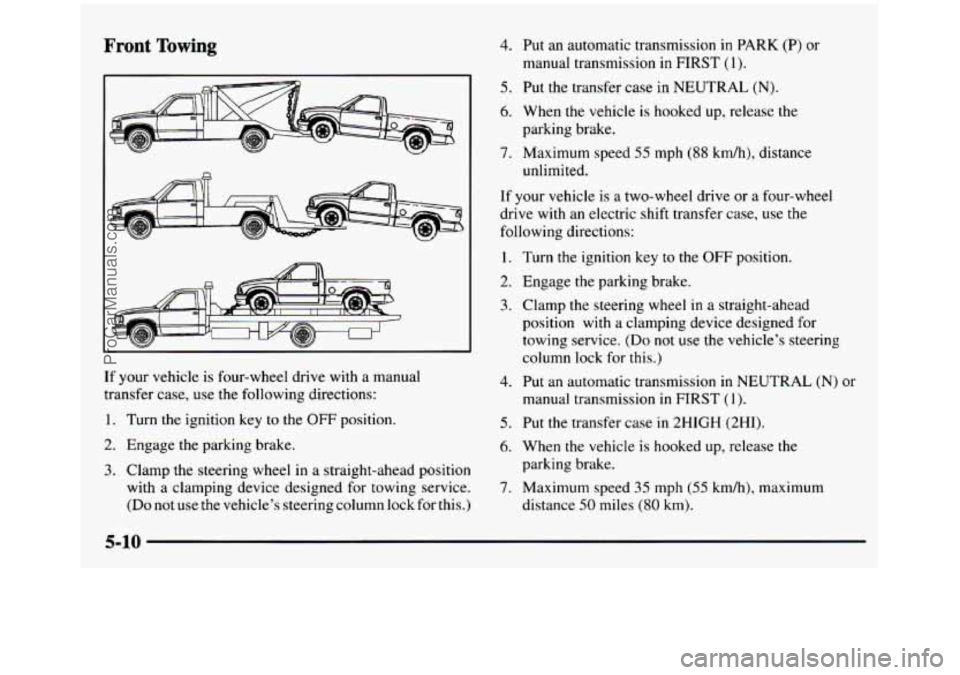
Front Towing 4. Put an automatic transmission in PARK (P) or
manual transmission in FIRST
(1).
5. Put the transfer case in NEUTRAL (N).
6. When the vehicle is hooked up, release the
7. Maximum speed 55 mph (88 kmh), distance
If your vehicle is a two-wheel drive or a four-wheel
drive with an electric shift transfer case,
use the
following directions: parking brake.
unlimited.
1.
2.
3.
If your vehicle is four-wheel drive with a manual transfer case, use the following directions:
1. Turn the ignition key to the OFF position.
2. Engage the parking brake.
3. Clamp the steering wheel in a straight-ahead position
with a clamping device designed for towing service.
(Do not use the vehicle’s steering column lock for this.)
4.
5.
6.
7.
Turn the ignition key to the OFF position.
Engage the parking brake.
Clamp the steering wheel in a straight-ahead
position with
a clamping device designed for
towing service.
(Do not use the vehicle’s steering
column lock
for this.)
Put an automatic transmission
in NEUTRAL (N) or
manual transmission in FIRST (1).
Put the transfer case
in 2HIGH (2HI).
When
the vehicle is hooked up, release the
parking brake.
Maximum speed
35 mph (55 km/h), maximum
distance
50 miles (80 km).
5-10
ProCarManuals.com
Page 251 of 436
Rear Towing
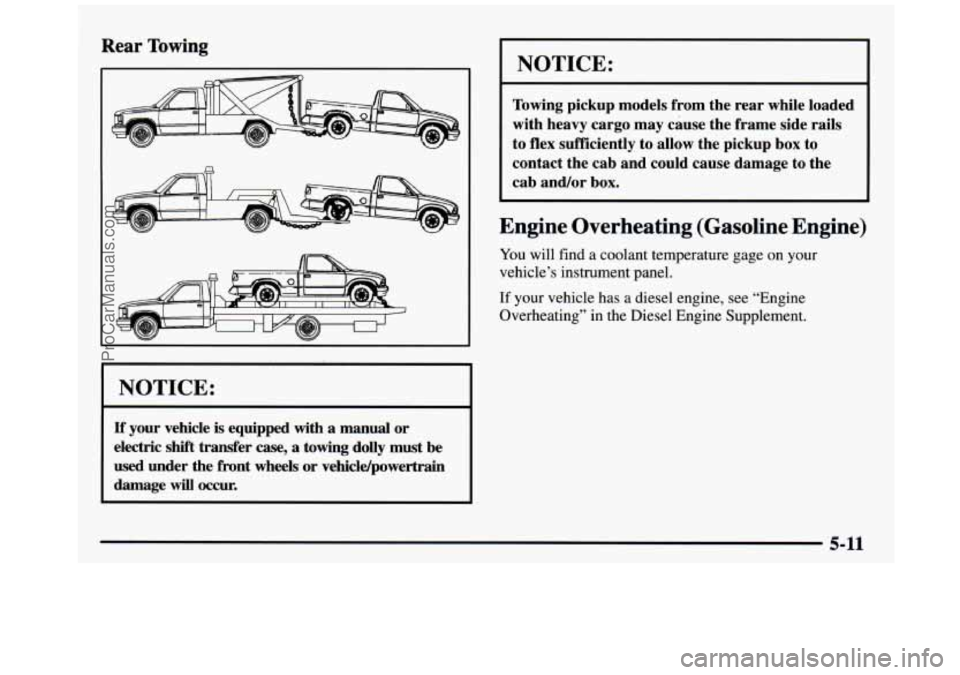
I NOTICE:
If your vehicle is equipped with a manual or
electric shift transfer
case, a towing dolly must be
used under the front wheels or vehicldpowertrain
damage
will occur.
NOTICE:
Towing pickup models from the rear while loaded
with heavy cargo may cause the frame side rails
to flex sufficiently
to allow the pickup box to
contact the cab and could cause damage to the
cab and/or box.
Engine Overheating (Gasoline Engine)
You will find a coolant temperature gage on your
vehicle’s instrument panel.
If your vehicle has a diesel engine, see “Engine
Overheating” in the Diesel Engine Supplement.
5-11
ProCarManuals.com
Page 261 of 436
Engine Fan Noise
Your vehicle has a clutched engine cooling fan. When
the clutch is engaged, the fan spi.ns faster to provide
more air
to cool the engine. In most everyday driving
conditions, the fan is spinning slower and the clutch is
not fully engaged. This improves
fuel economy and
reduces fan noise. Under heavy vehicle loading, trailer towing and/or high outside temperatures, the fan speed
increases as the clutch more fully engages.
So you may
hear an increase in fan noise. This
is normal and should
not be mistaken as the transmission slipping or making
extra shifts. It is merely the cooling system functioning
properly. The fan will slow down when additional
cooling is not required and the clutch disengages.
You may also hear this
fan noise when you start the engine.
It will
go away as the fan clutch partially disengages.
If a Tire Goes Flat
It’s unusual for a tire to “blow out” while you’re driving,
especially
if you maintain your tires properly. If air goes
out
of a tire, it’s much more likely to leak out slowly.
But if you should ever have
a “blowout,” here are a
few tips about what to expect and what to do:
If a front tire fails, the flat tire will create a drag that
pulls the vehicle toward that side. Take your foot off the
accelerator pedal and grip the steering wheel firmly.
Steer to maintain lane position, and then gently brake to
a stop well out of the traffic lane.
A rear blowout, particularly on a curve, acts much like a
skid and may require the same correction you’d use in
a skid. In any rear blowout, remove your foot from
the accelerator pedal. Get the vehicle under control by
steering the way you want the vehicle to go. It may be
very bumpy and noisy, but
you can still steer. Gently
brake
to a stop -- well off the road if possible.
If a tire goes flat, the next part shows how to
use your
jacking equipment
to change a flat tire safely.
ProCarManuals.com
Page 275 of 436
I NOTICE: I
Spinning your wheels can destroy parts of your
vehicle as well
as the tires. If you spin the wheels
too fast while shifting your transmission back
and forth, you can destroy your transmission.
For information about using tire chains on your vehicle,
see “Tire Chains”
in the Index.
Rocking Your Vehicle To Get It Out
First, turn your steering wheel left and right. That will
clear the area around your front wheels. Then shift back
and forth between REVERSE
(R) and a forward gear
(or with
a manual transmission, between FIRST (1) or
SECOND (2) and REVERSE(R)), spinning the wheels
as little as possible. Release the accelerator pedal while
you shift, and press lightly on the accelerator pedal
when the transmission is in gear. If that doesn’t get
you out after a few tries,
you may need to be towed out.
Or, you can use your recovery hooks if your vehicle has
them.
If you do need to be towed out, see ”Towing Your
Vehicle”
in the Index.
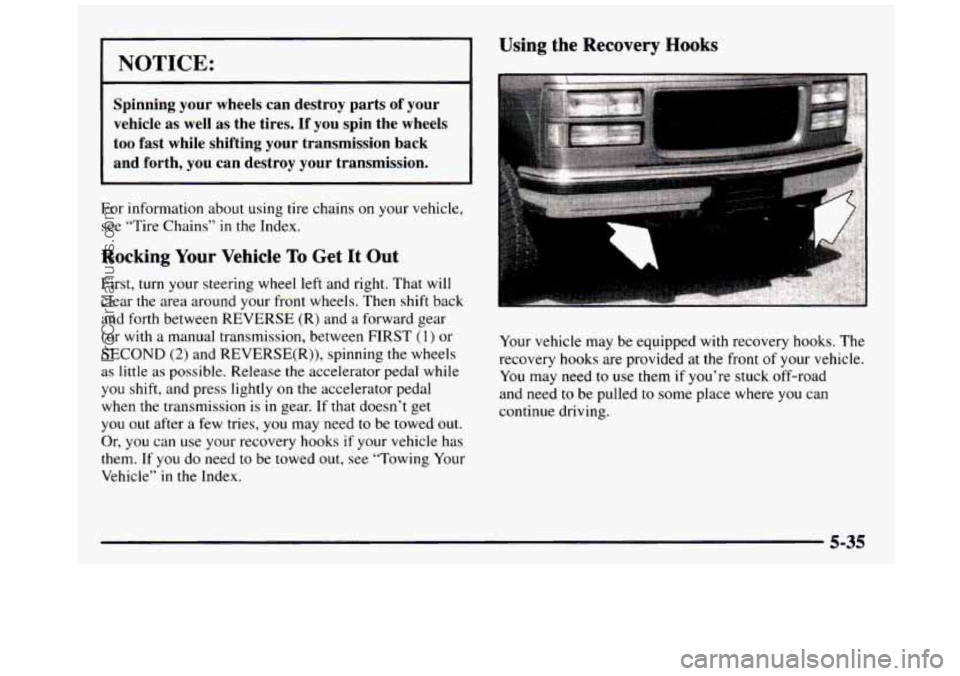
Using the Recovery Hooks
Your vehicle may be equipped with recovery hooks. The
recovery hooks are provided at
the front of your vehicle.
You may need
to use them if you’re stuck off-road
and need
to be pulled to some place where you can
continue driving.
5-35
ProCarManuals.com
Page 297 of 436
Refer to the Maintenance Schedule to determine when to
replace the air filter. See “Owner Checks and Services”
in
the Index.
Operating the engine with the
air cleaner off
can cause you OF others to be burned. The air
cleaner not only cleans the air,
it stops flame if
the engine backfires.
If it isn’t there, and the
engine backfires, you could be burned. Don’t
drive with it
off, and be careful working on the
engine with the air cleaner
off.
I NOTICE:
If the air cleaner is off, a backfire can cause a
damaging engine fire. And, dirt can easily get
into your engine, which will damage it. Always
have the air cleaner in place when you’re driving.
Automatic Transmission Fluid
When to Check and Change
A good time to check your automatic transmission fluid
level is
when the engine oil is changed.
Change both the fluid and filter every
50,000 miles
(83
000 km) if the vehicle’s CVWR is over 8,600 or
if the vehicle is mainly driven under one or more
of
these conditions:
In heavy city traffic where the outside temperature
regularly reaches
90°F (32°C) or higher.
In hilly or mountainous terrain.
When doing frequent trailer towing.
Uses such as found in taxi, police or delivery service.
If your vehicle’s GVWR is not over
8,600 and you do
not use your vehicle under any
of these conditions, the
fluid and filter do
not require changing.
See “Scheduled Maintenance Services’’
in the Index.
ProCarManuals.com
Page 303 of 436
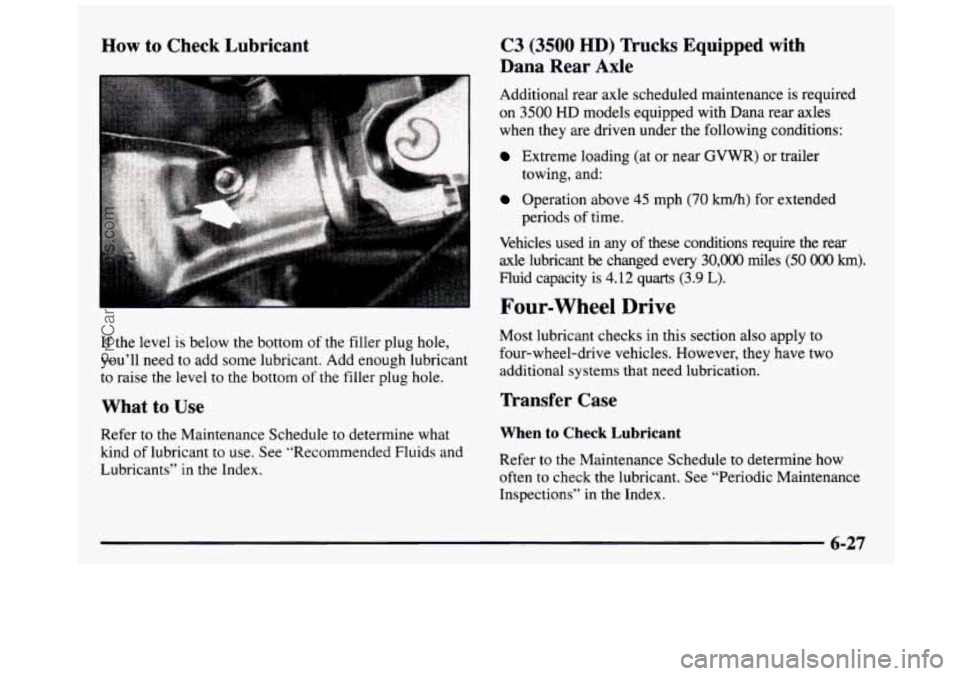
How to Check Lubricant
If the level is below the bottom of the filler plug hole,
you’ll need to add
some lubricant. Add enough lubricant
to raise the level
to the bottom of the filler plug hole.
What to Use
Refer to the Maintenance Schedule to determine what
kind
of lubricant to use. See “Recommended Fluids and
Lubricants”
in the Index.
C3 (3500 HD) Trucks Equipped with
Dana Rear Axle
Additional rear axle scheduled maintenance is required
on
3500 HD models equipped with Dana rear axles
when they are driven under the following conditions:
Extreme loading (at or near GVWR) or trailer
Operation above 45 mph (70 km/h) for extended
towing, and:
periods of time.
Vehicles used in any
of these conditions require the rear
axle lubricant be changed every
30,000 miles (50 OOO km).
Fluid capacity is 4.12 quarts (3.9 L).
Four-wheel Drive
Most lubricant checks in this section also apply to
four-wheel-drive vehicles. However, they have two
additional systems that need lubrication.
Transfer Case
When to Check Lubricant
Refer to the Maintenance Schedule to determine how
often to check the lubricant. See “Periodic Maintenance
Inspections” in the Index.
ProCarManuals.com
Page 360 of 436
Maintenance Schedule
Follow this maintenance schedule only if none of the
conditions from the Short Trip/City Maintenance
Schedule is true.
Da not use this schedule if the vehicle
is used for trailer towing, driven in a dusty area or used
off paved roads. Use the Short Trip/City schedule for
these conditions.
Driving a vehicle with afully warmed engine under
highway conditions causes engine
oil to break
down slower:
Every 7,500 Miles (12 500 km): Engine Oil and Filter
Change (or every
12 months, whichever occurs first).
Chassis Lubrication (or every 12 months, whichever
occurs first). Drive Axle Service. Tire Rotation.
Underhood Insulation Inspection (GVWR above
8,500 lbs. only).
Every 15,000 Miles (25 OOO km): Shields and
I
1 Long Trip/Highway Intervals -- Gasoline Engines ~~~ ~
~ ~~
Every 30,000 Miles (50 000 km): Fuel Filter
Replacement. Front Wheel Bearing Repack
(2WD only)
(or at each brake relining, whichever occurs fiist).
Transmission Service (vehicles over
8600 GVWR or
driven under severe conditions only).
Every 60,000 Miles (100 000 km): Engine Accessory
Drive Belt Inspection. Fuel
Tank, Cap and Lines
Inspection. Exhaust Gas Recirculation System
Inspection. Evaporative Control System Inspection.
Every 100,000 Miles (166 000 km): Spark Plug Wire
Inspection. Spark Plug Replacement. Positive
Crankcase Ventilation (PCV) Valve Inspection.
Every 150,000 Miles (240 000 km): Cooling System
Service (or every
60 months, whichever occurs first).
Every 50,000 Miles (83 000 km): Automatic
These intervals only summarize maintenance services.
Be sure to
follow the complete maintenance schedule
on the following pages.
7-6
ProCarManuals.com
Page 362 of 436
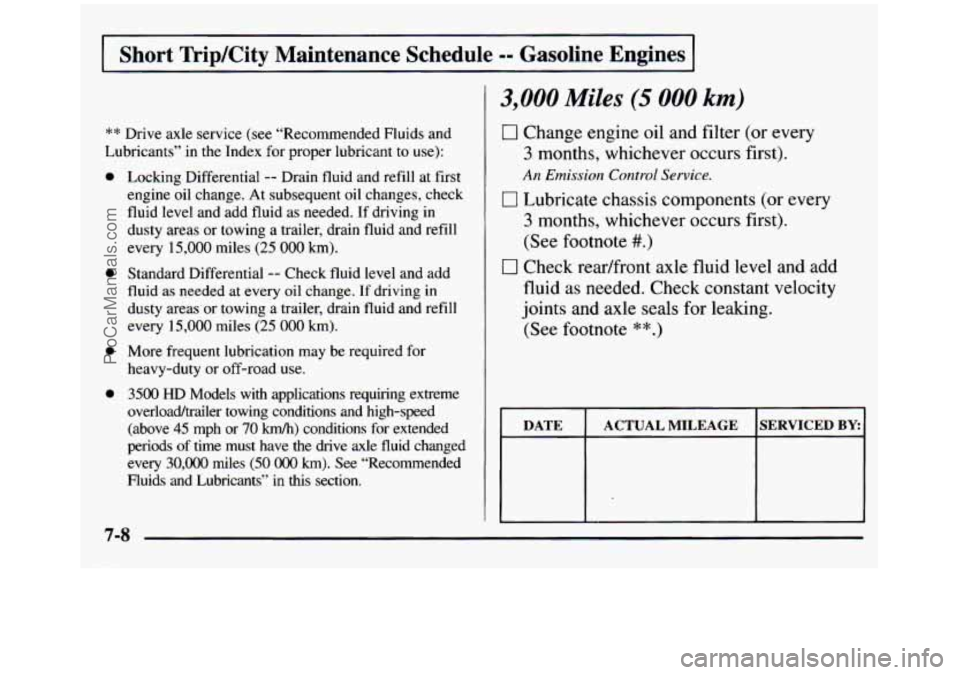
Short TripKity Maintenance Schedule -- Gasoline Engines
** Drive axle service (see “Recommended Fluids and
Lubricants”
in the Index for proper lubricant to use):
0
e
0
0
Locking Differential -- Drain fluid and refill at first
engine oil change. At subsequent oil changes, check
fluid level and add fluid as needed. If driving in
dusty areas
or towing a trailer, drain fluid and refill
every 15,000 miles
(25 000 km).
Standard Differential -- Check fluid level and add
fluid
as needed at every oil change. If driving in
dusty areas or towing a trailer, drain fluid and refill
every
15,000 miles (25 000 km).
More frequent lubrication may be required for
heavy-duty
or off-road use.
3500 HD Models with applications requiring extreme
overloadtrailer towing conditions and high-speed (above
45 mph or 70 km/h) conditions for extended
periods of time must have the drive axle fluid changed every
30,000 miles (50 OOO km). See “Recommended
Fluids and Lubricants” in this section.
3,000 Miles (5 000 km)
0 Change engine oil and filter (or every
3 months, whichever occurs first).
An Emission Control Service.
0 Lubricate chassis components (or every
3 months, whichever occurs first).
(See footnote
#.)
0 Check readfront axle fluid level and add
fluid as needed. Check constant velocity
joints and axle seals for leaking.
(See footnote **.)
DATE ACTUAL MILEAGE SERVICED BY:
ProCarManuals.com
Page 372 of 436
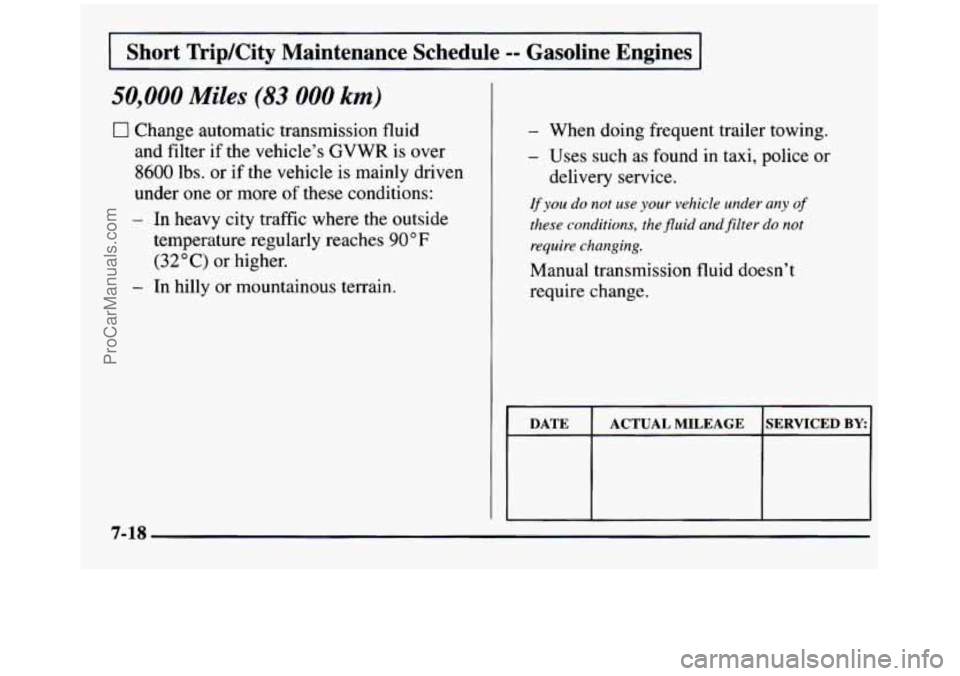
Short TripKity Maintenance Schedule -- Gasoline Engines
50,000 Miles (83 000 km)
0 Change automatic transmission fluid
and filter if
the vehicle’s GVWR is over
8600 lbs. or if the vehicle is mainly driven
under one or more
of these conditions:
- In heavy city traffic where the outside
temperature regularly reaches
90 O F
(32°C) or higher.
- In hilly or mountainous terrain.
- When doing frequent trailer towing.
- Uses such as found in taxi, police or
lf you do not use your vehicle under any of
these conditions, the fluid and filter do not
require changing.
Manual transmission fluid doesn’t
require change.
delivery
service.
I DATE I ACTUAL MILEAGE ISERVICED BY:)
7-18
ProCarManuals.com