wheel GMC SIERRA 1997 User Guide
[x] Cancel search | Manufacturer: GMC, Model Year: 1997, Model line: SIERRA, Model: GMC SIERRA 1997Pages: 436, PDF Size: 23.38 MB
Page 86 of 436
I NOTICE: I
If your key seems stuck in LOCK and you can’t
turn it, be sure
you are using the correct key; if
so, is it all the way in? If it is, then turn the
steering wheel left and right while you turn the
key hard. But turn the key only with your hand.
Using
a tool to force it could break the key or the
ignition switch. If none of this works, then your
vehicle needs service.
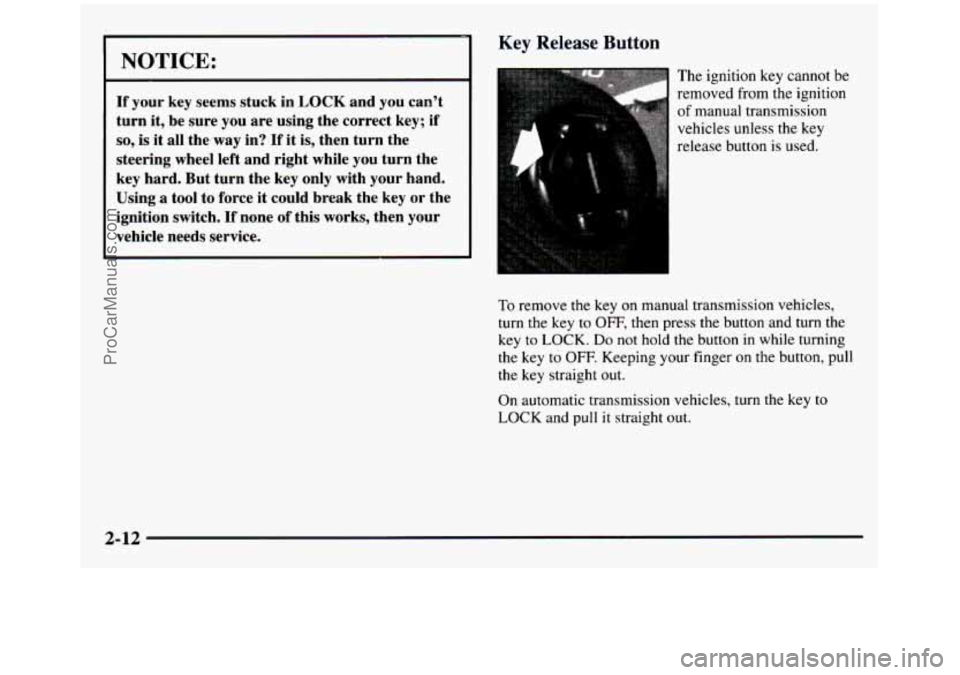
Key Release Button
of manual transmiss~on
vehicles unless the key
release button
is used.
To remove the key on manual transmission vehicles,
turn the key to
OFF, then press the button and turn the
key to
LOCK. Do not hold the button in while turning
the key to
OFF. Keeping your finger on the button, pull
the key straight out.
On automatic transmission vehicles, turn the key to
LOCK and pull it straight out.
2-12
ProCarManuals.com
Page 90 of 436
If your vehcle is equipped with an automatic transmission,
it now features an electronic shift position indicator within
the instrument cluster. This display must be powered
anytime the
shift lever is capable of being moved out of
PARK (P). This means that if your key is in OFF, rather
than
LOCK, there will be a small current drain on your
battery which could discharge your battery over
a period
of time. If you have to leave your key in the
ignition
in OFF for an extended period, it is recommended
that you disconnect the battery cable from the battery to
prevent discharging your battery.
PARK
(P): This locks your rear wheels. It’s the best
position to use when you start your engine because your
vehicle can’t move easily.
It is dangerous to get out of your vehicle if the
shift lever is not fully in PARK
(P) with the
parking brake firmly set. Your vehicle can roll.
CAUTION: (Continued)
I
Don’t leave your vehicle when the engine is
running unless you have to. If you have left the
engine running, the vehicle can move suddenly.
You or others could be injured. To be sure your
vehicle won’t move, even when you’re on fairly
level ground,
always set your parking brake and
move the shift lever to PARK
(P).
If you have four-wheel drive, your vehicle
will be free to roll -- even if your shift lever
is in PARK
(P) -- if your transfer case is in
NEUTRAL
(N). So, be sure the transfer case is in
a drive gear, two-wheel high
(2H) or four-wheel
high
(4H) or four-wheel low (4L) -- not in
NEUTRAL
(N). See “Shifting Into PARK (P)” in
the Index.
If you’re pulling a trailer, see “Towing
a Trailer” in the Index.
2-16
ProCarManuals.com
Page 91 of 436
REVERSE (R): Use this gear to back up.
~OTICE:
r
~~
Shifting to REVERSE (R) while your vehicle is
moving forward could damage your transmission.
Shift to
REVERSE (R) only after your vehicle
is stopped.
To rock your vehicle back and forth to get out of snow,
ice or sand without damaging your transmission, see
“Stuck: In Sand, Mud, Ice or Snow”
in the Index.
NEUTRAL
(N): In this position, your engine
doesn’t connect
with the wheels. To restart when you’re
already moving, use
NEUTRAL (N) only. Also, use
NEUTRAL (N) when your vehicle is being towed. Shifting out
of PARK
(P) or NEUTRAL (N) while
your engine is “racing” (running at high speed) is
dangerous. Unless your foot
is firmly on the
brake pedal, your vehicle could move
very
rapidly. You could lose control and hit people
or objects. Don’t shift out
of PARK (P) or
NEUTRAL
(N) while your engine is racing.
NOTICE:
Damage to your transmission caused by shifting
out
of PARK (P) or NEUTRAL (N) with the
engine racing isn’t covered by your warranty.
2-17
ProCarManuals.com
Page 92 of 436
AUTOMATIC OVERDRIVE (@): This position is for
normal driving. If you need more power for passing, and
you’re:
Going less than about 35 mph (56 km/h), push your
Going about 35 mph (56 km/h) or more, push the
accelerator
pedal about halfway down.
accelerator all
the way down.
You’ll shift down to the next gear and have more power.
AUTOMATIC OVERDRIVE
(a) can be used when
towing
a trailer, carrying a heavy load, driving on steep
hills or for off-road driving.
You may want to shift the
transmission to THIRD
(3) or, if necessary, a lower gear
selection if the transmission shifts too often.
THIRD (3): This position is also used for normal
driving, however it offers more power and lower
fuel
economy than AUTOMATIC OVERDRIVE (a).
SECOND (2): This position gives you more power but
lower fuel economy.
You can use SECOND (2) on hills.
It can help control your speed as you go down steep
mountain roads, but then you would also want
to use
your brakes
off and on.
If you manually select SECOND (2)’ the transmission will
drive in
second gear. You may use this feature for reducing torque to the rear wheels when you are trying
to start your
vehicle from a stop on slippery road surfaces.
FIRST (1): This position gives you even more power
(but lower fuel economy) than
SECOND (2). You can
use it on very steep hills, or in deep snow or mud. If the
selector lever is
put in FIRST (1) while the vehicle is
moving forward,
the transmission won’t shift into first
gear until the vehicle
is going slowly enough.
NOTICE:
~ ~~
If your rear wheels can’t rotate, don’t try to
drive. This might happen if you were stuck in
very deep sand or mud or were up against
a solid
object. You could damage your transmission.
Also, if you stop when going uphill, don’t hold
your vehicle there with only the accelerator
pedal. This could overheat and damage the
transmission. Use your brakes or shift into
PARK (P) to hold your vehicle in position
on a hill.
2-18
ProCarManuals.com
Page 96 of 436
Up Shift Light
SHIFT
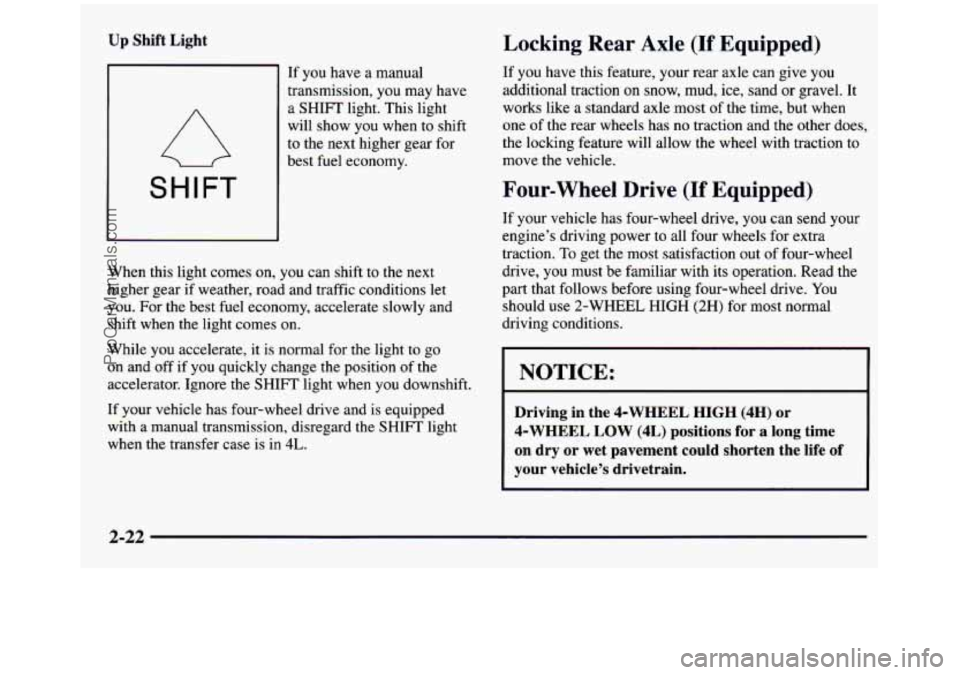
If you have a manual
transmission,
you may have
a SHIFT light. This light
will show
you when to shift
to the next higher gear for
best fuel economy.
When this light comes on, you can shift to the next
higher gear
if weather, road and traffic conditions let
you. For the best fuel economy, accelerate slowly and shift when the light comes
on.
While you accelerate, it is normal for the light to go
on and off if you quickly change the position of the
accelerator. Ignore the
SHIFT light when you downshift.
If your vehicle has four-wheel drive and is equipped
with a manual transmission, disregard the
SHIFT light
when the transfer case is in
4L.
Locking Rear Axle (If Equipped)
If you have this feature, your rear axle can give you
additional traction on snow, mud, ice, sand
or gravel. It
works like a standard axle most
of the time, but when
one of the rear wheels has no traction and the other
does,
the locking feature will allow the wheel with traction to
move the vehicle.
Four-wheel Drive (If Equipped)
If your vehicle has four-wheel drive, you can send your
engine’s driving power to all four wheels for extra
traction.
To get the most satisfaction out of four-wheel
drive, you must be familiar with its operation. Read the
part that follows before using four-wheel drive. You
should use 2-WHEEL
HIGH (2H) for most normal
driving conditions.
I NOTICE: I
Driving in the 4-WHEEL HIGH (4H) or
4-WHEEL LOW (4L) positions for a long time
on dry or wet pavement could shorten the life of
your vehicle’s drivetrain.
2-22
ProCarManuals.com
Page 97 of 436
Front Axle Locking Feature
The front axle locks and unlocks automatically when you shift the transfer case. Some delay for the axle to lock or
unlock is normal. If the outside temperature is very hot, or
the vehicle has
been used under hard driving conditions,
there may be a slight delay for the axle to unlock.
Manual Transfer Case (If Equipped)
The transfer case shift lever is on the floor to the right of
the driver. Use this lever to shift into and out of
four-wheel drive. The front
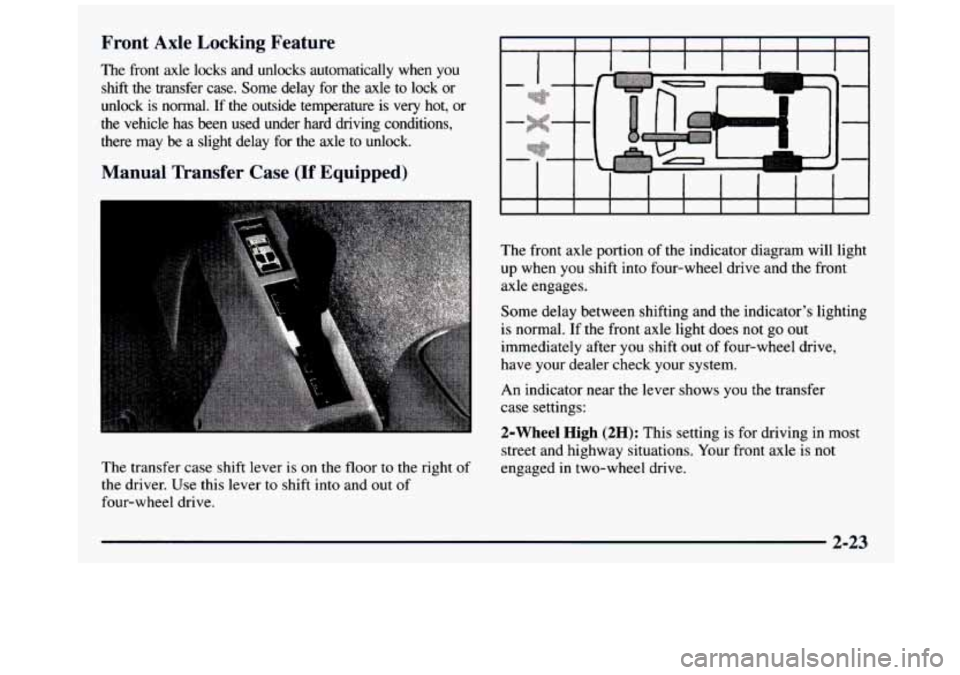
axle portion of the indicator diagram will light
up when
you shift into four-wheel drive and the front
axle engages.
Some delay between shifting and the indicator’s lighting
is normal. If
the front axle light does not go out
immediately after you shift out of four-wheel drive,
have your dealer check your system.
An indicator near the lever shows you the transfer
case settings:
2-Wheel High (2H): This setting is for driving in most
street and highway situations. Your front axle is not
engaged in two-wheel drive.
2-23
ProCarManuals.com
Page 98 of 436
$-Wheel High (4H): This setting engages your front
axle
to help drive your vehicle. Use 4H when you need
extra traction, such as on wet or icy roads, or in most
off-road situations.
Neutral (N): Shift to this setting only when your vehicle
needs to be towed or when using a power take-off.
4-Wheel Low (4L): This setting also engages your front
axle to give you extra power and also gives you a higher
driveline ratio. It should
be used only for off-road driving.
You can shift from 2-WHEEL HIGH (2H) to 4-WHEEL
HIGH (4H) or from 4-WHEEL HIGH
(4H) to
2-WHEEL HIGH (2H) while the vehicle is moving.
Your front axle will engage faster if
you take your foot
off of the accelerator for a few seconds after you shift.
In extremely cold weather, it may be necessary
to stop
or slow the vehicle
to shift into 4-WHEEL HIGH (4H). To
shift into or out of 4-WHEEL LOW (4L) or
NEUTRAL
(N):
1. Slow the vehicle to a roll, about 1 to 3 mph (2 to
5 kmh) and shift an automatic transmission into
NEUTRAL (N), or with a manual transmission,
press the clutch pedal.
2. Shift the transfer case shift lever in one continuous motion.
Don’t pause in NEUTRAL
(N) as you shift the transfer
case into 4-WHEEL LOW (4L), or your gears
could clash.
Remember that driving in 4-WHEEL HIGH (4H) or
4-WHEEL LOW (4L) may reduce fuel economy.
Also,
driving in four-wheel drive on dry pavement could
cause your tires to wear faster and make your transfer
case harder to shift and run noisier.
When your headlamps or parking lamps are on,
rotate the thumb wheel next to the headlamp switch
up to brighten or down
to dim your transfer case
indicator light.
2-24
ProCarManuals.com
Page 99 of 436
Electronic Transfer Case (If Equipped)
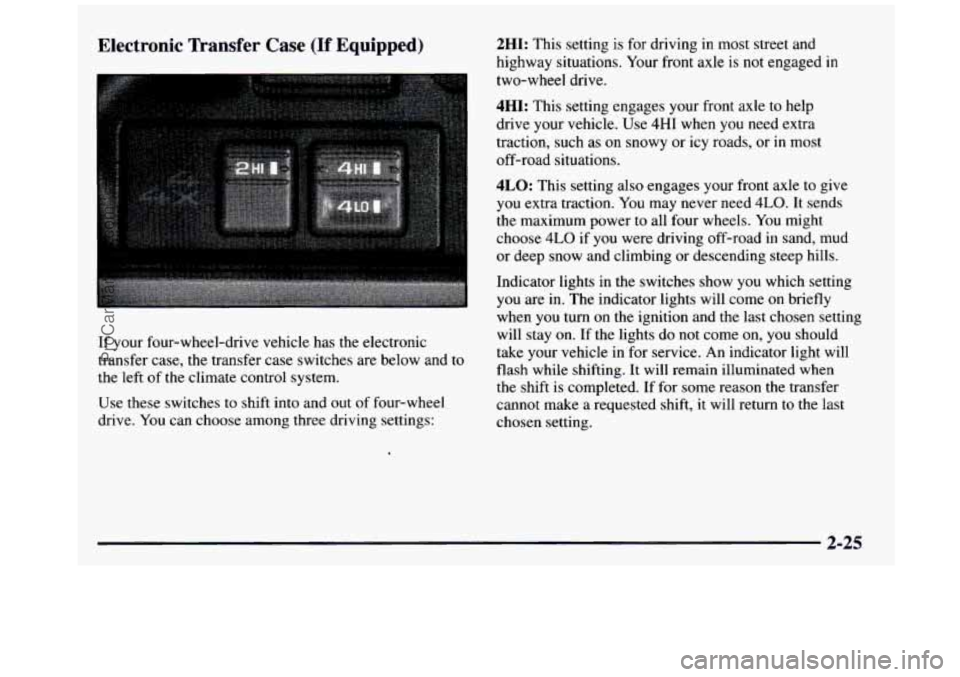
If your four-wheel-drive vehicle has the electronic
transfer case, the transfer case switches are below and
to
the left of the climate control system.
Use these switches to shift into and out
of four-wheel
drive. You can choose among three driving settings:
.
2HI: This setting is for driving in most street and
highway situations. Your front axle is not engaged
in
two-wheel drive.
4HI: This setting engages your front axle to help
drive your vehicle. Use
4HI when you need extra
traction, such as
on snowy or icy roads, or in most
off-road situations.
4LO: This setting also engages your front axle to give
you extra traction. You may never need
4LO. It sends
the maximum power to all four wheels. You might
choose
4LO if you were driving off-road in sand, mud
or deep snow and climbing or descending steep hills.
Indicator lights in the switches show you which setting
you are in. The indicator lights will come
on briefly
when you turn on the ignition and the last chosen setting
will stay on. If the lights do not come on, you should
take your vehicle in for service. An indicator light will
flash while shifting. It
will remain illuminated when
the shift is completed. If for some reason the transfer
cannot make a requested shift,
it will return to the last
chosen setting.
ProCarManuals.com
Page 102 of 436
Shifting Into PARK (P) (Automatic
Transmission
Models Only)
It can be danL *ous to get out of your vehicle if
the shift lever
is not fully in PARK (P) with the
parking brake firmly set. Your vehicle can roll.
If you have left the engine running, the vehicle
can move suddenly. You or others could be
injured.
To be sure your vehicle won’t move, even
when you’re on fairly level ground, use the steps
that follow. If you have four-wheel drive and
your transfer case
is in NEUTRAL (N), your
vehicle will be free to roll, even if your shift lever
is in PARK (P). So, be sure the transfer case is
in a drive gear
-- not in NEUTRAL (N). If
you’re pulling a trailer, see “Towing
a Trailer”
in the Index.
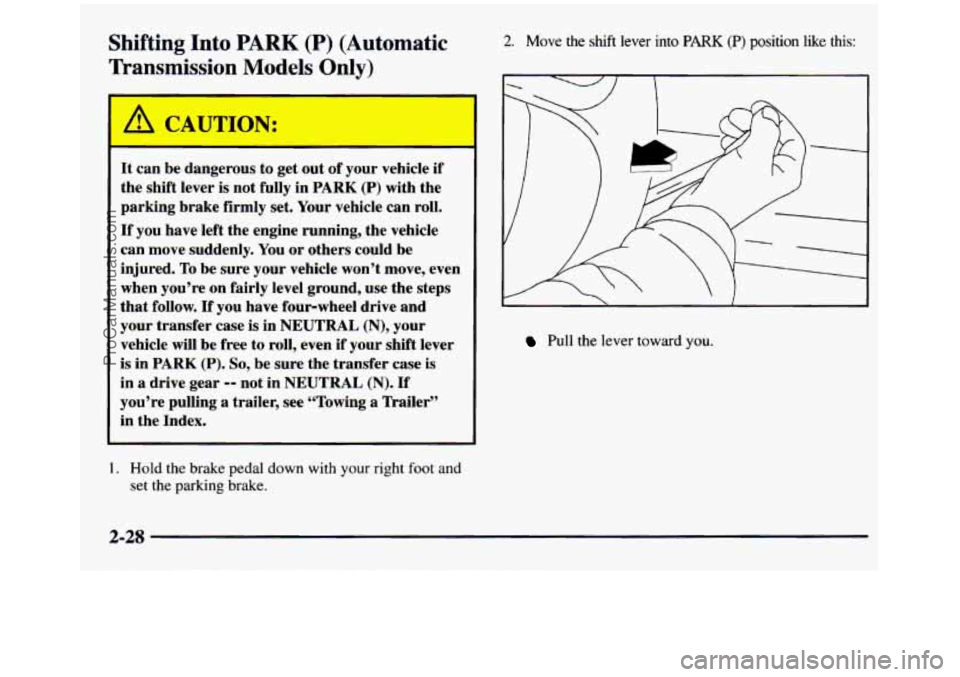
2. Move the shift lever into PARK (P) position like this:
Pull the lever toward you.
1. Hold the brake pedal down with your right foot and
set the parking brake.
2-28
ProCarManuals.com
Page 103 of 436
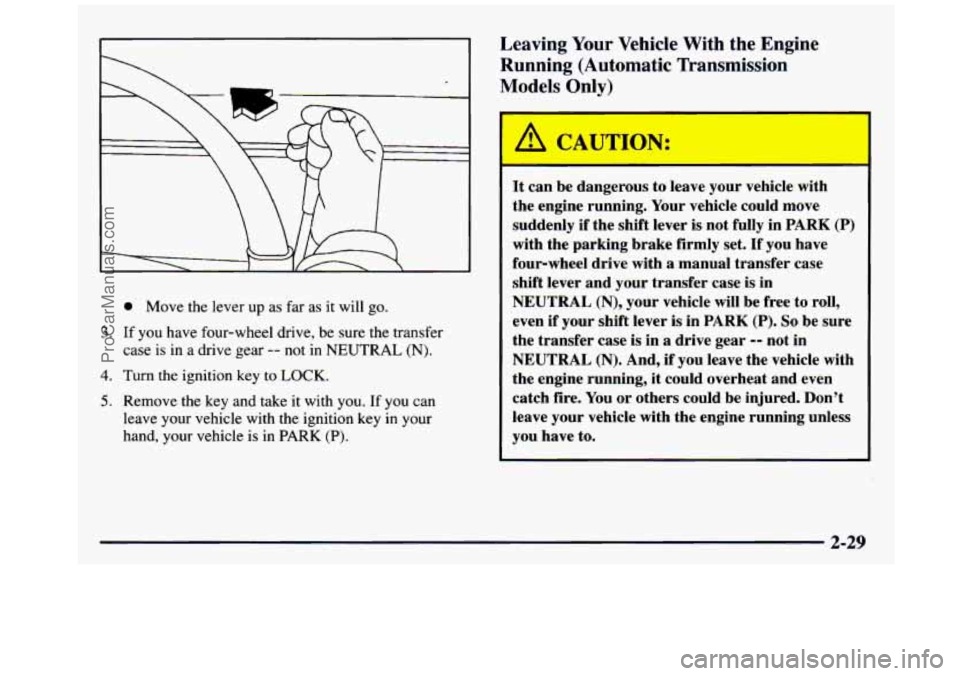
0 Move the lever up as far as it will go.
3. If you have four-wheel drive, be sure the transfer
case is in a drive gear
-- not in NEUTRAL (N).
4. Turn the ignition key to LOCK.
5. Remove the key and take it with you. If you can
leave your vehicle with the ignition key in your
hand, your vehicle
is in PARK (P).
Leaving Your Vehicle With the Engine
Running (Automatic Transmission
Models Only)
It can be dangerous to leave your vehicle with
the engine running. Your vehicle could move
suddenly if the shift lever is not fully in PARK (P)
with the parking brake firmly set.
If you have
four-wheel drive with
a manual transfer case
shift lever and your transfer case is in
NEUTRAL
(N), your vehicle will be free to roll,
even if your shift lever is in PARK
(P). So be sure
the transfer case is in
a drive gear -- not in
NEUTRAL
(N). And, if you leave the vehicle with
the engine running, it could overheat and even
catch fire.
You or others could be injured. Don’t
leave your vehicle with the engine running unless
you have
to.
ProCarManuals.com