clutch GMC SIERRA 1997 Owners Manual
[x] Cancel search | Manufacturer: GMC, Model Year: 1997, Model line: SIERRA, Model: GMC SIERRA 1997Pages: 436, PDF Size: 23.38 MB
Page 87 of 436
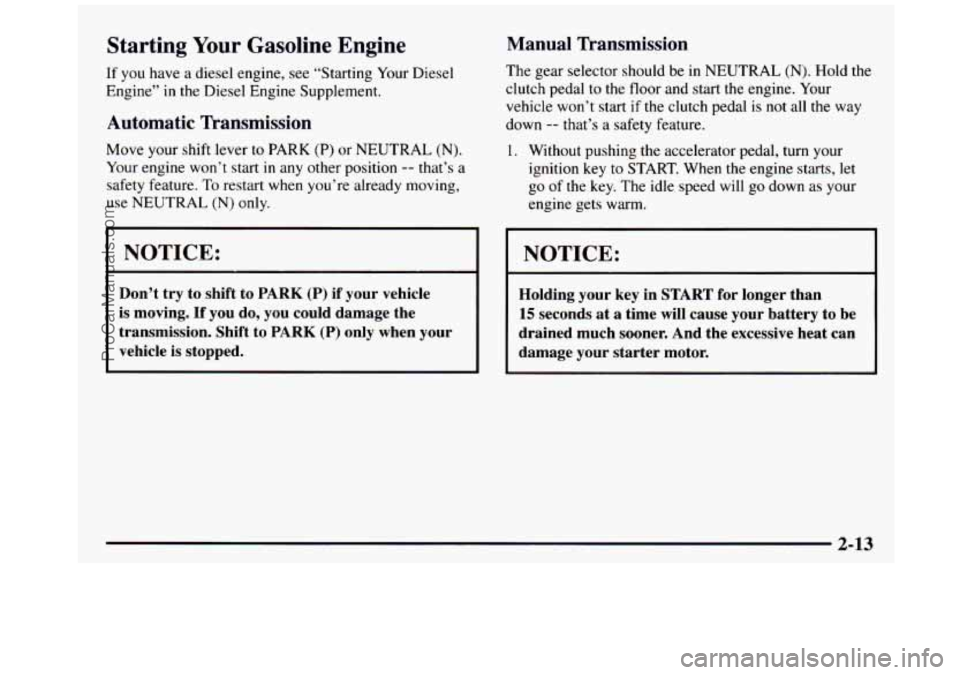
Starting Your Gasoline Engine
If you have a diesel engine, see “Starting Your Diesel
Engine”
in the Diesel Engine Supplement.
Automatic Transmission
Move your shift lever to PARK (P) or NEUTRAL (N).
Your engine won’t start in any other position -- that’s a
safety feature. To restart when you’re already moving,
use NEUTRAL
(N) only.
Manual Transmission
The gear selector should be in NEUTRAL (N). Hold the
clutch pedal to the floor and start the engine. Your
vehicle won’t start
if the clutch pedal is not all the way
down -- that’s a safety feature.
1. Without pushing the accelerator pedal, turn your
ignition key to START. When the engine starts, let
go of the key. The idle speed will go down as your
engine gets warm.
NOTICE:
NOTICE:
I I I I
Don’t try to shift to PARK (P) if your vehicle
is moving.
If you do, you could damage the Holding your key in START
for longer than
damage your starter motor.
vehicle is stopped. drained
much sooner. And the excessive heat can
transmission. Shift
to PARK
(P) only when your
15 seconds at a time will cause your battery to be
ProCarManuals.com
Page 93 of 436
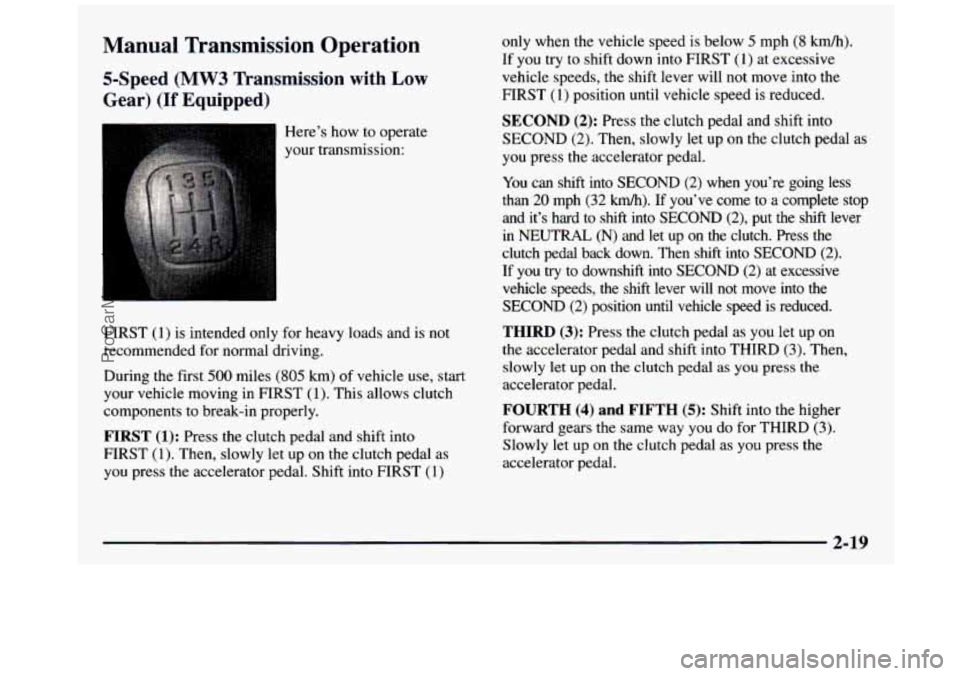
Manual Transmission Operation
5-Speed (MW3 Transmission with Low
Gear) (If Equipped)
Here’s how to operate
your transmission:
FIRST
(1) is intended only for heavy loads and is not
recommended for normal driving.
During the first
500 miles (805 km) of vehicle use, start
your vehicle moving
in FIRST (1). This allows clutch
components to break-in properly.
FIRST (1): Press the clutch pedal and shift into
FIRST
(1). Then, slowly let up on the clutch pedal as
you press the accelerator pedal. Shift into FIRST
(1)
only when the vehicle speed is below 5 mph (8 km/h).
If you try to shift down into FIRST (1) at excessive
vehicle speeds, the shift lever will not move into
the
FIRST (1) position until vehicle speed is reduced.
SECOND (2): Press the clutch pedal and shift into
SECOND
(2). Then, slowly let up on the clutch pedal as
you press the accelerator pedal.
You can shift into SECOND (2) when you’re going less
than 20 mph (32 km/h). If you’ve come to a complete stop
and it’s hard
to shift into SECOND (2), put the shift lever
in NEUTRAL (N) and let up on the clutch. Press the
clutch pedal back down. Then
shift into SECOND (2).
If you try to downshift into SECOND (2) at excessive
vehicle speeds, the shift lever will not move into the
SECOND (2) position
until vehicle speed is reduced.
THIRD (3): Press the clutch pedal as you let up on
the accelerator pedal and shift into THIRD (3). Then,
slowly let up on
the clutch pedal as you press the
accelerator pedal.
FOURTH (4) and FIFTH (5): Shift into the higher
forward gears the same way you do for THIRD (3).
Slowly let up on the clutch pedal as you press the
accelerator pedal.
ProCarManuals.com
Page 94 of 436
To stop, let up on the accelerator pedal and press the
brake pedal. Just before the vehicle stops, press the
clutch pedal and the brake pedal, and shift
to
NEUTRAL (N).
NEUTRAL (N): Use this position when you start or
idle your engine.
REVERSE (R): To back up, first press down the clutch
pedal. Wait about
five seconds for the internal parts to
stop spinning and then shift into REVERSE
(R).
Let up on the clutch pedal slowly while pressing the
accelerator pedal.
NOTICE:
Shift to REVERSE (R) only after your vehicle is
stopped. Shifting to REVERSE (R) while your
vehicle
is moving could damage your transmission.
Also, use REVERSE (R), along with the parking brake,
when turning off your engine and parking your vehicle.
5-Speed (MG5M50 Transmissions Without
Low Gear) (If Equipped)
Here’s how to operate your transmission:
FIRST (1): Press the clutch pedal and shift into
FIRST (1). Then, slowly let up on the clutch pedal as
you press
the accelerator pedal.
You can
shift into FIRST (1) when you’re going less
than
20 mph (32 km/h). If you’ve come to a complete
stop and it’s hard to shift into FIRST
(I), put the shift
lever
in NEUTRAL (N) and let up on the clutch. Press
the clutch pedal back down. Then shift into FIRST (1).
SECOND (2): Press the clutch pedal as you let up on
the accelerator pedal and shift into
SECOND (2). Then,
slowly let up on the clutch pedal as you press the
accelerator pedal.
THIRD (3), FOURTH (4) and FIFTH (5): Shift into
THIRD
(3), FOURTH (4) and FIFTH (5) the same way
you do for
SECOND (2). Slowly let up on the clutch
pedal as you press the accelerator pedal.
To stop, let up on the accelerator pedal and press the
brake pedal. Just before the vehicle stops, press the
clutch pedal and the brake pedal, and shift to NEUTRAL
(N).
2-20
ProCarManuals.com
Page 95 of 436
NEUTRAL (N): Use this position when you start or
idle your engine.
Shift Speeds
REVERSE (R): To back up, first press down the clutch
pedal. Wait about five seconds for the internal parts
to
stop spinning and then, shift into REVERSE (R).
Let up on the clutch pedal slowly while pressing the
accelerator pedal.
)NOTICE:
Shift to REVERSE (R) only after your vehicle is
stopped. Shifting to REVERSE
(R) while your
vehicle is moving could damage your transmission.
Also, use REVERSE (R), along with the parking brake,
when turning off your engine and parking your vehicle.
A CAUTION:
If you skip more than one gear when you
downshift, you could
lose control of your vehicle.
And you could injure yourself or others. Don’t shift down more than one gear when you downshift.
~~ ~
If your speed drops below 20 mph (32 kmh), or if the
engine is not running smoothly, you should downshift to
the next lower gear.
You may have to downshift two or
more gears to keep the engine running smoothly or for
good performance.
2-21
ProCarManuals.com
Page 98 of 436
$-Wheel High (4H): This setting engages your front
axle
to help drive your vehicle. Use 4H when you need
extra traction, such as on wet or icy roads, or in most
off-road situations.
Neutral (N): Shift to this setting only when your vehicle
needs to be towed or when using a power take-off.
4-Wheel Low (4L): This setting also engages your front
axle to give you extra power and also gives you a higher
driveline ratio. It should
be used only for off-road driving.
You can shift from 2-WHEEL HIGH (2H) to 4-WHEEL
HIGH (4H) or from 4-WHEEL HIGH
(4H) to
2-WHEEL HIGH (2H) while the vehicle is moving.
Your front axle will engage faster if
you take your foot
off of the accelerator for a few seconds after you shift.
In extremely cold weather, it may be necessary
to stop
or slow the vehicle
to shift into 4-WHEEL HIGH (4H). To
shift into or out of 4-WHEEL LOW (4L) or
NEUTRAL
(N):
1. Slow the vehicle to a roll, about 1 to 3 mph (2 to
5 kmh) and shift an automatic transmission into
NEUTRAL (N), or with a manual transmission,
press the clutch pedal.
2. Shift the transfer case shift lever in one continuous motion.
Don’t pause in NEUTRAL
(N) as you shift the transfer
case into 4-WHEEL LOW (4L), or your gears
could clash.
Remember that driving in 4-WHEEL HIGH (4H) or
4-WHEEL LOW (4L) may reduce fuel economy.
Also,
driving in four-wheel drive on dry pavement could
cause your tires to wear faster and make your transfer
case harder to shift and run noisier.
When your headlamps or parking lamps are on,
rotate the thumb wheel next to the headlamp switch
up to brighten or down
to dim your transfer case
indicator light.
2-24
ProCarManuals.com
Page 199 of 436
0 As you are backing down the hill, put your left hand
on the steering wheel at the 12 o’clock position. This
way, you’ll be able to
tell if your wheels are straight
and maneuver as you back down. It’s best that you
back down the
hill with your wheels straight rather
than
in the left or right direction. Turning the wheel
too far to the left or right will increase the possibility
of a rollover.
Here are some things you
must not do if you stall, or are
about to stall, when going up a hill.
0 Never attempt to prevent a stall by shifting into
NEUTRAL
(N) (or depressing the clutch, if you
have a manual transmission) to “rev-up” the engine
and regain forward momentum. This won’t work.
Your vehicle will roll backwards very quickly and
you could
go out of control.
Instead, apply the regular brake to stop the
vehicle. Then apply
the parking brake. Shift to
REVERSE (R), release the parking brake, and
slowly back straight down.
0 Never attempt to turn around if you are about to stall
when going up a hill. If the hill is steep enough
to
stall your vehicle, it’s steep enough to cause you to
roll over if you turn around.
If you can’t make it up
the hill, you must back straight down the hill.
@ Suppose, after stalling, I try to back down the hill
and decide
I just can’t do it. What should I do?
A: Set the parking brake, put your transmission in
PARK (P) (or the manual transmission in FIRST (1))
and turn off the engine. Leave the vehicle and go get
some help. Exit on the uphill side and stay clear
of
the path the vehicle would take if it rolled downhill.
Do not shift the transfer case to NEUTRAL (N)
when you leave the vehicle. Leave it in I ne gel
Shifting the transfer case to NEUTR
I (N) can
cause your vehicle to roll even if the transmission
is in PARK (P) (or, if you have the manual
transmission, even if you’re in gear). This is
because the
NEUTRAL (N) position on the
transfer case overrides the transmission.
If you
are going to leave your vehicle, set the parking
brake and shift the transmission to
PARK (P)
(or, put your manual transmission in FIRST (1)).
But do not shift the transfer case to the
NEUTRAL
(N) position. Leave the transfer case
in the
2 Wheel, 4 High or 4 Low position.
4-21
ProCarManuals.com
Page 200 of 436
Driving Downhill
When off-roading takes you downhill, you 11 want to
consider
a number of things:
How steep is the downhill? Will I be able to maintain
What’s the surface like? Smooth? Rough? Slippery?
Are there hidden surface obstacles? Ruts? Logs?
What’s at the bottom of the hill? Is there a hidden
vehicle control?
Hard-packed dirt? Gravel?
Boulders?
creek bank or even a river bottom with large rocks?
If you decide you can go down a hill safely, then try to
keep your vehicle headed straight down, and use a low
gear. This way, engine drag can help your brakes and
they won’t have to do all the work. Descend slowly,
keeping your vehicle under control at all times.
I a CAUTIO, .:
0
0
Heavy braking when going down a hill can cause
your brakes to overheat and fade. This could
cause loss of control and
a serious accident.
Apply the brakes lightly when descending a
hill and use a low gear to keep vehicle speed
under control.
&: Are there some things I should not do when
A: Yes! These are important because if you ignore them
driving down a hill?
you could lose control and have a serious accident.
When driving downhill, avoid turns that take you
across the incline
of the hill. A hill that’s not too
steep to drive down may be too steep to drive across.
You could roll over if you don’t drive straight down.
Never
go downhill with the transmission in
NEUTRAL
(N), or with the clutch pedal depressed
in a manual shift. This is called “free-wheeling.”
Your brakes will have to do all the work and could
overheat and fade.
4-22
ProCarManuals.com
Page 237 of 436
Power Winches
If you wish to use a power winch on your vehicle, only
use it when your vehicle is stationary or anchored.
I NOTICE:
Using a power winch with the transmission in
gear may damage the transmission. When
operating a power winch, always leave the
transmission in NEUTRAL
(N).
Use the regular brakes, set the parking brake, or block
the wheels
to keep your vehicle from rolling.
Power Take-Off (PTO) (Manual Tkansmission)
NOTICE:
If you have a PTO that will exceed 35 hp installed
on your vehicle, it could damage the transfer case
or transmission. When having
a PTO installed
on
your vehicle, make sure that it will not exceed
35 hp. Before using
a PTO, refer to the manufacturer’s
or
installer’s instructions.
I NOTICE:
Using a PTO while operating in one place before
the vehicle has reached normal operating
temperature can damage the transfer case or
transmission. If you will be using the
PTO while
operating in one place, drive and warm up the
vehicle before using the
PTO.
To engage a PTO:
1. Hold the clutch pedal down.
2. Set the parking brake.
3. Shift the transmission into NEUTRAL (N).
4. Engage the PTO.
4-59
ProCarManuals.com
Page 238 of 436
NOTICE:
Using a PTO for more than four hours without
driving your vehicle can damage the transfer case
or transmission. If using a
PTO for more than
four hours without driving your vehicle, drive your vehicle for a while
to allow the transfer case
and transmission
to cool.
If you are going to drive the vehicle, shift the
transfer case into the range you want (if
you have
four-wheel drive). Then shift the transmission into
the' gear you want, apply the regular brakes and
release the parking brake.
5. Release the clutch (and the regular brakes) as you
normally would. When you release the clutch, the
PTO will start.
To engage a PTO while the vehicle is moving:
1. Hold the clutch pedal down.
2. Shift the transmission into NEUTRAL (N).
3. Engage the PTO.
4. Shift the transmission into the gear you want.
5. Release the clutch as you normally would. When you
release the clutch, the PTO will start.
Using a Transfer Case Mounted Power
Take-Off (Manual Transmission)
1.
2.
3.
4.
5.
6.
Hold the clutch pedal down.
Set the parking brake.
Shift the transfer case into NEUTRAL
(N).
If the vehicle will remain in the same place, shift the
transmission into the highest gear.
Engage
the PTO.
If you are going to drive the vehicle, shift the
transmission into the gear you want. Then shift the
transfer case into
the range you want, apply the
regular brakes and release
the parking brake.
Release the clutch (and the regular brakes) as you
normally would. When you release
the clutch, the
PTO will start.
4-60
ProCarManuals.com
Page 261 of 436
Engine Fan Noise
Your vehicle has a clutched engine cooling fan. When
the clutch is engaged, the fan spi.ns faster to provide
more air
to cool the engine. In most everyday driving
conditions, the fan is spinning slower and the clutch is
not fully engaged. This improves
fuel economy and
reduces fan noise. Under heavy vehicle loading, trailer towing and/or high outside temperatures, the fan speed
increases as the clutch more fully engages.
So you may
hear an increase in fan noise. This
is normal and should
not be mistaken as the transmission slipping or making
extra shifts. It is merely the cooling system functioning
properly. The fan will slow down when additional
cooling is not required and the clutch disengages.
You may also hear this
fan noise when you start the engine.
It will
go away as the fan clutch partially disengages.
If a Tire Goes Flat
It’s unusual for a tire to “blow out” while you’re driving,
especially
if you maintain your tires properly. If air goes
out
of a tire, it’s much more likely to leak out slowly.
But if you should ever have
a “blowout,” here are a
few tips about what to expect and what to do:
If a front tire fails, the flat tire will create a drag that
pulls the vehicle toward that side. Take your foot off the
accelerator pedal and grip the steering wheel firmly.
Steer to maintain lane position, and then gently brake to
a stop well out of the traffic lane.
A rear blowout, particularly on a curve, acts much like a
skid and may require the same correction you’d use in
a skid. In any rear blowout, remove your foot from
the accelerator pedal. Get the vehicle under control by
steering the way you want the vehicle to go. It may be
very bumpy and noisy, but
you can still steer. Gently
brake
to a stop -- well off the road if possible.
If a tire goes flat, the next part shows how to
use your
jacking equipment
to change a flat tire safely.
ProCarManuals.com