light GMC SIERRA 1998 User Guide
[x] Cancel search | Manufacturer: GMC, Model Year: 1998, Model line: SIERRA, Model: GMC SIERRA 1998Pages: 452, PDF Size: 23.65 MB
Page 104 of 452
NOTICE:
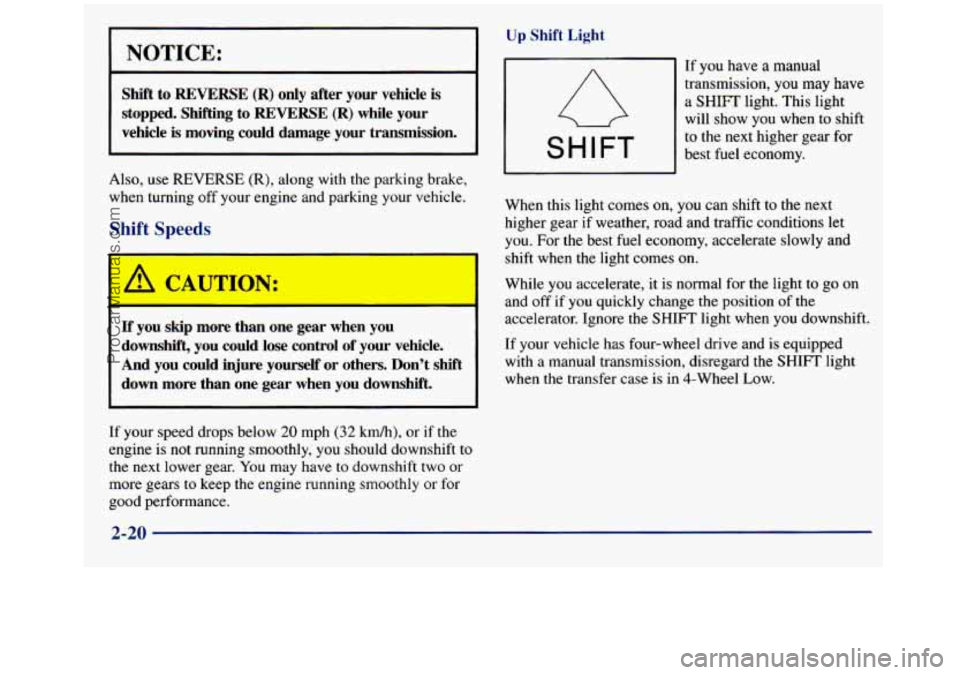
Up Shift Light
4l
If you have a manual
Shift to REVERSE (R) only after your vehicle is transmission, you may have
a SHIFT light. This light
stopped. Shifting to REVERSE (R) while your
vehicle is moving could damage your transmission. will show you when to shift
best fuel economy.
to the next higher gear for
SHIFT
AI - - , use REVERSE (R), along with the parking brake,
when turning
off your engine and parking your vehicle.
Shift Speeds
I JOU skip more than one gear when you
downshift, you could lose control
of your vehicle.
And you could injure yourself or others. Don’t shift
down more than one gear when you downshift.
If your speed drops below 20 mph (32 kmh), or if the
engine
is not running smoothly, you should downshift to
the next lower gear. You may have to downshift two or
more gears to keep the engine running smoothly or for
good performance. When
this light comes on,
you can shift to the next
higher gear if weather, road and traffic conditions let
you. For the best fuel economy, accelerate slowly and
shift when the light comes on.
While
you accelerate, it is normal for the light to go on
and
off if you quickly change the position of the
accelerator. Ignore the
SHIFT light when you downshift.
If your vehicle has four-wheel drive and
is equipped
with a manual transmission, disregard the SHIFT light
when
the transfer case is in 4-Wheel Low.
I
2-20
ProCarManuals.com
Page 105 of 452
Four-wheel Drive (If Equipped)
If your vehicle has four-wheel drive, you can send your
engine’s driving power to all four wheels for
extra
traction. To get the most satisfaction out of four-wheel
drive, you must be familiar with its operation. Read the
part that follows before using four-wheel drive. You
should use
2-WHEEL HIGH (2H) for most normal
driving conditions.
I i
I NOTICE:
Driving in the 4-WHEEL HIGH (4H) or
4-WHEEL LOW (4L) positions for a long time
on dry or wet pavement could shorten the life
of
your vehicle’s drivetrain.
Front Axle Locking Feature
The front axle locks and unlocks automatically when you
shift the transfer case. Some delay for the axle to lock or
unlock is normal.
If the outside temperature is very hot, or
the vehicle has been used under hard driving conditions,
there may
be a slight delay for the axle to unlock.
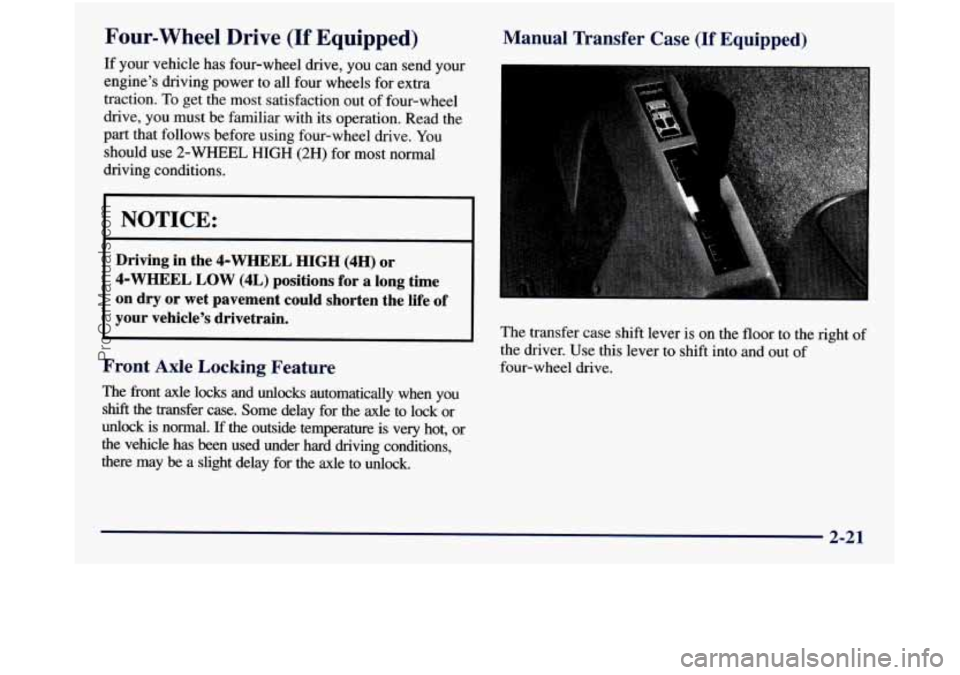
Manual Transfer Case (If Equipped)
The transfer case shift lever is on the floor to the right of
the driver. Use this lever to shift into and out of
four-wheel drive.
2-21
ProCarManuals.com
Page 106 of 452
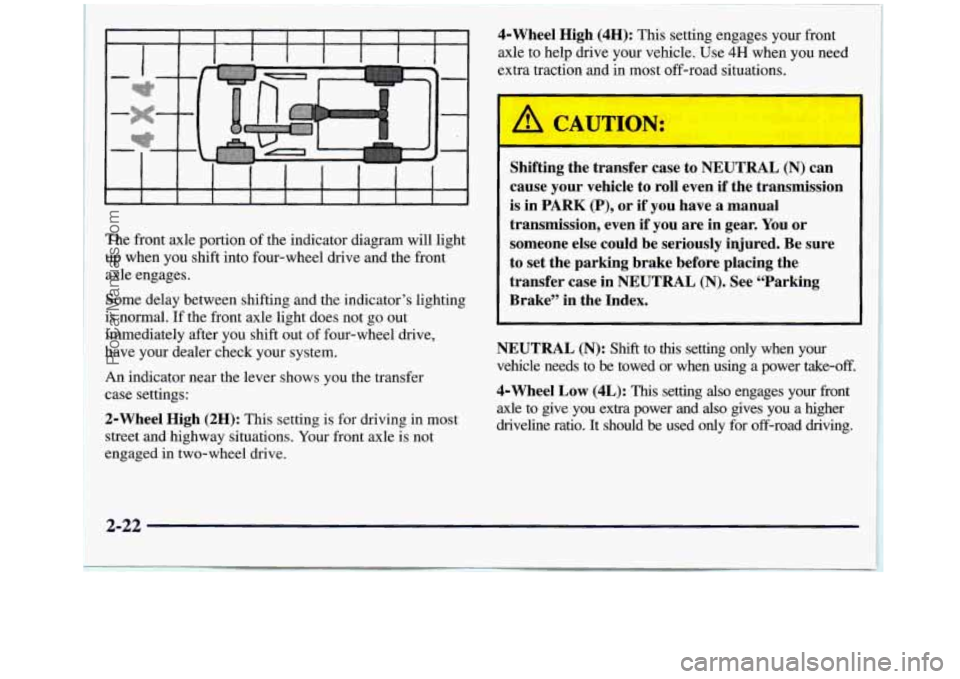
I ~ The front axle portion of the indicator diagram will light
up when you shift into four-wheel drive and the front
axle engages.
Some delay between shifting and the indicator’s lighting
is normal. If the front axle light does not go out
immediately after you shift out of four-wheel drive,
1 have your dealer check your system.
An indicator near the lever shows you the transfer
case settings:
2-Wheel High (2H): This setting is for driving in most
street and highway situations. Your front axle is not
engaged in two-wheel drive. 4-Wheel High
(4H): This setting engages your front
axle to help drive your vehicle. Use
4H when you need
extra traction and in most off-road situations.
Shifting the transfer case to
NEUTRAL (N) can
cause your vehicle to roll even
if the transmission
is in
PARK (P), or if you have a manual
transmission, even if you are in gear. You or
someone else could be seriously injured. Be
sure
to set the parking brake before placing the
transfer case in
NEUTRAL (N). See “Parking
Brake” in the Index.
NEUTRAL (N): Shift to this setting only when your
vehicle needs to be towed or when using a power take-off.
4-Wheel
Low (4L): This setting also engages your front
axle to give you extra power and also gives you
a higher
driveline ratio. It should be used only for off-road driving.
2-22
ProCarManuals.com
Page 107 of 452
You can shift from 2-WHEEL HIGH (2H) to 4-WHEEL
HIGH (4H) or from 4-WHEEL HIGH (4H) to
2-WHEEL HIGH (2H) while
the vehicle is moving.
Your front axle will engage faster
if you take your foot
off the accelerator for a few seconds after you shift. In
extremely cold weather, it may be necessary to stop or
slow the vehicle
to shift into 4-WHEEL HIGH (4H).
To
shift into or out of 4-WHEEL LOW (4L) or
NEUTRAL
(N):
1. Slow the vehicle to a roll, about 1 to 3 mph
(2
to 5 km/h) and shift an automatic transmission
into NEUTRAL
(N), or with a manual transmission,
press the clutch pedal.
2. Shift
the transfer case shift lever in one
continuous motion.
Don’t pause
in NEUTRAL (N) as you shift the
transfer case into 4-WHEEL LOW (4L), or your
gears
could clash.
Remember that driving
in 4-WHEEL HIGH (4H) or
4-WHEEL LOW (4L) may reduce
fuel economy. Also,
driving
in four-wheel drive on dry pavement could
cause your tires to wear faster and make your transfer
case harder
to shift and run noisier. When your headlamps
or parking lamps are on, rotate the
thumb wheel next
to the headlamp switch up to brighten
or down to dim your transfer case indicator light.
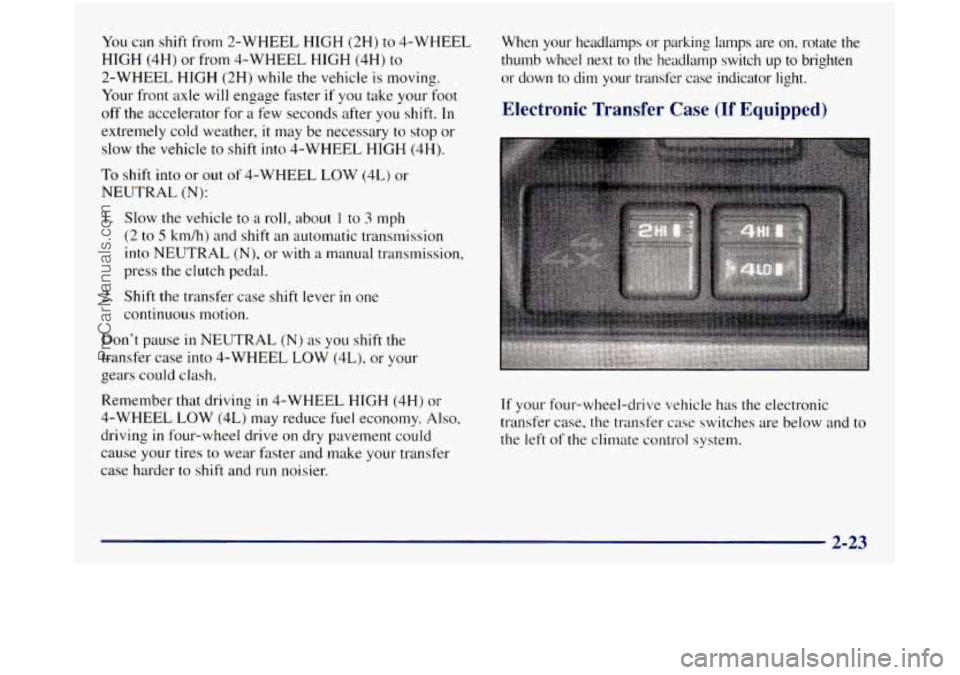
Electronic Transfer Case (If Equipped)
If your four-wheel-drive vehicle has the electronic
transfer case,
the transfer case switches are below and to
the left of the climate control system.
2-23
ProCarManuals.com
Page 108 of 452
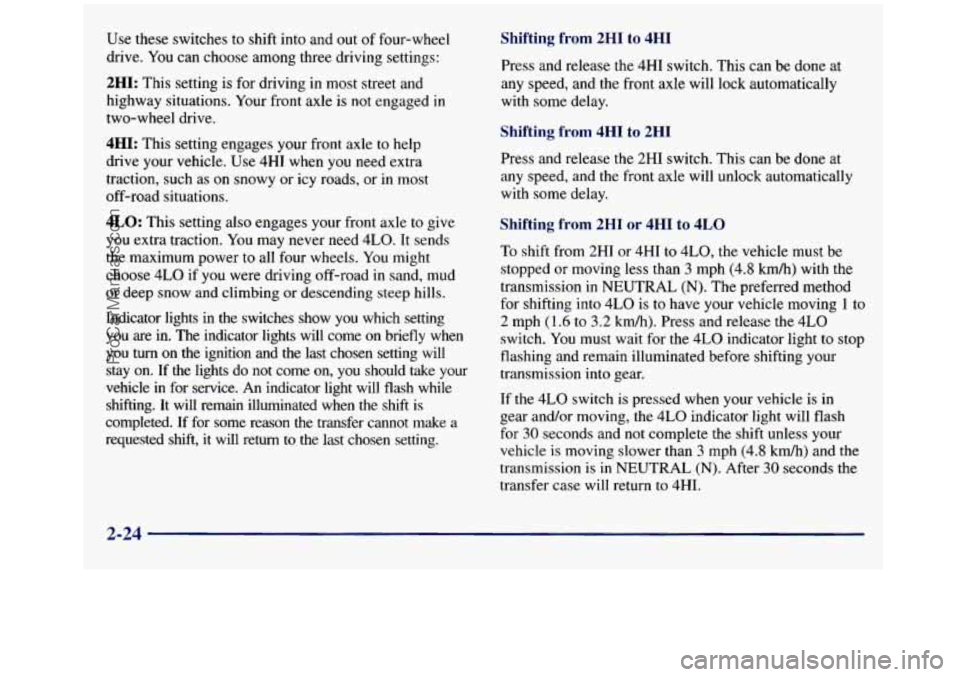
Use these switches to shift into and out of four-wheel
drive. You can choose among three driving settings:
2HI: This setting is for driving in most street and
highway situations. Your front axle is not engaged
in
two-wheel drive.
4HI: This setting engages your front axle to help
drive your vehicle. Use 4HI when you need extra
traction, such as
on snowy or icy roads, or in most
off-road situations.
4LO: This setting also engages your front axle to give
you extra traction. You may never need 4LO. It sends
the maximum power to all
four wheels. You might
choose 4LO if you were driving off-road in sand, mud
or deep snow and climbing or descending steep hills.
Indicator lights in the switches show you which setting
you are in. The indicator lights will come on briefly when
you
turn on the ignition and the last chosen setting will
stay on. If the lights
do not come on, you should take your
vehicle in for service. An indicator light will flash while
shifting. It will remain illuminated when
the shift is
completed. If for some reason the transfer cannot make a
requested shift, it will return
to the last chosen setting.
Shifting from 2HI to 4HI
Press and release the 4HI switch. This can be done at
any speed, and the front axle will lock automatically
with some delay.
Shifting from 4HI to 2HI
Press and release the 2HI switch. This can be done at
any speed, and the front axle will unlock automatically
with some delay.
ting from 2HI or 4HI to 4LO
'li hift from 2HI or 4HI to 4L0, the vehicle must be
stopped or moving less than
3 mph (4.8 km/h) with the
transmission in
NEUTRAL (N). The preferred method
for shifting into 4LO is to have your vehicle moving
1 to
2 mph (1.6 to
3.2 kmh). Press and release the 4LO
switch. You must wait for the
4LO indicator light to stop
flashing and remain illuminated before shifting your
transmission into gear.
If the 4LO switch is pressed when your vehicle is in
gear and/or moving, the 4LO indicator light will flash
for 30 seconds and not complete the shift unless your
vehicle is moving slower than
3 mph (4.8 kmh) and the
transmission is
in NEUTRAL (N). After 30 seconds the
transfer case will return to 4HI.
2-24
ProCarManuals.com
Page 109 of 452
Shifting from 4LO to 4HI or 2HI
To shift from 4LO to 4HI or 2H1, your vehicle must be
stopped or moving less than
3 mph (4.8 km/h) with the
transmission in
NEUTRAL (N). The preferred method
for shifting out of
4LO is to have your vehicle moving
1 to 2 mph (1.6 to 3.2 km/h). Press and release the 4HI
switch. You must wait for the 4HI indicator light to stop
flashing and remain illuminated before shifting your
transmission into gear.
If the 4HI switch is pressed when your vehicle is in gear
and/or moving, the
4HI indicator light will flash for
30 seconds but will not complete the shift unless the
vehicle is moving slower than
3 mph (4.8 km/h) and the
transmission is in
NEUTRAL (N).
Parking Brake
To set the parking brake, hold the regular brake pedal
down with your right foot. Push down the parking brake
pedal with your left foot.
If the ignition is on, the brake system warning light will
come on.
To release the parking brake, hold the regular brake
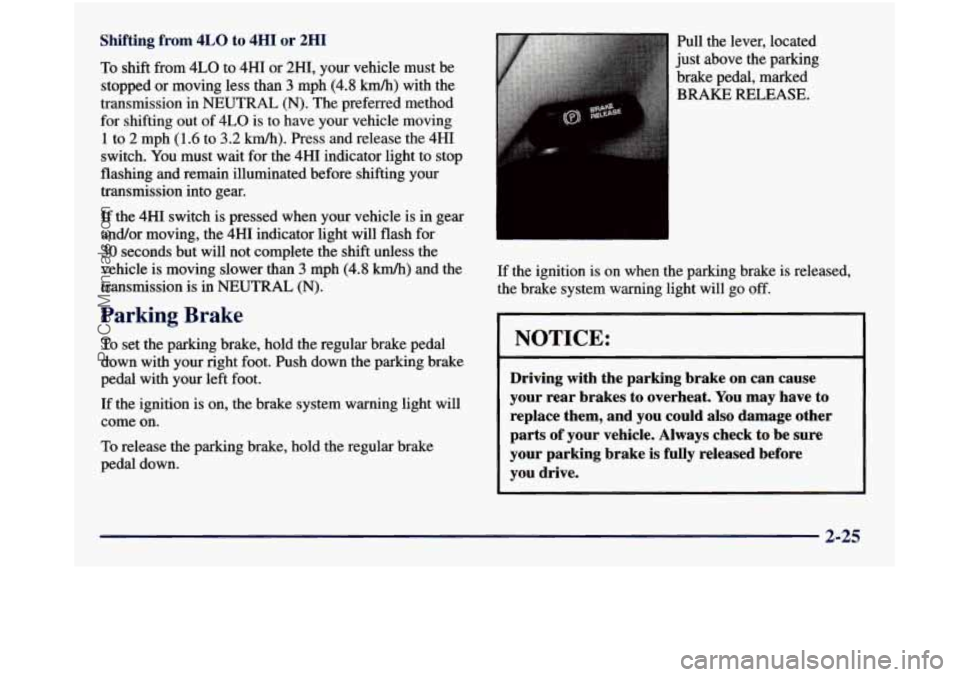
pedal down. Pull
the lever, located
just above the parking
brake pedal, marked
BRAISE RELEASE.
If the ignition is on when the parking brake is released,
the brake system warning light will go off.
NOTICE:
Driving with the parking brake on can cause
your rear brakes to overheat. You may have to
replace them, and you could also damage other
parts of your vehicle. Always check to be sure
your parking brake is fully released before
you drive.
2-25
ProCarManuals.com
Page 117 of 452
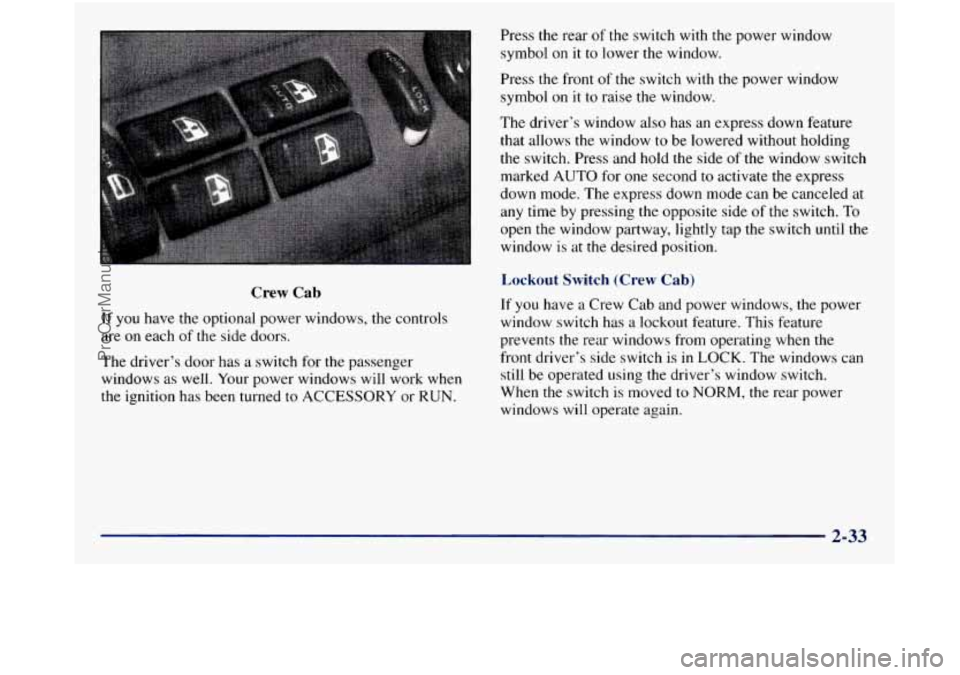
Crew Cab
If you have the optional power windows, the controls
are on each of the side doors.
The driver’s door has a switch for the passenger
windows as well. Your power windows will work when
the ignition has been turned
to ACCESSORY or RUN. Press the rear
of the
switch with the power window
symbol on
it to lower the window.
Press the front of
the switch with the power window
symbol
on it to raise the window.
The driver’s window also has an express down feature
that allows the window to be lowered without holding
the switch. Press and hold the side of the window switch
marked
AUTO for one second to activate the express
down mode. The express down mode can be canceled at
any time by pressing the opposite side
of the switch. To
open the window partway, lightly tap the switch until the
window is at the desired position.
Lockout Switch (Crew Cab)
If you have a Crew Cab and power windows, the power
window switch has
a lockout feature. This feature
prevents the rear windows from operating when
the
front driver’s side switch is in LOCK. The windows can
still be operated using the driver’s window switch.
When the switch is moved
to NORM, the rear power
windows will operate again.
2-33
ProCarManuals.com
Page 120 of 452
If a bulb is burned out, replace it to help avoid an
accident. If the arrows don’t go on at all when you
signal
a turn, check for burned-out bulbs and a blown
fuse (see “Fuses and Circuit Breakers”
in the Index).
Headlamp HighLow-Beam Changer
To change the headlamps from low to high beam or high
to low beam, pull the multifunction lever all the way
toward
you. Then release it.
When the high beams are
on, this light
on the
instrument panel also will
be on.
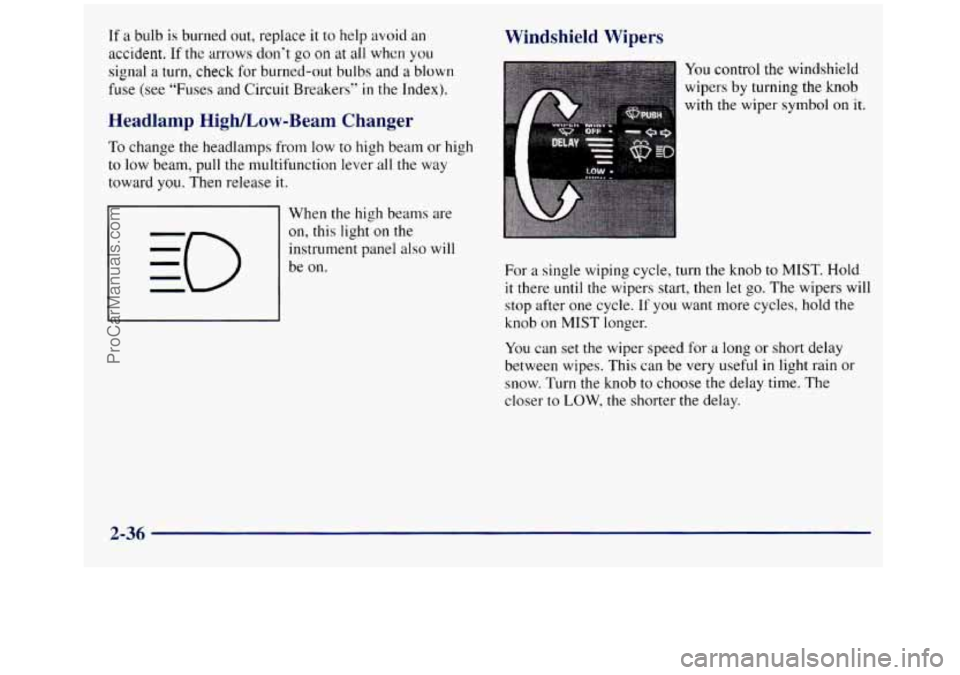
Windshield Wipers
You control the windshield
wipers
by turning the knob
with the wiper
symbol on it.
For a single wiping cycle, turn the knob to MIST. Hold
it there until the wipers start, then let
go. The wipers will
stop after one cycle.
If you want more cycles, hold the
knob on MIST longer.
You can set
the wiper speed for a long or short delay
between wipes. This can be very useful
in light rain or
snow. Turn the knob to choose the delay time. The
closer to
LOW, the shorter the delay.
2-36
ProCarManuals.com
Page 125 of 452
Ending Cruise Control
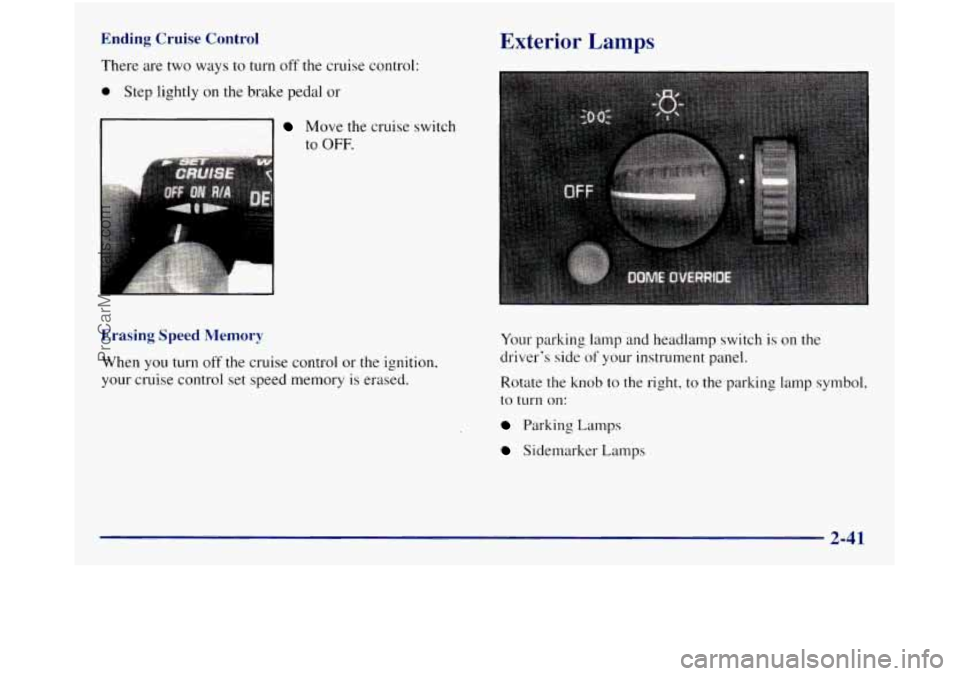
There are two ways to turn off the cruise control:
0 Step lightly on the brake pedal or
Move the cruise switch
to
OFF.
Erasing Speed Memory
When you turn off the cruise control or the ignition,
your cruise control set speed memory is erased.
Exterior Lamps
Your parking lamp and headlamp switch is on the
driver's side
of your instrument panel.
Rotate the knob to the right, to the parking lamp symbol.
to
turn on:
Parking Lamps
Sidemarker Lamps
2-41
ProCarManuals.com
Page 126 of 452
Clearance Lamps (If Equipped)
Taillamps License Plate Lamps
Instrument Panel Lights
Transfer Case Shift Indicator Light (Four-Wheel-Drive Vehicles)
Rotate the knob to the right again to the master
lighting symbol
to turn on all the lamps listed as
well as the headlamps.
Rotate the knob to the left,
to OFF, to turn off
your lamps.
Rotate the thumb wheel next to
the knob up to adjust
instrument panel lights. Rotate the thumb wheel
up to
the first notch to return the radio display and gearshift
indicator
LED display to full intensity when the
headlamps or parking lamps are on.
You can switch your headlamps from high
to low beams
by pulling on the turn signal/multifunction lever.
Headlamps On Reminder
A buzzer will sound when your headlamps are turned on
and the key
is turned to the OFF, LOCK or
ACCESSORY position.
If you need to use your
headlamps when the key is turned to OFF-
LOCK or ACCESSORY, the
buzzer can be turned off by turning
the thumb wheel next
to the parking lamp/headlamp
knob all the way down.
Daytime Running Lamps
Daytime Running Lamps (DRL) can make it easier for
others to see the front of your vehicle during the day.
DRL can be helpful
in many different driving
conditions, but they can be especially helpful
in the
short periods after dawn and before sunset.
The DRL system
will make your headlamps come on at
a reduced brightness when:
0 the ignition is on,
0 the headlamp switch is off and
the parking brake is released.
When the DRL are on, only your headlamps will be on.
The taillamps, sidemarker and other lamps won’t
be on.
Your instrument panel won’t be lit
up either.
When it begins to get dark, your DRL indicator light is a
reminder to turn your headlamp switch on. The other lamps
that come
on with your headlanips will also come on.
When you
turn off the headlamp switch, the regular
lamps will
go off, and your headlamps will change to
the reduced brightness of DRL.
2-42
ProCarManuals.com