mirror GMC SIERRA 1998 User Guide
[x] Cancel search | Manufacturer: GMC, Model Year: 1998, Model line: SIERRA, Model: GMC SIERRA 1998Pages: 452, PDF Size: 23.65 MB
Page 201 of 452
Loss of Control
Let’s review what driving experts say about what
happens when the three control systems (brakes, steering
and acceleration) don’t have enough friction where
the
tires meet the road to do what the driver has asked.
In any emergency, don’t give up. Keep trying to steer and
constantly seek an escape route or area of less danger.
Skidding
In a skid, a driver can lose control of the vehicle. Defensive
drivers avoid most skids by taking reasonable care suited
to
existing conditions, and by not “overdriving” those
conditions. But skids are always possible.
The three types of skids correspond
to your vehicle’s
three control systems. In the braking skid, your wheels
aren’t rolling. In the steering or cornering skid,
too
much speed or steering in a curve causes tires to slip and
lose cornering force. And
in the acceleration skid, too
much throttle causes the driving wheels to spin.
A cornering skid and an acceleration skid are best
handled by easing your foot off the accelerator pedal. If
your vehicle starts
to slide, ease your foot off the
accelerator pedal and quickly steer the way you want the
vehicle
to go. If you start steering quickly enough, your
vehicle may straighten out. Always be ready for
a
second skid if it occurs.
Of course, traction
is reduced when water, snow, ice.
gravel or other material
is on the road. For safety, you’ll
want to slow down and adjust your driving to these
conditions.
It is important to slow down on slippery
surfaces because stopping distance will be longer and
vehicle control more limited.
While driving on a surface
with reduced traction, try
your best to avoid sudden steering, acceleration or
braking (including engine braking
by shifting to a lower
gear). Any sudden changes could cause the tires
to slide.
You may not realize the surface is slippery until your
vehicle is skidding. Learn to recognize warning clues
--
such as enough water, ice or packed snow on the road to
make
a “mirrored surface” -- and slow down when you
have any doubt.
Remember:
Any anti-lock brake system (ABS) helps
avoid only the braking skid.
4-13
ProCarManuals.com
Page 215 of 452
steering, suspension, wheels, tires ana exhaust system
for damage.
Also, check the fuel lines and cooling
system for any leakage. Night driving is more dangerous than
day driving. One
reason is that some drivers are likely to
be impaired -- by
alcohol or
drugs, with night vision problems, or by fatigue.
Your vehicle will require more frequent service due to
off-road use. Refer
to the Maintenance Schedule for
additional information.
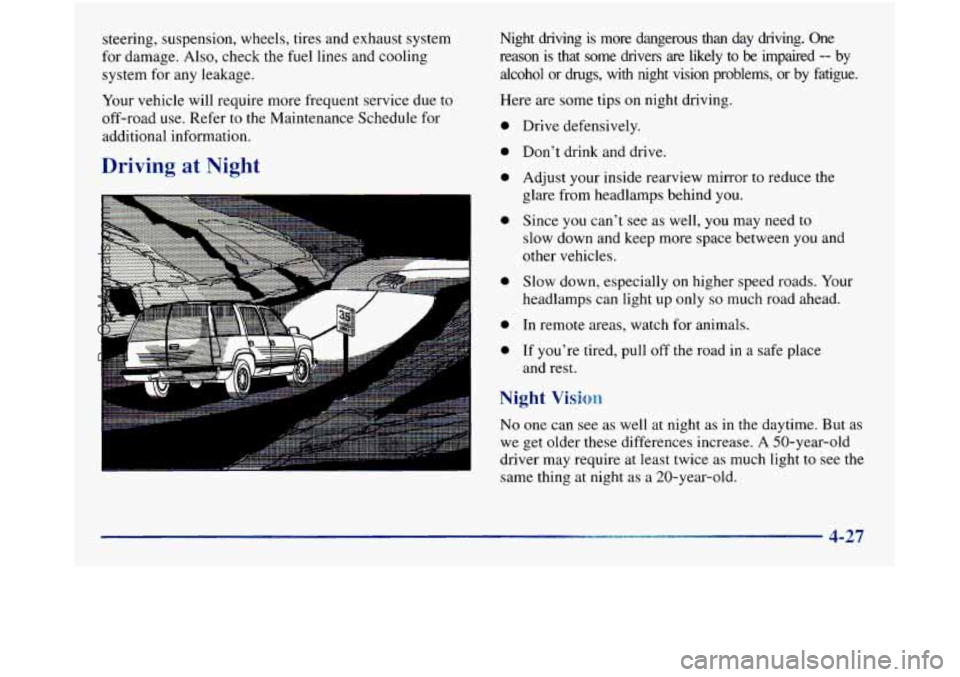
Driving at Night
Here are some tips on night driving.
0
0
0
0
0
0
0
Drive defensively.
Don’t drink and drive.
Adjust your inside rearview mirror
to reauce me
glare from headlamps behind you.
Since you can’t see as well,
you may need to
slow down and keep more space between you and
other vehicles.
Slow down, especially on higher speed roads. Your
headlamps can light
up only so much road ahead.
In remote areas, watch for animals.
If you’re tired, pull off
the road in a safe place
and rest.
Night Vision
No one can see as well at night as in the daytime. But as
we get older
these differences increase. A 50-year-old
driver may require at least twice as much light
to see the
same thing at night as a 20-year-old.
4-27
ProCarManuals.com
Page 220 of 452
Freeway Driving
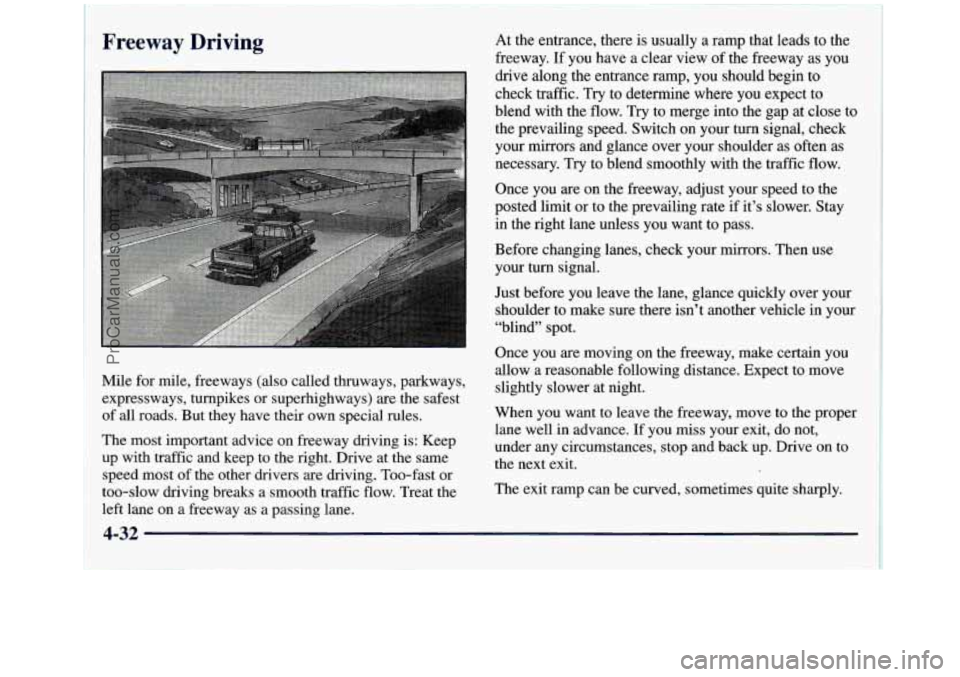
Mile for mile, freeways (also called thruways, parkways,
expressways, turnpikes or superhighways) are the safest
of all roads. But they have their own special rules.
The most important advice on freeway driving is: Keep
up with traffic and keep to the right. Drive at the same
speed most
of the other drivers are driving. Too-fast or
too-slow driving breaks a smooth traffic flow. Treat the
left lane on a freeway as a passing lane.
~ ~~~ . ~
~~ ~~ ~
At the entrance, there is usually a ramp that leads to the
freeway.
If you have a clear view of the freeway as you
drive along the entrance ramp, you should begin to
check traffic. Try to determine where
you expect to
blend with the flow.
Try to merge into the gap at close to
the prevailing speed. Switch on your turn signal, check
your mirrors and glance over your shoulder as often as
necessary. Try to blend smoothly with the traffic flow.
Once you are on the freeway, adjust your speed to the
posted limit or to the prevailing rate
if it’s slower. Stay
in the right lane unless you want
to pass.
Before changing lanes, check your mirrors. Then use
your turn signal.
Just before you leave the lane, glance quickly over your
shoulder to make sure there isn’t another vehicle
in your
“blind” spot.
Once you are moving on the freeway, make certain you
allow a reasonable following distance. Expect to move
slightly slower at night.
When you want
to leave the freeway, move to the proper
lane well in advance. If
you miss your exit, do not,
under any circumstances, stop and back up. Drive on to
the next exit.
The exit ramp can be curved, sometimes quite sharply.
4-32
ProCarManuals.com
Page 222 of 452
What can you do about highway hypnosis? First, be
aware that it
can happen.
Then here are some tips:
0 Make sure your vehicle is well ventilated, with a
comfortably cool interior.
Keep your eyes moving. Scan the road ahead and
to the sides. Check your mirrors and your
instruments frequently.
If you get sleepy, pull off the road into a rest, service
or parking area and take a nap, get some exercise, or
both. For safety, treat drowsiness on the highway as
an emergency.
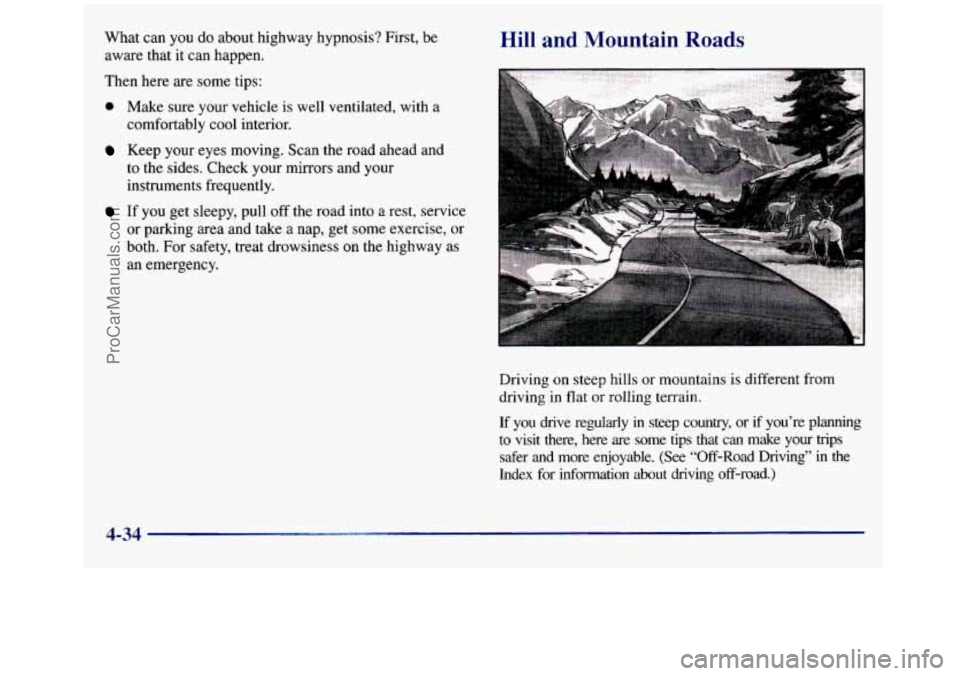
Hill and Mountain Roads
Driving on steep hills or mountains is different from
driving in flat or rolling terrain.
If you drive regularly in steep country, or if you’re planning
to visit there, here are some tips that can make your trips
safer
and more enjoyable. (See “Off-Road Driving” in the
Index for infolmation about driving off-road.)
4-34
ProCarManuals.com
Page 244 of 452
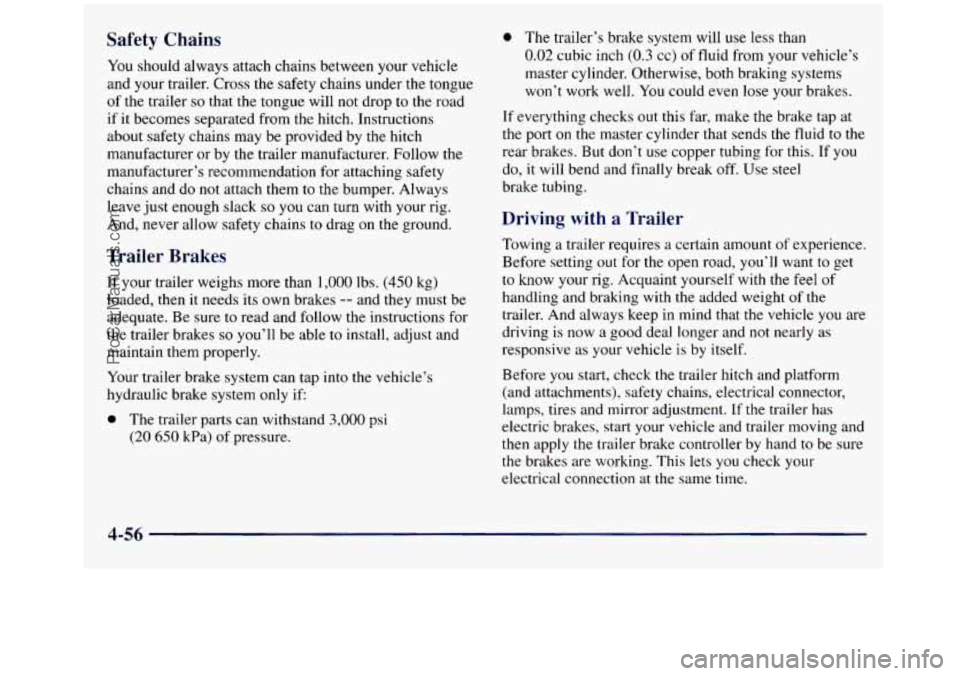
Safety Chains
You should always attach chains between your vehicle
and your trailer. Cross the safety chains under the tongue
of the trailer so that’the tongue will not drop to the road
if it becomes separated from the hitch. Instructions
about safety chains may be provided by the hitch
manufacturer or by the trailer manufacturer. Follow the
manufacturer’s recommendation for attaching safety
chains and do not attach them to the bumper. Always
leave just enough slack
so you can turn with your rig.
And, never allow safety chains
to drag on the ground.
Trailer Brakes
If your trailer weighs more than 1,000 Ibs. (450 kg)
loaded, then it needs its own brakes
-- and they must be
adequate. Be sure to read and follow the instructions for
the trailer brakes so you’ll be able to install, adjust and
maintain them properly.
Your trailer brake system can tap into the vehicle’s
hydraulic brake system only if
0 The trailer parts can withstand 3,000 psi
(20 650 kPa) of pressure.
0 The trailer’s brake system will use less than
0.02 cubic inch (0.3 cc) of fluid from your vehicle’s
master cylinder. Otherwise, both braking systems
won’t work well. You could even lose your brakes.
If everything checks out this far, make the brake tap at
the port
on the master cylinder that sends the fluid to the
rear brakes.
But don’t use copper tubing for this. If you
do,
it will bend and finally break off. Use steel
brake tubing.
Driving with a Trailer
Towing a trailer requires a certain amount of experience.
Before setting out for the open road, you’ll want to get
to
know your rig. Acquaint yourself with the feel of
handling and braking with the added weight of
the
trailer. And always keep in mind that the vehicle you are
driving is now a good deal longer and not nearly as
responsive as your vehicle
is by itself.
Before you start, check
the trailer hitch and platform
(and attachments), safety chains, electrical connector,
lamps, tires and mirror adjustment.
If the trailer has
electric brakes, start your vehicle and trailer moving and
then apply
the trailer brake controller by hand to be sure
the brakes are working. This lets you check your
electrical connection at the same time.
4-56
ProCarManuals.com
Page 363 of 452
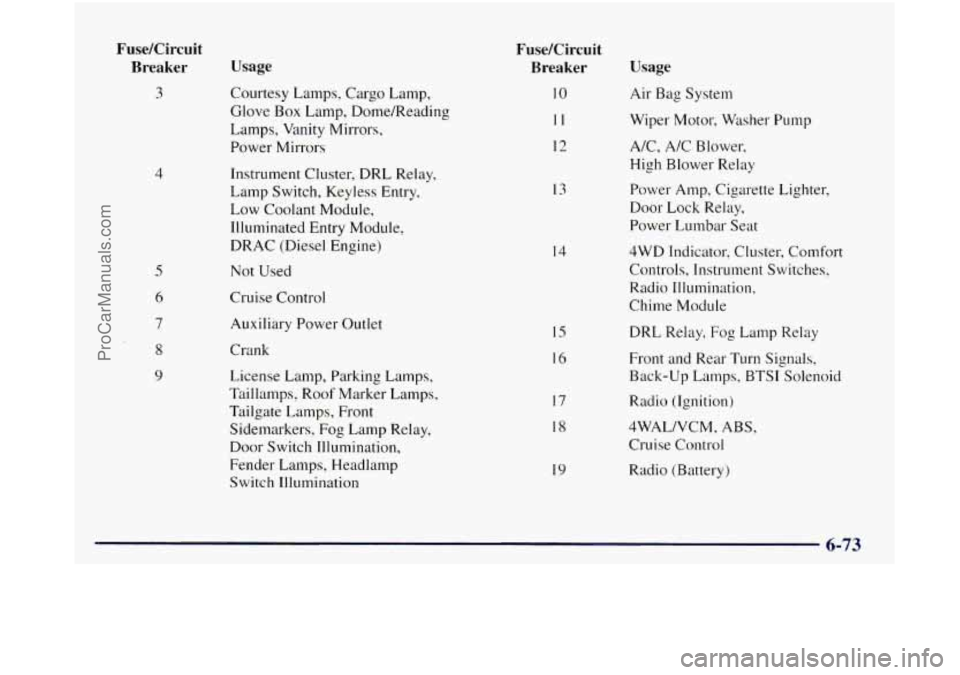
FuseKircuit Breaker
3
4
Usage
Courtesy Lamps, Cargo Lamp,
Glove Box Lamp, Dome/Reading
Lamps, Vanity Mirrors,
Power Mirrors
Instrument Cluster, DRL Relay,
Lamp Switch, Keyless Entry,
Low Coolant Module, Illuminated Entry Module,
DRAC (Diesel Engine)
Not Used
Cruise Control
Auxiliary Power Outlet
Crank
License Lamp, Parking Lamps,
Taillamps,
Roof Marker Lamps,
Tailgate Lamps, Front
Sidemarkers, Fog Lamp Relay,
Door Switch Illumination,
Fender Lamps, Headlamp Switch Illumination
FuseKircuit
Breaker
10
11
12
13
14
15
I6
17
18
19
Usage
Air Bag System
Wiper Motor, Washer Pump
A/C,
A/C Blower,
High Blower Relay
Power
Amp, Cigarette Lighter,
Door Lock Relay,
Power Lumbar Seat
4WD Indicator, Cluster, Comfort
Controls, Instrument Switches,
Radio Illumination,
Chime Module
DRL Relay,
Fog Lamp Relay
Front and Rear Turn Signals,
Back-up Lamps, BTSl Solenoid
Radio (Ignition)
4WAL/VCM, ABS. Cruise Control
Radio (Batterv)
6-73
ProCarManuals.com
Page 366 of 452
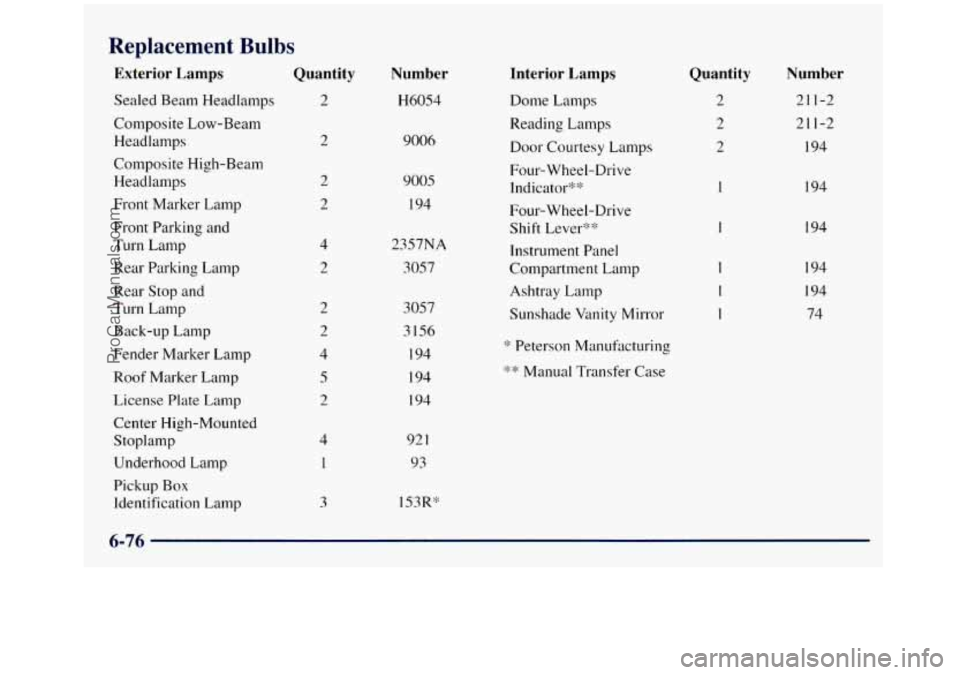
Replacen- - --:
Exterior Lamps
.-
Quantity Number
H6054
Interior Lamps Quantity Number
21 1-2
21 1-2
194
Sealed
Beam Headlamps
Composite Low-Beam
Headlamps
Composite High-Beam
Headlamps
Front Marker Lamp
Front Parking and
Turn Lamp
Rear Parking Lamp
Rear Stop and
Turn Lamp
Back-up Lamp
Fender Marker Lamp
Roof Marker Lamp
License Plate Lamp
Center High-Mounted
Stoplamp
Underhood Lamp
Pickup
Box
Identification Lamp
2 Dome Lamps
Reading Lamps Door Courtesy Lamps
Four-Wheel-Drive
Indicator**
Four-Wheel-Drive Shift Lever4:
:P
Instrument Panel
Compartment Lamp
2 9006
2
2 9005
194 1 194
1 194
4
2
2357NA
3057 194
194
74
Ashtray Lamp
Sunshade Vmity Mirror
3057
3156 I94
194
194
'@ Peterson Manufacturing
*'k Manual Transfer Case
4
1
92 1
93
3
6-76
ProCarManuals.com
Page 436 of 452
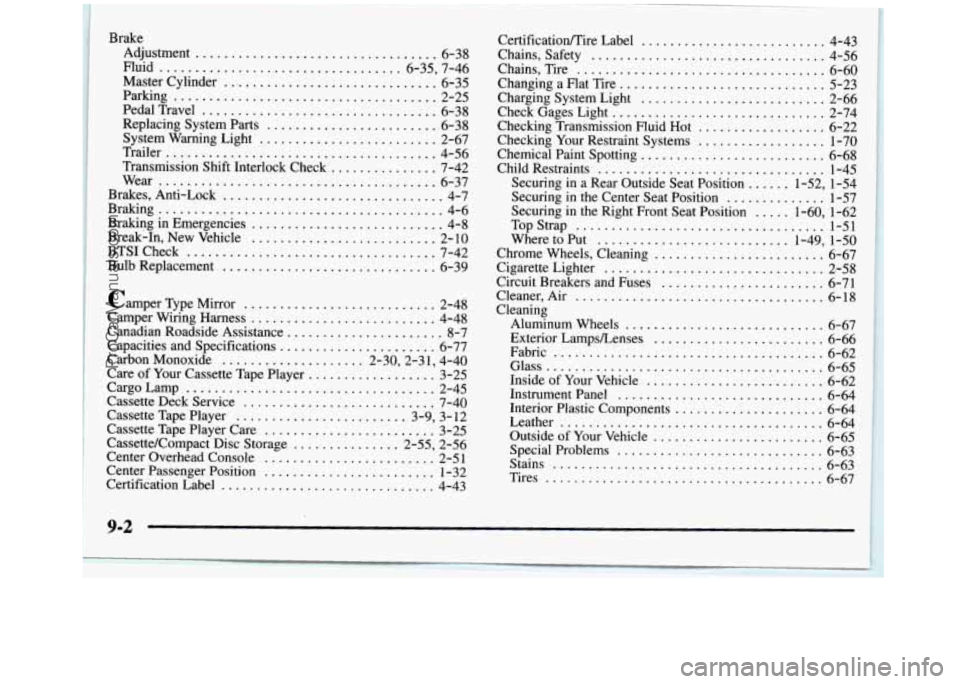
Brake Adjustment
.................................. 6-38
Fluid .................................. 6-35, 7-46 Master Cylinder .............................. 6-35
PedalTravel ................................. 6-38 Replacing System Parts ........................ 6-38
System Warning Light ......................... 2-67
Transmission Shift Interlock Check ............... 7-42
Brakes, Anti-Lock ............................... 4-7
Braking ........................................ 4-6 Braking in Emergencies ........................... 4-8
Break-In, New Vehicle .......................... 2-10
Bulb Replacement .............................. 6-39
Parking ..................................... 2-25
Trailer ...................................... 4-56
Wear ....................................... 6-37
BTSICheck ..................................... 42
Camper vpe Mirror ........................... 2-48
Camper Wiring Harness .......................... 4-48
Canadian Roadside Assistance ...................... 8-7
Capacities and Specifications ...................... 6-77
Carbon Monoxide .................... 2.30.2.31. 4.40
Care of Your Cassette Tape Player .................. 3-25
Cassette Deck Service ........................... 7-40
Cassette Tape Player ........................ 3-9, 3- 12
Cassette Tape Player Care ........................ 3-25
CassetteKompact Disc Storage ............... 2-55, 2-56
Center Overhead Console ........................ 2-51
Center Passenger Position ........................ 1-32
Certification Label .............................. 4-43
CargoLamp ................................... 2-45
.
ProCarManuals.com
Page 437 of 452
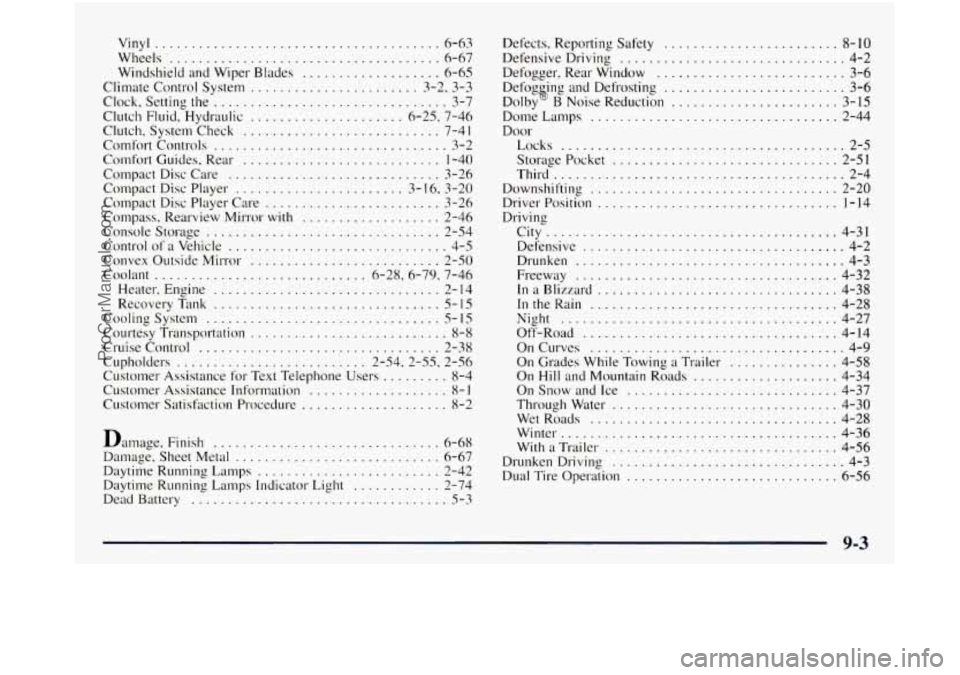
Vinyl ....................................... 6-63
Wheels
..................................... 6-67
Windshield and Wiper Blades
................... 6-65
Clock. Setting the ................................ 3-7
Clutch Fluid. Hydraulic
..................... 6-25. 7-46
Clutch. System Check
........................... 7-41
Comfort Controls
................................ 3-2
Comfort Guides. Rear
........................... 1-40
Compact Disc Care
............................. 3-26
Compact Disc Player
.......................
3-16 . 3-20
Compact Disc Player Care
........................ 3-26
Compass. Rearview Mirror
with ................... 2-46
Console Storage
................................ 2-54
Control
of a Vehicle .............................. 4-5
Convex Outside Mirror .......................... 2-SO
Coolant ............................. 6-28.6-79.7-46
Heater
. Engine ............................... 2- 14
Recovery Tank ............................... 5- I5
Cooling System ................................ 5- IS
Courtesy Transportation ........................... 8-8
Cruise Control
................................. 2-38
Cupholders
.......................... 2.54.2.55. 2-56
Customer Assistance Information ................... 8- I
Customer Satisfaction Procedure .................... 8-2
Climate Control System ....................... 3.2 . 3-3
Customer Assistance for Text Telephone Users
......... 8-4
Damage. Finish
............................... 6-68
Darnage. Sheet Metal
............................ 6-67
Daytime Running Lamps
......................... 2-42
Daytime Running Lamps Indicator Lighl
............ 2-74
Dead Battery
................................... 5-3
Defects. Reporting Safety ........................ 8- 10
Defensive Driving ............................... 4-2
Defogger. Rear Window .......................... 3-6
Defoggng
and Defrosting ......................... 3-6
Dolby B Noise Reduction
....................... 3-15
Dome Lamps
.................................. 2-44
DO0
I.
Locks ....................................... 2-5
Storage Pocket ............................... 2-51
Third
........................................ 2-4
Downshifting
.................................. 2-20
Driver Position ................................. 1-14
Driving City
........................................ 4-31
Defensive
.................................... 4-2
Drunken
..................................... 4-3
Freeway
.................................... 4-32
In a Blizzard ................................. 4-38
In the Rain .................................. 4-28
Night
...................................... 4-27
Off-Road
................................... 4-14
On Curves
................................... 4-9
On Grades While Towing a Trailer ............... 4-58
On Hill and Mountain Roads .................... 4-34
On Snow and Ice
............................. 4-37
Through Water
............................... 4-30
Wet Roads
.................................. 4-28
Winte
l- ...................................... 4-36
With
a Trailer ................................ 4-56
Drunken Driving
................................ 4-3
Dual Tire Operation
............................. 6-56
9-3
ProCarManuals.com
Page 440 of 452
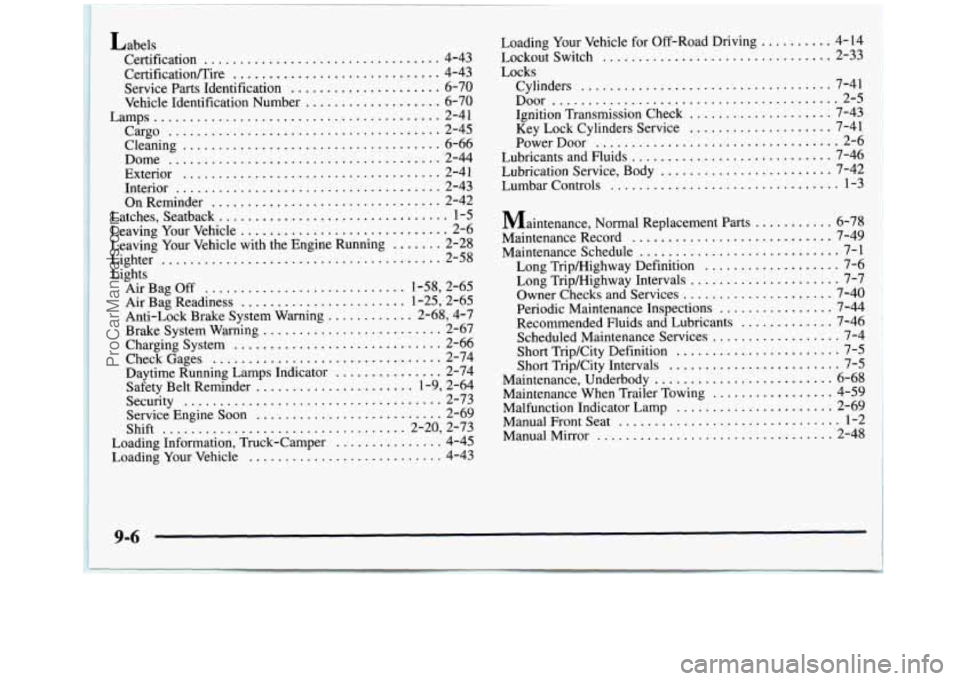
Loading Your Vehicle for Off-Road Driving
Lockout Switch
......................
Locks
Cylinders
.........................
Door .............................
Ignition Transmission Check ..........
Key Lock Cylinders Service ..........
Power Door .......................
Lubricants and Fluids ..................
Lubrication Service, Body ..............
Lumbar Controls .....................
Maintenance, Normal Replacement Parts .
Maintenance Record ..................
Maintenance Schedule .................
Long Trip/Highway Definition ........
Long Tripmighway Intervals ..........
Owner Checks and Services ...........
Periodic Maintenance Inspections ......
Recommended Fluids and Lubricants ...
Scheduled Maintenance Services .......
Short TripKity Definition ............
Short TripKity Intervals .............
Maintenance, Underbody ...............
Maintenance When Trailer Towing .......
Malfunction Indicator Lamp ............
Manual Front Seat ....................
Manual Mirror .......................
......
......
......
......
......
......
......
......
......
......
......
......
......
......
......
......
......
......
......
......
......
......
......
......
......
......
ProCarManuals.com