mirror GMC SIERRA 1998 Owners Manual
[x] Cancel search | Manufacturer: GMC, Model Year: 1998, Model line: SIERRA, Model: GMC SIERRA 1998Pages: 452, PDF Size: 23.65 MB
Page 85 of 452
Section 2 Features and Controls
Here you can learn about the many standard and optional features on your vehicle, and information on starting,
shifting and braking. Also explained are the instrument panel and
the warning systems that tell you if everything is
working properly
-- and what to do if you have a problem.
2-2
2-
3
2-4 2-5
2-6
2-9
2-
10
2- 10
2-1 1
2-12
2- 14
2-15
2-18
2-2
I
2-25
2-26
2-29 Keys
Tailgate
Third Door
(If Equipped)
Door Locks
Keyless Entry System (If Equipped)
Theft
PasslockTM
New Vehicle ”Break-In”
Ignition Positions
Starting Your Gasoline Engine
Engine Coolant Heater (If Equipped) Automatic Transmission Operation
Manual Transmission Operation Four-wheel Drive
(If Equipped)
Parking Brake
Shifting Into Park
(P) (Automatic
Transmission Models
Only)
Shifting Out of Park (P)
(Automatic Transmission) 2-29
2-30
2-30
2-3 1
2-32
2-32
2-34
2-35
2-4
1
2-43
2-45
2-5
1
2-60
2-62
2-64 Parking
Your Vehicle (Manual Transmission
Models
Only)
Parking Over Things That Burn
Engine Exhaust
Running Your Engine While You’re Parked
(Automatic Transmission)
Locking Rear Axle (If Equipped)
Windows
Tilt Wheel (If Equipped)
Turn Signal/Multifunction Lever
Exterior Lamps
Interior Lamps Mirrors
Storage Compartments
Instrument Panel
Instrument Panel Cluster
Warning Lights, Gages and Indicators
ProCarManuals.com
Page 129 of 452
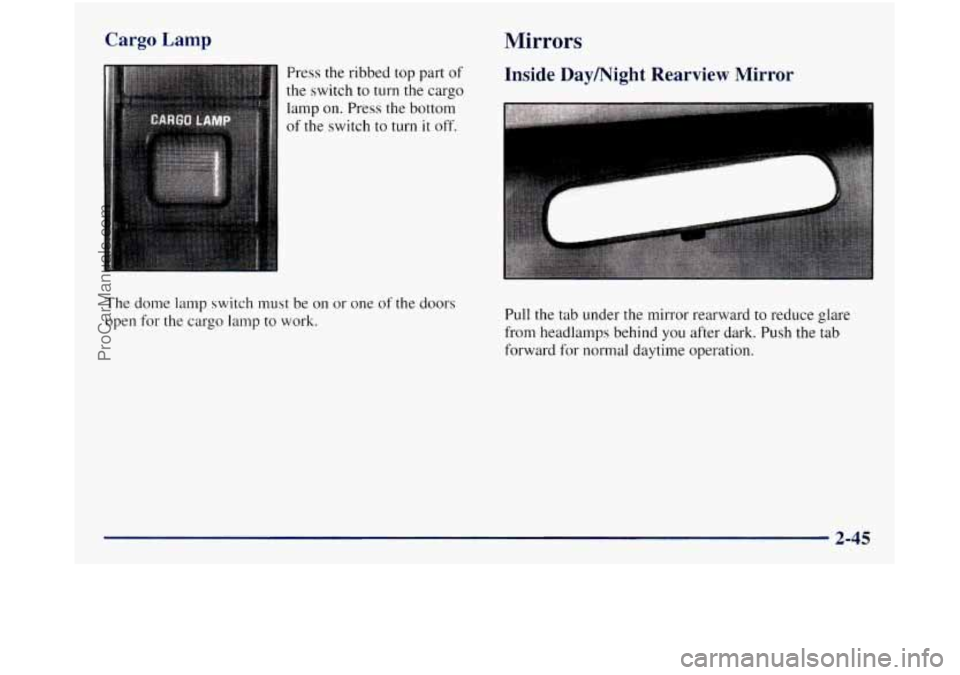
Cargo Lamp
Press the ribbed top part of
the switch to turn the cargo
lamp on. Press the bottom
of the switch to turn it off.
The dome lamp switch must be on or one of the doors
open
for the cargo lamp to work.
Mirrors
Inside Daymight Rearview Mirror
P
Pull the tab under the mirror rearward to reduce glare
from headlamps behind
you after dark. Push the tab
forward for normal daytime operation.
2-45
ProCarManuals.com
Page 130 of 452
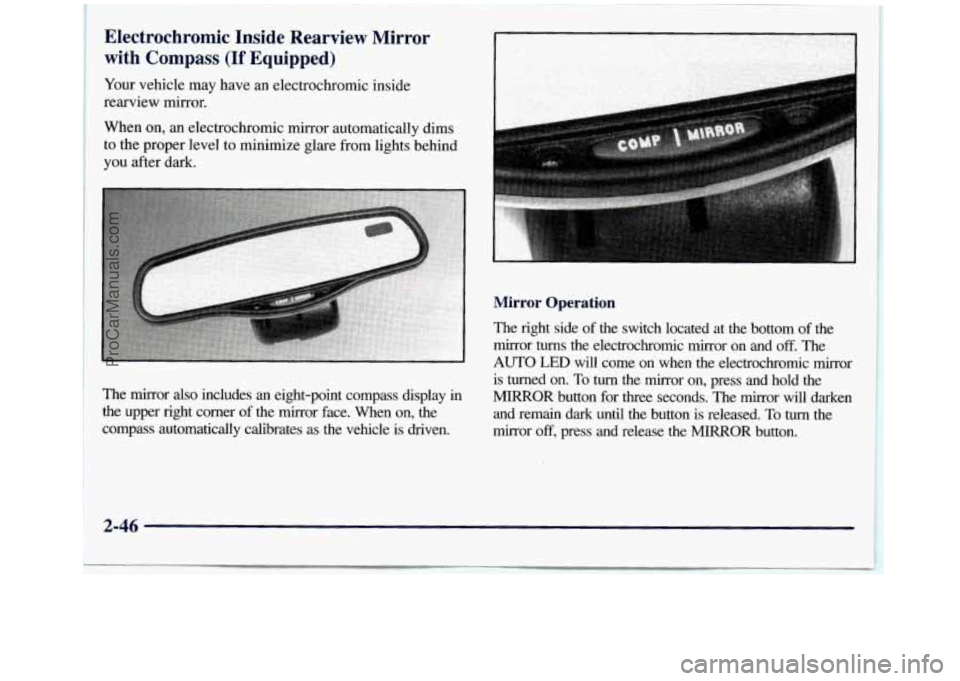
The mirror also includes an eight-point compass display in
the upper right corner
of the mirror face. When on, the
compass automatically calibrates as the vehicle is driven,
Mirror Operation
The right side of the switch located at the bottom of the
mirror
turns the electrochromic mirror on and off. The
AUTO LED will come on when the electrochromic mirror
is turned on.
To turn the mirror on, press and hold the
MIRROR button for three seconds. The mirror will darken
and remain dark until the button is released. To
turn the
mirror
off, press and release the MIRROR button.
2-46
ProCarManuals.com
Page 131 of 452
Compass Operation The mirror can be calibrated in one of two ways:
Press the COMP switch once briefly to turn the compass
on or
off.
When the ignition and the compass feature are on, the
compass will show two character boxes for
approximately two seconds. After two seconds, the
mirror will display the compass heading.
When cleaning the mirror, use
a paper towel or similar
material dampened
with glass cleaner. Do not spray
glass cleaner directly on the mirror as that may cause the
liquid cleaner to enter the mirror housing.
Compass Calibration
If, after two seconds, the display does not show a compass
heading
(“N? for North, for example), there may be a
strong magnetic field interfering with the compass. Such
interference may be caused by a magnetic antenna mount,
magnetic note pad holder or
a similar magnetic item. If the
letter
“C” should ever appear in the compass window, the
mirror may need calibration.
0 Drive the vehicle in circles at five mph (8 km/hj or
less until the display reads a direction, or
0 Drive the vehicle on your everyday routine.
Compass Variance
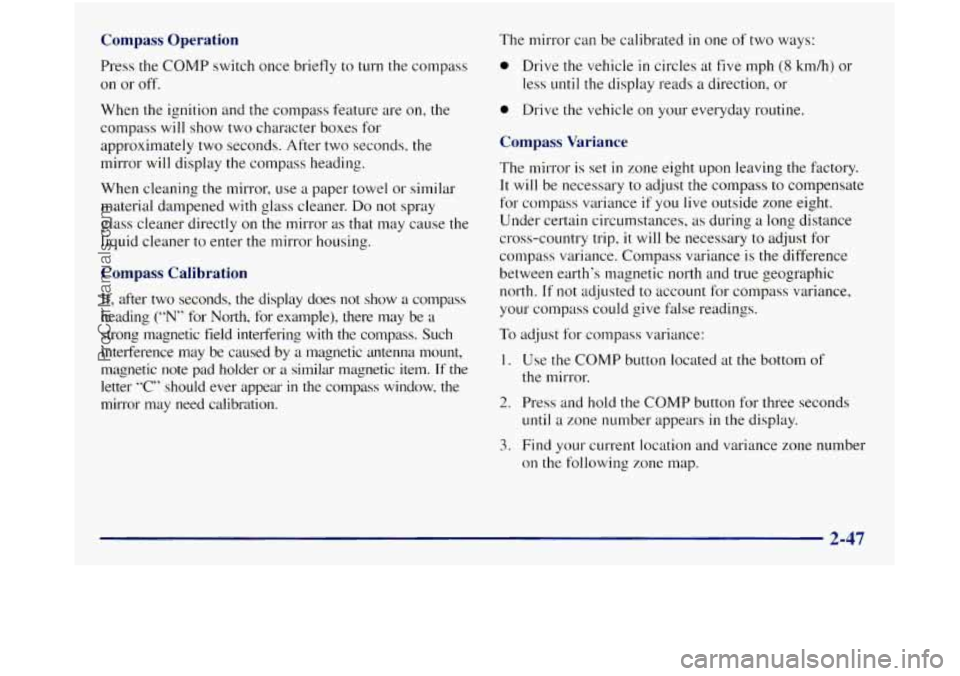
The mirror is set in zone eight upon leaving the fictory.
It will be necessary to adjust the compass to compensate
for compass variance
if you live outside zone eight.
Under certain circumstances, as during
it long distance
cross-country trip,
it will be necessary to adjust for
con~pass variance. Compass variance
is the difference
between earth’s magnetic north and true geographic
north.
If not ad-justed to account for compass variance,
your compass could give false readings.
To adjust for compass variance:
1. Use the COMP button located at the bottom of
the mirror.
2. Press and hold the COMP button for three seconds
until a zone number appears in the display.
3. Find your current location and variance zone number
on the following zone map.
2-47
ProCarManuals.com
Page 132 of 452
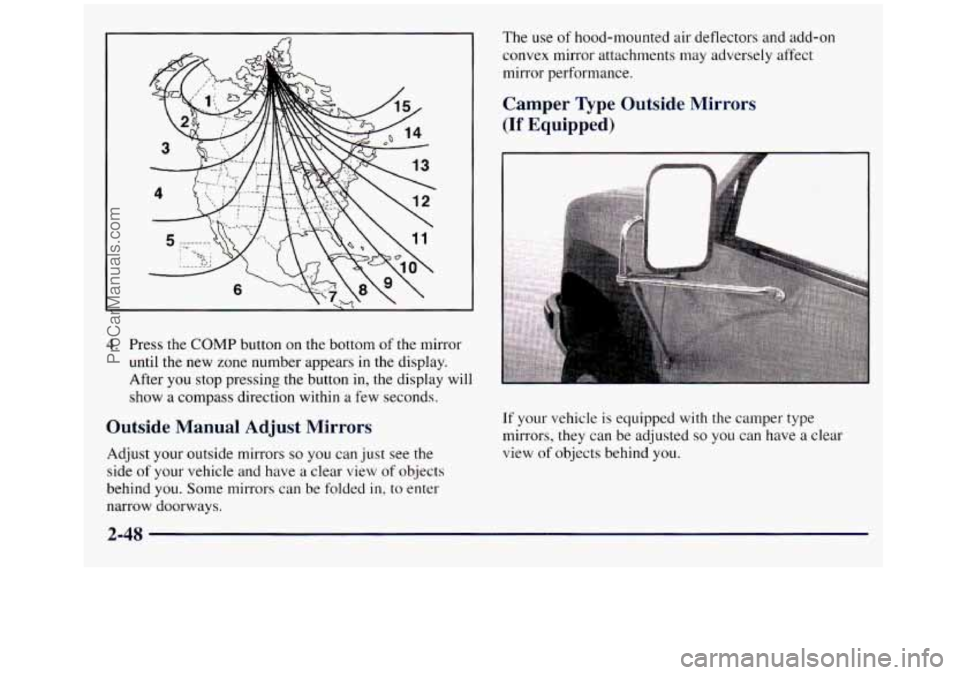
4. Press the COMP button on the bottom of the mirror
until the new zone number appears
in the display.
After you stop pressing the button in, the display will
show
a compass direction within a few seconds.
Outside Manual Adjust Mirrors
Adjust your outside mirrors so you can just see the
side
of your vehicle and have a clear view of objects
behind you. Some mirrors can be folded
in. to enter
narrow doorways. The
use
of hood-mounted air deflectors and add-on
convex mirror attachments may adversely affect
mirror performance.
Camper Type Outside Mirrors
(If Equipped)
If your vehicle is equipped with the camper type
mirrors, they can be adjusted
so you can have a clear
view
of objects behind you.
ProCarManuals.com
Page 133 of 452
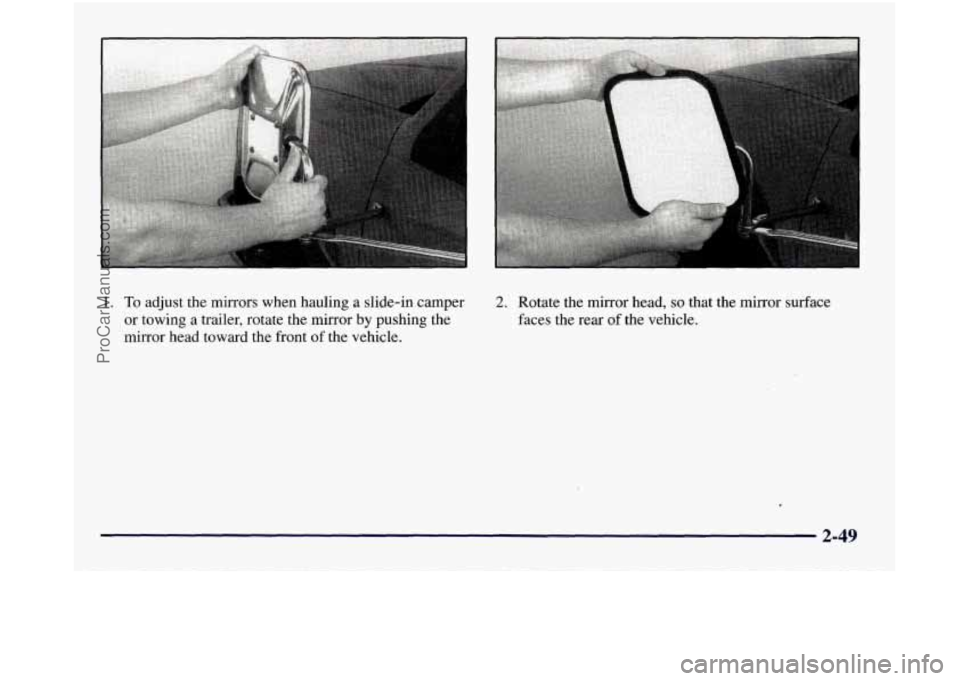
1. To adjust the mirrors when hauling a slide-in camper
or towing
a trailer, rotate the mirror by pushing the
mirror head toward the front
of the vehicle.
2. Rotate the mirror head, so that the mirror surface
faces the rear of the vehicle.
2-49
ProCarManuals.com
Page 134 of 452
West Coast Type Outside Mirrors
(If Equipped)
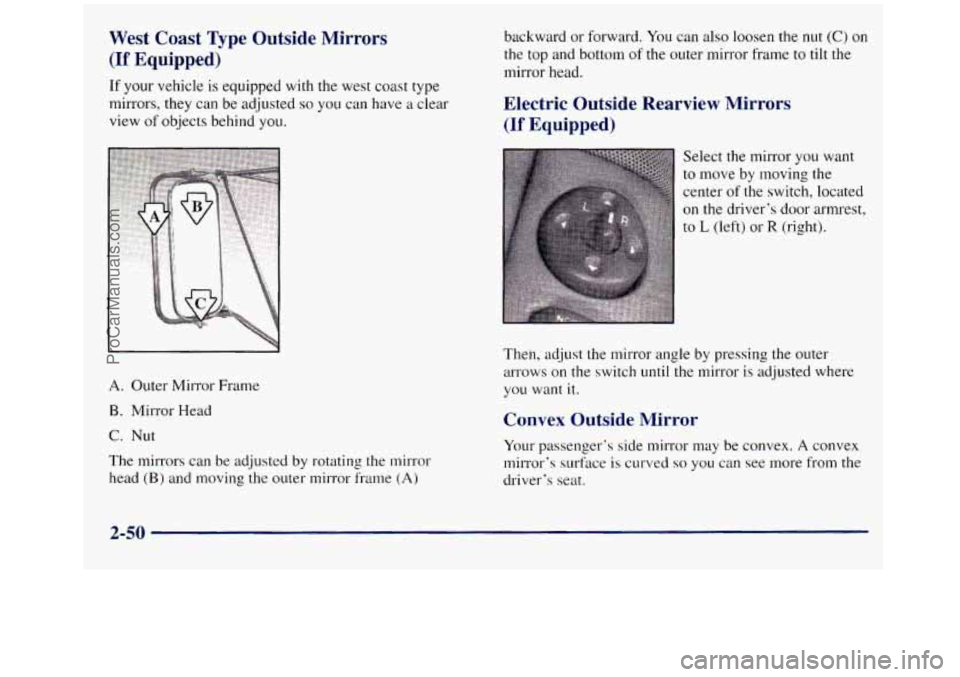
If your vehicle is equipped with the west coast type
mirrors, they can be adjusted so you can have a clear
view
of objects behind you.
A. Outer Mirror Frame
B. Mirror Head
C. Nut
The mirrors can
be adjusted by rotating the mirror
head
(€3) and moving the outer mirror frame (A)
backward or forward. You can also loosen the nut (C) on
the top and bottom of the outer mirror frame to tilt the
mirror head.
Electric Outside Rearview Mirrors
(If Equipped)
Select the mirror you want
to move by moving the
center
of the switch, located
on
the driver's door armrest,
to L (left) or R (right).
Then, ad-just the mirror angle by pressing the outer
arrows on the switch
until the mirror is adjusted where
you want
it.
Convex Outside Mirror
Your passenger's side mirror may be convex. A convex
mirror's surface
is curved so you can see more from the
driver's seat.
2-50
ProCarManuals.com
Page 135 of 452
A convex mirror can make things (like other
vehicles) look farther away than they really are.
If you cut too sharply into the right lane, you
could hit a vehicle
on your right. Check your
inside mirror or glance over your shoulder before
changing lanes.
Storage Compartments
Your vehicle has a variety of storage compartments
designed to store small items.
Your vehicle includes a number of storage
compartments for storage
of often-used items.
Some vehicles have storage areas
in the instrument panel.
Use these spaces for items such as gloves or small books. Some
models have
a storage pocket on each of the
front doors.
Some vehicles have a storage area behind the seat.
Glove Box
To open your glove box, move the button toward the
passenger’s side and pull the door open.
Center Overhead Console (If Equipped)
Your vehicle may have an overhead console. It has
storage compartments inside it.
Installing a Garage Door Opener
If you have a garage door opener, the front overhead
compartment can be used to conveniently store
the opener.
1. To install the garage door opener, first open the
compartment door by pressing the release
button forward.
2-51
ProCarManuals.com
Page 143 of 452
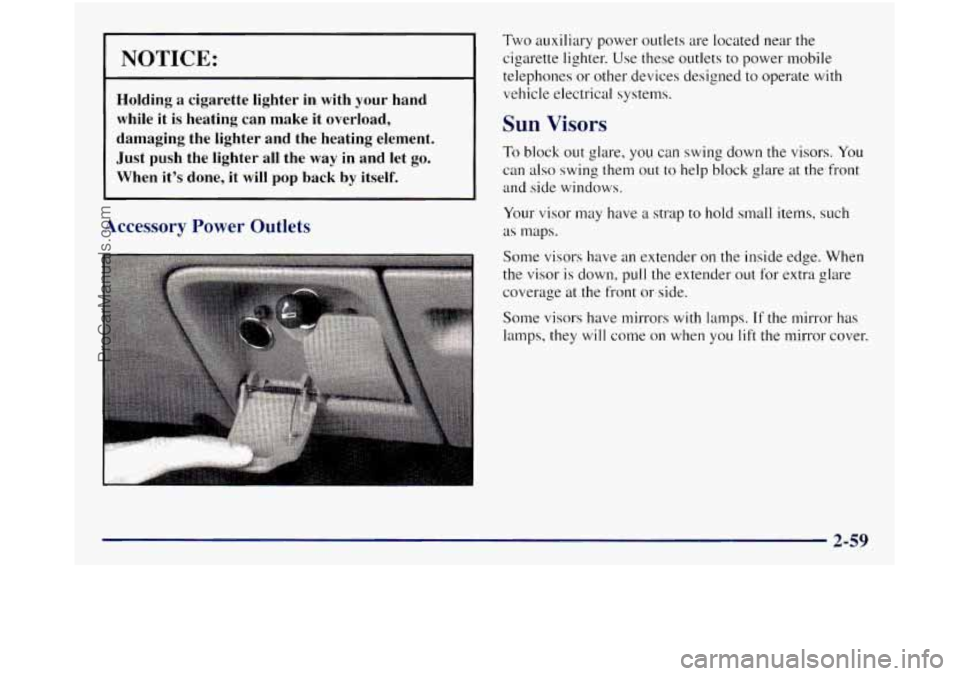
’ NOTICE:
Holding a cigarette lighter in with your hand
while
it is heating can make it overload,
~ damaging the lighter and the heating element.
Just push the lighter all the way in and let go.
When it’s done,
it will pop back by itself.
Accessory Power Outlets
Two auxiliary power outlets are located near the
cigarette lighter. Use these outlets to power mobile
telephones or other devices designed to operate
with
vehicle electrical systems.
Sun Visors
To block out glare, you can swing down the visors. You
can also swing them
out to help block glare at the front
and side windows.
Your visor may have a strap
to hold small items, such
as maps.
Some visors have an extender on the inside edge. When
the visor is down, pull
the extender out for extra glare
coverage at the front
or side.
Some visors have mirrors with lamps.
If the mirror has
lamps, they will come on when
you lift the mirror cover.
2-59
ProCarManuals.com
Page 200 of 452
Do not get too close to the vehicle you want to pass
while you’re awaiting
an opportunity. For one thing,
following too closely reduces your area
of vision,
especially if you’re following a larger vehicle.
Also, you
won’t have adequate space if the vehicle ahead suddenly
slows or stops. Keep back a reasonable distance.
When it looks like a chance to pass is coming up,
start
to accelerate but stay in the right lane and don’t
get too close. Time your move
so you will be
increasing speed as the time comes
to move into the
other lane. If
the way is clear to pass, you will have a
“running start” that more than makes up for the
distance you would lose by dropping back. And if
something happens to cause you to cancel your pass,
you need only slow down and drop back again and
wait for another opportunity.
If other cars are lined up to pass a slow vehicle, wait
your turn. But take care that someone
isn’t trying to
pass you as you pull
out to pass the slow vehicle.
Remember
to glance over your shoulder and check
the blind spot.
Check your mirrors, glance over your shoulder and
start your
left lane change signal before moving out
of the right lane to pass. When
you are far enough
ahead
of the passed vehicle to see its front in your
inside mirror, activate your right lane change signal
and move back into the right lane. (Remember that if
your right outside mirror
is convex, the vehicle you
just passed may seem to be farther away from you
than it really is.)
Try not to pass more than one vehicle at a time
on two-lane roads. Reconsider before passing the
next vehicle.
Don’t overtake a slowly moving vehicle too rapidly.
Even though the brake lamps are not flashing, it may
be slowing down or starting
to turn.
If you’re being passed, make it easy for the
following driver to get ahead
of you. Perhaps you
can ease a little to the right.
4-12
ProCarManuals.com