service GMC SIERRA 1998 User Guide
[x] Cancel search | Manufacturer: GMC, Model Year: 1998, Model line: SIERRA, Model: GMC SIERRA 1998Pages: 452, PDF Size: 23.65 MB
Page 96 of 452
NOTICE: ~
If your key seems stuck in LOCK and you can’t
turn
it, be sure you are using the correct key; if
so, is it all the way in? If it is, then turn the
steering wheel left and right while you turn the
key hard. But turn the key only with your hand.
Using
a tool to force it could break the key or the
ignition switch.
If none of this works, then your
vehicle needs service.
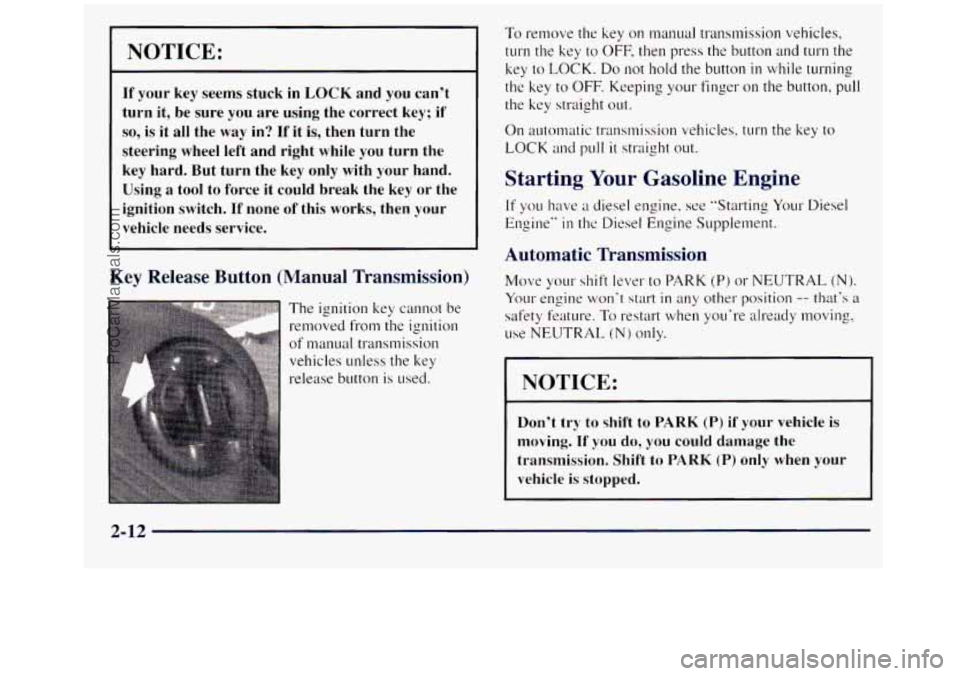
Key Release Button (Manual Tr :--:I: ssion)
The ignition key cannot be
relnoved from the ignition
of manual transmission
vehicles unless the key
release button is used.
To remove the key on n-mual transmission vehicles,
turn the key to OFF, then press the button and turn the
key
to LOCK. Do not hold the button in while turning
the key
to OFF. Keeping your finger on the button, pull
the key straight out.
On automatic transmission vehicles, turn the key to
LOCK and pull it straight out.
Starting Your Gasoline Engine
If you have ;I diesel engine, see “Starting Your Diesel
Engine”
in the Diesel Engine Supplement.
Automatic Transmission
Move your shift lever to PARK (P) or NEUTRAL (N).
Your engine won‘t start in any other position -- that’s a
safety feature. To restart when you‘re already moving,
use NEUTRAL
(N) only.
NOTICE:
Don’t try to shift to PARK (P) if your vehicle is
moving. If
you do, you could damage the
transmission. Shift to
PARK (P) only when your
vehicle
is stopped.
2-12
ProCarManuals.com
Page 108 of 452
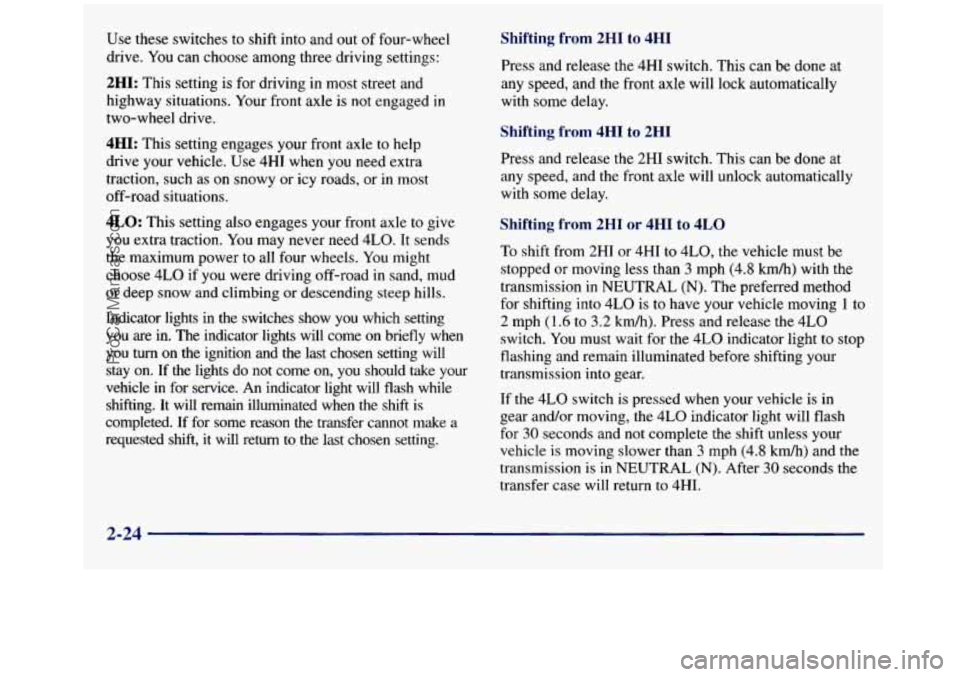
Use these switches to shift into and out of four-wheel
drive. You can choose among three driving settings:
2HI: This setting is for driving in most street and
highway situations. Your front axle is not engaged
in
two-wheel drive.
4HI: This setting engages your front axle to help
drive your vehicle. Use 4HI when you need extra
traction, such as
on snowy or icy roads, or in most
off-road situations.
4LO: This setting also engages your front axle to give
you extra traction. You may never need 4LO. It sends
the maximum power to all
four wheels. You might
choose 4LO if you were driving off-road in sand, mud
or deep snow and climbing or descending steep hills.
Indicator lights in the switches show you which setting
you are in. The indicator lights will come on briefly when
you
turn on the ignition and the last chosen setting will
stay on. If the lights
do not come on, you should take your
vehicle in for service. An indicator light will flash while
shifting. It will remain illuminated when
the shift is
completed. If for some reason the transfer cannot make a
requested shift, it will return
to the last chosen setting.
Shifting from 2HI to 4HI
Press and release the 4HI switch. This can be done at
any speed, and the front axle will lock automatically
with some delay.
Shifting from 4HI to 2HI
Press and release the 2HI switch. This can be done at
any speed, and the front axle will unlock automatically
with some delay.
ting from 2HI or 4HI to 4LO
'li hift from 2HI or 4HI to 4L0, the vehicle must be
stopped or moving less than
3 mph (4.8 km/h) with the
transmission in
NEUTRAL (N). The preferred method
for shifting into 4LO is to have your vehicle moving
1 to
2 mph (1.6 to
3.2 kmh). Press and release the 4LO
switch. You must wait for the
4LO indicator light to stop
flashing and remain illuminated before shifting your
transmission into gear.
If the 4LO switch is pressed when your vehicle is in
gear and/or moving, the 4LO indicator light will flash
for 30 seconds and not complete the shift unless your
vehicle is moving slower than
3 mph (4.8 kmh) and the
transmission is
in NEUTRAL (N). After 30 seconds the
transfer case will return to 4HI.
2-24
ProCarManuals.com
Page 149 of 452
Air Bag Readiness Light
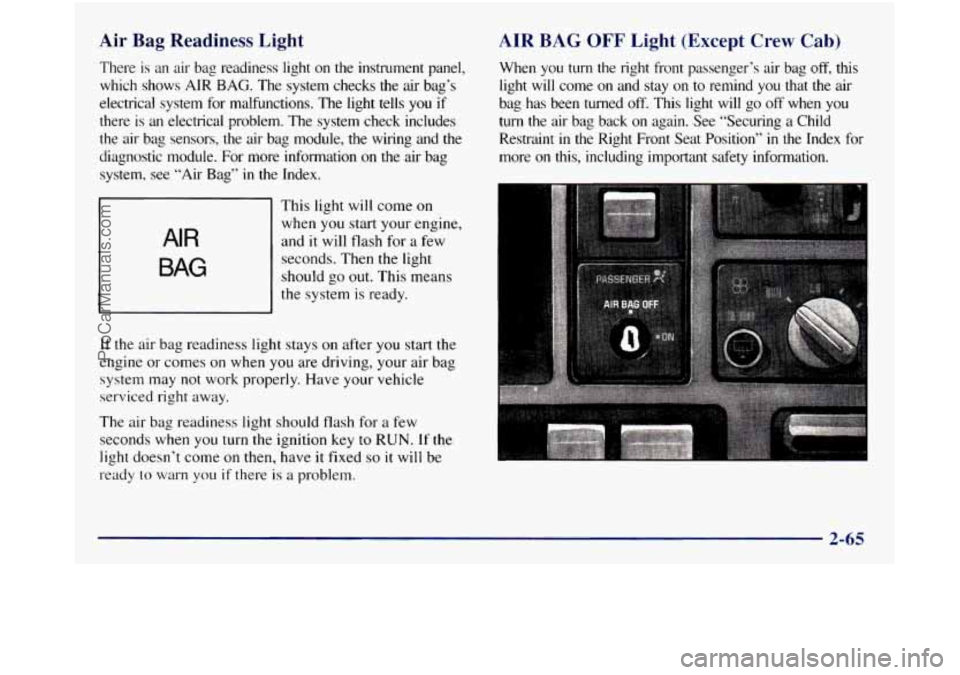
There is an air bag readiness light on the instrument panel,
which shows AIR BAG. The system checks
the air bag’s
electrical system for malfunctions. The light tells
you if
there is an electrical problem. The system check includes
the air bag sensors, the air bag module, the wiring and the
diagnostic module. For more information
on the air bag
system, see “Air Bag”
in the Index,
~
AIR
BAG
This light will come on
when you start your engine,
and
it will flash for a few
seconds. Then the light
should go out. This means
the system is ready.
If the air bag readiness light stays on after you start the
engine or comes on when
you are driving, your air bag
system may not work properly. Have your vehicle
serviced right away.
The air bag readiness light should flash for a few
seconds when
you turn the ignition key to RUN. If the
light doesn’t come
on then, have it fixed so it will be
ready to warn you
if there is a problem.
AIR BAG OFF Light (Except Crew Cab)
When you turn the right front passenger’s air bag off, this
light will come
on and stay on to remind you that the air
bag has been turned off. This light will go off when you
turn the air bag back on again. See “Securing a Child
Restraint in the Right Front Seat Position”
in the Index for
more on this, including important safety information.
-
2-65
ProCarManuals.com
Page 150 of 452
If the right front passenger’s air bag is turned
off, an adult or
a child who is no longer an infant
sitting in the right front passenger’s position
won’t have the extra protection of an air bag. In
a crash, the air bag wouldn’t be able to inflate
and help protect the person sitting there. Make
sure the air bag is turned on unless you are using
a rear-facing child restraint in the right front
seat position.
A
A CAUTION:
If the air bag readiness light ever comes on when
you have turned off the air bag, it means that
something may be wrong with the air bag system.
The right front passenger’s air bag could inflate
even though the switch is off.
If this ever
happens, don’t secure a rear-facing child
restraint in your vehicle until you have your
vehicle serviced.
Charging System Indicator Light
7-1 This light should come on
I-+I
brieflywhen you turn on the
ignition, before starting the
engine,
as a check to show
you it is working.
2-66
ProCarManuals.com
Page 151 of 452
After the engine starts, the light should go out. If it stays
on or comes on while you are driving, you may have a
problem with your charging system. It could indicate a
problem with the generator
drive belt, or some other
charging system problem. Have it checked right away.
Driving while this light
is on could drain your battery.
If you must drive a short distance with this light on, it
helps to turn off all your accessories, such as the radio
and the
air conditioner.
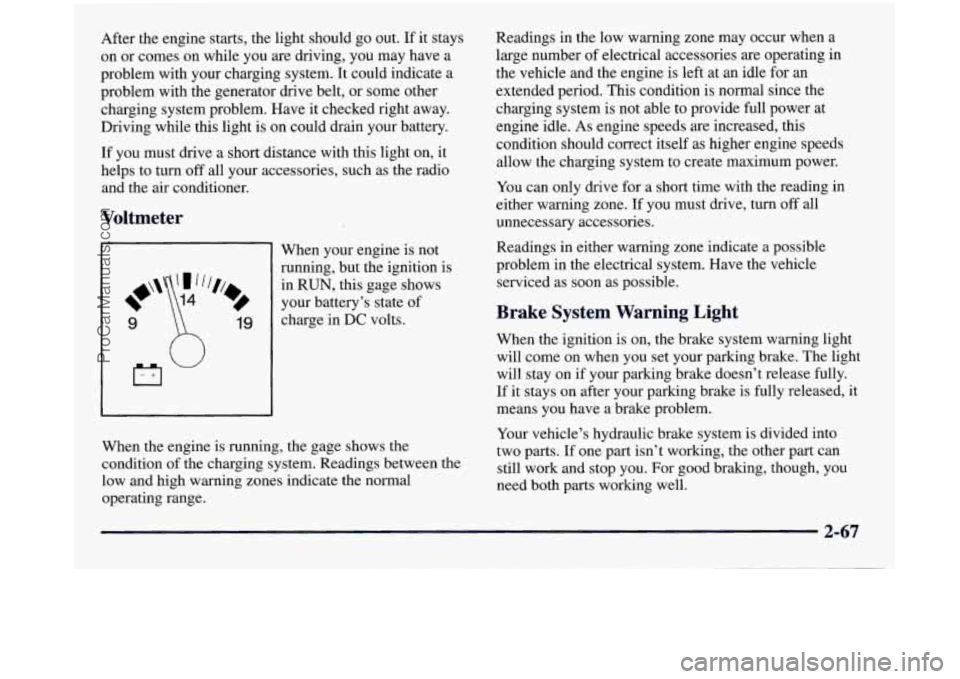
Voltmeter
19
When your engine is not
running, but the ignition is
in RUN, this gage shows
your battery’s state of
charge in
DC volts.
When the engine is running, the gage shows the
condition of the charging system. Readings between the
low and high warning zones indicate the normal
operating range. Readings
in the low warning zone may occur when a
large number
of electrical accessories are operating in
the vehicle and the engine is left at an idle for an
extended period.. This condition is normal since the
charging system
is not able to provide full power at
engine idle. As engine speeds are increased, this
condition should correct itself as higher engine speeds
allow the charging system to create maximum power.
You can only drive for a short time with the reading in
either warning zone. If you must drive, turn off all
unnecessary accessories.
Readings in either warning zone indicate a possible
problem in the electrical system. Have the vehicle
serviced as soon as possible.
Brake System Warning Light
When the ignition is on, the brake system warning light
will come on when you set your parking brake. The light
will stay on
if your parking brake doesn’t release fully.
If it stays on after your parking brake is fully released, it
means you have a brake problem.
Your vehicle’s hydraulic brake system is divided into
two parts. If one part isn’t working, the other part can
still work and stop you. For good braking, though,
you
need both parts working well.
2-67
ProCarManuals.com
Page 152 of 452
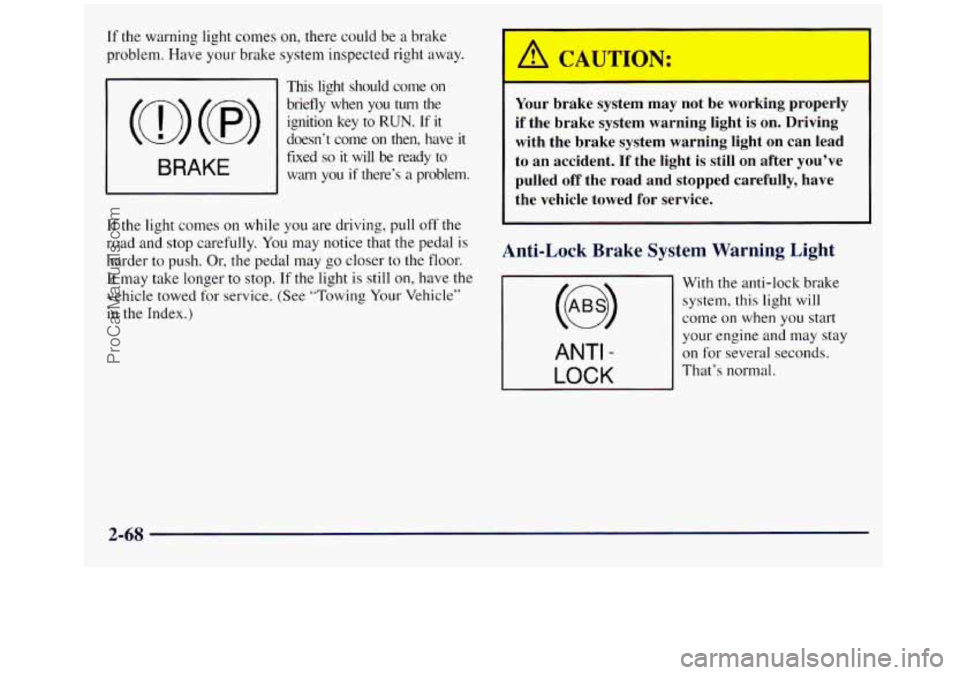
If the warning light comes on, there co11ld be a brake
problem. Have your brake system inspected right away.
This light should come on
(a) (@)
briefly when you turn the
ignition key
to RUN. If it
doesn‘t come on then, have
it
fixed so it will be ready to
warn you if there’s a problem. BRAKE
If the light comes on while you are driving, pull off the
road and
stop carefully. You may notice that the pedal is
harder
to push. Or, the pedal may go closer to the floor.
It may take longer to stop.
If the light is still on, have the
vehicle towed
for service. (See “Towing Your Vehicle”
in the Index.)
Your brake system may not be working properly
if the brake system warning light is
on. Driving
with the brake system warning light on can lead
to an accident.
If the light is still on after you’ve
pulled off the road and stopped carefully, have
the vehicle towed for service.
Anti-Lock Brake System Warning Light
With the anti-lock brake
system,
this light will
come on when you start
ANTI -
LOCK
your engine and may stay
on for several seconds.
That’s normal.
2-68
ProCarManuals.com
Page 153 of 452
If the light stays on, or comes on when you’re driving,
your vehicle needs service.
If the regular brake system
warning light isn’t on, you still have brakes, but you
don’t have anti-lock brakes.
If the regular brake system
warning light is also on, you don’t have anti-lock brakes
and there‘s a problem
with your regular brakes. See
“Brake System Warning Light” earlier
in this section.
The anti-lock brake system warning light should come
on briefly when you turn the ignition key to RUN. If the
light doesn‘t come on then. have it fixed
so it will be
ready to warn you
if there is a problem.
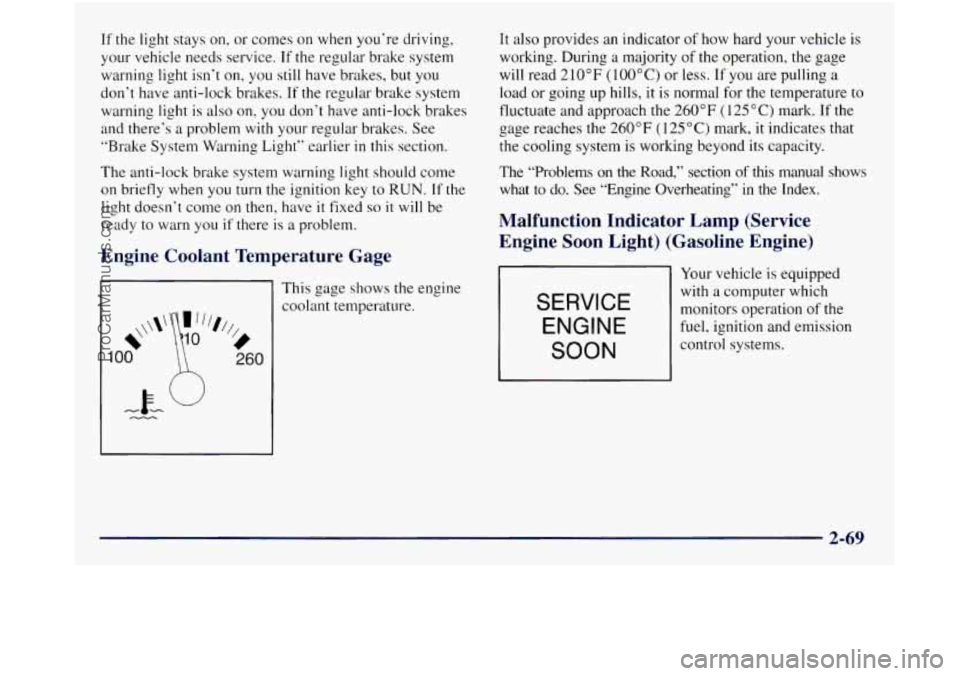
Engine Coolant Temperature Gage
1
This gage shows the engine
coolant temperature.
It also provides an indicator of how hard your vehicle is
working. During a majority of the operation, the gage
will read
210°F (100°C) or less. If you are pulling a
load or going up hills, it is normal for the temperature to
fluctuate and approach the
260°F (1 25 “C) mark. If the
gage reaches the
260°F (125°C) mark, it indicates that
the cooling system is working beyond its capacity.
The “Problems on
the Road,” section of this manual shows
what
to do. See “Engine Overheating” in the Index.
Malfunction Indicator Lamp (Service
Engine
Soon Light) (Gasoline Engine)
SERVICE
ENGINE
SOON
Your vehicle is equipped
with a computer which
monitors operation
of the
fuel, ignition and emission
control systems.
2-69
ProCarManuals.com
Page 154 of 452
This system is called OBD I1 (On-Board
Diagnostics-Second Generation) and is intended to
assure that emissions are at acceptable levels for the life
of the vehicle, helping to produce a cleaner
environment. The
SERVICE ENGINE SOON light
comes on to indicate that there is a problem and service
is required. Malfunctions often will be indicated by the
system before any problem is apparent. This may
prevent more serious damage to your vehicle. This
system is also designed to assist your service technician
in correctly diagnosing any malfunction.
~OTICE:
If you keep driving your vehicle with this light
on, after a while, your emission controls may not
work as well, your fuel economy may not be as
good and your engine may not run as smoothly.
This could lead to costly repairs that may not be
covered by your warranty.
This light should come on, as a check to show you it is
working, when the ignition is on and the engine is not
running. If the light doesn’t come on, have it repaired.
2-70
This light will also come on during a malfunction in one
of two ways:
0 Light Flashing -- A misfire condition has been
detected. A misfire increases vehicle emissions and
may damage the emission control system on your
vehicle. Dealer or qualified service center diagnosis
and service may be required.
0 Light On Steady -- An emission control system
malfunction has been detected on your vehicle.
Dealer or qualified service center diagnosis and
service may be required.
If the Light Is Flashing
The following may prevent’more serious aamage to
your vehicle:
Reducing vehicle speed.
Avoiding hard accelerations.
0 Avoiding steep uphill grades.
0 If you are towing a trailer, reduce the amount of
cargo being hauled as soon as it is possible.
If the light stops flashing
and remains on steady, see “If
the Light Is On Steady” following.
If the light continues
to flash, when it is safe to do so,
stop the vehicle. Find a safe place to park your vehicle.
ProCarManuals.com
Page 155 of 452
Turn the key off, wait at least 10 seconds and restart the
engine.
If the light remains on steady, see “If the Light
Is On Steady” following. If the light is still flashing,
follow the previous steps, and drive the vehicle to your
dealer or qualified service center
for service.
If the Light Is On Steady
You may be able to correct the emission system
malfunction by considering the following:
Did you recently
put fuel into your vehicle?
If
so, reinstall the fuel cap, making sure to fully install
the cap. The diagnostic system can determine if the fuel
cap has been left off or improperly installed.
A loose or
missing fuel cap will allow fuel to evaporate into the
atmosphere.
A few driving trips with the cap properly
installed should turn the light
off.
Did you just drive through a deep puddle of water‘?
If so, your electrical system may be wet. The condition
will usually be corrected when the electrical system
dries out.
A few driving trips should turn the light off.
Are you low on fuel? As
your engine starts to run
out of fuel, your engine may
not run
as efficiently as designed since small amounts of
air are sucked into the fuel line causing
a misfire. The
system can detect this. Adding fuel should correct this
condition. Make sure to install the
fuel cap properly. It
will take
a few driving trips to turn the light off.
Have you recently changed brands of fuel?
If
so, be sure to fuel your vehicle with quality fuel (see
“Fuel”
in the Index). Poor fuel quality will cause your
engine not to run
as efficiently as designed. You may
notice this as stalling after start-up, st.alling
when you
put the vehicle into gear, misfiring, hesitation on
acceleration or stumbling on acceleration. (These
conditions may go away once the engine is warmed up.)
This will be detected by the system and cause the light
to turn on.
If
you experience one or more of these conditions,
change the fuel brand
you use. It will require at least one
full tank of the proper fuel to turn the light off.
If none of the above steps have made the light turn off,
have your dealer or qualified service center check the
vehicle. Your dealer has the proper test equipment and
diagnostic
tools to fix any mechanical or electrical
problems that may have developed.
ProCarManuals.com
Page 156 of 452
Oil Pressure Gage
0
Y3
80
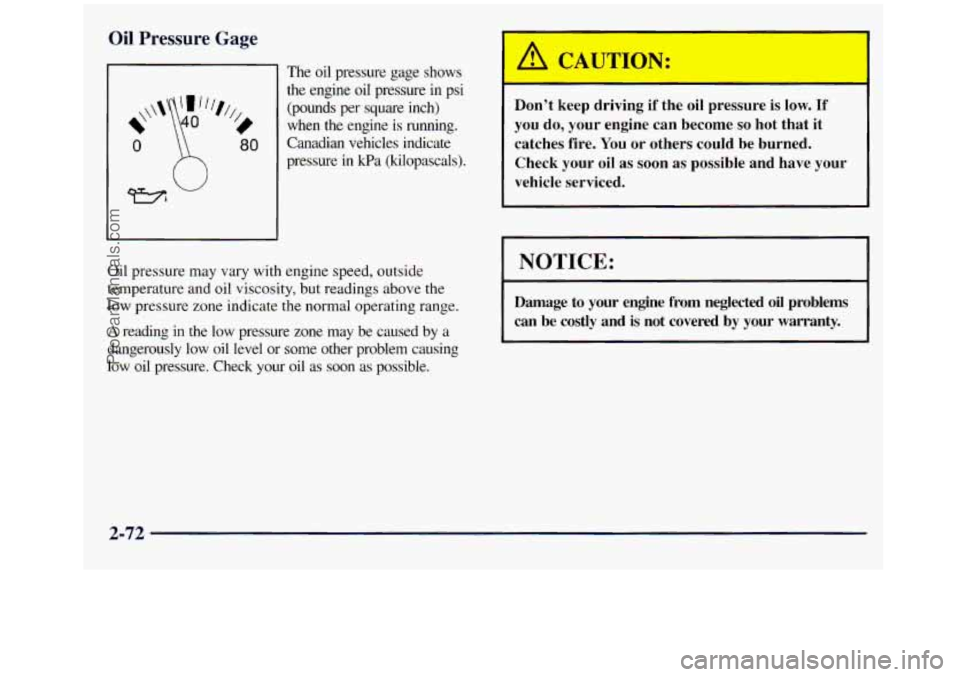
The oil pressure gage shows
the engine oil pressure in psi (pounds per square inch)
when the engine
is running.
Canadian vehicles indicate
pressure
in kPa (kilopascals).
Oil pressure may vary with engine speed, outside
temperature
and oil viscosity, but readings above the
low pressure zone indicate the
normal operating range.
A reading in the low pressure zone may be caused by a
dangerously low oil level or some other problem causing
low oil pressure. Check
your oil as soon as possible.
I
Don’t keep driving if the oil pressure is low. If
you do, your engine can become
so hot that it
catches fire.
You or others could be burned.
Check your oil as soon as possible and have your
vehicle serviced.
I NOTICE:
Damage to your engine from neglected oil problems
can be costly and is not covered by your warranty.
2-72
ProCarManuals.com