service GMC SIERRA 1998 Owner's Manual
[x] Cancel search | Manufacturer: GMC, Model Year: 1998, Model line: SIERRA, Model: GMC SIERRA 1998Pages: 452, PDF Size: 23.65 MB
Page 158 of 452
Daytime Running Lamps Indicator Light
:::o e..
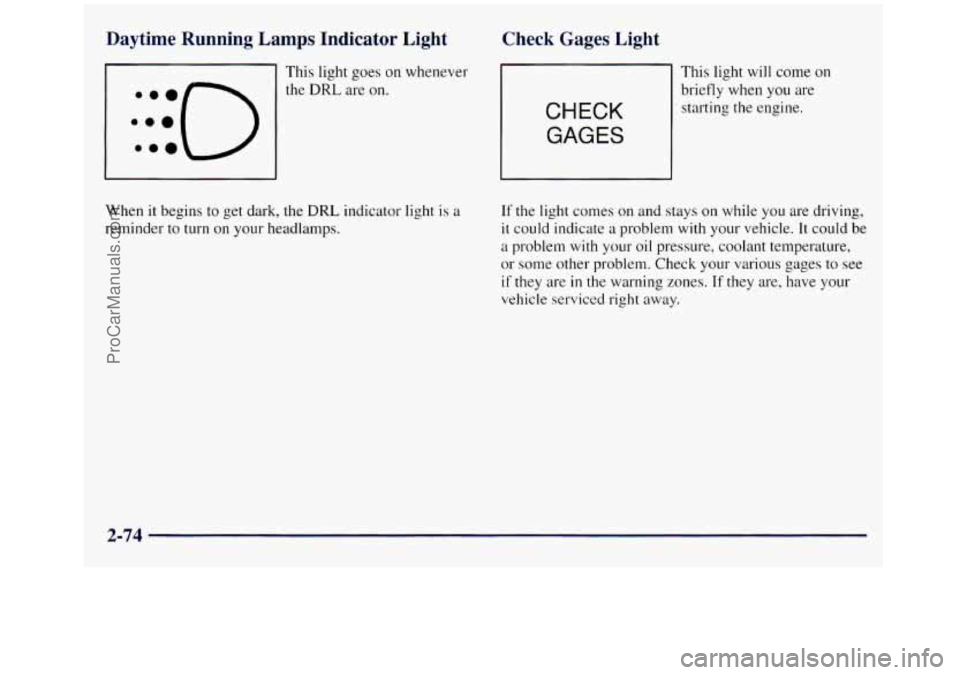
This light goes on whenever
the
DRL are on.
Check Gages Light
CHECK
GAGES
This light will come on
briefly when you are
starting the engine.
When
it begins to get dark, the DRL indicator light is a
reminder to turn on your headlamps. If the light comes on and stays on while you are driving,
it could indicate a problem with your vehicle. It could be
a problem with your oil pressure, coolant temperature,
or
some other problem. Check your various gages to see
if they are in the warning zones. If they are, have your
vehicle serviced right away.
2-74
ProCarManuals.com
Page 186 of 452
If your vehicle is equipped with the AM-FM Stereo with
Cassette Tape Player and Automatic Tone Control:
1. Turn the ignition to RUN or ACCESSORY.
2. Turn the radio off.
3. Press and hold the TAPE AUX button for
five seconds. The tape symbol
on the display will
flash for two seconds.
4. Insert the scrubbing action cleaning cassette.
5. Eject the cleaning cassette after the manufacturer's
recommended cleaning time.
When the cleaning cassette has been ejected, the cut tape
detection feature is active again.
You may also choose
a non-scrubbing action, wet-type
cleaner which uses
a cassette with a fabric belt to clean
the tape head. This type of cleaning cassette will not
eject
on its own. A non-scrubbing action cleaner may
not clean as thoroughly as the scrubbing type cleaner.
The use of
a non-scrubbing action, dry-type cleaning
cassette is not recommended
After you clean the player, press and hold EJECT for
five seconds to reset the CLN indicator. The radio
will
display --- to show the indicator was reset.
Cassettes are subject to wear and the sound quality
may
degrade over time. Always Incake sure the cassette tape is in
good condition before you have yo~~r tape player serviced.
Care of Your Compact Discs
Handle discs carefully. Store them in their original cases
or other protective cases and away from direct sunlight
and dust.
If the surface of a disc is soiled, dampen a
clean, soft cloth in a mild, neutral detergent solution and
clean
it, wiping from the center to the edge.
Be sure never to touch the signal surface when handling
discs. Pick up discs by grasping the outer edges or the
edge of the hole and the outer edge.
Care of Your Compact Disc Player
The use of CD lens cleaner discs is not advised, due to
the risk of contaminating the lens of the CD optics with
lubricants internal to the CD mechanism.
Fixed Mast Antenna
The fixed mast antenna can withstand most car washes
without being damaged.
If the mast should ever become
slightly bent, you can straighten
it out by hand. If the
mast is badly bent, as it might be by vandals, you should
replace it.
Check every once
in a while to be sure the mast is still
tightened
to the cowl.
ProCarManuals.com
Page 202 of 452
Off-Road Driving with Your
Four-Wheel-Drive
Vehicle
This off-road guide is for vehicles that have
four-wheel drive.
Also, see “Anti-Lock Brakes“
in the Index.
If your vehicle doesn’t have four-wheel drive, you
shouldn’t drive off-road unless you’re on a level,
solid surface.
Off-road driving can be great fun. But
it does have some
definite hazards. The greatest of these is the terrain itself.
“Off-roading” means you’ve left
the great North
American road system behind. Traffic lanes aren’t
marked. Curves aren’t banked. There are
no road signs.
Surfaces can be slippery, rough, uphill or downhill.
In
short, you’ve gone right back to nature.
Off-road driving involves some new skills. And that’s
why it’s very important that you read this guide. You’ll
find many driving tips and suggestions. These
will help
make your off-road driving safer and more enjoyable.
Before You Go Off-Roading
There are some things to do before you go out. For
example, be
sure to have all necessary maintenance and
service work done. Check
to make sure all underbody
shields
(if so equipped) are properly attached. Be sure
you read
all the information about your
four-wheel-drive vehicle
in this manual. Is there enough
firel‘?
Is the spare tire fully inflated? Are the fluid levels
up where
they should be‘? What are the local laws that
apply to off-roading where you’ll be driving?
If you
don’t know, you should check
with law enforcement
people
in the area. Will you be on someone’s private
land?
If so, be sure to get the necessary permission.
Loading Your Vehicle for Off-Road Driving
There are some important things to remember about
how to load your vehicle.
0 The heaviest things should be on the load floor and
forward of your rear axle. Put heavier items
as far
forward
as you can.
Be sure the load is secured properly, so driving on
the off-road terrain doesn’t toss things around.
4-14
ProCarManuals.com
Page 215 of 452
steering, suspension, wheels, tires ana exhaust system
for damage.
Also, check the fuel lines and cooling
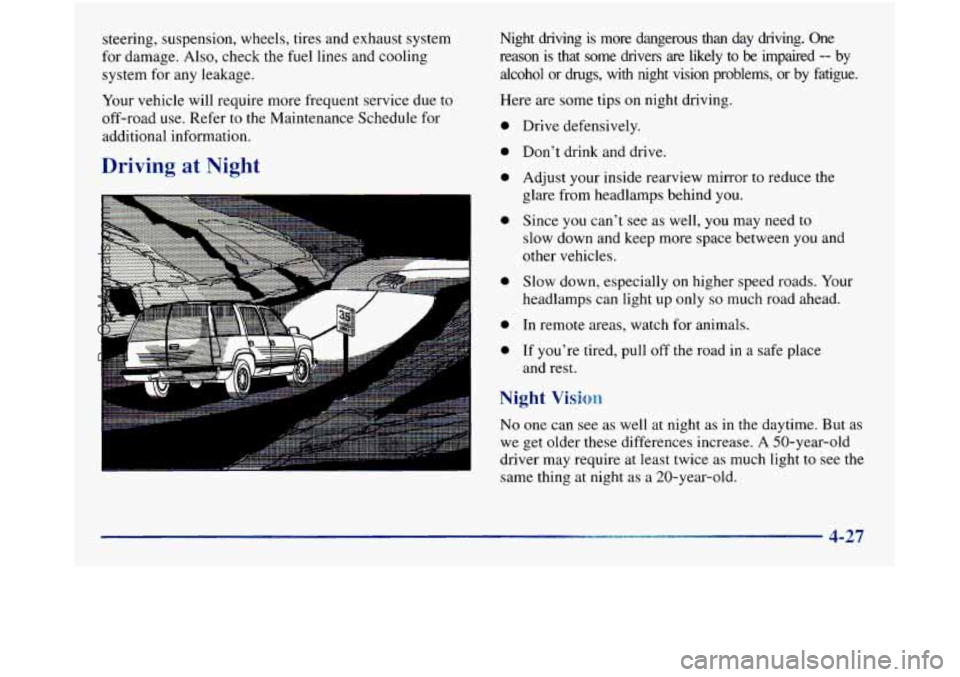
system for any leakage. Night driving is more dangerous than
day driving. One
reason is that some drivers are likely to
be impaired -- by
alcohol or
drugs, with night vision problems, or by fatigue.
Your vehicle will require more frequent service due to
off-road use. Refer
to the Maintenance Schedule for
additional information.
Driving at Night
Here are some tips on night driving.
0
0
0
0
0
0
0
Drive defensively.
Don’t drink and drive.
Adjust your inside rearview mirror
to reauce me
glare from headlamps behind you.
Since you can’t see as well,
you may need to
slow down and keep more space between you and
other vehicles.
Slow down, especially on higher speed roads. Your
headlamps can light
up only so much road ahead.
In remote areas, watch for animals.
If you’re tired, pull off
the road in a safe place
and rest.
Night Vision
No one can see as well at night as in the daytime. But as
we get older
these differences increase. A 50-year-old
driver may require at least twice as much light
to see the
same thing at night as a 20-year-old.
4-27
ProCarManuals.com
Page 221 of 452
The exit speed is usually posted.
Reduce your speed according
to your speedometer, not
to your sense of motion. After driving for any distance
at higher speeds,
you may tend to think you are going
slower than you actually are.
Before Leaving on a Long Trip
Make sure you’re ready. Try to oe wed rested. If you
must start when you’re not fresh
-- such as after a day’s
work
-- don’t plan to make too many miles that first part
of the journey. Wear comfortable clothing and shoes you
can easily drive in.
Is your vehicle ready for a long trip? If you keep it
serviced and maintained, it’s ready to
go. If it needs
service, have
it done before starting out. Of course,
you’ll find experienced and able service experts in
GM
dealerships all across North America. They’ll be ready
and willing
to help if you need it.
Here are some things you can check before a trip:
0 Windshield Washer Fluid: Is the reservoir full? Are
all windows clean inside and outside?
Wiper Blades: Are they in good shape?
0
0
0
0
0
Fuel, Engine Oil, Other Fluids: Have you checked
all levels?
Lamps: Are they all working? Are the lenses clean?
Tires: They are vitally important to a safe,
trouble-free trip.
Is the tread good enough for
long-distance driving? Are the tires all inflated to the
recommended pressure?
Weather Forecasts: What’s the weather outlook
along your route? Should you delay your trip
a short
time
to avoid a major storm system?
Maps: Do you have up-to-date maps?
Highway Hypnosis
Is there actually such a condition as “highway hypnosis”?
Or is
it just plain falling asleep at the wheel? Call it
highway hypnosis, lack of awareness, or whatever.
There
is something about an easy stretch of road with the
same scenery, along with the hum of the tires on the road,
the drone of
the engine, and the rush of the wind against
the vehicle that can make you sleepy. Don’t let it happen to you! If it does, your vehicle can leave
the road in less
than n second, and you could crash and be injured.
4-33
ProCarManuals.com
Page 222 of 452
What can you do about highway hypnosis? First, be
aware that it
can happen.
Then here are some tips:
0 Make sure your vehicle is well ventilated, with a
comfortably cool interior.
Keep your eyes moving. Scan the road ahead and
to the sides. Check your mirrors and your
instruments frequently.
If you get sleepy, pull off the road into a rest, service
or parking area and take a nap, get some exercise, or
both. For safety, treat drowsiness on the highway as
an emergency.
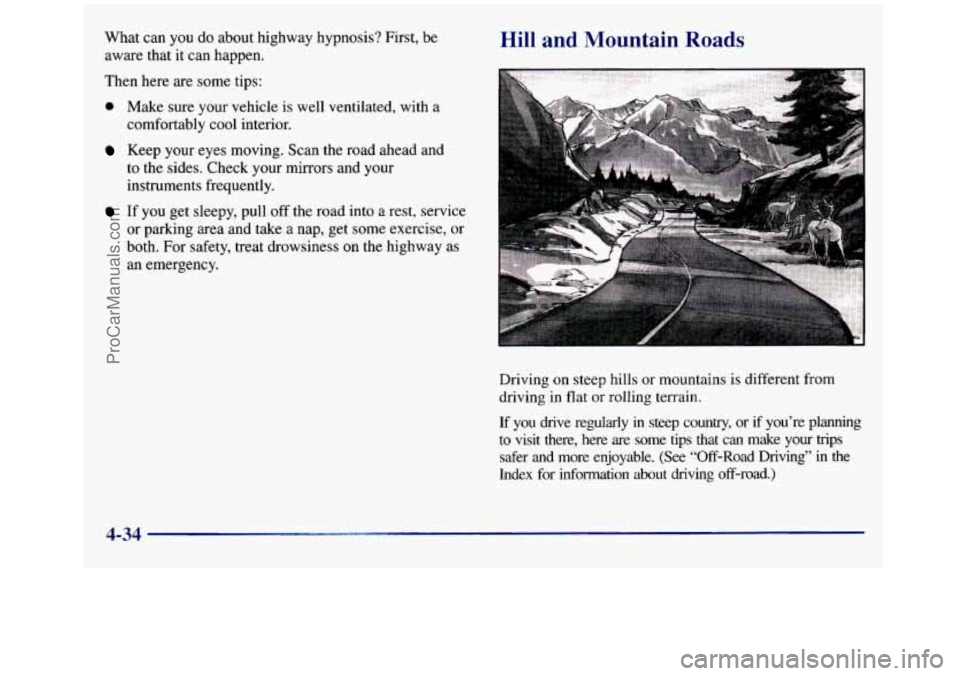
Hill and Mountain Roads
Driving on steep hills or mountains is different from
driving in flat or rolling terrain.
If you drive regularly in steep country, or if you’re planning
to visit there, here are some tips that can make your trips
safer
and more enjoyable. (See “Off-Road Driving” in the
Index for infolmation about driving off-road.)
4-34
ProCarManuals.com
Page 229 of 452
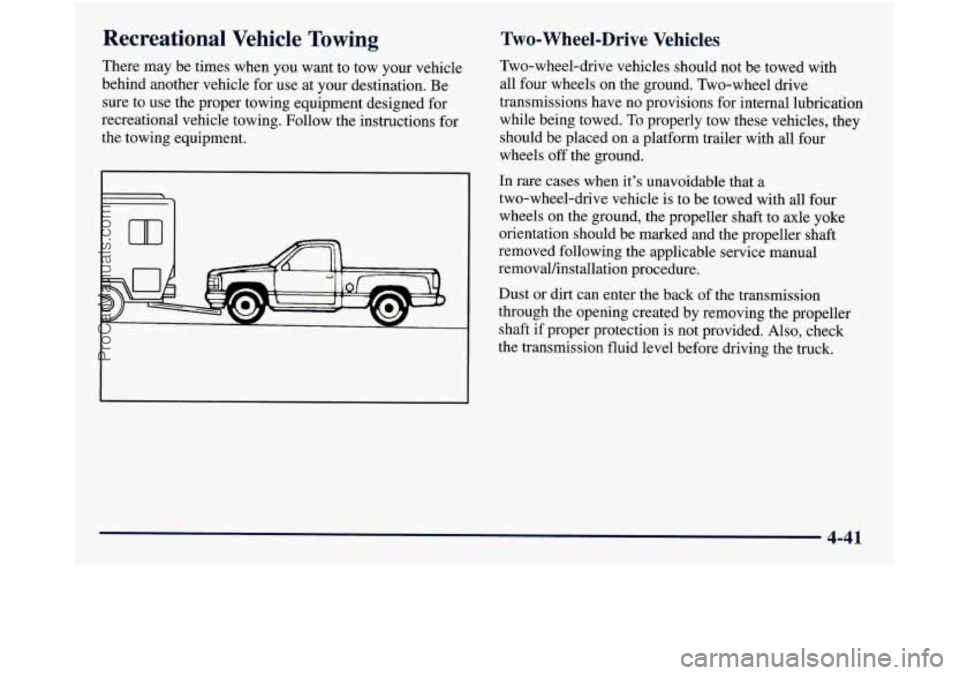
Recreational Vehicle Towing
There may be times when you want to tow your vehicle
behind another vehicle for use at your destination. Be
sure to use the proper towing equipment designed for
recreational vehicle towing. Follow the instructions for
the towing equipment.
I
I1
c
Two-Wheel-Drive Vehicles
Two-wheel-drive vehicles should not be towed with
all four wheels on the ground. Two-wheel drive
transmissions have no provisions for internal lubrication
while being towed. To properly tow these vehicles, they
should be placed on a platform trailer with all four
wheels off the ground.
In
rare cases when it's unavoidable that a
two-wheel-drive vehicle is to be towed with all 'four
wheels on the ground, the propeller shaft to axle yoke
orientation should be marked and the propeller shaft
removed following the applicable service manual
removal/installation procedure.
Dust or dirt can enter the back of the transmission
through the opening created by removing the propeller
shaft if proper protection is not provided. Also, check
the transmission fluid level before driving the truck.
4-41
ProCarManuals.com
Page 247 of 452
5. If you have a four-wheel-drive vehicle,
be sure the transfer case is in
a drive gear and not
in
NEUTRAL (N).
6. Release the regular brakes.
-
/r CAUTIOIA:
It can be dangerous to get out of your vehicle if
the shift lever is not fully in
PARK (P) with the
parking brake firmly set. Your vehicle can roll.
If you have left the engine running, the vehicle
can move suddenly. You or others could be
injured.
To be sure your vehicle won’t move, even
when you’re on fairly level ground, use the steps
that follow.
If you have four-wheel drive and your transfer
case is in
NEUTRAL (N), your vehicle will be free
to
roll, even if your shift lever is in PARK (P). So,
be sure the transfer case is in a drive gear -- not
in
NEUTRAL (N).
When You Are Ready to Leave After
Parking
on a Hill
1. Apply your regular brakes and hold the pedal down
while you:
Start your engine;
Shift into a gear; and
Release the parking brake.
2. Let up on the brake pedal.
3. Drive slowly
until the trailer is clear of the chocks.
4. Stop and have someone pick up and store the chocks.
Maintenance When Trailer Towing
Your vehicle will need service more often when you’re
pulling
a trailer. See the Maintenance Schedule for more
on this. Things that are especially important
in trailer
operation are automatic transmission fluid (don’t
overfill), engine
oil, axle lubricant, belt, cooling system
and brake adjustment. Each of these is covered in this
manual, and the Index will help you find them quickly.
If you’re trailering, it’s a good idea to review these
sections before
you start your trip.
Check periodically
to see that all hitch nuts and bolts
are tight.
ProCarManuals.com
Page 260 of 452
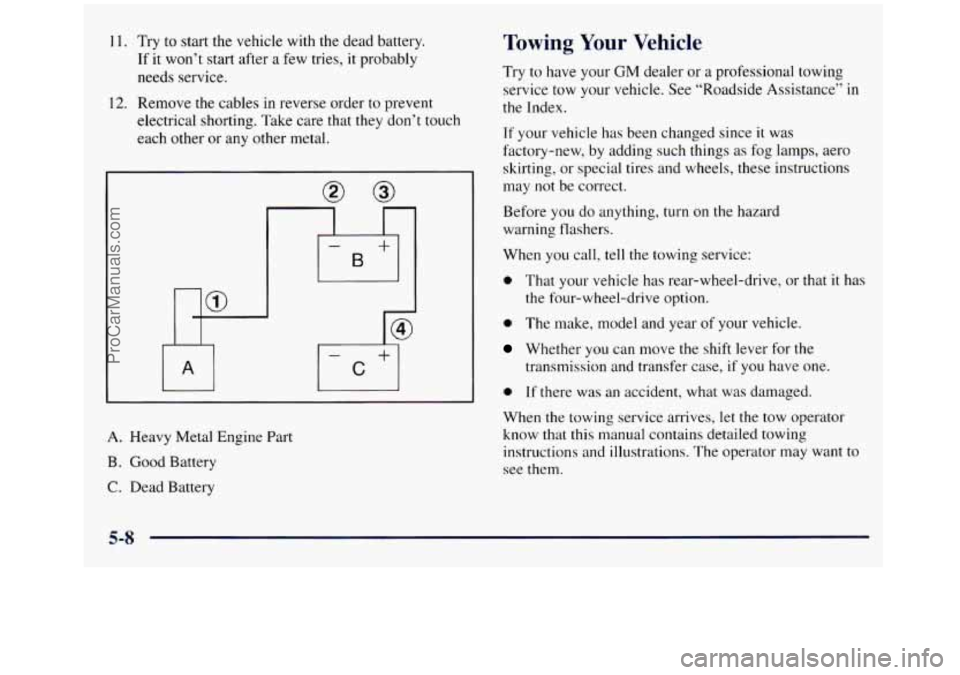
11. Try to start the vehicle with the dead battery.
If it won’t start after
a few tries, it probably
needs service.
12. Remove the cables in reverse order to prevent
electrical shorting. Take care that they don’t touch
each other or any other metal.
A. Heavy Metal Engine Part
B. Good Battery
C. Dead Battery
Towing Your Vehicle
Try to have your GM dealer or a professional towing
service tow your vehicle. See “Roadside Assistance’’
in
the Index.
If your vehicle has been changed since it was
factory-new, by adding such things
as fog lamps, aero
skirting, or special tires and wheels, these instructions
may not be correct.
Before you do anything, turn on the hazard
warning flashers.
When you call, tell the towing service:
0 That your vehicle has rear-wheel-drive, or that it has
the four-wheel-drive option.
0 The make, model and year of your vehicle.
Whether you can move the shift lever for the
0 If there was an accident, what was damaged.
When
the towing service arrives, let the tow operator
know that this manual contains detailed towing
instructions and illustrations. The operator may want to
see
them.
transmission and transfer case, if you have one.
5-8
ProCarManuals.com
Page 262 of 452
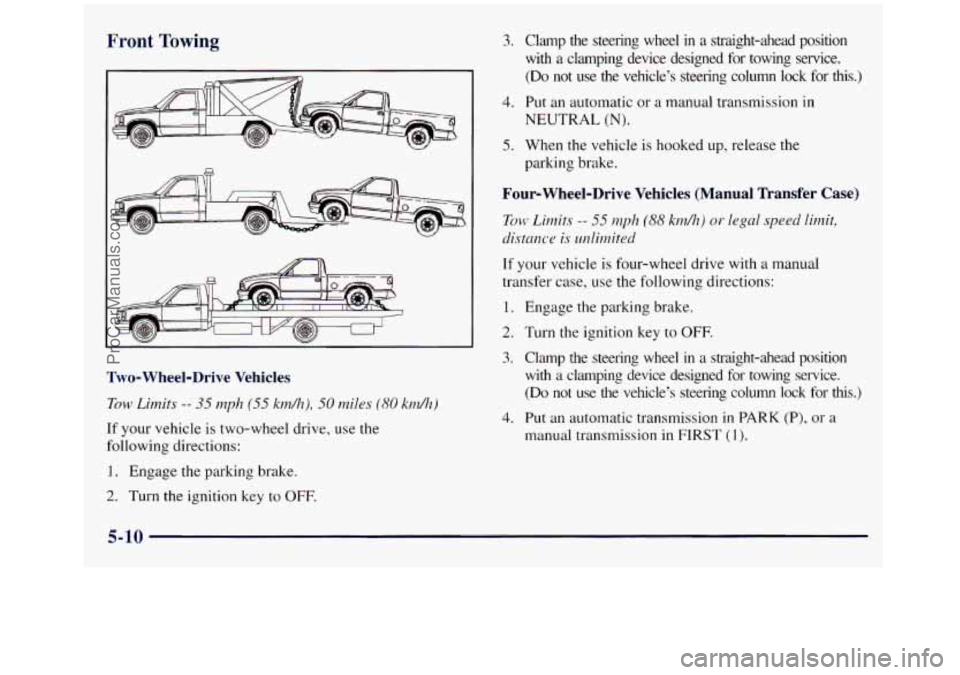
Front Towing
Two- Wheel-Drive Vehicles
Tow Lirnits -- 35 nzph (55 kdh), 50 miles (80 kr.n/h)
If your vehicle is two-wheel drive, use the
following directions:
I. Engage the parking brake.
2. Turn the ignition key to OFF.
3. Clamp the steering wheel in a straight-ahead position
with a clamping device designed for towing service.
(Do not use the vehicle’s steering column lock for this.)
4. Put an automatic or a manual transmission in
NEUTRAL (N).
5. When the vehicle is hooked up, release the
parking brake.
Four-Wheel-Drive Vehicles (Manual Transfer Case)
Tow Lirnits -- 55 rnph (88 knzdh) or legtrl speed limit,
distance
is unlimited
If your vehicle is four-wheel drive with a manual
transfer case, use the following directions:
1. Engage the parking brake.
2. Turn the ignition key to OFF.
3. Clamp the steering wheel in a straight-ahead position
with
a clamping device designed for towing service.
(Do not use the vehicle’s steering column lock for this.)
4. Put an automatic transmission in PARK (P), or a
manual transmission
in FIRST (1).
5-10
ProCarManuals.com