steering GMC SIERRA 1998 User Guide
[x] Cancel search | Manufacturer: GMC, Model Year: 1998, Model line: SIERRA, Model: GMC SIERRA 1998Pages: 452, PDF Size: 23.65 MB
Page 119 of 452
Turn SignaVIWultifunction Lever Turn Signal and Lane Change Signals
The turn signal has two upward (for right) and two
downward (for left) positions. These positions allow you
to signal
a turn or a lane change.
To signal a turn, move the lever all the way up or
down. When
the turn is finished, the lever will
return automatically.
An arrow on the instrument
panel will flash
in the
direction
of the turn or
lane change.
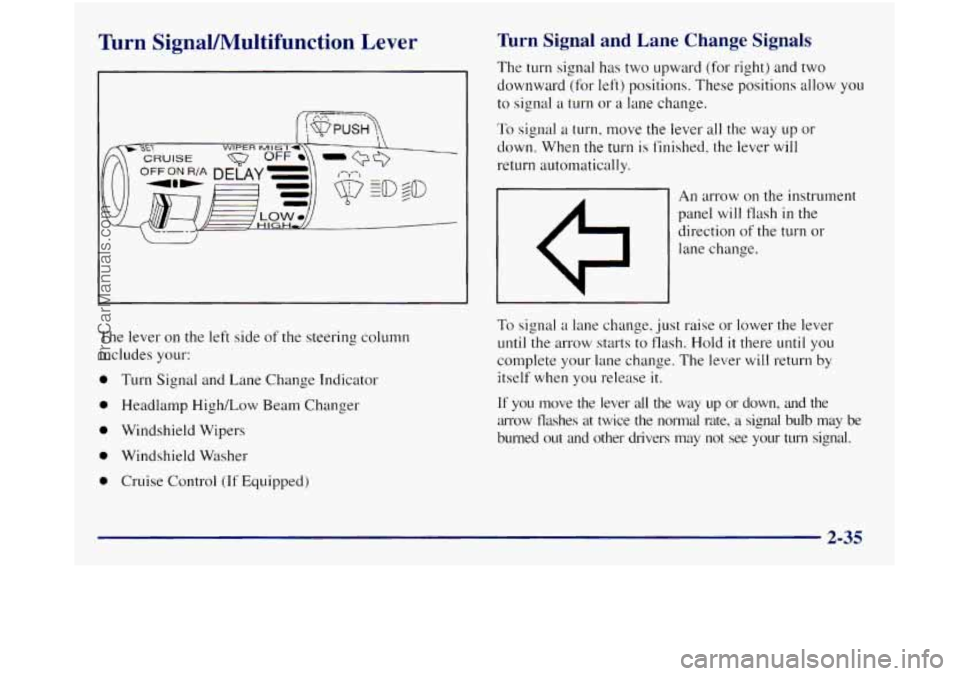
The lever on the left side
of the steering column
includes your:
0 Turn Signal and Lane Change Indicator
0 Headlamp High/Low Beam Changer
0 Windshield Wipers
0 Windshield Washer
0 Cruise Control (If Equipped)
To signal a lane change, just raise or lower the lever
until the arrow starts to flash. Hold it there
until you
complete your lane change. The lever will return by
itself when you release it.
If you move the lever all the way up or down, and the
arrow flashes at twice the normal rate,
a signal bulb may be
burned out and other drivers may not see your
turn signal.
2-35
ProCarManuals.com
Page 189 of 452
Section 4 Yoiir Driving and the Road
Here you’ll find information about driving on different kinds of roads and in varying weather conditions. We’ve also
included many other useful tips on driving.
4-
2
4- 2
4-5
4-6
4- 8
4-1
1
4-1 1
4- 13
4- 14
4-27
4-28
Defensive Driving Drunken Driving
Control of a Vehicle
Braking
Steering
Off-Road Recovery Passing
Loss of Control
Off-Road Driving with Your
Four-Wheel-Drive Vehicle
Driving at Night
Driving
in Rain and on Wet Roads 4-3
1
4-32
4-33
4-33
4-34
4-36 4-4
1
4-42
4-47
4-47
4-48 City Driving
Freeway Driving
Before Leaving
on a Long Trip
Highway Hypnosis
Hill and Mountain Roads
Winter Driving Recreational Vehicle Towing
Loading Your Vehicle
Camper Wiring Harness
(If Equipped)
Pickup Conversion
to Chassis Cab
Towing a Trailer
4-1
ProCarManuals.com
Page 193 of 452
The body takes about an hour to rid itself of the alcohol
in one drink. No amount of coffee or number of cold
showers will speed that up.
“I’ll be careful” isn’t the
right answer. What
if there’s an emergency, a need to
take sudden action, as when a child darts into the street?
A person with even a moderate BAC might not be able
to react quickly enough to avoid the collision.
There‘s something else about drinking and driving that
many people don’t know. Medical research shows that
alcohol
in a person’s system can make crash injuries
worse, especially injuries to the brain, spinal cord or
heart. This means that when anyone who has been
drinking
-- driver or passenger -- is in a crash, that
person’s chance of being killed or permanently disabled
is higher than if the person had not been drinking.
A CAUTION:
Drinking and then driving is very dangerous.
Your reflexes, perceptions, attentiveness and
judgment can be affected by even a small amount
of alcohol. You can have a serious
-- or even
fatal
-- collision if you drive after drinking.
Please don’t drink and drive or ride with
a driver
who has been drinking. Ride home in
a cab; or if
you’re with
a group, designate a driver who will
not drink.
Control of a Vehicle
You have three systems that make your vehicle go where
you want
it to go. They are the brakes, the steering and
the accelerator.
All three systems have to do their work
at the places where the tires meet
the road.
4-5
ProCarManuals.com
Page 196 of 452
The anti-lock system can change the brlzke pressure faster
than any driver could. The computer is programmed
to
make the most of available tire and road conditions.
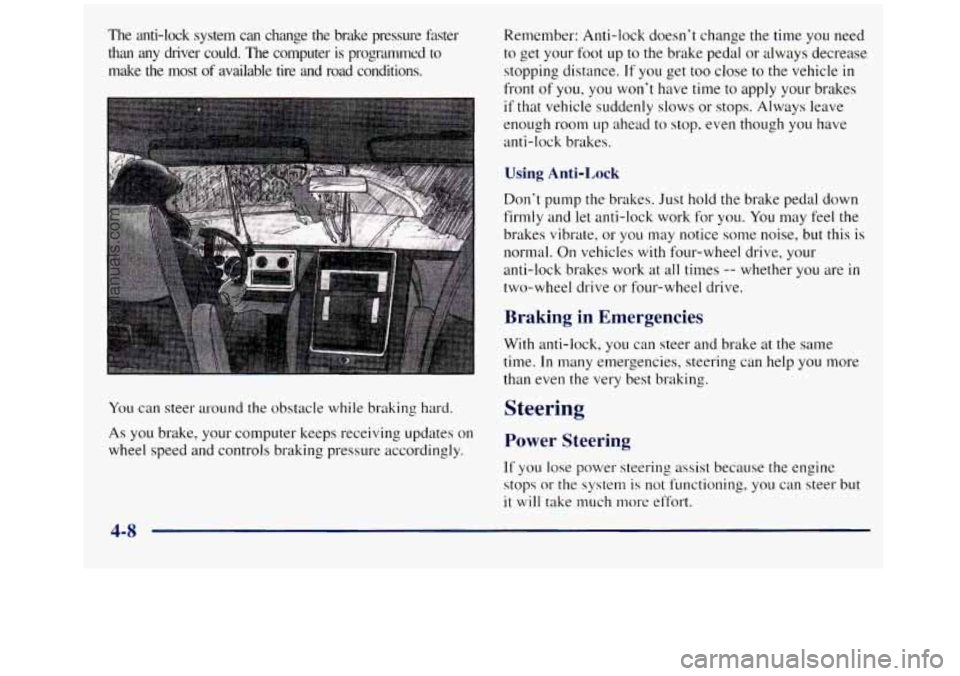
You can steer around the obstacle while braking hard.
As you brake, your computer keeps receiving updates on
wheel speed and controls braking pressure accordingly. Remember: Anti-lock doesn’t change the
time you need
to get your foot
up to the brake pedal or always decrease
stopping distance.
If you get too close to the vehicle in
front of you, you won’t have time to apply your brakes
if that vehicle. suddenly slows or stops. Always leave
enough room
up ahead to stop, even though you have
anti-lock brakes.
Using Anti-Lock
Don’t pump the brakes. Just hold the brake pedal down
firmly and let anti-lock work for you.
You may feel the
brakes vibrate, or you may notice some noise, but this is
normal. On vehicles
with four-wheel drive, your
anti-lock brakes work at all times
-- whether you are in
two-wheel drive or four-wheel drive.
Braking in Emergencies
With anti-lock, you can steer and brake at the same
time. In many emergencies, steering can help you more
than even the very best braking.
Steering
Power Steering
If you lose power steering assist because the engine
stops
or the system is not functioning, you can steer but
it will take much more effort.
4-8
ProCarManuals.com
Page 197 of 452
Speed Sensitive Steering
This system varies the amount of steering effort
proportionate
to your vehicle speed. Steering is easier at
lower speeds for maneuvering and parking ease.
As your
vehicle speed increases,
the steering effort also
increases.
At highway speeds, the amount of steering
effort is increased for vehicle control and stability.
Steering Tips
Driving on Curves
It’s important to take curves at a reasonable speed.
A lot of the “driver lost control” accidents mentioned on
the news happen on curves. Here’s why:
Experienced driver or beginner, each
of us is subject to
the same laws of physics when driving on curves. The
traction of the tires against the road surface makes
it
possible for the vehicle to change its path when you turn
the front wheels.
If there’s no traction, inertia will keep
the vehicle going
in the same direction. If you’ve ever
tried
to steer a vehicle on wet ice, you‘ll understand this.
The traction
you can get in a curve depends on the
condition of your tires and the road surface, the angle at which the curve
is banked, and your speed. While you’re in
a curve, speed is the one factor you can control. Suppose you’re
steering through a sharp curve.
Then you suddenly accelerate. Both control
systems
-- steering and acceleration -- have to do their
work where the tires meet the road. Adding the sudden
acceleration can demand too much
of those places. You
can lose control.
What should
you do if this ever happens? Ease up on the
accelerator pedal, steer the vehicle the way
you want it
to go, and slow down.
Speed
limit signs near curves warn that you should
adjust your speed.
Of course, the posted speeds are
based on good weather and road conditions. Under less
favorable conditions you’ll want to go slower.
If you need to reduce your speed as you approach a
curve, do
it before you enter the curve, while your front
wheels are straight ahead.
Try to adjust your speed
so you can “drive” through the
curve. Maintain a reasonable, steady speed. Wait to
accelerate
until you are out of the curve, and then
accelerate gently into the straightaway.
4-9
ProCarManuals.com
Page 198 of 452
Steering in Emergencies
There are times when steering can be more effective
than braking. For example, you come over a hill and
find a truck stopped in your lane, or
a car suddenly pulls
out from nowhere, or
a child darts out from between
parked cars and stops right in front
of you. You can
avoid these problems by braking
-- if you can stop in
time. But sometimes you can’t; there isn’t room.
That’s
the time for evasive action -- steering around
the problem.
Your vehicle can perform very well
in emergencies like
these. First apply your brakes. (See “Braking in
Emergencies’’ earlier in this section.)
It is better to
remove as much speed as you can from a possible
collision. Then steer around the problem, to the left or
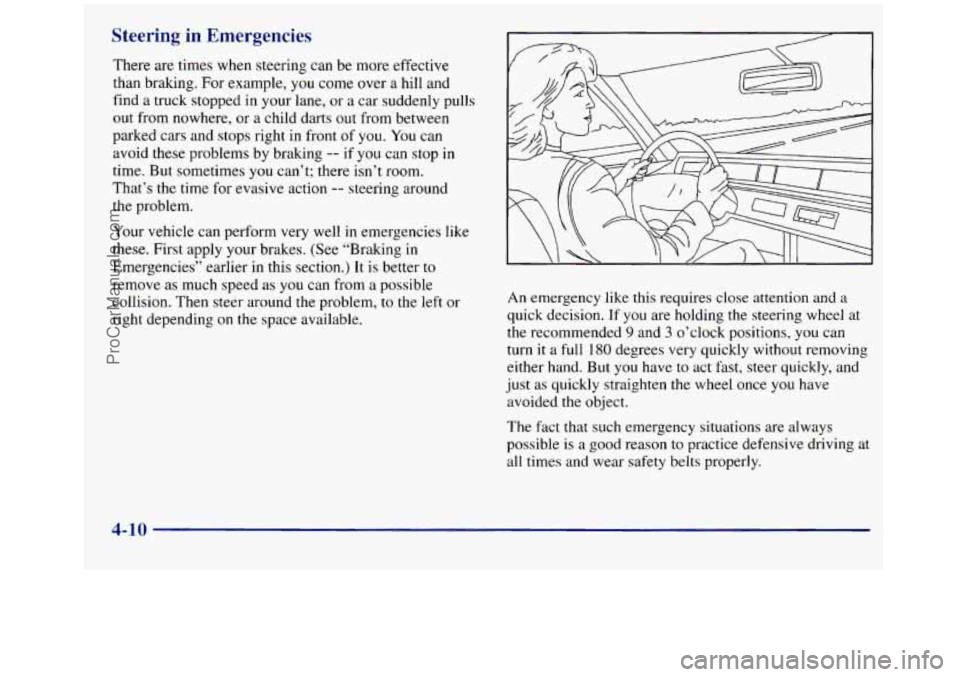
right depending on the space available. An
emergency like this requires close attention
and a
quick decision. If you are holding the steering wheel at
the recommended
9 and 3 o’clock positions, you can
turn it
a full 180 degrees very quickly without removing
either hand. But
you have to act fast, steer quickly, and
just as quickly straighten the wheel once you have
avoided
the object.
The fact that such emergency situations are always
possible is a good reason to practice defensive driving at
all times and wear safety belts properly.
4-10
ProCarManuals.com
Page 199 of 452
Off-Road Recovery Passing
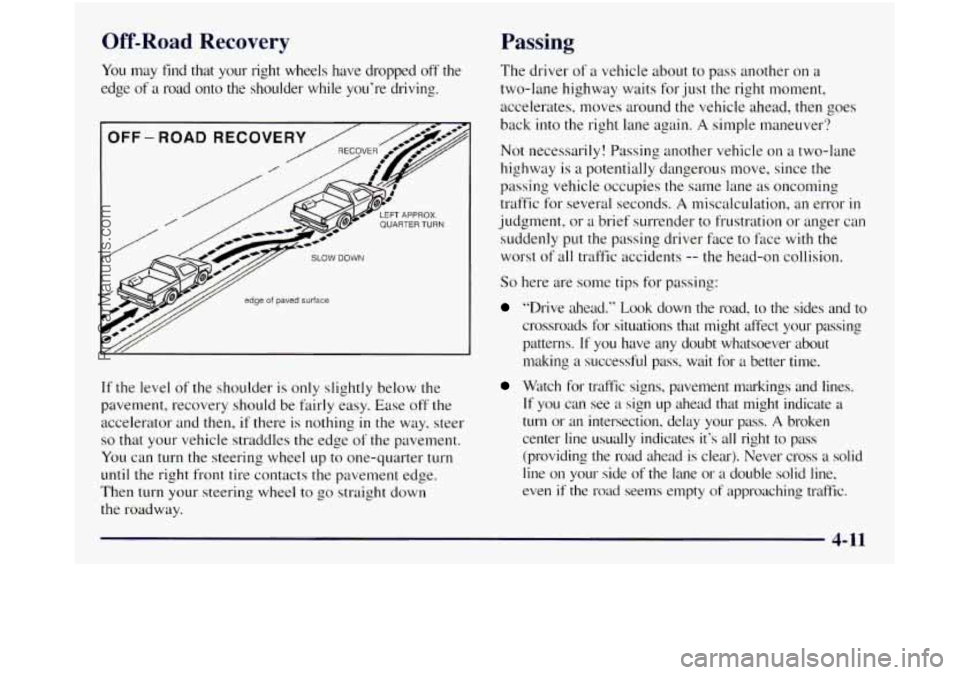
You may find that your right wheels have dropped off the
edge of
a road onto the shoulder while you‘re driving.
If the level of the shoulder is only slightly below the
pavement, recovery should be fairly easy. Ease off the
accelerator and then,
if there is nothing in the way. steer
so that your vehicle straddles the edge of the pavement.
You can turn the steering wheel up to one-quarter turn
until the right front tire contacts the pavement edge.
Then
turn your steering wheel to go straight down
the roadway. The driver
of a vehicle about to pass another on a
two-lane highway waits
for just the right moment,
accelerates, lnoves around the vehicle ahead, then goes
back into the right
lane again. A simple maneuver‘?
Not necessarily! Passing another vehicle on a two-lane
highway is
a potentially dangerous move, since the
passing vehicle occupies the same lane as oncoming
traffic for several seconds.
A miscalculation, an error in
judgment, or a brief surrender to frustration or anger can
suddenly
put the passing driver face to face with the
worst of all traffic accidents -- the head-on collision.
So here are some tips for passing:
“Drive ahead.” Look down the road, to the sides and to
crossroads for situations that might affect your passing
patterns.
If you have any doubt whatsoever about
making a successful pass, wait for a better time.
Watch for traff‘ic signs, pavernent rnarkings and lines.
If you can see a sign up ahead that might indicate a
turn or an intersection, delay your pass. A broken
center line usually indicates it‘s all right to pass
(providing the road ahead is clear). Never cross
a solid
line on
YOLII- side of the lane or a double solid line,
even if the road seems empty of approaching traffic.
4-11
ProCarManuals.com
Page 201 of 452
Loss of Control
Let’s review what driving experts say about what
happens when the three control systems (brakes, steering
and acceleration) don’t have enough friction where
the
tires meet the road to do what the driver has asked.
In any emergency, don’t give up. Keep trying to steer and
constantly seek an escape route or area of less danger.
Skidding
In a skid, a driver can lose control of the vehicle. Defensive
drivers avoid most skids by taking reasonable care suited
to
existing conditions, and by not “overdriving” those
conditions. But skids are always possible.
The three types of skids correspond
to your vehicle’s
three control systems. In the braking skid, your wheels
aren’t rolling. In the steering or cornering skid,
too
much speed or steering in a curve causes tires to slip and
lose cornering force. And
in the acceleration skid, too
much throttle causes the driving wheels to spin.
A cornering skid and an acceleration skid are best
handled by easing your foot off the accelerator pedal. If
your vehicle starts
to slide, ease your foot off the
accelerator pedal and quickly steer the way you want the
vehicle
to go. If you start steering quickly enough, your
vehicle may straighten out. Always be ready for
a
second skid if it occurs.
Of course, traction
is reduced when water, snow, ice.
gravel or other material
is on the road. For safety, you’ll
want to slow down and adjust your driving to these
conditions.
It is important to slow down on slippery
surfaces because stopping distance will be longer and
vehicle control more limited.
While driving on a surface
with reduced traction, try
your best to avoid sudden steering, acceleration or
braking (including engine braking
by shifting to a lower
gear). Any sudden changes could cause the tires
to slide.
You may not realize the surface is slippery until your
vehicle is skidding. Learn to recognize warning clues
--
such as enough water, ice or packed snow on the road to
make
a “mirrored surface” -- and slow down when you
have any doubt.
Remember:
Any anti-lock brake system (ABS) helps
avoid only the braking skid.
4-13
ProCarManuals.com
Page 205 of 452
Scanning the Terrain
Off-road driving can take you over many different kinds
of terrain. You need to
be familiar with the terrain and its
many different features. Here are some things to consider.
Su$ace Conditions. Off-roading can take you over
hard-packed dirt, gravel, rocks, grass, sand, mud, snow or
ice. Each
of these surfaces affects the steering, acceleration
and braking of your vehicle in different ways. Depending
upon the kind of surface
you are on, you may experience
slipping, sliding, wheel spinning, delayed acceleration,
poor traction and longer braking distances.
Su$ace Obstacles. Unseen or hidden obstacles can be
hazardous. A rock, log, hole, rut or bump can startle you if
you’re not prepared for them. Often these obstacles are
hidden by grass, bushes, snow or even the
rise and fall of
the terrain itself. Here are some things to consider:
Is the path ahead clear?
Will the surface texture change abruptly up ahead?
Does the travel take you uphill or downhill? (There’s
more discussion of these subjects later.)
Will you have to stop suddenly or change
direction quickly? When
you drive over obstacles or
rough terrain, keep a
firm grip on the steering wheel. Ruts, troughs or
other
surface features can jerk the wheel out of your hands if
you’re not prepared.
When you drive over bumps, rocks, or other obstacles,
your wheels can leave the ground. If this happens, even
with
one or two wheels, you can’t control the vehicle as
well or at all.
Because
you will be on an unpaved surface, it’s
especially important to avoid sudden acceleration,
sudden turns or sudden braking.
In a way, off-road driving requires a different kind of
alertness from driving
on paved roads and highways.
There are
no road signs, posted speed limits or signal
lights. You have to use your own good judgment about
what is safe and what isn’t.
Drinking and driving can be very dangerous on any
road. And this is certainly true for off-road driving. At
the very time you need special alertness and driving
skills, your reflexes, perceptions and judgment can be
affected by even a small amount
of alcohol. You could
have a serious
-- or even fatal -- accident if you drink
and drive or ride with a driver who has been drinking.
See “Drunken Driving’’ in the Index.
4-17
ProCarManuals.com
Page 207 of 452
Driving Uphill
Once you decide you can safely drive up the hill, you
need to take some special steps.
0
0
0
Use a low gear and get a firm grip on the
steering wheel.
Get a smooth start
up the hill and try to maintain
your speed. Don’t
use more power than you need,
because you don’t want your wheels to start spinning
or sliding.
Try to drive straight up the
hill if at all possible. If
the path twists and turns, you might want to find
another route.
l A C * UYON:
0
0
0
0
Ease up on your speed as you approach the top of
the hill.
Attach a flag to the vehicle to make you more visible
to approaching traffic on trails or hills.
Sound the horn as you approach the top
of the hill to
let opposing traffic know you’re there.
Use your headlamps even during the day. They make
you more visible to oncoming traffic.
Turning or driving across steep hills can be
dangerous. You could lose traction, slide
sideways, and possibly roll over. You could be
seriously injured or killed. When driving up hills,
always try to go straight up.
1 A CAUTION:
Driving to the top (crest) of a hill at full speed can
cause an accident. There could be a drop-off,
embankment, cliff, or even another vehicle. You
could be seriously injured or killed.
As you near
the top of a hill, slow down and stay alert.
4-19
ProCarManuals.com