steering GMC SIERRA 1998 Owner's Manual
[x] Cancel search | Manufacturer: GMC, Model Year: 1998, Model line: SIERRA, Model: GMC SIERRA 1998Pages: 452, PDF Size: 23.65 MB
Page 208 of 452
What should I do if my vehicle stalls, or is about
to stall, and I can’t make it up the hill?
A: If this happens, there are some things you should
do, and there
are some things you must not do.
First, here’s what you
should do:
0 Push the brake pedal to stop the vehicle and keep it
from rolling backwards.
Also, apply the parking brake.
0 If your engine is still running, shift the transmission
to REVERSE (R), release the parking brake, and
slowly back down the hill in REVERSE (R).
0 If your engine has stopped running, you’ll need to
restart
it. With the brake pedal depressed and the
parking brake still applied, shift the transmission to
PARK
(P) (or, shift to NEUTRAL (N) if your
vehicle has a manual transmission) and restart the
engine. Then, shift to REVERSE (R), release the
parking brake, and slowly back down the hill as
straight as possible in REVERSE (R).
0 As you are backing down the hill, put your left hand
on the steering wheel at the 12 o’clock position. This
way, you’ll be able to tell if your wheels are straight
and maneuver as you back down. It’s best that you back down
the hill with your wheels straight rather
than in the left or right direction. Turning the wheel
too far to the left or right will increase the possibility
of a rollover.
Here are some things you
must not do if you stall, or are
about to stall, when going up a hill.
0 Never attempt to prevent a stall by shifting into
NEUTRAL (N) (or depressing the clutch, if you
have a manual transmission) to “rev-up” the engine
and regain forward momentum. This won’t work.
Your vehicle will roll backwards very quickly and
you could
go out of control.
Instead, apply the regular brake to stop the vehicle.
Then apply the parking brake. Shift to
REVERSE (R), release the parking brake, and slowly back straight down.
Never attempt to turn around if you are about to stall
when going up a hill. If the hill is steep enough
to
stall your vehicle, it’s steep enough to cause you to
roll over if
you turn around. If you can’t make it up
the hill,
you must back straight down the hill.
4-20
ProCarManuals.com
Page 213 of 452
I-
I A CAUTION:
-
~ Getting out on the downhill (low) side of a vehicle
~ stopped across an incline is dangerous. If the
vehicle
rolls over, you could be crushed or killed.
Always get out on the uphill (high) side of the
~ vehicle and stay well clear of the rollover path.
Driving in Mud, Sand, Snow or Ice
When you drive in mud, snow or sand, your wheels
won’t get good traction. You can’t accelerate
as
quickly, turning is more difficult, and you’ll need
longer braking distances.
It‘s best to use a low gear when you’re
in mud -- the
deeper the mud, the lower the gear.
In really deep mud,
the idea
is to keep your vehicle moving so you don’t
get stuck.
When you drive on sand, you’ll sense
a change in wheel
traction. But
it will depend upon how loosely packed the
sand is. On loosely packed sand (as on beaches or sand
dunes) your tires will tend to sink into the sand. This has
an
effect on steering, accelerating and braking. You may
want to reduce the air pressure in your tires slightly
when driving on sand. This will improve traction.
Hard packed snow and ice offer the worst tire traction.
On these surfaces, it’s very easy to lose control. On wet
ice, for example, the traction is
so poor that you will
have difficulty accelerating. And
if you do get moving,
poor steering
and difficult braking can cause you to slide
out of control.
r A CAUTION:
Driving on frozen lakes, ponds or rivers can be
dangerous. Underwater springs, currents under
the ice, or sudden thaws can weaken the ice. Your
vehicle could fall through the ice and you and
your passengers could drown. Drive your vehicle
on safe surfaces only.
4-25
ProCarManuals.com
Page 215 of 452
steering, suspension, wheels, tires ana exhaust system
for damage.
Also, check the fuel lines and cooling
system for any leakage. Night driving is more dangerous than
day driving. One
reason is that some drivers are likely to
be impaired -- by
alcohol or
drugs, with night vision problems, or by fatigue.
Your vehicle will require more frequent service due to
off-road use. Refer
to the Maintenance Schedule for
additional information.
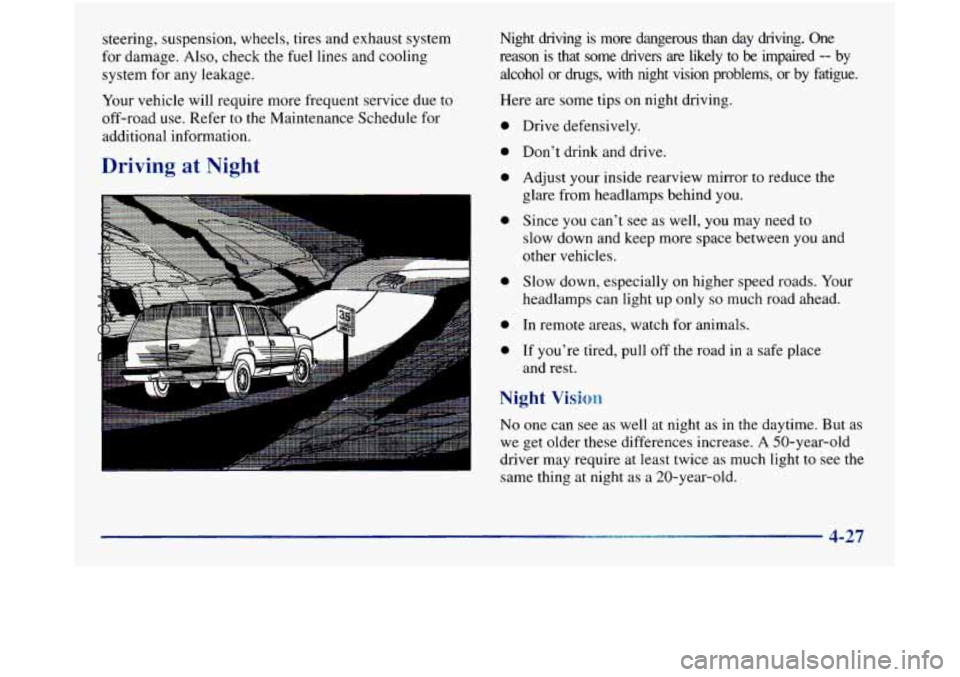
Driving at Night
Here are some tips on night driving.
0
0
0
0
0
0
0
Drive defensively.
Don’t drink and drive.
Adjust your inside rearview mirror
to reauce me
glare from headlamps behind you.
Since you can’t see as well,
you may need to
slow down and keep more space between you and
other vehicles.
Slow down, especially on higher speed roads. Your
headlamps can light
up only so much road ahead.
In remote areas, watch for animals.
If you’re tired, pull off
the road in a safe place
and rest.
Night Vision
No one can see as well at night as in the daytime. But as
we get older
these differences increase. A 50-year-old
driver may require at least twice as much light
to see the
same thing at night as a 20-year-old.
4-27
ProCarManuals.com
Page 226 of 452
0 Watch for slippery spots. The road might be fine
until
you hit a spot that’s covered with ice. On an
otherwise clear road, ice patches may appear in
shaded areas where the sun can’t reach: around
clumps of trees, behind buildings or under bridges.
Sometimes the surface of a curve or an overpass may
remain icy when the surrounding roads are clear.
If
you see a patch of ice ahead of you, brake before you
are on it. Try not to brake while you’re actually
on
the ice, and avoid sudden steering maneuvers.
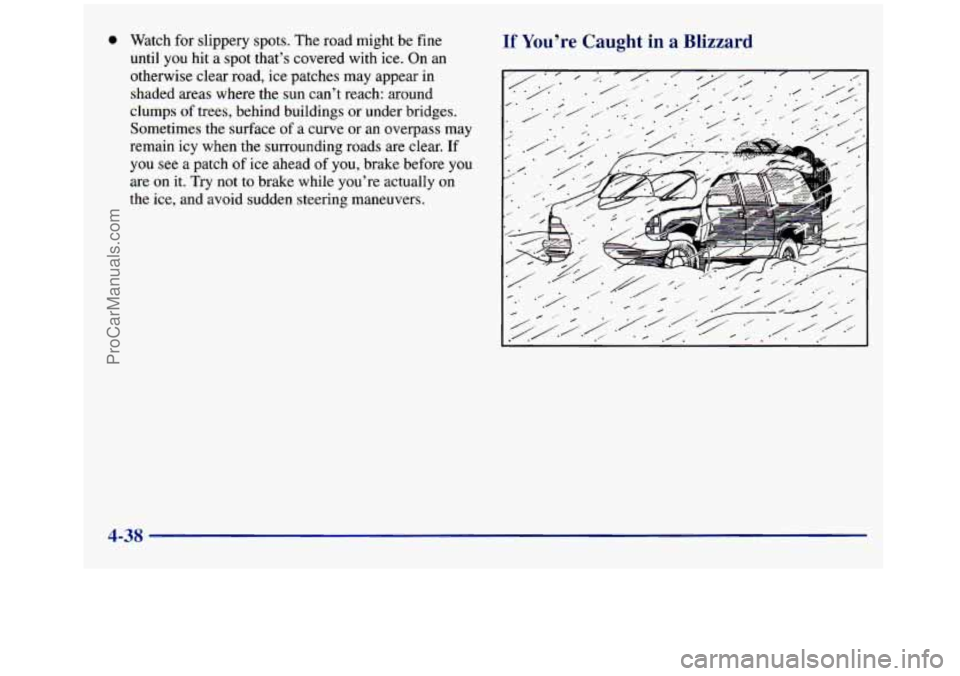
If You’re Caught in a Blizzard
4-38
ProCarManuals.com
Page 230 of 452
Four-Wheel-Drive Vehicles
(Manual Transfer Case Only)
‘A
-
Shifting the transfer case into NEUTRAL (N) can
cause your vehicle to roll even if the transmission
is in
PARK (P), for an automatic transmission, or
if your vehicle is in gear, for
a manual
transmission.
You or others could be injured.
Make sure the parking brake is firmly set before
you shift the transfer case into NEUTRAL (N).
Use the following procedure to correctly tow your
vehicle on all four wheels:
1.
2.
3.
4.
5.
6.
Firmly set the parking brake.
Place the transmission in
PARK (P) or a manual
transmission in FIRST
(1).
Securely attach the vehicle being towed to the
tow vehicle.
With the engine running, shift the transfer case to
NEUTRAL
(N). See “Four-wheel Drive” in the
Index for the proper procedure to select the neutral
position for your vehicle.
Release the parking brake only after the vehicle
being towed is firmly attached to the towing vehicle.
Turn the ignition to
OFF, The OFF position unlocks the
steering column and reduces battery
drain. Unlocking
the steering column will allow the proper movement
of
the front wheels and tires during towing.
4-42
ProCarManuals.com
Page 245 of 452
During your trip, check occasionally to be sure that the
load is secure, and that the lamps and any trailer brakes
are still working.
Following Distance
Stay at least twice as far behind the vehicle ahead as you
would when driving your vehicle without
a trailer. This
can help
you avoid situations that require heavy braking
and sudden turns.
Passing
You’ll need more passing distance up ahead when
you’re towing a trailer. And, because you’re a good deal
longer,
you’ll need to go much farther beyond the
passed vehicle before you can return to
your lane.
Backing Up
Hold the bottom of the steering wheel with one hand.
Then, to move the trailer
to the left, just move that hand
to the left.
To move the trailer to the right, move your
hand to the right. Always back up slowly and, if
possible, have someone guide you.
Making Turns
I NOTICE:
Making very sharp turns while trailering could
cause the trailer to come in contact with the
vehicle. Your vehicle could be damaged. Avoid
making very sharp turns while trailering.
When you’re turning with a trailer, make wider turns than
normal. Do this
so your trailer won’t strike soft shoulders,
curbs, road signs, trees or other objects. Avoid jerky or
sudden maneuvers. Signal well in advance.
Turn Signals When Towing a Trailer
The arrows on your instrument panel will flash
whenever
you signal a turn or lane change. Properly
hooked up, the trailer lamps will also flash, telling other
drivers you’re about to turn, change lanes or stop.
When towing a trailer, the arrows on your instrument
panel
will flash for turns even if the bulbs on the trailer are
burned out. Thus,
you may think drivers behind you are
seeing your signal when they are not. It’s important to
check occasionally
to be sure the trailer bulbs are
still working.
ProCarManuals.com
Page 262 of 452
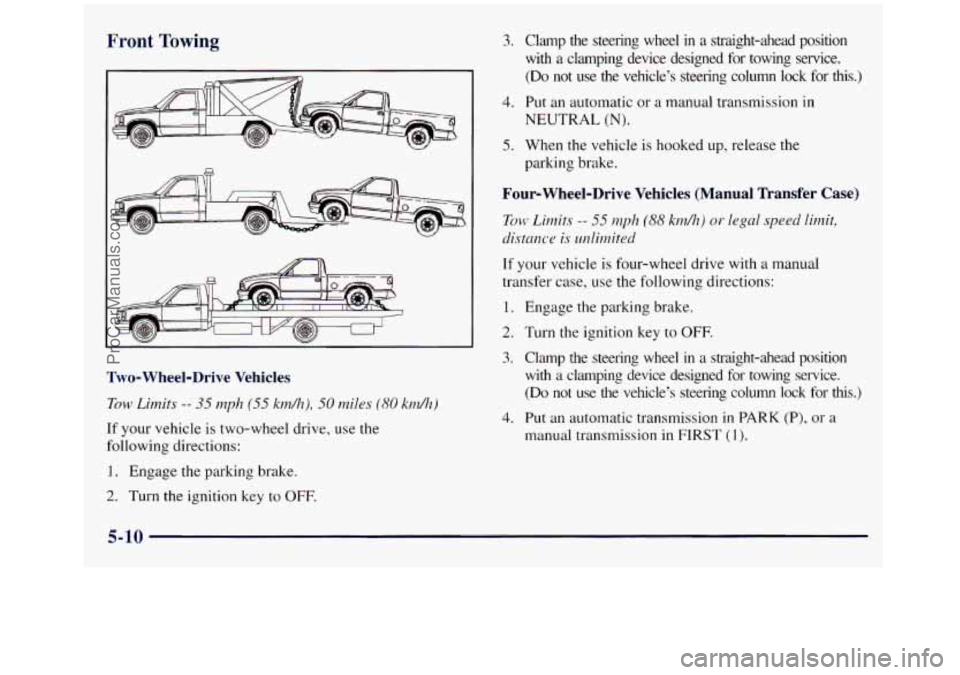
Front Towing
Two- Wheel-Drive Vehicles
Tow Lirnits -- 35 nzph (55 kdh), 50 miles (80 kr.n/h)
If your vehicle is two-wheel drive, use the
following directions:
I. Engage the parking brake.
2. Turn the ignition key to OFF.
3. Clamp the steering wheel in a straight-ahead position
with a clamping device designed for towing service.
(Do not use the vehicle’s steering column lock for this.)
4. Put an automatic or a manual transmission in
NEUTRAL (N).
5. When the vehicle is hooked up, release the
parking brake.
Four-Wheel-Drive Vehicles (Manual Transfer Case)
Tow Lirnits -- 55 rnph (88 knzdh) or legtrl speed limit,
distance
is unlimited
If your vehicle is four-wheel drive with a manual
transfer case, use the following directions:
1. Engage the parking brake.
2. Turn the ignition key to OFF.
3. Clamp the steering wheel in a straight-ahead position
with
a clamping device designed for towing service.
(Do not use the vehicle’s steering column lock for this.)
4. Put an automatic transmission in PARK (P), or a
manual transmission
in FIRST (1).
5-10
ProCarManuals.com
Page 263 of 452
5. Put the transfer case in NEUTRAL (N). See
“Four-wheel Drive” in the Index
for the proper
procedure to select NEUTRAL
(N).
6. When the vehicle is hooked up, release the
parking brake.
4. Put the transmission in NEUTRAL (N).
5. Put the transfer case in 2 High (2HI).
6. When the vehicle is hooked up, release the
parking brake.
Four- Wheel Drive-Vehicles (Electronic
Transfer Case)
Tow Limits -- 35 mph (55 krdh), 50 miles (80 krn/l1)
If your vehicle is four-wheel drive with an electronic
transfer case, use the following directions:
1. Engage the parking brake.
2. Turn the ignition key to OFF.
3. Clamp the steering wheel in a straight-ahead position
with a clamping device designed for towing service.
(Do not use the vehicle’s steering column lock for this.)
NOTICE:
If your vehicle is equipped with an electronic
transfer case and the tow limits must be
exceeded, a towing dolly must be used under the rear wheels or vehicle/powertrain damage
will occur.
5-11
ProCarManuals.com
Page 264 of 452
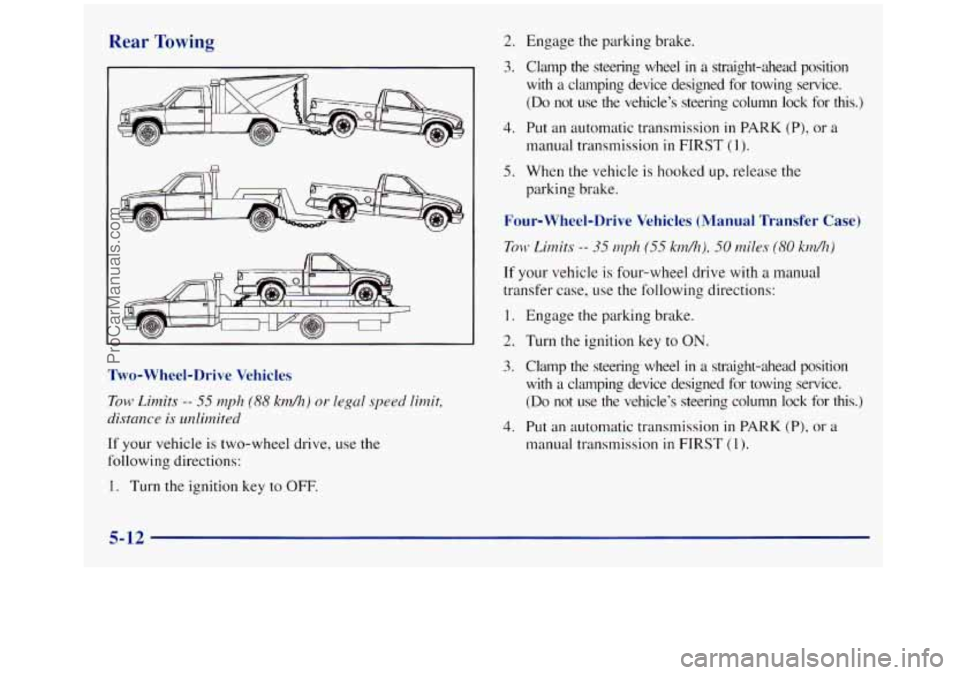
Rear Towing
Two-Wheel-Drive Vehicles
Tow Limits -- 55 ~zph (88 krdh) or legal speed limit,
distmce is ditnited
If your vehicle is two-wheel drive, use the
following directions:
1. Turn the ignition key to OFF.
2.
3.
4.
5.
Engage the parking brake.
Clamp the steering wheel in a straight-ahedd position
with a clamping device designed for towing service.
(Do not use the vehicle’s steering column lock for this.)
Put an automatic transmission
in PARK (P), or a
manual transmission in FIRST (1).
When the vehicle is hooked up, release the
parking brake.
Four-Wheel-Drive Vehicles (Manual Transfer Case)
If your vehicle is four-wheel drive with a manual
transfer case, use the following directions:
1.
2.
3.
4.
Engage the parking brake.
Turn the ignition
key to ON.
Clamp the steering wheel in a straight-ahead position
with a clamping device designed for towing service.
(Do not use the vehicle’s steering column lock for this.)
Put an automatic transmission
in PARK (P), or a
manual transmission in FIRST (1).
5-12
ProCarManuals.com
Page 265 of 452
5. Put the transfer case in NEUTRAL (N). See
“Four-Wheel Drive’’
in the Index for the proper
procedure to select NEUTRAL
(N).
6. When the vehicle is hooked up. release the
parking brake.
7. Turn the ignition key to OFF.
Four- Wheel-Drive Vehicles (Electronic
Transfer Case)
Eml Limits -- 35 mph (55 km/JZ), 50 milc?s (80 kndh)
If your vehicle is four-wheel drive with an electronic
transfer case, use the following directions:
I. Engage the parking brake.
2. Turn the ignition key to ON.
3. Clamp the steering wheel in a straight-ahead position
with
a clamping device designed for towing service.
(Do not use the vehicle’s steering column lock for this.)
4. Put the transmission in NEUTRAL (N).
5. Put the transfer case in 2 High (2HI).
6. When the vehicle is hooked up, release the
parking brake.
7. Turn the ignition key to OFF.
NOTICE:
If your vehicle is equipped with four-wheel drive
and the towing limits must be exceeded, a towing
dolly must be used under the front wheels or
vehicle/powertrain damage will occur.
I NOTICE:
Towing pickup models from the rear while loaded
with heavy cargo may cause the frame side rails
to flex sufficiently to allow the pickup box to
contact the cab and could cause damage to the
cab and/or box.
Engine Overheating (Gasoline Engine)
You will find a coolant temperature gage on your
vehicle’s instrument panel. See “Engine Coolant
Temperature Gage”
in the Index.
If your vehicle has a diesel engine, see “Engine
Overheating”
in the Diesel Engine Supplement.
5-13
ProCarManuals.com