wheel GMC SIERRA 1998 Owner's Manual
[x] Cancel search | Manufacturer: GMC, Model Year: 1998, Model line: SIERRA, Model: GMC SIERRA 1998Pages: 452, PDF Size: 23.65 MB
Page 112 of 452
Leaving Your Vehicle With the Engine
Running (Automatic Transmission
Only)
I A CATJTION:
It can be dangerous to leave your vehicle with the
engine running. Your vehicle could move
suddenly if the shift lever
is not fully in PARK (P)
with the parking brake firmly set. If you have
four-wheel drive with
a manual transfer case
shift lever and your transfer case is in
NEUTRAL
(N), your vehicle will be free to roll,
even if your shift lever is in PARK
(P). So be sure
the transfer case is in
a drive gear -- not in
NEUTRAL
(N). And, if you leave the vehicle with
the engine running, it could overheat and even
catch fire.
You or others could be injured. Don’t
leave your vehicle with the engine running unless
you have to. If you
have to leave your vehicle with the engine
running, be sure your vehicle
is in PARK (P) and the
parking brake is firmly set before you leave it. After
you
move the shift lever into PARK (P), hold the regular
brake pedal down. Then, see if you can move the shift
lever away from PARK
(P) without first pulling it
toward you. If you can, it means that
the shift lever
wasn’t
fully locked into PARK (P).
Torque Lock (Automatic Transmission)
If you are parking on a hill and you don’t shift your
transmission into PARK (P) properly, the weight of the
vehicle may put
too much force on the parking pawl in
the transmission.
You may find it difficult to pull the
shift lever out of PARK
(P). This is called “torque lock.”
To prevent torque lock, set the parking brake and then
shift
into PARK (P) properly before you leave the
driver’s seat.
To find out how, see “Shifting Into
PARK
(P)” in the Index.
When
you are ready to drive, move the shift lever out of
PARK (P)
before you release the parking brake.
If torque lock does occur, you may need to have another
vehicle push yours a little uphill to take some
of the
pressure from the parking pawl in the transmission,
so
you can pull the shift lever out of PARK (P).
2-28
ProCarManuals.com
Page 113 of 452
Shifting Out of PARK (P)
(Automatic Transmission)
Your vehicle has a brake-transmission shift interlock
system. You have to fully apply your regular brakes
before you can shift from PARK
(P) when the ignition is
in
RUN. See “Automatic Transmission” in the Index.
If you cannot shift out of PARK
(P), ease pressure on
the shift lever and push the shift lever all the way up
into PARK
(P) as you maintain brake application. Then,
move the shift lever
to any gear you want.
If you ever hold the brake pedal down but still can’t
shift
out of PARK (P), try this:
1. Turn the key to OFF.
2. Apply and hold the brake until the end of Step 4.
3. Shift to NEUTRAL (N).
4. Start the vehicle and shift to the drive gear you want.
5. Have the brake-transmission shift interlock system
fixed as
soon as you can.
Parking Your Vehicle
(Manual Transmission Models
Only)
Before you get out of your vehicle, put your manual
transmission in REVERSE
(R), turn off the engine, and
firmly apply the parking brake.
If you have four-wheel drive, be sure your transfer case
is in a drive gear. Your vehicle could roll if it isn’t.
If
you are parking on a hill, or if you are pulling a
trailer, see “Towing a Trailer” in
the Index.
2-29
ProCarManuals.com
Page 115 of 452
Running Your Engine While You’re
Parked (Automatic
1 ~ ission) an
It’s better not to park with the engme rblllling. But if
ever you have to, here are some things to know.
c
A A AUTION: -1
i Idling the engine with the air system control off
could allow dangerous exhaust into your vehicle
(see the earlier Caution under “Engine Exhaust”).
Also, idling in a closed-in place can let deadly
carbon monoxide
(CO) into your vehicle even if
the fan switch is at the highest setting. One place
this can happen is a garage. Exhaust
-- with
CO -- can come in easily. NEVER park in a
garage with the engine running.
Another closed-in place can be a blizzard. (See
“Blizzard” in the Index.)
4 CAUT- IN: -
It can be dangerous to get out of your vehicle if
the shift lever is not fully in
PARK (P) with the
parking brake firmly set. Your vehicle can
roll.
Don’t leave your vehicle when the engine is
running unless you have to. If you’ve left the
engine running, the vehicle can move suddenly.
You or others could be injured.
To be sure your
vehicle won’t move, even when you’re on fairly
level ground, always set your parking brake and
move the shift lever to
PARK (P).
If you have four-wheel drive and your transfer case is in
NEUTRAL (N), your vehicle will be free to roll, even if
your shift lever is in PARK (P). So. be sure the transfer
case is in a drive gear -- not in NEUTRAL (N). Always
set your parking brake. Follow the proper steps to be
sure your vehicle won’t move.
See ”Shifting Into
PARK
(P)” in the Index.
If you’re pulling a trailer. see “Towing a Trailer” in
the Index.
2-31
ProCarManuals.com
Page 116 of 452
Locking Rear Axle (If Equipped)
If you have this feature, your locking rear axle can give
you additional traction on snow, mud, ice, sand or
gravel. It works like a standard axle most of the time,
but when one
of the rear wheels has no traction and the
other does, this feature will allow
the wheel with
traction to move the vehicle.
Windows
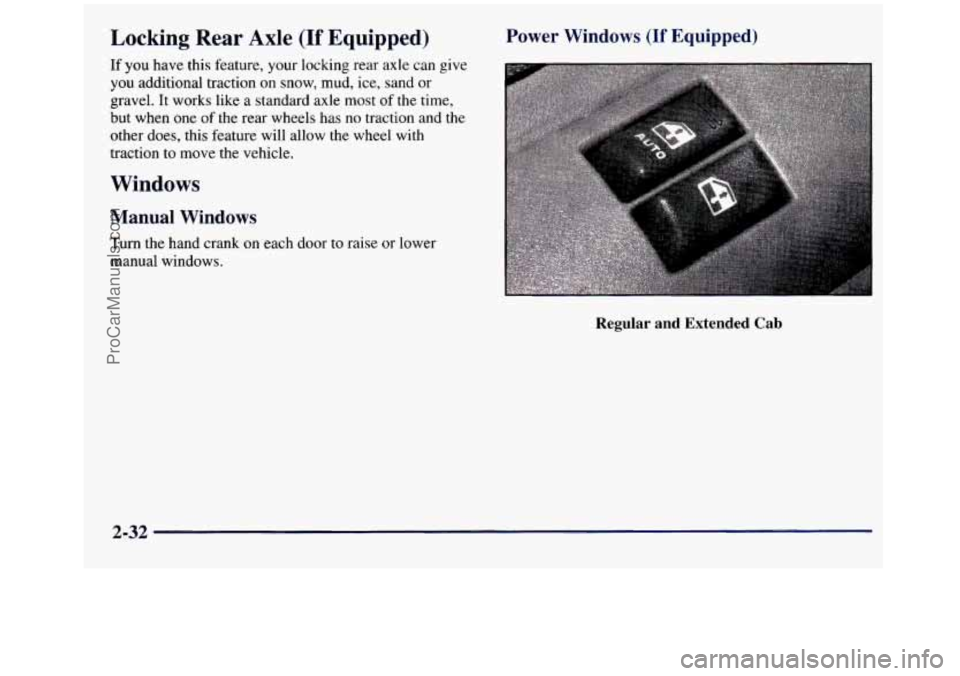
Manual Windows Power Windows
(If Equipped)
Turn the
hand crank on each door to raise or lower
manual windows.
Regular and Extended Cab
2-32
ProCarManuals.com
Page 118 of 452
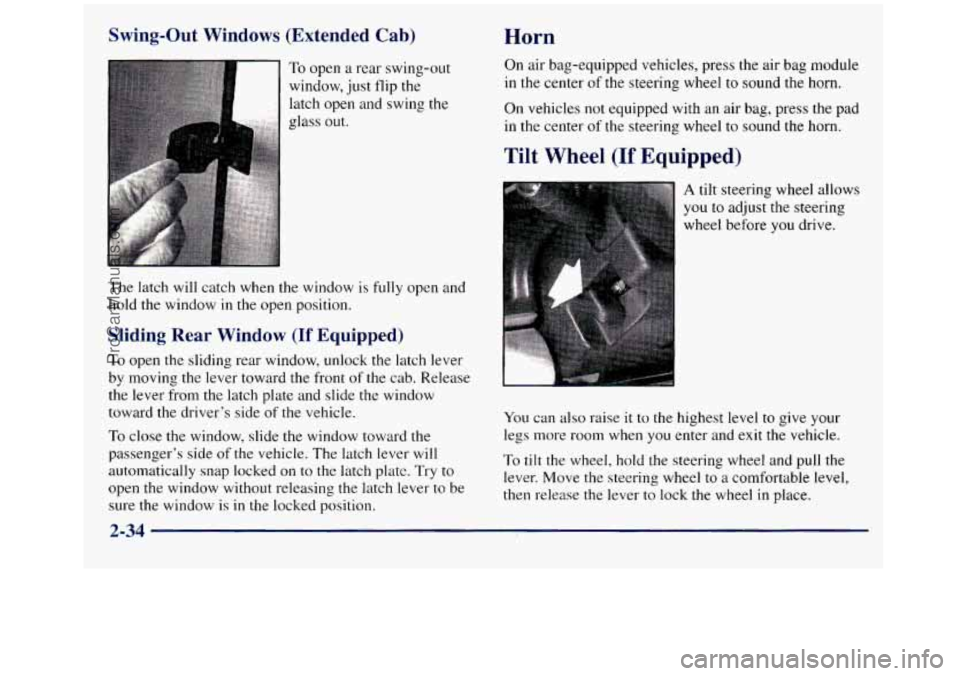
Swing-Out Windows (Extended Cab)
Sliding Rear Window (If Equipped)
To open the sliding rear window, unlock the latch lever
by moving the lever toward the front
of the cab. Release
the lever from the latch plate and slide the window
toward the driver’s side
of the vehicle.
To close the window, slide the window toward the
passenger’s side
of the vehicle. The latch lever will
automatically snap locked on to the latch plate. Try to
open the window without releasing the latch lever to be sure the window is
in the locked position.
Horn
On air bag-equipped vehicles, press the air bag module
in the center
of the steering wheel to sound the horn.
On vehicles not equipped with an air bag, press the pad
in the center of the steering wheel to sound the horn.
Tilt Wheel (If Equipped)
A tilt steering wheel allows
you to adjust the steering
wheel before
you drive.
You can also raise it to the highest level to give your
legs more room when you enter and exit the vehicle.
To tilt the wheel, hold the steering wheel and puli the
lever. Move the steering wheel to
a comfortable level,
then release the lever to lock the wheel
in place.
2-34
ProCarManuals.com
Page 122 of 452
Washer fluid will spray as long as you push the paddle.
When you let
go of the paddle, the wipers will continue
to wipe for
a few seconds and then e.ither stop or return
to the preset speed.
The use of a hood-mounted air deflector may adversely
affect windshield wiper and washer performance.
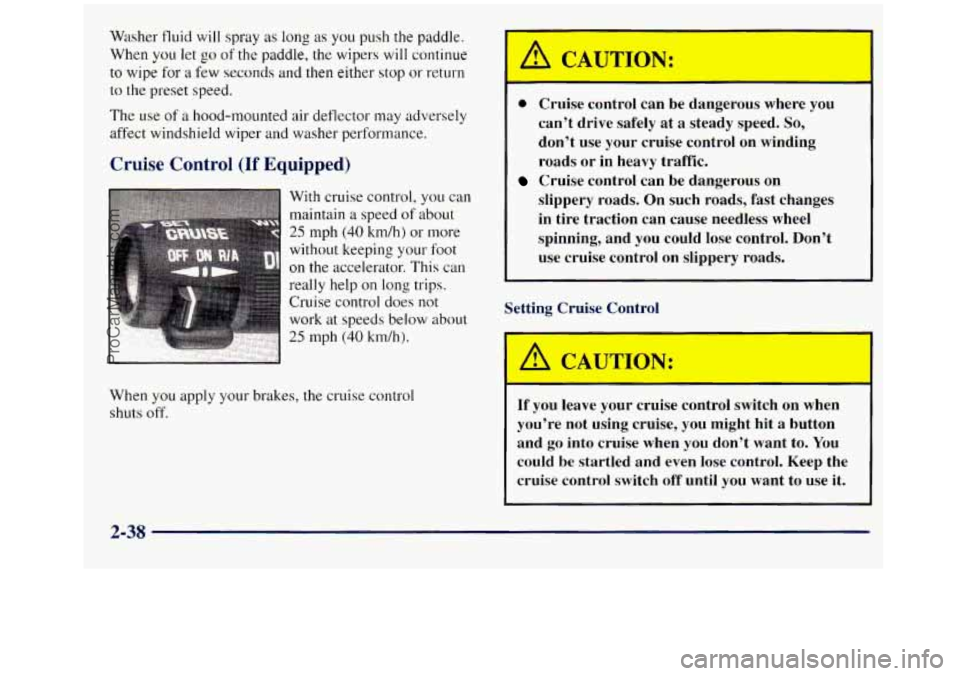
Cruise Control (If Equipped)
really help on long trips.
Cruise control does not
work at speeds below about
, .. .. .. . , . :.!r+.l .. 25 mph (40 km/h).
When
you apply your brakes, the cruise control
shuts
off.
C * ‘JTIOT ;
0 Cruise control can be dangerous where you
can’t drive safely at a steady speed. So,
don’t use your cruise control on winding
roads or in heavy traffic.
slippery roads. On such roads, fast changes in tire traction can cause needless wheel
spinning, and you could lose control. Don’t
use cruise control on slippery roads.
Cruise control can be dangerous on
Setting Cruise Control
If you leave your cruise control switch on W,AI
you’re not using cruise, you might hit a button
and
go into cruise when you don’t want to. You
could
be startled and even lose control. Keep the
cruise control switch off until
you want to use it.
2-38
ProCarManuals.com
Page 126 of 452
Clearance Lamps (If Equipped)
Taillamps License Plate Lamps
Instrument Panel Lights
Transfer Case Shift Indicator Light (Four-Wheel-Drive Vehicles)
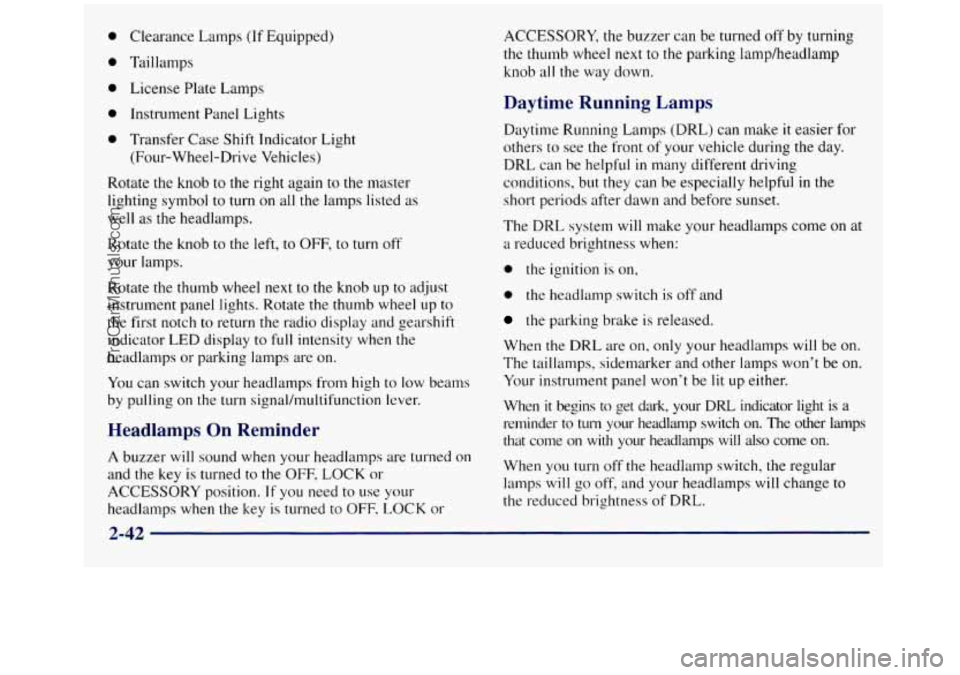
Rotate the knob to the right again to the master
lighting symbol
to turn on all the lamps listed as
well as the headlamps.
Rotate the knob to the left,
to OFF, to turn off
your lamps.
Rotate the thumb wheel next to
the knob up to adjust
instrument panel lights. Rotate the thumb wheel
up to
the first notch to return the radio display and gearshift
indicator
LED display to full intensity when the
headlamps or parking lamps are on.
You can switch your headlamps from high
to low beams
by pulling on the turn signal/multifunction lever.
Headlamps On Reminder
A buzzer will sound when your headlamps are turned on
and the key
is turned to the OFF, LOCK or
ACCESSORY position.
If you need to use your
headlamps when the key is turned to OFF-
LOCK or ACCESSORY, the
buzzer can be turned off by turning
the thumb wheel next
to the parking lamp/headlamp
knob all the way down.
Daytime Running Lamps
Daytime Running Lamps (DRL) can make it easier for
others to see the front of your vehicle during the day.
DRL can be helpful
in many different driving
conditions, but they can be especially helpful
in the
short periods after dawn and before sunset.
The DRL system
will make your headlamps come on at
a reduced brightness when:
0 the ignition is on,
0 the headlamp switch is off and
the parking brake is released.
When the DRL are on, only your headlamps will be on.
The taillamps, sidemarker and other lamps won’t
be on.
Your instrument panel won’t be lit
up either.
When it begins to get dark, your DRL indicator light is a
reminder to turn your headlamp switch on. The other lamps
that come
on with your headlanips will also come on.
When you
turn off the headlamp switch, the regular
lamps will
go off, and your headlamps will change to
the reduced brightness of DRL.
2-42
ProCarManuals.com
Page 127 of 452
To idle your vehicle with the DRL off, set the parking
brake. The DRL will stay
off until you release the
parking brake.
As with any vehicle, you should turn on the regular
headlamp system when you need it.
Fog Lamps (If Equipped)
If you have fog lamps, use them for better vision in
foggy or misty conditions.
Your parking lamps and/or
low-beam headlamps must be on for your fog lamps
to work.
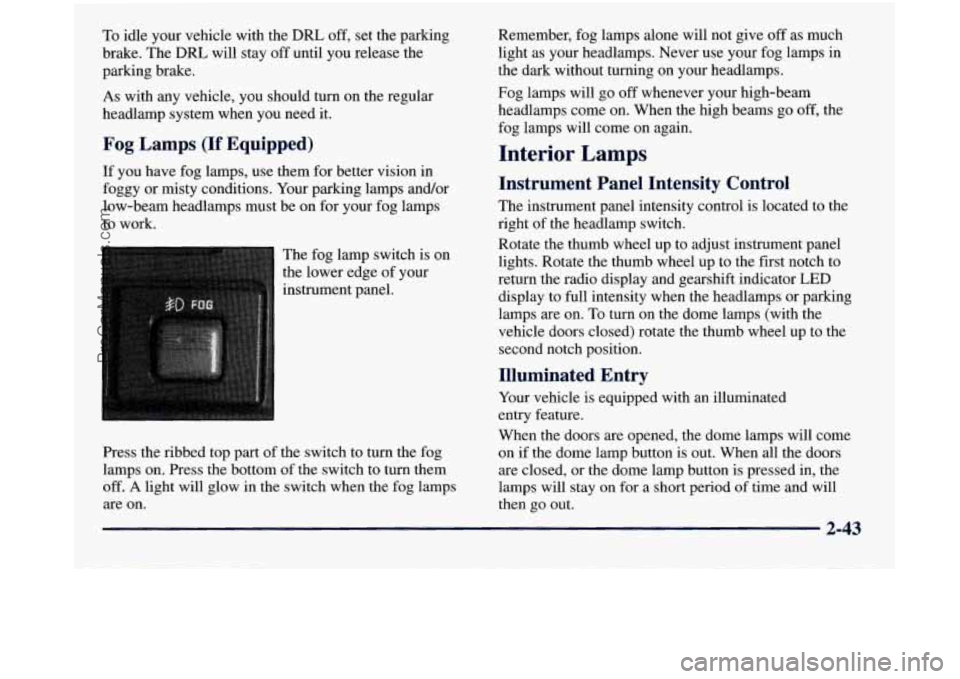
The fog lamp switch is on
the lower edge of your
instrument panel.
Press the ribbed top part of the switch to turn the fog
lamps on. Press
the bottom of the switch to turn them
off.
A light will glow in the switch when the fog lamps
are on. Remember,
fog lamps alone will not give off as much
light as your headlamps. Never use your fog lamps in
the dark without turning on your headlamps.
Fog lamps will go off whenever your high-beam
headlamps come on. When the high beams go
off, the
fog lamps will come on again.
Interior Lamps
Instrument Panel Intensity Control
The instrument panel intensity control is located to the
right of the headlamp switch.
Rotate the thumb wheel up to adjust instrument panel
lights. Rotate the thumb wheel up to the first notch to
return the radio display and gearshift indicator LED
display to full intensity when the headlamps or parking
lamps are on. To turn on the dome lamps (with the
vehicle doors closed) rotate the thumb wheel up to the second notch position.
Illuminated Entry
Your vehicle is equipped with an illuminated
entry feature.
When the doors are opened, the dome lamps will come
on if the dome lamp button is out. When all the doors
are closed, or the dome lamp button is pressed in, the
lamps will stay on for
a short period of time and will
then go out.
2-43
ProCarManuals.com
Page 128 of 452
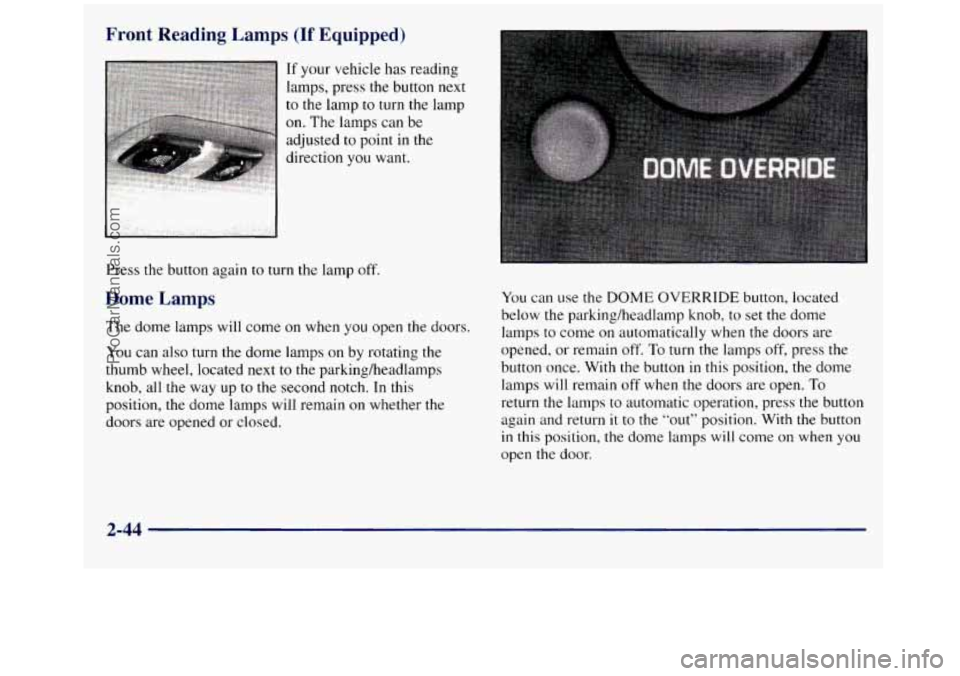
Front Reading Lamps (If Equipped)
If your vehicle has reading
lamps, press the button next
to the lamp to turn the lamp
on. The lamps can be
adjusted to point in the
direction you want.
Press the button again
to turn the lamp off.
Dome Lamps
The dome lamps will come on when you open the doors.
You can also turn the dome lamps on by rotating the
thumb wheel, located next
to the parking/headlamps
knob, all the way up to the second notch.
In this
position, the dome lamps will remain on whether the
doors are opened or closed. You
can use the
DOME OVERRIDE button, located
below the parking/headlamp knob, to set
the dome
lamps to come
on automatically when the doors are
opened, or remain off.
To turn the lamps off, press the
button once. With the button in this position,
the dome
lamps will remain off when the doors are open.
To
return the lamps to automatic operation, press the button
again and return
it to the “out” position. With the button
in this position, the dome lamps will come on when you
open the door.
2-44
ProCarManuals.com
Page 189 of 452
Section 4 Yoiir Driving and the Road
Here you’ll find information about driving on different kinds of roads and in varying weather conditions. We’ve also
included many other useful tips on driving.
4-
2
4- 2
4-5
4-6
4- 8
4-1
1
4-1 1
4- 13
4- 14
4-27
4-28
Defensive Driving Drunken Driving
Control of a Vehicle
Braking
Steering
Off-Road Recovery Passing
Loss of Control
Off-Road Driving with Your
Four-Wheel-Drive Vehicle
Driving at Night
Driving
in Rain and on Wet Roads 4-3
1
4-32
4-33
4-33
4-34
4-36 4-4
1
4-42
4-47
4-47
4-48 City Driving
Freeway Driving
Before Leaving
on a Long Trip
Highway Hypnosis
Hill and Mountain Roads
Winter Driving Recreational Vehicle Towing
Loading Your Vehicle
Camper Wiring Harness
(If Equipped)
Pickup Conversion
to Chassis Cab
Towing a Trailer
4-1
ProCarManuals.com