wheel GMC SIERRA 1998 Workshop Manual
[x] Cancel search | Manufacturer: GMC, Model Year: 1998, Model line: SIERRA, Model: GMC SIERRA 1998Pages: 452, PDF Size: 23.65 MB
Page 230 of 452
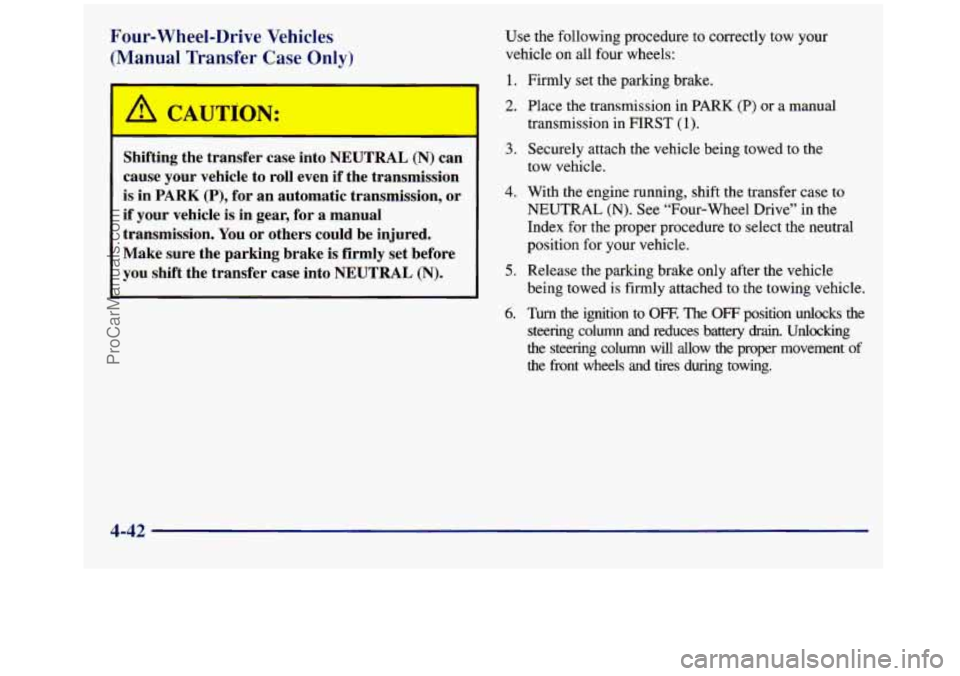
Four-Wheel-Drive Vehicles
(Manual Transfer Case Only)
‘A
-
Shifting the transfer case into NEUTRAL (N) can
cause your vehicle to roll even if the transmission
is in
PARK (P), for an automatic transmission, or
if your vehicle is in gear, for
a manual
transmission.
You or others could be injured.
Make sure the parking brake is firmly set before
you shift the transfer case into NEUTRAL (N).
Use the following procedure to correctly tow your
vehicle on all four wheels:
1.
2.
3.
4.
5.
6.
Firmly set the parking brake.
Place the transmission in
PARK (P) or a manual
transmission in FIRST
(1).
Securely attach the vehicle being towed to the
tow vehicle.
With the engine running, shift the transfer case to
NEUTRAL
(N). See “Four-wheel Drive” in the
Index for the proper procedure to select the neutral
position for your vehicle.
Release the parking brake only after the vehicle
being towed is firmly attached to the towing vehicle.
Turn the ignition to
OFF, The OFF position unlocks the
steering column and reduces battery
drain. Unlocking
the steering column will allow the proper movement
of
the front wheels and tires during towing.
4-42
ProCarManuals.com
Page 235 of 452
If your slide-in camper and its load weighs less than the
CWR, the center
of gravity zone for your vehicle may
be larger.
Your dealer can help you make a good vehicle-camper
match. He’ll also help
you determine your CWR.
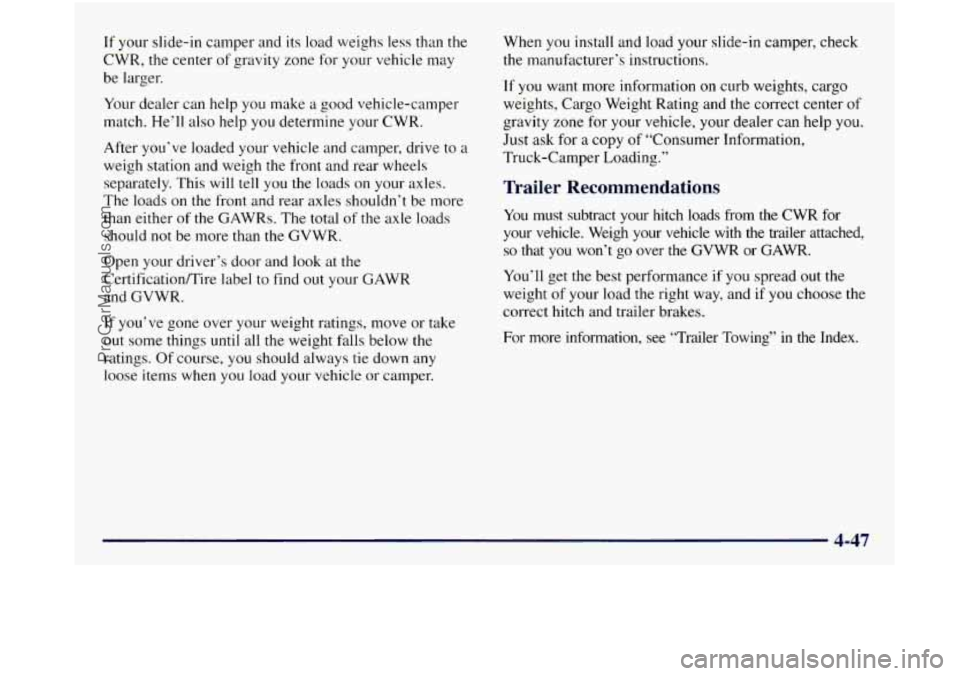
After you’ve loaded your vehicle and camper, drive to a
weigh station and weigh the front and rear wheels
separately. This will tell you
the loads on your axles.
The loads on the front and rear axles shouldn’t be more
than either of
the GAWRs. The total of the axle loads
should
not be more than the GVWR.
Open your driver’s door and look at the
CertificatiodTire label to find
out your GAWR
and GVWR.
If you’ve gone over your weight ratings, move or take
out some things until all the weight falls below the
ratings.
Of course, you should always tie down any
loose items when you load your vehicle or camper. When you
install and load your slide-in camper, check
the manufacturer’s instructions.
If you want more information
on curb weights, cargo
weights, Cargo Weight Rating and the correct center of
gravity zone for your vehicle, your dealer can help
you.
Just ask for a copy of “Consumer Information,
Truck-Camper Loading.”
Trailer Recommendations
You must subtract your hitch loads from the CWR for
your vehicle. Weigh your vehicle with the trailer attached,
so that you won’t go over the GVWR or GAWR.
You’ll get the best performance if you spread out the
weight
of your load the right way, and if you choose the
correct hitch and trailer brakes.
For more information, see “Trailer Towing”
in the Index.
4-47
ProCarManuals.com
Page 240 of 452
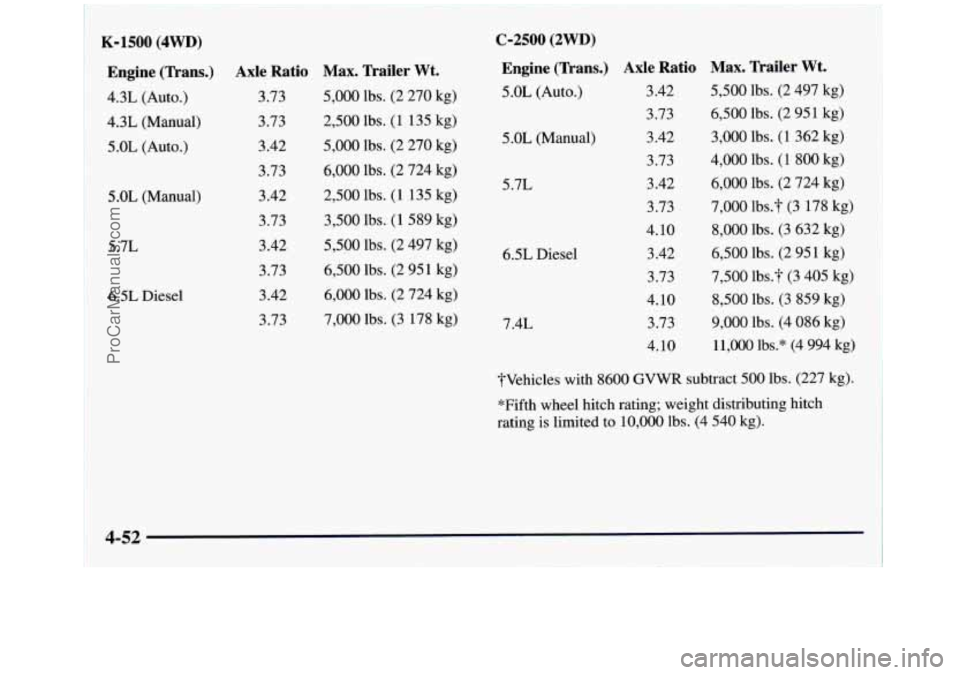
1 K-1500 (4WD)
~ Engine (Trans.) Axle Ratio 4.3L
(Auto.) 3.73
1 4.3L
(Manual)
i 5.0L (Auto.)
5
.OL (Manual)
5.7L 6.5L Diesel 3.73
3.42
3.73
3.42 3.73
3.42
3.73
3.42
3.73
Max. Trailer Wt.
5,000 lbs. (2 270 kg)
2,500 lbs. (1 135 kg)
5,000 lbs. (2 270 kg)
6,000 lbs. (2 724 kg)
2,500 lbs. (1 135 kg)
3,500 lbs. (1 589 kg)
5,500 lbs. (2 497 kg)
6,500 lbs. (2 951 kg)
6,000 lbs. (2 724 kg)
7,000 lbs. (3 178 kg) 5 .OL (Manual)
5.7L
6.5L Diesel
7.4L
C-2500 (2WD) Engine (Trans.) Axle Ratio
5.0L (Auto.) 3.42
3.73
3.42
3.73
3.42
3.73
4.10
3.42 3.73
4.10 3.73
4.10
Max. Trailer Wt.
5,500 lbs. (2 497 kg)
6,500 lbs. (2 951 kg)
3,000 lbs. (1 362 kg)
4,000 lbs. (1 800 kg)
6,000 lbs.
(2 724 kg)
7,000 lbs.3' (3 178 kg)
8,000 lbs. (3 632 kg)
6,500 lbs. (2 951 kg)
7,500 1bs.T (3
405 kg)
8,500 lbs. (3 859 kg)
9,000 lbs. (4 086 kg)
11,OOO lbs.* (4 994 kg)
?Vehicles with
8600 GVWR subtract 500 lbs. (227 kg).
*Fifth wheel hitch rating; weight distributing hitch
rating is limited to 10,000 lbs. (4 540 kg).
ProCarManuals.com
Page 241 of 452
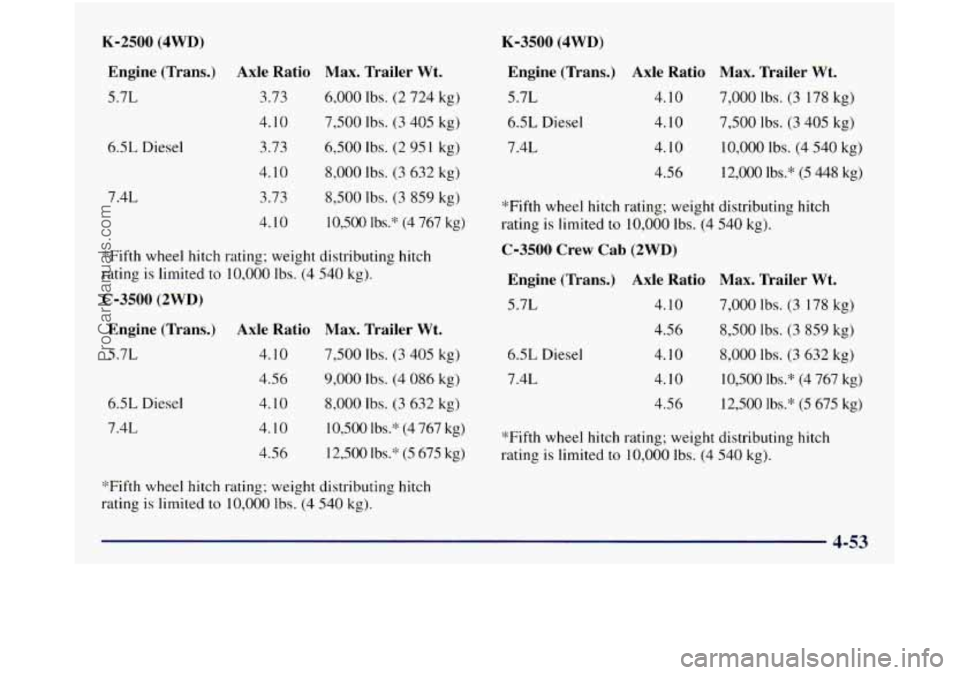
K-2500 (4WD)
Engine (Trans.) Axle Ratio Max. Trailer Wt.
5.7L 3.73 6,000 lbs. (2 724 kg)
3.73 6,500 Ibs.
(2 95 1 kg)
3.73
8,500 lbs. (3 859 kg)
4.10 10,500 lbs.* (4 767 kg)
4.10 7,500
lbs. (3 405 kg)
4.10 8,000 Ibs. (3 632 kg)
6.5L
Diesel
7.4L
*'Fifth wheel hitch rating; weight distributing hitch
rating is limited to 10,000 Ibs. (4 540 kg).
C-3500 (2WD)
6.5L Diesel
7.4L
Engine (Trans.) Axle Ratio Max. Trailer Wt.
5.7L 4.10 7,500 lbs. (3 405 kg)
4.56 9,000 lbs. (4 086 kg)
4.10
8,000 lbs. (3 632 kg)
4.10 10,500 lbs." (4 767 kg)
4.56 12,500 Ibs."
(5 675 kg)
"Fifth wheel hitch rating; weight distributing hitch
rating is limited
to 10,000 lbs. (4 540 kg).
K-3500 (4WD)
Engine (Trans.) Axle Ratio Max. Trailer Wt.
5.7L 4.10 7,000 lbs. (3 178 kg)
7.4L 4.10 10,000 lbs. (4 540 kg)
6.5L
Diesel 4.10 7,500 lbs. (3 405 kg)
4.56 12,000 lbs.* (5
448 kg)
*Fifth wheel hitch rating; weight distributing hitch
rating is limited to 10,000 Ibs. (4 540 kg).
C-3500 Crew Cab (2WD)
6.5L Diesel
7.4L
Engine (Trans.) Axle Ratio Max. Trailer Wt.
5.7L 4.10 7,000 lbs. (3 178 kg)
4.56 8,500 lbs.
(3 859 kg)
4.10 8,000 lbs.
(3 632 kg)
4.10 10,500
lbs." (4 767 kg)
4.56 12,500 lbs."
(5 675 kg)
*Fifth wheel hitch rating; weight distributing hitch
rating is limited to 10,000 Ibs. (4 540
kg).
4-53
ProCarManuals.com
Page 242 of 452
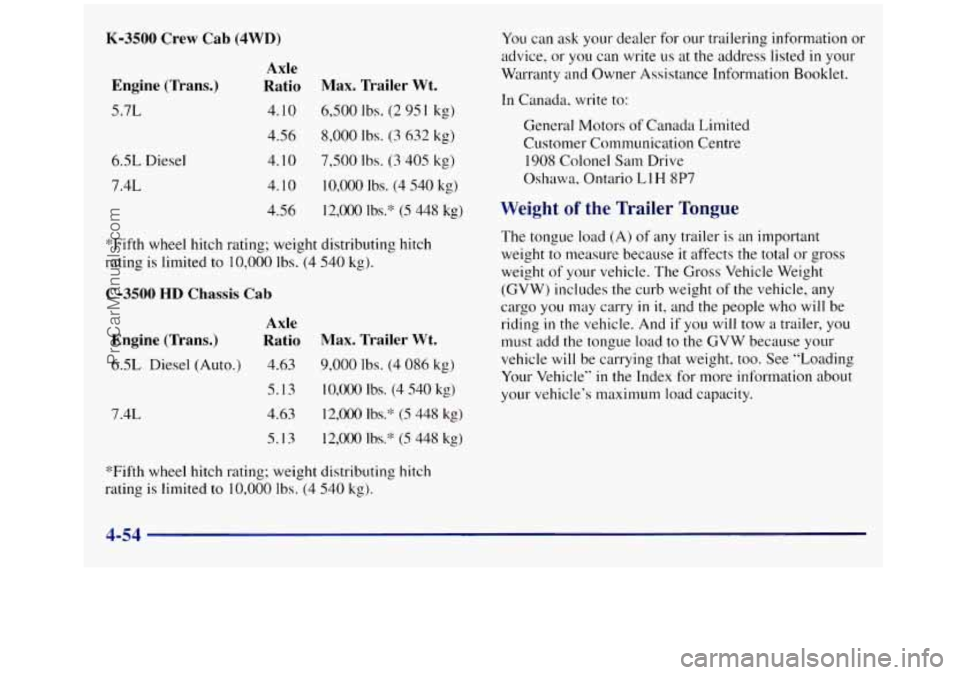
K-3500 Crew Cab (4WD)
Engine (Trans.)
5.7L
6.5L Diesel
7.4L
Axle
Ratio Max. Trailer Wt.
4.10 6,500 Ibs. (2 95 I kg)
4.56 8,000 lbs.
(3 ti32 kg)
4.10 7,500 Ibs.
(3 405 kg)
4.10
10,000 Ibs. (4 540 kg)
4.56 12,000
Ibs.'% (5 448 kg)
*Fifth wheel hitch rating; weight distributing hitch
rating is limited to
10,000 lbs. (4 540 kg).
C-3500 HD Chassis Cab
Engine (Trans.)
6.5L Diesel (Auto.)
7.4L
Axle
Ratio Max. Trailer Wt.
4.63 9,000 lbs. (4 084 kg)
5.1
3 10,OOO Ibs. (4 540 kg)
4.63
12,000 Ibs.'': (5 448 kg)
5.1
3 12,000 Ibs." (5 448 kg) You
can ask your dealer for
our trailering information or
advice, or you can write us at the address listed
in your
Warranty and Owner Assistance Information Booklet.
In Canada, write to:
General Motors of Canada Limited
Customer Communication Centre
1908 Colonel Sam Drive
Oshawa, Ontario
L1 H 8P7
Weight of the Trailer Tongue
The tongue load (A) of any trailer is an important
weight
to measure because it affects the total or gross
weight of your vehicle. The Gross Vehicle Weight
(GVW) includes the curb weight
of the vehicle, any
cargo you may carry
in it, and the people who will be
riding
in the vehicle. And if you will tow a trailer, you
must add the tongue load to
the GVW because your
vehicle will be carrying that weight, too. See "Loading
Your Vehicle"
in the Index for mot-e information about
your vehicle's maximum load capacity.
"Fifth wheel hitch rating; weight distributing hitch
rating is limited
to 10,000 lbs. (4 540 kg).
ProCarManuals.com
Page 245 of 452
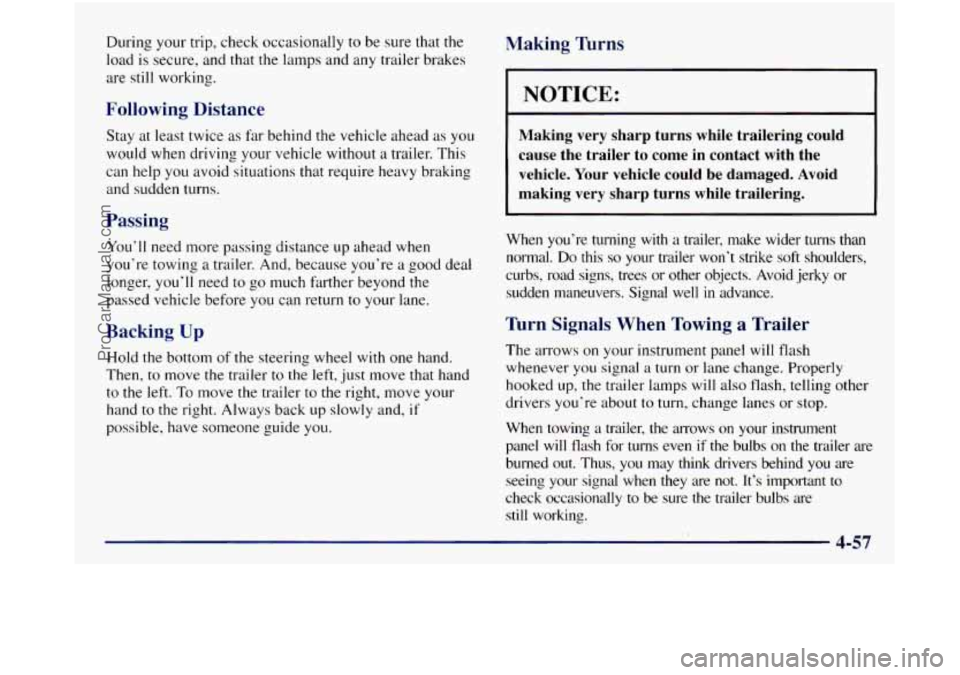
During your trip, check occasionally to be sure that the
load is secure, and that the lamps and any trailer brakes
are still working.
Following Distance
Stay at least twice as far behind the vehicle ahead as you
would when driving your vehicle without
a trailer. This
can help
you avoid situations that require heavy braking
and sudden turns.
Passing
You’ll need more passing distance up ahead when
you’re towing a trailer. And, because you’re a good deal
longer,
you’ll need to go much farther beyond the
passed vehicle before you can return to
your lane.
Backing Up
Hold the bottom of the steering wheel with one hand.
Then, to move the trailer
to the left, just move that hand
to the left.
To move the trailer to the right, move your
hand to the right. Always back up slowly and, if
possible, have someone guide you.
Making Turns
I NOTICE:
Making very sharp turns while trailering could
cause the trailer to come in contact with the
vehicle. Your vehicle could be damaged. Avoid
making very sharp turns while trailering.
When you’re turning with a trailer, make wider turns than
normal. Do this
so your trailer won’t strike soft shoulders,
curbs, road signs, trees or other objects. Avoid jerky or
sudden maneuvers. Signal well in advance.
Turn Signals When Towing a Trailer
The arrows on your instrument panel will flash
whenever
you signal a turn or lane change. Properly
hooked up, the trailer lamps will also flash, telling other
drivers you’re about to turn, change lanes or stop.
When towing a trailer, the arrows on your instrument
panel
will flash for turns even if the bulbs on the trailer are
burned out. Thus,
you may think drivers behind you are
seeing your signal when they are not. It’s important to
check occasionally
to be sure the trailer bulbs are
still working.
ProCarManuals.com
Page 246 of 452
Driving On Grades
Reduce speed and shift to a lower gear before you start
down a long or steep downgrade. If
you don’t shift
down,
you might have to use your brakes so much that
they would
get hot and no longer work well.
On a long uphill grade, shift down and reduce your
speed
to around 45 mph (70 kdh) to reduce the
possibility
of engine and transmission overheating.
If you have an automatic transmission, you can tow in
AUTOMATIC OVERDRIVE
(@). You may want to
shift the transmission
to THIRD (3) or, if necessary, a
lower gear selection
if the transmission shifts too often
(e.g., under heavy loads and/or hilly conditions).
If
you have a manual transmission and you are towing a
trailer, it’s better not to
use FIFTH (5) gear. Just drive in
FOURTH
(4) gear (or, as you need to, a lower gear).
When towing at high altitude
on steep uphill grades,
consider the following: Engine coolant
will boil at a
lower temperature than at normal altitudes. If you turn
your engine off immediately after towing
at high altitude
on steep uphill grades, your vehicle may show signs
similar to engine overheating. To avoid this, let the
engine run while parked (preferably on level ground) with
the automatic transmission in
PARK (P) (or the
manual transmission out of gear and the parking brake
applied) for a few minutes before turning the engine
off.
If you do get the overheat warning, see “Engine
Overheating’’ in
the Index.
Parking on Hills
You really should not park your vehicle, with a trailer
attached, on a
hill. If something goes wrong, your rig
could start to move. People can be injured, and both
your vehicle and the trailer can be damaged.
But
if you ever have to park your rig on a hill, here’s
how to do it:
1.
2.
3.
4.
Apply your regular brakes, but don’t shift into
PARK
(P) yet for an automatic transmission, or into
gear for a manual transmission.
Have someone place chocks under the trailer wheels.
When the wheel chocks are
in place, release the
regular brakes until the chocks absorb the load.
Reapply the regular brakes. Then apply your parking brake and
shift into PARK (P) for an automatic
transmission, or REVERSE (R)
for a manual
transmission.
4-58
ProCarManuals.com
Page 247 of 452
5. If you have a four-wheel-drive vehicle,
be sure the transfer case is in
a drive gear and not
in
NEUTRAL (N).
6. Release the regular brakes.
-
/r CAUTIOIA:
It can be dangerous to get out of your vehicle if
the shift lever is not fully in
PARK (P) with the
parking brake firmly set. Your vehicle can roll.
If you have left the engine running, the vehicle
can move suddenly. You or others could be
injured.
To be sure your vehicle won’t move, even
when you’re on fairly level ground, use the steps
that follow.
If you have four-wheel drive and your transfer
case is in
NEUTRAL (N), your vehicle will be free
to
roll, even if your shift lever is in PARK (P). So,
be sure the transfer case is in a drive gear -- not
in
NEUTRAL (N).
When You Are Ready to Leave After
Parking
on a Hill
1. Apply your regular brakes and hold the pedal down
while you:
Start your engine;
Shift into a gear; and
Release the parking brake.
2. Let up on the brake pedal.
3. Drive slowly
until the trailer is clear of the chocks.
4. Stop and have someone pick up and store the chocks.
Maintenance When Trailer Towing
Your vehicle will need service more often when you’re
pulling
a trailer. See the Maintenance Schedule for more
on this. Things that are especially important
in trailer
operation are automatic transmission fluid (don’t
overfill), engine
oil, axle lubricant, belt, cooling system
and brake adjustment. Each of these is covered in this
manual, and the Index will help you find them quickly.
If you’re trailering, it’s a good idea to review these
sections before
you start your trip.
Check periodically
to see that all hitch nuts and bolts
are tight.
ProCarManuals.com
Page 249 of 452
Power Winches
If you wish to use a power winch on your vehicle, only
use
it when your vehicle is stationary or anchored.
I NOTICE:
Using a power winch with the transmission in
gear may damage the transmission. When
operating
a power winch, always leave the
transmission in NEUTRAL
(N).
Use the regular brakes, set the parking brake, or block
the wheels
to keep your vehicle from rolling.
Power Take-Off (PTO)
(Manual Transmission)
NOTICE:
If you have a PTO that will exceed 35 hp installed
on your vehicle, it could damage the transfer case
or transmission. When having
a PTO installed on
your vehicle, make sure that it will not exceed
35 hp.
Before using
a PTO, refer to the manufacturer’s or
installer’s instructions.
I NOTICE:
Using a PTO while operating in one place before
the vehicle has reached normal operating
temperature can damage the transfer case or
transmission. If you
will be using the PTO while
operating in one place, drive and warm up the
vehicle before using the PTO.
4-61
ProCarManuals.com
Page 250 of 452
To engage a PTO:
1. Hold the clutch pedal down.
2. Set the parking brake.
3. Shift the transmission into NEUTRAL (N).
4. Engage the PTO.
NOTICE:
Using a PTO for more than four hours without
driving your vehicle can damage the transfer case
or transmission. If using a
PTO for more than
four hours without driving your vehicle, drive
your vehicle for a while to allow the transfer case
and transmission to cool.
If you are going to drive the vehicle, shift the
transfer case into the range you want
(if you have
four-wheel drive). Then shift
the transmission into
the gear you want, apply the regular brakes and
release the parking brake.
5. Release the clutch (and the regular brakes) as you
normally would. When
you release the clutch, the
PTO will start.
To engage a PTO while the vehicle is moving:
1. Hold the clutch pedal down.
2. Shift the transmission into NEUTRAL (N).
3. Engage the PTO.
4. Shift the transmission into the gear you want.
5. Release the clutch as you normally would. When you
release the clutch, the
PTO will start.
Using a Transfer Case Mounted Power
Take-Off (Manual Transmission)
1.
2.
3.
4.
5.
6.
Hold the clutch pedal down.
Set the parking brake.
Shift
the transfer case into NEUTRAL (N).
If the vehicle will remain in the same place, shift the
transmission into
the highest gear.
Engage the PTO.
If you are going to drive the vehicle, shift the
transmission into the gear you want. Then shift the
transfer case into the range you want, apply the
regular brakes and release the parking brake.
Release the clutch (and the regular brakes) as
you
normally would. When you release the clutch, the
PTO will start.
4-62
ProCarManuals.com