tow GMC SIERRA 1998 Workshop Manual
[x] Cancel search | Manufacturer: GMC, Model Year: 1998, Model line: SIERRA, Model: GMC SIERRA 1998Pages: 452, PDF Size: 23.65 MB
Page 263 of 452
5. Put the transfer case in NEUTRAL (N). See
“Four-wheel Drive” in the Index
for the proper
procedure to select NEUTRAL
(N).
6. When the vehicle is hooked up, release the
parking brake.
4. Put the transmission in NEUTRAL (N).
5. Put the transfer case in 2 High (2HI).
6. When the vehicle is hooked up, release the
parking brake.
Four- Wheel Drive-Vehicles (Electronic
Transfer Case)
Tow Limits -- 35 mph (55 krdh), 50 miles (80 krn/l1)
If your vehicle is four-wheel drive with an electronic
transfer case, use the following directions:
1. Engage the parking brake.
2. Turn the ignition key to OFF.
3. Clamp the steering wheel in a straight-ahead position
with a clamping device designed for towing service.
(Do not use the vehicle’s steering column lock for this.)
NOTICE:
If your vehicle is equipped with an electronic
transfer case and the tow limits must be
exceeded, a towing dolly must be used under the rear wheels or vehicle/powertrain damage
will occur.
5-11
ProCarManuals.com
Page 264 of 452
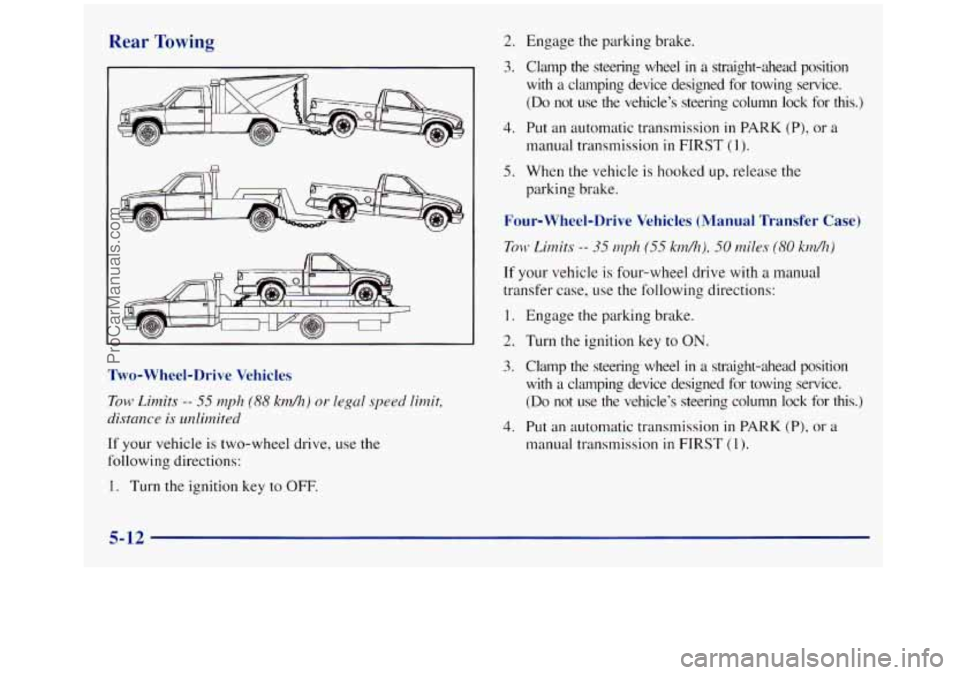
Rear Towing
Two-Wheel-Drive Vehicles
Tow Limits -- 55 ~zph (88 krdh) or legal speed limit,
distmce is ditnited
If your vehicle is two-wheel drive, use the
following directions:
1. Turn the ignition key to OFF.
2.
3.
4.
5.
Engage the parking brake.
Clamp the steering wheel in a straight-ahedd position
with a clamping device designed for towing service.
(Do not use the vehicle’s steering column lock for this.)
Put an automatic transmission
in PARK (P), or a
manual transmission in FIRST (1).
When the vehicle is hooked up, release the
parking brake.
Four-Wheel-Drive Vehicles (Manual Transfer Case)
If your vehicle is four-wheel drive with a manual
transfer case, use the following directions:
1.
2.
3.
4.
Engage the parking brake.
Turn the ignition
key to ON.
Clamp the steering wheel in a straight-ahead position
with a clamping device designed for towing service.
(Do not use the vehicle’s steering column lock for this.)
Put an automatic transmission
in PARK (P), or a
manual transmission in FIRST (1).
5-12
ProCarManuals.com
Page 265 of 452
5. Put the transfer case in NEUTRAL (N). See
“Four-Wheel Drive’’
in the Index for the proper
procedure to select NEUTRAL
(N).
6. When the vehicle is hooked up. release the
parking brake.
7. Turn the ignition key to OFF.
Four- Wheel-Drive Vehicles (Electronic
Transfer Case)
Eml Limits -- 35 mph (55 km/JZ), 50 milc?s (80 kndh)
If your vehicle is four-wheel drive with an electronic
transfer case, use the following directions:
I. Engage the parking brake.
2. Turn the ignition key to ON.
3. Clamp the steering wheel in a straight-ahead position
with
a clamping device designed for towing service.
(Do not use the vehicle’s steering column lock for this.)
4. Put the transmission in NEUTRAL (N).
5. Put the transfer case in 2 High (2HI).
6. When the vehicle is hooked up, release the
parking brake.
7. Turn the ignition key to OFF.
NOTICE:
If your vehicle is equipped with four-wheel drive
and the towing limits must be exceeded, a towing
dolly must be used under the front wheels or
vehicle/powertrain damage will occur.
I NOTICE:
Towing pickup models from the rear while loaded
with heavy cargo may cause the frame side rails
to flex sufficiently to allow the pickup box to
contact the cab and could cause damage to the
cab and/or box.
Engine Overheating (Gasoline Engine)
You will find a coolant temperature gage on your
vehicle’s instrument panel. See “Engine Coolant
Temperature Gage”
in the Index.
If your vehicle has a diesel engine, see “Engine
Overheating”
in the Diesel Engine Supplement.
5-13
ProCarManuals.com
Page 266 of 452
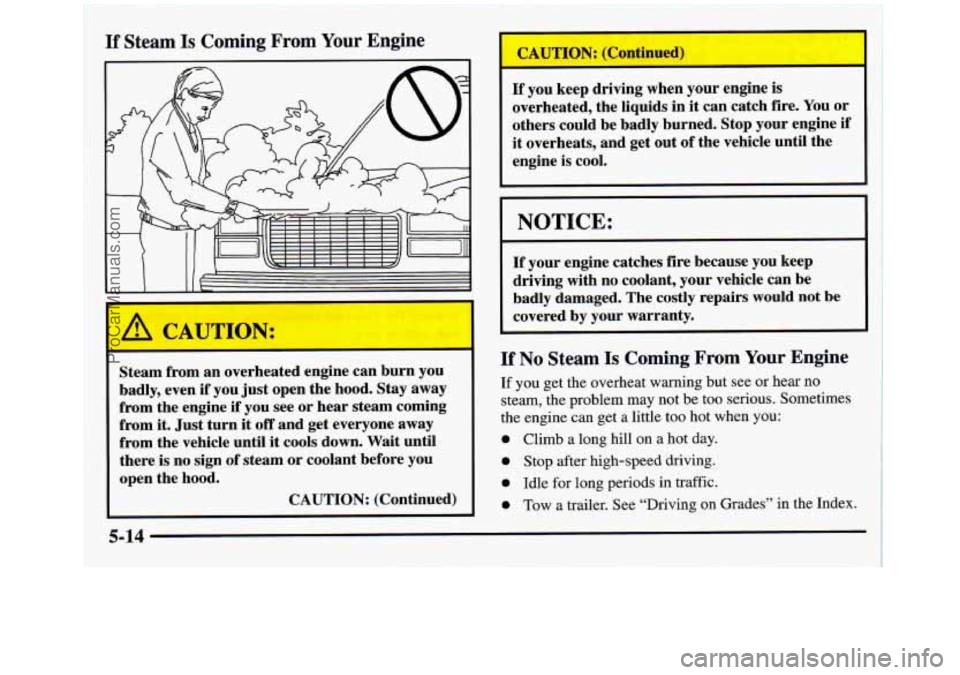
If Steam Is Coming From Your Engine
I
Steam from an overheated engine can burn you
badly, even if you just open the hood. Stay away
from the engine
if you see or hear steam coming
from it. Just turn
it off and get everyone away
from the vehicle until it cools down. Wait until
there is no sign of steam or coolant before you
open the hood.
CAUTION: (Continued)
I
If you keep driving when your engine is
overheated, the liquids in
it can catch fire. You or
others could be badly burned. Stop your engine if
it overheats, and get out
of the vehicle until the
engine is cool.
NOTICE:
If your engine catches fire because you keep
driving with no coolant, your vehicle can be
badly damaged. The costly repairs would not be
covered by your warranty.
If No Steam Is Coming From Your Engine
If you get the overheat warning but see or hear no
steam, the problem may not be too serious. Sometimes
the engine can get a little
too hot when you:
0 Climb a long hill on a hot day.
0 Stop after high-speed driving.
0 Idle for long periods in traffic.
0 Tow a trailer. See “Driving on Grades” in the Index.
5-14
ProCarManuals.com
Page 275 of 452
Engine Fan Noise If a Tire Goes Flat
Your vehicle has a clutched engine cooling fan. When
the clutch is engaged, the fan spins faster to provide
more air to cool the engine.
In most everyday driving
conditions, the fan is spinning slower and the clutch
is
not fully engaged. This improves fuel economy and
reduces fan noise. Under heavy vehicle loading. trailer
towing and/or high outside temperatures, the fan speed
increases as the clutch more
fully engages. So you may
hear an increase
in fan noise. This is normal and should
not be mistaken as the transmission slipping or making
extra shifts.
It is merely the cooling system functioning
properly. The fan
will slow down when additional
cooling
is not required and the clutch disengages.
You may
also hear this fan noise when you start
the engine.
It will go away as the fan clutch
partially disengages. It‘s
unusual for
a tire to “blow out’’ while you’re driving,
especially if you maintain your tires properly.
If air goes
out of a tire, it’s much more likely to leak out slowly.
But if you should ever have a “blowout,” here are a
few tips about what to expect and what to do:
If a front tire hils, the flat tire will create a drag that
pulls the vehicle toward that side. Take your foot off the
accelerator pedal and grip the steering wheel firmly.
Steer to maintain lane position, and then gently brake to
a stop well out of the traffic lane.
A rear blowout, particularly on a curve, acts much like a
skid and may require the same correction you’d use in
a skid. In any rear blowout, remove your foot from
the accelerator pedal. Get
the vehicle under control by
steering the way you want the vehicle to go.
It may be
very bumpy and noisy, but you can still steer. Gently
brake to
a stop -- well off the road if possible.
If a tire goes flat, the next part shows how to use your
jacking equipment to change a flat tire safely.
5-23
ProCarManuals.com
Page 283 of 452
I I
Rust or dirt on the wheel, or on the parts to
which it is fastened, can make the wheel nuts
become loose after a time. The wheel could come
off and cause an accident. When you change
a
wheel, remove any rust or dirt from the places
where the wheel attaches to the vehicle.
In an
emergency, you can use a cloth or
a paper towel
to do this; but be sure to use
a scraper or wire
brush later,
if you need to, to get all the rust or
dirt off.
Never use oil or grease on studs or nuts.
If you
do, the nuts might come loose. Your wheel could
fall off, causing
a serious accident.
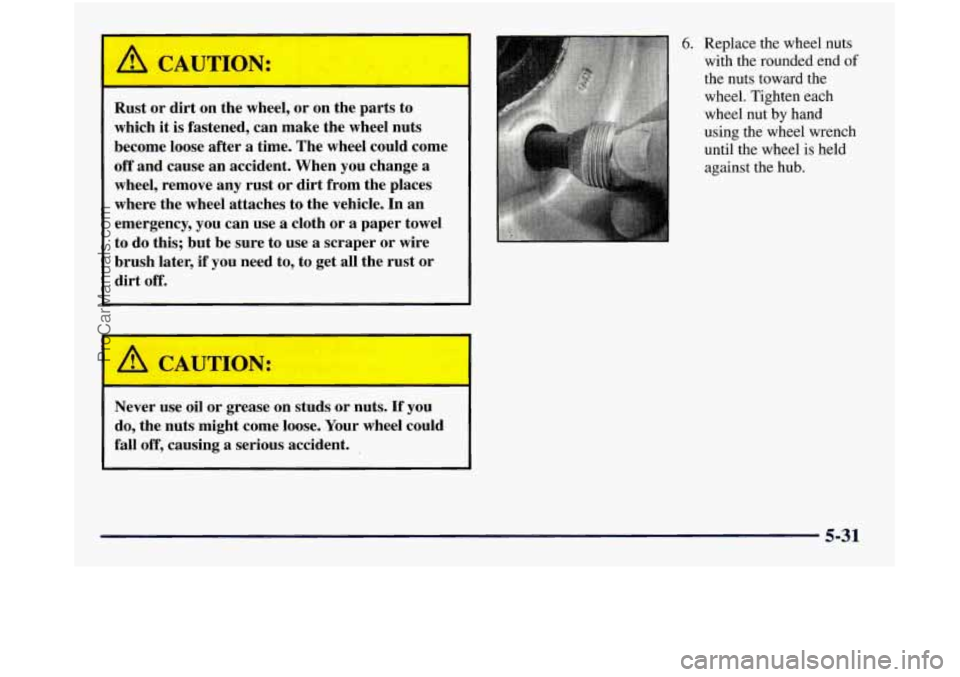
6. Replace the wheel nuts
with the rounded end
of
the nuts toward the
wheel. Tighten each
wheel nut by hand
using the wheel wrench
until the wheel
is held
against the hub.
5-31
ProCarManuals.com
Page 289 of 452
NOTICE:
Spinning your wheels can destroy parts of your
vehicle as well as the tires. If you spin the wheels
too fast while shifting your transmission back
and forth,
you can destroy your transmission. I
For information about using tire chains on your vehicle,
see “Tire Chains”
in the Index.
Rocking Your Vehicle To Get It Out
First, turn your steering wheel left and right. That will
clear the area around your front wheels. If
you have a
four-wheel drive vehicle, shift into
4HI. Then shift back
and forth between
REVERSE (R) and a forward gear
(or with a manual transmission, between FIRST
(1) or
SECOND (2) and REVERSE (R)), spinning the wheels
as little as possible. Release the accelerator pedal while
you shift, and press lightly on the accelerator pedal
when the transmission is
in gear. If that doesn’t get
you out after a few tries, you may need to be towed out.
Or,
you can use your recovery hooks if your vehicle has
them.
If you do need to be towed out, see “Towing
Your Vehicle”
in the Index.
Using the Recovery Hooks
Your vehicle may be equipped with recovery hooks.
The recovery hooks are provided
at the front of your
vehicle.
You may need to use them if you’re stuck
off-road and need to be pulled to some place where
you can continue driving.
5-37
ProCarManuals.com
Page 290 of 452
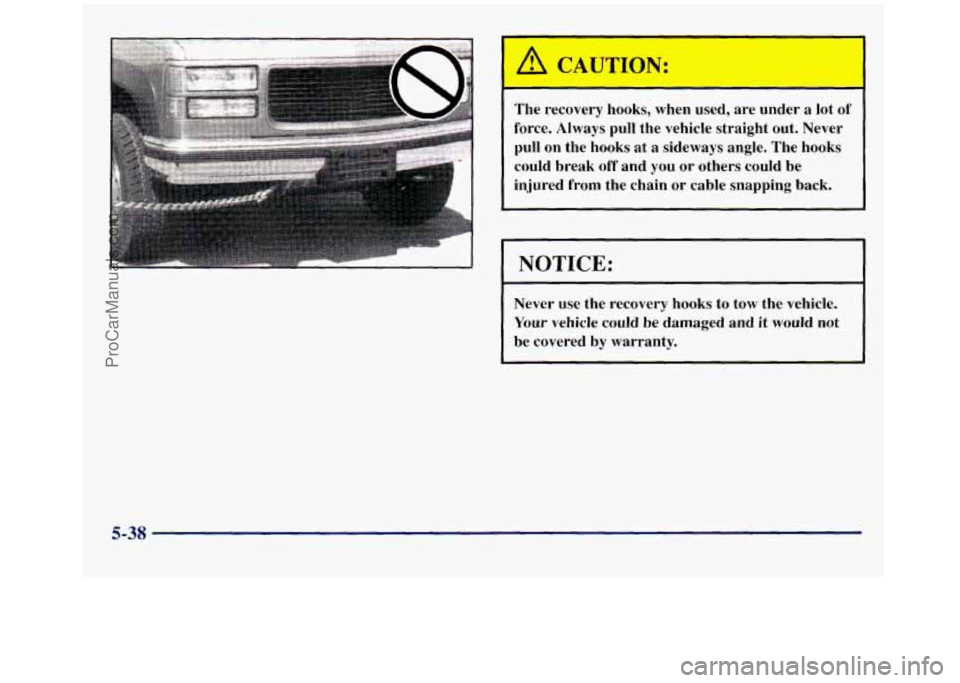
The recovery hooks, when used, are under a lot of
force. Always pull the vehicle straight out. Never
pull on the hooks at
a sideways angle. The hooks
could break off and you or others could be
injured from the chain or cable snapping back.
NOTICE:
Never use the recovery hooks to tow the vehicle.
Your vehicle could be damaged and
it would not
be covered
by warranty.
5-38
ProCarManuals.com
Page 304 of 452
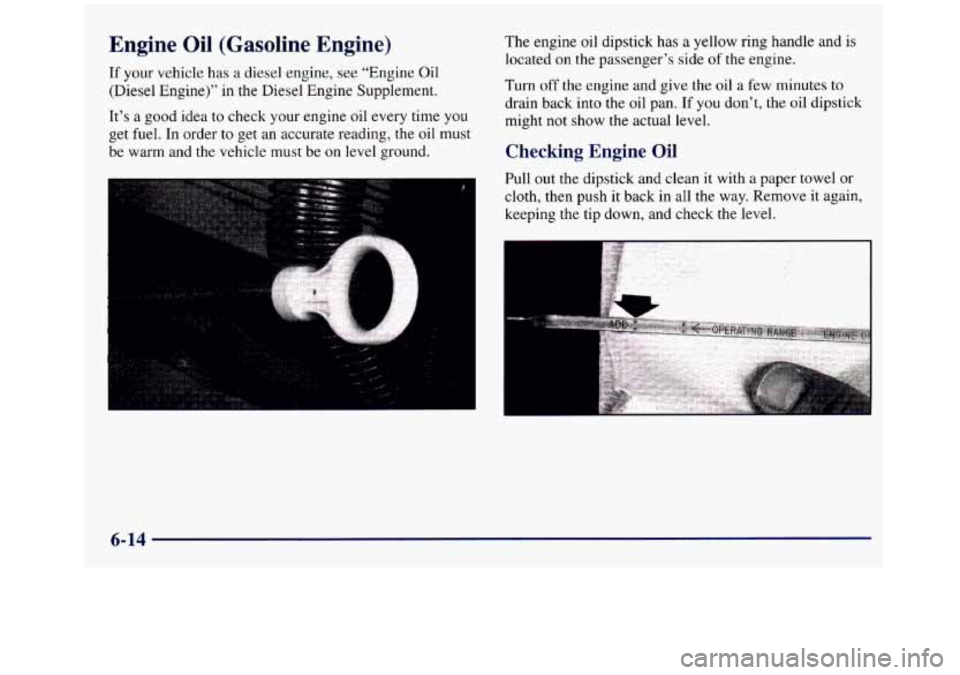
Engine Oil (Gasoline Engine)
If your vehicle has a diesel engine, see “Engine Oil
(Diesel Engine)” in the Diesel Engine Supplement.
It’s
a good idea to check your engine oil every time you
get fuel. In order to get an accurate reading, the
oil must
be warm and the vehicle
must be on level ground.
.. ..
The engine oil dipstick has a yellow ring handle and is
located
on the passenger’s side of the engine.
Turn
off the engine and give the oil a few minutes to
drain back into
the oil pan. If you don’t, the oil dipstick
might not show the actual
level.
Checking Engine Oil
Pull out the dipstick and clean it with a paper towel or
cloth, then push it back in all the way. Remove it again,
keeping the tip down, and check the level.
u
6-14
ProCarManuals.com
Page 307 of 452
As shown in the chart, SAE 5W-30 is best for your
vehicle. However,
you can use SAE 1OW-30 if it’s going
to be
0°F (- 18 “C) or above. These numbers on an oil
container show
its viscosity, or thickness. Do not use
other viscosity oils, such
as SAE 20W-50.
NOTICE:
Use only engine oil with the American Petroleum
Institute Certified For Gasoline Engines “Starburst” symbol. Failure to use the
recommended oil can result in engine damage not
covered by your warranty.
GM Goodwrench@ oil meets all the requirements for
your vehicle.
If you are in an area where the temperature falls below
-20°F (-29°C)’ consider using either an SAE 5W-30
synthetic oil or an
SAE OW-30 oil. Both will provide
easier cold starting and better protection for your engine
at extremely low temperatures.
Engine Oil Additives
Don’t add anything to your oil. Your dealer is ready to
advise if
you think something should be added.
When to Change Engine Oil
If any one of these is true for you, use the short tripkity
maintenance schedule:
Most trips are less than 5 to 10 miles (8 to 16 km).
This is particularly important when outside
temperatures are below freezing.
Most trips include extensive idling (such as frequent
driving
in stop-and-go traffic).
You operate your vehicle in dusty areas or
off-road frequently.
You frequently tow a trailer.
The vehicle is used for delivery service, police, taxi
or other commercial application.
Driving under these conditions causes engine
oil to
break down sooner.
If any one of these is true for your
vehicle,
then you need to change your oil and filter
every
3,000 miles (5 000 km) or 3 months -- whichever
occurs first.
If none of them is true, use the long trip/highway
maintenance schedule. Change the oil and filter every
7,500 miles (12 500 km) or 12 months -- whichever
occurs first. Driving a vehicle with
a fully warmed
engine under highway conditions causes engine
oil to
break down slower.
6-S7
ProCarManuals.com