light GMC SIERRA 1998 Repair Manual
[x] Cancel search | Manufacturer: GMC, Model Year: 1998, Model line: SIERRA, Model: GMC SIERRA 1998Pages: 452, PDF Size: 23.65 MB
Page 257 of 452
I
Using a match near a battery can cause battery
gas to explode. People have been hurt doing this,
and some have been blinded. Use a flashlight
if
you need more light.
Be sure the batteries have enough water. You
don’t need to add water to the ACDelco
Freedom@ battery (or batteries) installed in
every new
GM vehicle. But if a battery has filler
caps, be sure the right amount of fluid is there.
If
it is low, add water to take care of that first. If
you don’t, explosive gas could be present.
Battery fluid contains acid that can burn you.
Don’t get it on you.
If you accidentally get it in
your eyes or on your skin, flush the place with
water and get medical help immediately.
5. Check that the jumper cables don’t have loose or
missing insulation.
If they do, you could get a shock.
The vehicles could be damaged too.
Before you connect the cables, here are some
basic things
you should know. Positive (+) will
go to positive
(+) and negative (-) will go to a
metal engine part. Don’t connect positive
(+) to
negative
(-) or you’ll get a short that would
damage the battery and maybe other parts
too.
On vehicles equipped with dual batteries, make any
battery connections
to the primary battery located on
the passenger’s side of the vehicle.
Fans or other moving engine parts can injure you
badly. Keep your hands
away from moving parts
once the engine is running.
5-5
ProCarManuals.com
Page 289 of 452
NOTICE:
Spinning your wheels can destroy parts of your
vehicle as well as the tires. If you spin the wheels
too fast while shifting your transmission back
and forth,
you can destroy your transmission. I
For information about using tire chains on your vehicle,
see “Tire Chains”
in the Index.
Rocking Your Vehicle To Get It Out
First, turn your steering wheel left and right. That will
clear the area around your front wheels. If
you have a
four-wheel drive vehicle, shift into
4HI. Then shift back
and forth between
REVERSE (R) and a forward gear
(or with a manual transmission, between FIRST
(1) or
SECOND (2) and REVERSE (R)), spinning the wheels
as little as possible. Release the accelerator pedal while
you shift, and press lightly on the accelerator pedal
when the transmission is
in gear. If that doesn’t get
you out after a few tries, you may need to be towed out.
Or,
you can use your recovery hooks if your vehicle has
them.
If you do need to be towed out, see “Towing
Your Vehicle”
in the Index.
Using the Recovery Hooks
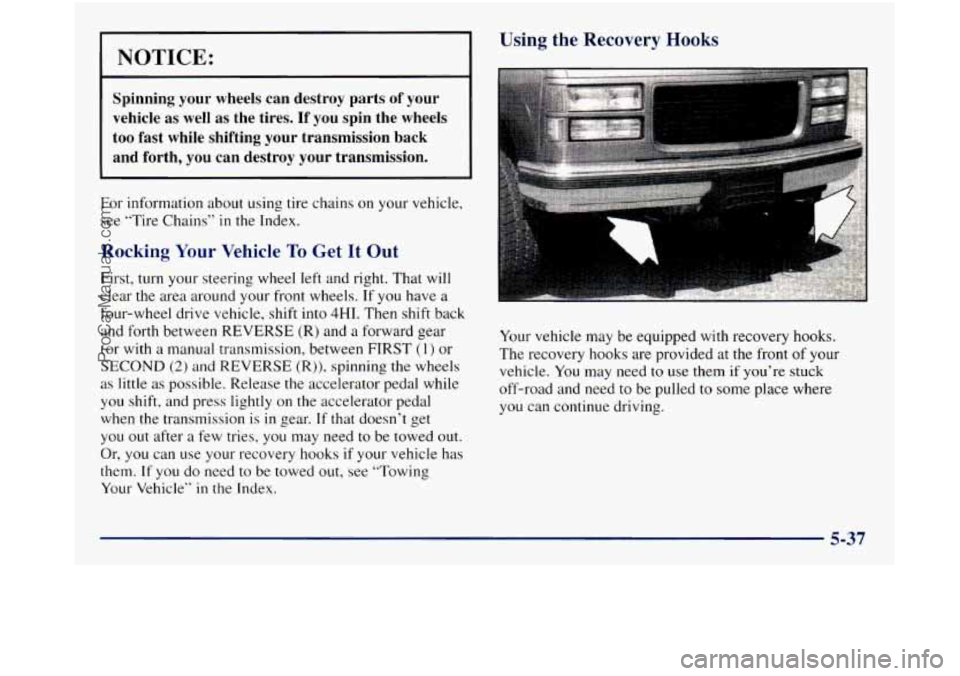
Your vehicle may be equipped with recovery hooks.
The recovery hooks are provided
at the front of your
vehicle.
You may need to use them if you’re stuck
off-road and need to be pulled to some place where
you can continue driving.
5-37
ProCarManuals.com
Page 298 of 452
~ Be
careful not to spill gasoline. Clean gasoline from
~ painted surfaces as soon as possible. See “Cleaning the
i Outside of Your Vehicle” in the Index.
When you put
the cap back on, turn it to the right
(clockwise)
until you hear a clicking sound. Make sure you
fully install the cap. The diagnostic system can determine if
the fuel cap has been left off or improperly installed. This
would allow fuel to evaporate into the atmosphere. See
“Malfunction Indicator Lamp”
in the Index.
NOTICE:
If you need a new cap, be sure to get the right
type. Your dealer can get one for you. If you get
the wrong type, it may not
fit properly. This may
cause your malfunction indicator lamp to light
and your fuel tank and emissions system may be
damaged. See ‘LMalfunction Indicator Lamp” in
the Index.
Filling a Portable Fuel Container
Never fill a portable fuel container while it is in
your vehicle. Static electricity discharge from the
container can ignite the gasoline vapor. You can
be badly burned and your vehicle damaged
if this
occurs.
To help avoid injury to you and others:
Dispense gasoline only into
approved containers.
Do not fill a container while it is inside a
vehicle, in
a vehicle’s trunk, pickup bed or
on any surface other than the ground.
inside of the
fill opening before operating
the nozzle. Contact should be maintained
until the filling is complete.
0 Bring the fill nozzle in contact with the
0 Don’t smoke while pumping gasoline.
6-8
I
ProCarManuals.com
Page 315 of 452
How to Add Fluid
Here’s how to add fluid. Refer to the Maintenance
Schedule to determine what kind of fluid to use. See
”Recommended Fluids and Lubricants”
in the Index.
1. Remove the filler plug.
2. Add fluid at the filler plug hole. Add only enough
fluid to bring the tluid level up to the bottom of the
filler plug hole.
3. Install the filler plug.
Be sure the plug is fully seated.
Hydraulic Clutch
The hydraulic clutch system in your vehicle is
self-adjusting. A slight amount of play (1/4 inch to
1/2 inch or 6 lnm to 12 mm) in the pedal is normal.
It isn‘t a good idea to “top off’ your clutch fluid. Adding
fluid won’t correct a leak.
A fluid loss in this system could
indicate a problem. Have
the system inspected and repaired.
When to Check and What to Use
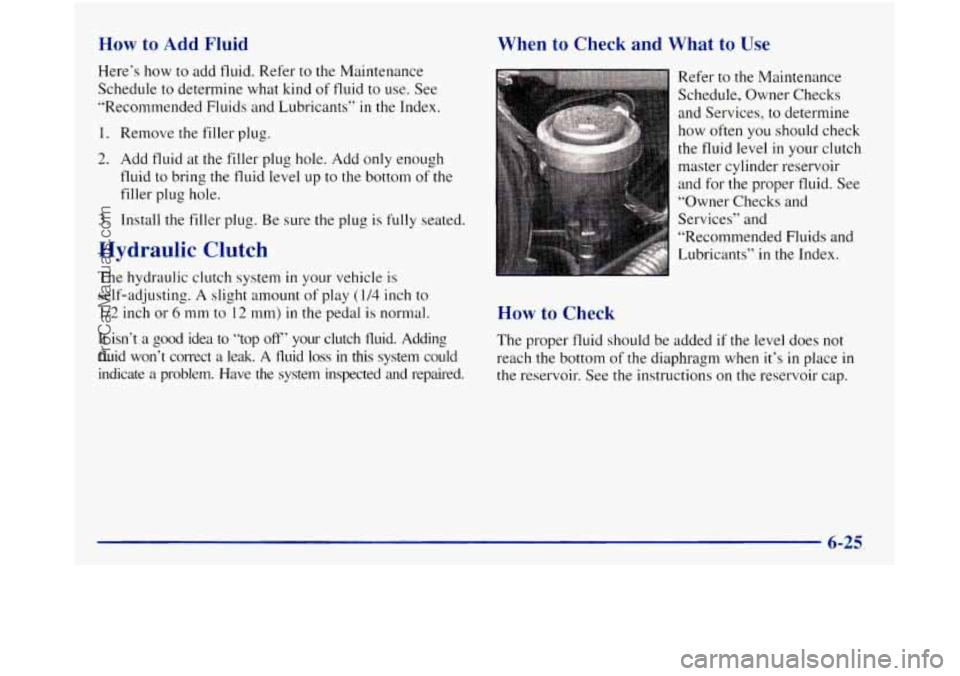
Refer to the Maintenance
Schedule, Owner Checks
and Services,
to determine
how often you should check
the fluid level
in your clutch
master cylinder reservoir
and for the proper fluid. See
“Owner Checks and
Services” and
“Recommended Fluids and
Lubricants” in the Index.
How to Check
The proper fluid should be added if the level does not
reach the bottom
of the diaphragm when it’s in place in
the reservoir. See the instructions on the reservoir cap.
6-25
ProCarManuals.com
Page 328 of 452
Some driving conditions or climates may cause a brake
squeal when the brakes are first applied or lightly
applied. This does
not mean something is wrong with
your brakes.
Properly torqued wheel
nuts are necessary to help
prevent brake pulsation. When tires are rotated, inspect
brake pads for wear and evenly torque wheel nuts
in the
proper sequence to
GM specifications.
If you have rear drum brakes, they don‘t have wear
indicators, but if you ever hear a rear brake rubbing
noise, have the rear brake linings inspected immediately. Also, the rear brake drums should be removed and
inspected each time the tires are removed for rotation
or
changing. When you have the front brake pads replaced,
have the rear brakes inspected, too.
Brake linings should always be replaced as complete
axle sets.
See “Brake System Inspection”
in Section 7 of this manual
under
Part C “Periodic Maintenance Inspections.”
Brake Pedal Travel
See your dealer if the brake pedal does not return to
normal height, or
if there is a rapid increase in pedal
travel. This could be a sign of brake trouble.
Brake Adjustment
Every time you make a brake stop, your disc brakes
adjust for wear.
If your brake pedal goes down farther than normal, your
rear drum brakes may need adjustment. Adjust them by
backing
up and firmly applying the brakes a few times.
Replacing Brake System Parts
The braking system on a modern vehicle is complex. Its
many parts have to be
of top quality and work well
together if the vehicle is to have really good braking.
Your vehicle was designed and tested
with top-quality
GM brake parts. When you replace parts of your braking
system
-- for example, when your brake linings wear
down and you have
to have new ones put in -- be sure
you get new approved
GM replacement parts. If you
don’t,
your brakes may no longer work properly. For
example,
if someone puts in brake linings that are wrong
for your vehicle, the balance between your front and
rear brakes can change
-- for the worse. The braking
performance you’ve come
to expect can change in many
other ways
if someone puts in the wrong replacement
brake parts.
6-38
ProCarManuals.com
Page 348 of 452
While the tires available on General Motors passenger
cars and light trucks may vary with respect to these
grades, they must also conform to Federal safety
requirements and additional General Motors Tire
Performance Criteria (TPC) standards.
Treadwear
The treadwear grade is a comparative rating based on
the wear rate of the tire when tested under controlled
conditions on a specified government test course. For
example, a tire graded 150 would wear one and a half
(1 1/2) times as well on the government course as a tire
graded
100. The relative performance of tires depends
upon the actual conditions of their use, however, and
may depart significantly from the norm due to variations
in driving habits, service practices and differences in
road characteristics and climate.
Traction -- A, B, C
The traction grades, from highest to lowest, are A, B, and
C, and they represent the tire’s ability to stop
on wet
pavement
as measured under controlled conditions on
specified government test surfaces of asphalt and concrete.
A tire marked C may have poor traction performance. Warning:
The traction grade assigned to this tire is based
on braking (straight ahead) traction tests and does not
include cornering (turning) traction.
Temperature -- A, B, C
The temperature grades are A (the highest), B, and C,
representing the tire’s resistance to the generation of
heat and its ability
to dissipate heat when tested under
controlled conditions
on a specified indoor laboratory
test wheel. Sustained high temperature can cause the
material of
the tire to degenerate and reduce tire life, and
excessive temperature can lead to sudden tire failure.
The grade
C corresponds to a level of performance
which
all passenger car tires must meet under the
Federal Motor Vehicle Safety Standard
No. 109.
Grades B and A represent higher levels of performance
on the laboratory test wheel than the minimum required
by law.
Warning: The temperature grade for this tire is
established for a tire that is properly inflated and
not
overloaded. Excessive speed, underinflation, or
excessive loading, either separately or in combination,
can cause heat buildup and possible tire failure.
6-58
ProCarManuals.com
Page 359 of 452
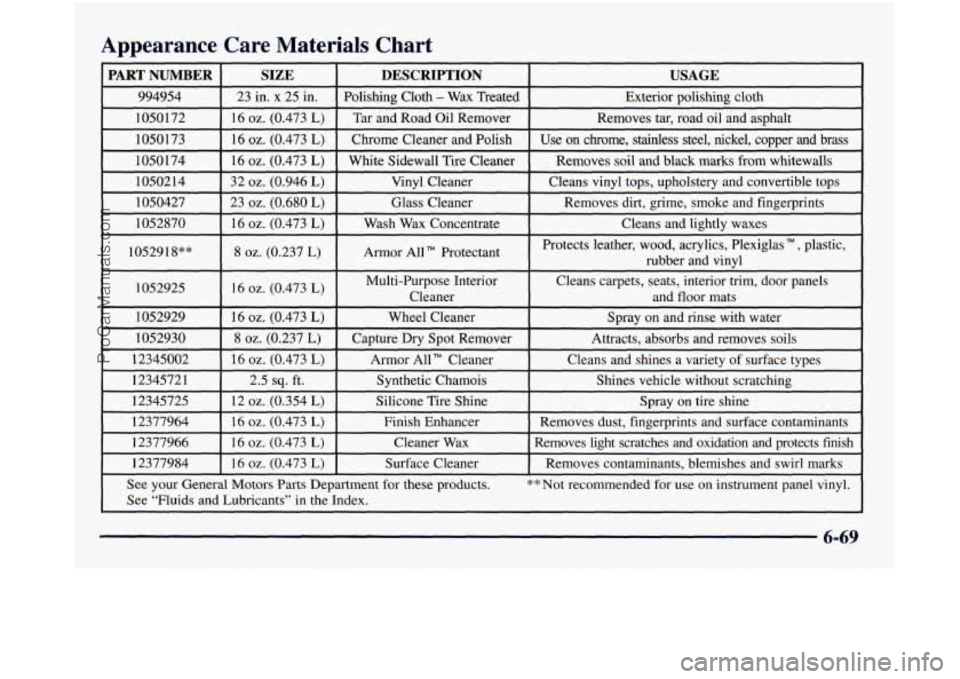
Appearance Care Materials Chart
PART NUMBER SIZE DESCRIPTION USAGE
994954 23 in. x 25 in. Polishing Cloth - Wax Treated
Exterior polishing cloth
1050172 16
oz. (0.473 L) Tar and Road Oil Remover Removes tar, road oil and asphalt
1050173 16
oz. (0.473 L) Chrome Cleaner and Polish Use on chrome, stainless steel, nickel, copper and brass
1050 174 16
oz. (0.473 L) White Sidewall Tire Cleaner Removes soil and black marks from whitewalls
1050214 32
oz. (0.946 L) Vinyl Cleaner Cleans vinyl tops, upholstery and convertible tops
1050427 23
oz. (0.680 L) Glass Cleaner Removes dirt, grime,
smoke and fingerprints
1052870
16 oz. (0.473 L) Wash Wax Concenmace Cleans and lightly waxes ~.
1052918”” 8 oz. (0.237 L) Armor All Protectant Protects
leather, wood, acrylics, Plexiglas TM , plastic,
rubber and vinyl
1052925
[ 16 oz. (0.473 L) I Multi-Purpose Interior Cleans carpets, seats, interior trim, door panels
I Cleaner and floor mats I I
1052929 I 16 oz. (0.473 L) I Wheel Cleaner I Spray on and rinse with water
1052930
8 oz. (0.237 L) Capture Dry Spot Remover
Attracts, absorbs and removes soils
12345002
16 oz. (0.473 L) Armor All” Cleaner Cleans
and shines a variety of surface types
12345721 2.5
sq. ft. Synthetic Chamois
Shines vehicle without scratching
12345725 12
oz. (0.354 L) Silicone Tire Shine Spray
on tire shine
12377964 16
oz. (0.473 L) Finish Enhancer Removes dust, fingerprints andsurface contaminants
12377966 16
oz. (0.473 L) Cleaner Wax Removes light scratches and oxidation and protects fish
12377984
I 16 oz. (0.473 L) I Surface Cleaner I Removes contaminants, blemishes and swirl marks
See your General Motors Parts Department for these products.
** Not recommended for use on instrument panel vinyl.
See “Fluids and Lubricants’’ in the Index.
6-69
ProCarManuals.com
Page 361 of 452
Headlamps Fuses and Circuit Breakers
The headlamp wiring is protected by an internal circuit
breaker. An electrical overload will cause
the lamps
to go on and off, or
in some cases to remain off. If
this happens, have your headlamp wiring checked
right away.
Windshield Wipers
The windshield wiper motor is protected by a circuit
breaker and
a fuse. If the motor overheats due to heavy
snow, etc., the wiper will stop
until the motor cools. If
the overload is caused by some electrical problem and
not snow, etc., be sure to get it fixed.
Power Windows and Other Power Options
Circuit breakers protect the power windows and other
power accessories. When the current load is too heavy,
the circuit breaker opens and closes, protecting the
circuit
until the problem is fixed or goes away. The wiring circuits
in your vehicle are protected from
short circuits by
a combination of fuses, circuit breakers
and fusible thermal links.
This greatly reduces the
chance
of fires caused by electrical problems.
Look at the silver-colored band inside the fuse. If the
band is broken or melted, replace the fuse. Be sure you
replace
a bad fuse with a new one of the identical size
and rating.
If you ever have
a problem on the road and don’t have a
spare fuse, you can “borrow” one that has the same
amperage. Just pick some feature
of your vehicle that
you can get along without
-- like the radio or cigarette
lighter
-- and use its fuse, if it is the correct amperage.
Replace
it as soon as you can.
6-7 1
ProCarManuals.com
Page 363 of 452
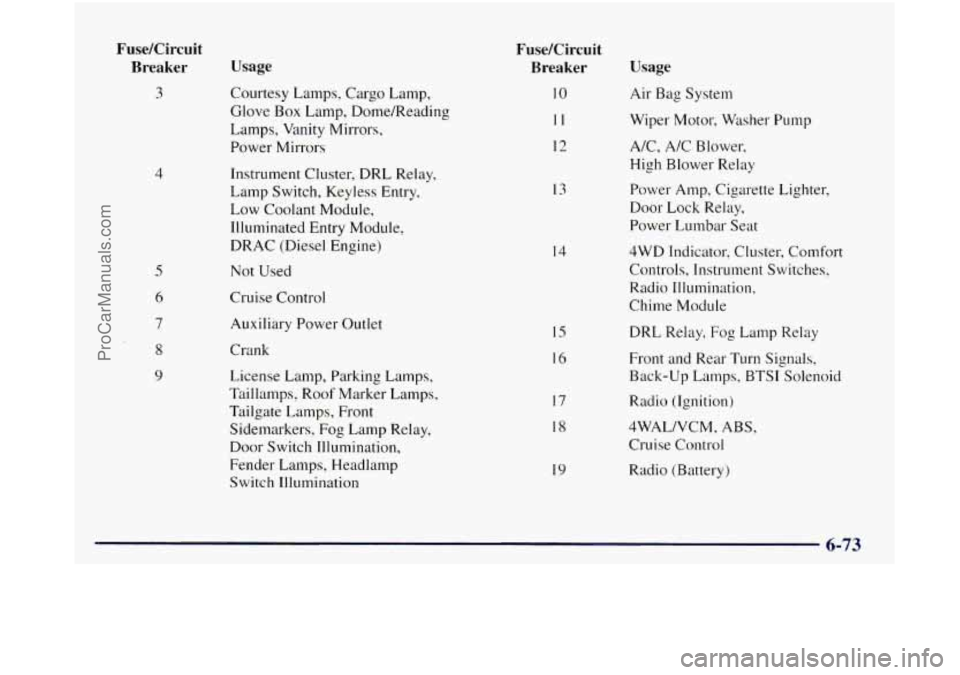
FuseKircuit Breaker
3
4
Usage
Courtesy Lamps, Cargo Lamp,
Glove Box Lamp, Dome/Reading
Lamps, Vanity Mirrors,
Power Mirrors
Instrument Cluster, DRL Relay,
Lamp Switch, Keyless Entry,
Low Coolant Module, Illuminated Entry Module,
DRAC (Diesel Engine)
Not Used
Cruise Control
Auxiliary Power Outlet
Crank
License Lamp, Parking Lamps,
Taillamps,
Roof Marker Lamps,
Tailgate Lamps, Front
Sidemarkers, Fog Lamp Relay,
Door Switch Illumination,
Fender Lamps, Headlamp Switch Illumination
FuseKircuit
Breaker
10
11
12
13
14
15
I6
17
18
19
Usage
Air Bag System
Wiper Motor, Washer Pump
A/C,
A/C Blower,
High Blower Relay
Power
Amp, Cigarette Lighter,
Door Lock Relay,
Power Lumbar Seat
4WD Indicator, Cluster, Comfort
Controls, Instrument Switches,
Radio Illumination,
Chime Module
DRL Relay,
Fog Lamp Relay
Front and Rear Turn Signals,
Back-up Lamps, BTSl Solenoid
Radio (Ignition)
4WAL/VCM, ABS. Cruise Control
Radio (Batterv)
6-73
ProCarManuals.com
Page 364 of 452
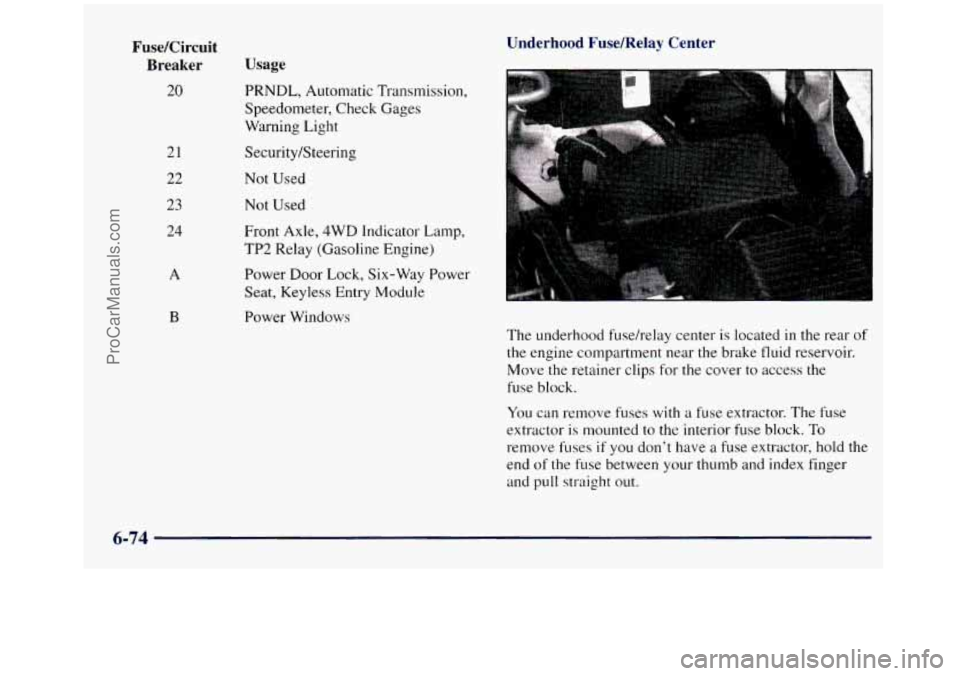
Fuse/Circuit Breaker Usage
20
21
22
23
24
A
B
PRNDL, Automatic Transmission,
Speedometer, Check Gages
Warning Light
Security/Steering
Not Used
Not Used
Front Axle,
4WD Indicator Lamp,
TP2 Relay (Gasoline Engine)
Power Door Lock, Six-Way Power Seat, Keyless Entry Module
Power Windows
Underhood Fuse/Relay Center
The underhood fusehelay center is located in the rear of
the engine compartment near the brake fluid reservoir.
Move the retainer clips
for the cover to access the
fuse block.
You can remove fuses with a fuse extractor. The fuse
extractor
is mounted to the interior fuse block. TO
remove fuses
if you don’t have a fuse extractor, hold the
end of the fuse between your thumb and index finger
and pull straight out.
6-74
ProCarManuals.com