ignition GMC SIERRA 1998 Owners Manual
[x] Cancel search | Manufacturer: GMC, Model Year: 1998, Model line: SIERRA, Model: GMC SIERRA 1998Pages: 452, PDF Size: 23.65 MB
Page 42 of 452
I NOTICE:
If you damage the covering for the driver’s or the
right front passenger’s air bag, the bag may not
work properly. You may have to replace the air
bag module in the steering wheel or both the air
bag module and the instrument panel for the right front passenger’s air bag.
Do not open or
break the air bag coverings.
Servicing Your Air Bag-Equipped Vehicle
Air bags affect how your vehicle should be serviced.
There are parts
of the air bag system in several places
around your vehicle. You don’t want the system to
inflate while someone is working on your vehicle. Your
dealer and the service manual have information about
servicing your vehicle and the air
bag system. To
purchase a service manual, see “Service and Owner
Publications”
in the Index.
If your vehicle ever gets into a lot of water -- such as
water up to the carpeting or higher -- or if water enters
your vehicle
and soaks the carpet, the air bag controller
can be soaked and ruined. If this ever happens, and then
you start your vehicle, the damage could make the air
bags inflate, even if there’s no crash.
You would have to
replace the air bags
as well as the sensors and related
parts. If your vehicle is ever
in a flood? or if it‘s exposed
to water that soaks the carpet, you can avoid needless
repair costs
by turning off the vehicle immediately.
Don’t
let anyone start the vehicle, even to tow it, unless
the battery cables are first disconnected.
I
For up to 10 minutes after the ignition key is
turned off and the battery is disconnected, an air
bag can still inflate during improper service. You
can be injured if you are close to an air bag when
it inflates. Avoid
wires wrapped with yellow tape
or yellow connectors. They are probably part of
the
air bag system. Be sure to follow proper
service procedures, and make sure the person
performing work for you
is qualified to do so.
~~
The ail- bag system does not need regular maintenance.
1-30
ProCarManuals.com
Page 75 of 452
’ A CAUTION:
-
A child in a rear-facing child restraint can be
seriously injured or killed if the right front
passenger’s air bag inflates, even though your
vehicle has reduced-force frontal
air bags. This is
because the back of the rear-facing child
i restraint would be very close to the inflating air
bag. Be sure to turn off the air bag before using a
rear-facing child restraint in the right front seat
position.
If a forward-facing child restraint is
suitable for your child, always move the
passenger seat as
far back as it will go.
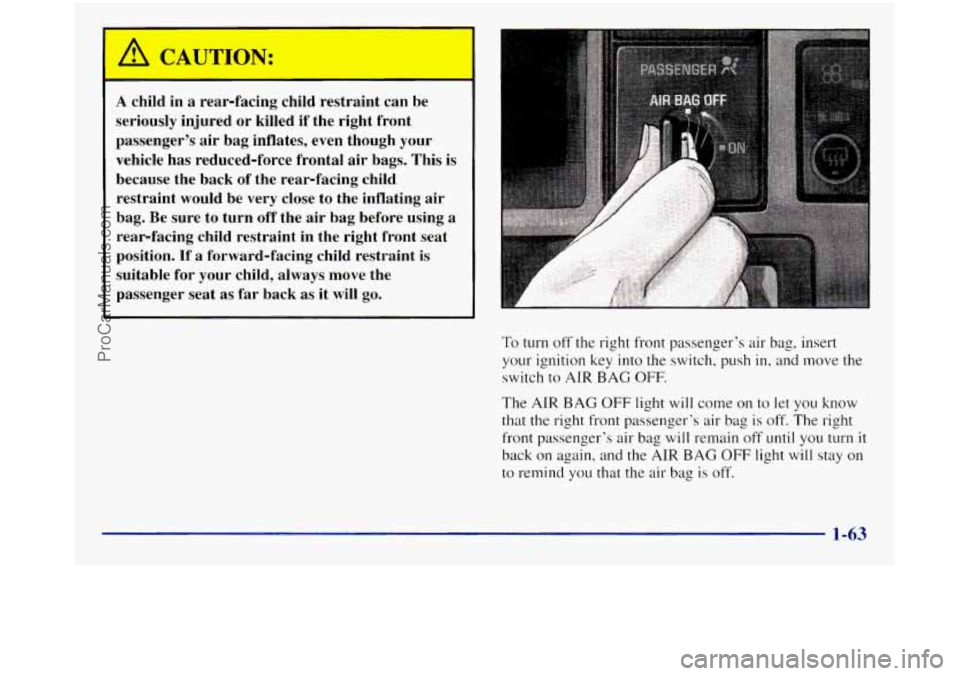
To turn off the right front passenger’s air bag, insert
your ignition key into the switch, push
in, and move the
switch to
AIR BAG OFF.
The AIR BAG OFF light will come on to let you know
that the right front passenger’s air bag is off. The right
front passenger’s air bag
will remain off until you turn it
back on again, and the AIR BAG OFF light will stay on
to remind you that the air bag is off.
1-63
ProCarManuals.com
Page 78 of 452
~ ~~ ~~~~ ~ ~
~~~~ ~~ ~~~~~~
~ ~. ,
To remove the child restraint, just unbuckle the vehicle’s
safety belt and let it go back all the way. The safety belt
will move freely again and be ready to work for an adult
or larger child passenger.
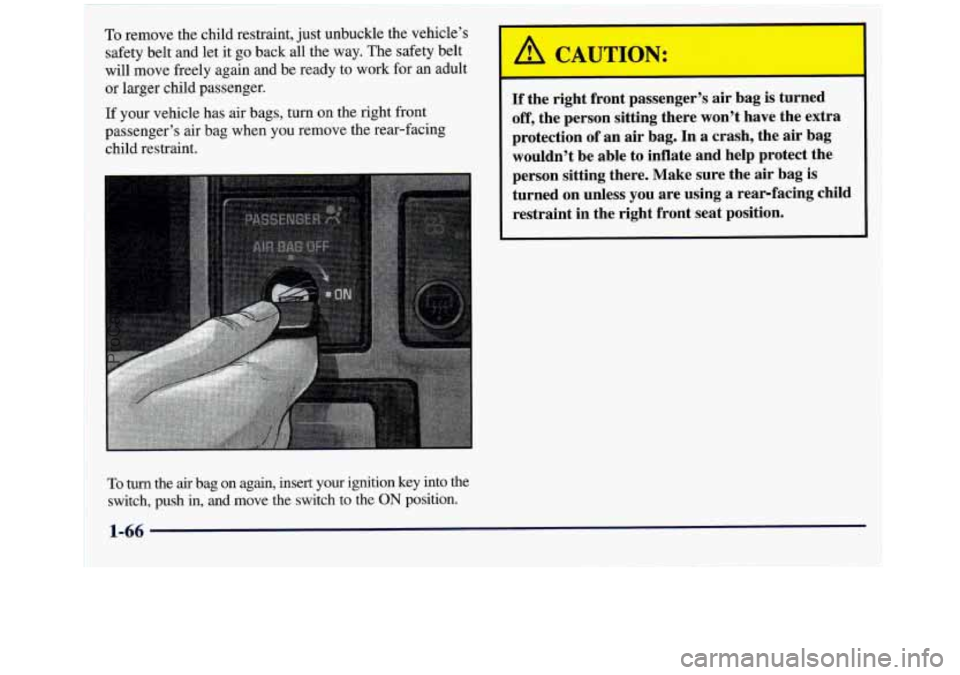
If your vehicle has air bags, turn on the right front
passenger’s air bag when you remove the rear-facing
child restraint.
To turn the air bag on again, insert your ignition key into the
switch, push in, and move the switch to the
ON position.
If the right front passenger’s air bag is turned
off, the person sitting there won’t have the extra
protection of an
air bag. In a crash, the air bag
wouldn’t be able to inflate and help protect the
person sitting there. Make sure the air bag is
turned on unless you are using
a rear-facing child
restraint in the right front seat position.
1-66
ProCarManuals.com
Page 85 of 452
Section 2 Features and Controls
Here you can learn about the many standard and optional features on your vehicle, and information on starting,
shifting and braking. Also explained are the instrument panel and
the warning systems that tell you if everything is
working properly
-- and what to do if you have a problem.
2-2
2-
3
2-4 2-5
2-6
2-9
2-
10
2- 10
2-1 1
2-12
2- 14
2-15
2-18
2-2
I
2-25
2-26
2-29 Keys
Tailgate
Third Door
(If Equipped)
Door Locks
Keyless Entry System (If Equipped)
Theft
PasslockTM
New Vehicle ”Break-In”
Ignition Positions
Starting Your Gasoline Engine
Engine Coolant Heater (If Equipped) Automatic Transmission Operation
Manual Transmission Operation Four-wheel Drive
(If Equipped)
Parking Brake
Shifting Into Park
(P) (Automatic
Transmission Models
Only)
Shifting Out of Park (P)
(Automatic Transmission) 2-29
2-30
2-30
2-3 1
2-32
2-32
2-34
2-35
2-4
1
2-43
2-45
2-5
1
2-60
2-62
2-64 Parking
Your Vehicle (Manual Transmission
Models
Only)
Parking Over Things That Burn
Engine Exhaust
Running Your Engine While You’re Parked
(Automatic Transmission)
Locking Rear Axle (If Equipped)
Windows
Tilt Wheel (If Equipped)
Turn Signal/Multifunction Lever
Exterior Lamps
Interior Lamps Mirrors
Storage Compartments
Instrument Panel
Instrument Panel Cluster
Warning Lights, Gages and Indicators
ProCarManuals.com
Page 86 of 452
Keys
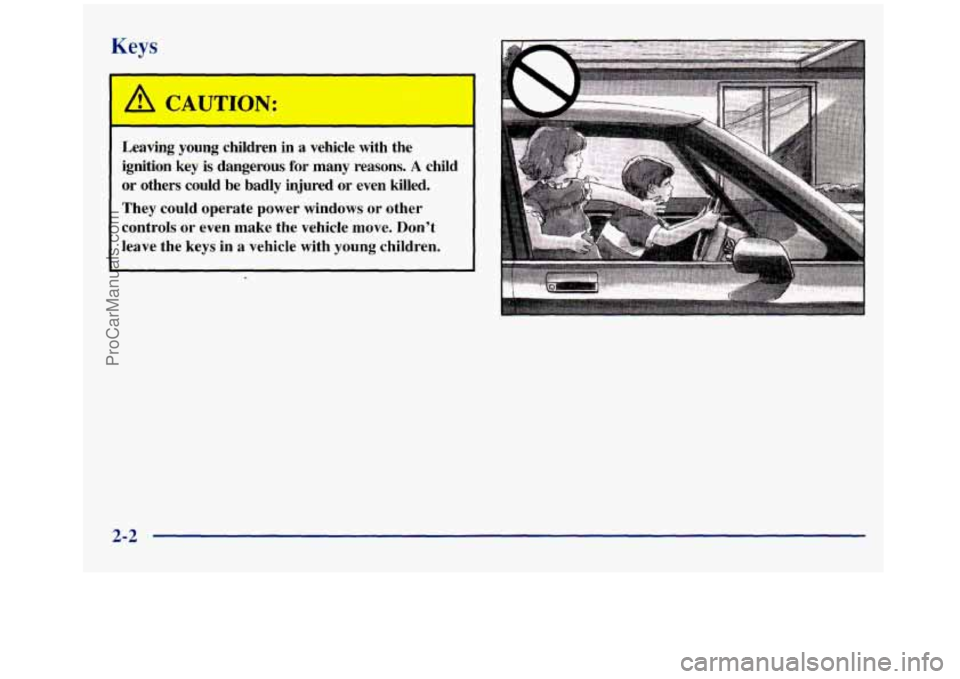
Leaving young children in a vehicle with the
ignition key
is dangerous for many reasons. A child
or others could be badly injured or even killed.
They could operate power windows
or other
controls or even make the vehicle
move. Don't
leave the keys in
a vehicle with young children.
2-2
ProCarManuals.com
Page 87 of 452
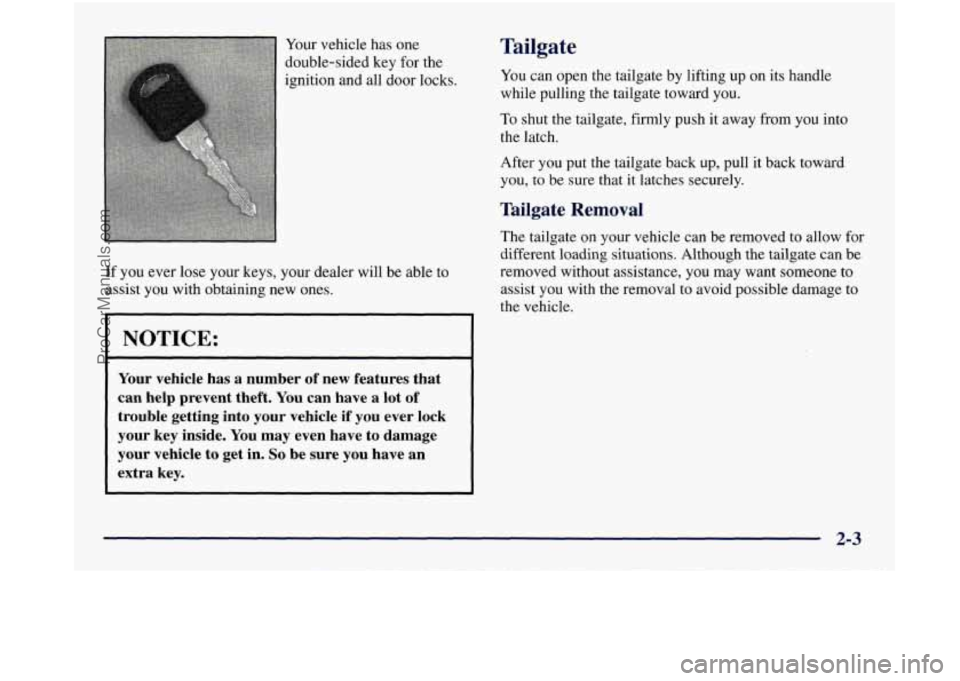
Your vehicle has one
double-sided key for the
ignition and all door locks.
If you ever lose your keys, your dealer will be able to
assist you with obtaining new ones. Tailgate
You can open the tailgate by lifting up on its handle
while pulling the tailgate toward you.
To shut the tailgate, firmly push it away from you into
the latch.
After you put the tailgate back up, pull it back toward
you,
to be sure that it latches securely.
Tailgate Removal
The tailgate on your vehicle can be removed to allow for
different loading situations. Although the tailgate can be
removed without assistance, you may want someone to
assist you with the removal to avoid possible damage to
the vehicle.
NOTICE:
' Your vehicle has a number of new features that
can help prevent theft.
You can have a lot of
trouble getting into your vehicle if you ever lock
your key inside.
You may even have to damage
your vehicle to get in.
So be sure you have an
extra key.
~. _~- -- . ~. - ~
2-3
ProCarManuals.com
Page 91 of 452
This system has a range of about 3 feet (1 m) up to
30 feet (9 m). At times you may notice a decrease in
range. This is normal for any remote keyless entry
system.
If the transmitter does not work or if you have
to stand closer to your vehicle for the transmitter to
work, try this:
0 Check to determine if battery replacement or
transmitter resynchronization is necessary. See the
instructions that follow.
Check the distance. You may be too far from your
vehicle.
You may need to stand closer during rainy
or snowy weather.
Check the location. Other vehicles or objects may be
blocking the signal. Take a few steps to the left or
right, hold the transmitter higher, and try again.
If you're still having trouble, see your dealer or a
qualified technician for service.
Operation
To unlock the driver's door, press the UNLOCK button.
The interior lamps
will come on for 40 seconds or until
the ignition is turned on. if you press the UNLOCK
button again within five seconds, all the remaining doors
(except the third door)
will unlock. Press the
LOCK button to lock
all the doors (except
the third door). The interior lamps will come on
for
two seconds as soon as all the doors are closed. If you
press the LOCK button twice the horn will chirp to
confirm that the doors have locked.
If you do not want the horn to chirp as a confirmation
that the doors have locked or unlocked, please consult
your dealer.
Matching Transmitter(s) To Your Vehicle
Each remote keyless entry transmitter is coded to
prevent another transmitter from unlocking your vehicle.
If a transmitter is lost or stolen, a replacement can be
purchased through your dealer. Remember to bring any
remaining transmitters
with you when you go to your
dealer. When the dealer matches the replacement
t~-ansmitter to your vehicle, any remaining transmitters
must also be matched. Once your dealer has coded the
new transmitter, the lost transmitter
will not unlock your
vehicle. Each vehicle can have only
four transmitters
matched to
it.
2-7
ProCarManuals.com
Page 93 of 452
Synchronization
Synchronization may be necessary d~te to the security
method used by this system. The transmitter does not
send the
same signal twice to the receiver. The receiver
will not respond to a signal it has been sent previously.
This prevents anyone from recording and playing back
the signal
from the transmitter.
To resynchronize your transmitter, stand close to your
vehicle and simultaneously press and hold the
LOCK
and UNLOCK buttons on the transmitter for at least
five seconds. The door locks should cycle to confirm
synchronization.
If the locks do not cycle. see your
dealer for service.
Theft
Vehicle theft is big business, especially in scme cities.
Although your vehicle has
a number of theft-deterrent
features, we know that nothing we put on
it can make it
impossible to steal. However. there are ways you can help.
Key in the Ignition
If you leave your vehicle with the keys inside, it's an
easy target forjoy riders
01- professional thieves -- so
don't do it.
When you park your vehicle and open the driver's door,
you'll hear
a tone reminding you to remove your key
from the ignition and take
it with you. Always do this.
Ycx~r steering wheel will be locked, and so will your
ignition.
If you have an automatic transmission, taking
your key
out also locks your transmission. And
remember
to lock the doors.
Parking at Night
Park in a lighted spot, close all windows and lock your
vehicle. Remember
to keep your valuables out of sight.
Put them in a storage area, or take them with you.
Parking Lots
If you park in a lot where someone will be watching
your vehicle, it's best to lock
it up and take your keys.
But what if you have to leave your ignition key? What if
you have to leave something valuable in your vehicle'?
Put your valuables in a storage area, like your
glove box.
Lock all the doors except the driver's.
2-9
ProCarManuals.com
Page 94 of 452
Passlock@ New Vehicle “Break-In”
Your vehicle is equipped with the Passlock
theft-deterrent system.
Passlock is a passive theft-deterrent system. The
system
is armed once the key is removed from the ignition.
Passlock enables fuel if the ignition lock cylinder
is
turned with a valid key. If a correct key is not used, f~lel
is disabled.
During normal operation, the
SECURITY light will go
off after the engine is started.
If the engine stalls and the SECURITY light flashes.
wait
until the light stops flashing before trying to restart
the engine. Remember to release the key from the
START position as soon as the engine starts.
If you are driving and the SECURITY light comes on, you
will be able to restart the engine
if you turn the engine off.
However, your Passlock system is not working properly
and must be serviced by your dealer. Your vehicle is not
protected by Passlock at this time,
You may also want to
check the fuse (see “Fuses
and Circuit Breakers” in the
Index), See your dealer for service.
If the SECURITY light comes on while the engine is
running, a problem has been detected and the system
may need service. See your dealer for service.
In an emergency, call the Roadside Assistance Center.
NOTICE:
Your vehicle doesn’t need an elaborate
“break-in.” But it will perform better in the long
run if you follow these guidelines:
0
0
0
0
Keep your speed at 55 mph (88 kmh) or
less for the first
500 miles (805 km).
Don’t drive at any one speed
-- fast or
slaw
-- for the first 500 miles (805 km).
Don’t make full-throttle starts.
Avoid making hard stops for the first
200 miles (322 km) or so. During this time
your new brake linings aren’t yet broken
in. Hard stops with new linings can mean
premature wear and earlier replacement.
Follow this breaking-in guideline every
time you get new brake linings.
Don’t tow
a trailer during break-in.
See “Towing
a Trailer” in the Index for
more information.
ProCarManuals.com
Page 95 of 452
Ignition Positions
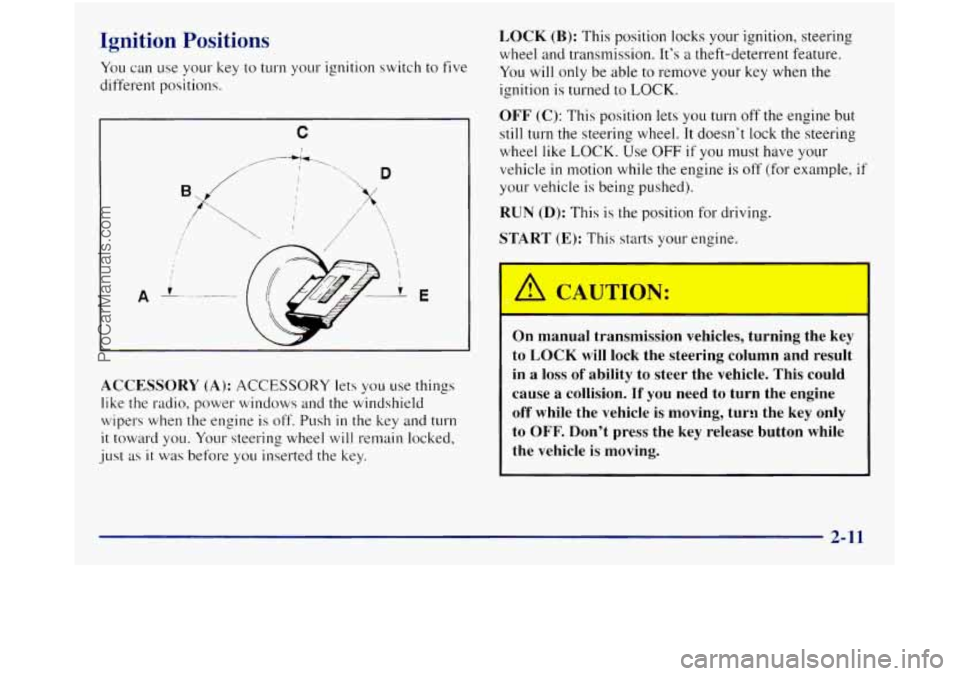
You can use your key to turn your ignition switch to five
different positions.
C
I
E
LOCK (B): This position locks your ignition, steering
wheel and transmission. It’s a theft-deterrent feature.
You
will only be able to remove your key when the
ignition
is turned to LOCK.
OFF (C): This position lets you turn off the engine but
still turn the steering wheel. It doesn’t lock the steering
wheel
like LOCK. Use OFF if you must have your
vehicle
in motion while the engine is off (for example, if
your vehicle is being pushed).
RUN (D): This is the position for driving.
START (E): This starts your engine.
ACCESSORY
(A): ACCESSORY lets you use things
like the radio, power windows and the windshield
wipers when the engine
is off. Push in the key and turn
it toward you. Your steering wheel will re~nain locked,
just
as it was before you inserted the key.
~ On manual transmission vehicles, turning the key
to LOCK
will lock the steering column and result
in a loss
of ability to steer the vehicle. This could
cause
a collision. If you need to turn the engine
off while the vehicle is moving, turn the key only
to
OFF. Don’t press the key release button while
the vehicle is moving.
I
2-11
ProCarManuals.com