light GMC SIERRA 2006 Owner's Guide
[x] Cancel search | Manufacturer: GMC, Model Year: 2006, Model line: SIERRA, Model: GMC SIERRA 2006Pages: 600, PDF Size: 3.49 MB
Page 114 of 600
The horn may chirp for 10 seconds before the alarm
goes off if the theft-deterrent system is activated using
the remote keyless entry transmitter and the driver’s door
is opened. If this occurs, you can turn off the alarm by
pressing unlock on the remote keyless entry transmitter
or by placing the key in the ignition and turning it to
START.
Here is how to avoid setting off the alarm by accident:
If you do not want to activate the theft-deterrent
system, the vehicle should be locked with the
door key after the doors are closed.
Always unlock a door with the remote keyless entry
transmitter.
If you set off the alarm by accident, turn off the alarm by
pressing unlock on the remote keyless entry transmitter
or by placing the key in the ignition and turning it to
START.
Testing the Alarm
The alarm can be tested by following these steps:
1. From inside the vehicle, activate the system by
locking the doors with the remote keyless entry
transmitter.
2. Wait for the security light to go out.
3. Unlock the door with the manual door lock and
open the door. This should set off the alarm.
4. Turn off the alarm by pressing unlock on the remote
keyless entry transmitter or by placing the key in
the ignition and turning it to START.
If the alarm does not sound when it should, but the
vehicle’s headlamps ash, check to see if the horn
works. The horn fuse may be blown. To replace the
fuse, seeInstrument Panel Fuse Block on page 5-124
andUnderhood Fuse Block on page 5-127.
If the alarm does not sound or the vehicle’s headlamps
do not ash, see your dealer for service.
2-20
Page 115 of 600
Passlock®
Your vehicle is equipped with the Passlock®
theft-deterrent system.
Passlock
®is a passive theft-deterrent system.
Passlock®enables fuel if the ignition lock cylinder is
turned with a valid key. If a correct key is not used or the
ignition lock cylinder is tampered with, fuel is disabled.
If the engine stalls and the security light ashes, wait until
the light stops ashing before trying to restart the engine.
Remember to release the key from START as soon as
the engine starts.
If the engine is running and the security light comes on,
you will be able to restart the engine if you turn the engine
off. However, your Passlock
®system is not working
properly and must be serviced by your dealer. Your
vehicle is not protected by Passlock
®at this time. You
may also want to check the fuse. SeeFuses and Circuit
Breakers on page 5-123. See your dealer for service.
In an emergency, call the GM Roadside Assistance
Center. SeeRoadside Assistance Program on page 7-6.
Starting and Operating Your
Vehicle
New Vehicle Break-In
Notice:Your vehicle does not need an elaborate
break-in. But it will perform better in the long run if
you follow these guidelines:
Keep your speed at 55 mph (88 km/h) or less for
the rst 500 miles (805 km).
Do not drive at any one constant speed, fast or
slow, for the rst 500 miles (805 km). Do not
make full-throttle starts. Avoid downshifting to
brake, or slow, the vehicle.
Avoid making hard stops for the rst 200 miles
(322 km) or so. During this time your new brake
linings are not yet broken in. Hard stops with
new linings can mean premature wear and earlier
replacement. Follow this breaking-in guideline
every time you get new brake linings.
Do not tow a trailer during break-in. See
Towing a Trailer on page 4-67for the trailer
towing capabilities of your vehicle and more
information.
Following break-in, engine speed and load can be
gradually increased.
2-21
Page 125 of 600
Cold Weather Operation
(Allison Transmission®)
On cold days, approximately 32°F (0°C) or colder, your
automatic transmission is designed to shift differently.
The transmission uses a warm-up mode shift schedule
until the engine reaches normal operating temperature.
While the transmission is in warm-up mode it is normal for
transmission upshifts to be delayed or held longer. This
feature improves heater performance by giving quicker
vehicle warm-ups.
When temperatures are below−13°F (−25°C), the
transmission will prevent certain operations to protect
against damage. When active the DIC will display
the message “Trans in Warm-up”.
SeeDIC Warnings and Messages on page 3-55for
more information.
Tow/Haul Mode
If your vehicle has an automatic transmission, it may
have a Tow/Haul mode. If your vehicle has an
Allison Transmission
®see “Tow/Haul Mode (Allison
Transmission®) following. Tow/Haul mode adjusts
the transmission shift pattern to reduce shift cycling,
providing increased performance, vehicle control, and
transmission cooling when towing or hauling heavy loads.
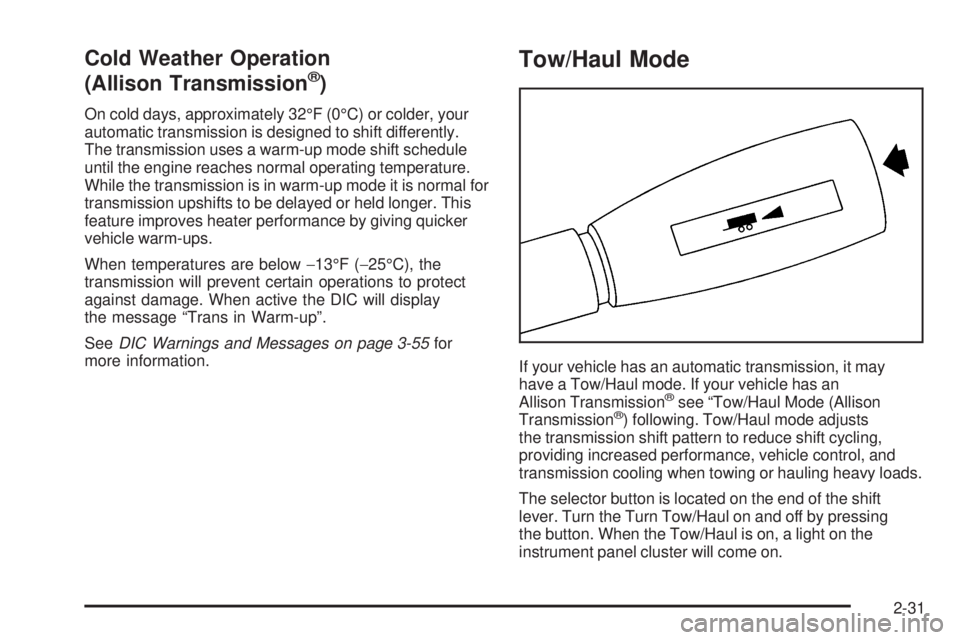
The selector button is located on the end of the shift
lever. Turn the Turn Tow/Haul on and off by pressing
the button. When the Tow/Haul is on, a light on the
instrument panel cluster will come on.
2-31
Page 126 of 600
SeeTow/Haul Mode Light on page 3-50for more
information.
If your vehicle is equipped with the Performance
Package-Enhanced Towing, activating the manual
selectable ride will adjust the shock absorber
characteristics to enhance the ride and handling of the
vehicle for towing or hauling heavy loads.
Also see Tow Haul Mode underTowing a Trailer on
page 4-67for more information.
Tow/Haul Mode
(Allison Transmission®)
If your vehicle has an Allison Transmission®,itmay
have a Tow/Haul mode. Tow/Haul mode adjusts the
transmission shift pattern to reduce shift cycling,
providing increased performance, vehicle control, and
transmission cooling when towing or hauling heavy loads.
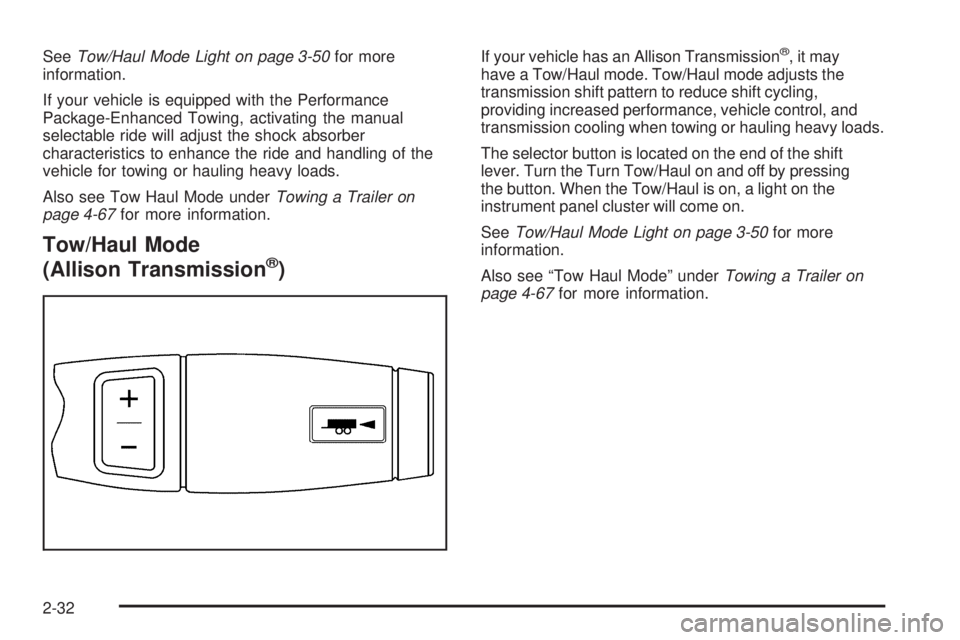
The selector button is located on the end of the shift
lever. Turn the Turn Tow/Haul on and off by pressing
the button. When the Tow/Haul is on, a light on the
instrument panel cluster will come on.
SeeTow/Haul Mode Light on page 3-50for more
information.
Also see “Tow Haul Mode” underTowing a Trailer on
page 4-67for more information.
2-32
Page 130 of 600
Six-Speed (VORTEC™ 8.1L V8 and
DURAMAX®™ 6.6L V8 Engines)
Here is how to operate
your transmission.
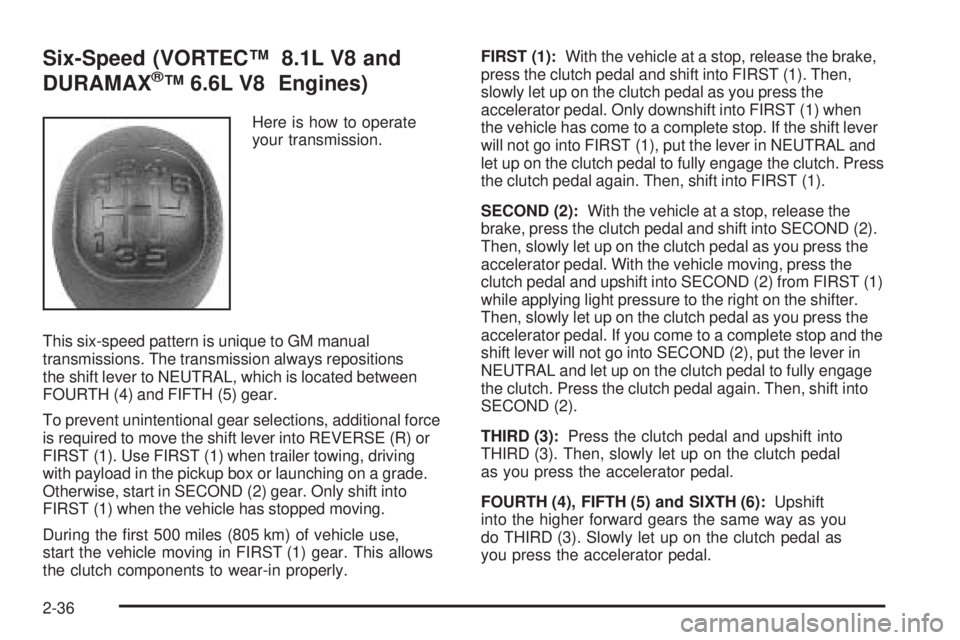
This six-speed pattern is unique to GM manual
transmissions. The transmission always repositions
the shift lever to NEUTRAL, which is located between
FOURTH (4) and FIFTH (5) gear.
To prevent unintentional gear selections, additional force
is required to move the shift lever into REVERSE (R) or
FIRST (1). Use FIRST (1) when trailer towing, driving
with payload in the pickup box or launching on a grade.
Otherwise, start in SECOND (2) gear. Only shift into
FIRST (1) when the vehicle has stopped moving.
During the rst 500 miles (805 km) of vehicle use,
start the vehicle moving in FIRST (1) gear. This allows
the clutch components to wear-in properly.FIRST (1):With the vehicle at a stop, release the brake,
press the clutch pedal and shift into FIRST (1). Then,
slowly let up on the clutch pedal as you press the
accelerator pedal. Only downshift into FIRST (1) when
the vehicle has come to a complete stop. If the shift lever
will not go into FIRST (1), put the lever in NEUTRAL and
let up on the clutch pedal to fully engage the clutch. Press
the clutch pedal again. Then, shift into FIRST (1).
SECOND (2):With the vehicle at a stop, release the
brake, press the clutch pedal and shift into SECOND (2).
Then, slowly let up on the clutch pedal as you press the
accelerator pedal. With the vehicle moving, press the
clutch pedal and upshift into SECOND (2) from FIRST (1)
while applying light pressure to the right on the shifter.
Then, slowly let up on the clutch pedal as you press the
accelerator pedal. If you come to a complete stop and the
shift lever will not go into SECOND (2), put the lever in
NEUTRAL and let up on the clutch pedal to fully engage
the clutch. Press the clutch pedal again. Then, shift into
SECOND (2).
THIRD (3):Press the clutch pedal and upshift into
THIRD (3). Then, slowly let up on the clutch pedal
as you press the accelerator pedal.
FOURTH (4), FIFTH (5) and SIXTH (6):Upshift
into the higher forward gears the same way as you
do THIRD (3). Slowly let up on the clutch pedal as
you press the accelerator pedal.
2-36
Page 132 of 600
Up-Shift Light
If you have a manual
transmission, you may
have a shift light. This light
will show you when to shift
to the next higher gear for
best fuel economy.
When this light comes on, you can shift to the next higher
gear if weather, road and traffic conditions allow. For the
best fuel economy, accelerate slowly and shift when the
light comes on.
While you accelerate, it is normal for the light to
go on and off if you quickly change the position of the
accelerator.
If your vehicle has four-wheel drive and is equipped with
a manual transmission, disregard the shift light when the
transfer case is in Four-Wheel Low.
Ignore the shift light when you downshift.
Four-Wheel Drive
If your vehicle has four-wheel drive, you can send your
engine’s driving power to all four wheels for extra traction.
To get the most satisfaction out of four-wheel drive, you
must be familiar with its operation. Read the part that
follows before using four-wheel drive. See the
appropriate text for the transfer case in your vehicle.
Front Axle Locking Feature
The front axle locks and unlocks automatically when
you shift the transfer case. Some delay for the axle
to lock or unlock is normal.
2-38
Page 133 of 600
Manual Transfer Case
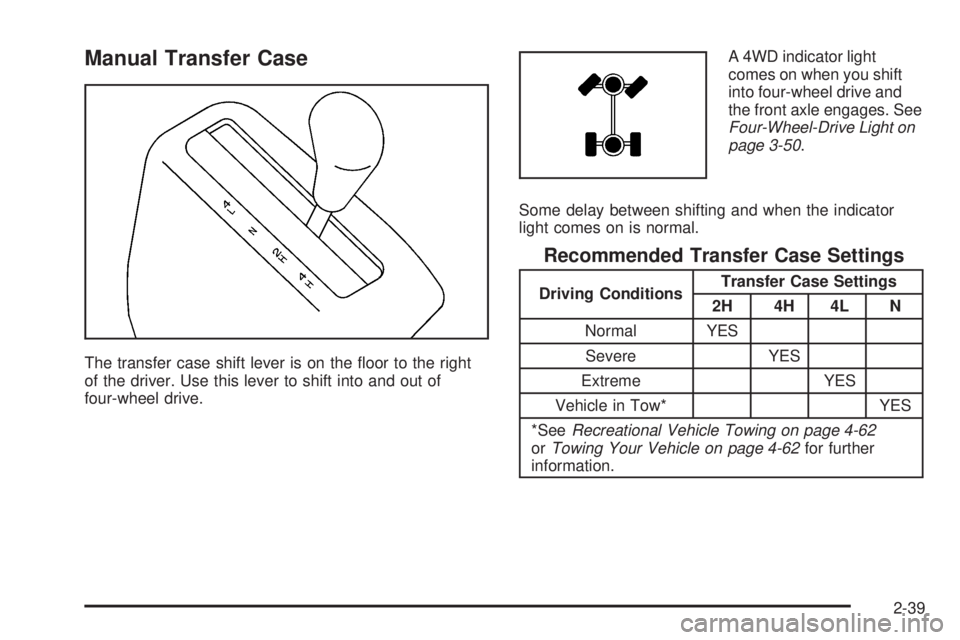
The transfer case shift lever is on the oor to the right
of the driver. Use this lever to shift into and out of
four-wheel drive.A 4WD indicator light
comes on when you shift
into four-wheel drive and
the front axle engages. See
Four-Wheel-Drive Light on
page 3-50.
Some delay between shifting and when the indicator
light comes on is normal.
Recommended Transfer Case Settings
Driving ConditionsTransfer Case Settings
2H 4H 4L N
Normal YES
Severe YES
Extreme YES
Vehicle in Tow* YES
*SeeRecreational Vehicle Towing on page 4-62
orTowing Your Vehicle on page 4-62for further
information.
2-39
Page 134 of 600
An indicator light near the lever shows you the transfer
case settings:
Notice:Driving on clean, dry pavement in
four-wheel drive for an extended period of time may
cause premature wear on your vehicle’s powertrain.
Do not drive on clean, dry pavement in four-wheel
drive for extended periods of time.
4L (Four-Wheel Low):This setting also engages your
front axle and delivers extra torque. You may never need
4L. It sends maximum power to all four wheels. You might
choose 4L if you are driving off-road in deep sand, deep
mud, deep snow, and while climbing or descending steep
hills. When operating in Four-Wheel Low, the gear ratio
provides additional torque when compared to four-wheel
high. The transmission gear shift feel will be exaggerated.
{CAUTION:
Shifting the transfer case to NEUTRAL
can cause your vehicle to roll even if the
transmission is in PARK (P), or if you have a
manual transmission, even if you are in gear.
You or someone else could be seriously injured.
Be sure to set the parking brake before placing
the transfer case in NEUTRAL. SeeParking
Brake on page 2-52.N (Neutral):Shift to this setting only when your vehicle
needs to be towed. SeeRecreational Vehicle Towing
on page 4-62orTowing Your Vehicle on page 4-62.
2H (Two-Wheel High):This setting is used for driving in
most street and highway situations. Your front axle is not
engaged in two-wheel drive. This setting also provides
the best fuel economy.
4H (Four-Wheel High):Use this setting when you need
extra traction, such as on snowy or icy roads or in most
off-road situations. This setting also engages your front
axle to help drive your vehicle. This is the best setting to
use when plowing snow.
You can shift from 2H to 4H or 4H high to 2H while the
vehicle is moving. Your front axle will engage faster if
you take your foot off of the accelerator for a couple of
seconds after you shift. In extremely cold weather,
it may be necessary to stop or slow the vehicle to shift
into four-wheel high.
2-40
Page 135 of 600
When Using the Manual Transfer Case
Shifting should be made using quick motions.
Shifting slowly may make it more difficult to shift.
You may notice that it is harder to shift when the
vehicle is cold. After the vehicle warms up the
shifting will return to normal.
While in 4H or 4L you may experience reduced fuel
economy.
Avoid driving in four-wheel drive on clean, dry
pavement. It may cause your tires to wear faster,
and make your transfer case harder to shift and run
noisier.
Shifting from 2H (Two-Wheel High) to
4H (Four-Wheel High)
Shifts between 2H and 4H can be made at any
vehicle speed.
It is easiest to shift the transfer case when
maintaining a constant speed or a slight acceleration.
If possible, avoid shifting while slowing down, as it
will may make it harder to shift.
Shift your transfer case lever in one continuous
motion into either the 4H or 2H position.
In extremely cold weather, it may be necessary to
slow or stop the vehicle to shift into four-wheel high
until your vehicle has warmed up.
While in 4H, your vehicle can be driven at any posted
legal speed limit.
Shifting In or Out of 4L (Four-Wheel Low)
Notice:Shifting the transfer case into 4L while
moving at speeds faster than 3 mph (5 km/h) may
cause premature wear to the transfer case, and may
cause the gears to grind. To avoid causing premature
wear, and grinding the gears, do not shift the transfer
case into 4L while the vehicle is moving faster than
3 mph (5 km/h).
Shifts into 4L can be made with the vehicle at a stop, or
while slowly rolling about 1 to 3 mph (2 to 5 km/h).
Shift the automatic transmission into NEUTRAL (N),
or with a manual transmission, press the clutch
pedal, or shift into NEUTRAL (N).
Shift the transfer case shift lever in one continuous
motion into the 4L position.
When in 4L do not drive faster than 45 mph.
This will reduce wear and extend the life of
your transfer case.
Shifting In or Out of NEUTRAL
1. With the vehicle running and the engine at an idle
set the parking brake.
2. Place the transmission into NEUTRAL (N).
Shift the transfer case in one continuous motion into or
out of the NEUTRAL position.
2-41
Page 137 of 600
When the vehicle detects a loss of traction, the system
will automatically engage four-wheel drive. Driving in
this mode results in slightly lower fuel economy than
Two-Wheel High.
2
m(Two-Wheel High):This setting is used for driving
in most street and highway situations. Your front axle is
not engaged in two-wheel drive. This setting also
provides the best fuel economy.
{CAUTION:
Shifting the transfer case to NEUTRAL
can cause your vehicle to roll even if the
transmission is in PARK (P). You or someone
else could be seriously injured. Be sure to set
the parking brake before placing the transfer
case in NEUTRAL. SeeParking Brake on
page 2-52.
N (NEUTRAL):Shift the vehicle’s transfer case to
N (NEUTRAL) only when towing your vehicle. See
Recreational Vehicle Towing on page 4-62orTowing
Your Vehicle on page 4-62for more information.4
m(Four-Wheel High):Use this setting when you
need extra traction, such a on snowy or icy roads or in
most off-road situations. This setting also engages your
front axle to help drive your vehicle. This is the best
setting to use when plowing snow.
4
n(Four-Wheel Low):This setting also engages
your front axle and delivers extra torque. You may never
need Four-Wheel Low. It sends maximum power to all
four wheels. You might choose Four-Wheel Low if you
are driving off-road in deep sand, deep mud, deep snow,
and while climbing or descending steep hills. When
operating in Four-Wheel Low, the gear ratio provides
additional torque when compared to four-wheel high.
The transmission gear shift feel will be exaggerated.
Indicator lights in the switches show which setting your
transfer case is in. The indicator lights will come on briey
when you turn on the ignition and one will stay on. If the
lights do not come on, you should take your vehicle to
your dealer for service. An indicator light will ash while
the transfer case is being shifted. It will stay on when the
shift is complete. If for some reason the transfer case
cannot make a requested shift, it will return to the last
chosen setting.
If the SERVICE 4WD message stays on, you should take
your vehicle to your dealer for service. SeeDIC Warnings
and Messages on page 3-55for further information.
2-43