brakes GMC SIERRA 2008 Owner's Guide
[x] Cancel search | Manufacturer: GMC, Model Year: 2008, Model line: SIERRA, Model: GMC SIERRA 2008Pages: 578, PDF Size: 6.47 MB
Page 320 of 578
If you decide you can go down a hill safely, then try to
keep your vehicle headed straight down, and use a
low gear. This way, engine drag can help the brakes and
they will not have to do all the work. Descend slowly,
keeping your vehicle under control at all times.
{CAUTION:
Heavy braking when going down a hill can
cause your brakes to overheat and fade. This
could cause loss of control and a serious
accident. Apply the brakes lightly when
descending a hill and use a low gear to keep
vehicle speed under control.There some things not to do when driving down a hill.
These are important because, if you ignore them,
you could lose control and have a serious accident:
When driving downhill, avoid turns that take you
across the incline of the hill. A hill that is not too steep
to drive down may be too steep to drive across. You
could roll over if you do not drive straight down.
Never go downhill with the transmission in
NEUTRAL (N). This is called “free-wheeling.” The
brakes will have to do all the work and could
overheat and fade.
Your vehicle is much more likely to stall when going
uphill. But if it happens when going downhill:
1. Stop your vehicle by applying the regular brakes.
Apply the parking brake.
2. Shift to PARK (P) and, while still braking, restart the
engine.
3. Shift back to a low gear, release the parking brake,
and drive straight down.
4. If the engine will not start, get out and get help.
4-22
Page 324 of 578
Driving in Water
{CAUTION:
Driving through rushing water can be
dangerous. Deep water can sweep your vehicle
downstream and you and your passengers
could drown. If it is only shallow water, it can
still wash away the ground from under your
tires, and you could lose traction and roll
the vehicle over. Do not drive through
rushing water.Heavy rain can mean ash ooding, and ood waters
demand extreme caution.
Find out how deep the water is before you drive through
it. If it is deep enough to cover the wheel hubs, axles,
or exhaust pipe, do not try it — you probably will not get
through. Also, water that deep can damage the axle
and other vehicle parts.
If the water is not too deep, drive slowly through it. At
faster speeds, water splashes on the ignition system and
your vehicle can stall. Stalling can also occur if you
get the tailpipe under water. And, as long as the tailpipe
is under water, you will never be able to start the
engine. When you go through water, remember that
when the brakes get wet, it may take you longer to stop.
SeeDriving in Rain and on Wet Roads on page 4-28
for more information on driving through water.
4-26
Page 326 of 578
Driving in Rain and on Wet Roads
Rain and wet roads can reduce vehicle traction
and affect your ability to stop and accelerate. Always
drive slower in these types of driving conditions
and avoid driving through large puddles and
deep-standing or owing water.
{CAUTION:
Wet brakes can cause crashes. They might not
work as well in a quick stop and could cause
pulling to one side. You could lose control of
the vehicle.
After driving through a large puddle of water
or a car/vehicle wash, lightly apply the brake
pedal until the brakes work normally.
Flowing or rushing water creates strong
forces. Driving through owing water could
cause your vehicle to be carried away. If this
happens, you and other vehicle occupants
could drown. Do not ignore police warnings
and be very cautious about trying to drive
through owing water.
Hydroplaning
Hydroplaning is dangerous. Water can build up under
your vehicle’s tires so they actually ride on the
water. This can happen if the road is wet enough and
you are going fast enough. When your vehicle is
hydroplaning, it has little or no contact with the road.
There is no hard and fast rule about hydroplaning. The
best advice is to slow down when the road is wet.
4-28
Page 328 of 578
Hill and Mountain Roads
Driving on steep hills or through mountains is different
than driving on at or rolling terrain. Tips for driving
in these conditions include:
Keep your vehicle serviced and in good shape.
Check all uid levels and brakes, tires, cooling
system, and transmission.
Going down steep or long hills, shift to a
lower gear.
{CAUTION:
If you do not shift down, the brakes could get
so hot that they would not work well. You
would then have poor braking or even none
going down a hill. You could crash. Shift down
to let the engine assist the brakes on a steep
downhill slope.
{CAUTION:
Coasting downhill in NEUTRAL (N) or with the
ignition off is dangerous. The brakes will have
to do all the work of slowing down and they
could get so hot that they would not work well.
You would then have poor braking or even
none going down a hill. You could crash.
Always have the engine running and your
vehicle in gear when you go downhill.
Stay in your own lane. Do not swing wide or cut
across the center of the road. Drive at speeds
that let you stay in your own lane.
Top of hills: Be alert — something could be in your
lane (stalled car, accident).
Pay attention to special road signs (falling rocks
area, winding roads, long grades, passing or
no-passing zones) and take appropriate action.
SeeOff-Road Driving on page 4-12for information
about driving off-road.
4-30
Page 344 of 578
You can add heavier equipment on the front of the
vehicle if you compensate for it by carrying fewer
passengers, less cargo, or by positioning cargo towards
the rear. This has the effect of reducing the load on
the front. However, the front GAWR, rear GAWR, and
the Gross Vehicle Weight Rating (GVWR) must never be
exceeded.
{CAUTION:
On some vehicles that have certain front
mounted equipment, such as a snow plow, it
may be possible to load the front axle to the
front gross axle weight rating (GAWR) but not
have enough weight on the rear axle to have
proper braking performance. If your brakes can
not work properly, you could have a crash.
CAUTION: (Continued)
CAUTION: (Continued)
To help your brakes work properly when a
snow plow is installed, always follow the snow
plow manufacturer or installer’s
recommendation for rear ballast to ensure a
proper front and rear weight distribution ratio,
even though the actual front weight may be
less than the front GAWR, and the total vehicle
weight is less than the gross vehicle weight
rating (GVWR). Maintaining a proper front and
rear weight distribution ratio is necessary to
provide proper braking performance.
4-46
Page 353 of 578
6. Release the parking brake only after the vehicle
being towed is rmly attached to the tow vehicle.
7. Turn the ignition to LOCK/OFF.
Towing a Trailer
If your vehicle has a diesel engine, see the DURAMAX®
Diesel manual for more information.
Do not tow a trailer during break-in. SeeNew Vehicle
Break-In on page 2-22for more information.
{CAUTION:
If you do not use the correct equipment and
drive properly, you can lose control when you
pull a trailer. For example, if the trailer is too
heavy, the brakes may not work well — or even
at all. You and your passengers could be
seriously injured. Pull a trailer only if you have
followed all the steps in this section. Ask your
dealer for advice and information about towing
a trailer with your vehicle.Notice:Pulling a trailer improperly can damage
your vehicle and result in costly repairs not covered
by your warranty. To pull a trailer correctly, follow
the advice in this part, and see your dealer for
important information about towing a trailer with
your vehicle.
To identify the trailering capacity of your vehicle, you
should read the information in “Weight of the Trailer” that
appears later in this section.
Trailering is different than just driving your vehicle by
itself. Trailering means changes in acceleration, braking,
handling, durability and fuel economy. Successful,
safe trailering takes correct equipment, and it has to be
used properly.
That’s the reason for this part. In it are many time-tested,
important trailering tips and safety rules. Many of
these are important for your safety and that of your
passengers. So please read this section carefully before
you pull a trailer.
4-55
Page 375 of 578
The hitch should be located in the pickup bed so that it’s
centerline is over or slightly in front of the rear axle. Take
care that it is not so far forward that it will contact the back
of the cab in sharp turns. This is especially important for
short box pickups. Trailer pin box extensions and sliding
fth wheel hitch assemblies can help this condition. There
should be at least six inches of clearance between the top
of the pickup box and the bottom of the trailer shelf that
extends over the box.
Make sure the hitch is attached to the tow vehicle frame
rails. Do not use the pickup box for support.
Safety Chains
You should always attach chains between your vehicle
and your trailer. Cross the safety chains under the tongue
of the trailer to help prevent the tongue from contacting
the road if it becomes separated from the hitch.
Instructions about safety chains may be provided by the
hitch manufacturer or by the trailer manufacturer. If you
are towing a trailer up to 5,000 lbs (2 271 kg) with a
factory-installed step bumper, you may attach the safety
chains to the attaching points on the bumper. If you are
towing a trailer up to your vehicle’s trailer rating limit you
may attach the safety chains to the attaching point on the
hitch platform. If you are towing with an aftermarket hitch
follow the trailer or hitch manufacturer’s recommendation
for attaching safety chains. Always leave just enough
slack so you can turn with your rig. Never allow safety
chains to drag on the ground.
Trailer Brakes
If your trailer weighs more than 2,000 lbs (900 kg)
loaded, then it needs its own brakes – and they must be
adequate. Be sure to read and follow the instructions
for the trailer brakes so you’ll be able to install,
adjust and maintain them properly.
If your vehicle is equipped with StabiliTrak
®, your trailer
cannot tap into the vehicle’s hydraulic brake system.
Your trailer brake system can tap into the vehicle’s
hydraulic brake system only if:
The trailer parts can withstand 3,000 psi
(20 650 kPa) of pressure.
The trailer’s brake system will use less than
0.02 cubic inch (0.3 cc) of uid from your vehicle’s
master cylinder. Otherwise, both braking systems
won’t work well. You could even lose your brakes.
If everything checks out this far, make the brake tap at
the port on the master cylinder that sends the uid
to the rear brakes. But don’t use copper tubing for this.
If you do, it will bend and nally break off. Use steel
brake tubing.
4-77
Page 376 of 578
Integrated Trailer Brake Control
System
Your vehicle may have an
Integrated Trailer Brake
Control (ITBC) system for
electric trailer brakes.
This symbol is located on the Trailer Brake Control
Panel on vehicles with an Integrated Trailer Brake
Control System. The power output to the trailer brakes
is based on the amount of brake pressure being
applied by your vehicle’s brake system. This available
power output to the trailer brakes can be adjusted
to a wide range of trailering situations.The ITBC system is integrated with your vehicle’s brake,
anti-lock brake and StabiliTrak
®(if equipped) systems.
In trailering conditions that cause your vehicle’s anti-lock
brake or StabiliTrak
®systems to activate, power sent
to the trailer’s brakes will be automatically adjusted
to minimize trailer wheel lock-up. This does not imply
that your trailer has the StabiliTrak
®system.
If your vehicle’s brake, anti-lock brake or StabiliTrak
®
systems are not functioning properly, your ITBC system
may not be fully functional or may not function at all.
Make sure all of these systems are fully operational to
ensure full functionality of the ITBC system.
The ITBC system is powered through your vehicle’s
electrical system. Turning the ignition off will also turn off
the ITBC system. The ITBC system is fully functional
only when the ignition is in ON or in RUN.
The ITBC system can only be used with trailers with
electric brakes.
4-78
Page 377 of 578
{CAUTION:
Connecting a trailer that is not compatible with
the ITBC system may result in reduced or
complete loss of trailer braking. There may be
an increase in stopping distance or trailer
instability which could result in personal injury
or damage to your vehicle, trailer, or other
property. An aftermarket controller may be
available for use with trailers with surge, air or
electric-over-hydraulic trailer brake systems.
To determine the type of brakes on your trailer
and the availability of controllers, check with
your trailer manufacturer or dealer.When trailering, make sure of the following:
The ITBC system is used only with trailers that are
equipped with electric brakes.
All applicable local and federal laws and regulations
are followed.
All electrical and mechanical connections to the
trailer are made correctly.
The trailer’s brakes are in proper working condition.
The trailer and vehicle are properly loaded for
the towing condition.
The ITBC system is a factory installed item.
Out-of-factory installation of this system should not be
attempted. GM is not responsible for warranty or
performance of the system resulting from out-of-factory
installation.
4-79
Page 378 of 578
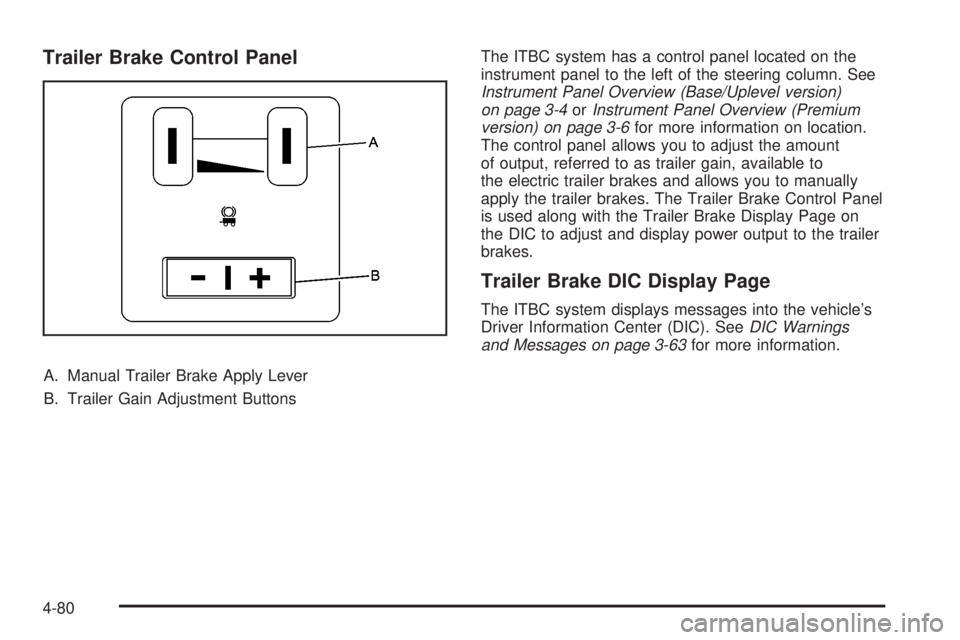
Trailer Brake Control Panel
A. Manual Trailer Brake Apply Lever
B. Trailer Gain Adjustment ButtonsThe ITBC system has a control panel located on the
instrument panel to the left of the steering column. See
Instrument Panel Overview (Base/Uplevel version)
on page 3-4orInstrument Panel Overview (Premium
version) on page 3-6for more information on location.
The control panel allows you to adjust the amount
of output, referred to as trailer gain, available to
the electric trailer brakes and allows you to manually
apply the trailer brakes. The Trailer Brake Control Panel
is used along with the Trailer Brake Display Page on
the DIC to adjust and display power output to the trailer
brakes.
Trailer Brake DIC Display Page
The ITBC system displays messages into the vehicle’s
Driver Information Center (DIC). SeeDIC Warnings
and Messages on page 3-63for more information.
4-80