engine overheat GMC SIERRA 2008 Owner's Guide
[x] Cancel search | Manufacturer: GMC, Model Year: 2008, Model line: SIERRA, Model: GMC SIERRA 2008Pages: 578, PDF Size: 6.47 MB
Page 426 of 578
Cooling System
If your vehicle has the DURAMAX®Diesel engine, see
the DURAMAX®Diesel manual for more information.
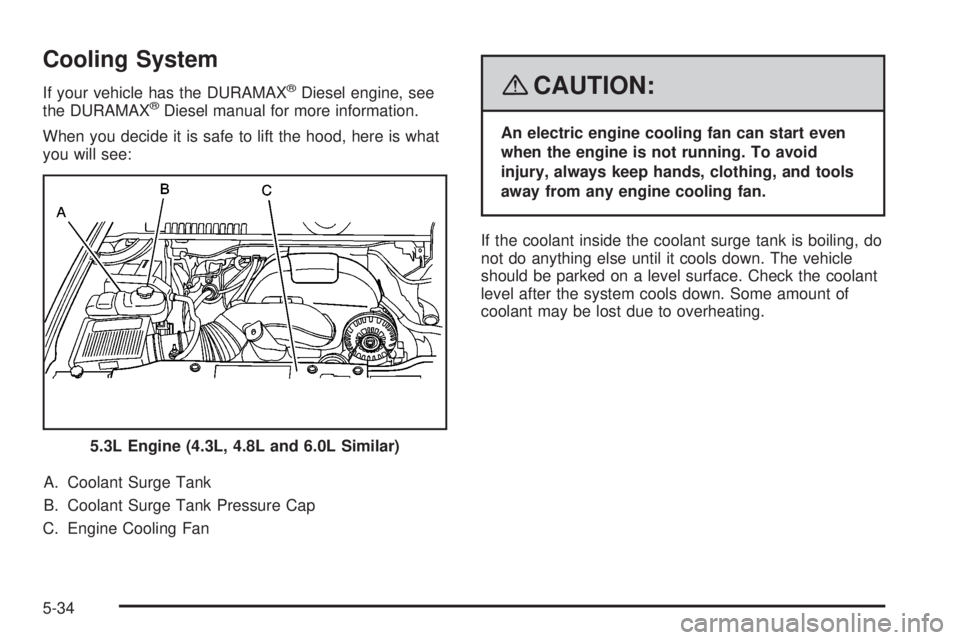
When you decide it is safe to lift the hood, here is what
you will see:
A. Coolant Surge Tank
B. Coolant Surge Tank Pressure Cap
C. Engine Cooling Fan
{CAUTION:
An electric engine cooling fan can start even
when the engine is not running. To avoid
injury, always keep hands, clothing, and tools
away from any engine cooling fan.
If the coolant inside the coolant surge tank is boiling, do
not do anything else until it cools down. The vehicle
should be parked on a level surface. Check the coolant
level after the system cools down. Some amount of
coolant may be lost due to overheating.
5.3L Engine (4.3L, 4.8L and 6.0L Similar)
5-34
Page 427 of 578
The coolant level should be at or above the FULL
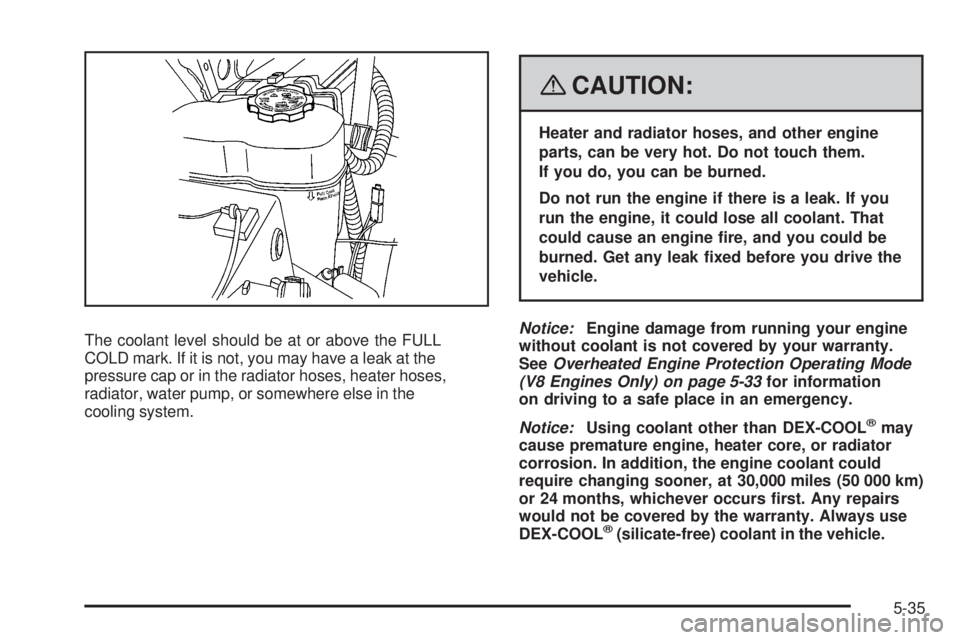
COLD mark. If it is not, you may have a leak at the
pressure cap or in the radiator hoses, heater hoses,
radiator, water pump, or somewhere else in the
cooling system.
{CAUTION:
Heater and radiator hoses, and other engine
parts, can be very hot. Do not touch them.
If you do, you can be burned.
Do not run the engine if there is a leak. If you
run the engine, it could lose all coolant. That
could cause an engine re, and you could be
burned. Get any leak xed before you drive the
vehicle.
Notice:Engine damage from running your engine
without coolant is not covered by your warranty.
SeeOverheated Engine Protection Operating Mode
(V8 Engines Only) on page 5-33for information
on driving to a safe place in an emergency.
Notice:Using coolant other than DEX-COOL
®may
cause premature engine, heater core, or radiator
corrosion. In addition, the engine coolant could
require changing sooner, at 30,000 miles (50 000 km)
or 24 months, whichever occurs rst. Any repairs
would not be covered by the warranty. Always use
DEX-COOL
®(silicate-free) coolant in the vehicle.
5-35
Page 428 of 578
How to Add Coolant to the Coolant
Surge Tank for Gasoline Engines
If your vehicle has a diesel engine, see “Cooling
System” in the DURAMAX®Diesel Supplement for the
proper coolant ll procedure.
If you have not found a problem yet, check to see if
coolant is visible in the surge tank. If coolant is visible
but the coolant level is not at or above the FULL COLD
mark, add a 50/50 mixture of clean, drinkable water and
DEX-COOL
®coolant at the coolant surge tank, but be
sure the cooling system, including the coolant surge tank
pressure cap, is cool before you do it. SeeEngine
Coolant on page 5-28for more information.
If no coolant is visible in the surge tank, add coolant
as follows:
{CAUTION:
Steam and scalding liquids from a hot cooling
system can blow out and burn you badly. They
are under pressure, and if you turn the coolant
surge tank pressure cap — even a little — they
can come out at high speed. Never turn the
CAUTION: (Continued)
CAUTION: (Continued)
cap when the cooling system, including the
coolant surge tank pressure cap, is hot. Wait
for the cooling system and coolant surge tank
pressure cap to cool if you ever have to turn
the pressure cap.
{CAUTION:
Adding only plain water to your cooling system
can be dangerous. Plain water, or some other
liquid such as alcohol, can boil before the
proper coolant mixture will. Your vehicle’s
coolant warning system is set for the proper
coolant mixture. With plain water or the wrong
mixture, your engine could get too hot but you
would not get the overheat warning. Your
engine could catch re and you or others could
be burned. Use a 50/50 mixture of clean,
drinkable water and a proper coolant.
5-36
Page 468 of 578
Dual Tire Operation
When the vehicle is new, or whenever a wheel,
wheel bolt or wheel nut is replaced, check the wheel
nut torque after 100, 1,000 and 6,000 miles
(160, 1 600 and 10 000 km) of driving. For proper
torque and wheel nut tightening information, see
Removing the Spare Tire and Tools on page 5-93.
The outer tire on a dual wheel setup generally wears
faster than the inner tire. Your tires will wear more
evenly and last longer if you rotate the tires periodically,
seeTire Inspection and Rotation on page 5-81. Also see
Scheduled Maintenance (Gasoline Engine) on page 6-4.
{CAUTION:
If you operate your vehicle with a tire that is
badly underinated, the tire can overheat. An
overheated tire can lose air suddenly or catch
re. You or others could be injured. Be sure all
tires (including the spare) are properly inated.
SeeInflation - Tire Pressure on page 5-74, for
information on proper tire ination.
Tire Pressure Monitor System
The Tire Pressure Monitor System (TPMS) uses radio
and sensor technology to check tire pressure levels. The
TPMS sensors monitor the air pressure in your vehicle’s
tires and transmit tire pressure readings to a receiver
located in the vehicle.
Each tire, including the spare (if provided), should be
checked monthly when cold and inated to the ination
pressure recommended by the vehicle manufacturer
on the vehicle placard or tire ination pressure label.
(If your vehicle has tires of a different size than the size
indicated on the vehicle placard or tire ination pressure
label, you should determine the proper tire ination
pressure for those tires.)
As an added safety feature, your vehicle has been
equipped with a tire pressure monitoring system (TPMS)
that illuminates a low tire pressure telltale when one or
more of your tires is signicantly under-inated.
Accordingly, when the low tire pressure telltale
illuminates, you should stop and check your tires as
soon as possible, and inate them to the proper
pressure. Driving on a signicantly under-inated tire
causes the tire to overheat and can lead to tire failure.
Under-ination also reduces fuel efficiency and tire
tread life, and may affect the vehicle’s handling and
stopping ability.
5-76
Page 569 of 578
Electrical System (cont.)
Instrument Panel Fuse Block.......................5-124
Power Windows and Other Power Options....5-123
Underhood Fuse Block...............................5-126
Windshield Wiper Fuses.............................5-123
Engine
Air Cleaner/Filter.........................................5-19
Check and Service Engine Soon Light............3-48
Coolant......................................................5-28
Coolant Heater............................................2-26
Coolant Temperature Gage...........................3-46
Drive Belt Routing.......................................6-18
Engine Compartment Overview......................5-14
Exhaust.....................................................2-53
Fan Noise..................................................5-39
Fast Idle System.........................................2-25
Oil .............................................................5-15
Oil Life System...........................................5-18
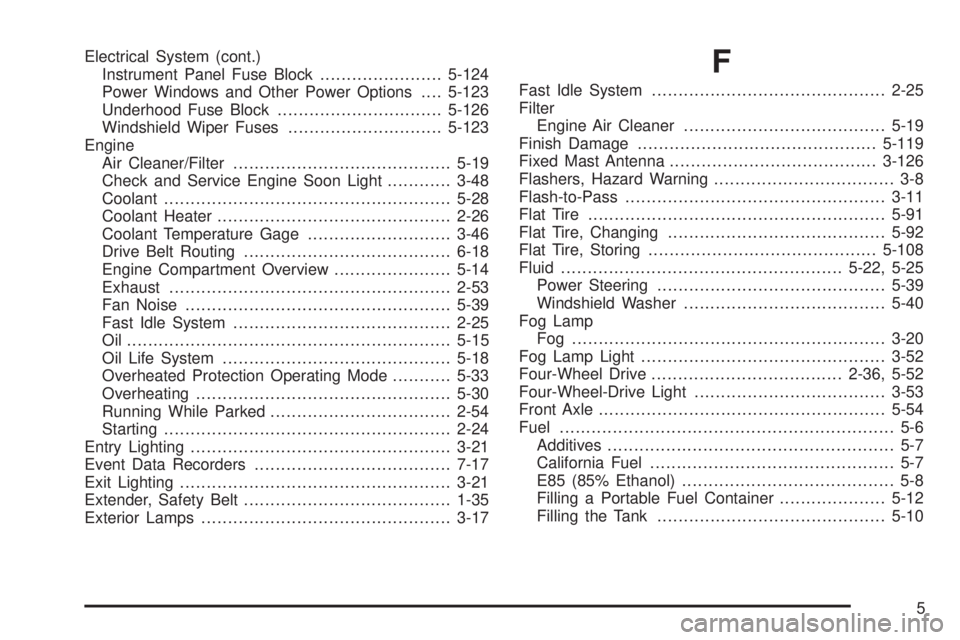
Overheated Protection Operating Mode...........5-33
Overheating................................................5-30
Running While Parked..................................2-54
Starting......................................................2-24
Entry Lighting.................................................3-21
Event Data Recorders.....................................7-17
Exit Lighting...................................................3-21
Extender, Safety Belt.......................................1-35
Exterior Lamps...............................................3-17F
Fast Idle System............................................2-25
Filter
Engine Air Cleaner......................................5-19
Finish Damage.............................................5-119
Fixed Mast Antenna.......................................3-126
Flashers, Hazard Warning.................................. 3-8
Flash-to-Pass.................................................3-11
Flat Tire........................................................5-91
Flat Tire, Changing.........................................5-92
Flat Tire, Storing...........................................5-108
Fluid.....................................................5-22, 5-25
Power Steering...........................................5-39
Windshield Washer......................................5-40
Fog Lamp
Fog ...........................................................3-20
Fog Lamp Light..............................................3-52
Four-Wheel Drive....................................2-36, 5-52
Four-Wheel-Drive Light....................................3-53
Front Axle......................................................5-54
Fuel............................................................... 5-6
Additives...................................................... 5-7
California Fuel.............................................. 5-7
E85 (85% Ethanol)........................................ 5-8
Filling a Portable Fuel Container....................5-12
Filling the Tank...........................................5-10
5
Page 573 of 578
Mirrors
Automatic Dimming Rearview with Compass
and Temperature Display...........................2-57
Automatic Dimming Rearview with OnStar
®,
Compass and Temperature Display.............2-55
Manual Rearview Mirror................................2-55
Outside Manual Mirrors................................2-58
Outside Power Foldaway Mirrors....................2-61
Outside Power Mirrors..................................2-59
Outside Trailer-Tow Mirrors...........................2-59
MP3 ..................................................3-102, 3-106
MyGMLink.com................................................ 7-4
N
Navigation System, Privacy..............................7-18
Navigation/Radio System, see Navigation
Manual.....................................................3-112
New Vehicle Break-In......................................2-22
Noise Control System, Tampering......................5-56
O
Odometer......................................................3-36
Odometer, Trip...............................................3-36
Off-Road Driving.............................................4-12Off-Road Recovery..........................................4-10
Oil
Engine.......................................................5-15
Pressure Gage............................................3-50
Pressure Light.............................................3-51
Oil, Engine Oil Life System..............................5-18
Older Children, Restraints................................1-35
Online Owner Center........................................ 7-4
OnStar, Privacy..............................................7-18
OnStar
®System, see OnStar®Manual...............2-65
Operation, Universal Home Remote System........2-69
Other Warning Devices...................................... 3-8
Outlet Adjustment............................................3-33
Outlets
Accessory Power.........................................3-23
Outside
Manual Mirrors............................................2-58
Power Foldaway Mirrors...............................2-61
Power Mirrors.............................................2-59
Trailer-Tow Mirrors.......................................2-59
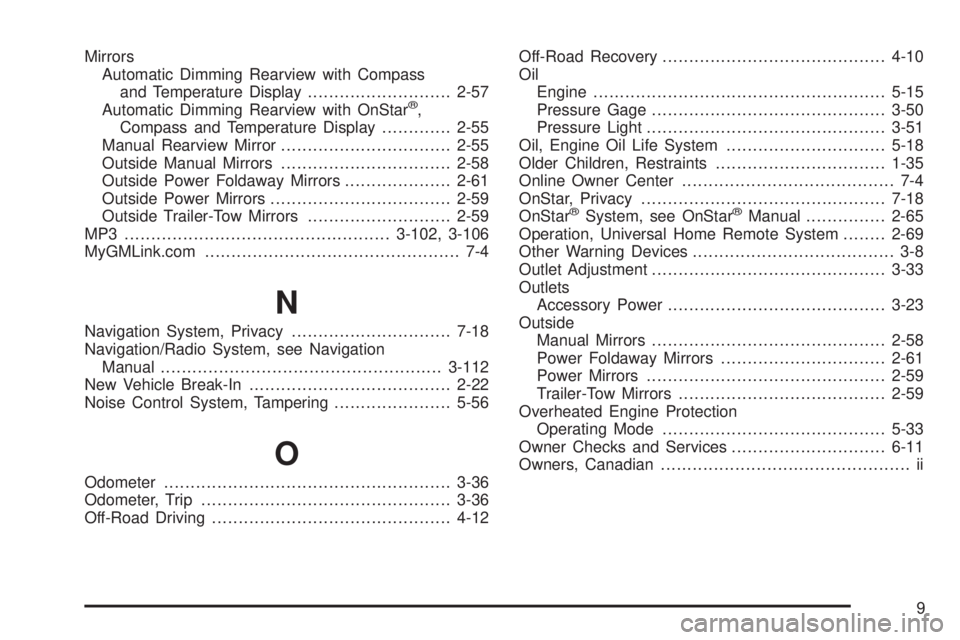
Overheated Engine Protection
Operating Mode..........................................5-33
Owner Checks and Services.............................6-11
Owners, Canadian............................................... ii
9